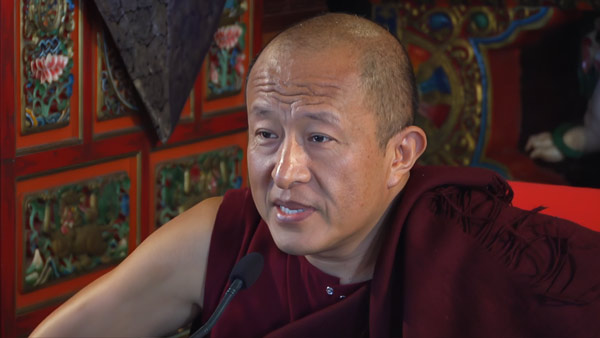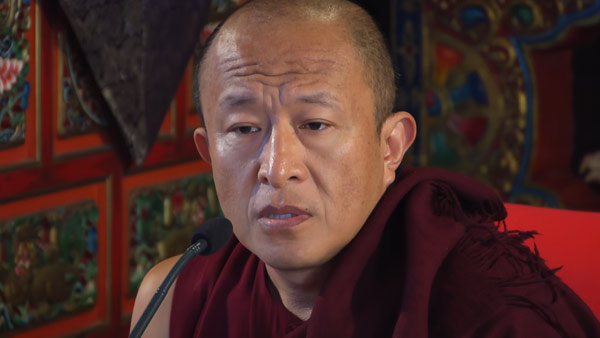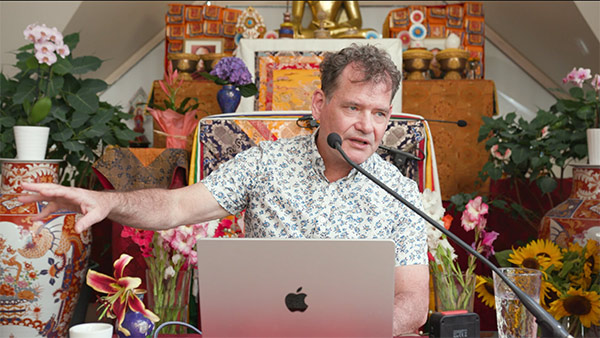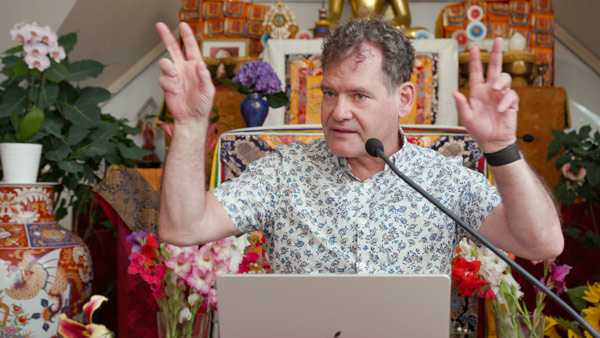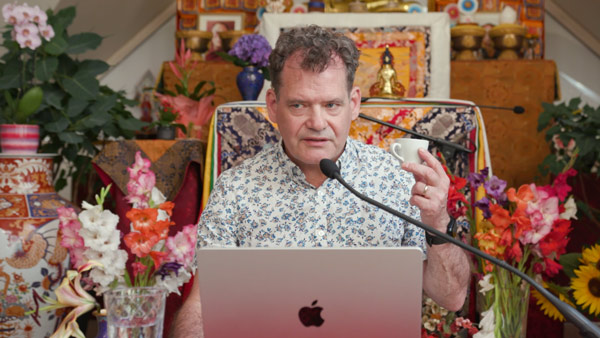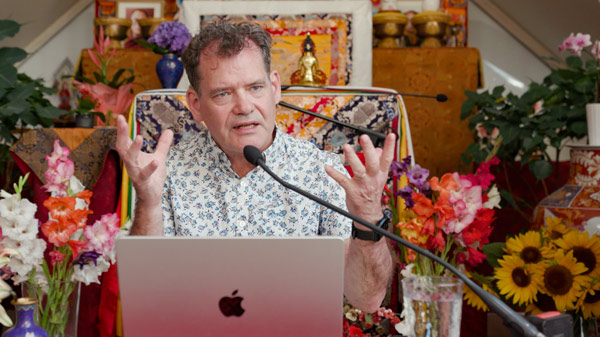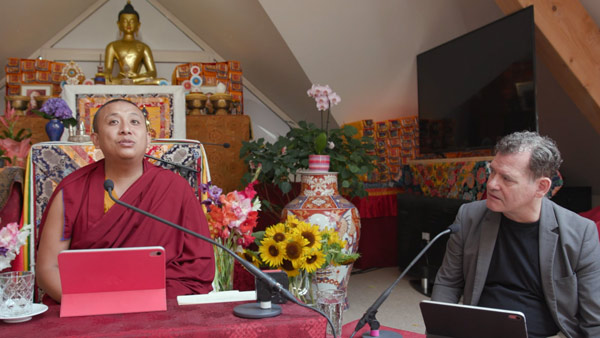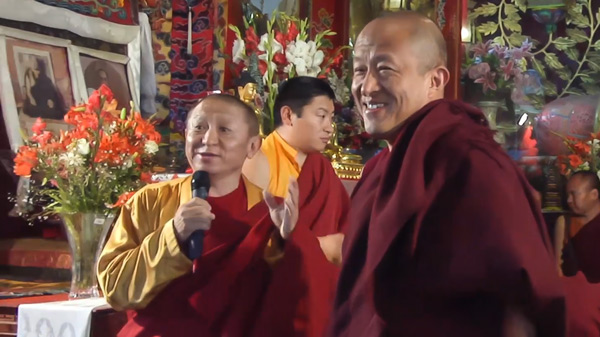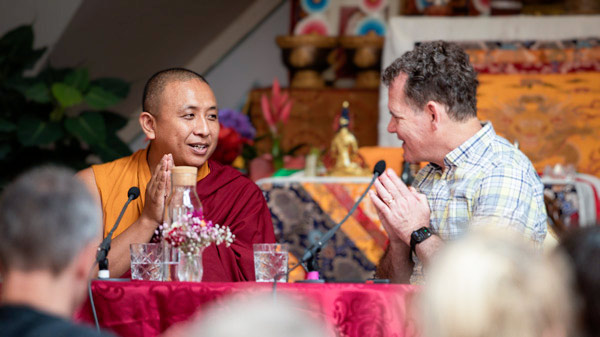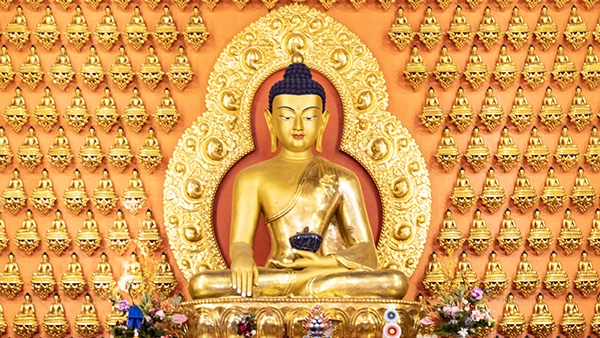
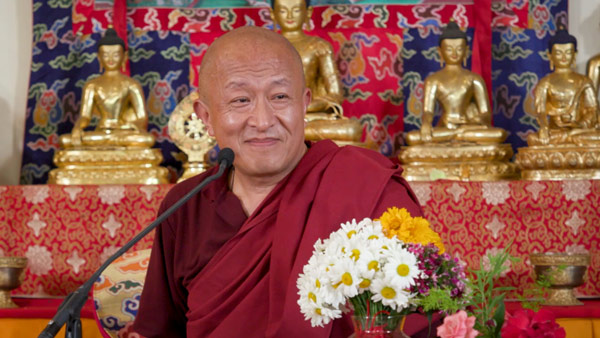
In honor of Dzongsar Khyentse Rinpoche’s birthday on June 18, DharmaSun is happy to offer these two teachings again in the new DharmaSun video format. Given at Ka-Nying Shedrub Ling Monastery for the students of Rangjung Yeshe Institute, the teachings explore the relationship between academic study and Dharma practice, as well as Je Tsongkhapa’s profound instructions on renunciation, bodhichitta, and wisdom.
New Releases
Discover a mix of brand-new teachings, enhanced versions of previous ones and content released for the first time in your own language. Scroll down for ‘Courses’.
Talks
Dzongsar Khyentse Rinpoche explores how Buddhist academic study can help preserve and transmit the Dharma by distinguishing timeless truth from culture, habit, and personal assumptions. He explains that Buddhist study and practice are rooted in nonduality, careful analysis, and paradox, while genuine devotion is strengthened—not weakened—by intelligent doubt and critical inquiry.
Collection:
- Buddhist Classics and Philosophy
Teacher:
Recorded: April 24, 2019
Published: June 18, 2026
Dzongsar Khyentse Rinpoche explains that renunciation and bodhichitta must be completed by wisdom, especially the understanding of dependent arising and emptiness. Through vivid examples, he shows how appearances function without being truly existent, and how recognizing this protects practitioners from the extremes of eternalism and nihilism.
Collection:
- Buddhist Classics and Philosophy
Teacher:
Recorded: February 8, 2013
Published: June 18, 2026
In this teaching given at the invitation of Chokyi Nyima Rinpoche to the students of Rangjung Yeshe Institute at Ka-Nying Shedrub Ling, Dzongsar Khyentse Rinpoche introduces Je Tsongkhapa’s Three Principal Aspects of the Path. He explains renunciation as the recognition that samsara cannot provide lasting satisfaction, and shows why it must be joined with bodhichitta, compassion for beings driven by birth, old age, sickness, death, karma, and self-clinging.
Collection:
- Buddhist Classics and Philosophy
Teacher:
Recorded: February 8, 2013
Published: June 18, 2026
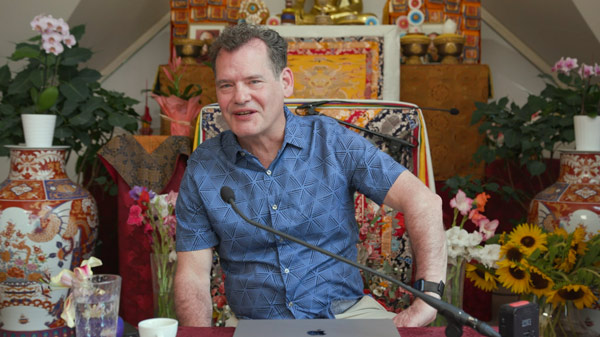
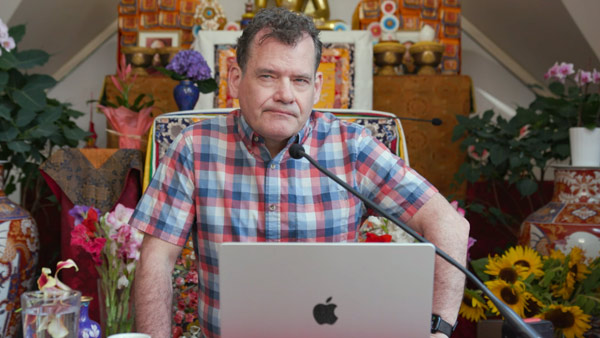
John D. Dunne concludes the course by showing how philosophical analysis can help clear away confusion and prepare the ground for deeper recognition, rather than replacing direct experiential guidance from a qualified teacher. He closes by emphasizing that authentic progress is shown through fewer afflictions, greater kindness, and a more integrated union of view and practice.
Collection:
- Buddhist Classics and Philosophy
Teacher:
Recorded: July 27, 2024
Published: April 10, 2026
John D. Dunne uses the double-slit experiment and other examples of perceptual error to distinguish conceptual confusion from the deeper, non-conceptual distortion of subject-object duality. He then explains why non-dual awareness must be recognized through direct methods such as inquiry, meditation, tantra, or devotion rather than through concepts alone.
Collection:
- Buddhist Classics and Philosophy
Teacher:
Recorded: July 27, 2024
Published: April 10, 2026
John D. Dunne relates the course’s philosophical analysis to Mahāmudrā practice by explaining reflexive awareness, meta-awareness, and the difference between objects of attention and the background quality of awareness itself. The session shows how meditation can reveal the luminous and non-dual nature of mind that is already present within ordinary experience.
Collection:
- Buddhist Classics and Philosophy
Teacher:
Recorded: July 26, 2024
Published: April 3, 2026
John D. Dunne presents Yogācāra as a crucial step in a deeper Madhyamaka analysis, where both external objects and the sense of an inner subject are gradually undermined. The session also introduces reflexive awareness as a key idea for understanding how non-dual knowing is already present within experience.
Collection:
- Buddhist Classics and Philosophy
Teacher:
Recorded: July 26, 2024
Published: April 3, 2026
John D. Dunne presents Yogācāra as a response to the question of what experience is when subject-object duality is seen as false. The session introduces luminous, non-dual experience as what remains in emptiness, while warning against reifying consciousness into a new ultimate reality.
Collection:
- Buddhist Classics and Philosophy
Teacher:
Recorded: July 26, 2024
Published: April 3, 2026
John D. Dunne explains emptiness and interdependence as two perspectives on the same reality, depending on whether one is seeing conventionally or through ultimate analysis. The session also points toward non-dual knowing by showing that emptiness cannot ultimately be grasped as an object of thought.
Collection:
- Buddhist Classics and Philosophy
Teacher:
Recorded: July 26, 2024
Published: April 3, 2026
John D. Dunne presents Nāgārjuna’s Middle Way as a progressive teaching that frees the mind from all extremes without replacing them with another fixed view. The session also begins to open the transition from emptiness alone toward later discussions of Buddha-nature and luminosity.
Collection:
- Buddhist Classics and Philosophy
Teacher:
Recorded: July 25, 2024
Published: March 27, 2026
John D. Dunne explains that true knowledge of emptiness is non-dual and cannot be grasped through subject-object cognition. By examining the role of prapañca, the session shows how both conceptual and pre-conceptual distortions sustain the illusion of reality.
Collection:
- Buddhist Classics and Philosophy
Teacher:
Recorded: July 25, 2024
Published: March 27, 2026
John D. Dunne deepens the Madhyamaka analysis by showing that neither wholes nor their parts can be established as inherently existent. Through both reductive and relational reasoning, the session reveals that all phenomena exist only interdependently and lack intrinsic essence.
Collection:
- Buddhist Classics and Philosophy
Teacher:
Recorded: July 25, 2024
Published: March 27, 2026
The teaching explains that all phenomena lack fixed, inherent identity and only exist relationally within contexts, which is what emptiness means. Properly understood, emptiness is not nothingness but the basis that allows change, understanding, and compassionate engagement with others.
Collection:
- Buddhist Classics and Philosophy
Teacher:
Recorded: July 24, 2024
Published: March 21, 2026
John D. Dunne presents the Madhyamaka argument that phenomena are neither truly one nor many. This analysis demonstrates the absence of intrinsic existence while preserving the functioning of conventional reality.
Collection:
- Buddhist Classics and Philosophy
Teacher:
Recorded: July 24, 2024
Published: March 21, 2026
Khenpo Pema Namgyal answers questions on science, ultimate reality, and the practical benefits of understanding emptiness. The session shows how Madhyamaka reasoning applies both to philosophical inquiry and to reducing suffering in daily life.
Collection:
- Buddhist Classics and Philosophy
Teacher:
Recorded: July 24, 2024
Published: March 21, 2026
Courses
Collection:
- Buddhist Classics and Philosophy
Teacher(s):
Duration:
3 hour(s)
Published: June 18, 2026
Nāgārjuna and the Madhyamaka Tradition
Teachings by John D. Dunne and Khenpo Pema Namgyal exploring Nāgārjuna’s Middle Way and the relationship between emptiness, the luminous nature of mind, and compassion.
Collection:
- Buddhist Classics and Philosophy
Teacher(s):
Duration:
18 hour(s)
Published: March 13, 2026
Chokyi Nyima Rinpoche guides us through the essential points of the Four Seals of Dharma:
- All Conditioned Things are Impermanent.
- All Defiled Things are Suffering
- All Phenomena Are Empty and Devoid of Self
- Nirvana is Peace
Collection:
- Foundations of Buddhism
Teacher(s):
Duration:
10 hour(s)
Recordings start: September 21, 2023
Published: May 11, 2025
A collection of stand-alone teachings mainly by Chokyi Nyima Rinpoche, offering heartfelt advice suffused with wisdom. Many of these teachings were given as Saturday Talks—informal sessions Rinpoche offered for decades at Ka-Nying Shedrub Ling, open to all, both new and old. Each talk is complete in itself, like an unstrung bead—independent yet sharing the same essence, guiding us by means of wisdom and compassion.
Collection:
- Heartfelt Advice
Teacher(s):
Duration:
8 hour(s)
Published: May 11, 2025
A course on Nagarjuna’s brilliantly sharp reasoning, taught by Dr. Thomas Doctor at the Rangjung Yeshe Institute over a month. For everyone with an interest in the way things really are.
Collection:
- Buddhist Classics and Philosophy
Teacher(s):
Duration:
29 day(s)
Recordings start: February 5, 2023
Published: May 11, 2025
A complete guide to practicing A Treasury of Blessings, featuring a chanted sadhana with Tibetan and English subtitles, introductory teachings by Khenpo Pema Namgyal, and a full series of in-depth teachings by Lama Tenzin Sangpo, culminating in a profound session with Chokyi Nyima Rinpoche on the inseparability of compassion and emptiness.
Collection:
- Sadhanas and Prayers
Teacher(s):
Duration:
13 hour(s)
Published: May 11, 2025