
Video
Audio
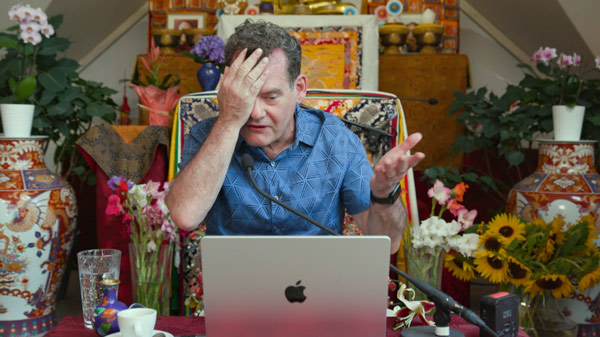
01:06:30
So, good morning, everybody, and we are
going to have a little special event
before we start our formal session.
I'm going to ask Philippe to introduce
himself, tell you a little bit about himself,
and then he's going to guide us
through a quantum experience.
So, here we go.
Thanks for having me here.
Thanks, John.
Thanks, Bibi.
Yeah, I'm Philippe Haslinger. I thought I was pretty good in mathematics during school time. So, after school I went to Vienna to study mathematics, which actually turned out that I'm not that good in mathematics. So, I also started at the same time to study physics. In physics, everything worked out. So, I did my PhD in the group of Marcus Arndt with matter-wave interferometry, which is kind of similar to the double-slit experiment, which I'm going to show you in a minute or two, but done with matter, with molecules. And we have done this not only with atoms, but also with molecules which you are used to drink. For example, caffeine molecules. So, we showed in the end, during my PhD thesis, that caffeine molecules can be delocalized and go through two slits, two doors at the same time and form afterwards an interference pattern. After this PhD, I did some post-doc at UC Berkeley, um, and then I came back to Vienna and started my group, research group. They are focused on experimental quantum optics. Okay, so, um, what's physics? You can look it up in Wikipedia. Physics is the natural science that studies matter, its fundamental constituents, its motion, its behavior through space and time, and the related entities of energy and force. So, we can explain the rainbow, for example. There is some laser light going on. Can you see this on my... The balloons, like hot air, is lighter than cold air. Therefore, the balloons float in the sky. We can explain the thunder and the weather, more or less. We can look to galaxies and pretty know what's going on there. And we can also name what we don't know, or at least what we know that we don't know. So, dark energy and dark matter. We have other questions. It's about angular momentum, spinning the nuclear bomb, nuclear energy, orbitals of atoms, but also just mechanics, so that the house is constructed in a solid way or cars can drive. And recently, I'm very proud of 2022, Anton Zeilinger got the Nobel Prize for his work in the fundamentals of quantum physics.
So, physics was highly influenced, or was mainly up to 1900, the classical physics, which we know. That's just like mechanics and acoustics, it's optics, electrodynamics, thermodynamics, and up to 1900, we thought that everything is deterministic, so like a clockwork. So, if we know in principle every atom, every particle in the universe, we know its position and its momentum, then we can calculate how they collide on each other and we can calculate the future, but we could also calculate the past. So, everything would be deterministic. And randomness is only due to our ignorance, because we don't know everything. That's what people thought. So, in principle, there's no free will.
Um, that changed drastically with quantum physics. And quantum physics came up around 1900, at a time where people thought that physics is completed. So, there's not that much to solve. There might be two, three puzzling experiments, which we cannot describe, um, but this changed in everything. And that are the heroes of this quantum physics revolution, Max Planck, Albert Einstein, Niels Bohr, Werner Heisenberg, Evan Schrödinger, and many more. And they kind of developed a theory, also with experiments, which break with this radical determinism. So, which gave us back our free will. There might be super-determinism or other stuff, which we cannot solve right now. But, uh, kind of quantum physics, you can say, so if you want to, brought us back the free will, that nothing is really determined. Um, and in quantum physics, we only can talk about probabilities, and we can prove that, there's a proof in our world, with our tools, that there's an objective randomness. That this is not just something which we made up. Every one of us knows from tools from the first quantum revolution, which took place about 1940-50s. So this is nuclear medicine, nuclear power, the transistor or mobile phones, governed by quantum physical principles, the lasers and MRI imaging. And right now we are in the second quantum revolution, where we make use of entanglement, so quantum cryptography, you might have heard about that, um, and also quantum computing.
Okay, now to the double slit. That was like one of these experiments around 1900, um, which needed some explanation, and there was a French-Italian young guy, Louis Debreli, um, who postulated a certain formula, the Debreli wavelength formula. It's like H is a constant, a fundamental constant divided by the momentum of any particle. It gives you a wavelength. And this wavelength can be used now to describe the wave properties of these particles. And he said, kind of postulated in a way, everything is an intuitive explanation right now, that all waves have particle properties, but also all particles have wave properties. And that's nicely illustrated by this art piece. So some of you might be able to read the word wave with a W here, an A, a V, an E, and some of you might be able to read now particle as well, with a P, an A, an R, a T, an I, C, L, E. Okay, at this point I normally ask my students, so you can read particle and you can read wave, can you read both at the same time? Or does it depend on what you would like to measure to get knowledge about?
Okay, so particles as well as light have strange quantum properties, and these properties can be described with this Debreli wavelength, and it shows kind of that they have, that their location of this particle is only probabilistic. And we can now measure these particles or wave properties under certain conditions. And um, a guy who put a lot of effort into that, he's one of the first next to Newton, was Thomas Young around 1800, and he developed the theory of light, and we have like a lot of his notes still, and he was also puzzled by how we actually perceive something with our eyes, because he wanted to understand nature totally, so before he studied like objects, he was studying the eye, so how the image forms and that it's upside down in the eye. And then later on he studied the double slit experiment here, nicely illustrated.
And for that, at that time, he used sunlight to do the experiments. He used some sunlight that focused it, collimated it on a double slit, so you have two slits, the rest of its aperture to block the light, and then um, you observe with your eyes at the screen um, the light intensity. And this experiment is actually built up behind this big screen, and I'm inviting you afterwards to join me to have a look at it. But first, to explain to you what you actually can see there. So you have like, it was sunlight for Thomas Young, we use a red laser, we collimated, and then we shine light on two slits. In the beginning we close one slit, and just light comes from one slit, like here, just the right slit, and we see like a certain intensity distribution from this light. Then we close the one slit and open the other slit, and we see again a certain intensity of the light. So, the crazy things now happen when you give the light, or you kind of, you have one slit and you open the other slit, so you would expect that there's just double as much light. No? So we have two light sources, so when you're in a dark room, and you switch on the light, you switch on another light to make it more bright. Um, But in this case, under these experimental circumstances, um, when you switch on, or like enable the light to go through the second slit, uh, he observed an interference pattern, so that the light is not any more equally distributed, but at certain points the light is reduced to zero. So by shining twice as much light, you can actually delete the light at certain positions. And this is highly contradictory with a particle point of view of light. How would you like to delete with another particle, one particle? But in a wave, a view, that works. So that's the particle theory, how the light should look like if light would be made out of particles, and that's how it looks like for the wave behavior of light. Okay, now take the other microphone.
So we are right now behind the big screen, teaming up in a dark corner of this lecture room. In front of me we have like an experiment which I brought from Vienna, which consists of a laser, here a red laser as you can see in my hand.
An aperture holder which actually also holds the double slit. And here I can put apertures in front of the slit so I can block where the light comes through. And an optical microscope which enables us or allows us to see through which slit the light comes. And now I'm trying to close this.
And about like three meters away from this experiment there's a wall in the shade. We can see now the laser light, how it looks like when it's shined through just. So this is only one slit illuminated. And now when I get the double much light to it, it gets brighter. But there are also spots so it's really getting zero. And the crazy thing is this is now done with like millions of photons. But you can also do this one by one. So one photon every second. And in our laboratories, like you saw it with Bibi, you can actually detect single photons. They make a click, they make like a trigger. And uh, when you wait for like several seconds with single photons, they also build up exactly such a pattern. So these photons are totally independent from each other. And they build like this pattern. So now I can try to close one of the slits.
It's just one slit. And now it's two slits. It gets immediately brighter. But also at certain points. It's a destructive interference pattern. We call it like this. Constructive, where it like adds up and gets brighter. Destructive, where it like deletes each other. And this not only holds for photons, like I said in the beginning, it also holds for molecules, which you can taste. We also did experiments with vanillin powder. The chemical, just the substance of that. And that also works. And the record right now is on the order of a hundred thousand atomic mass units of molecules consisting of several thousand atoms. Even of that size, yes. And that's kind of a race. That's not quantum, I wouldn't say so, yes. And they want to do it like in thought Gedanken-experiments. We were wondering if that holds also when you do it with a virus. Can you shoot viruses through two slits at the same time? Or like small bacterias? Similar to the Schrödinger-Katz, Schrödinger-Cat experiment, where a cat is in a superposition between two states, between dead and alive. In our case, it's between the right and the left slit in position. So is that the plan, you're going to shoot cats? Yes. We start with baby cats, because it's easier. Yeah, first we pet them a lot.
And such experiments are done in laboratories at the University of Vienna and the Technische Universität Wien.
okmin chökyi yingkyi phodrang né düsum sangyé kün gyi ngowo nyi rangsem chöku ngönsum tönzé pa tsawai lamai shapla sölwa dep
So I invite you to settle your mind. Find a comfortable but alert position.
And bring up our motivation.
Alright and let's begin. So thank you very much, Philippe. That was really interesting and I'm going to try to say something that maybe kind of makes some sense of that as well in a Buddhist context. My voice is a little off because we were celebrating Mikki's birthday yesterday. Happy birthday, Mikki. And things got a little late, so... Just a little late.
It was a lot of fun, though. And we're very grateful that Mikki has another year. What would we do without him? So one of the things that I think is really fascinating about what Philippe is presenting is that, is a couple of things. One of them is, in a sense, you know, when we had that image, and I sort of wish I'd grabbed that slide for you, from you almost, like, can you see both at the same time? And as Philippe said, why do we see one or the other? Now, in a certain way, you might say we are seeing both at the same time. And then what we're doing is we are conceptualizing one, right? So that the conceptual system or the conceptual framework or the attention that we're bringing to that phenomenon that we're experiencing determines, in a sense, what we see. But in a way, we're not seeing that, we're thinking that, right? So we have on this model that we've had before, we have a, this perceptual experience here. And then we have something that we conceptualize. So one way of thinking about what we're talking about here is that this is, in a sense, open to both interpretations. And then depending on what, how you interpret it, what conceptual framework you bring to it, then you end up with a different interpretation. If you think that the thing you're seeing sort of has an objective identity in and of itself, and then moreover, if you think that, that objective, objective identity requires that it be either a wave or a particle, then it seems like this is a contradiction. When you come up on the one hand, you find it's a wave and on the other hand, you find it's a particle. But if we say, okay, there's something here, which is just being interpreted in different ways, then what we're saying in a sense is that what's real to us is actually a product of our conceptual system, right? But there's also the question of whether is it really just at this level that that phenomenon is happening, or is it here in some way? Like are we actually... is it just a product of our conceptual framework, or is there something deeper than that, that is determining what we see, even prior to the conceptualization? That's a really fascinating question. But in either case, what we seem to be coming into, which is really, I think, relevant for us, is a kind of contradiction, like something is wrong. And we need to resolve that contradiction in order for us to, in a sense, move forward. Right? Like this... Something's not making sense. So if we take a classic, as I understand it, a classical physics approach, and we say this is a wave or it's a particle, then how come we have something that's doing both, like something impossible, it would seem? So the question there is, where is this error? And that's what I want to raise now, is just talking about the different kinds of error. Because remember, in the way we've been conceptualizing things, the error that is ignorance can occur both at the conceptual level, which in this diagram is here, similar to that other diagram we were using, or it can be here. And we're going to look at those two different kinds of error right now. So one kind of error is where you misidentify the object. So you think, on the basis of this, you would make an identification, and you're wrong. So here's the classic example, which hopefully you can see. You're walking down a path at night, in a place where you know there are a lot of snakes, and then you see this in the path, and you go, oh, it's a snake! Right? So this is the famous rope snake example, where what's happening here is that conceptually, we're bringing the wrong interpretation to the data. So the data itself, this data itself, so to speak, if we want to call it that, this perceptual moment is not distorted. It is, you could say, in a sense, that it is still reliable. But the problem is that the way we're conceptualizing it makes it, uh, makes it impossible for us to act effectively. And on this system, and this is the Dharmakīrtian system, of uh, our perception that we discussed earlier, what makes this perception reliable, actually, is that it produces an accurate conceptualization. So that, and what does accurate mean? It means that this conceptualization tracks back causally to this stimulus, and this stimulus is continuing in time, so that when we act on its causal descendant a few moments later, where you can act effectively. Right? So if I identify that as a rope, then I can pick it up and tie things with it or whatever. If I identify it as a snake, I can't do that kind of thing. So the causal capacities of this stimulus are meant to be picked up, and I could go into more detail, but I won't, but they are meant to be picked up by this conceptualization. The conceptualization is not picking up some real category that this thing exists in terms of, or instantiates, but it is accurately characterizing the causal capacities of that thing. So when it fails to do that, in a way that also means that this was somehow not adequate. So there's a very important issue here. When would that be not adequate? What could be faulty about our own perceptual experiences such that we end up with something false in our conceptualizations? It could be that our faculties aren't sharp enough. In this case, there's not enough light. But there can also be expectations that are carrying through. We're afraid of snakes. We think, we expect there to be snakes. And those expectations actually literally alter what we see. This is called cognitive penetration in cognitive science. Like we, we sort of are seeing what we expect to see. And because of that, the actual perceptual content is not, is already in some sense problematic. It's not totally distorted, but it makes it much more difficult for us to come up with the correct conceptualization, because we're working already within the framework of expectations, emotions, what we've learned, our you know, even like our personal history and so on, such that whatever we're experiencing in some sense has already been distorted by the gunk. Right? So sometimes we think of this as, oh, there's just like perfectly good sense data and then we just make a mistake. That's not a good way to think about this kind of error. So this kind of error is already some, in a way already there's something pre-conceptual happening in this kind of error. And a lot of what that pre-conceptual stuff is, is conceptual. What I mean by that is this is theoretically a pre-conceptual moment, but a lot of this gunk is the conceptual frameworks, our story of ourselves, of our past, of our hopes and fears for the future, and that goes into and actually alters the experience itself. Right? So even though this is called conceptual error, this is one of the main forms of conceptual error, there is a way in which there's some pre-conceptual stuff or gunk that is very relevant to that. So what would be, in terms of what we've been talking about this week, what might be some of that kind of pre-conceptual gunk that might say, so for example, one conceptualization I might have of this is that it's something coiled. That would be accurate, right? One conceptualization I could have of this is that it is, I don't know, blue?
And that would be accurate. But what wouldn't be accurate, what would, in our common conceptualization of our favorite vase here, what would not be accurate?
Anything?
What's that?
What I'm saying is we're making a conceptualization, that we, we call it a vase, what might be included in our conceptualization of a vase that is actually not accurate about this thing, in terms of what we've been talking about.
Like when we say, oh, that's a vase, what's in part of our usual conceptualization of a vase that is actually not accurate?
Huh? How about that it's a single thing? How about that it exists unchanging over time?
How about that it's truly real, objectively real? That calling it a vase is not a matter of our conceptual system, but that somehow its vase-ness is out there, objectively. Right? So there's all kinds of things that are in our conceptualizations that are actually partially, in a way you can say that this kind of conceptual error is happening all the time. But a lot of the time it's not relevant because, the you know, it's good enough such that the conceptualization of the vase still enables us to do what we want because it's picking up certain types of causal properties in our experience. Right? But in certain cases then those conceptualizations start to fall apart. So, for example, we have when we think of people, we think of people as maybe unchanging or ourselves as having some kind of unchanging identity and that conceptual framework sometimes doesn't really matter but in some circumstances it matters a lot. Where your best friend or your partner or whatever suddenly wakes up and is a different person. What a surprise!
So that's conceptualization, that's a kind of misidentification of the object, that's one form of conceptual error and there's another form of conceptual error which is where we believe that our concepts are perceptual. In other words, that the map is the territory, right? And here's, you know, a vase. This is the standard, this is the Indian version, looks quite like our little one here. The gata, the standard example. And this version of error is really, there are many aspects of our concept of a vase that we just discussed that are actually false. One of them being this basic problem of perceptual binding where we have a visual field that has extension and we take it and our perceptual system puts it together as a single thing. That kind of perceptual binding actually on this account is conceptual. So the singularity of objects is not just given by the objects but actually requires a certain kind of conceptual process in which we're organizing our visual field. So that's another way to be wrong. Conceptually. So our self-model, remember there's like two places we have the perception, the interpretation, then we have the intention to act and the action itself. So at the act, at the moment of interpretation the idea is that the self-model is already causing this kind of error. Really both of these kinds of error. We're attributing qualities to ourselves, the story of ourselves that are actually not inherently true of ourselves. And also it involves a sense that that story itself is who we are. Like we are who we think we are. And the idea is you're not who you think you are.
Even though that's a very deep habit. But then there's another kind of error which is not about concepts. So we said you can have ignorance at the level of the conceptualization and that's primarily the self-model. It also is about the reality habit in general. But there's something that precedes that, that's deeper than that, which is prapañca. So prapañca is pointing to something that's a non-conceptual error. Right? So the standard example of this, there are many different examples. But one example is you know, the, the supposed white conch shell which when you have some kind of an eye disease, you see it like this. And I used to think, because I think some people told me, oh when you get jaundiced that's not really what happens, you don't see things that way. And then something happened.
Because is I nearly poked my eye out. Early in the pandemic, actually, I was exercising on my road bike in the basement. Not riding around in the basement, but I was, you know, that's a nice image, right? And I was on Zwift, for those of you who are Zwifters, and I like leaned down after my exercise and there was this pegboard with a long peg coming out, like a thin rod, and I went..., yeah, it's about this long. And I felt my eye go, woo!
And so that caused an injury, and eventually a cataract, so I had to have an eye operation, so I actually do not have natural lenses in my eyes. I have artificial lenses in my eyes. And I also can see x-rays, no I'm kidding, but I have quantum level perception, so it all looks like a double slit experiment, no. Uh, and uh, so, uh when they did this, and really actually my vision was not that great, I had to wear glasses before, and now I don't have to wear glasses, I have 20-20 near and far vision, and I had like pretty bad vision. I used to have four times better than normal vision, but then I got old. So uh, they do this one at a time, they do both eyes, and they do it one at a time, so I had one lens put in, one natural lens taken out, and then a new lens, artificial lens put in, and then just to be sure that, you know, they don't mess up and you can't see at all, at least you have one eye that still works. So when they put that lens in, then I started to, first it's a little blurry, and then it got a little better, and then, you know, I was starting to experiment, okay, let's see what's the difference between the eyes, and this is what I noticed. So when I looked with my new eye at a white piece of paper, it looked like what you see on the left-hand side. When I looked, when I covered that, so I did the new lens, right, and I looked, it said, oh, it looks white. And then I covered that eye and I looked at the same piece of paper and I saw this. Like, I've been walking around in a yellow world for I don't know how long.
And I had no idea I was walking around in a yellow world. And then I went to the doctor and very excitedly said, oh, look what I discovered. And she went, oh, yeah, yeah. People come in and say, God, I got to get my house painted. It's like, everything, I had no idea it looked so bad. Until, you know, you put in these new lenses and I can see colors. Right? So it's actually a well-known phenomenon. The uh, the natural lens actually yellows a little over time as you get old like me. And, yeah, you don't really want to know that, do you, Eric?
So this is, so that's a really great example of a non-conceptual error because it's not like, there are certain kinds of errors that are temporary errors, right? So we talked about the double moon when you have basically had a little too much at Mikki's party and, you know, you see the double moon or you put a stick in the water and the refraction causes it to look bent. So the idea of these kinds of non-conceptual errors is that you, if you give an honest report of what you're actually seeing. Right? Then when you give that honest report, you report something that's false, even if you know that it's false. The honest report is, for example, you know the stick is straight, you put it in the water, it looks bent, and you say, and if I ask you if the stick is bent and you actually report on your experience, then you'll say, yeah, it looks bent, even though you know it's not. Right? And so another example they give of this kind of error is the moving trees, where you're on a boat, moving very slowly, and your visual system is not able to adjust and the trees look to you like they're moving. So there are various kinds of examples like that. But what's great about this example is that this is all the time. It's a non-conceptual error that i... that you don't... So in the case of the bent stick, you take the stick out of the water and you see it's straight. In the case of the moving trees, you get off the boat, you see it's the boat that's moving, not the trees, right? You recover from your excesses and there is only one moon now.
But this, until someone takes one of your lenses out, you have no idea that you're actually seeing the world this way. So what kind of error are we talking about in terms of what we've been talking about this week? What's the kind of error that is relevant here?
The non-conceptual error. Anybody?
One that we're walking around with all the time. Not a schema. The reality habit. Prapañca. Whatever prapañca is. And what would be one version of that? So the reality habit sort of in general, but how is the reality habit structured? Subject-object duality. Is just like this error. Right? That we are, we are constantly... So like again, the conceptual error, like the error at the level of conceptualization is also really powerful for us. You know, we have ideas, we have stories about ourselves, stories about the world, stories about other people. And they can very much, not only do they make it so that we misinterpret what we're experiencing, but they do affect what we're experiencing. Like even the non-conceptual data, so to speak, is being affected by all the gunk. And the gunk includes our concepts, our conceptual habits, if you like. Right? You know, like psychotherapy is often going after that stuff. But here we're talking about something that even if you somehow, you know, could clean out all that conceptual gunk, all of your past history and whatever, this isn't going to go away by doing that. It doesn't matter how much therapy you get. Right? This is something at a much deeper level, which is the subject-object duality that underlies the reality habit in the form of Yogācāra Mādhyamika that we've been looking at. Right? So how do you think you get rid of that?
Well, we cut out a certain part of your brain and no one... How do you get rid of that?
Why would meditation work?
Student: Well, like Chokyi Nyima Rinpoche mentions, the non-meditation is like the only way you're kind of dropping the habit of doing that somehow. Yes, so he says, and this is a great phrase that I love, and I remember some years ago when he first said it, I went like, boing, oh wow, that's amazing. འཛིན་པས་འཛིན་པ་མི་སྤོང་། Dzim pe dzim pa mi pong You can't get rid of grasping with more grasping. Right? You can't, and grasping here is both, is at both of these levels, right? It's at the... Grasping is at both at the conceptual and the, at the conceptual level and at the non-conceptual level. So at the conceptual level it has to do with the way in which we take our... You know, it's this error, the belief that concepts are perceptual. That's one strong version of that. We take the map to be the territory. We take our beliefs, our stories about ourselves and the world to be the reality. That's one form of grasping. And then it's also at this level, which basically grasping is duality. So more concepts aren't going to undo. You can't like in a sense, just prove your concepts wrong and that's it. You can't just rest with a conceptual understanding. And you can't, and you can't by using more dualistic perception, you can't get rid of the dualistic error.
But so in general, how do we get rid of error?
This is like going all the way back to the beginning of the week which feels like, I don't know, a year ago, whatever. How do we get rid of our errors? Yeah? Uh, insight? Yes, wisdom. Wisdom, yes. Right! Wisdom removes ignorance. And what's wisdom? This is like, you know, the oral exam here, everyone. What is, what is,wisdom? Yeah, but more generally, it's seeing the way things really are. So seeing the way things really are counteracts our errors. Right? But that seeing the way things really are, has to be really experiential.
It can't just be an idea. And so like, you know, we have my, my squircle monster in the closet, Rowan finds me, you know, again, with a bunch of, you know, I don't know what it is this time. Like, I keep getting taking those nice potatoes from lunch. And I pile him up, finds me in the room, that nice room. And now it's, you know, all messed up because there's a bunch of potatoes, a heap of mashed potatoes outside the closet, several heaps over the course of the week. And, you know, he takes me in the closet, he makes a nice map even, map even, we map it out, we go through and everything's good. And then, you know, I say, okay, we clean up the potatoes and then next day after lunch, there it is again, comes in to check on me and there it is again, heap of potatoes. Why? Because even though I really did even experientially see that there's no blue monster in the closet, the habit is so deep that that experience has to become really deep also. It has to become as deep as the habit in order to counteract it. So that's one thing, that's one reason why meditation is necessary is it's like, and so one of the translations of meditation in Tibetan, the standard translation has to do with the idea of habituation actually. You're habituating yourself to the way things really are. Right? But here we have, so there's some versions of that, could even be that where you just have a concept of selflessness and you just habituate, habituate, habituate, and then you have a direct experience of it, and then you habituate to that. But that's not going to be, get rid of the non-dual. Why?
That's actually, even, that's not going to get rid of the duality, such that it produces a non-dual experience,
because it's a concept that you're habituating yourself to. Right? So one theory here in terms of what's called Yogi Pratyakṣa, or nam jungsum in Tibetan, is that it's like when someone is really upset, you know, the lover who's obsessed, like, you know, let's say that I saw Lady Gaga in her meat dress. Do you ever see her in her meat dress? And then I just can't stop thinking about Lady Gaga in her meat dress, and I keep thinking, and then finally I see her. I hallucinate Lady Gaga in her meat dress. So I went from a concept to a direct experience of what the concept represents, but there's nothing there. Or, uh, you know, I'm kind of half falling asleep in the night, kind of dreaming of thieves, as Dharmakīrti puts it, and then I kind of like feel it, oh, there's a thief in the room, but there isn't. I went from a thought about, you know, fear of thieves, and then I experienced it. And then also, Dharmakīrti uses another example, which is the meditation on ugliness, where some of you remember Khenpo was talking about this, some of you heard Khenpo's talk, where one version of this meditation on the aśubha, on the unbeautiful, is you meditate on skeletons. And you start with like meditating just on kind of your, you know the bone of your forehead here, really visualizing it clearly as there's no skin, it's just bone, and then your whole body, and then everybody. And you like look at people and you see a skeleton, and you like really see a skeleton. You hallucinate people as skeletons. Sounds fun, huh? Yeah. Might be good for Halloween, but you know.
So it really like counteracts, that strongly counteracts desire and attachment, and Dharmakīrti mentions this as well. So that's where you're taking a concept and you're focusing so hard on the concept that in a sense you experience it.
And that's what Dharmakīrti presents as being the kind of the, uh, the, before we get to non-dual, before we try to uproot duality, we can uproot the self-model cause it's conceptual by in a sense kind of experientially you know, bringing into our own experience another self-model, a different self-model. In other words, we replace one schema that's making us see the world one way with another schema. We take one conceptual model, one story about self and world and we, we uh, replace it with another one. And to the point where it just feels real now, that model feels real. It's also just a conceptual model. Right? It's kind of like being, you know, larping, live role-playing, it's like, you know, you pretend so much to be an elf in the Tolkien world that you're just, okay, I'm an elf, you know. That one didn't work. You guys don't know what I'm talking about, do you? At least Rowan does.
But you can't, so dzin pe dzin pa mi pong, you can't do that with the non-dual. Because if you try to uproot the non-dual with a conceptual model, it's not going to work. Right? So, what are you going to do?
How are you going to do it?
What's that?
Yeah, not by doing. So first of all, one thing we're saying is you need an experience that is non-dual. That's going to show you that, like, the closet actually, there is no monster in the closet. So how is, where does that, wher, wher, how is that experience going to happen?
Is it happening now?
You remember this?
How many, how often does this, in how many moments of consciousness is this framework present? All of them.
So there's a non, so reflexivity, which is non-dual, in part, even when you're having dualistic cognition, there's an aspect which is non-dual, which is your awareness of your own sense of subjectivity is non-dual. Right?
So there's something already to work with. So the good thing is, unlike learning, unlearning a conceptual framework and replacing it with another conceptual framework, you don't have to learn something and replace, unlearn one thing and replace it with another. You already have the thing, so you don't need to learn it. Okay? You already have it. So it's not a matter of unlearning and learning or replacement. It's just unlearning.
Right? Okay. So how would you unlearn?
How would you unlearn? What things could you do? What? Pronunciation and such would be very important. You have, you know, as Rinpoche would say, you need uh, nge jung kyoshe renunciation and dissatisfaction with the way things are now. You need jamze nyingje loving kindness and compassion. Right? These are key things that are necessary. And in this tradition, mögü dak nang, མོས་གུས་དག་སྣང་ devotion and pure perception, which we'll talk about why that's necessary soon. So those are kind of prerequisites. But what, like, what do you need to do?
You need to induce somehow an experience that isn't dualistic, where the non-dual becomes, the non-dual aspect of your experience becomes evident. Right? Where you, in a sense, you recognize it. So here again is Advaya Vajra. The non-dual Vajra is his name, Maitrīpa. So one way you could do that is philosophical analysis. How would philosophical analysis work? Because isn't that conceptual? How could that work?
Yes? Rowan's got all the answers today. That's good. Student: It can lead eventually to an experience of it by almost breaking your conceptual, yeah, framework. Exactly. That's right. So you could have a special kind of philosophical framework whose only purpose is to undo philosophy. Right? Whose only purpose, you can have a view, a conceptual view, whose only purpose is the relinquishment of all views, Sarva dṛṣṭīnāṃ niḥsaraṇaṃ, that we had before, right? And it's not proving anything. Its only goal is to, in a sense, unprove things. And when you study that repeatedly, you think about it, and then at some point you kind of go like, oh!
So it's a very special kind of philosophy, which is quite difficult to do, right? What's the main problem with that approach? What's the main problem with using philosophy? Anybody?
Yes, right? But you're going to say the same more or less? Yeah. Go ahead. That's it, yeah. Because the concept, conceptuality is itself dualistic. So this is, oh I've forgotten which Zen master this is, but this is a Chinese Chan master depicting, you know, the finger pointing to the moon, which is also a metaphor you find in some Mahāmudrā texts. And what the meaning of this is, of course, that the finger is the concepts that are trying to point you to something. But in some ways this isn't a great metaphor, right? Because the concepts aren't pointing you to anything. It's more like, you know, the finger's getting chopped off.
Which is another Zen story, you know of the... Some of these Zen stories are a little gruesome. Uh, I can't remember the exact koan, name of this koan, but it's pretty well known. There's a Zen master who's teaching, you know, what is basically the nature of the mind, and he uses this gesture. You know, there are some gestures that people sometimes use, like snapping the fingers or whatever, and he uses this sort of gesture to try to get people there. And there's a young, you know, like acolyte who kind of is always there because he cleans the temple and stuff. And uh, uh, you know, then someone comes in to get, like, pointing out type thing, and, and the master is about to do this, and then the kid does it before the master does. So he chops his thumb off with his sword.
I'm assuming this is not a true story. But the idea is like, oh, yes, here's the symbol of the nature of the... Even symbols don't work. You can't use language, you can't use a symbol. You can, only if it's a kind of symbol or language or conceptual system that undoes itself.
You see that? That's hard. Cause concepts, part of what concepts do is they like, oh, they're real, they're real, they're real. They have this feature, like, we believe that the concepts are perceptual, that the map is the territory. It's very hard to use, whether it's philosophy or your thumb or, you know, holding up, whoops, holding up a flower or whatever it is. Oh, there we go. It's hard not to mistake the finger for the moon.
But you can, you could, you could use, so even when you're not doing philosophy and you're like telling people, you're giving them koans. So the feature, a key feature of koans, which are basically cases, right? They're stories, is that they're sort of, they have, often have a kind of moment of contradiction, or something, some kind of paradox and the idea, you know, like the sound of one hand clapping, which of course then, you know, my undergraduate students go like this, but is, yeah, it does make a sound, but then you're really missing the point, right? It's that these kinds of ideas, the stories, use of concepts are meant to like go boom, oh, put you into a non-conceptual state where that non-dual aspect of awareness becomes available. But what else can you do? You could induce it physiologically.
And the way you do that in, you know, this tradition is you induce something that is, and in general in Buddhist Tantra, at the highest level of Tantra, you basically induce something that is death, but not completely death. So you use psychophysiological techniques to in, and here you, you know, the, the stuff that everything's made out of mind and body is basically a kind of energy that they call vāyu in Sanskrit or lung རླུང in Tibetan. And you manipulate that energy in such a way that the process that happens when you die is simulated and you go through a series of dissolutions until all that remains is what's called the clear light or the simulacrum clear light. The actual clear light occurs at death and this is something that's very similar to it, which involves collecting all of those energies at the heart. I'm not going to talk about the details. And then you're in a non, you've like induced physiologically a non-dual state.
But you also still need someone to have, you have to have interestingly, a kind of someone needs to still point that out to you. Just being in the state is not sufficient because when you come out of it, you'll just bounce right back. So interestingly, the tradition maintains that you still need kind of a little bit of a conceptual framework that prepares you for that. Okay? And then a third way you could do this is through faith and devotion that we've been talking about. And here also you could say compassion. So like really deep interpersonal connection, profound interpersonal connection. Why would that work?
Why would faith and devotion work?
Like it's like, you know, love. Why would that work?
Rowan's on a roll. Student: I don't know if it's correct. Because in this, there's like a selflessness in the love that is devoid of subject object if it's like very deep devotion or love. So yes, I think that's definitely one way. That's one aspect of why it might work, which is that when you're really feeling that kind of, when you have that feeling for someone, it, o, it, so the... why do we have a conceptual framework? What are concepts for? Why do we conceptualize? To make our way in the world, right? So it's about us surviving. So in other words, it's like self-focus. It's self-cherishing. So one thing that starts to break that down is you're cherishing somebody else. Right? So that's also one of the main reasons why compassion is so important. And faith and devotion are like very concrete. Compassion can be quite abstract sometimes, but faith and devotion are very concrete, like really directly connecting. Okay? And that's starting to open, open one up in that way, in the sense of, not like it's about me, it's no longer about me anymore, so to speak. Right? So that's definitely one thing for sure. But here's the thing. You can't, anything you say about the non-dual primordial wakefulness that's free of the conceptualizations of agent, object and action, anything you say will be wrong. Anything you say might be, you know, you might think it's the finger again. Oh, it's that. Not the moon. Because all of those things you say, even you put up your hand or, you know, you do some gesture or whatever, it's all dualistic. It's conceptual. So, how much you convey something to somebody non-conceptually?
Well, they might be me like this?
This is going to be my version of, you know, the thumb. Studen: I mean, like acting in the world in a certain way. Yes, but that's still like, you're seeing that and interpreting it, right?
How might else you do it?
Yeah?
Maybe something that is like emotional contagion? Yeah, that's good. Yeah. So you want to tell people what emotion contagion is? Well, when somebody comes in the room and has a very bad mood, you kind of feel it. It might be a little bit contagious. Or when there's laughter in the room or a lot of good energy, you know, you feel it also. And it's contagious to your mood. Yes. And then interestingly, you probably know about this study, but there was a study in Canada with psychedelics where they blinded people to whether they got the psychedelics or not. And the people who didn't get the psychedelics reported psychedelic experiences. Right? So this is thuk yid se wa (ཐུགས་ཡིད་བསྲེ་བ་) blending of minds,
where someone who's in that, you know, who is realizing the non-dual primordial wakefulness or manifesting it, you in a sense have the contagion of it. It's not a gesture. It's not something they say. It's like you participate in the experience with them.
So that's why this kind of level of connection is considered to be so important. So that's another method. And the thing to remember, of course, is that all of these are methods. Right? And they work for different people. There are 84,000 different versions of the Dharma for the 84,000 personality types. I mean, this is not a precise number, this is just means like a lot.
Okay, let's take a break until 11.30 and we'll close out with some questions and final reflections. sönam diyi thamché sikpa nyi thopné nyepai dranam phamjé né kyega nachi balap trukpa yi sipai tsolé drowa drölwar shok
Yeah, I'm Philippe Haslinger. I thought I was pretty good in mathematics during school time. So, after school I went to Vienna to study mathematics, which actually turned out that I'm not that good in mathematics. So, I also started at the same time to study physics. In physics, everything worked out. So, I did my PhD in the group of Marcus Arndt with matter-wave interferometry, which is kind of similar to the double-slit experiment, which I'm going to show you in a minute or two, but done with matter, with molecules. And we have done this not only with atoms, but also with molecules which you are used to drink. For example, caffeine molecules. So, we showed in the end, during my PhD thesis, that caffeine molecules can be delocalized and go through two slits, two doors at the same time and form afterwards an interference pattern. After this PhD, I did some post-doc at UC Berkeley, um, and then I came back to Vienna and started my group, research group. They are focused on experimental quantum optics. Okay, so, um, what's physics? You can look it up in Wikipedia. Physics is the natural science that studies matter, its fundamental constituents, its motion, its behavior through space and time, and the related entities of energy and force. So, we can explain the rainbow, for example. There is some laser light going on. Can you see this on my... The balloons, like hot air, is lighter than cold air. Therefore, the balloons float in the sky. We can explain the thunder and the weather, more or less. We can look to galaxies and pretty know what's going on there. And we can also name what we don't know, or at least what we know that we don't know. So, dark energy and dark matter. We have other questions. It's about angular momentum, spinning the nuclear bomb, nuclear energy, orbitals of atoms, but also just mechanics, so that the house is constructed in a solid way or cars can drive. And recently, I'm very proud of 2022, Anton Zeilinger got the Nobel Prize for his work in the fundamentals of quantum physics.
So, physics was highly influenced, or was mainly up to 1900, the classical physics, which we know. That's just like mechanics and acoustics, it's optics, electrodynamics, thermodynamics, and up to 1900, we thought that everything is deterministic, so like a clockwork. So, if we know in principle every atom, every particle in the universe, we know its position and its momentum, then we can calculate how they collide on each other and we can calculate the future, but we could also calculate the past. So, everything would be deterministic. And randomness is only due to our ignorance, because we don't know everything. That's what people thought. So, in principle, there's no free will.
Um, that changed drastically with quantum physics. And quantum physics came up around 1900, at a time where people thought that physics is completed. So, there's not that much to solve. There might be two, three puzzling experiments, which we cannot describe, um, but this changed in everything. And that are the heroes of this quantum physics revolution, Max Planck, Albert Einstein, Niels Bohr, Werner Heisenberg, Evan Schrödinger, and many more. And they kind of developed a theory, also with experiments, which break with this radical determinism. So, which gave us back our free will. There might be super-determinism or other stuff, which we cannot solve right now. But, uh, kind of quantum physics, you can say, so if you want to, brought us back the free will, that nothing is really determined. Um, and in quantum physics, we only can talk about probabilities, and we can prove that, there's a proof in our world, with our tools, that there's an objective randomness. That this is not just something which we made up. Every one of us knows from tools from the first quantum revolution, which took place about 1940-50s. So this is nuclear medicine, nuclear power, the transistor or mobile phones, governed by quantum physical principles, the lasers and MRI imaging. And right now we are in the second quantum revolution, where we make use of entanglement, so quantum cryptography, you might have heard about that, um, and also quantum computing.
Okay, now to the double slit. That was like one of these experiments around 1900, um, which needed some explanation, and there was a French-Italian young guy, Louis Debreli, um, who postulated a certain formula, the Debreli wavelength formula. It's like H is a constant, a fundamental constant divided by the momentum of any particle. It gives you a wavelength. And this wavelength can be used now to describe the wave properties of these particles. And he said, kind of postulated in a way, everything is an intuitive explanation right now, that all waves have particle properties, but also all particles have wave properties. And that's nicely illustrated by this art piece. So some of you might be able to read the word wave with a W here, an A, a V, an E, and some of you might be able to read now particle as well, with a P, an A, an R, a T, an I, C, L, E. Okay, at this point I normally ask my students, so you can read particle and you can read wave, can you read both at the same time? Or does it depend on what you would like to measure to get knowledge about?
Okay, so particles as well as light have strange quantum properties, and these properties can be described with this Debreli wavelength, and it shows kind of that they have, that their location of this particle is only probabilistic. And we can now measure these particles or wave properties under certain conditions. And um, a guy who put a lot of effort into that, he's one of the first next to Newton, was Thomas Young around 1800, and he developed the theory of light, and we have like a lot of his notes still, and he was also puzzled by how we actually perceive something with our eyes, because he wanted to understand nature totally, so before he studied like objects, he was studying the eye, so how the image forms and that it's upside down in the eye. And then later on he studied the double slit experiment here, nicely illustrated.
And for that, at that time, he used sunlight to do the experiments. He used some sunlight that focused it, collimated it on a double slit, so you have two slits, the rest of its aperture to block the light, and then um, you observe with your eyes at the screen um, the light intensity. And this experiment is actually built up behind this big screen, and I'm inviting you afterwards to join me to have a look at it. But first, to explain to you what you actually can see there. So you have like, it was sunlight for Thomas Young, we use a red laser, we collimated, and then we shine light on two slits. In the beginning we close one slit, and just light comes from one slit, like here, just the right slit, and we see like a certain intensity distribution from this light. Then we close the one slit and open the other slit, and we see again a certain intensity of the light. So, the crazy things now happen when you give the light, or you kind of, you have one slit and you open the other slit, so you would expect that there's just double as much light. No? So we have two light sources, so when you're in a dark room, and you switch on the light, you switch on another light to make it more bright. Um, But in this case, under these experimental circumstances, um, when you switch on, or like enable the light to go through the second slit, uh, he observed an interference pattern, so that the light is not any more equally distributed, but at certain points the light is reduced to zero. So by shining twice as much light, you can actually delete the light at certain positions. And this is highly contradictory with a particle point of view of light. How would you like to delete with another particle, one particle? But in a wave, a view, that works. So that's the particle theory, how the light should look like if light would be made out of particles, and that's how it looks like for the wave behavior of light. Okay, now take the other microphone.
So we are right now behind the big screen, teaming up in a dark corner of this lecture room. In front of me we have like an experiment which I brought from Vienna, which consists of a laser, here a red laser as you can see in my hand.
An aperture holder which actually also holds the double slit. And here I can put apertures in front of the slit so I can block where the light comes through. And an optical microscope which enables us or allows us to see through which slit the light comes. And now I'm trying to close this.
And about like three meters away from this experiment there's a wall in the shade. We can see now the laser light, how it looks like when it's shined through just. So this is only one slit illuminated. And now when I get the double much light to it, it gets brighter. But there are also spots so it's really getting zero. And the crazy thing is this is now done with like millions of photons. But you can also do this one by one. So one photon every second. And in our laboratories, like you saw it with Bibi, you can actually detect single photons. They make a click, they make like a trigger. And uh, when you wait for like several seconds with single photons, they also build up exactly such a pattern. So these photons are totally independent from each other. And they build like this pattern. So now I can try to close one of the slits.
It's just one slit. And now it's two slits. It gets immediately brighter. But also at certain points. It's a destructive interference pattern. We call it like this. Constructive, where it like adds up and gets brighter. Destructive, where it like deletes each other. And this not only holds for photons, like I said in the beginning, it also holds for molecules, which you can taste. We also did experiments with vanillin powder. The chemical, just the substance of that. And that also works. And the record right now is on the order of a hundred thousand atomic mass units of molecules consisting of several thousand atoms. Even of that size, yes. And that's kind of a race. That's not quantum, I wouldn't say so, yes. And they want to do it like in thought Gedanken-experiments. We were wondering if that holds also when you do it with a virus. Can you shoot viruses through two slits at the same time? Or like small bacterias? Similar to the Schrödinger-Katz, Schrödinger-Cat experiment, where a cat is in a superposition between two states, between dead and alive. In our case, it's between the right and the left slit in position. So is that the plan, you're going to shoot cats? Yes. We start with baby cats, because it's easier. Yeah, first we pet them a lot.
And such experiments are done in laboratories at the University of Vienna and the Technische Universität Wien.
okmin chökyi yingkyi phodrang né düsum sangyé kün gyi ngowo nyi rangsem chöku ngönsum tönzé pa tsawai lamai shapla sölwa dep
So I invite you to settle your mind. Find a comfortable but alert position.
And bring up our motivation.
Alright and let's begin. So thank you very much, Philippe. That was really interesting and I'm going to try to say something that maybe kind of makes some sense of that as well in a Buddhist context. My voice is a little off because we were celebrating Mikki's birthday yesterday. Happy birthday, Mikki. And things got a little late, so... Just a little late.
It was a lot of fun, though. And we're very grateful that Mikki has another year. What would we do without him? So one of the things that I think is really fascinating about what Philippe is presenting is that, is a couple of things. One of them is, in a sense, you know, when we had that image, and I sort of wish I'd grabbed that slide for you, from you almost, like, can you see both at the same time? And as Philippe said, why do we see one or the other? Now, in a certain way, you might say we are seeing both at the same time. And then what we're doing is we are conceptualizing one, right? So that the conceptual system or the conceptual framework or the attention that we're bringing to that phenomenon that we're experiencing determines, in a sense, what we see. But in a way, we're not seeing that, we're thinking that, right? So we have on this model that we've had before, we have a, this perceptual experience here. And then we have something that we conceptualize. So one way of thinking about what we're talking about here is that this is, in a sense, open to both interpretations. And then depending on what, how you interpret it, what conceptual framework you bring to it, then you end up with a different interpretation. If you think that the thing you're seeing sort of has an objective identity in and of itself, and then moreover, if you think that, that objective, objective identity requires that it be either a wave or a particle, then it seems like this is a contradiction. When you come up on the one hand, you find it's a wave and on the other hand, you find it's a particle. But if we say, okay, there's something here, which is just being interpreted in different ways, then what we're saying in a sense is that what's real to us is actually a product of our conceptual system, right? But there's also the question of whether is it really just at this level that that phenomenon is happening, or is it here in some way? Like are we actually... is it just a product of our conceptual framework, or is there something deeper than that, that is determining what we see, even prior to the conceptualization? That's a really fascinating question. But in either case, what we seem to be coming into, which is really, I think, relevant for us, is a kind of contradiction, like something is wrong. And we need to resolve that contradiction in order for us to, in a sense, move forward. Right? Like this... Something's not making sense. So if we take a classic, as I understand it, a classical physics approach, and we say this is a wave or it's a particle, then how come we have something that's doing both, like something impossible, it would seem? So the question there is, where is this error? And that's what I want to raise now, is just talking about the different kinds of error. Because remember, in the way we've been conceptualizing things, the error that is ignorance can occur both at the conceptual level, which in this diagram is here, similar to that other diagram we were using, or it can be here. And we're going to look at those two different kinds of error right now. So one kind of error is where you misidentify the object. So you think, on the basis of this, you would make an identification, and you're wrong. So here's the classic example, which hopefully you can see. You're walking down a path at night, in a place where you know there are a lot of snakes, and then you see this in the path, and you go, oh, it's a snake! Right? So this is the famous rope snake example, where what's happening here is that conceptually, we're bringing the wrong interpretation to the data. So the data itself, this data itself, so to speak, if we want to call it that, this perceptual moment is not distorted. It is, you could say, in a sense, that it is still reliable. But the problem is that the way we're conceptualizing it makes it, uh, makes it impossible for us to act effectively. And on this system, and this is the Dharmakīrtian system, of uh, our perception that we discussed earlier, what makes this perception reliable, actually, is that it produces an accurate conceptualization. So that, and what does accurate mean? It means that this conceptualization tracks back causally to this stimulus, and this stimulus is continuing in time, so that when we act on its causal descendant a few moments later, where you can act effectively. Right? So if I identify that as a rope, then I can pick it up and tie things with it or whatever. If I identify it as a snake, I can't do that kind of thing. So the causal capacities of this stimulus are meant to be picked up, and I could go into more detail, but I won't, but they are meant to be picked up by this conceptualization. The conceptualization is not picking up some real category that this thing exists in terms of, or instantiates, but it is accurately characterizing the causal capacities of that thing. So when it fails to do that, in a way that also means that this was somehow not adequate. So there's a very important issue here. When would that be not adequate? What could be faulty about our own perceptual experiences such that we end up with something false in our conceptualizations? It could be that our faculties aren't sharp enough. In this case, there's not enough light. But there can also be expectations that are carrying through. We're afraid of snakes. We think, we expect there to be snakes. And those expectations actually literally alter what we see. This is called cognitive penetration in cognitive science. Like we, we sort of are seeing what we expect to see. And because of that, the actual perceptual content is not, is already in some sense problematic. It's not totally distorted, but it makes it much more difficult for us to come up with the correct conceptualization, because we're working already within the framework of expectations, emotions, what we've learned, our you know, even like our personal history and so on, such that whatever we're experiencing in some sense has already been distorted by the gunk. Right? So sometimes we think of this as, oh, there's just like perfectly good sense data and then we just make a mistake. That's not a good way to think about this kind of error. So this kind of error is already some, in a way already there's something pre-conceptual happening in this kind of error. And a lot of what that pre-conceptual stuff is, is conceptual. What I mean by that is this is theoretically a pre-conceptual moment, but a lot of this gunk is the conceptual frameworks, our story of ourselves, of our past, of our hopes and fears for the future, and that goes into and actually alters the experience itself. Right? So even though this is called conceptual error, this is one of the main forms of conceptual error, there is a way in which there's some pre-conceptual stuff or gunk that is very relevant to that. So what would be, in terms of what we've been talking about this week, what might be some of that kind of pre-conceptual gunk that might say, so for example, one conceptualization I might have of this is that it's something coiled. That would be accurate, right? One conceptualization I could have of this is that it is, I don't know, blue?
And that would be accurate. But what wouldn't be accurate, what would, in our common conceptualization of our favorite vase here, what would not be accurate?
Anything?
What's that?
What I'm saying is we're making a conceptualization, that we, we call it a vase, what might be included in our conceptualization of a vase that is actually not accurate about this thing, in terms of what we've been talking about.
Like when we say, oh, that's a vase, what's in part of our usual conceptualization of a vase that is actually not accurate?
Huh? How about that it's a single thing? How about that it exists unchanging over time?
How about that it's truly real, objectively real? That calling it a vase is not a matter of our conceptual system, but that somehow its vase-ness is out there, objectively. Right? So there's all kinds of things that are in our conceptualizations that are actually partially, in a way you can say that this kind of conceptual error is happening all the time. But a lot of the time it's not relevant because, the you know, it's good enough such that the conceptualization of the vase still enables us to do what we want because it's picking up certain types of causal properties in our experience. Right? But in certain cases then those conceptualizations start to fall apart. So, for example, we have when we think of people, we think of people as maybe unchanging or ourselves as having some kind of unchanging identity and that conceptual framework sometimes doesn't really matter but in some circumstances it matters a lot. Where your best friend or your partner or whatever suddenly wakes up and is a different person. What a surprise!
So that's conceptualization, that's a kind of misidentification of the object, that's one form of conceptual error and there's another form of conceptual error which is where we believe that our concepts are perceptual. In other words, that the map is the territory, right? And here's, you know, a vase. This is the standard, this is the Indian version, looks quite like our little one here. The gata, the standard example. And this version of error is really, there are many aspects of our concept of a vase that we just discussed that are actually false. One of them being this basic problem of perceptual binding where we have a visual field that has extension and we take it and our perceptual system puts it together as a single thing. That kind of perceptual binding actually on this account is conceptual. So the singularity of objects is not just given by the objects but actually requires a certain kind of conceptual process in which we're organizing our visual field. So that's another way to be wrong. Conceptually. So our self-model, remember there's like two places we have the perception, the interpretation, then we have the intention to act and the action itself. So at the act, at the moment of interpretation the idea is that the self-model is already causing this kind of error. Really both of these kinds of error. We're attributing qualities to ourselves, the story of ourselves that are actually not inherently true of ourselves. And also it involves a sense that that story itself is who we are. Like we are who we think we are. And the idea is you're not who you think you are.
Even though that's a very deep habit. But then there's another kind of error which is not about concepts. So we said you can have ignorance at the level of the conceptualization and that's primarily the self-model. It also is about the reality habit in general. But there's something that precedes that, that's deeper than that, which is prapañca. So prapañca is pointing to something that's a non-conceptual error. Right? So the standard example of this, there are many different examples. But one example is you know, the, the supposed white conch shell which when you have some kind of an eye disease, you see it like this. And I used to think, because I think some people told me, oh when you get jaundiced that's not really what happens, you don't see things that way. And then something happened.
Because is I nearly poked my eye out. Early in the pandemic, actually, I was exercising on my road bike in the basement. Not riding around in the basement, but I was, you know, that's a nice image, right? And I was on Zwift, for those of you who are Zwifters, and I like leaned down after my exercise and there was this pegboard with a long peg coming out, like a thin rod, and I went..., yeah, it's about this long. And I felt my eye go, woo!
And so that caused an injury, and eventually a cataract, so I had to have an eye operation, so I actually do not have natural lenses in my eyes. I have artificial lenses in my eyes. And I also can see x-rays, no I'm kidding, but I have quantum level perception, so it all looks like a double slit experiment, no. Uh, and uh, so, uh when they did this, and really actually my vision was not that great, I had to wear glasses before, and now I don't have to wear glasses, I have 20-20 near and far vision, and I had like pretty bad vision. I used to have four times better than normal vision, but then I got old. So uh, they do this one at a time, they do both eyes, and they do it one at a time, so I had one lens put in, one natural lens taken out, and then a new lens, artificial lens put in, and then just to be sure that, you know, they don't mess up and you can't see at all, at least you have one eye that still works. So when they put that lens in, then I started to, first it's a little blurry, and then it got a little better, and then, you know, I was starting to experiment, okay, let's see what's the difference between the eyes, and this is what I noticed. So when I looked with my new eye at a white piece of paper, it looked like what you see on the left-hand side. When I looked, when I covered that, so I did the new lens, right, and I looked, it said, oh, it looks white. And then I covered that eye and I looked at the same piece of paper and I saw this. Like, I've been walking around in a yellow world for I don't know how long.
And I had no idea I was walking around in a yellow world. And then I went to the doctor and very excitedly said, oh, look what I discovered. And she went, oh, yeah, yeah. People come in and say, God, I got to get my house painted. It's like, everything, I had no idea it looked so bad. Until, you know, you put in these new lenses and I can see colors. Right? So it's actually a well-known phenomenon. The uh, the natural lens actually yellows a little over time as you get old like me. And, yeah, you don't really want to know that, do you, Eric?
So this is, so that's a really great example of a non-conceptual error because it's not like, there are certain kinds of errors that are temporary errors, right? So we talked about the double moon when you have basically had a little too much at Mikki's party and, you know, you see the double moon or you put a stick in the water and the refraction causes it to look bent. So the idea of these kinds of non-conceptual errors is that you, if you give an honest report of what you're actually seeing. Right? Then when you give that honest report, you report something that's false, even if you know that it's false. The honest report is, for example, you know the stick is straight, you put it in the water, it looks bent, and you say, and if I ask you if the stick is bent and you actually report on your experience, then you'll say, yeah, it looks bent, even though you know it's not. Right? And so another example they give of this kind of error is the moving trees, where you're on a boat, moving very slowly, and your visual system is not able to adjust and the trees look to you like they're moving. So there are various kinds of examples like that. But what's great about this example is that this is all the time. It's a non-conceptual error that i... that you don't... So in the case of the bent stick, you take the stick out of the water and you see it's straight. In the case of the moving trees, you get off the boat, you see it's the boat that's moving, not the trees, right? You recover from your excesses and there is only one moon now.
But this, until someone takes one of your lenses out, you have no idea that you're actually seeing the world this way. So what kind of error are we talking about in terms of what we've been talking about this week? What's the kind of error that is relevant here?
The non-conceptual error. Anybody?
One that we're walking around with all the time. Not a schema. The reality habit. Prapañca. Whatever prapañca is. And what would be one version of that? So the reality habit sort of in general, but how is the reality habit structured? Subject-object duality. Is just like this error. Right? That we are, we are constantly... So like again, the conceptual error, like the error at the level of conceptualization is also really powerful for us. You know, we have ideas, we have stories about ourselves, stories about the world, stories about other people. And they can very much, not only do they make it so that we misinterpret what we're experiencing, but they do affect what we're experiencing. Like even the non-conceptual data, so to speak, is being affected by all the gunk. And the gunk includes our concepts, our conceptual habits, if you like. Right? You know, like psychotherapy is often going after that stuff. But here we're talking about something that even if you somehow, you know, could clean out all that conceptual gunk, all of your past history and whatever, this isn't going to go away by doing that. It doesn't matter how much therapy you get. Right? This is something at a much deeper level, which is the subject-object duality that underlies the reality habit in the form of Yogācāra Mādhyamika that we've been looking at. Right? So how do you think you get rid of that?
Well, we cut out a certain part of your brain and no one... How do you get rid of that?
Why would meditation work?
Student: Well, like Chokyi Nyima Rinpoche mentions, the non-meditation is like the only way you're kind of dropping the habit of doing that somehow. Yes, so he says, and this is a great phrase that I love, and I remember some years ago when he first said it, I went like, boing, oh wow, that's amazing. འཛིན་པས་འཛིན་པ་མི་སྤོང་། Dzim pe dzim pa mi pong You can't get rid of grasping with more grasping. Right? You can't, and grasping here is both, is at both of these levels, right? It's at the... Grasping is at both at the conceptual and the, at the conceptual level and at the non-conceptual level. So at the conceptual level it has to do with the way in which we take our... You know, it's this error, the belief that concepts are perceptual. That's one strong version of that. We take the map to be the territory. We take our beliefs, our stories about ourselves and the world to be the reality. That's one form of grasping. And then it's also at this level, which basically grasping is duality. So more concepts aren't going to undo. You can't like in a sense, just prove your concepts wrong and that's it. You can't just rest with a conceptual understanding. And you can't, and you can't by using more dualistic perception, you can't get rid of the dualistic error.
But so in general, how do we get rid of error?
This is like going all the way back to the beginning of the week which feels like, I don't know, a year ago, whatever. How do we get rid of our errors? Yeah? Uh, insight? Yes, wisdom. Wisdom, yes. Right! Wisdom removes ignorance. And what's wisdom? This is like, you know, the oral exam here, everyone. What is, what is,wisdom? Yeah, but more generally, it's seeing the way things really are. So seeing the way things really are counteracts our errors. Right? But that seeing the way things really are, has to be really experiential.
It can't just be an idea. And so like, you know, we have my, my squircle monster in the closet, Rowan finds me, you know, again, with a bunch of, you know, I don't know what it is this time. Like, I keep getting taking those nice potatoes from lunch. And I pile him up, finds me in the room, that nice room. And now it's, you know, all messed up because there's a bunch of potatoes, a heap of mashed potatoes outside the closet, several heaps over the course of the week. And, you know, he takes me in the closet, he makes a nice map even, map even, we map it out, we go through and everything's good. And then, you know, I say, okay, we clean up the potatoes and then next day after lunch, there it is again, comes in to check on me and there it is again, heap of potatoes. Why? Because even though I really did even experientially see that there's no blue monster in the closet, the habit is so deep that that experience has to become really deep also. It has to become as deep as the habit in order to counteract it. So that's one thing, that's one reason why meditation is necessary is it's like, and so one of the translations of meditation in Tibetan, the standard translation has to do with the idea of habituation actually. You're habituating yourself to the way things really are. Right? But here we have, so there's some versions of that, could even be that where you just have a concept of selflessness and you just habituate, habituate, habituate, and then you have a direct experience of it, and then you habituate to that. But that's not going to be, get rid of the non-dual. Why?
That's actually, even, that's not going to get rid of the duality, such that it produces a non-dual experience,
because it's a concept that you're habituating yourself to. Right? So one theory here in terms of what's called Yogi Pratyakṣa, or nam jungsum in Tibetan, is that it's like when someone is really upset, you know, the lover who's obsessed, like, you know, let's say that I saw Lady Gaga in her meat dress. Do you ever see her in her meat dress? And then I just can't stop thinking about Lady Gaga in her meat dress, and I keep thinking, and then finally I see her. I hallucinate Lady Gaga in her meat dress. So I went from a concept to a direct experience of what the concept represents, but there's nothing there. Or, uh, you know, I'm kind of half falling asleep in the night, kind of dreaming of thieves, as Dharmakīrti puts it, and then I kind of like feel it, oh, there's a thief in the room, but there isn't. I went from a thought about, you know, fear of thieves, and then I experienced it. And then also, Dharmakīrti uses another example, which is the meditation on ugliness, where some of you remember Khenpo was talking about this, some of you heard Khenpo's talk, where one version of this meditation on the aśubha, on the unbeautiful, is you meditate on skeletons. And you start with like meditating just on kind of your, you know the bone of your forehead here, really visualizing it clearly as there's no skin, it's just bone, and then your whole body, and then everybody. And you like look at people and you see a skeleton, and you like really see a skeleton. You hallucinate people as skeletons. Sounds fun, huh? Yeah. Might be good for Halloween, but you know.
So it really like counteracts, that strongly counteracts desire and attachment, and Dharmakīrti mentions this as well. So that's where you're taking a concept and you're focusing so hard on the concept that in a sense you experience it.
And that's what Dharmakīrti presents as being the kind of the, uh, the, before we get to non-dual, before we try to uproot duality, we can uproot the self-model cause it's conceptual by in a sense kind of experientially you know, bringing into our own experience another self-model, a different self-model. In other words, we replace one schema that's making us see the world one way with another schema. We take one conceptual model, one story about self and world and we, we uh, replace it with another one. And to the point where it just feels real now, that model feels real. It's also just a conceptual model. Right? It's kind of like being, you know, larping, live role-playing, it's like, you know, you pretend so much to be an elf in the Tolkien world that you're just, okay, I'm an elf, you know. That one didn't work. You guys don't know what I'm talking about, do you? At least Rowan does.
But you can't, so dzin pe dzin pa mi pong, you can't do that with the non-dual. Because if you try to uproot the non-dual with a conceptual model, it's not going to work. Right? So, what are you going to do?
How are you going to do it?
What's that?
Yeah, not by doing. So first of all, one thing we're saying is you need an experience that is non-dual. That's going to show you that, like, the closet actually, there is no monster in the closet. So how is, where does that, wher, wher, how is that experience going to happen?
Is it happening now?
You remember this?
How many, how often does this, in how many moments of consciousness is this framework present? All of them.
So there's a non, so reflexivity, which is non-dual, in part, even when you're having dualistic cognition, there's an aspect which is non-dual, which is your awareness of your own sense of subjectivity is non-dual. Right?
So there's something already to work with. So the good thing is, unlike learning, unlearning a conceptual framework and replacing it with another conceptual framework, you don't have to learn something and replace, unlearn one thing and replace it with another. You already have the thing, so you don't need to learn it. Okay? You already have it. So it's not a matter of unlearning and learning or replacement. It's just unlearning.
Right? Okay. So how would you unlearn?
How would you unlearn? What things could you do? What? Pronunciation and such would be very important. You have, you know, as Rinpoche would say, you need uh, nge jung kyoshe renunciation and dissatisfaction with the way things are now. You need jamze nyingje loving kindness and compassion. Right? These are key things that are necessary. And in this tradition, mögü dak nang, མོས་གུས་དག་སྣང་ devotion and pure perception, which we'll talk about why that's necessary soon. So those are kind of prerequisites. But what, like, what do you need to do?
You need to induce somehow an experience that isn't dualistic, where the non-dual becomes, the non-dual aspect of your experience becomes evident. Right? Where you, in a sense, you recognize it. So here again is Advaya Vajra. The non-dual Vajra is his name, Maitrīpa. So one way you could do that is philosophical analysis. How would philosophical analysis work? Because isn't that conceptual? How could that work?
Yes? Rowan's got all the answers today. That's good. Student: It can lead eventually to an experience of it by almost breaking your conceptual, yeah, framework. Exactly. That's right. So you could have a special kind of philosophical framework whose only purpose is to undo philosophy. Right? Whose only purpose, you can have a view, a conceptual view, whose only purpose is the relinquishment of all views, Sarva dṛṣṭīnāṃ niḥsaraṇaṃ, that we had before, right? And it's not proving anything. Its only goal is to, in a sense, unprove things. And when you study that repeatedly, you think about it, and then at some point you kind of go like, oh!
So it's a very special kind of philosophy, which is quite difficult to do, right? What's the main problem with that approach? What's the main problem with using philosophy? Anybody?
Yes, right? But you're going to say the same more or less? Yeah. Go ahead. That's it, yeah. Because the concept, conceptuality is itself dualistic. So this is, oh I've forgotten which Zen master this is, but this is a Chinese Chan master depicting, you know, the finger pointing to the moon, which is also a metaphor you find in some Mahāmudrā texts. And what the meaning of this is, of course, that the finger is the concepts that are trying to point you to something. But in some ways this isn't a great metaphor, right? Because the concepts aren't pointing you to anything. It's more like, you know, the finger's getting chopped off.
Which is another Zen story, you know of the... Some of these Zen stories are a little gruesome. Uh, I can't remember the exact koan, name of this koan, but it's pretty well known. There's a Zen master who's teaching, you know, what is basically the nature of the mind, and he uses this gesture. You know, there are some gestures that people sometimes use, like snapping the fingers or whatever, and he uses this sort of gesture to try to get people there. And there's a young, you know, like acolyte who kind of is always there because he cleans the temple and stuff. And uh, uh, you know, then someone comes in to get, like, pointing out type thing, and, and the master is about to do this, and then the kid does it before the master does. So he chops his thumb off with his sword.
I'm assuming this is not a true story. But the idea is like, oh, yes, here's the symbol of the nature of the... Even symbols don't work. You can't use language, you can't use a symbol. You can, only if it's a kind of symbol or language or conceptual system that undoes itself.
You see that? That's hard. Cause concepts, part of what concepts do is they like, oh, they're real, they're real, they're real. They have this feature, like, we believe that the concepts are perceptual, that the map is the territory. It's very hard to use, whether it's philosophy or your thumb or, you know, holding up, whoops, holding up a flower or whatever it is. Oh, there we go. It's hard not to mistake the finger for the moon.
But you can, you could, you could use, so even when you're not doing philosophy and you're like telling people, you're giving them koans. So the feature, a key feature of koans, which are basically cases, right? They're stories, is that they're sort of, they have, often have a kind of moment of contradiction, or something, some kind of paradox and the idea, you know, like the sound of one hand clapping, which of course then, you know, my undergraduate students go like this, but is, yeah, it does make a sound, but then you're really missing the point, right? It's that these kinds of ideas, the stories, use of concepts are meant to like go boom, oh, put you into a non-conceptual state where that non-dual aspect of awareness becomes available. But what else can you do? You could induce it physiologically.
And the way you do that in, you know, this tradition is you induce something that is, and in general in Buddhist Tantra, at the highest level of Tantra, you basically induce something that is death, but not completely death. So you use psychophysiological techniques to in, and here you, you know, the, the stuff that everything's made out of mind and body is basically a kind of energy that they call vāyu in Sanskrit or lung རླུང in Tibetan. And you manipulate that energy in such a way that the process that happens when you die is simulated and you go through a series of dissolutions until all that remains is what's called the clear light or the simulacrum clear light. The actual clear light occurs at death and this is something that's very similar to it, which involves collecting all of those energies at the heart. I'm not going to talk about the details. And then you're in a non, you've like induced physiologically a non-dual state.
But you also still need someone to have, you have to have interestingly, a kind of someone needs to still point that out to you. Just being in the state is not sufficient because when you come out of it, you'll just bounce right back. So interestingly, the tradition maintains that you still need kind of a little bit of a conceptual framework that prepares you for that. Okay? And then a third way you could do this is through faith and devotion that we've been talking about. And here also you could say compassion. So like really deep interpersonal connection, profound interpersonal connection. Why would that work?
Why would faith and devotion work?
Like it's like, you know, love. Why would that work?
Rowan's on a roll. Student: I don't know if it's correct. Because in this, there's like a selflessness in the love that is devoid of subject object if it's like very deep devotion or love. So yes, I think that's definitely one way. That's one aspect of why it might work, which is that when you're really feeling that kind of, when you have that feeling for someone, it, o, it, so the... why do we have a conceptual framework? What are concepts for? Why do we conceptualize? To make our way in the world, right? So it's about us surviving. So in other words, it's like self-focus. It's self-cherishing. So one thing that starts to break that down is you're cherishing somebody else. Right? So that's also one of the main reasons why compassion is so important. And faith and devotion are like very concrete. Compassion can be quite abstract sometimes, but faith and devotion are very concrete, like really directly connecting. Okay? And that's starting to open, open one up in that way, in the sense of, not like it's about me, it's no longer about me anymore, so to speak. Right? So that's definitely one thing for sure. But here's the thing. You can't, anything you say about the non-dual primordial wakefulness that's free of the conceptualizations of agent, object and action, anything you say will be wrong. Anything you say might be, you know, you might think it's the finger again. Oh, it's that. Not the moon. Because all of those things you say, even you put up your hand or, you know, you do some gesture or whatever, it's all dualistic. It's conceptual. So, how much you convey something to somebody non-conceptually?
Well, they might be me like this?
This is going to be my version of, you know, the thumb. Studen: I mean, like acting in the world in a certain way. Yes, but that's still like, you're seeing that and interpreting it, right?
How might else you do it?
Yeah?
Maybe something that is like emotional contagion? Yeah, that's good. Yeah. So you want to tell people what emotion contagion is? Well, when somebody comes in the room and has a very bad mood, you kind of feel it. It might be a little bit contagious. Or when there's laughter in the room or a lot of good energy, you know, you feel it also. And it's contagious to your mood. Yes. And then interestingly, you probably know about this study, but there was a study in Canada with psychedelics where they blinded people to whether they got the psychedelics or not. And the people who didn't get the psychedelics reported psychedelic experiences. Right? So this is thuk yid se wa (ཐུགས་ཡིད་བསྲེ་བ་) blending of minds,
where someone who's in that, you know, who is realizing the non-dual primordial wakefulness or manifesting it, you in a sense have the contagion of it. It's not a gesture. It's not something they say. It's like you participate in the experience with them.
So that's why this kind of level of connection is considered to be so important. So that's another method. And the thing to remember, of course, is that all of these are methods. Right? And they work for different people. There are 84,000 different versions of the Dharma for the 84,000 personality types. I mean, this is not a precise number, this is just means like a lot.
Okay, let's take a break until 11.30 and we'll close out with some questions and final reflections. sönam diyi thamché sikpa nyi thopné nyepai dranam phamjé né kyega nachi balap trukpa yi sipai tsolé drowa drölwar shok
So, good morning, everybody, and we are
going to have a little special event
before we start our formal session.
I'm going to ask Philippe to introduce
himself, tell you a little bit about himself,
and then he's going to guide us
through a quantum experience.
So, here we go.
Thanks for having me here.
Thanks, John.
Thanks, Bibi.
Yeah, I'm Philippe Haslinger. I thought I was pretty good in mathematics during school time. So, after school I went to Vienna to study mathematics, which actually turned out that I'm not that good in mathematics. So, I also started at the same time to study physics. In physics, everything worked out. So, I did my PhD in the group of Marcus Arndt with matter-wave interferometry, which is kind of similar to the double-slit experiment, which I'm going to show you in a minute or two, but done with matter, with molecules. And we have done this not only with atoms, but also with molecules which you are used to drink. For example, caffeine molecules. So, we showed in the end, during my PhD thesis, that caffeine molecules can be delocalized and go through two slits, two doors at the same time and form afterwards an interference pattern. After this PhD, I did some post-doc at UC Berkeley, um, and then I came back to Vienna and started my group, research group. They are focused on experimental quantum optics. Okay, so, um, what's physics? You can look it up in Wikipedia. Physics is the natural science that studies matter, its fundamental constituents, its motion, its behavior through space and time, and the related entities of energy and force. So, we can explain the rainbow, for example. There is some laser light going on. Can you see this on my... The balloons, like hot air, is lighter than cold air. Therefore, the balloons float in the sky. We can explain the thunder and the weather, more or less. We can look to galaxies and pretty know what's going on there. And we can also name what we don't know, or at least what we know that we don't know. So, dark energy and dark matter. We have other questions. It's about angular momentum, spinning the nuclear bomb, nuclear energy, orbitals of atoms, but also just mechanics, so that the house is constructed in a solid way or cars can drive. And recently, I'm very proud of 2022, Anton Zeilinger got the Nobel Prize for his work in the fundamentals of quantum physics.
So, physics was highly influenced, or was mainly up to 1900, the classical physics, which we know. That's just like mechanics and acoustics, it's optics, electrodynamics, thermodynamics, and up to 1900, we thought that everything is deterministic, so like a clockwork. So, if we know in principle every atom, every particle in the universe, we know its position and its momentum, then we can calculate how they collide on each other and we can calculate the future, but we could also calculate the past. So, everything would be deterministic. And randomness is only due to our ignorance, because we don't know everything. That's what people thought. So, in principle, there's no free will.
Um, that changed drastically with quantum physics. And quantum physics came up around 1900, at a time where people thought that physics is completed. So, there's not that much to solve. There might be two, three puzzling experiments, which we cannot describe, um, but this changed in everything. And that are the heroes of this quantum physics revolution, Max Planck, Albert Einstein, Niels Bohr, Werner Heisenberg, Evan Schrödinger, and many more. And they kind of developed a theory, also with experiments, which break with this radical determinism. So, which gave us back our free will. There might be super-determinism or other stuff, which we cannot solve right now. But, uh, kind of quantum physics, you can say, so if you want to, brought us back the free will, that nothing is really determined. Um, and in quantum physics, we only can talk about probabilities, and we can prove that, there's a proof in our world, with our tools, that there's an objective randomness. That this is not just something which we made up. Every one of us knows from tools from the first quantum revolution, which took place about 1940-50s. So this is nuclear medicine, nuclear power, the transistor or mobile phones, governed by quantum physical principles, the lasers and MRI imaging. And right now we are in the second quantum revolution, where we make use of entanglement, so quantum cryptography, you might have heard about that, um, and also quantum computing.
Okay, now to the double slit. That was like one of these experiments around 1900, um, which needed some explanation, and there was a French-Italian young guy, Louis Debreli, um, who postulated a certain formula, the Debreli wavelength formula. It's like H is a constant, a fundamental constant divided by the momentum of any particle. It gives you a wavelength. And this wavelength can be used now to describe the wave properties of these particles. And he said, kind of postulated in a way, everything is an intuitive explanation right now, that all waves have particle properties, but also all particles have wave properties. And that's nicely illustrated by this art piece. So some of you might be able to read the word wave with a W here, an A, a V, an E, and some of you might be able to read now particle as well, with a P, an A, an R, a T, an I, C, L, E. Okay, at this point I normally ask my students, so you can read particle and you can read wave, can you read both at the same time? Or does it depend on what you would like to measure to get knowledge about?
Okay, so particles as well as light have strange quantum properties, and these properties can be described with this Debreli wavelength, and it shows kind of that they have, that their location of this particle is only probabilistic. And we can now measure these particles or wave properties under certain conditions. And um, a guy who put a lot of effort into that, he's one of the first next to Newton, was Thomas Young around 1800, and he developed the theory of light, and we have like a lot of his notes still, and he was also puzzled by how we actually perceive something with our eyes, because he wanted to understand nature totally, so before he studied like objects, he was studying the eye, so how the image forms and that it's upside down in the eye. And then later on he studied the double slit experiment here, nicely illustrated.
And for that, at that time, he used sunlight to do the experiments. He used some sunlight that focused it, collimated it on a double slit, so you have two slits, the rest of its aperture to block the light, and then um, you observe with your eyes at the screen um, the light intensity. And this experiment is actually built up behind this big screen, and I'm inviting you afterwards to join me to have a look at it. But first, to explain to you what you actually can see there. So you have like, it was sunlight for Thomas Young, we use a red laser, we collimated, and then we shine light on two slits. In the beginning we close one slit, and just light comes from one slit, like here, just the right slit, and we see like a certain intensity distribution from this light. Then we close the one slit and open the other slit, and we see again a certain intensity of the light. So, the crazy things now happen when you give the light, or you kind of, you have one slit and you open the other slit, so you would expect that there's just double as much light. No? So we have two light sources, so when you're in a dark room, and you switch on the light, you switch on another light to make it more bright. Um, But in this case, under these experimental circumstances, um, when you switch on, or like enable the light to go through the second slit, uh, he observed an interference pattern, so that the light is not any more equally distributed, but at certain points the light is reduced to zero. So by shining twice as much light, you can actually delete the light at certain positions. And this is highly contradictory with a particle point of view of light. How would you like to delete with another particle, one particle? But in a wave, a view, that works. So that's the particle theory, how the light should look like if light would be made out of particles, and that's how it looks like for the wave behavior of light. Okay, now take the other microphone.
So we are right now behind the big screen, teaming up in a dark corner of this lecture room. In front of me we have like an experiment which I brought from Vienna, which consists of a laser, here a red laser as you can see in my hand.
An aperture holder which actually also holds the double slit. And here I can put apertures in front of the slit so I can block where the light comes through. And an optical microscope which enables us or allows us to see through which slit the light comes. And now I'm trying to close this.
And about like three meters away from this experiment there's a wall in the shade. We can see now the laser light, how it looks like when it's shined through just. So this is only one slit illuminated. And now when I get the double much light to it, it gets brighter. But there are also spots so it's really getting zero. And the crazy thing is this is now done with like millions of photons. But you can also do this one by one. So one photon every second. And in our laboratories, like you saw it with Bibi, you can actually detect single photons. They make a click, they make like a trigger. And uh, when you wait for like several seconds with single photons, they also build up exactly such a pattern. So these photons are totally independent from each other. And they build like this pattern. So now I can try to close one of the slits.
It's just one slit. And now it's two slits. It gets immediately brighter. But also at certain points. It's a destructive interference pattern. We call it like this. Constructive, where it like adds up and gets brighter. Destructive, where it like deletes each other. And this not only holds for photons, like I said in the beginning, it also holds for molecules, which you can taste. We also did experiments with vanillin powder. The chemical, just the substance of that. And that also works. And the record right now is on the order of a hundred thousand atomic mass units of molecules consisting of several thousand atoms. Even of that size, yes. And that's kind of a race. That's not quantum, I wouldn't say so, yes. And they want to do it like in thought Gedanken-experiments. We were wondering if that holds also when you do it with a virus. Can you shoot viruses through two slits at the same time? Or like small bacterias? Similar to the Schrödinger-Katz, Schrödinger-Cat experiment, where a cat is in a superposition between two states, between dead and alive. In our case, it's between the right and the left slit in position. So is that the plan, you're going to shoot cats? Yes. We start with baby cats, because it's easier. Yeah, first we pet them a lot.
And such experiments are done in laboratories at the University of Vienna and the Technische Universität Wien.
okmin chökyi yingkyi phodrang né düsum sangyé kün gyi ngowo nyi rangsem chöku ngönsum tönzé pa tsawai lamai shapla sölwa dep
So I invite you to settle your mind. Find a comfortable but alert position.
And bring up our motivation.
Alright and let's begin. So thank you very much, Philippe. That was really interesting and I'm going to try to say something that maybe kind of makes some sense of that as well in a Buddhist context. My voice is a little off because we were celebrating Mikki's birthday yesterday. Happy birthday, Mikki. And things got a little late, so... Just a little late.
It was a lot of fun, though. And we're very grateful that Mikki has another year. What would we do without him? So one of the things that I think is really fascinating about what Philippe is presenting is that, is a couple of things. One of them is, in a sense, you know, when we had that image, and I sort of wish I'd grabbed that slide for you, from you almost, like, can you see both at the same time? And as Philippe said, why do we see one or the other? Now, in a certain way, you might say we are seeing both at the same time. And then what we're doing is we are conceptualizing one, right? So that the conceptual system or the conceptual framework or the attention that we're bringing to that phenomenon that we're experiencing determines, in a sense, what we see. But in a way, we're not seeing that, we're thinking that, right? So we have on this model that we've had before, we have a, this perceptual experience here. And then we have something that we conceptualize. So one way of thinking about what we're talking about here is that this is, in a sense, open to both interpretations. And then depending on what, how you interpret it, what conceptual framework you bring to it, then you end up with a different interpretation. If you think that the thing you're seeing sort of has an objective identity in and of itself, and then moreover, if you think that, that objective, objective identity requires that it be either a wave or a particle, then it seems like this is a contradiction. When you come up on the one hand, you find it's a wave and on the other hand, you find it's a particle. But if we say, okay, there's something here, which is just being interpreted in different ways, then what we're saying in a sense is that what's real to us is actually a product of our conceptual system, right? But there's also the question of whether is it really just at this level that that phenomenon is happening, or is it here in some way? Like are we actually... is it just a product of our conceptual framework, or is there something deeper than that, that is determining what we see, even prior to the conceptualization? That's a really fascinating question. But in either case, what we seem to be coming into, which is really, I think, relevant for us, is a kind of contradiction, like something is wrong. And we need to resolve that contradiction in order for us to, in a sense, move forward. Right? Like this... Something's not making sense. So if we take a classic, as I understand it, a classical physics approach, and we say this is a wave or it's a particle, then how come we have something that's doing both, like something impossible, it would seem? So the question there is, where is this error? And that's what I want to raise now, is just talking about the different kinds of error. Because remember, in the way we've been conceptualizing things, the error that is ignorance can occur both at the conceptual level, which in this diagram is here, similar to that other diagram we were using, or it can be here. And we're going to look at those two different kinds of error right now. So one kind of error is where you misidentify the object. So you think, on the basis of this, you would make an identification, and you're wrong. So here's the classic example, which hopefully you can see. You're walking down a path at night, in a place where you know there are a lot of snakes, and then you see this in the path, and you go, oh, it's a snake! Right? So this is the famous rope snake example, where what's happening here is that conceptually, we're bringing the wrong interpretation to the data. So the data itself, this data itself, so to speak, if we want to call it that, this perceptual moment is not distorted. It is, you could say, in a sense, that it is still reliable. But the problem is that the way we're conceptualizing it makes it, uh, makes it impossible for us to act effectively. And on this system, and this is the Dharmakīrtian system, of uh, our perception that we discussed earlier, what makes this perception reliable, actually, is that it produces an accurate conceptualization. So that, and what does accurate mean? It means that this conceptualization tracks back causally to this stimulus, and this stimulus is continuing in time, so that when we act on its causal descendant a few moments later, where you can act effectively. Right? So if I identify that as a rope, then I can pick it up and tie things with it or whatever. If I identify it as a snake, I can't do that kind of thing. So the causal capacities of this stimulus are meant to be picked up, and I could go into more detail, but I won't, but they are meant to be picked up by this conceptualization. The conceptualization is not picking up some real category that this thing exists in terms of, or instantiates, but it is accurately characterizing the causal capacities of that thing. So when it fails to do that, in a way that also means that this was somehow not adequate. So there's a very important issue here. When would that be not adequate? What could be faulty about our own perceptual experiences such that we end up with something false in our conceptualizations? It could be that our faculties aren't sharp enough. In this case, there's not enough light. But there can also be expectations that are carrying through. We're afraid of snakes. We think, we expect there to be snakes. And those expectations actually literally alter what we see. This is called cognitive penetration in cognitive science. Like we, we sort of are seeing what we expect to see. And because of that, the actual perceptual content is not, is already in some sense problematic. It's not totally distorted, but it makes it much more difficult for us to come up with the correct conceptualization, because we're working already within the framework of expectations, emotions, what we've learned, our you know, even like our personal history and so on, such that whatever we're experiencing in some sense has already been distorted by the gunk. Right? So sometimes we think of this as, oh, there's just like perfectly good sense data and then we just make a mistake. That's not a good way to think about this kind of error. So this kind of error is already some, in a way already there's something pre-conceptual happening in this kind of error. And a lot of what that pre-conceptual stuff is, is conceptual. What I mean by that is this is theoretically a pre-conceptual moment, but a lot of this gunk is the conceptual frameworks, our story of ourselves, of our past, of our hopes and fears for the future, and that goes into and actually alters the experience itself. Right? So even though this is called conceptual error, this is one of the main forms of conceptual error, there is a way in which there's some pre-conceptual stuff or gunk that is very relevant to that. So what would be, in terms of what we've been talking about this week, what might be some of that kind of pre-conceptual gunk that might say, so for example, one conceptualization I might have of this is that it's something coiled. That would be accurate, right? One conceptualization I could have of this is that it is, I don't know, blue?
And that would be accurate. But what wouldn't be accurate, what would, in our common conceptualization of our favorite vase here, what would not be accurate?
Anything?
What's that?
What I'm saying is we're making a conceptualization, that we, we call it a vase, what might be included in our conceptualization of a vase that is actually not accurate about this thing, in terms of what we've been talking about.
Like when we say, oh, that's a vase, what's in part of our usual conceptualization of a vase that is actually not accurate?
Huh? How about that it's a single thing? How about that it exists unchanging over time?
How about that it's truly real, objectively real? That calling it a vase is not a matter of our conceptual system, but that somehow its vase-ness is out there, objectively. Right? So there's all kinds of things that are in our conceptualizations that are actually partially, in a way you can say that this kind of conceptual error is happening all the time. But a lot of the time it's not relevant because, the you know, it's good enough such that the conceptualization of the vase still enables us to do what we want because it's picking up certain types of causal properties in our experience. Right? But in certain cases then those conceptualizations start to fall apart. So, for example, we have when we think of people, we think of people as maybe unchanging or ourselves as having some kind of unchanging identity and that conceptual framework sometimes doesn't really matter but in some circumstances it matters a lot. Where your best friend or your partner or whatever suddenly wakes up and is a different person. What a surprise!
So that's conceptualization, that's a kind of misidentification of the object, that's one form of conceptual error and there's another form of conceptual error which is where we believe that our concepts are perceptual. In other words, that the map is the territory, right? And here's, you know, a vase. This is the standard, this is the Indian version, looks quite like our little one here. The gata, the standard example. And this version of error is really, there are many aspects of our concept of a vase that we just discussed that are actually false. One of them being this basic problem of perceptual binding where we have a visual field that has extension and we take it and our perceptual system puts it together as a single thing. That kind of perceptual binding actually on this account is conceptual. So the singularity of objects is not just given by the objects but actually requires a certain kind of conceptual process in which we're organizing our visual field. So that's another way to be wrong. Conceptually. So our self-model, remember there's like two places we have the perception, the interpretation, then we have the intention to act and the action itself. So at the act, at the moment of interpretation the idea is that the self-model is already causing this kind of error. Really both of these kinds of error. We're attributing qualities to ourselves, the story of ourselves that are actually not inherently true of ourselves. And also it involves a sense that that story itself is who we are. Like we are who we think we are. And the idea is you're not who you think you are.
Even though that's a very deep habit. But then there's another kind of error which is not about concepts. So we said you can have ignorance at the level of the conceptualization and that's primarily the self-model. It also is about the reality habit in general. But there's something that precedes that, that's deeper than that, which is prapañca. So prapañca is pointing to something that's a non-conceptual error. Right? So the standard example of this, there are many different examples. But one example is you know, the, the supposed white conch shell which when you have some kind of an eye disease, you see it like this. And I used to think, because I think some people told me, oh when you get jaundiced that's not really what happens, you don't see things that way. And then something happened.
Because is I nearly poked my eye out. Early in the pandemic, actually, I was exercising on my road bike in the basement. Not riding around in the basement, but I was, you know, that's a nice image, right? And I was on Zwift, for those of you who are Zwifters, and I like leaned down after my exercise and there was this pegboard with a long peg coming out, like a thin rod, and I went..., yeah, it's about this long. And I felt my eye go, woo!
And so that caused an injury, and eventually a cataract, so I had to have an eye operation, so I actually do not have natural lenses in my eyes. I have artificial lenses in my eyes. And I also can see x-rays, no I'm kidding, but I have quantum level perception, so it all looks like a double slit experiment, no. Uh, and uh, so, uh when they did this, and really actually my vision was not that great, I had to wear glasses before, and now I don't have to wear glasses, I have 20-20 near and far vision, and I had like pretty bad vision. I used to have four times better than normal vision, but then I got old. So uh, they do this one at a time, they do both eyes, and they do it one at a time, so I had one lens put in, one natural lens taken out, and then a new lens, artificial lens put in, and then just to be sure that, you know, they don't mess up and you can't see at all, at least you have one eye that still works. So when they put that lens in, then I started to, first it's a little blurry, and then it got a little better, and then, you know, I was starting to experiment, okay, let's see what's the difference between the eyes, and this is what I noticed. So when I looked with my new eye at a white piece of paper, it looked like what you see on the left-hand side. When I looked, when I covered that, so I did the new lens, right, and I looked, it said, oh, it looks white. And then I covered that eye and I looked at the same piece of paper and I saw this. Like, I've been walking around in a yellow world for I don't know how long.
And I had no idea I was walking around in a yellow world. And then I went to the doctor and very excitedly said, oh, look what I discovered. And she went, oh, yeah, yeah. People come in and say, God, I got to get my house painted. It's like, everything, I had no idea it looked so bad. Until, you know, you put in these new lenses and I can see colors. Right? So it's actually a well-known phenomenon. The uh, the natural lens actually yellows a little over time as you get old like me. And, yeah, you don't really want to know that, do you, Eric?
So this is, so that's a really great example of a non-conceptual error because it's not like, there are certain kinds of errors that are temporary errors, right? So we talked about the double moon when you have basically had a little too much at Mikki's party and, you know, you see the double moon or you put a stick in the water and the refraction causes it to look bent. So the idea of these kinds of non-conceptual errors is that you, if you give an honest report of what you're actually seeing. Right? Then when you give that honest report, you report something that's false, even if you know that it's false. The honest report is, for example, you know the stick is straight, you put it in the water, it looks bent, and you say, and if I ask you if the stick is bent and you actually report on your experience, then you'll say, yeah, it looks bent, even though you know it's not. Right? And so another example they give of this kind of error is the moving trees, where you're on a boat, moving very slowly, and your visual system is not able to adjust and the trees look to you like they're moving. So there are various kinds of examples like that. But what's great about this example is that this is all the time. It's a non-conceptual error that i... that you don't... So in the case of the bent stick, you take the stick out of the water and you see it's straight. In the case of the moving trees, you get off the boat, you see it's the boat that's moving, not the trees, right? You recover from your excesses and there is only one moon now.
But this, until someone takes one of your lenses out, you have no idea that you're actually seeing the world this way. So what kind of error are we talking about in terms of what we've been talking about this week? What's the kind of error that is relevant here?
The non-conceptual error. Anybody?
One that we're walking around with all the time. Not a schema. The reality habit. Prapañca. Whatever prapañca is. And what would be one version of that? So the reality habit sort of in general, but how is the reality habit structured? Subject-object duality. Is just like this error. Right? That we are, we are constantly... So like again, the conceptual error, like the error at the level of conceptualization is also really powerful for us. You know, we have ideas, we have stories about ourselves, stories about the world, stories about other people. And they can very much, not only do they make it so that we misinterpret what we're experiencing, but they do affect what we're experiencing. Like even the non-conceptual data, so to speak, is being affected by all the gunk. And the gunk includes our concepts, our conceptual habits, if you like. Right? You know, like psychotherapy is often going after that stuff. But here we're talking about something that even if you somehow, you know, could clean out all that conceptual gunk, all of your past history and whatever, this isn't going to go away by doing that. It doesn't matter how much therapy you get. Right? This is something at a much deeper level, which is the subject-object duality that underlies the reality habit in the form of Yogācāra Mādhyamika that we've been looking at. Right? So how do you think you get rid of that?
Well, we cut out a certain part of your brain and no one... How do you get rid of that?
Why would meditation work?
Student: Well, like Chokyi Nyima Rinpoche mentions, the non-meditation is like the only way you're kind of dropping the habit of doing that somehow. Yes, so he says, and this is a great phrase that I love, and I remember some years ago when he first said it, I went like, boing, oh wow, that's amazing. འཛིན་པས་འཛིན་པ་མི་སྤོང་། Dzim pe dzim pa mi pong You can't get rid of grasping with more grasping. Right? You can't, and grasping here is both, is at both of these levels, right? It's at the... Grasping is at both at the conceptual and the, at the conceptual level and at the non-conceptual level. So at the conceptual level it has to do with the way in which we take our... You know, it's this error, the belief that concepts are perceptual. That's one strong version of that. We take the map to be the territory. We take our beliefs, our stories about ourselves and the world to be the reality. That's one form of grasping. And then it's also at this level, which basically grasping is duality. So more concepts aren't going to undo. You can't like in a sense, just prove your concepts wrong and that's it. You can't just rest with a conceptual understanding. And you can't, and you can't by using more dualistic perception, you can't get rid of the dualistic error.
But so in general, how do we get rid of error?
This is like going all the way back to the beginning of the week which feels like, I don't know, a year ago, whatever. How do we get rid of our errors? Yeah? Uh, insight? Yes, wisdom. Wisdom, yes. Right! Wisdom removes ignorance. And what's wisdom? This is like, you know, the oral exam here, everyone. What is, what is,wisdom? Yeah, but more generally, it's seeing the way things really are. So seeing the way things really are counteracts our errors. Right? But that seeing the way things really are, has to be really experiential.
It can't just be an idea. And so like, you know, we have my, my squircle monster in the closet, Rowan finds me, you know, again, with a bunch of, you know, I don't know what it is this time. Like, I keep getting taking those nice potatoes from lunch. And I pile him up, finds me in the room, that nice room. And now it's, you know, all messed up because there's a bunch of potatoes, a heap of mashed potatoes outside the closet, several heaps over the course of the week. And, you know, he takes me in the closet, he makes a nice map even, map even, we map it out, we go through and everything's good. And then, you know, I say, okay, we clean up the potatoes and then next day after lunch, there it is again, comes in to check on me and there it is again, heap of potatoes. Why? Because even though I really did even experientially see that there's no blue monster in the closet, the habit is so deep that that experience has to become really deep also. It has to become as deep as the habit in order to counteract it. So that's one thing, that's one reason why meditation is necessary is it's like, and so one of the translations of meditation in Tibetan, the standard translation has to do with the idea of habituation actually. You're habituating yourself to the way things really are. Right? But here we have, so there's some versions of that, could even be that where you just have a concept of selflessness and you just habituate, habituate, habituate, and then you have a direct experience of it, and then you habituate to that. But that's not going to be, get rid of the non-dual. Why?
That's actually, even, that's not going to get rid of the duality, such that it produces a non-dual experience,
because it's a concept that you're habituating yourself to. Right? So one theory here in terms of what's called Yogi Pratyakṣa, or nam jungsum in Tibetan, is that it's like when someone is really upset, you know, the lover who's obsessed, like, you know, let's say that I saw Lady Gaga in her meat dress. Do you ever see her in her meat dress? And then I just can't stop thinking about Lady Gaga in her meat dress, and I keep thinking, and then finally I see her. I hallucinate Lady Gaga in her meat dress. So I went from a concept to a direct experience of what the concept represents, but there's nothing there. Or, uh, you know, I'm kind of half falling asleep in the night, kind of dreaming of thieves, as Dharmakīrti puts it, and then I kind of like feel it, oh, there's a thief in the room, but there isn't. I went from a thought about, you know, fear of thieves, and then I experienced it. And then also, Dharmakīrti uses another example, which is the meditation on ugliness, where some of you remember Khenpo was talking about this, some of you heard Khenpo's talk, where one version of this meditation on the aśubha, on the unbeautiful, is you meditate on skeletons. And you start with like meditating just on kind of your, you know the bone of your forehead here, really visualizing it clearly as there's no skin, it's just bone, and then your whole body, and then everybody. And you like look at people and you see a skeleton, and you like really see a skeleton. You hallucinate people as skeletons. Sounds fun, huh? Yeah. Might be good for Halloween, but you know.
So it really like counteracts, that strongly counteracts desire and attachment, and Dharmakīrti mentions this as well. So that's where you're taking a concept and you're focusing so hard on the concept that in a sense you experience it.
And that's what Dharmakīrti presents as being the kind of the, uh, the, before we get to non-dual, before we try to uproot duality, we can uproot the self-model cause it's conceptual by in a sense kind of experientially you know, bringing into our own experience another self-model, a different self-model. In other words, we replace one schema that's making us see the world one way with another schema. We take one conceptual model, one story about self and world and we, we uh, replace it with another one. And to the point where it just feels real now, that model feels real. It's also just a conceptual model. Right? It's kind of like being, you know, larping, live role-playing, it's like, you know, you pretend so much to be an elf in the Tolkien world that you're just, okay, I'm an elf, you know. That one didn't work. You guys don't know what I'm talking about, do you? At least Rowan does.
But you can't, so dzin pe dzin pa mi pong, you can't do that with the non-dual. Because if you try to uproot the non-dual with a conceptual model, it's not going to work. Right? So, what are you going to do?
How are you going to do it?
What's that?
Yeah, not by doing. So first of all, one thing we're saying is you need an experience that is non-dual. That's going to show you that, like, the closet actually, there is no monster in the closet. So how is, where does that, wher, wher, how is that experience going to happen?
Is it happening now?
You remember this?
How many, how often does this, in how many moments of consciousness is this framework present? All of them.
So there's a non, so reflexivity, which is non-dual, in part, even when you're having dualistic cognition, there's an aspect which is non-dual, which is your awareness of your own sense of subjectivity is non-dual. Right?
So there's something already to work with. So the good thing is, unlike learning, unlearning a conceptual framework and replacing it with another conceptual framework, you don't have to learn something and replace, unlearn one thing and replace it with another. You already have the thing, so you don't need to learn it. Okay? You already have it. So it's not a matter of unlearning and learning or replacement. It's just unlearning.
Right? Okay. So how would you unlearn?
How would you unlearn? What things could you do? What? Pronunciation and such would be very important. You have, you know, as Rinpoche would say, you need uh, nge jung kyoshe renunciation and dissatisfaction with the way things are now. You need jamze nyingje loving kindness and compassion. Right? These are key things that are necessary. And in this tradition, mögü dak nang, མོས་གུས་དག་སྣང་ devotion and pure perception, which we'll talk about why that's necessary soon. So those are kind of prerequisites. But what, like, what do you need to do?
You need to induce somehow an experience that isn't dualistic, where the non-dual becomes, the non-dual aspect of your experience becomes evident. Right? Where you, in a sense, you recognize it. So here again is Advaya Vajra. The non-dual Vajra is his name, Maitrīpa. So one way you could do that is philosophical analysis. How would philosophical analysis work? Because isn't that conceptual? How could that work?
Yes? Rowan's got all the answers today. That's good. Student: It can lead eventually to an experience of it by almost breaking your conceptual, yeah, framework. Exactly. That's right. So you could have a special kind of philosophical framework whose only purpose is to undo philosophy. Right? Whose only purpose, you can have a view, a conceptual view, whose only purpose is the relinquishment of all views, Sarva dṛṣṭīnāṃ niḥsaraṇaṃ, that we had before, right? And it's not proving anything. Its only goal is to, in a sense, unprove things. And when you study that repeatedly, you think about it, and then at some point you kind of go like, oh!
So it's a very special kind of philosophy, which is quite difficult to do, right? What's the main problem with that approach? What's the main problem with using philosophy? Anybody?
Yes, right? But you're going to say the same more or less? Yeah. Go ahead. That's it, yeah. Because the concept, conceptuality is itself dualistic. So this is, oh I've forgotten which Zen master this is, but this is a Chinese Chan master depicting, you know, the finger pointing to the moon, which is also a metaphor you find in some Mahāmudrā texts. And what the meaning of this is, of course, that the finger is the concepts that are trying to point you to something. But in some ways this isn't a great metaphor, right? Because the concepts aren't pointing you to anything. It's more like, you know, the finger's getting chopped off.
Which is another Zen story, you know of the... Some of these Zen stories are a little gruesome. Uh, I can't remember the exact koan, name of this koan, but it's pretty well known. There's a Zen master who's teaching, you know, what is basically the nature of the mind, and he uses this gesture. You know, there are some gestures that people sometimes use, like snapping the fingers or whatever, and he uses this sort of gesture to try to get people there. And there's a young, you know, like acolyte who kind of is always there because he cleans the temple and stuff. And uh, uh, you know, then someone comes in to get, like, pointing out type thing, and, and the master is about to do this, and then the kid does it before the master does. So he chops his thumb off with his sword.
I'm assuming this is not a true story. But the idea is like, oh, yes, here's the symbol of the nature of the... Even symbols don't work. You can't use language, you can't use a symbol. You can, only if it's a kind of symbol or language or conceptual system that undoes itself.
You see that? That's hard. Cause concepts, part of what concepts do is they like, oh, they're real, they're real, they're real. They have this feature, like, we believe that the concepts are perceptual, that the map is the territory. It's very hard to use, whether it's philosophy or your thumb or, you know, holding up, whoops, holding up a flower or whatever it is. Oh, there we go. It's hard not to mistake the finger for the moon.
But you can, you could, you could use, so even when you're not doing philosophy and you're like telling people, you're giving them koans. So the feature, a key feature of koans, which are basically cases, right? They're stories, is that they're sort of, they have, often have a kind of moment of contradiction, or something, some kind of paradox and the idea, you know, like the sound of one hand clapping, which of course then, you know, my undergraduate students go like this, but is, yeah, it does make a sound, but then you're really missing the point, right? It's that these kinds of ideas, the stories, use of concepts are meant to like go boom, oh, put you into a non-conceptual state where that non-dual aspect of awareness becomes available. But what else can you do? You could induce it physiologically.
And the way you do that in, you know, this tradition is you induce something that is, and in general in Buddhist Tantra, at the highest level of Tantra, you basically induce something that is death, but not completely death. So you use psychophysiological techniques to in, and here you, you know, the, the stuff that everything's made out of mind and body is basically a kind of energy that they call vāyu in Sanskrit or lung རླུང in Tibetan. And you manipulate that energy in such a way that the process that happens when you die is simulated and you go through a series of dissolutions until all that remains is what's called the clear light or the simulacrum clear light. The actual clear light occurs at death and this is something that's very similar to it, which involves collecting all of those energies at the heart. I'm not going to talk about the details. And then you're in a non, you've like induced physiologically a non-dual state.
But you also still need someone to have, you have to have interestingly, a kind of someone needs to still point that out to you. Just being in the state is not sufficient because when you come out of it, you'll just bounce right back. So interestingly, the tradition maintains that you still need kind of a little bit of a conceptual framework that prepares you for that. Okay? And then a third way you could do this is through faith and devotion that we've been talking about. And here also you could say compassion. So like really deep interpersonal connection, profound interpersonal connection. Why would that work?
Why would faith and devotion work?
Like it's like, you know, love. Why would that work?
Rowan's on a roll. Student: I don't know if it's correct. Because in this, there's like a selflessness in the love that is devoid of subject object if it's like very deep devotion or love. So yes, I think that's definitely one way. That's one aspect of why it might work, which is that when you're really feeling that kind of, when you have that feeling for someone, it, o, it, so the... why do we have a conceptual framework? What are concepts for? Why do we conceptualize? To make our way in the world, right? So it's about us surviving. So in other words, it's like self-focus. It's self-cherishing. So one thing that starts to break that down is you're cherishing somebody else. Right? So that's also one of the main reasons why compassion is so important. And faith and devotion are like very concrete. Compassion can be quite abstract sometimes, but faith and devotion are very concrete, like really directly connecting. Okay? And that's starting to open, open one up in that way, in the sense of, not like it's about me, it's no longer about me anymore, so to speak. Right? So that's definitely one thing for sure. But here's the thing. You can't, anything you say about the non-dual primordial wakefulness that's free of the conceptualizations of agent, object and action, anything you say will be wrong. Anything you say might be, you know, you might think it's the finger again. Oh, it's that. Not the moon. Because all of those things you say, even you put up your hand or, you know, you do some gesture or whatever, it's all dualistic. It's conceptual. So, how much you convey something to somebody non-conceptually?
Well, they might be me like this?
This is going to be my version of, you know, the thumb. Studen: I mean, like acting in the world in a certain way. Yes, but that's still like, you're seeing that and interpreting it, right?
How might else you do it?
Yeah?
Maybe something that is like emotional contagion? Yeah, that's good. Yeah. So you want to tell people what emotion contagion is? Well, when somebody comes in the room and has a very bad mood, you kind of feel it. It might be a little bit contagious. Or when there's laughter in the room or a lot of good energy, you know, you feel it also. And it's contagious to your mood. Yes. And then interestingly, you probably know about this study, but there was a study in Canada with psychedelics where they blinded people to whether they got the psychedelics or not. And the people who didn't get the psychedelics reported psychedelic experiences. Right? So this is thuk yid se wa (ཐུགས་ཡིད་བསྲེ་བ་) blending of minds,
where someone who's in that, you know, who is realizing the non-dual primordial wakefulness or manifesting it, you in a sense have the contagion of it. It's not a gesture. It's not something they say. It's like you participate in the experience with them.
So that's why this kind of level of connection is considered to be so important. So that's another method. And the thing to remember, of course, is that all of these are methods. Right? And they work for different people. There are 84,000 different versions of the Dharma for the 84,000 personality types. I mean, this is not a precise number, this is just means like a lot.
Okay, let's take a break until 11.30 and we'll close out with some questions and final reflections. sönam diyi thamché sikpa nyi thopné nyepai dranam phamjé né kyega nachi balap trukpa yi sipai tsolé drowa drölwar shok
Yeah, I'm Philippe Haslinger. I thought I was pretty good in mathematics during school time. So, after school I went to Vienna to study mathematics, which actually turned out that I'm not that good in mathematics. So, I also started at the same time to study physics. In physics, everything worked out. So, I did my PhD in the group of Marcus Arndt with matter-wave interferometry, which is kind of similar to the double-slit experiment, which I'm going to show you in a minute or two, but done with matter, with molecules. And we have done this not only with atoms, but also with molecules which you are used to drink. For example, caffeine molecules. So, we showed in the end, during my PhD thesis, that caffeine molecules can be delocalized and go through two slits, two doors at the same time and form afterwards an interference pattern. After this PhD, I did some post-doc at UC Berkeley, um, and then I came back to Vienna and started my group, research group. They are focused on experimental quantum optics. Okay, so, um, what's physics? You can look it up in Wikipedia. Physics is the natural science that studies matter, its fundamental constituents, its motion, its behavior through space and time, and the related entities of energy and force. So, we can explain the rainbow, for example. There is some laser light going on. Can you see this on my... The balloons, like hot air, is lighter than cold air. Therefore, the balloons float in the sky. We can explain the thunder and the weather, more or less. We can look to galaxies and pretty know what's going on there. And we can also name what we don't know, or at least what we know that we don't know. So, dark energy and dark matter. We have other questions. It's about angular momentum, spinning the nuclear bomb, nuclear energy, orbitals of atoms, but also just mechanics, so that the house is constructed in a solid way or cars can drive. And recently, I'm very proud of 2022, Anton Zeilinger got the Nobel Prize for his work in the fundamentals of quantum physics.
So, physics was highly influenced, or was mainly up to 1900, the classical physics, which we know. That's just like mechanics and acoustics, it's optics, electrodynamics, thermodynamics, and up to 1900, we thought that everything is deterministic, so like a clockwork. So, if we know in principle every atom, every particle in the universe, we know its position and its momentum, then we can calculate how they collide on each other and we can calculate the future, but we could also calculate the past. So, everything would be deterministic. And randomness is only due to our ignorance, because we don't know everything. That's what people thought. So, in principle, there's no free will.
Um, that changed drastically with quantum physics. And quantum physics came up around 1900, at a time where people thought that physics is completed. So, there's not that much to solve. There might be two, three puzzling experiments, which we cannot describe, um, but this changed in everything. And that are the heroes of this quantum physics revolution, Max Planck, Albert Einstein, Niels Bohr, Werner Heisenberg, Evan Schrödinger, and many more. And they kind of developed a theory, also with experiments, which break with this radical determinism. So, which gave us back our free will. There might be super-determinism or other stuff, which we cannot solve right now. But, uh, kind of quantum physics, you can say, so if you want to, brought us back the free will, that nothing is really determined. Um, and in quantum physics, we only can talk about probabilities, and we can prove that, there's a proof in our world, with our tools, that there's an objective randomness. That this is not just something which we made up. Every one of us knows from tools from the first quantum revolution, which took place about 1940-50s. So this is nuclear medicine, nuclear power, the transistor or mobile phones, governed by quantum physical principles, the lasers and MRI imaging. And right now we are in the second quantum revolution, where we make use of entanglement, so quantum cryptography, you might have heard about that, um, and also quantum computing.
Okay, now to the double slit. That was like one of these experiments around 1900, um, which needed some explanation, and there was a French-Italian young guy, Louis Debreli, um, who postulated a certain formula, the Debreli wavelength formula. It's like H is a constant, a fundamental constant divided by the momentum of any particle. It gives you a wavelength. And this wavelength can be used now to describe the wave properties of these particles. And he said, kind of postulated in a way, everything is an intuitive explanation right now, that all waves have particle properties, but also all particles have wave properties. And that's nicely illustrated by this art piece. So some of you might be able to read the word wave with a W here, an A, a V, an E, and some of you might be able to read now particle as well, with a P, an A, an R, a T, an I, C, L, E. Okay, at this point I normally ask my students, so you can read particle and you can read wave, can you read both at the same time? Or does it depend on what you would like to measure to get knowledge about?
Okay, so particles as well as light have strange quantum properties, and these properties can be described with this Debreli wavelength, and it shows kind of that they have, that their location of this particle is only probabilistic. And we can now measure these particles or wave properties under certain conditions. And um, a guy who put a lot of effort into that, he's one of the first next to Newton, was Thomas Young around 1800, and he developed the theory of light, and we have like a lot of his notes still, and he was also puzzled by how we actually perceive something with our eyes, because he wanted to understand nature totally, so before he studied like objects, he was studying the eye, so how the image forms and that it's upside down in the eye. And then later on he studied the double slit experiment here, nicely illustrated.
And for that, at that time, he used sunlight to do the experiments. He used some sunlight that focused it, collimated it on a double slit, so you have two slits, the rest of its aperture to block the light, and then um, you observe with your eyes at the screen um, the light intensity. And this experiment is actually built up behind this big screen, and I'm inviting you afterwards to join me to have a look at it. But first, to explain to you what you actually can see there. So you have like, it was sunlight for Thomas Young, we use a red laser, we collimated, and then we shine light on two slits. In the beginning we close one slit, and just light comes from one slit, like here, just the right slit, and we see like a certain intensity distribution from this light. Then we close the one slit and open the other slit, and we see again a certain intensity of the light. So, the crazy things now happen when you give the light, or you kind of, you have one slit and you open the other slit, so you would expect that there's just double as much light. No? So we have two light sources, so when you're in a dark room, and you switch on the light, you switch on another light to make it more bright. Um, But in this case, under these experimental circumstances, um, when you switch on, or like enable the light to go through the second slit, uh, he observed an interference pattern, so that the light is not any more equally distributed, but at certain points the light is reduced to zero. So by shining twice as much light, you can actually delete the light at certain positions. And this is highly contradictory with a particle point of view of light. How would you like to delete with another particle, one particle? But in a wave, a view, that works. So that's the particle theory, how the light should look like if light would be made out of particles, and that's how it looks like for the wave behavior of light. Okay, now take the other microphone.
So we are right now behind the big screen, teaming up in a dark corner of this lecture room. In front of me we have like an experiment which I brought from Vienna, which consists of a laser, here a red laser as you can see in my hand.
An aperture holder which actually also holds the double slit. And here I can put apertures in front of the slit so I can block where the light comes through. And an optical microscope which enables us or allows us to see through which slit the light comes. And now I'm trying to close this.
And about like three meters away from this experiment there's a wall in the shade. We can see now the laser light, how it looks like when it's shined through just. So this is only one slit illuminated. And now when I get the double much light to it, it gets brighter. But there are also spots so it's really getting zero. And the crazy thing is this is now done with like millions of photons. But you can also do this one by one. So one photon every second. And in our laboratories, like you saw it with Bibi, you can actually detect single photons. They make a click, they make like a trigger. And uh, when you wait for like several seconds with single photons, they also build up exactly such a pattern. So these photons are totally independent from each other. And they build like this pattern. So now I can try to close one of the slits.
It's just one slit. And now it's two slits. It gets immediately brighter. But also at certain points. It's a destructive interference pattern. We call it like this. Constructive, where it like adds up and gets brighter. Destructive, where it like deletes each other. And this not only holds for photons, like I said in the beginning, it also holds for molecules, which you can taste. We also did experiments with vanillin powder. The chemical, just the substance of that. And that also works. And the record right now is on the order of a hundred thousand atomic mass units of molecules consisting of several thousand atoms. Even of that size, yes. And that's kind of a race. That's not quantum, I wouldn't say so, yes. And they want to do it like in thought Gedanken-experiments. We were wondering if that holds also when you do it with a virus. Can you shoot viruses through two slits at the same time? Or like small bacterias? Similar to the Schrödinger-Katz, Schrödinger-Cat experiment, where a cat is in a superposition between two states, between dead and alive. In our case, it's between the right and the left slit in position. So is that the plan, you're going to shoot cats? Yes. We start with baby cats, because it's easier. Yeah, first we pet them a lot.
And such experiments are done in laboratories at the University of Vienna and the Technische Universität Wien.
okmin chökyi yingkyi phodrang né düsum sangyé kün gyi ngowo nyi rangsem chöku ngönsum tönzé pa tsawai lamai shapla sölwa dep
So I invite you to settle your mind. Find a comfortable but alert position.
And bring up our motivation.
Alright and let's begin. So thank you very much, Philippe. That was really interesting and I'm going to try to say something that maybe kind of makes some sense of that as well in a Buddhist context. My voice is a little off because we were celebrating Mikki's birthday yesterday. Happy birthday, Mikki. And things got a little late, so... Just a little late.
It was a lot of fun, though. And we're very grateful that Mikki has another year. What would we do without him? So one of the things that I think is really fascinating about what Philippe is presenting is that, is a couple of things. One of them is, in a sense, you know, when we had that image, and I sort of wish I'd grabbed that slide for you, from you almost, like, can you see both at the same time? And as Philippe said, why do we see one or the other? Now, in a certain way, you might say we are seeing both at the same time. And then what we're doing is we are conceptualizing one, right? So that the conceptual system or the conceptual framework or the attention that we're bringing to that phenomenon that we're experiencing determines, in a sense, what we see. But in a way, we're not seeing that, we're thinking that, right? So we have on this model that we've had before, we have a, this perceptual experience here. And then we have something that we conceptualize. So one way of thinking about what we're talking about here is that this is, in a sense, open to both interpretations. And then depending on what, how you interpret it, what conceptual framework you bring to it, then you end up with a different interpretation. If you think that the thing you're seeing sort of has an objective identity in and of itself, and then moreover, if you think that, that objective, objective identity requires that it be either a wave or a particle, then it seems like this is a contradiction. When you come up on the one hand, you find it's a wave and on the other hand, you find it's a particle. But if we say, okay, there's something here, which is just being interpreted in different ways, then what we're saying in a sense is that what's real to us is actually a product of our conceptual system, right? But there's also the question of whether is it really just at this level that that phenomenon is happening, or is it here in some way? Like are we actually... is it just a product of our conceptual framework, or is there something deeper than that, that is determining what we see, even prior to the conceptualization? That's a really fascinating question. But in either case, what we seem to be coming into, which is really, I think, relevant for us, is a kind of contradiction, like something is wrong. And we need to resolve that contradiction in order for us to, in a sense, move forward. Right? Like this... Something's not making sense. So if we take a classic, as I understand it, a classical physics approach, and we say this is a wave or it's a particle, then how come we have something that's doing both, like something impossible, it would seem? So the question there is, where is this error? And that's what I want to raise now, is just talking about the different kinds of error. Because remember, in the way we've been conceptualizing things, the error that is ignorance can occur both at the conceptual level, which in this diagram is here, similar to that other diagram we were using, or it can be here. And we're going to look at those two different kinds of error right now. So one kind of error is where you misidentify the object. So you think, on the basis of this, you would make an identification, and you're wrong. So here's the classic example, which hopefully you can see. You're walking down a path at night, in a place where you know there are a lot of snakes, and then you see this in the path, and you go, oh, it's a snake! Right? So this is the famous rope snake example, where what's happening here is that conceptually, we're bringing the wrong interpretation to the data. So the data itself, this data itself, so to speak, if we want to call it that, this perceptual moment is not distorted. It is, you could say, in a sense, that it is still reliable. But the problem is that the way we're conceptualizing it makes it, uh, makes it impossible for us to act effectively. And on this system, and this is the Dharmakīrtian system, of uh, our perception that we discussed earlier, what makes this perception reliable, actually, is that it produces an accurate conceptualization. So that, and what does accurate mean? It means that this conceptualization tracks back causally to this stimulus, and this stimulus is continuing in time, so that when we act on its causal descendant a few moments later, where you can act effectively. Right? So if I identify that as a rope, then I can pick it up and tie things with it or whatever. If I identify it as a snake, I can't do that kind of thing. So the causal capacities of this stimulus are meant to be picked up, and I could go into more detail, but I won't, but they are meant to be picked up by this conceptualization. The conceptualization is not picking up some real category that this thing exists in terms of, or instantiates, but it is accurately characterizing the causal capacities of that thing. So when it fails to do that, in a way that also means that this was somehow not adequate. So there's a very important issue here. When would that be not adequate? What could be faulty about our own perceptual experiences such that we end up with something false in our conceptualizations? It could be that our faculties aren't sharp enough. In this case, there's not enough light. But there can also be expectations that are carrying through. We're afraid of snakes. We think, we expect there to be snakes. And those expectations actually literally alter what we see. This is called cognitive penetration in cognitive science. Like we, we sort of are seeing what we expect to see. And because of that, the actual perceptual content is not, is already in some sense problematic. It's not totally distorted, but it makes it much more difficult for us to come up with the correct conceptualization, because we're working already within the framework of expectations, emotions, what we've learned, our you know, even like our personal history and so on, such that whatever we're experiencing in some sense has already been distorted by the gunk. Right? So sometimes we think of this as, oh, there's just like perfectly good sense data and then we just make a mistake. That's not a good way to think about this kind of error. So this kind of error is already some, in a way already there's something pre-conceptual happening in this kind of error. And a lot of what that pre-conceptual stuff is, is conceptual. What I mean by that is this is theoretically a pre-conceptual moment, but a lot of this gunk is the conceptual frameworks, our story of ourselves, of our past, of our hopes and fears for the future, and that goes into and actually alters the experience itself. Right? So even though this is called conceptual error, this is one of the main forms of conceptual error, there is a way in which there's some pre-conceptual stuff or gunk that is very relevant to that. So what would be, in terms of what we've been talking about this week, what might be some of that kind of pre-conceptual gunk that might say, so for example, one conceptualization I might have of this is that it's something coiled. That would be accurate, right? One conceptualization I could have of this is that it is, I don't know, blue?
And that would be accurate. But what wouldn't be accurate, what would, in our common conceptualization of our favorite vase here, what would not be accurate?
Anything?
What's that?
What I'm saying is we're making a conceptualization, that we, we call it a vase, what might be included in our conceptualization of a vase that is actually not accurate about this thing, in terms of what we've been talking about.
Like when we say, oh, that's a vase, what's in part of our usual conceptualization of a vase that is actually not accurate?
Huh? How about that it's a single thing? How about that it exists unchanging over time?
How about that it's truly real, objectively real? That calling it a vase is not a matter of our conceptual system, but that somehow its vase-ness is out there, objectively. Right? So there's all kinds of things that are in our conceptualizations that are actually partially, in a way you can say that this kind of conceptual error is happening all the time. But a lot of the time it's not relevant because, the you know, it's good enough such that the conceptualization of the vase still enables us to do what we want because it's picking up certain types of causal properties in our experience. Right? But in certain cases then those conceptualizations start to fall apart. So, for example, we have when we think of people, we think of people as maybe unchanging or ourselves as having some kind of unchanging identity and that conceptual framework sometimes doesn't really matter but in some circumstances it matters a lot. Where your best friend or your partner or whatever suddenly wakes up and is a different person. What a surprise!
So that's conceptualization, that's a kind of misidentification of the object, that's one form of conceptual error and there's another form of conceptual error which is where we believe that our concepts are perceptual. In other words, that the map is the territory, right? And here's, you know, a vase. This is the standard, this is the Indian version, looks quite like our little one here. The gata, the standard example. And this version of error is really, there are many aspects of our concept of a vase that we just discussed that are actually false. One of them being this basic problem of perceptual binding where we have a visual field that has extension and we take it and our perceptual system puts it together as a single thing. That kind of perceptual binding actually on this account is conceptual. So the singularity of objects is not just given by the objects but actually requires a certain kind of conceptual process in which we're organizing our visual field. So that's another way to be wrong. Conceptually. So our self-model, remember there's like two places we have the perception, the interpretation, then we have the intention to act and the action itself. So at the act, at the moment of interpretation the idea is that the self-model is already causing this kind of error. Really both of these kinds of error. We're attributing qualities to ourselves, the story of ourselves that are actually not inherently true of ourselves. And also it involves a sense that that story itself is who we are. Like we are who we think we are. And the idea is you're not who you think you are.
Even though that's a very deep habit. But then there's another kind of error which is not about concepts. So we said you can have ignorance at the level of the conceptualization and that's primarily the self-model. It also is about the reality habit in general. But there's something that precedes that, that's deeper than that, which is prapañca. So prapañca is pointing to something that's a non-conceptual error. Right? So the standard example of this, there are many different examples. But one example is you know, the, the supposed white conch shell which when you have some kind of an eye disease, you see it like this. And I used to think, because I think some people told me, oh when you get jaundiced that's not really what happens, you don't see things that way. And then something happened.
Because is I nearly poked my eye out. Early in the pandemic, actually, I was exercising on my road bike in the basement. Not riding around in the basement, but I was, you know, that's a nice image, right? And I was on Zwift, for those of you who are Zwifters, and I like leaned down after my exercise and there was this pegboard with a long peg coming out, like a thin rod, and I went..., yeah, it's about this long. And I felt my eye go, woo!
And so that caused an injury, and eventually a cataract, so I had to have an eye operation, so I actually do not have natural lenses in my eyes. I have artificial lenses in my eyes. And I also can see x-rays, no I'm kidding, but I have quantum level perception, so it all looks like a double slit experiment, no. Uh, and uh, so, uh when they did this, and really actually my vision was not that great, I had to wear glasses before, and now I don't have to wear glasses, I have 20-20 near and far vision, and I had like pretty bad vision. I used to have four times better than normal vision, but then I got old. So uh, they do this one at a time, they do both eyes, and they do it one at a time, so I had one lens put in, one natural lens taken out, and then a new lens, artificial lens put in, and then just to be sure that, you know, they don't mess up and you can't see at all, at least you have one eye that still works. So when they put that lens in, then I started to, first it's a little blurry, and then it got a little better, and then, you know, I was starting to experiment, okay, let's see what's the difference between the eyes, and this is what I noticed. So when I looked with my new eye at a white piece of paper, it looked like what you see on the left-hand side. When I looked, when I covered that, so I did the new lens, right, and I looked, it said, oh, it looks white. And then I covered that eye and I looked at the same piece of paper and I saw this. Like, I've been walking around in a yellow world for I don't know how long.
And I had no idea I was walking around in a yellow world. And then I went to the doctor and very excitedly said, oh, look what I discovered. And she went, oh, yeah, yeah. People come in and say, God, I got to get my house painted. It's like, everything, I had no idea it looked so bad. Until, you know, you put in these new lenses and I can see colors. Right? So it's actually a well-known phenomenon. The uh, the natural lens actually yellows a little over time as you get old like me. And, yeah, you don't really want to know that, do you, Eric?
So this is, so that's a really great example of a non-conceptual error because it's not like, there are certain kinds of errors that are temporary errors, right? So we talked about the double moon when you have basically had a little too much at Mikki's party and, you know, you see the double moon or you put a stick in the water and the refraction causes it to look bent. So the idea of these kinds of non-conceptual errors is that you, if you give an honest report of what you're actually seeing. Right? Then when you give that honest report, you report something that's false, even if you know that it's false. The honest report is, for example, you know the stick is straight, you put it in the water, it looks bent, and you say, and if I ask you if the stick is bent and you actually report on your experience, then you'll say, yeah, it looks bent, even though you know it's not. Right? And so another example they give of this kind of error is the moving trees, where you're on a boat, moving very slowly, and your visual system is not able to adjust and the trees look to you like they're moving. So there are various kinds of examples like that. But what's great about this example is that this is all the time. It's a non-conceptual error that i... that you don't... So in the case of the bent stick, you take the stick out of the water and you see it's straight. In the case of the moving trees, you get off the boat, you see it's the boat that's moving, not the trees, right? You recover from your excesses and there is only one moon now.
But this, until someone takes one of your lenses out, you have no idea that you're actually seeing the world this way. So what kind of error are we talking about in terms of what we've been talking about this week? What's the kind of error that is relevant here?
The non-conceptual error. Anybody?
One that we're walking around with all the time. Not a schema. The reality habit. Prapañca. Whatever prapañca is. And what would be one version of that? So the reality habit sort of in general, but how is the reality habit structured? Subject-object duality. Is just like this error. Right? That we are, we are constantly... So like again, the conceptual error, like the error at the level of conceptualization is also really powerful for us. You know, we have ideas, we have stories about ourselves, stories about the world, stories about other people. And they can very much, not only do they make it so that we misinterpret what we're experiencing, but they do affect what we're experiencing. Like even the non-conceptual data, so to speak, is being affected by all the gunk. And the gunk includes our concepts, our conceptual habits, if you like. Right? You know, like psychotherapy is often going after that stuff. But here we're talking about something that even if you somehow, you know, could clean out all that conceptual gunk, all of your past history and whatever, this isn't going to go away by doing that. It doesn't matter how much therapy you get. Right? This is something at a much deeper level, which is the subject-object duality that underlies the reality habit in the form of Yogācāra Mādhyamika that we've been looking at. Right? So how do you think you get rid of that?
Well, we cut out a certain part of your brain and no one... How do you get rid of that?
Why would meditation work?
Student: Well, like Chokyi Nyima Rinpoche mentions, the non-meditation is like the only way you're kind of dropping the habit of doing that somehow. Yes, so he says, and this is a great phrase that I love, and I remember some years ago when he first said it, I went like, boing, oh wow, that's amazing. འཛིན་པས་འཛིན་པ་མི་སྤོང་། Dzim pe dzim pa mi pong You can't get rid of grasping with more grasping. Right? You can't, and grasping here is both, is at both of these levels, right? It's at the... Grasping is at both at the conceptual and the, at the conceptual level and at the non-conceptual level. So at the conceptual level it has to do with the way in which we take our... You know, it's this error, the belief that concepts are perceptual. That's one strong version of that. We take the map to be the territory. We take our beliefs, our stories about ourselves and the world to be the reality. That's one form of grasping. And then it's also at this level, which basically grasping is duality. So more concepts aren't going to undo. You can't like in a sense, just prove your concepts wrong and that's it. You can't just rest with a conceptual understanding. And you can't, and you can't by using more dualistic perception, you can't get rid of the dualistic error.
But so in general, how do we get rid of error?
This is like going all the way back to the beginning of the week which feels like, I don't know, a year ago, whatever. How do we get rid of our errors? Yeah? Uh, insight? Yes, wisdom. Wisdom, yes. Right! Wisdom removes ignorance. And what's wisdom? This is like, you know, the oral exam here, everyone. What is, what is,wisdom? Yeah, but more generally, it's seeing the way things really are. So seeing the way things really are counteracts our errors. Right? But that seeing the way things really are, has to be really experiential.
It can't just be an idea. And so like, you know, we have my, my squircle monster in the closet, Rowan finds me, you know, again, with a bunch of, you know, I don't know what it is this time. Like, I keep getting taking those nice potatoes from lunch. And I pile him up, finds me in the room, that nice room. And now it's, you know, all messed up because there's a bunch of potatoes, a heap of mashed potatoes outside the closet, several heaps over the course of the week. And, you know, he takes me in the closet, he makes a nice map even, map even, we map it out, we go through and everything's good. And then, you know, I say, okay, we clean up the potatoes and then next day after lunch, there it is again, comes in to check on me and there it is again, heap of potatoes. Why? Because even though I really did even experientially see that there's no blue monster in the closet, the habit is so deep that that experience has to become really deep also. It has to become as deep as the habit in order to counteract it. So that's one thing, that's one reason why meditation is necessary is it's like, and so one of the translations of meditation in Tibetan, the standard translation has to do with the idea of habituation actually. You're habituating yourself to the way things really are. Right? But here we have, so there's some versions of that, could even be that where you just have a concept of selflessness and you just habituate, habituate, habituate, and then you have a direct experience of it, and then you habituate to that. But that's not going to be, get rid of the non-dual. Why?
That's actually, even, that's not going to get rid of the duality, such that it produces a non-dual experience,
because it's a concept that you're habituating yourself to. Right? So one theory here in terms of what's called Yogi Pratyakṣa, or nam jungsum in Tibetan, is that it's like when someone is really upset, you know, the lover who's obsessed, like, you know, let's say that I saw Lady Gaga in her meat dress. Do you ever see her in her meat dress? And then I just can't stop thinking about Lady Gaga in her meat dress, and I keep thinking, and then finally I see her. I hallucinate Lady Gaga in her meat dress. So I went from a concept to a direct experience of what the concept represents, but there's nothing there. Or, uh, you know, I'm kind of half falling asleep in the night, kind of dreaming of thieves, as Dharmakīrti puts it, and then I kind of like feel it, oh, there's a thief in the room, but there isn't. I went from a thought about, you know, fear of thieves, and then I experienced it. And then also, Dharmakīrti uses another example, which is the meditation on ugliness, where some of you remember Khenpo was talking about this, some of you heard Khenpo's talk, where one version of this meditation on the aśubha, on the unbeautiful, is you meditate on skeletons. And you start with like meditating just on kind of your, you know the bone of your forehead here, really visualizing it clearly as there's no skin, it's just bone, and then your whole body, and then everybody. And you like look at people and you see a skeleton, and you like really see a skeleton. You hallucinate people as skeletons. Sounds fun, huh? Yeah. Might be good for Halloween, but you know.
So it really like counteracts, that strongly counteracts desire and attachment, and Dharmakīrti mentions this as well. So that's where you're taking a concept and you're focusing so hard on the concept that in a sense you experience it.
And that's what Dharmakīrti presents as being the kind of the, uh, the, before we get to non-dual, before we try to uproot duality, we can uproot the self-model cause it's conceptual by in a sense kind of experientially you know, bringing into our own experience another self-model, a different self-model. In other words, we replace one schema that's making us see the world one way with another schema. We take one conceptual model, one story about self and world and we, we uh, replace it with another one. And to the point where it just feels real now, that model feels real. It's also just a conceptual model. Right? It's kind of like being, you know, larping, live role-playing, it's like, you know, you pretend so much to be an elf in the Tolkien world that you're just, okay, I'm an elf, you know. That one didn't work. You guys don't know what I'm talking about, do you? At least Rowan does.
But you can't, so dzin pe dzin pa mi pong, you can't do that with the non-dual. Because if you try to uproot the non-dual with a conceptual model, it's not going to work. Right? So, what are you going to do?
How are you going to do it?
What's that?
Yeah, not by doing. So first of all, one thing we're saying is you need an experience that is non-dual. That's going to show you that, like, the closet actually, there is no monster in the closet. So how is, where does that, wher, wher, how is that experience going to happen?
Is it happening now?
You remember this?
How many, how often does this, in how many moments of consciousness is this framework present? All of them.
So there's a non, so reflexivity, which is non-dual, in part, even when you're having dualistic cognition, there's an aspect which is non-dual, which is your awareness of your own sense of subjectivity is non-dual. Right?
So there's something already to work with. So the good thing is, unlike learning, unlearning a conceptual framework and replacing it with another conceptual framework, you don't have to learn something and replace, unlearn one thing and replace it with another. You already have the thing, so you don't need to learn it. Okay? You already have it. So it's not a matter of unlearning and learning or replacement. It's just unlearning.
Right? Okay. So how would you unlearn?
How would you unlearn? What things could you do? What? Pronunciation and such would be very important. You have, you know, as Rinpoche would say, you need uh, nge jung kyoshe renunciation and dissatisfaction with the way things are now. You need jamze nyingje loving kindness and compassion. Right? These are key things that are necessary. And in this tradition, mögü dak nang, མོས་གུས་དག་སྣང་ devotion and pure perception, which we'll talk about why that's necessary soon. So those are kind of prerequisites. But what, like, what do you need to do?
You need to induce somehow an experience that isn't dualistic, where the non-dual becomes, the non-dual aspect of your experience becomes evident. Right? Where you, in a sense, you recognize it. So here again is Advaya Vajra. The non-dual Vajra is his name, Maitrīpa. So one way you could do that is philosophical analysis. How would philosophical analysis work? Because isn't that conceptual? How could that work?
Yes? Rowan's got all the answers today. That's good. Student: It can lead eventually to an experience of it by almost breaking your conceptual, yeah, framework. Exactly. That's right. So you could have a special kind of philosophical framework whose only purpose is to undo philosophy. Right? Whose only purpose, you can have a view, a conceptual view, whose only purpose is the relinquishment of all views, Sarva dṛṣṭīnāṃ niḥsaraṇaṃ, that we had before, right? And it's not proving anything. Its only goal is to, in a sense, unprove things. And when you study that repeatedly, you think about it, and then at some point you kind of go like, oh!
So it's a very special kind of philosophy, which is quite difficult to do, right? What's the main problem with that approach? What's the main problem with using philosophy? Anybody?
Yes, right? But you're going to say the same more or less? Yeah. Go ahead. That's it, yeah. Because the concept, conceptuality is itself dualistic. So this is, oh I've forgotten which Zen master this is, but this is a Chinese Chan master depicting, you know, the finger pointing to the moon, which is also a metaphor you find in some Mahāmudrā texts. And what the meaning of this is, of course, that the finger is the concepts that are trying to point you to something. But in some ways this isn't a great metaphor, right? Because the concepts aren't pointing you to anything. It's more like, you know, the finger's getting chopped off.
Which is another Zen story, you know of the... Some of these Zen stories are a little gruesome. Uh, I can't remember the exact koan, name of this koan, but it's pretty well known. There's a Zen master who's teaching, you know, what is basically the nature of the mind, and he uses this gesture. You know, there are some gestures that people sometimes use, like snapping the fingers or whatever, and he uses this sort of gesture to try to get people there. And there's a young, you know, like acolyte who kind of is always there because he cleans the temple and stuff. And uh, uh, you know, then someone comes in to get, like, pointing out type thing, and, and the master is about to do this, and then the kid does it before the master does. So he chops his thumb off with his sword.
I'm assuming this is not a true story. But the idea is like, oh, yes, here's the symbol of the nature of the... Even symbols don't work. You can't use language, you can't use a symbol. You can, only if it's a kind of symbol or language or conceptual system that undoes itself.
You see that? That's hard. Cause concepts, part of what concepts do is they like, oh, they're real, they're real, they're real. They have this feature, like, we believe that the concepts are perceptual, that the map is the territory. It's very hard to use, whether it's philosophy or your thumb or, you know, holding up, whoops, holding up a flower or whatever it is. Oh, there we go. It's hard not to mistake the finger for the moon.
But you can, you could, you could use, so even when you're not doing philosophy and you're like telling people, you're giving them koans. So the feature, a key feature of koans, which are basically cases, right? They're stories, is that they're sort of, they have, often have a kind of moment of contradiction, or something, some kind of paradox and the idea, you know, like the sound of one hand clapping, which of course then, you know, my undergraduate students go like this, but is, yeah, it does make a sound, but then you're really missing the point, right? It's that these kinds of ideas, the stories, use of concepts are meant to like go boom, oh, put you into a non-conceptual state where that non-dual aspect of awareness becomes available. But what else can you do? You could induce it physiologically.
And the way you do that in, you know, this tradition is you induce something that is, and in general in Buddhist Tantra, at the highest level of Tantra, you basically induce something that is death, but not completely death. So you use psychophysiological techniques to in, and here you, you know, the, the stuff that everything's made out of mind and body is basically a kind of energy that they call vāyu in Sanskrit or lung རླུང in Tibetan. And you manipulate that energy in such a way that the process that happens when you die is simulated and you go through a series of dissolutions until all that remains is what's called the clear light or the simulacrum clear light. The actual clear light occurs at death and this is something that's very similar to it, which involves collecting all of those energies at the heart. I'm not going to talk about the details. And then you're in a non, you've like induced physiologically a non-dual state.
But you also still need someone to have, you have to have interestingly, a kind of someone needs to still point that out to you. Just being in the state is not sufficient because when you come out of it, you'll just bounce right back. So interestingly, the tradition maintains that you still need kind of a little bit of a conceptual framework that prepares you for that. Okay? And then a third way you could do this is through faith and devotion that we've been talking about. And here also you could say compassion. So like really deep interpersonal connection, profound interpersonal connection. Why would that work?
Why would faith and devotion work?
Like it's like, you know, love. Why would that work?
Rowan's on a roll. Student: I don't know if it's correct. Because in this, there's like a selflessness in the love that is devoid of subject object if it's like very deep devotion or love. So yes, I think that's definitely one way. That's one aspect of why it might work, which is that when you're really feeling that kind of, when you have that feeling for someone, it, o, it, so the... why do we have a conceptual framework? What are concepts for? Why do we conceptualize? To make our way in the world, right? So it's about us surviving. So in other words, it's like self-focus. It's self-cherishing. So one thing that starts to break that down is you're cherishing somebody else. Right? So that's also one of the main reasons why compassion is so important. And faith and devotion are like very concrete. Compassion can be quite abstract sometimes, but faith and devotion are very concrete, like really directly connecting. Okay? And that's starting to open, open one up in that way, in the sense of, not like it's about me, it's no longer about me anymore, so to speak. Right? So that's definitely one thing for sure. But here's the thing. You can't, anything you say about the non-dual primordial wakefulness that's free of the conceptualizations of agent, object and action, anything you say will be wrong. Anything you say might be, you know, you might think it's the finger again. Oh, it's that. Not the moon. Because all of those things you say, even you put up your hand or, you know, you do some gesture or whatever, it's all dualistic. It's conceptual. So, how much you convey something to somebody non-conceptually?
Well, they might be me like this?
This is going to be my version of, you know, the thumb. Studen: I mean, like acting in the world in a certain way. Yes, but that's still like, you're seeing that and interpreting it, right?
How might else you do it?
Yeah?
Maybe something that is like emotional contagion? Yeah, that's good. Yeah. So you want to tell people what emotion contagion is? Well, when somebody comes in the room and has a very bad mood, you kind of feel it. It might be a little bit contagious. Or when there's laughter in the room or a lot of good energy, you know, you feel it also. And it's contagious to your mood. Yes. And then interestingly, you probably know about this study, but there was a study in Canada with psychedelics where they blinded people to whether they got the psychedelics or not. And the people who didn't get the psychedelics reported psychedelic experiences. Right? So this is thuk yid se wa (ཐུགས་ཡིད་བསྲེ་བ་) blending of minds,
where someone who's in that, you know, who is realizing the non-dual primordial wakefulness or manifesting it, you in a sense have the contagion of it. It's not a gesture. It's not something they say. It's like you participate in the experience with them.
So that's why this kind of level of connection is considered to be so important. So that's another method. And the thing to remember, of course, is that all of these are methods. Right? And they work for different people. There are 84,000 different versions of the Dharma for the 84,000 personality types. I mean, this is not a precise number, this is just means like a lot.
Okay, let's take a break until 11.30 and we'll close out with some questions and final reflections. sönam diyi thamché sikpa nyi thopné nyepai dranam phamjé né kyega nachi balap trukpa yi sipai tsolé drowa drölwar shok
