
Video
Audio
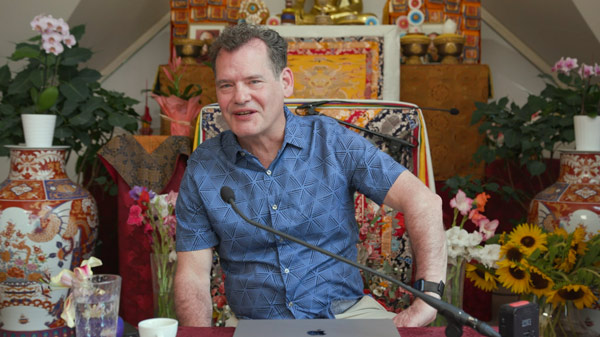
So, um, let me say a couple
of things and then let's just
open it up for questions
after that, or actually, let's see.
Maybe there are questions now and then
I'll say something.
How's that?
Any questions?
You're just like so worn out you can't...
Student: Yeah, I guess what I'm still a bit confused
about is the way that you've now been
describing reflexive awareness or sort
of the non-dual aspect of our experience,
uh, that it's always present but
obviously we're not mindful of it.
And I guess how I would understand getting your
view is to become aware of that experience.
I don't know.
I've done meditations and then the point is
like awareness becoming aware of itself,
something like that.
Maybe that's already a conceptualization
of it and that has its issues but I guess
my question is how is that possible
without invoking some sort of duality,
like a second order subjectivity?
Right, so that's a great question.
So, um,
When you say awareness of awareness, is there any problem with that statement?
What's the problem?
I don't know, the subject is the subject. Or it suggests that there's something aware of something else, which is a second order, which would require a second order cognition, right? So I could put the slides up but maybe we don't need to do that, like you're trying to see your mind from outside your mind, or you're seeing some first order level of experience from a second order level, which is dualistic. But like right now, as you're like looking at me, you're aware of the sense of the looking and if there's some sense of there being like the inside outside, you're aware of the inside, you're seeing me as an object. But even to do that, and vision is good for this, like you have to have this dimensionality to it. So you have to know, in order for me to look like I'm over here, you also have to be knowing that there's an in here, right? Like, I'm there... no wait, I'm here? I'm there, and you're here, right? From your perspective. So you know the here-ness, but you don't know that... like if you see the here-ness, if you try to see the here-ness, you like try to turn around and look at the here, I'm here, you do that, that becomes there, right? The minute you try to do that, right? Like I think you've been doing this with Eric maybe, like trying to find the self. So when you do that, you're just doing the same old, same old. And the key here is actually effort.
So remember, conceptuality is um, necessarily dualistic. It's also necessarily effortful. So this is actually one of Dharmakīrti's main contributions and part of the reason he's so influential for this tradition. It's abhoga, or tsolwa, or tsolche in Tibetan. And uh, if we try to be aware of the non-dual aspect of the mind, right, to be aware of the nature of the mind, which is, again, the key thing here is the dualistic structure and the nature in our experience confuses us, makes us think that's like inherent to consciousness, but it's not.
So, however, that doesn't mean like if there's clouds in the sky, it's not like it does anything to the sky, right? So having dualistic content is not in itself the issue. It's taking that content and that structure to be real. So there's a famous instruction from Tilopā to the very key figure in the Mahāmudrā tradition to his student Nāropā, another key figure. Like, and we only have the Tibetan, I think it's Bu nangwai ma ching ...
My child, you're not bound by appearances, by dualistic appearances. You're bound by clinging to them, taking them to be real.
So even though it can be helpful to induce a state in which is like this, you don't need that. You know, that can be a very helpful thing. You know, maybe especially for people like me who are very stubborn and whatever, sure of themselves, but uh, uh, you don't need that. You can be... This is also non-dual in its nature, even with the structure and the content. But what, when we try, we're making an effort, we're already in that dualistic mode because it's I'm doing something. We're back into the structure of the survivor in samsara. Like, I'm going to do this. So the re... part of that thing of this, so the ma ying མ་ཡེངས་, mi gom མི་སྒོམ་, undistracted is you're not caught by objects, you're not caught into a dualistic structure. And the mi gom མི་སྒོམ་, non-meditation, is you're not trying to do something. You're not trying to make something happen. You're not trying to stop anything. You're not trying to do something good or avoid something bad. You're just letting go in a sense. What they say, another term they use, you may have heard something like this from Eric, is ma cho མ་བཅོས་, unadjusted. You're not trying to fix anything. And in a way, you know, sometimes one metaphor that kind of works for me is like it's out the corner of your eye. Like we usually identify habitually with the sense of subjectivity. And the idea here is to not identify with that. You're aware without identifying with that.
Right? And it's like you're in a sense you're aware of both what you're seeing and the subjectivity and everything else larger without falling into objects or subjects. Because that's like the whole package is being presented in your experience. Right? It's not like just the subject, just the object that you're looking at is presented in your experience. All of that stuff that gives you the here-ness, the sense of embodiment, all of that's also presented. So it's sort of tapping into that, like broader sense of what you're aware of that is without, and the way you do that is instead of you try, you stop trying.
Does that help? sTUDENT. Yeah, no, definitely. I think it definitely does. I guess I'm still just a bit confused about how a knowing quality can be known because it's still, I don't know, it still feels very paradoxical. I just cannot get around that somehow. Where's that stick? Ava had a stick.
Yeah, maybe just go talk to Eric.
Uh, you know, I'll just say this, okay?
Or I'll just ask you this. So, you know, you see the flower?
Student: Yes. You're sure you see the flower? Student: Yeah. Okay. Uh, you... Are you seeing the flower or is it Rowan seeing the flower? Student: Uh, it's me (not Rowan). Are you sure it's you? Student: I guess so, yeah. Like you're the subject of the, you're having, you're absolutely sure that a visual, let's take out you and I and everything, a visual experience is occurring? Student: Uh, Yes. And there is a visual object presented in the experience? Student: Yes. And that's presented to some perspective? Student: Sure, yeah. Well... Right? Like, it's over here, over there for you, and there's a sense of being here at the same time, right? Student: Right. Are you sure that there's here?
Student: Well, I feel more sure that there's not in this, I don't know. What I mean is, are you sure that, like, when you're seeing this is over there, are you also sure that that's over there relative to here? Your a sense of here,
as part of the experience, just as you're sure you're seeing it, that the seeing is happening, that means you have to be sure that there's here for you. The sense of here-ness, or in here-ness, is over there, this is over there for you, and that means there has to be here-ness for you. Otherwise it wouldn't be over there, right? So just as sure as you are that it's over there, you're sure of a sense of here,
which is, which you don't, you can't see the here by looking at it, because then it becomes over there. If you turn around and try to look at it, it's over there now. But you're sure it's here. You're sure of the here-ness while you look at this. Right? Okay, that's all, that's the point.
Did I do okay?
I know we don't want to go too far in this direction, but... So this is just conceptual, then, you know, the actual, like, part of this is what we're, I think both Eric and I are kind of doing, is sort of setting up for someone like Chokyi Nyima Rinpoche, then bring you further into an actual experience. But you can do a lot of preparation, so to speak, for that.
That's okay? I hope that makes things clearer. All right. Yeah, go.
Why don't you come over here? Oh, you want to be there? Oh, you're here. No, I'm there. Wait. It's not working. No, really, come over here.
So the online people can see you. Yeah, I've been trying to stay offline for the first time ever in my whole life. Here's Eric, everybody. Hi. I think that this is more for the benefit of the online people, anyway. I think the thing that we have to remember is it's really frustrating, because this is the one thing the conceptual mind cannot grasp. And so we're trying, because that's what we do conceptually, to make some kind of framework so we can relate to it and understand it. And it's just never going to work. There's just simply no way to resolve it through conceptual thinking. If there was, it would be so much easier. And so it's just kind of, at some point, you have to have a sense of humor, or even just that frustration is a sign that you're making progress. It's actually a wonderful thing, something you can celebrate, even though it feels kind of uncomfortable and horrible at the same time. So this is just, it's just very, very simple. You can understand empty, you can understand appearance, that there are unity, is impossible to resolve through concepts.
Well put. Okay, sorry. I just want to get away.
Sadu, sadu, sadu.
So that's, yeah. Uh, the, so let's talk a little bit about kind of what happens when at some point you conclude, you know, we conclude that our conceptual schema of self-world, in some sense, and here's a mistake in this slide, so let me fix it,
that it tells a false story or it includes false constraints. In other words, that the sense of what is possible, like, for example, we think that particles are inherently particles and waves are inherently waves and never the twain shall meet. And then suddenly we do a double slit kind of experiment. And I didn't know it was done that early, actually. I didn't know about that history. And then, you know, really, you know, suddenly like, wow, that model doesn't make any sense because we can just see in our experience that the conceptual framework that we're using is like false. And we can even have, another thing we can have is we can have a non-conceptual error, we can be like seeing yellow, you know, with our eyes, but then somehow, you know, somebody puts in a different lens and suddenly like oh man, I didn't know that. But maybe that only happens for a moment and then, you know, you're back to your yellow world. But you know that now you know it's yellow.
Maybe you have a moment of a kind of non-dual experience and then you, in the meditative, you know, what we call nyam shak མཉམ་བཞག་, meditative equipoise, and then you enter the post-meditative state and you're back to being dualistic, but you know, now you know, oh, experience is not essentially dualistic. It's possible to be in, to experience, to have non-dual experience, experience without that structure. And now that you know that, that means that, oh, you know, the idea that somehow this framework is essential to being aware that that idea is false. That also means that, like since that framework is what it's the basis of, for example, all of the stories we tell about ourselves, that means that all of those stories are also not truly real. That's not who we really are. Right? So, and that can be very therapeutic, actually. It's part of the reason why when people have experiences in which kind of the, that somehow those sense of self-world somehow falls away in whatever method is being used, that afterward, especially, it's like, wow, you know, all the terrible stories I tell about myself were, I was still aware, you know, awareness was happening, but all those stories were gone because they can't persist in that state. Right? So we can get to the point where what we thought was possible, what we thought was impossible, actually turns out to be possible.
So, one big question here is, like, how do we remap?
We find out that our, that our map is, is false and now we're going to do some remapping.
And one big question is, well, how do we do the remapping? One thing that is key here is knowing that the map is a map. Right? If we come out of that kind of an experience and then we go, now I know the truth and I will tell you the truth, especially if you pay me enough. And, you know, like, that, that's not a, that's a really bad sign. That's like, remember, the incure, the person whose view is emptiness is incurable, that if you're, you know, the person whose view is non-duality, which in this case is a version of emptiness, is like, wow, we've got a problem there. Because that means that you have that experience and you've actually turned that into a thing.
So, we need to find a way to remap and we start, the remapping starts by not taking the map as territory. But also, here's key, if we're talking about things that are not just like we've figured something out conceptually, which is also good. That, we can figure out that our maps are false just by doing experiments and discovering like we have some certain results and then we see that our conceptual system is wrong and we don't even do experiments, maybe. We just kind of go through the conceptual system. We see, for example, the idea of truly existent wholes is, is, just doesn't make sense conceptually. But especially when we start to have experiences, a key part of the remapping, like we have an experience, we go, wow, is that it has to be done with other people. Right? So that the, it's key, like we have an experience that we think is you know, somehow I've seen whatever, the ultimate, the gremlins in the wall, whatever it is, we have to be able to, and we're going to try to remap based on that. Like it totally blows away our beliefs when we come, when we're going to do that, the first thing we need to do is like see how that experience aligns with other people,
especially other people who claim to be having similar experiences. Right? So this is actually in phenomenology where you're looking for, you know, you're talking about eidetic variation and you're looking for invariance across experience. And that's going to be totally conceptual. But you need to do that. You need to like, okay, we have in a sense, experimental results that we observe. In this case, we have like meditative states, for example, we have amazing things that happen, maybe not about nature of the mind, maybe other kinds of things that kind of really call into question our beliefs. If that's just you, that's not a good way. You can't remap based on just you because maps are not about your individual experience. Maps are shared. So a very important thing about remapping is you, is that, you're what's part of what you have to preserve in the remapping is that the remapping is done with others. If you end up in your own little private map, you're also in trouble.
Okay? So those experiences, you need to share them with people, with your teachers. Right? With your, as we say, Dharma brothers and sisters, right, in the right context, not just with anybody like, you know, you're on the bus and say, I had this, turn to someb, I had this amazing non-dual experience, you know, that's not the right context for that. Okay, so that's really key, that it be with other people, and that you're in a sense, you know when you make sense of certain kinds of experiences actually, you know are, you can, they challenge your beliefs, but especially when we're talking about nature of mind, that those, the kinds of things that seem to be related to that, it's very, we know that the map is going to be inadequate, but you still need the map. Even though it's going to be incomplete, it's going to be inaccurate, we need the map. And we need to do that with others, with our teachers, with our, you know, fellow practitioners. And then the big question is like, how much do we preserve of our old model?
And that question is partially like about the community, it's partially about how you're going to communicate with people, but the main thing is that when you're going to remap, if you're a bodhisattva, you're a practitioner of the Mahāyāna, the remapping has to like, okay, you know, I've had, I've seen whatever, I've had this amazing experience, I'm trying to make sense of this, it's changed my beliefs about the nature of reality, it's changed my beliefs about what's possible, it's changed my beliefs about who I am. Right? I've talked with others and so on, I'm going to try ma, I'm going to try to make sense of this in language, maybe in art or whatever. But whatever the thing is that the map, the criteria for what's a good map is not that it's true.
Because it can't be true.
It needs to be useful.
And what kinds of usefulness are there? One of them is obviously in this context is like, it helps you and others to see the nature of reality. But that also means that what it should like, if you're looking for, is this an indicator of a way of thinking about things that really works? It should, as a result of the practice and the map you're using to interpret what's happening, and of course this is what the tradition is trying to provide are these kinds of maps, multiple ones, different ones, is that the practice and the way you make sense of it, alway, it, it... on the average, you can have ups and downs, but on average, you have fewer afflictions. Like I remember some years ago, I met, I saw Tsoknyi Rinpoche and I hadn't seen him, you know, Chokyi Nyima Rinpoche's brother, I hadn't seen him in quite a long time, actually at the Mind and Life Summer Research Institute. And, you know, he sort of, he heard me talking or something and he came up to me and he's like, oh, it's nice to see you again. You know, you're really not as much of a jerk as you used to be. It's kind of the thing that Tsoknyi Rinpoche said.
And, you know, like, for a moment I was like, what? And then he's like, oh, gee, that's a compliment.
Like, yes, you didn't, you know, yeah, you should become less of a jerk. Fewer afflictions, less suffering for yourself and others. Again, this is on average, right? It's going to be going up and down. And more flourishing.
Right? Less bad stuff, more good stuff, as it were. And those are like signs of effective practice, but practice also means, it means, it includes those maps.
Right? That's part of the practice, is working with those maps, adjusting them, you know, the philosophy, the ethics.
Those all, that's part of the practice, actually. All right, so I think unless there's any final question, and maybe we can just chat over lunch or whatever, I'm going to close us out now and say thank you very much for your tremendous attention this week. We've done a lot this week. You know, it's pretty intensive. We had Khenpo and Eric, and, you know, we had four sessions a day, really, actually, right? We have morning meditation, and then to a session, this kind of session in the morning, and another this kind of session in the afternoon, and then evening meditation, and, you know... What's that? Party, yes. We had our, you know, party session last night, and uh well, during which everyone, I'm sure, experienced non-dual nature of mind, but... Uh and uh, everyone but me, of course. But uh, uh, it's been quite a week, and so I'm even a little tired, but I am also really enjoyed spending this time with you, so I just want to thank you for your tremendous attention, and thank everyone at Gomde for making it possible, and really look forward to seeing all of you again sometime. So... Thank you very much, John. We have to thank you, we have to thank Khenpo Pema Namgyal, we have to thank Eric Solomon, and first and foremost, Rinpoche, for bringing this trio together. So, naturally, I think, or we all feel that it was an incredible, rich program, and we hope that it happens many, many more times, especially this combination of practice, of classical philosophy, and of modern, of the modern approach to it, is phenomenal. I think our minds are blown, twisted, boggled. They are definitely in another place now than they were one week before. We all enjoyed your teaching so much. The multifacetedness of it all is just really, really extraordinary. We are so glad and honored that you could be here to teach us. And thank you, Eric, for bringing in the practical approach to it. I think this was very enriching for everyone, also to understand the lectures on a different level. And thank you, Khenpo Pema Namgyal, for, in a very condensed, very short time, transporting this incredible knowledge of the arguments of Mādhyamika to us. So, and thank you, everyone, for participating, for being present at every session. That's something. No? Yes. And for the intelligent questions, for the engagement, and for the discussions in the breaks. I think, yeah, it just shows how we would really love to have this again and again and again. Thank you very much. Thank you, Bibi. Thank you very much.
So let's just dedicate the merit.
sönam diyi thamché sikpa nyi thopné nyepai dranam phamjé né kyega nachi balap trukpa yi sipai tsolé drowa drölwar shok jangchup semchok rinpoché ma kyepa nam kyé gyurchik kyepa nyampa mepa yang gongné gongdu phelwar shok
And even though I wasn't at Eric's sessions, I could tell from the way people looked after that something very good was going on. And it's been a real pleasure to get to know Eric. We've never met in person before. And to like, and hopefully we're going to do more of this kind of thing.
When you say awareness of awareness, is there any problem with that statement?
What's the problem?
I don't know, the subject is the subject. Or it suggests that there's something aware of something else, which is a second order, which would require a second order cognition, right? So I could put the slides up but maybe we don't need to do that, like you're trying to see your mind from outside your mind, or you're seeing some first order level of experience from a second order level, which is dualistic. But like right now, as you're like looking at me, you're aware of the sense of the looking and if there's some sense of there being like the inside outside, you're aware of the inside, you're seeing me as an object. But even to do that, and vision is good for this, like you have to have this dimensionality to it. So you have to know, in order for me to look like I'm over here, you also have to be knowing that there's an in here, right? Like, I'm there... no wait, I'm here? I'm there, and you're here, right? From your perspective. So you know the here-ness, but you don't know that... like if you see the here-ness, if you try to see the here-ness, you like try to turn around and look at the here, I'm here, you do that, that becomes there, right? The minute you try to do that, right? Like I think you've been doing this with Eric maybe, like trying to find the self. So when you do that, you're just doing the same old, same old. And the key here is actually effort.
So remember, conceptuality is um, necessarily dualistic. It's also necessarily effortful. So this is actually one of Dharmakīrti's main contributions and part of the reason he's so influential for this tradition. It's abhoga, or tsolwa, or tsolche in Tibetan. And uh, if we try to be aware of the non-dual aspect of the mind, right, to be aware of the nature of the mind, which is, again, the key thing here is the dualistic structure and the nature in our experience confuses us, makes us think that's like inherent to consciousness, but it's not.
So, however, that doesn't mean like if there's clouds in the sky, it's not like it does anything to the sky, right? So having dualistic content is not in itself the issue. It's taking that content and that structure to be real. So there's a famous instruction from Tilopā to the very key figure in the Mahāmudrā tradition to his student Nāropā, another key figure. Like, and we only have the Tibetan, I think it's Bu nangwai ma ching ...
My child, you're not bound by appearances, by dualistic appearances. You're bound by clinging to them, taking them to be real.
So even though it can be helpful to induce a state in which is like this, you don't need that. You know, that can be a very helpful thing. You know, maybe especially for people like me who are very stubborn and whatever, sure of themselves, but uh, uh, you don't need that. You can be... This is also non-dual in its nature, even with the structure and the content. But what, when we try, we're making an effort, we're already in that dualistic mode because it's I'm doing something. We're back into the structure of the survivor in samsara. Like, I'm going to do this. So the re... part of that thing of this, so the ma ying མ་ཡེངས་, mi gom མི་སྒོམ་, undistracted is you're not caught by objects, you're not caught into a dualistic structure. And the mi gom མི་སྒོམ་, non-meditation, is you're not trying to do something. You're not trying to make something happen. You're not trying to stop anything. You're not trying to do something good or avoid something bad. You're just letting go in a sense. What they say, another term they use, you may have heard something like this from Eric, is ma cho མ་བཅོས་, unadjusted. You're not trying to fix anything. And in a way, you know, sometimes one metaphor that kind of works for me is like it's out the corner of your eye. Like we usually identify habitually with the sense of subjectivity. And the idea here is to not identify with that. You're aware without identifying with that.
Right? And it's like you're in a sense you're aware of both what you're seeing and the subjectivity and everything else larger without falling into objects or subjects. Because that's like the whole package is being presented in your experience. Right? It's not like just the subject, just the object that you're looking at is presented in your experience. All of that stuff that gives you the here-ness, the sense of embodiment, all of that's also presented. So it's sort of tapping into that, like broader sense of what you're aware of that is without, and the way you do that is instead of you try, you stop trying.
Does that help? sTUDENT. Yeah, no, definitely. I think it definitely does. I guess I'm still just a bit confused about how a knowing quality can be known because it's still, I don't know, it still feels very paradoxical. I just cannot get around that somehow. Where's that stick? Ava had a stick.
Yeah, maybe just go talk to Eric.
Uh, you know, I'll just say this, okay?
Or I'll just ask you this. So, you know, you see the flower?
Student: Yes. You're sure you see the flower? Student: Yeah. Okay. Uh, you... Are you seeing the flower or is it Rowan seeing the flower? Student: Uh, it's me (not Rowan). Are you sure it's you? Student: I guess so, yeah. Like you're the subject of the, you're having, you're absolutely sure that a visual, let's take out you and I and everything, a visual experience is occurring? Student: Uh, Yes. And there is a visual object presented in the experience? Student: Yes. And that's presented to some perspective? Student: Sure, yeah. Well... Right? Like, it's over here, over there for you, and there's a sense of being here at the same time, right? Student: Right. Are you sure that there's here?
Student: Well, I feel more sure that there's not in this, I don't know. What I mean is, are you sure that, like, when you're seeing this is over there, are you also sure that that's over there relative to here? Your a sense of here,
as part of the experience, just as you're sure you're seeing it, that the seeing is happening, that means you have to be sure that there's here for you. The sense of here-ness, or in here-ness, is over there, this is over there for you, and that means there has to be here-ness for you. Otherwise it wouldn't be over there, right? So just as sure as you are that it's over there, you're sure of a sense of here,
which is, which you don't, you can't see the here by looking at it, because then it becomes over there. If you turn around and try to look at it, it's over there now. But you're sure it's here. You're sure of the here-ness while you look at this. Right? Okay, that's all, that's the point.
Did I do okay?
I know we don't want to go too far in this direction, but... So this is just conceptual, then, you know, the actual, like, part of this is what we're, I think both Eric and I are kind of doing, is sort of setting up for someone like Chokyi Nyima Rinpoche, then bring you further into an actual experience. But you can do a lot of preparation, so to speak, for that.
That's okay? I hope that makes things clearer. All right. Yeah, go.
Why don't you come over here? Oh, you want to be there? Oh, you're here. No, I'm there. Wait. It's not working. No, really, come over here.
So the online people can see you. Yeah, I've been trying to stay offline for the first time ever in my whole life. Here's Eric, everybody. Hi. I think that this is more for the benefit of the online people, anyway. I think the thing that we have to remember is it's really frustrating, because this is the one thing the conceptual mind cannot grasp. And so we're trying, because that's what we do conceptually, to make some kind of framework so we can relate to it and understand it. And it's just never going to work. There's just simply no way to resolve it through conceptual thinking. If there was, it would be so much easier. And so it's just kind of, at some point, you have to have a sense of humor, or even just that frustration is a sign that you're making progress. It's actually a wonderful thing, something you can celebrate, even though it feels kind of uncomfortable and horrible at the same time. So this is just, it's just very, very simple. You can understand empty, you can understand appearance, that there are unity, is impossible to resolve through concepts.
Well put. Okay, sorry. I just want to get away.
Sadu, sadu, sadu.
So that's, yeah. Uh, the, so let's talk a little bit about kind of what happens when at some point you conclude, you know, we conclude that our conceptual schema of self-world, in some sense, and here's a mistake in this slide, so let me fix it,
that it tells a false story or it includes false constraints. In other words, that the sense of what is possible, like, for example, we think that particles are inherently particles and waves are inherently waves and never the twain shall meet. And then suddenly we do a double slit kind of experiment. And I didn't know it was done that early, actually. I didn't know about that history. And then, you know, really, you know, suddenly like, wow, that model doesn't make any sense because we can just see in our experience that the conceptual framework that we're using is like false. And we can even have, another thing we can have is we can have a non-conceptual error, we can be like seeing yellow, you know, with our eyes, but then somehow, you know, somebody puts in a different lens and suddenly like oh man, I didn't know that. But maybe that only happens for a moment and then, you know, you're back to your yellow world. But you know that now you know it's yellow.
Maybe you have a moment of a kind of non-dual experience and then you, in the meditative, you know, what we call nyam shak མཉམ་བཞག་, meditative equipoise, and then you enter the post-meditative state and you're back to being dualistic, but you know, now you know, oh, experience is not essentially dualistic. It's possible to be in, to experience, to have non-dual experience, experience without that structure. And now that you know that, that means that, oh, you know, the idea that somehow this framework is essential to being aware that that idea is false. That also means that, like since that framework is what it's the basis of, for example, all of the stories we tell about ourselves, that means that all of those stories are also not truly real. That's not who we really are. Right? So, and that can be very therapeutic, actually. It's part of the reason why when people have experiences in which kind of the, that somehow those sense of self-world somehow falls away in whatever method is being used, that afterward, especially, it's like, wow, you know, all the terrible stories I tell about myself were, I was still aware, you know, awareness was happening, but all those stories were gone because they can't persist in that state. Right? So we can get to the point where what we thought was possible, what we thought was impossible, actually turns out to be possible.
So, one big question here is, like, how do we remap?
We find out that our, that our map is, is false and now we're going to do some remapping.
And one big question is, well, how do we do the remapping? One thing that is key here is knowing that the map is a map. Right? If we come out of that kind of an experience and then we go, now I know the truth and I will tell you the truth, especially if you pay me enough. And, you know, like, that, that's not a, that's a really bad sign. That's like, remember, the incure, the person whose view is emptiness is incurable, that if you're, you know, the person whose view is non-duality, which in this case is a version of emptiness, is like, wow, we've got a problem there. Because that means that you have that experience and you've actually turned that into a thing.
So, we need to find a way to remap and we start, the remapping starts by not taking the map as territory. But also, here's key, if we're talking about things that are not just like we've figured something out conceptually, which is also good. That, we can figure out that our maps are false just by doing experiments and discovering like we have some certain results and then we see that our conceptual system is wrong and we don't even do experiments, maybe. We just kind of go through the conceptual system. We see, for example, the idea of truly existent wholes is, is, just doesn't make sense conceptually. But especially when we start to have experiences, a key part of the remapping, like we have an experience, we go, wow, is that it has to be done with other people. Right? So that the, it's key, like we have an experience that we think is you know, somehow I've seen whatever, the ultimate, the gremlins in the wall, whatever it is, we have to be able to, and we're going to try to remap based on that. Like it totally blows away our beliefs when we come, when we're going to do that, the first thing we need to do is like see how that experience aligns with other people,
especially other people who claim to be having similar experiences. Right? So this is actually in phenomenology where you're looking for, you know, you're talking about eidetic variation and you're looking for invariance across experience. And that's going to be totally conceptual. But you need to do that. You need to like, okay, we have in a sense, experimental results that we observe. In this case, we have like meditative states, for example, we have amazing things that happen, maybe not about nature of the mind, maybe other kinds of things that kind of really call into question our beliefs. If that's just you, that's not a good way. You can't remap based on just you because maps are not about your individual experience. Maps are shared. So a very important thing about remapping is you, is that, you're what's part of what you have to preserve in the remapping is that the remapping is done with others. If you end up in your own little private map, you're also in trouble.
Okay? So those experiences, you need to share them with people, with your teachers. Right? With your, as we say, Dharma brothers and sisters, right, in the right context, not just with anybody like, you know, you're on the bus and say, I had this, turn to someb, I had this amazing non-dual experience, you know, that's not the right context for that. Okay, so that's really key, that it be with other people, and that you're in a sense, you know when you make sense of certain kinds of experiences actually, you know are, you can, they challenge your beliefs, but especially when we're talking about nature of mind, that those, the kinds of things that seem to be related to that, it's very, we know that the map is going to be inadequate, but you still need the map. Even though it's going to be incomplete, it's going to be inaccurate, we need the map. And we need to do that with others, with our teachers, with our, you know, fellow practitioners. And then the big question is like, how much do we preserve of our old model?
And that question is partially like about the community, it's partially about how you're going to communicate with people, but the main thing is that when you're going to remap, if you're a bodhisattva, you're a practitioner of the Mahāyāna, the remapping has to like, okay, you know, I've had, I've seen whatever, I've had this amazing experience, I'm trying to make sense of this, it's changed my beliefs about the nature of reality, it's changed my beliefs about what's possible, it's changed my beliefs about who I am. Right? I've talked with others and so on, I'm going to try ma, I'm going to try to make sense of this in language, maybe in art or whatever. But whatever the thing is that the map, the criteria for what's a good map is not that it's true.
Because it can't be true.
It needs to be useful.
And what kinds of usefulness are there? One of them is obviously in this context is like, it helps you and others to see the nature of reality. But that also means that what it should like, if you're looking for, is this an indicator of a way of thinking about things that really works? It should, as a result of the practice and the map you're using to interpret what's happening, and of course this is what the tradition is trying to provide are these kinds of maps, multiple ones, different ones, is that the practice and the way you make sense of it, alway, it, it... on the average, you can have ups and downs, but on average, you have fewer afflictions. Like I remember some years ago, I met, I saw Tsoknyi Rinpoche and I hadn't seen him, you know, Chokyi Nyima Rinpoche's brother, I hadn't seen him in quite a long time, actually at the Mind and Life Summer Research Institute. And, you know, he sort of, he heard me talking or something and he came up to me and he's like, oh, it's nice to see you again. You know, you're really not as much of a jerk as you used to be. It's kind of the thing that Tsoknyi Rinpoche said.
And, you know, like, for a moment I was like, what? And then he's like, oh, gee, that's a compliment.
Like, yes, you didn't, you know, yeah, you should become less of a jerk. Fewer afflictions, less suffering for yourself and others. Again, this is on average, right? It's going to be going up and down. And more flourishing.
Right? Less bad stuff, more good stuff, as it were. And those are like signs of effective practice, but practice also means, it means, it includes those maps.
Right? That's part of the practice, is working with those maps, adjusting them, you know, the philosophy, the ethics.
Those all, that's part of the practice, actually. All right, so I think unless there's any final question, and maybe we can just chat over lunch or whatever, I'm going to close us out now and say thank you very much for your tremendous attention this week. We've done a lot this week. You know, it's pretty intensive. We had Khenpo and Eric, and, you know, we had four sessions a day, really, actually, right? We have morning meditation, and then to a session, this kind of session in the morning, and another this kind of session in the afternoon, and then evening meditation, and, you know... What's that? Party, yes. We had our, you know, party session last night, and uh well, during which everyone, I'm sure, experienced non-dual nature of mind, but... Uh and uh, everyone but me, of course. But uh, uh, it's been quite a week, and so I'm even a little tired, but I am also really enjoyed spending this time with you, so I just want to thank you for your tremendous attention, and thank everyone at Gomde for making it possible, and really look forward to seeing all of you again sometime. So... Thank you very much, John. We have to thank you, we have to thank Khenpo Pema Namgyal, we have to thank Eric Solomon, and first and foremost, Rinpoche, for bringing this trio together. So, naturally, I think, or we all feel that it was an incredible, rich program, and we hope that it happens many, many more times, especially this combination of practice, of classical philosophy, and of modern, of the modern approach to it, is phenomenal. I think our minds are blown, twisted, boggled. They are definitely in another place now than they were one week before. We all enjoyed your teaching so much. The multifacetedness of it all is just really, really extraordinary. We are so glad and honored that you could be here to teach us. And thank you, Eric, for bringing in the practical approach to it. I think this was very enriching for everyone, also to understand the lectures on a different level. And thank you, Khenpo Pema Namgyal, for, in a very condensed, very short time, transporting this incredible knowledge of the arguments of Mādhyamika to us. So, and thank you, everyone, for participating, for being present at every session. That's something. No? Yes. And for the intelligent questions, for the engagement, and for the discussions in the breaks. I think, yeah, it just shows how we would really love to have this again and again and again. Thank you very much. Thank you, Bibi. Thank you very much.
So let's just dedicate the merit.
sönam diyi thamché sikpa nyi thopné nyepai dranam phamjé né kyega nachi balap trukpa yi sipai tsolé drowa drölwar shok jangchup semchok rinpoché ma kyepa nam kyé gyurchik kyepa nyampa mepa yang gongné gongdu phelwar shok
And even though I wasn't at Eric's sessions, I could tell from the way people looked after that something very good was going on. And it's been a real pleasure to get to know Eric. We've never met in person before. And to like, and hopefully we're going to do more of this kind of thing.
So, um, let me say a couple
of things and then let's just
open it up for questions
after that, or actually, let's see.
Maybe there are questions now and then
I'll say something.
How's that?
Any questions?
You're just like so worn out you can't...
Student: Yeah, I guess what I'm still a bit confused
about is the way that you've now been
describing reflexive awareness or sort
of the non-dual aspect of our experience,
uh, that it's always present but
obviously we're not mindful of it.
And I guess how I would understand getting your
view is to become aware of that experience.
I don't know.
I've done meditations and then the point is
like awareness becoming aware of itself,
something like that.
Maybe that's already a conceptualization
of it and that has its issues but I guess
my question is how is that possible
without invoking some sort of duality,
like a second order subjectivity?
Right, so that's a great question.
So, um,
When you say awareness of awareness, is there any problem with that statement?
What's the problem?
I don't know, the subject is the subject. Or it suggests that there's something aware of something else, which is a second order, which would require a second order cognition, right? So I could put the slides up but maybe we don't need to do that, like you're trying to see your mind from outside your mind, or you're seeing some first order level of experience from a second order level, which is dualistic. But like right now, as you're like looking at me, you're aware of the sense of the looking and if there's some sense of there being like the inside outside, you're aware of the inside, you're seeing me as an object. But even to do that, and vision is good for this, like you have to have this dimensionality to it. So you have to know, in order for me to look like I'm over here, you also have to be knowing that there's an in here, right? Like, I'm there... no wait, I'm here? I'm there, and you're here, right? From your perspective. So you know the here-ness, but you don't know that... like if you see the here-ness, if you try to see the here-ness, you like try to turn around and look at the here, I'm here, you do that, that becomes there, right? The minute you try to do that, right? Like I think you've been doing this with Eric maybe, like trying to find the self. So when you do that, you're just doing the same old, same old. And the key here is actually effort.
So remember, conceptuality is um, necessarily dualistic. It's also necessarily effortful. So this is actually one of Dharmakīrti's main contributions and part of the reason he's so influential for this tradition. It's abhoga, or tsolwa, or tsolche in Tibetan. And uh, if we try to be aware of the non-dual aspect of the mind, right, to be aware of the nature of the mind, which is, again, the key thing here is the dualistic structure and the nature in our experience confuses us, makes us think that's like inherent to consciousness, but it's not.
So, however, that doesn't mean like if there's clouds in the sky, it's not like it does anything to the sky, right? So having dualistic content is not in itself the issue. It's taking that content and that structure to be real. So there's a famous instruction from Tilopā to the very key figure in the Mahāmudrā tradition to his student Nāropā, another key figure. Like, and we only have the Tibetan, I think it's Bu nangwai ma ching ...
My child, you're not bound by appearances, by dualistic appearances. You're bound by clinging to them, taking them to be real.
So even though it can be helpful to induce a state in which is like this, you don't need that. You know, that can be a very helpful thing. You know, maybe especially for people like me who are very stubborn and whatever, sure of themselves, but uh, uh, you don't need that. You can be... This is also non-dual in its nature, even with the structure and the content. But what, when we try, we're making an effort, we're already in that dualistic mode because it's I'm doing something. We're back into the structure of the survivor in samsara. Like, I'm going to do this. So the re... part of that thing of this, so the ma ying མ་ཡེངས་, mi gom མི་སྒོམ་, undistracted is you're not caught by objects, you're not caught into a dualistic structure. And the mi gom མི་སྒོམ་, non-meditation, is you're not trying to do something. You're not trying to make something happen. You're not trying to stop anything. You're not trying to do something good or avoid something bad. You're just letting go in a sense. What they say, another term they use, you may have heard something like this from Eric, is ma cho མ་བཅོས་, unadjusted. You're not trying to fix anything. And in a way, you know, sometimes one metaphor that kind of works for me is like it's out the corner of your eye. Like we usually identify habitually with the sense of subjectivity. And the idea here is to not identify with that. You're aware without identifying with that.
Right? And it's like you're in a sense you're aware of both what you're seeing and the subjectivity and everything else larger without falling into objects or subjects. Because that's like the whole package is being presented in your experience. Right? It's not like just the subject, just the object that you're looking at is presented in your experience. All of that stuff that gives you the here-ness, the sense of embodiment, all of that's also presented. So it's sort of tapping into that, like broader sense of what you're aware of that is without, and the way you do that is instead of you try, you stop trying.
Does that help? sTUDENT. Yeah, no, definitely. I think it definitely does. I guess I'm still just a bit confused about how a knowing quality can be known because it's still, I don't know, it still feels very paradoxical. I just cannot get around that somehow. Where's that stick? Ava had a stick.
Yeah, maybe just go talk to Eric.
Uh, you know, I'll just say this, okay?
Or I'll just ask you this. So, you know, you see the flower?
Student: Yes. You're sure you see the flower? Student: Yeah. Okay. Uh, you... Are you seeing the flower or is it Rowan seeing the flower? Student: Uh, it's me (not Rowan). Are you sure it's you? Student: I guess so, yeah. Like you're the subject of the, you're having, you're absolutely sure that a visual, let's take out you and I and everything, a visual experience is occurring? Student: Uh, Yes. And there is a visual object presented in the experience? Student: Yes. And that's presented to some perspective? Student: Sure, yeah. Well... Right? Like, it's over here, over there for you, and there's a sense of being here at the same time, right? Student: Right. Are you sure that there's here?
Student: Well, I feel more sure that there's not in this, I don't know. What I mean is, are you sure that, like, when you're seeing this is over there, are you also sure that that's over there relative to here? Your a sense of here,
as part of the experience, just as you're sure you're seeing it, that the seeing is happening, that means you have to be sure that there's here for you. The sense of here-ness, or in here-ness, is over there, this is over there for you, and that means there has to be here-ness for you. Otherwise it wouldn't be over there, right? So just as sure as you are that it's over there, you're sure of a sense of here,
which is, which you don't, you can't see the here by looking at it, because then it becomes over there. If you turn around and try to look at it, it's over there now. But you're sure it's here. You're sure of the here-ness while you look at this. Right? Okay, that's all, that's the point.
Did I do okay?
I know we don't want to go too far in this direction, but... So this is just conceptual, then, you know, the actual, like, part of this is what we're, I think both Eric and I are kind of doing, is sort of setting up for someone like Chokyi Nyima Rinpoche, then bring you further into an actual experience. But you can do a lot of preparation, so to speak, for that.
That's okay? I hope that makes things clearer. All right. Yeah, go.
Why don't you come over here? Oh, you want to be there? Oh, you're here. No, I'm there. Wait. It's not working. No, really, come over here.
So the online people can see you. Yeah, I've been trying to stay offline for the first time ever in my whole life. Here's Eric, everybody. Hi. I think that this is more for the benefit of the online people, anyway. I think the thing that we have to remember is it's really frustrating, because this is the one thing the conceptual mind cannot grasp. And so we're trying, because that's what we do conceptually, to make some kind of framework so we can relate to it and understand it. And it's just never going to work. There's just simply no way to resolve it through conceptual thinking. If there was, it would be so much easier. And so it's just kind of, at some point, you have to have a sense of humor, or even just that frustration is a sign that you're making progress. It's actually a wonderful thing, something you can celebrate, even though it feels kind of uncomfortable and horrible at the same time. So this is just, it's just very, very simple. You can understand empty, you can understand appearance, that there are unity, is impossible to resolve through concepts.
Well put. Okay, sorry. I just want to get away.
Sadu, sadu, sadu.
So that's, yeah. Uh, the, so let's talk a little bit about kind of what happens when at some point you conclude, you know, we conclude that our conceptual schema of self-world, in some sense, and here's a mistake in this slide, so let me fix it,
that it tells a false story or it includes false constraints. In other words, that the sense of what is possible, like, for example, we think that particles are inherently particles and waves are inherently waves and never the twain shall meet. And then suddenly we do a double slit kind of experiment. And I didn't know it was done that early, actually. I didn't know about that history. And then, you know, really, you know, suddenly like, wow, that model doesn't make any sense because we can just see in our experience that the conceptual framework that we're using is like false. And we can even have, another thing we can have is we can have a non-conceptual error, we can be like seeing yellow, you know, with our eyes, but then somehow, you know, somebody puts in a different lens and suddenly like oh man, I didn't know that. But maybe that only happens for a moment and then, you know, you're back to your yellow world. But you know that now you know it's yellow.
Maybe you have a moment of a kind of non-dual experience and then you, in the meditative, you know, what we call nyam shak མཉམ་བཞག་, meditative equipoise, and then you enter the post-meditative state and you're back to being dualistic, but you know, now you know, oh, experience is not essentially dualistic. It's possible to be in, to experience, to have non-dual experience, experience without that structure. And now that you know that, that means that, oh, you know, the idea that somehow this framework is essential to being aware that that idea is false. That also means that, like since that framework is what it's the basis of, for example, all of the stories we tell about ourselves, that means that all of those stories are also not truly real. That's not who we really are. Right? So, and that can be very therapeutic, actually. It's part of the reason why when people have experiences in which kind of the, that somehow those sense of self-world somehow falls away in whatever method is being used, that afterward, especially, it's like, wow, you know, all the terrible stories I tell about myself were, I was still aware, you know, awareness was happening, but all those stories were gone because they can't persist in that state. Right? So we can get to the point where what we thought was possible, what we thought was impossible, actually turns out to be possible.
So, one big question here is, like, how do we remap?
We find out that our, that our map is, is false and now we're going to do some remapping.
And one big question is, well, how do we do the remapping? One thing that is key here is knowing that the map is a map. Right? If we come out of that kind of an experience and then we go, now I know the truth and I will tell you the truth, especially if you pay me enough. And, you know, like, that, that's not a, that's a really bad sign. That's like, remember, the incure, the person whose view is emptiness is incurable, that if you're, you know, the person whose view is non-duality, which in this case is a version of emptiness, is like, wow, we've got a problem there. Because that means that you have that experience and you've actually turned that into a thing.
So, we need to find a way to remap and we start, the remapping starts by not taking the map as territory. But also, here's key, if we're talking about things that are not just like we've figured something out conceptually, which is also good. That, we can figure out that our maps are false just by doing experiments and discovering like we have some certain results and then we see that our conceptual system is wrong and we don't even do experiments, maybe. We just kind of go through the conceptual system. We see, for example, the idea of truly existent wholes is, is, just doesn't make sense conceptually. But especially when we start to have experiences, a key part of the remapping, like we have an experience, we go, wow, is that it has to be done with other people. Right? So that the, it's key, like we have an experience that we think is you know, somehow I've seen whatever, the ultimate, the gremlins in the wall, whatever it is, we have to be able to, and we're going to try to remap based on that. Like it totally blows away our beliefs when we come, when we're going to do that, the first thing we need to do is like see how that experience aligns with other people,
especially other people who claim to be having similar experiences. Right? So this is actually in phenomenology where you're looking for, you know, you're talking about eidetic variation and you're looking for invariance across experience. And that's going to be totally conceptual. But you need to do that. You need to like, okay, we have in a sense, experimental results that we observe. In this case, we have like meditative states, for example, we have amazing things that happen, maybe not about nature of the mind, maybe other kinds of things that kind of really call into question our beliefs. If that's just you, that's not a good way. You can't remap based on just you because maps are not about your individual experience. Maps are shared. So a very important thing about remapping is you, is that, you're what's part of what you have to preserve in the remapping is that the remapping is done with others. If you end up in your own little private map, you're also in trouble.
Okay? So those experiences, you need to share them with people, with your teachers. Right? With your, as we say, Dharma brothers and sisters, right, in the right context, not just with anybody like, you know, you're on the bus and say, I had this, turn to someb, I had this amazing non-dual experience, you know, that's not the right context for that. Okay, so that's really key, that it be with other people, and that you're in a sense, you know when you make sense of certain kinds of experiences actually, you know are, you can, they challenge your beliefs, but especially when we're talking about nature of mind, that those, the kinds of things that seem to be related to that, it's very, we know that the map is going to be inadequate, but you still need the map. Even though it's going to be incomplete, it's going to be inaccurate, we need the map. And we need to do that with others, with our teachers, with our, you know, fellow practitioners. And then the big question is like, how much do we preserve of our old model?
And that question is partially like about the community, it's partially about how you're going to communicate with people, but the main thing is that when you're going to remap, if you're a bodhisattva, you're a practitioner of the Mahāyāna, the remapping has to like, okay, you know, I've had, I've seen whatever, I've had this amazing experience, I'm trying to make sense of this, it's changed my beliefs about the nature of reality, it's changed my beliefs about what's possible, it's changed my beliefs about who I am. Right? I've talked with others and so on, I'm going to try ma, I'm going to try to make sense of this in language, maybe in art or whatever. But whatever the thing is that the map, the criteria for what's a good map is not that it's true.
Because it can't be true.
It needs to be useful.
And what kinds of usefulness are there? One of them is obviously in this context is like, it helps you and others to see the nature of reality. But that also means that what it should like, if you're looking for, is this an indicator of a way of thinking about things that really works? It should, as a result of the practice and the map you're using to interpret what's happening, and of course this is what the tradition is trying to provide are these kinds of maps, multiple ones, different ones, is that the practice and the way you make sense of it, alway, it, it... on the average, you can have ups and downs, but on average, you have fewer afflictions. Like I remember some years ago, I met, I saw Tsoknyi Rinpoche and I hadn't seen him, you know, Chokyi Nyima Rinpoche's brother, I hadn't seen him in quite a long time, actually at the Mind and Life Summer Research Institute. And, you know, he sort of, he heard me talking or something and he came up to me and he's like, oh, it's nice to see you again. You know, you're really not as much of a jerk as you used to be. It's kind of the thing that Tsoknyi Rinpoche said.
And, you know, like, for a moment I was like, what? And then he's like, oh, gee, that's a compliment.
Like, yes, you didn't, you know, yeah, you should become less of a jerk. Fewer afflictions, less suffering for yourself and others. Again, this is on average, right? It's going to be going up and down. And more flourishing.
Right? Less bad stuff, more good stuff, as it were. And those are like signs of effective practice, but practice also means, it means, it includes those maps.
Right? That's part of the practice, is working with those maps, adjusting them, you know, the philosophy, the ethics.
Those all, that's part of the practice, actually. All right, so I think unless there's any final question, and maybe we can just chat over lunch or whatever, I'm going to close us out now and say thank you very much for your tremendous attention this week. We've done a lot this week. You know, it's pretty intensive. We had Khenpo and Eric, and, you know, we had four sessions a day, really, actually, right? We have morning meditation, and then to a session, this kind of session in the morning, and another this kind of session in the afternoon, and then evening meditation, and, you know... What's that? Party, yes. We had our, you know, party session last night, and uh well, during which everyone, I'm sure, experienced non-dual nature of mind, but... Uh and uh, everyone but me, of course. But uh, uh, it's been quite a week, and so I'm even a little tired, but I am also really enjoyed spending this time with you, so I just want to thank you for your tremendous attention, and thank everyone at Gomde for making it possible, and really look forward to seeing all of you again sometime. So... Thank you very much, John. We have to thank you, we have to thank Khenpo Pema Namgyal, we have to thank Eric Solomon, and first and foremost, Rinpoche, for bringing this trio together. So, naturally, I think, or we all feel that it was an incredible, rich program, and we hope that it happens many, many more times, especially this combination of practice, of classical philosophy, and of modern, of the modern approach to it, is phenomenal. I think our minds are blown, twisted, boggled. They are definitely in another place now than they were one week before. We all enjoyed your teaching so much. The multifacetedness of it all is just really, really extraordinary. We are so glad and honored that you could be here to teach us. And thank you, Eric, for bringing in the practical approach to it. I think this was very enriching for everyone, also to understand the lectures on a different level. And thank you, Khenpo Pema Namgyal, for, in a very condensed, very short time, transporting this incredible knowledge of the arguments of Mādhyamika to us. So, and thank you, everyone, for participating, for being present at every session. That's something. No? Yes. And for the intelligent questions, for the engagement, and for the discussions in the breaks. I think, yeah, it just shows how we would really love to have this again and again and again. Thank you very much. Thank you, Bibi. Thank you very much.
So let's just dedicate the merit.
sönam diyi thamché sikpa nyi thopné nyepai dranam phamjé né kyega nachi balap trukpa yi sipai tsolé drowa drölwar shok jangchup semchok rinpoché ma kyepa nam kyé gyurchik kyepa nyampa mepa yang gongné gongdu phelwar shok
And even though I wasn't at Eric's sessions, I could tell from the way people looked after that something very good was going on. And it's been a real pleasure to get to know Eric. We've never met in person before. And to like, and hopefully we're going to do more of this kind of thing.
When you say awareness of awareness, is there any problem with that statement?
What's the problem?
I don't know, the subject is the subject. Or it suggests that there's something aware of something else, which is a second order, which would require a second order cognition, right? So I could put the slides up but maybe we don't need to do that, like you're trying to see your mind from outside your mind, or you're seeing some first order level of experience from a second order level, which is dualistic. But like right now, as you're like looking at me, you're aware of the sense of the looking and if there's some sense of there being like the inside outside, you're aware of the inside, you're seeing me as an object. But even to do that, and vision is good for this, like you have to have this dimensionality to it. So you have to know, in order for me to look like I'm over here, you also have to be knowing that there's an in here, right? Like, I'm there... no wait, I'm here? I'm there, and you're here, right? From your perspective. So you know the here-ness, but you don't know that... like if you see the here-ness, if you try to see the here-ness, you like try to turn around and look at the here, I'm here, you do that, that becomes there, right? The minute you try to do that, right? Like I think you've been doing this with Eric maybe, like trying to find the self. So when you do that, you're just doing the same old, same old. And the key here is actually effort.
So remember, conceptuality is um, necessarily dualistic. It's also necessarily effortful. So this is actually one of Dharmakīrti's main contributions and part of the reason he's so influential for this tradition. It's abhoga, or tsolwa, or tsolche in Tibetan. And uh, if we try to be aware of the non-dual aspect of the mind, right, to be aware of the nature of the mind, which is, again, the key thing here is the dualistic structure and the nature in our experience confuses us, makes us think that's like inherent to consciousness, but it's not.
So, however, that doesn't mean like if there's clouds in the sky, it's not like it does anything to the sky, right? So having dualistic content is not in itself the issue. It's taking that content and that structure to be real. So there's a famous instruction from Tilopā to the very key figure in the Mahāmudrā tradition to his student Nāropā, another key figure. Like, and we only have the Tibetan, I think it's Bu nangwai ma ching ...
My child, you're not bound by appearances, by dualistic appearances. You're bound by clinging to them, taking them to be real.
So even though it can be helpful to induce a state in which is like this, you don't need that. You know, that can be a very helpful thing. You know, maybe especially for people like me who are very stubborn and whatever, sure of themselves, but uh, uh, you don't need that. You can be... This is also non-dual in its nature, even with the structure and the content. But what, when we try, we're making an effort, we're already in that dualistic mode because it's I'm doing something. We're back into the structure of the survivor in samsara. Like, I'm going to do this. So the re... part of that thing of this, so the ma ying མ་ཡེངས་, mi gom མི་སྒོམ་, undistracted is you're not caught by objects, you're not caught into a dualistic structure. And the mi gom མི་སྒོམ་, non-meditation, is you're not trying to do something. You're not trying to make something happen. You're not trying to stop anything. You're not trying to do something good or avoid something bad. You're just letting go in a sense. What they say, another term they use, you may have heard something like this from Eric, is ma cho མ་བཅོས་, unadjusted. You're not trying to fix anything. And in a way, you know, sometimes one metaphor that kind of works for me is like it's out the corner of your eye. Like we usually identify habitually with the sense of subjectivity. And the idea here is to not identify with that. You're aware without identifying with that.
Right? And it's like you're in a sense you're aware of both what you're seeing and the subjectivity and everything else larger without falling into objects or subjects. Because that's like the whole package is being presented in your experience. Right? It's not like just the subject, just the object that you're looking at is presented in your experience. All of that stuff that gives you the here-ness, the sense of embodiment, all of that's also presented. So it's sort of tapping into that, like broader sense of what you're aware of that is without, and the way you do that is instead of you try, you stop trying.
Does that help? sTUDENT. Yeah, no, definitely. I think it definitely does. I guess I'm still just a bit confused about how a knowing quality can be known because it's still, I don't know, it still feels very paradoxical. I just cannot get around that somehow. Where's that stick? Ava had a stick.
Yeah, maybe just go talk to Eric.
Uh, you know, I'll just say this, okay?
Or I'll just ask you this. So, you know, you see the flower?
Student: Yes. You're sure you see the flower? Student: Yeah. Okay. Uh, you... Are you seeing the flower or is it Rowan seeing the flower? Student: Uh, it's me (not Rowan). Are you sure it's you? Student: I guess so, yeah. Like you're the subject of the, you're having, you're absolutely sure that a visual, let's take out you and I and everything, a visual experience is occurring? Student: Uh, Yes. And there is a visual object presented in the experience? Student: Yes. And that's presented to some perspective? Student: Sure, yeah. Well... Right? Like, it's over here, over there for you, and there's a sense of being here at the same time, right? Student: Right. Are you sure that there's here?
Student: Well, I feel more sure that there's not in this, I don't know. What I mean is, are you sure that, like, when you're seeing this is over there, are you also sure that that's over there relative to here? Your a sense of here,
as part of the experience, just as you're sure you're seeing it, that the seeing is happening, that means you have to be sure that there's here for you. The sense of here-ness, or in here-ness, is over there, this is over there for you, and that means there has to be here-ness for you. Otherwise it wouldn't be over there, right? So just as sure as you are that it's over there, you're sure of a sense of here,
which is, which you don't, you can't see the here by looking at it, because then it becomes over there. If you turn around and try to look at it, it's over there now. But you're sure it's here. You're sure of the here-ness while you look at this. Right? Okay, that's all, that's the point.
Did I do okay?
I know we don't want to go too far in this direction, but... So this is just conceptual, then, you know, the actual, like, part of this is what we're, I think both Eric and I are kind of doing, is sort of setting up for someone like Chokyi Nyima Rinpoche, then bring you further into an actual experience. But you can do a lot of preparation, so to speak, for that.
That's okay? I hope that makes things clearer. All right. Yeah, go.
Why don't you come over here? Oh, you want to be there? Oh, you're here. No, I'm there. Wait. It's not working. No, really, come over here.
So the online people can see you. Yeah, I've been trying to stay offline for the first time ever in my whole life. Here's Eric, everybody. Hi. I think that this is more for the benefit of the online people, anyway. I think the thing that we have to remember is it's really frustrating, because this is the one thing the conceptual mind cannot grasp. And so we're trying, because that's what we do conceptually, to make some kind of framework so we can relate to it and understand it. And it's just never going to work. There's just simply no way to resolve it through conceptual thinking. If there was, it would be so much easier. And so it's just kind of, at some point, you have to have a sense of humor, or even just that frustration is a sign that you're making progress. It's actually a wonderful thing, something you can celebrate, even though it feels kind of uncomfortable and horrible at the same time. So this is just, it's just very, very simple. You can understand empty, you can understand appearance, that there are unity, is impossible to resolve through concepts.
Well put. Okay, sorry. I just want to get away.
Sadu, sadu, sadu.
So that's, yeah. Uh, the, so let's talk a little bit about kind of what happens when at some point you conclude, you know, we conclude that our conceptual schema of self-world, in some sense, and here's a mistake in this slide, so let me fix it,
that it tells a false story or it includes false constraints. In other words, that the sense of what is possible, like, for example, we think that particles are inherently particles and waves are inherently waves and never the twain shall meet. And then suddenly we do a double slit kind of experiment. And I didn't know it was done that early, actually. I didn't know about that history. And then, you know, really, you know, suddenly like, wow, that model doesn't make any sense because we can just see in our experience that the conceptual framework that we're using is like false. And we can even have, another thing we can have is we can have a non-conceptual error, we can be like seeing yellow, you know, with our eyes, but then somehow, you know, somebody puts in a different lens and suddenly like oh man, I didn't know that. But maybe that only happens for a moment and then, you know, you're back to your yellow world. But you know that now you know it's yellow.
Maybe you have a moment of a kind of non-dual experience and then you, in the meditative, you know, what we call nyam shak མཉམ་བཞག་, meditative equipoise, and then you enter the post-meditative state and you're back to being dualistic, but you know, now you know, oh, experience is not essentially dualistic. It's possible to be in, to experience, to have non-dual experience, experience without that structure. And now that you know that, that means that, oh, you know, the idea that somehow this framework is essential to being aware that that idea is false. That also means that, like since that framework is what it's the basis of, for example, all of the stories we tell about ourselves, that means that all of those stories are also not truly real. That's not who we really are. Right? So, and that can be very therapeutic, actually. It's part of the reason why when people have experiences in which kind of the, that somehow those sense of self-world somehow falls away in whatever method is being used, that afterward, especially, it's like, wow, you know, all the terrible stories I tell about myself were, I was still aware, you know, awareness was happening, but all those stories were gone because they can't persist in that state. Right? So we can get to the point where what we thought was possible, what we thought was impossible, actually turns out to be possible.
So, one big question here is, like, how do we remap?
We find out that our, that our map is, is false and now we're going to do some remapping.
And one big question is, well, how do we do the remapping? One thing that is key here is knowing that the map is a map. Right? If we come out of that kind of an experience and then we go, now I know the truth and I will tell you the truth, especially if you pay me enough. And, you know, like, that, that's not a, that's a really bad sign. That's like, remember, the incure, the person whose view is emptiness is incurable, that if you're, you know, the person whose view is non-duality, which in this case is a version of emptiness, is like, wow, we've got a problem there. Because that means that you have that experience and you've actually turned that into a thing.
So, we need to find a way to remap and we start, the remapping starts by not taking the map as territory. But also, here's key, if we're talking about things that are not just like we've figured something out conceptually, which is also good. That, we can figure out that our maps are false just by doing experiments and discovering like we have some certain results and then we see that our conceptual system is wrong and we don't even do experiments, maybe. We just kind of go through the conceptual system. We see, for example, the idea of truly existent wholes is, is, just doesn't make sense conceptually. But especially when we start to have experiences, a key part of the remapping, like we have an experience, we go, wow, is that it has to be done with other people. Right? So that the, it's key, like we have an experience that we think is you know, somehow I've seen whatever, the ultimate, the gremlins in the wall, whatever it is, we have to be able to, and we're going to try to remap based on that. Like it totally blows away our beliefs when we come, when we're going to do that, the first thing we need to do is like see how that experience aligns with other people,
especially other people who claim to be having similar experiences. Right? So this is actually in phenomenology where you're looking for, you know, you're talking about eidetic variation and you're looking for invariance across experience. And that's going to be totally conceptual. But you need to do that. You need to like, okay, we have in a sense, experimental results that we observe. In this case, we have like meditative states, for example, we have amazing things that happen, maybe not about nature of the mind, maybe other kinds of things that kind of really call into question our beliefs. If that's just you, that's not a good way. You can't remap based on just you because maps are not about your individual experience. Maps are shared. So a very important thing about remapping is you, is that, you're what's part of what you have to preserve in the remapping is that the remapping is done with others. If you end up in your own little private map, you're also in trouble.
Okay? So those experiences, you need to share them with people, with your teachers. Right? With your, as we say, Dharma brothers and sisters, right, in the right context, not just with anybody like, you know, you're on the bus and say, I had this, turn to someb, I had this amazing non-dual experience, you know, that's not the right context for that. Okay, so that's really key, that it be with other people, and that you're in a sense, you know when you make sense of certain kinds of experiences actually, you know are, you can, they challenge your beliefs, but especially when we're talking about nature of mind, that those, the kinds of things that seem to be related to that, it's very, we know that the map is going to be inadequate, but you still need the map. Even though it's going to be incomplete, it's going to be inaccurate, we need the map. And we need to do that with others, with our teachers, with our, you know, fellow practitioners. And then the big question is like, how much do we preserve of our old model?
And that question is partially like about the community, it's partially about how you're going to communicate with people, but the main thing is that when you're going to remap, if you're a bodhisattva, you're a practitioner of the Mahāyāna, the remapping has to like, okay, you know, I've had, I've seen whatever, I've had this amazing experience, I'm trying to make sense of this, it's changed my beliefs about the nature of reality, it's changed my beliefs about what's possible, it's changed my beliefs about who I am. Right? I've talked with others and so on, I'm going to try ma, I'm going to try to make sense of this in language, maybe in art or whatever. But whatever the thing is that the map, the criteria for what's a good map is not that it's true.
Because it can't be true.
It needs to be useful.
And what kinds of usefulness are there? One of them is obviously in this context is like, it helps you and others to see the nature of reality. But that also means that what it should like, if you're looking for, is this an indicator of a way of thinking about things that really works? It should, as a result of the practice and the map you're using to interpret what's happening, and of course this is what the tradition is trying to provide are these kinds of maps, multiple ones, different ones, is that the practice and the way you make sense of it, alway, it, it... on the average, you can have ups and downs, but on average, you have fewer afflictions. Like I remember some years ago, I met, I saw Tsoknyi Rinpoche and I hadn't seen him, you know, Chokyi Nyima Rinpoche's brother, I hadn't seen him in quite a long time, actually at the Mind and Life Summer Research Institute. And, you know, he sort of, he heard me talking or something and he came up to me and he's like, oh, it's nice to see you again. You know, you're really not as much of a jerk as you used to be. It's kind of the thing that Tsoknyi Rinpoche said.
And, you know, like, for a moment I was like, what? And then he's like, oh, gee, that's a compliment.
Like, yes, you didn't, you know, yeah, you should become less of a jerk. Fewer afflictions, less suffering for yourself and others. Again, this is on average, right? It's going to be going up and down. And more flourishing.
Right? Less bad stuff, more good stuff, as it were. And those are like signs of effective practice, but practice also means, it means, it includes those maps.
Right? That's part of the practice, is working with those maps, adjusting them, you know, the philosophy, the ethics.
Those all, that's part of the practice, actually. All right, so I think unless there's any final question, and maybe we can just chat over lunch or whatever, I'm going to close us out now and say thank you very much for your tremendous attention this week. We've done a lot this week. You know, it's pretty intensive. We had Khenpo and Eric, and, you know, we had four sessions a day, really, actually, right? We have morning meditation, and then to a session, this kind of session in the morning, and another this kind of session in the afternoon, and then evening meditation, and, you know... What's that? Party, yes. We had our, you know, party session last night, and uh well, during which everyone, I'm sure, experienced non-dual nature of mind, but... Uh and uh, everyone but me, of course. But uh, uh, it's been quite a week, and so I'm even a little tired, but I am also really enjoyed spending this time with you, so I just want to thank you for your tremendous attention, and thank everyone at Gomde for making it possible, and really look forward to seeing all of you again sometime. So... Thank you very much, John. We have to thank you, we have to thank Khenpo Pema Namgyal, we have to thank Eric Solomon, and first and foremost, Rinpoche, for bringing this trio together. So, naturally, I think, or we all feel that it was an incredible, rich program, and we hope that it happens many, many more times, especially this combination of practice, of classical philosophy, and of modern, of the modern approach to it, is phenomenal. I think our minds are blown, twisted, boggled. They are definitely in another place now than they were one week before. We all enjoyed your teaching so much. The multifacetedness of it all is just really, really extraordinary. We are so glad and honored that you could be here to teach us. And thank you, Eric, for bringing in the practical approach to it. I think this was very enriching for everyone, also to understand the lectures on a different level. And thank you, Khenpo Pema Namgyal, for, in a very condensed, very short time, transporting this incredible knowledge of the arguments of Mādhyamika to us. So, and thank you, everyone, for participating, for being present at every session. That's something. No? Yes. And for the intelligent questions, for the engagement, and for the discussions in the breaks. I think, yeah, it just shows how we would really love to have this again and again and again. Thank you very much. Thank you, Bibi. Thank you very much.
So let's just dedicate the merit.
sönam diyi thamché sikpa nyi thopné nyepai dranam phamjé né kyega nachi balap trukpa yi sipai tsolé drowa drölwar shok jangchup semchok rinpoché ma kyepa nam kyé gyurchik kyepa nyampa mepa yang gongné gongdu phelwar shok
And even though I wasn't at Eric's sessions, I could tell from the way people looked after that something very good was going on. And it's been a real pleasure to get to know Eric. We've never met in person before. And to like, and hopefully we're going to do more of this kind of thing.
