
Video
Audio
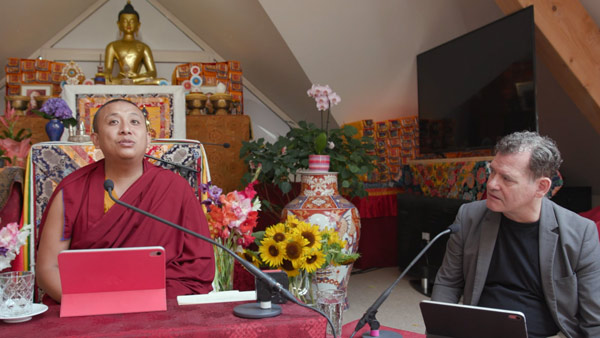
53:45
Oh, okay.
Apparently we have an online question.
Bibi: The first one is, so does this mean science is trapped? Are there areas in science that can cross this ontological boundary? Then we have, so is time and aspect also in viewing? Can we just do one? Yeah.
I think the first question to ask is whether science or scientists in general uh, would assert that things are intrinsically established or not.
If one has the attitude that things are intrinsically essentially established, then there doesn't seem to be really a way to do effective research.
But if one has an attitude that things are not intrinsically established, essentially established, then it's possible for research to improve more and more.
So if a scientist um, sort of engages in some kind of experimental work and has, has conclusions, if they don't hold that this is just the final, intrinsically established finding, but rather that some future scientists can continue this experimental work and, and find more results, subtler results, and so on, then science can advance.
And so the main thing, question is, so do, do they hold that things are intrinsically established or not?
I think they probably don't think that they're intrinsically essentially established in that way.
Because if they think that things are truly established, then there would be no way to advance research. You know, you'd find a result and that'd be it.
But in contrast then, you know, in the context of science, we always talk about scientific advancement, development.
Science is all into updates.
So, you know, there's the updating ourselves here. That's very important. From a... Scientists are about that. It... Progress.
Another question. And then we also have a question here. Bibi: My question is related to this. Oh, we have a... OK.
Student: I'm just wondering whether, similar to science, Buddhism is also uh, advancing or updating when we make new discoveries. Is it on? Student says: It should be. Like this?
Student says: So, I am wondering whether, similar to science, Buddhism is also continuously advancing or progressing when making new discoveries? Or is it more... I don't know.
Do you think it's good, would be better if there is an update or not? What do you think is better? Student says: I don't know. For me it's a conflict. Student: For me it's a conflict inside because I do think that when a tradition is so old Student: and uh, so well established, then uh, it definitely probably Student: is very valuable to keep to those traditions. Student: But my very um, yea, superficial impression of Buddhism so far is that Student: it is also a continuous search for understanding uh, of the world and of the mind. Student: So in my viewpoint I could see a space for updates and advancements in this as well.
Uh, so, one thing you could say is that the final nature of things can't be updated.
In reality is that the way... there's no updates to reality.
As I said before, this well-known statement, as I said yesterday, like, whether or not there are the Buddhas, the nature of things, the Dharmatā, is wha... is there regardless. Is what it is regardless.
Uh, so when we really are talking about what the nature of things are, we're you know coming to a single conclusion in that regard.
And it seems that, if we talk again about the ultimate nature of things, then uh, that's not something that should be variable. So it doesn't seem like we can do any updating.
We like what we wouldn't, we couldn't say that, for example, the previous Buddhas attained full awakening by virtue of their realization of the ultimate nature of things. But like, they sort of were somewhat incomplete in that, so that the later Buddhas got the updates, and they got you know, the better Buddhahood. That doesn't really work for us.
So you can certainly say that in terms of scientific research, yes, there is an idea of progress, you know. Earlier research has improved upon, but that doesn't really make sense in the context of Buddhahood, of attaining awakening.
And so we say the, that the essence of things, the Dharmatā, that isn't variable. That's invariable.
But even though, like when we talk about what the ultimate nature of things is, that's no variability there, there is an opportunity for updating in terms of the way people are engaging with that, in terms of the way it appears to them, in terms of their predilections, and so on.
And so one way to think about this is the tradition of what are called treasure texts, ter gyi chur or terma, and these occur at various times over history, and you can think of these as being updates in that sense, that they are sort of updating for what is needed at that particular time and place.
So you know, in those various uh, treasure teachings then, that occur, occur at various points historically, then the people at that time and in that place, uh, through engaging with that particular style of teaching, then are going to, based on their uh, uh, their motivation to realize the ultimate, they then make, they then advance on the path. But that's going to look a little different depending on which particular uh, time and place it is, which particular treasure text is involved. But in the end, of course, they're all driving toward the same realization of the ultimate. And in other words, their final meaning is the same.
You can say it's a little bit like, you know, we can have water in a glass, we can have it in a metal container, a wooden container, a brass container, we can have it in various containers, but the water is the same.
You can't really update water.
Uh, we're talking about not, you know, like super water or something. It's like pure water, no one's put anything in it. You can't update just plain pure water. 100% pure. Then I think better understand.
So that's how it is there. Thank you.
Student: So talking about ultimate truth and like full understanding, um, I once read that like Student: realizing ultimate truth means like there's no object of not knowing anymore. Student: So what, like what does it refer to? Like what can you know? Student: Like if you know everything, if there's everything to know. Student: Also these stories of um, Buddha's predicting the future kind of, Student: like when the iron bird flies, and when they talk about, yeah, at this Student: time there will be another reincarnation, and then this text will be needed. Student: Of course it's always hard to talk about this, but if you could explain a bit Student: how to imagine this ultimate knowledge, what was the name?
So here's a way to understand this. When we say we're um, we're understanding, coming to an understanding of the ultimate, what we're understanding is the nature of things. That's what, that's really initially what we're talking about.
So even with regard to all of these different various things that we may be examining, we're talking about them in terms of having this same nature.
So you could say that this single, the ultimate, this single nature that we say is characterizing all things, in that sense all things are included therein.
So we don't actually you know, need to make some kind of a distinction between like an exterior, the nature of exterior world, the nature of the uh, interior mind, or anything like that. We don't need to make those distinctions.
And so uh, in the context of the Perfection of Wisdom text, the, the Buddha spoke of the 18 forms of emptiness, and this is just a way of pointing out that however, what kind of conceptual distinctions you're making in terms of what's being examined, in the end you'll always arrive just at emptiness when you do the ultimate analysis.
Uh, so and therefore what we say is that when you, if one is able to realize, have a direct realization of this emptiness, the ultimate, then you have accomplished all virtue.
So when we talk about um, attaining what we say is omniscience, which occurs with Buddhahood, at that time it's not just having that sort of realization, but it means that you're constantly never separated from that realization, that that is constantly ongoing, the direct realization of the ultimate, direct awareness of the ultimate.
In other words, one is always in the state of what we call nyam par shak pa ཉམས་པར་བཤགས་པ་ or nyam shak, samāpatti, which means... uh, uh, o, um... What's a good translation of nyamshak? Yeah, equipoise, meditative equipoise. Absorption. I never know how to translate that word well. It, a typical translations are meditative equipoise, absorption, the meditative state, nyamshak ཉམས་བཤགས་.
So one way to talk about what this word means, samāpatti in Sanskrit or nyamshak ཉམས་བཤགས་ in Tibetan, is it doesn't mean you had to be in this meditative position it means that the mind is never displaced or fal, or um, falling into any particular conceptual mode.
It's completely free of any kind of distinctions about good and bad, about what needs to be done and what needs to be avoided. This con... This absorption or equipoise. And it's completely effortless.
So whether the bo... the whether the, the Buddha is going some, walking somewhere, whether he's lying down or eating whatever the awakened one, an awakened one is doing, their, the Buddhas are always in this nyamshak ཉམས་བཤགས་, in this equipoise.
And we say, of this we say that this is the awakened mind, the primordial non-conceptual wisdom or wakefulness.
But within this completely non-conceptual uh, awakened mind all uh, um, all normal things are available.
Eh uh, eh, all the... Everything of the three times, past, present and future, is clearly known.
The, so this kind of complete total omniscience really is, only applies to a fully awakened Buddha. Uh, the, you know, persons can attain what we refer to as uh, um, con... literally contaminated types of special awareness. Where uh, and this could apply to what we call abhijñār, or um, uh, a special awareness, special cognitive capacity, special capacities, conscious capacities. And they could be bodhisattvas, they could be arhats, they could be persons at various levels of the path. And they'll have, people will attain these various levels, but that's not that omniscience that we're talking about.
Bibi: Yes, there is um, there two more online, maybe even three.
Bibi: Okay, I have three questions online. Do you want to hear one after the other? Yeah, better one at a time. Bibi: Okay, so the first one is that it's clear that this way of reasoning helps us to have insight into ultimate reality. But other than that, does it also on a relative level help us to navigate the physical world, for example illnesses or yea, anything related to the physical world?
Yes, it's helpful.
When we have, you know, when we're ill or have other kinds of difficulties like that, mentally we often think, oh, this is real, this is, this, this is a real thing happening.
And so uh, that feeling of them not being truly established, of them not being ultimately real, that can sort of decrease in that context.
Or rather, excuse me, that, by thinking that way, then that can decrease that attitude.
In other words, by that attitude of things not being truly established and so on, then you kn... then one can know, feel that these, this suffering, this illness, these difficulties, they will change.
Uh, so if you have an attitude of things that is not changing at all, then when they actually change, that can feel very uncomfortable, that can cause you suffering.
When something that exists becomes non-existent, there's a kind of suffering that can happen there?
When what, what has gathered been gathered together, or meet, has met together, persons, things, when they fall apart, there's suffering.
When uh, when you've reached a certain height and then fall from there, there's suffering. When what's been accumulated is lost, there's suffering.
So when, when, so what's going on here is that when we think of what's existing as being really truly existent, and then it becomes non-existent. And to what, wh, what we've come, what we've met together with, who we've come together with, that that is truly existent, that relationship is truly existent, or that what we've accumulated, this accumulation, this wealth that's truly existent, or the level we've reached, the status we've reached is truly existent, then when it becomes, not when the existence becomes non-existent, that meeting together ends up in a parting, when the um, when that heights, when one falls from that height down to the depths, when one uh, loses what has been accumulated, then there's suffering because it was thought that, oh, that was truly real, but if the truly real shouldn't change, and when it changes, then one suffers.
So when things are in flux in this way, that kind of attitude makes it difficult to bear mentally. But if one has the attitude of recognizing that, recog, of recognizing change, then you don't have that kind of suffering.
So when one understands that what it means for things to be interdependently occurring, that means that they're not truly real, that they are in flux, that they change, and therefore, as a result of that, one's uh, of realizing that, then one's attachment and aversion are less, and one's suffering is therefore less.
Uh, but there's no benefit.
But there's not a lot of benefit in just, you know, when some kind of problem comes up, you just go, oh, it's empty. That doesn't really help.
But rather, when you've be, when have been studying, thinking about this, trying to understand this perspective for a while, like habituating yourself to this perspective, then uh, your tendency toward fixation and grasping is lessened. That's when it's going to help. If real difficulty comes, either need to run out, either need to eat medicine is a better idea. Then through, the result can come quickly, then we can think through this kind of understanding, then pain will be going to shrink and shrink.
And so when you're, you know, when you actually have a dif, difficulty, let's say maybe you do need to take medication or what have you, but the idea here is that if you have really accustomed yourself to this attitude of emptiness and lessened the grasping, then the suffering will be less.
So uh, you can actually find this in special instructions that Rinpoche himself has given, in some of the teachings that Rinpoche has given, in what we call tri yig. Uh, and there, the idea here is not that you just immediately, just by thinking of emptiness or something, that disease and so on is going to be less for one, that the suffering is going to be less. But rather that, through that process of training, so to speak, of uh, of really understanding an, an, and cultivating that notion of emptiness, then that will lessen one's attachments and fixation and lead to less suffering.
In other words, for us beginners, if we're beginners then that's not going to immediately happen.
But then, uh, the uh, like the previous great holy ones have, in contrast, those great holy ones, when they have this kind of even intense illness, because they have this kind of, they're quite filled with this kind of attitude, they're able to lessen their attachment and therefore not suffer as much.
Uh, for example, the 16th Karmapa, even though he was suffering greatly from intense cancer, he still remained, like in his face, he had a smiling face.
And for example, His Holiness the Dalai Lama, with every kind of issues that he faces, uh you know, physically, you always see him like smiling.
And he's you know, he hears all kinds of troubles and faces all kinds of difficulties, and yet he still can maintain this very positive attitude, appearance.
For example, Khyabje Tenga Rinpoche actually had to have both legs amputated. And yet, when you went to see him after that, he was smiling.
So, because these great lamas have, you know practiced so thoroughly, then they don't have that much attachment, they don't have that much fixation, and so they don't face the same kind of degree of difficulty and suffering and misery.
Uh, so when, uh, when, Khamtrul, Khamtrul Rinpoche Oh, Tulku Urgyen Rinpoche went to Germany to get an eye operation, they weren't able to give him anesthetic that would make him unconscious. And so they did the operation without anesthetic. Like, wow, that's kind of amazing.
So this is the kind of experiences that people can have, what, the way they experience these challenges when they have done a practice that is really a practice of non-fixation, non-grasping.
And this, we're not talking about you know, some ancient stories, we're actually talking about things that have happened quite recently, and there are plenty of people you can ask about who have seen these things.
Student: Um, you, earlier you said that if one attains Buddhahood, or the Buddha himself, Student: that he knew the past, present and the future at the same time. Student: And if one knows the future, for example, then it must be true. Student: So therefore by knowing the future, Student: he determines the future, therefore there is no free will in there. So everything that's happening will happen.
That's a free will.
Student: Can I add on something too? Maybe let's do that first. That's, I think, enough to start, if you don't mind.
He's not knowing the future as someone who's making it happen, the Buddha.
In other words, he's not doing that like a creator, but rather he's doing it from the perspective of someone who is understanding the results of sentient beings' karmic conditioning and kleśas.
And so he, the Buddha, of course, the direct, knows, sees that all sentient beings' nature is to have Buddha nature. And so from his perspective, there is pure appearance.
So he knows that all of us are going to become Buddhas in the future.
And therefore he has great respect for all sentient beings who are future Buddhas.
Uh, and so if you see all sentient beings as Buddhas in this sense, then you don't have these negative attitudes about them.
So it's just that when we talk about knowing the future, it's referring to knowing how, as a result, the kinds of things that occur as a result of sentient beings' karmic conditioning and negative mental states.
In brief, if you do something positive, you'll end up with positive results. And if you do something negative, you'll end up with negative results.
Uh, he doesn't think, though, that like...
It's not like, oh, if he does good things, then he will become good. If he does bad things, he'll become bad. But rather like, you know, when this certain good things happen, this positive results will happen. When bad things happen, bad things are done. Negative things are done. These negative results will occur.
No, it's not like a kind of... you know, It's not about knowing a fixed future.
In other words, if you follow this positive sort of path, then you're going to end up here. If you follow this negative path, you're going to end up here.
Yeah, so which path you end up on, that's up to you.
Is that good enough? Student: Yes, for the moment.
One of the things here is that when we think of there being a creator deity, like then there's this notion that everything is just fixed. The whole future is fixed. This is not what we say in Buddhist philosophy.
In other words, it's more like the Buddha is knowing the possible outcomes depending on what people choose to do, positive or negative.
So therefore it doesn't depend on you.
Normal logic, right? Common sense.
Student: Um, we talked about with you yesterday that there are like certain stuff that's real, Student: like particles in physics, but if you go down, down, down, then there are dharmas, exactly. Student: And then there are mental dharmas. Yes. Student: And um, since there are like... Student: As I understood, it's like a chain reaction. Right, but...
But that, remember, that's, that assumes the intrinsic existence of those things. So this is not that system. This system, this, that system can sound like, oh, there's like fixed causality. But we're going to talk today about the refu... So what Nāgārjuna does is say those kinds of things don't exist that way. Okay?
So there is a... for example, in India, ancient India, there is this tradition of rishis, ...kind of sages who gain capacities, for example, to know what people are dreaming. But the way they know that is not as that they actually enter into the dream of the person and experience the dream, sort of watch the person experiencing the dream. That's a kind of a metaphor for the way in which the Buddha is experiencing our futures. It's like experiencing our futures through our eyes, from the standpoint of our own confused experience. Not as something fixed in its nature, in other words.
And just to be clear that the person who is entering the dream is awake, but is able to kind of enter the dream and see the dream. So likewise, the Buddha sort of experiences the world, even now, our world through our own eyes, so to speak, from our own perspective. But it's not, which means it's from the perspective of our confusion. We think the world is ultimately real, but it's not. So the Buddha is not experiencing the world as ultimately real. It's not an ultimately real or fixed future that the Buddha is experiencing.
Yea, so we experience our lives as seeming... as real. We think, oh, this is just all real, really happening, it's all really happening and the Buddha doesn't experience it that way.
Okay, so maybe last question. Bibi: Yeah, there's one question that I've been trying to figure out how to ask it, Bibi: but I'll just read it out. Bibi: So is time and aspect also in viewing this? Is emptiness eternal, the opposite? Bibi: Is it the opposite of time and space? Eternity meaning timeless?
Yeah, that's right.
So in the sense that time itself, as well as existence and non-existence, these are all just mentally or conceptually imputed.
And if your... you can't posit time without it being posited from the standpoint of experience or the mind.
Uh, but the mind is, but rather, emptiness is in a sense beyond the confines of that dualistic mind.
And actually this is something that the different chapters of Nāgārjuna's main text um, on the Mādhyamika has different chapters. One chapter, for example, addresses time specifically, analysis of time.
And but this is actually, this is a good question because, you know, for example, there are definitely philosophical systems that posit uh, not only that there is time, but that things, in some sense, that existent things, are present in all three times. That a thing exists in the past, present and future.
And so what that means is that they see things as having like different conditions or states in these different temporal modes so that they have an intrinsically established state in the past, an intrinsically established state in the present, and an intrinsically established state in the future.
But the emptin... the perspective of emptiness will say that actually this perspective, the ultimate, that is to say emptiness, is completely beyond all that.
So when we're, when we're meditating on emptiness, we are doing emptiness meditation, it's not about meditating on the past, it's not meditating on the future. And since the present depends on, on the conceptual construction of the past and the future, it's also not about the present.
And so actually we need to understand what is said about this style of practice, or the emptiness practice, which is that it is not contaminated by the three times.
So in that kind of style of practice, the emptiness practice, if you're thinking, I'm going to be doing this in the future, well, you're not doing emptiness practice. Yea or if you think, oh, I did that in the past. Was that a good or a bad thing? And yet that's also not emptiness practice.
But if then, if one also right now is meditating but not fixating on the present, uh, in other words, one is meditating without fixation, free of fixation of attachment and aversion, then that is the meditation, the emptiness meditation.
Concerning these things, you need to listen again and again to Rinpoche's teachings.
If I say something, it's just going to be dry words.
But Rinpoche is speaking about these things, this style of practice from his own experience. And so there's really a special kind of meaning you can get out of them.
So this is the kind of thing where we were talking about guru yoga yesterday. This is yea, where guru yoga is really appropriate.
Uh, this is the basis for, you can say, the non-conceptual primordial wakefulness.
This is the mind of all the Buddhas, free of concepts.
Lhaso. Okay, now we need to stop.
So we spoke of the five types of great reasons in the Mādhyamika system. We talked about the ones that analyze, the reasoning analyzing the... the cause, the diamond sliver is the reasoning analyzing effect, whether existent or non, pre-existent or pre-non-existent effects. And also we spoke about the uh... the great reason of interdependence. Uh and uh, the professor has spoken a little bit to you about the analysis through neither one nor many, and he will continue to do that as well.
And tomorrow Khenpo, I just said Khenpo, I said he should say that he's leaving. Khenpo la is leaving tomorrow to go with Rinpoche to England.
So really, in terms of really understanding kind of the pith of the Mādhyamika system, of what Mādhyamika is really about, it's that whatever is appearing is what, in other words, something that's appearing that's happening interdependently, that is necessarily not established intrinsically. In other words, it's empty. It's empty of any kind of intrinsic establishment. And being empty of intrinsic establishment, that means everything is possible. Transformation is possible. And it also means that if something is empty of intrinsic establishment, that it's not fixed in some kind of essential nature, it is therefore, what is occurring is interdependent. Thank you. Bibi: Thank you so much, dearest Khenpo Pema Namgyal, Bibi: for teaching us here again at Gomde Germany - Austria. Bibi: We hope that you will continue to teach here countless times. Bibi: You will come again and again at least five times a year, six times, seven times a year. Bibi: And we just love having you and love having your insight, and your... Bibi: Um, it's just deeply impressive at such a young age, how you can really know Bibi: all the philosophies so well that you can answer every question that comes your way. Bibi: Um, it's just wonderful to have such a teacher with us. Thank you. Thank you. Thank you. Without Professor John Dunne I am mute, I cannot speak all of those things. So thankful for him very much because then he make more easy in English terminology because I don't know this terminology. Then it's also not so easy to translate this terminology. So thank you for him. And thank you for all of you listening very carefully. Then I also become more interested and more put attention. How can explanation, yeah? If listener is not interested, then I just want to finish the timing, yeah? Listening also very carefully, very question and answer. Then I also need to put more attention. How can I clarify easy way to understand? Okay, thank you. So now we go to dedication, page number nine. Dedication and page nine of the text, if you have it.
sönam diyi thamché sikpa nyi thopné nyepai dranam phamjé né kyega nachi balap trukpa yi sipai tsolé drowa drölwar shok jangchup semchok rinpoché ma kyepa nam kyé gyurchik kyepa nyampa mepa yang gongné gongdu phelwar shok
Bibi: The first one is, so does this mean science is trapped? Are there areas in science that can cross this ontological boundary? Then we have, so is time and aspect also in viewing? Can we just do one? Yeah.
I think the first question to ask is whether science or scientists in general uh, would assert that things are intrinsically established or not.
If one has the attitude that things are intrinsically essentially established, then there doesn't seem to be really a way to do effective research.
But if one has an attitude that things are not intrinsically established, essentially established, then it's possible for research to improve more and more.
So if a scientist um, sort of engages in some kind of experimental work and has, has conclusions, if they don't hold that this is just the final, intrinsically established finding, but rather that some future scientists can continue this experimental work and, and find more results, subtler results, and so on, then science can advance.
And so the main thing, question is, so do, do they hold that things are intrinsically established or not?
I think they probably don't think that they're intrinsically essentially established in that way.
Because if they think that things are truly established, then there would be no way to advance research. You know, you'd find a result and that'd be it.
But in contrast then, you know, in the context of science, we always talk about scientific advancement, development.
Science is all into updates.
So, you know, there's the updating ourselves here. That's very important. From a... Scientists are about that. It... Progress.
Another question. And then we also have a question here. Bibi: My question is related to this. Oh, we have a... OK.
Student: I'm just wondering whether, similar to science, Buddhism is also uh, advancing or updating when we make new discoveries. Is it on? Student says: It should be. Like this?
Student says: So, I am wondering whether, similar to science, Buddhism is also continuously advancing or progressing when making new discoveries? Or is it more... I don't know.
Do you think it's good, would be better if there is an update or not? What do you think is better? Student says: I don't know. For me it's a conflict. Student: For me it's a conflict inside because I do think that when a tradition is so old Student: and uh, so well established, then uh, it definitely probably Student: is very valuable to keep to those traditions. Student: But my very um, yea, superficial impression of Buddhism so far is that Student: it is also a continuous search for understanding uh, of the world and of the mind. Student: So in my viewpoint I could see a space for updates and advancements in this as well.
Uh, so, one thing you could say is that the final nature of things can't be updated.
In reality is that the way... there's no updates to reality.
As I said before, this well-known statement, as I said yesterday, like, whether or not there are the Buddhas, the nature of things, the Dharmatā, is wha... is there regardless. Is what it is regardless.
Uh, so when we really are talking about what the nature of things are, we're you know coming to a single conclusion in that regard.
And it seems that, if we talk again about the ultimate nature of things, then uh, that's not something that should be variable. So it doesn't seem like we can do any updating.
We like what we wouldn't, we couldn't say that, for example, the previous Buddhas attained full awakening by virtue of their realization of the ultimate nature of things. But like, they sort of were somewhat incomplete in that, so that the later Buddhas got the updates, and they got you know, the better Buddhahood. That doesn't really work for us.
So you can certainly say that in terms of scientific research, yes, there is an idea of progress, you know. Earlier research has improved upon, but that doesn't really make sense in the context of Buddhahood, of attaining awakening.
And so we say the, that the essence of things, the Dharmatā, that isn't variable. That's invariable.
But even though, like when we talk about what the ultimate nature of things is, that's no variability there, there is an opportunity for updating in terms of the way people are engaging with that, in terms of the way it appears to them, in terms of their predilections, and so on.
And so one way to think about this is the tradition of what are called treasure texts, ter gyi chur or terma, and these occur at various times over history, and you can think of these as being updates in that sense, that they are sort of updating for what is needed at that particular time and place.
So you know, in those various uh, treasure teachings then, that occur, occur at various points historically, then the people at that time and in that place, uh, through engaging with that particular style of teaching, then are going to, based on their uh, uh, their motivation to realize the ultimate, they then make, they then advance on the path. But that's going to look a little different depending on which particular uh, time and place it is, which particular treasure text is involved. But in the end, of course, they're all driving toward the same realization of the ultimate. And in other words, their final meaning is the same.
You can say it's a little bit like, you know, we can have water in a glass, we can have it in a metal container, a wooden container, a brass container, we can have it in various containers, but the water is the same.
You can't really update water.
Uh, we're talking about not, you know, like super water or something. It's like pure water, no one's put anything in it. You can't update just plain pure water. 100% pure. Then I think better understand.
So that's how it is there. Thank you.
Student: So talking about ultimate truth and like full understanding, um, I once read that like Student: realizing ultimate truth means like there's no object of not knowing anymore. Student: So what, like what does it refer to? Like what can you know? Student: Like if you know everything, if there's everything to know. Student: Also these stories of um, Buddha's predicting the future kind of, Student: like when the iron bird flies, and when they talk about, yeah, at this Student: time there will be another reincarnation, and then this text will be needed. Student: Of course it's always hard to talk about this, but if you could explain a bit Student: how to imagine this ultimate knowledge, what was the name?
So here's a way to understand this. When we say we're um, we're understanding, coming to an understanding of the ultimate, what we're understanding is the nature of things. That's what, that's really initially what we're talking about.
So even with regard to all of these different various things that we may be examining, we're talking about them in terms of having this same nature.
So you could say that this single, the ultimate, this single nature that we say is characterizing all things, in that sense all things are included therein.
So we don't actually you know, need to make some kind of a distinction between like an exterior, the nature of exterior world, the nature of the uh, interior mind, or anything like that. We don't need to make those distinctions.
And so uh, in the context of the Perfection of Wisdom text, the, the Buddha spoke of the 18 forms of emptiness, and this is just a way of pointing out that however, what kind of conceptual distinctions you're making in terms of what's being examined, in the end you'll always arrive just at emptiness when you do the ultimate analysis.
Uh, so and therefore what we say is that when you, if one is able to realize, have a direct realization of this emptiness, the ultimate, then you have accomplished all virtue.
So when we talk about um, attaining what we say is omniscience, which occurs with Buddhahood, at that time it's not just having that sort of realization, but it means that you're constantly never separated from that realization, that that is constantly ongoing, the direct realization of the ultimate, direct awareness of the ultimate.
In other words, one is always in the state of what we call nyam par shak pa ཉམས་པར་བཤགས་པ་ or nyam shak, samāpatti, which means... uh, uh, o, um... What's a good translation of nyamshak? Yeah, equipoise, meditative equipoise. Absorption. I never know how to translate that word well. It, a typical translations are meditative equipoise, absorption, the meditative state, nyamshak ཉམས་བཤགས་.
So one way to talk about what this word means, samāpatti in Sanskrit or nyamshak ཉམས་བཤགས་ in Tibetan, is it doesn't mean you had to be in this meditative position it means that the mind is never displaced or fal, or um, falling into any particular conceptual mode.
It's completely free of any kind of distinctions about good and bad, about what needs to be done and what needs to be avoided. This con... This absorption or equipoise. And it's completely effortless.
So whether the bo... the whether the, the Buddha is going some, walking somewhere, whether he's lying down or eating whatever the awakened one, an awakened one is doing, their, the Buddhas are always in this nyamshak ཉམས་བཤགས་, in this equipoise.
And we say, of this we say that this is the awakened mind, the primordial non-conceptual wisdom or wakefulness.
But within this completely non-conceptual uh, awakened mind all uh, um, all normal things are available.
Eh uh, eh, all the... Everything of the three times, past, present and future, is clearly known.
The, so this kind of complete total omniscience really is, only applies to a fully awakened Buddha. Uh, the, you know, persons can attain what we refer to as uh, um, con... literally contaminated types of special awareness. Where uh, and this could apply to what we call abhijñār, or um, uh, a special awareness, special cognitive capacity, special capacities, conscious capacities. And they could be bodhisattvas, they could be arhats, they could be persons at various levels of the path. And they'll have, people will attain these various levels, but that's not that omniscience that we're talking about.
Bibi: Yes, there is um, there two more online, maybe even three.
Bibi: Okay, I have three questions online. Do you want to hear one after the other? Yeah, better one at a time. Bibi: Okay, so the first one is that it's clear that this way of reasoning helps us to have insight into ultimate reality. But other than that, does it also on a relative level help us to navigate the physical world, for example illnesses or yea, anything related to the physical world?
Yes, it's helpful.
When we have, you know, when we're ill or have other kinds of difficulties like that, mentally we often think, oh, this is real, this is, this, this is a real thing happening.
And so uh, that feeling of them not being truly established, of them not being ultimately real, that can sort of decrease in that context.
Or rather, excuse me, that, by thinking that way, then that can decrease that attitude.
In other words, by that attitude of things not being truly established and so on, then you kn... then one can know, feel that these, this suffering, this illness, these difficulties, they will change.
Uh, so if you have an attitude of things that is not changing at all, then when they actually change, that can feel very uncomfortable, that can cause you suffering.
When something that exists becomes non-existent, there's a kind of suffering that can happen there?
When what, what has gathered been gathered together, or meet, has met together, persons, things, when they fall apart, there's suffering.
When uh, when you've reached a certain height and then fall from there, there's suffering. When what's been accumulated is lost, there's suffering.
So when, when, so what's going on here is that when we think of what's existing as being really truly existent, and then it becomes non-existent. And to what, wh, what we've come, what we've met together with, who we've come together with, that that is truly existent, that relationship is truly existent, or that what we've accumulated, this accumulation, this wealth that's truly existent, or the level we've reached, the status we've reached is truly existent, then when it becomes, not when the existence becomes non-existent, that meeting together ends up in a parting, when the um, when that heights, when one falls from that height down to the depths, when one uh, loses what has been accumulated, then there's suffering because it was thought that, oh, that was truly real, but if the truly real shouldn't change, and when it changes, then one suffers.
So when things are in flux in this way, that kind of attitude makes it difficult to bear mentally. But if one has the attitude of recognizing that, recog, of recognizing change, then you don't have that kind of suffering.
So when one understands that what it means for things to be interdependently occurring, that means that they're not truly real, that they are in flux, that they change, and therefore, as a result of that, one's uh, of realizing that, then one's attachment and aversion are less, and one's suffering is therefore less.
Uh, but there's no benefit.
But there's not a lot of benefit in just, you know, when some kind of problem comes up, you just go, oh, it's empty. That doesn't really help.
But rather, when you've be, when have been studying, thinking about this, trying to understand this perspective for a while, like habituating yourself to this perspective, then uh, your tendency toward fixation and grasping is lessened. That's when it's going to help. If real difficulty comes, either need to run out, either need to eat medicine is a better idea. Then through, the result can come quickly, then we can think through this kind of understanding, then pain will be going to shrink and shrink.
And so when you're, you know, when you actually have a dif, difficulty, let's say maybe you do need to take medication or what have you, but the idea here is that if you have really accustomed yourself to this attitude of emptiness and lessened the grasping, then the suffering will be less.
So uh, you can actually find this in special instructions that Rinpoche himself has given, in some of the teachings that Rinpoche has given, in what we call tri yig. Uh, and there, the idea here is not that you just immediately, just by thinking of emptiness or something, that disease and so on is going to be less for one, that the suffering is going to be less. But rather that, through that process of training, so to speak, of uh, of really understanding an, an, and cultivating that notion of emptiness, then that will lessen one's attachments and fixation and lead to less suffering.
In other words, for us beginners, if we're beginners then that's not going to immediately happen.
But then, uh, the uh, like the previous great holy ones have, in contrast, those great holy ones, when they have this kind of even intense illness, because they have this kind of, they're quite filled with this kind of attitude, they're able to lessen their attachment and therefore not suffer as much.
Uh, for example, the 16th Karmapa, even though he was suffering greatly from intense cancer, he still remained, like in his face, he had a smiling face.
And for example, His Holiness the Dalai Lama, with every kind of issues that he faces, uh you know, physically, you always see him like smiling.
And he's you know, he hears all kinds of troubles and faces all kinds of difficulties, and yet he still can maintain this very positive attitude, appearance.
For example, Khyabje Tenga Rinpoche actually had to have both legs amputated. And yet, when you went to see him after that, he was smiling.
So, because these great lamas have, you know practiced so thoroughly, then they don't have that much attachment, they don't have that much fixation, and so they don't face the same kind of degree of difficulty and suffering and misery.
Uh, so when, uh, when, Khamtrul, Khamtrul Rinpoche Oh, Tulku Urgyen Rinpoche went to Germany to get an eye operation, they weren't able to give him anesthetic that would make him unconscious. And so they did the operation without anesthetic. Like, wow, that's kind of amazing.
So this is the kind of experiences that people can have, what, the way they experience these challenges when they have done a practice that is really a practice of non-fixation, non-grasping.
And this, we're not talking about you know, some ancient stories, we're actually talking about things that have happened quite recently, and there are plenty of people you can ask about who have seen these things.
Student: Um, you, earlier you said that if one attains Buddhahood, or the Buddha himself, Student: that he knew the past, present and the future at the same time. Student: And if one knows the future, for example, then it must be true. Student: So therefore by knowing the future, Student: he determines the future, therefore there is no free will in there. So everything that's happening will happen.
That's a free will.
Student: Can I add on something too? Maybe let's do that first. That's, I think, enough to start, if you don't mind.
He's not knowing the future as someone who's making it happen, the Buddha.
In other words, he's not doing that like a creator, but rather he's doing it from the perspective of someone who is understanding the results of sentient beings' karmic conditioning and kleśas.
And so he, the Buddha, of course, the direct, knows, sees that all sentient beings' nature is to have Buddha nature. And so from his perspective, there is pure appearance.
So he knows that all of us are going to become Buddhas in the future.
And therefore he has great respect for all sentient beings who are future Buddhas.
Uh, and so if you see all sentient beings as Buddhas in this sense, then you don't have these negative attitudes about them.
So it's just that when we talk about knowing the future, it's referring to knowing how, as a result, the kinds of things that occur as a result of sentient beings' karmic conditioning and negative mental states.
In brief, if you do something positive, you'll end up with positive results. And if you do something negative, you'll end up with negative results.
Uh, he doesn't think, though, that like...
It's not like, oh, if he does good things, then he will become good. If he does bad things, he'll become bad. But rather like, you know, when this certain good things happen, this positive results will happen. When bad things happen, bad things are done. Negative things are done. These negative results will occur.
No, it's not like a kind of... you know, It's not about knowing a fixed future.
In other words, if you follow this positive sort of path, then you're going to end up here. If you follow this negative path, you're going to end up here.
Yeah, so which path you end up on, that's up to you.
Is that good enough? Student: Yes, for the moment.
One of the things here is that when we think of there being a creator deity, like then there's this notion that everything is just fixed. The whole future is fixed. This is not what we say in Buddhist philosophy.
In other words, it's more like the Buddha is knowing the possible outcomes depending on what people choose to do, positive or negative.
So therefore it doesn't depend on you.
Normal logic, right? Common sense.
Student: Um, we talked about with you yesterday that there are like certain stuff that's real, Student: like particles in physics, but if you go down, down, down, then there are dharmas, exactly. Student: And then there are mental dharmas. Yes. Student: And um, since there are like... Student: As I understood, it's like a chain reaction. Right, but...
But that, remember, that's, that assumes the intrinsic existence of those things. So this is not that system. This system, this, that system can sound like, oh, there's like fixed causality. But we're going to talk today about the refu... So what Nāgārjuna does is say those kinds of things don't exist that way. Okay?
So there is a... for example, in India, ancient India, there is this tradition of rishis, ...kind of sages who gain capacities, for example, to know what people are dreaming. But the way they know that is not as that they actually enter into the dream of the person and experience the dream, sort of watch the person experiencing the dream. That's a kind of a metaphor for the way in which the Buddha is experiencing our futures. It's like experiencing our futures through our eyes, from the standpoint of our own confused experience. Not as something fixed in its nature, in other words.
And just to be clear that the person who is entering the dream is awake, but is able to kind of enter the dream and see the dream. So likewise, the Buddha sort of experiences the world, even now, our world through our own eyes, so to speak, from our own perspective. But it's not, which means it's from the perspective of our confusion. We think the world is ultimately real, but it's not. So the Buddha is not experiencing the world as ultimately real. It's not an ultimately real or fixed future that the Buddha is experiencing.
Yea, so we experience our lives as seeming... as real. We think, oh, this is just all real, really happening, it's all really happening and the Buddha doesn't experience it that way.
Okay, so maybe last question. Bibi: Yeah, there's one question that I've been trying to figure out how to ask it, Bibi: but I'll just read it out. Bibi: So is time and aspect also in viewing this? Is emptiness eternal, the opposite? Bibi: Is it the opposite of time and space? Eternity meaning timeless?
Yeah, that's right.
So in the sense that time itself, as well as existence and non-existence, these are all just mentally or conceptually imputed.
And if your... you can't posit time without it being posited from the standpoint of experience or the mind.
Uh, but the mind is, but rather, emptiness is in a sense beyond the confines of that dualistic mind.
And actually this is something that the different chapters of Nāgārjuna's main text um, on the Mādhyamika has different chapters. One chapter, for example, addresses time specifically, analysis of time.
And but this is actually, this is a good question because, you know, for example, there are definitely philosophical systems that posit uh, not only that there is time, but that things, in some sense, that existent things, are present in all three times. That a thing exists in the past, present and future.
And so what that means is that they see things as having like different conditions or states in these different temporal modes so that they have an intrinsically established state in the past, an intrinsically established state in the present, and an intrinsically established state in the future.
But the emptin... the perspective of emptiness will say that actually this perspective, the ultimate, that is to say emptiness, is completely beyond all that.
So when we're, when we're meditating on emptiness, we are doing emptiness meditation, it's not about meditating on the past, it's not meditating on the future. And since the present depends on, on the conceptual construction of the past and the future, it's also not about the present.
And so actually we need to understand what is said about this style of practice, or the emptiness practice, which is that it is not contaminated by the three times.
So in that kind of style of practice, the emptiness practice, if you're thinking, I'm going to be doing this in the future, well, you're not doing emptiness practice. Yea or if you think, oh, I did that in the past. Was that a good or a bad thing? And yet that's also not emptiness practice.
But if then, if one also right now is meditating but not fixating on the present, uh, in other words, one is meditating without fixation, free of fixation of attachment and aversion, then that is the meditation, the emptiness meditation.
Concerning these things, you need to listen again and again to Rinpoche's teachings.
If I say something, it's just going to be dry words.
But Rinpoche is speaking about these things, this style of practice from his own experience. And so there's really a special kind of meaning you can get out of them.
So this is the kind of thing where we were talking about guru yoga yesterday. This is yea, where guru yoga is really appropriate.
Uh, this is the basis for, you can say, the non-conceptual primordial wakefulness.
This is the mind of all the Buddhas, free of concepts.
Lhaso. Okay, now we need to stop.
So we spoke of the five types of great reasons in the Mādhyamika system. We talked about the ones that analyze, the reasoning analyzing the... the cause, the diamond sliver is the reasoning analyzing effect, whether existent or non, pre-existent or pre-non-existent effects. And also we spoke about the uh... the great reason of interdependence. Uh and uh, the professor has spoken a little bit to you about the analysis through neither one nor many, and he will continue to do that as well.
And tomorrow Khenpo, I just said Khenpo, I said he should say that he's leaving. Khenpo la is leaving tomorrow to go with Rinpoche to England.
So really, in terms of really understanding kind of the pith of the Mādhyamika system, of what Mādhyamika is really about, it's that whatever is appearing is what, in other words, something that's appearing that's happening interdependently, that is necessarily not established intrinsically. In other words, it's empty. It's empty of any kind of intrinsic establishment. And being empty of intrinsic establishment, that means everything is possible. Transformation is possible. And it also means that if something is empty of intrinsic establishment, that it's not fixed in some kind of essential nature, it is therefore, what is occurring is interdependent. Thank you. Bibi: Thank you so much, dearest Khenpo Pema Namgyal, Bibi: for teaching us here again at Gomde Germany - Austria. Bibi: We hope that you will continue to teach here countless times. Bibi: You will come again and again at least five times a year, six times, seven times a year. Bibi: And we just love having you and love having your insight, and your... Bibi: Um, it's just deeply impressive at such a young age, how you can really know Bibi: all the philosophies so well that you can answer every question that comes your way. Bibi: Um, it's just wonderful to have such a teacher with us. Thank you. Thank you. Thank you. Without Professor John Dunne I am mute, I cannot speak all of those things. So thankful for him very much because then he make more easy in English terminology because I don't know this terminology. Then it's also not so easy to translate this terminology. So thank you for him. And thank you for all of you listening very carefully. Then I also become more interested and more put attention. How can explanation, yeah? If listener is not interested, then I just want to finish the timing, yeah? Listening also very carefully, very question and answer. Then I also need to put more attention. How can I clarify easy way to understand? Okay, thank you. So now we go to dedication, page number nine. Dedication and page nine of the text, if you have it.
sönam diyi thamché sikpa nyi thopné nyepai dranam phamjé né kyega nachi balap trukpa yi sipai tsolé drowa drölwar shok jangchup semchok rinpoché ma kyepa nam kyé gyurchik kyepa nyampa mepa yang gongné gongdu phelwar shok
Oh, okay.
Apparently we have an online question.
Bibi: The first one is, so does this mean science is trapped? Are there areas in science that can cross this ontological boundary? Then we have, so is time and aspect also in viewing? Can we just do one? Yeah.
I think the first question to ask is whether science or scientists in general uh, would assert that things are intrinsically established or not.
If one has the attitude that things are intrinsically essentially established, then there doesn't seem to be really a way to do effective research.
But if one has an attitude that things are not intrinsically established, essentially established, then it's possible for research to improve more and more.
So if a scientist um, sort of engages in some kind of experimental work and has, has conclusions, if they don't hold that this is just the final, intrinsically established finding, but rather that some future scientists can continue this experimental work and, and find more results, subtler results, and so on, then science can advance.
And so the main thing, question is, so do, do they hold that things are intrinsically established or not?
I think they probably don't think that they're intrinsically essentially established in that way.
Because if they think that things are truly established, then there would be no way to advance research. You know, you'd find a result and that'd be it.
But in contrast then, you know, in the context of science, we always talk about scientific advancement, development.
Science is all into updates.
So, you know, there's the updating ourselves here. That's very important. From a... Scientists are about that. It... Progress.
Another question. And then we also have a question here. Bibi: My question is related to this. Oh, we have a... OK.
Student: I'm just wondering whether, similar to science, Buddhism is also uh, advancing or updating when we make new discoveries. Is it on? Student says: It should be. Like this?
Student says: So, I am wondering whether, similar to science, Buddhism is also continuously advancing or progressing when making new discoveries? Or is it more... I don't know.
Do you think it's good, would be better if there is an update or not? What do you think is better? Student says: I don't know. For me it's a conflict. Student: For me it's a conflict inside because I do think that when a tradition is so old Student: and uh, so well established, then uh, it definitely probably Student: is very valuable to keep to those traditions. Student: But my very um, yea, superficial impression of Buddhism so far is that Student: it is also a continuous search for understanding uh, of the world and of the mind. Student: So in my viewpoint I could see a space for updates and advancements in this as well.
Uh, so, one thing you could say is that the final nature of things can't be updated.
In reality is that the way... there's no updates to reality.
As I said before, this well-known statement, as I said yesterday, like, whether or not there are the Buddhas, the nature of things, the Dharmatā, is wha... is there regardless. Is what it is regardless.
Uh, so when we really are talking about what the nature of things are, we're you know coming to a single conclusion in that regard.
And it seems that, if we talk again about the ultimate nature of things, then uh, that's not something that should be variable. So it doesn't seem like we can do any updating.
We like what we wouldn't, we couldn't say that, for example, the previous Buddhas attained full awakening by virtue of their realization of the ultimate nature of things. But like, they sort of were somewhat incomplete in that, so that the later Buddhas got the updates, and they got you know, the better Buddhahood. That doesn't really work for us.
So you can certainly say that in terms of scientific research, yes, there is an idea of progress, you know. Earlier research has improved upon, but that doesn't really make sense in the context of Buddhahood, of attaining awakening.
And so we say the, that the essence of things, the Dharmatā, that isn't variable. That's invariable.
But even though, like when we talk about what the ultimate nature of things is, that's no variability there, there is an opportunity for updating in terms of the way people are engaging with that, in terms of the way it appears to them, in terms of their predilections, and so on.
And so one way to think about this is the tradition of what are called treasure texts, ter gyi chur or terma, and these occur at various times over history, and you can think of these as being updates in that sense, that they are sort of updating for what is needed at that particular time and place.
So you know, in those various uh, treasure teachings then, that occur, occur at various points historically, then the people at that time and in that place, uh, through engaging with that particular style of teaching, then are going to, based on their uh, uh, their motivation to realize the ultimate, they then make, they then advance on the path. But that's going to look a little different depending on which particular uh, time and place it is, which particular treasure text is involved. But in the end, of course, they're all driving toward the same realization of the ultimate. And in other words, their final meaning is the same.
You can say it's a little bit like, you know, we can have water in a glass, we can have it in a metal container, a wooden container, a brass container, we can have it in various containers, but the water is the same.
You can't really update water.
Uh, we're talking about not, you know, like super water or something. It's like pure water, no one's put anything in it. You can't update just plain pure water. 100% pure. Then I think better understand.
So that's how it is there. Thank you.
Student: So talking about ultimate truth and like full understanding, um, I once read that like Student: realizing ultimate truth means like there's no object of not knowing anymore. Student: So what, like what does it refer to? Like what can you know? Student: Like if you know everything, if there's everything to know. Student: Also these stories of um, Buddha's predicting the future kind of, Student: like when the iron bird flies, and when they talk about, yeah, at this Student: time there will be another reincarnation, and then this text will be needed. Student: Of course it's always hard to talk about this, but if you could explain a bit Student: how to imagine this ultimate knowledge, what was the name?
So here's a way to understand this. When we say we're um, we're understanding, coming to an understanding of the ultimate, what we're understanding is the nature of things. That's what, that's really initially what we're talking about.
So even with regard to all of these different various things that we may be examining, we're talking about them in terms of having this same nature.
So you could say that this single, the ultimate, this single nature that we say is characterizing all things, in that sense all things are included therein.
So we don't actually you know, need to make some kind of a distinction between like an exterior, the nature of exterior world, the nature of the uh, interior mind, or anything like that. We don't need to make those distinctions.
And so uh, in the context of the Perfection of Wisdom text, the, the Buddha spoke of the 18 forms of emptiness, and this is just a way of pointing out that however, what kind of conceptual distinctions you're making in terms of what's being examined, in the end you'll always arrive just at emptiness when you do the ultimate analysis.
Uh, so and therefore what we say is that when you, if one is able to realize, have a direct realization of this emptiness, the ultimate, then you have accomplished all virtue.
So when we talk about um, attaining what we say is omniscience, which occurs with Buddhahood, at that time it's not just having that sort of realization, but it means that you're constantly never separated from that realization, that that is constantly ongoing, the direct realization of the ultimate, direct awareness of the ultimate.
In other words, one is always in the state of what we call nyam par shak pa ཉམས་པར་བཤགས་པ་ or nyam shak, samāpatti, which means... uh, uh, o, um... What's a good translation of nyamshak? Yeah, equipoise, meditative equipoise. Absorption. I never know how to translate that word well. It, a typical translations are meditative equipoise, absorption, the meditative state, nyamshak ཉམས་བཤགས་.
So one way to talk about what this word means, samāpatti in Sanskrit or nyamshak ཉམས་བཤགས་ in Tibetan, is it doesn't mean you had to be in this meditative position it means that the mind is never displaced or fal, or um, falling into any particular conceptual mode.
It's completely free of any kind of distinctions about good and bad, about what needs to be done and what needs to be avoided. This con... This absorption or equipoise. And it's completely effortless.
So whether the bo... the whether the, the Buddha is going some, walking somewhere, whether he's lying down or eating whatever the awakened one, an awakened one is doing, their, the Buddhas are always in this nyamshak ཉམས་བཤགས་, in this equipoise.
And we say, of this we say that this is the awakened mind, the primordial non-conceptual wisdom or wakefulness.
But within this completely non-conceptual uh, awakened mind all uh, um, all normal things are available.
Eh uh, eh, all the... Everything of the three times, past, present and future, is clearly known.
The, so this kind of complete total omniscience really is, only applies to a fully awakened Buddha. Uh, the, you know, persons can attain what we refer to as uh, um, con... literally contaminated types of special awareness. Where uh, and this could apply to what we call abhijñār, or um, uh, a special awareness, special cognitive capacity, special capacities, conscious capacities. And they could be bodhisattvas, they could be arhats, they could be persons at various levels of the path. And they'll have, people will attain these various levels, but that's not that omniscience that we're talking about.
Bibi: Yes, there is um, there two more online, maybe even three.
Bibi: Okay, I have three questions online. Do you want to hear one after the other? Yeah, better one at a time. Bibi: Okay, so the first one is that it's clear that this way of reasoning helps us to have insight into ultimate reality. But other than that, does it also on a relative level help us to navigate the physical world, for example illnesses or yea, anything related to the physical world?
Yes, it's helpful.
When we have, you know, when we're ill or have other kinds of difficulties like that, mentally we often think, oh, this is real, this is, this, this is a real thing happening.
And so uh, that feeling of them not being truly established, of them not being ultimately real, that can sort of decrease in that context.
Or rather, excuse me, that, by thinking that way, then that can decrease that attitude.
In other words, by that attitude of things not being truly established and so on, then you kn... then one can know, feel that these, this suffering, this illness, these difficulties, they will change.
Uh, so if you have an attitude of things that is not changing at all, then when they actually change, that can feel very uncomfortable, that can cause you suffering.
When something that exists becomes non-existent, there's a kind of suffering that can happen there?
When what, what has gathered been gathered together, or meet, has met together, persons, things, when they fall apart, there's suffering.
When uh, when you've reached a certain height and then fall from there, there's suffering. When what's been accumulated is lost, there's suffering.
So when, when, so what's going on here is that when we think of what's existing as being really truly existent, and then it becomes non-existent. And to what, wh, what we've come, what we've met together with, who we've come together with, that that is truly existent, that relationship is truly existent, or that what we've accumulated, this accumulation, this wealth that's truly existent, or the level we've reached, the status we've reached is truly existent, then when it becomes, not when the existence becomes non-existent, that meeting together ends up in a parting, when the um, when that heights, when one falls from that height down to the depths, when one uh, loses what has been accumulated, then there's suffering because it was thought that, oh, that was truly real, but if the truly real shouldn't change, and when it changes, then one suffers.
So when things are in flux in this way, that kind of attitude makes it difficult to bear mentally. But if one has the attitude of recognizing that, recog, of recognizing change, then you don't have that kind of suffering.
So when one understands that what it means for things to be interdependently occurring, that means that they're not truly real, that they are in flux, that they change, and therefore, as a result of that, one's uh, of realizing that, then one's attachment and aversion are less, and one's suffering is therefore less.
Uh, but there's no benefit.
But there's not a lot of benefit in just, you know, when some kind of problem comes up, you just go, oh, it's empty. That doesn't really help.
But rather, when you've be, when have been studying, thinking about this, trying to understand this perspective for a while, like habituating yourself to this perspective, then uh, your tendency toward fixation and grasping is lessened. That's when it's going to help. If real difficulty comes, either need to run out, either need to eat medicine is a better idea. Then through, the result can come quickly, then we can think through this kind of understanding, then pain will be going to shrink and shrink.
And so when you're, you know, when you actually have a dif, difficulty, let's say maybe you do need to take medication or what have you, but the idea here is that if you have really accustomed yourself to this attitude of emptiness and lessened the grasping, then the suffering will be less.
So uh, you can actually find this in special instructions that Rinpoche himself has given, in some of the teachings that Rinpoche has given, in what we call tri yig. Uh, and there, the idea here is not that you just immediately, just by thinking of emptiness or something, that disease and so on is going to be less for one, that the suffering is going to be less. But rather that, through that process of training, so to speak, of uh, of really understanding an, an, and cultivating that notion of emptiness, then that will lessen one's attachments and fixation and lead to less suffering.
In other words, for us beginners, if we're beginners then that's not going to immediately happen.
But then, uh, the uh, like the previous great holy ones have, in contrast, those great holy ones, when they have this kind of even intense illness, because they have this kind of, they're quite filled with this kind of attitude, they're able to lessen their attachment and therefore not suffer as much.
Uh, for example, the 16th Karmapa, even though he was suffering greatly from intense cancer, he still remained, like in his face, he had a smiling face.
And for example, His Holiness the Dalai Lama, with every kind of issues that he faces, uh you know, physically, you always see him like smiling.
And he's you know, he hears all kinds of troubles and faces all kinds of difficulties, and yet he still can maintain this very positive attitude, appearance.
For example, Khyabje Tenga Rinpoche actually had to have both legs amputated. And yet, when you went to see him after that, he was smiling.
So, because these great lamas have, you know practiced so thoroughly, then they don't have that much attachment, they don't have that much fixation, and so they don't face the same kind of degree of difficulty and suffering and misery.
Uh, so when, uh, when, Khamtrul, Khamtrul Rinpoche Oh, Tulku Urgyen Rinpoche went to Germany to get an eye operation, they weren't able to give him anesthetic that would make him unconscious. And so they did the operation without anesthetic. Like, wow, that's kind of amazing.
So this is the kind of experiences that people can have, what, the way they experience these challenges when they have done a practice that is really a practice of non-fixation, non-grasping.
And this, we're not talking about you know, some ancient stories, we're actually talking about things that have happened quite recently, and there are plenty of people you can ask about who have seen these things.
Student: Um, you, earlier you said that if one attains Buddhahood, or the Buddha himself, Student: that he knew the past, present and the future at the same time. Student: And if one knows the future, for example, then it must be true. Student: So therefore by knowing the future, Student: he determines the future, therefore there is no free will in there. So everything that's happening will happen.
That's a free will.
Student: Can I add on something too? Maybe let's do that first. That's, I think, enough to start, if you don't mind.
He's not knowing the future as someone who's making it happen, the Buddha.
In other words, he's not doing that like a creator, but rather he's doing it from the perspective of someone who is understanding the results of sentient beings' karmic conditioning and kleśas.
And so he, the Buddha, of course, the direct, knows, sees that all sentient beings' nature is to have Buddha nature. And so from his perspective, there is pure appearance.
So he knows that all of us are going to become Buddhas in the future.
And therefore he has great respect for all sentient beings who are future Buddhas.
Uh, and so if you see all sentient beings as Buddhas in this sense, then you don't have these negative attitudes about them.
So it's just that when we talk about knowing the future, it's referring to knowing how, as a result, the kinds of things that occur as a result of sentient beings' karmic conditioning and negative mental states.
In brief, if you do something positive, you'll end up with positive results. And if you do something negative, you'll end up with negative results.
Uh, he doesn't think, though, that like...
It's not like, oh, if he does good things, then he will become good. If he does bad things, he'll become bad. But rather like, you know, when this certain good things happen, this positive results will happen. When bad things happen, bad things are done. Negative things are done. These negative results will occur.
No, it's not like a kind of... you know, It's not about knowing a fixed future.
In other words, if you follow this positive sort of path, then you're going to end up here. If you follow this negative path, you're going to end up here.
Yeah, so which path you end up on, that's up to you.
Is that good enough? Student: Yes, for the moment.
One of the things here is that when we think of there being a creator deity, like then there's this notion that everything is just fixed. The whole future is fixed. This is not what we say in Buddhist philosophy.
In other words, it's more like the Buddha is knowing the possible outcomes depending on what people choose to do, positive or negative.
So therefore it doesn't depend on you.
Normal logic, right? Common sense.
Student: Um, we talked about with you yesterday that there are like certain stuff that's real, Student: like particles in physics, but if you go down, down, down, then there are dharmas, exactly. Student: And then there are mental dharmas. Yes. Student: And um, since there are like... Student: As I understood, it's like a chain reaction. Right, but...
But that, remember, that's, that assumes the intrinsic existence of those things. So this is not that system. This system, this, that system can sound like, oh, there's like fixed causality. But we're going to talk today about the refu... So what Nāgārjuna does is say those kinds of things don't exist that way. Okay?
So there is a... for example, in India, ancient India, there is this tradition of rishis, ...kind of sages who gain capacities, for example, to know what people are dreaming. But the way they know that is not as that they actually enter into the dream of the person and experience the dream, sort of watch the person experiencing the dream. That's a kind of a metaphor for the way in which the Buddha is experiencing our futures. It's like experiencing our futures through our eyes, from the standpoint of our own confused experience. Not as something fixed in its nature, in other words.
And just to be clear that the person who is entering the dream is awake, but is able to kind of enter the dream and see the dream. So likewise, the Buddha sort of experiences the world, even now, our world through our own eyes, so to speak, from our own perspective. But it's not, which means it's from the perspective of our confusion. We think the world is ultimately real, but it's not. So the Buddha is not experiencing the world as ultimately real. It's not an ultimately real or fixed future that the Buddha is experiencing.
Yea, so we experience our lives as seeming... as real. We think, oh, this is just all real, really happening, it's all really happening and the Buddha doesn't experience it that way.
Okay, so maybe last question. Bibi: Yeah, there's one question that I've been trying to figure out how to ask it, Bibi: but I'll just read it out. Bibi: So is time and aspect also in viewing this? Is emptiness eternal, the opposite? Bibi: Is it the opposite of time and space? Eternity meaning timeless?
Yeah, that's right.
So in the sense that time itself, as well as existence and non-existence, these are all just mentally or conceptually imputed.
And if your... you can't posit time without it being posited from the standpoint of experience or the mind.
Uh, but the mind is, but rather, emptiness is in a sense beyond the confines of that dualistic mind.
And actually this is something that the different chapters of Nāgārjuna's main text um, on the Mādhyamika has different chapters. One chapter, for example, addresses time specifically, analysis of time.
And but this is actually, this is a good question because, you know, for example, there are definitely philosophical systems that posit uh, not only that there is time, but that things, in some sense, that existent things, are present in all three times. That a thing exists in the past, present and future.
And so what that means is that they see things as having like different conditions or states in these different temporal modes so that they have an intrinsically established state in the past, an intrinsically established state in the present, and an intrinsically established state in the future.
But the emptin... the perspective of emptiness will say that actually this perspective, the ultimate, that is to say emptiness, is completely beyond all that.
So when we're, when we're meditating on emptiness, we are doing emptiness meditation, it's not about meditating on the past, it's not meditating on the future. And since the present depends on, on the conceptual construction of the past and the future, it's also not about the present.
And so actually we need to understand what is said about this style of practice, or the emptiness practice, which is that it is not contaminated by the three times.
So in that kind of style of practice, the emptiness practice, if you're thinking, I'm going to be doing this in the future, well, you're not doing emptiness practice. Yea or if you think, oh, I did that in the past. Was that a good or a bad thing? And yet that's also not emptiness practice.
But if then, if one also right now is meditating but not fixating on the present, uh, in other words, one is meditating without fixation, free of fixation of attachment and aversion, then that is the meditation, the emptiness meditation.
Concerning these things, you need to listen again and again to Rinpoche's teachings.
If I say something, it's just going to be dry words.
But Rinpoche is speaking about these things, this style of practice from his own experience. And so there's really a special kind of meaning you can get out of them.
So this is the kind of thing where we were talking about guru yoga yesterday. This is yea, where guru yoga is really appropriate.
Uh, this is the basis for, you can say, the non-conceptual primordial wakefulness.
This is the mind of all the Buddhas, free of concepts.
Lhaso. Okay, now we need to stop.
So we spoke of the five types of great reasons in the Mādhyamika system. We talked about the ones that analyze, the reasoning analyzing the... the cause, the diamond sliver is the reasoning analyzing effect, whether existent or non, pre-existent or pre-non-existent effects. And also we spoke about the uh... the great reason of interdependence. Uh and uh, the professor has spoken a little bit to you about the analysis through neither one nor many, and he will continue to do that as well.
And tomorrow Khenpo, I just said Khenpo, I said he should say that he's leaving. Khenpo la is leaving tomorrow to go with Rinpoche to England.
So really, in terms of really understanding kind of the pith of the Mādhyamika system, of what Mādhyamika is really about, it's that whatever is appearing is what, in other words, something that's appearing that's happening interdependently, that is necessarily not established intrinsically. In other words, it's empty. It's empty of any kind of intrinsic establishment. And being empty of intrinsic establishment, that means everything is possible. Transformation is possible. And it also means that if something is empty of intrinsic establishment, that it's not fixed in some kind of essential nature, it is therefore, what is occurring is interdependent. Thank you. Bibi: Thank you so much, dearest Khenpo Pema Namgyal, Bibi: for teaching us here again at Gomde Germany - Austria. Bibi: We hope that you will continue to teach here countless times. Bibi: You will come again and again at least five times a year, six times, seven times a year. Bibi: And we just love having you and love having your insight, and your... Bibi: Um, it's just deeply impressive at such a young age, how you can really know Bibi: all the philosophies so well that you can answer every question that comes your way. Bibi: Um, it's just wonderful to have such a teacher with us. Thank you. Thank you. Thank you. Without Professor John Dunne I am mute, I cannot speak all of those things. So thankful for him very much because then he make more easy in English terminology because I don't know this terminology. Then it's also not so easy to translate this terminology. So thank you for him. And thank you for all of you listening very carefully. Then I also become more interested and more put attention. How can explanation, yeah? If listener is not interested, then I just want to finish the timing, yeah? Listening also very carefully, very question and answer. Then I also need to put more attention. How can I clarify easy way to understand? Okay, thank you. So now we go to dedication, page number nine. Dedication and page nine of the text, if you have it.
sönam diyi thamché sikpa nyi thopné nyepai dranam phamjé né kyega nachi balap trukpa yi sipai tsolé drowa drölwar shok jangchup semchok rinpoché ma kyepa nam kyé gyurchik kyepa nyampa mepa yang gongné gongdu phelwar shok
Bibi: The first one is, so does this mean science is trapped? Are there areas in science that can cross this ontological boundary? Then we have, so is time and aspect also in viewing? Can we just do one? Yeah.
I think the first question to ask is whether science or scientists in general uh, would assert that things are intrinsically established or not.
If one has the attitude that things are intrinsically essentially established, then there doesn't seem to be really a way to do effective research.
But if one has an attitude that things are not intrinsically established, essentially established, then it's possible for research to improve more and more.
So if a scientist um, sort of engages in some kind of experimental work and has, has conclusions, if they don't hold that this is just the final, intrinsically established finding, but rather that some future scientists can continue this experimental work and, and find more results, subtler results, and so on, then science can advance.
And so the main thing, question is, so do, do they hold that things are intrinsically established or not?
I think they probably don't think that they're intrinsically essentially established in that way.
Because if they think that things are truly established, then there would be no way to advance research. You know, you'd find a result and that'd be it.
But in contrast then, you know, in the context of science, we always talk about scientific advancement, development.
Science is all into updates.
So, you know, there's the updating ourselves here. That's very important. From a... Scientists are about that. It... Progress.
Another question. And then we also have a question here. Bibi: My question is related to this. Oh, we have a... OK.
Student: I'm just wondering whether, similar to science, Buddhism is also uh, advancing or updating when we make new discoveries. Is it on? Student says: It should be. Like this?
Student says: So, I am wondering whether, similar to science, Buddhism is also continuously advancing or progressing when making new discoveries? Or is it more... I don't know.
Do you think it's good, would be better if there is an update or not? What do you think is better? Student says: I don't know. For me it's a conflict. Student: For me it's a conflict inside because I do think that when a tradition is so old Student: and uh, so well established, then uh, it definitely probably Student: is very valuable to keep to those traditions. Student: But my very um, yea, superficial impression of Buddhism so far is that Student: it is also a continuous search for understanding uh, of the world and of the mind. Student: So in my viewpoint I could see a space for updates and advancements in this as well.
Uh, so, one thing you could say is that the final nature of things can't be updated.
In reality is that the way... there's no updates to reality.
As I said before, this well-known statement, as I said yesterday, like, whether or not there are the Buddhas, the nature of things, the Dharmatā, is wha... is there regardless. Is what it is regardless.
Uh, so when we really are talking about what the nature of things are, we're you know coming to a single conclusion in that regard.
And it seems that, if we talk again about the ultimate nature of things, then uh, that's not something that should be variable. So it doesn't seem like we can do any updating.
We like what we wouldn't, we couldn't say that, for example, the previous Buddhas attained full awakening by virtue of their realization of the ultimate nature of things. But like, they sort of were somewhat incomplete in that, so that the later Buddhas got the updates, and they got you know, the better Buddhahood. That doesn't really work for us.
So you can certainly say that in terms of scientific research, yes, there is an idea of progress, you know. Earlier research has improved upon, but that doesn't really make sense in the context of Buddhahood, of attaining awakening.
And so we say the, that the essence of things, the Dharmatā, that isn't variable. That's invariable.
But even though, like when we talk about what the ultimate nature of things is, that's no variability there, there is an opportunity for updating in terms of the way people are engaging with that, in terms of the way it appears to them, in terms of their predilections, and so on.
And so one way to think about this is the tradition of what are called treasure texts, ter gyi chur or terma, and these occur at various times over history, and you can think of these as being updates in that sense, that they are sort of updating for what is needed at that particular time and place.
So you know, in those various uh, treasure teachings then, that occur, occur at various points historically, then the people at that time and in that place, uh, through engaging with that particular style of teaching, then are going to, based on their uh, uh, their motivation to realize the ultimate, they then make, they then advance on the path. But that's going to look a little different depending on which particular uh, time and place it is, which particular treasure text is involved. But in the end, of course, they're all driving toward the same realization of the ultimate. And in other words, their final meaning is the same.
You can say it's a little bit like, you know, we can have water in a glass, we can have it in a metal container, a wooden container, a brass container, we can have it in various containers, but the water is the same.
You can't really update water.
Uh, we're talking about not, you know, like super water or something. It's like pure water, no one's put anything in it. You can't update just plain pure water. 100% pure. Then I think better understand.
So that's how it is there. Thank you.
Student: So talking about ultimate truth and like full understanding, um, I once read that like Student: realizing ultimate truth means like there's no object of not knowing anymore. Student: So what, like what does it refer to? Like what can you know? Student: Like if you know everything, if there's everything to know. Student: Also these stories of um, Buddha's predicting the future kind of, Student: like when the iron bird flies, and when they talk about, yeah, at this Student: time there will be another reincarnation, and then this text will be needed. Student: Of course it's always hard to talk about this, but if you could explain a bit Student: how to imagine this ultimate knowledge, what was the name?
So here's a way to understand this. When we say we're um, we're understanding, coming to an understanding of the ultimate, what we're understanding is the nature of things. That's what, that's really initially what we're talking about.
So even with regard to all of these different various things that we may be examining, we're talking about them in terms of having this same nature.
So you could say that this single, the ultimate, this single nature that we say is characterizing all things, in that sense all things are included therein.
So we don't actually you know, need to make some kind of a distinction between like an exterior, the nature of exterior world, the nature of the uh, interior mind, or anything like that. We don't need to make those distinctions.
And so uh, in the context of the Perfection of Wisdom text, the, the Buddha spoke of the 18 forms of emptiness, and this is just a way of pointing out that however, what kind of conceptual distinctions you're making in terms of what's being examined, in the end you'll always arrive just at emptiness when you do the ultimate analysis.
Uh, so and therefore what we say is that when you, if one is able to realize, have a direct realization of this emptiness, the ultimate, then you have accomplished all virtue.
So when we talk about um, attaining what we say is omniscience, which occurs with Buddhahood, at that time it's not just having that sort of realization, but it means that you're constantly never separated from that realization, that that is constantly ongoing, the direct realization of the ultimate, direct awareness of the ultimate.
In other words, one is always in the state of what we call nyam par shak pa ཉམས་པར་བཤགས་པ་ or nyam shak, samāpatti, which means... uh, uh, o, um... What's a good translation of nyamshak? Yeah, equipoise, meditative equipoise. Absorption. I never know how to translate that word well. It, a typical translations are meditative equipoise, absorption, the meditative state, nyamshak ཉམས་བཤགས་.
So one way to talk about what this word means, samāpatti in Sanskrit or nyamshak ཉམས་བཤགས་ in Tibetan, is it doesn't mean you had to be in this meditative position it means that the mind is never displaced or fal, or um, falling into any particular conceptual mode.
It's completely free of any kind of distinctions about good and bad, about what needs to be done and what needs to be avoided. This con... This absorption or equipoise. And it's completely effortless.
So whether the bo... the whether the, the Buddha is going some, walking somewhere, whether he's lying down or eating whatever the awakened one, an awakened one is doing, their, the Buddhas are always in this nyamshak ཉམས་བཤགས་, in this equipoise.
And we say, of this we say that this is the awakened mind, the primordial non-conceptual wisdom or wakefulness.
But within this completely non-conceptual uh, awakened mind all uh, um, all normal things are available.
Eh uh, eh, all the... Everything of the three times, past, present and future, is clearly known.
The, so this kind of complete total omniscience really is, only applies to a fully awakened Buddha. Uh, the, you know, persons can attain what we refer to as uh, um, con... literally contaminated types of special awareness. Where uh, and this could apply to what we call abhijñār, or um, uh, a special awareness, special cognitive capacity, special capacities, conscious capacities. And they could be bodhisattvas, they could be arhats, they could be persons at various levels of the path. And they'll have, people will attain these various levels, but that's not that omniscience that we're talking about.
Bibi: Yes, there is um, there two more online, maybe even three.
Bibi: Okay, I have three questions online. Do you want to hear one after the other? Yeah, better one at a time. Bibi: Okay, so the first one is that it's clear that this way of reasoning helps us to have insight into ultimate reality. But other than that, does it also on a relative level help us to navigate the physical world, for example illnesses or yea, anything related to the physical world?
Yes, it's helpful.
When we have, you know, when we're ill or have other kinds of difficulties like that, mentally we often think, oh, this is real, this is, this, this is a real thing happening.
And so uh, that feeling of them not being truly established, of them not being ultimately real, that can sort of decrease in that context.
Or rather, excuse me, that, by thinking that way, then that can decrease that attitude.
In other words, by that attitude of things not being truly established and so on, then you kn... then one can know, feel that these, this suffering, this illness, these difficulties, they will change.
Uh, so if you have an attitude of things that is not changing at all, then when they actually change, that can feel very uncomfortable, that can cause you suffering.
When something that exists becomes non-existent, there's a kind of suffering that can happen there?
When what, what has gathered been gathered together, or meet, has met together, persons, things, when they fall apart, there's suffering.
When uh, when you've reached a certain height and then fall from there, there's suffering. When what's been accumulated is lost, there's suffering.
So when, when, so what's going on here is that when we think of what's existing as being really truly existent, and then it becomes non-existent. And to what, wh, what we've come, what we've met together with, who we've come together with, that that is truly existent, that relationship is truly existent, or that what we've accumulated, this accumulation, this wealth that's truly existent, or the level we've reached, the status we've reached is truly existent, then when it becomes, not when the existence becomes non-existent, that meeting together ends up in a parting, when the um, when that heights, when one falls from that height down to the depths, when one uh, loses what has been accumulated, then there's suffering because it was thought that, oh, that was truly real, but if the truly real shouldn't change, and when it changes, then one suffers.
So when things are in flux in this way, that kind of attitude makes it difficult to bear mentally. But if one has the attitude of recognizing that, recog, of recognizing change, then you don't have that kind of suffering.
So when one understands that what it means for things to be interdependently occurring, that means that they're not truly real, that they are in flux, that they change, and therefore, as a result of that, one's uh, of realizing that, then one's attachment and aversion are less, and one's suffering is therefore less.
Uh, but there's no benefit.
But there's not a lot of benefit in just, you know, when some kind of problem comes up, you just go, oh, it's empty. That doesn't really help.
But rather, when you've be, when have been studying, thinking about this, trying to understand this perspective for a while, like habituating yourself to this perspective, then uh, your tendency toward fixation and grasping is lessened. That's when it's going to help. If real difficulty comes, either need to run out, either need to eat medicine is a better idea. Then through, the result can come quickly, then we can think through this kind of understanding, then pain will be going to shrink and shrink.
And so when you're, you know, when you actually have a dif, difficulty, let's say maybe you do need to take medication or what have you, but the idea here is that if you have really accustomed yourself to this attitude of emptiness and lessened the grasping, then the suffering will be less.
So uh, you can actually find this in special instructions that Rinpoche himself has given, in some of the teachings that Rinpoche has given, in what we call tri yig. Uh, and there, the idea here is not that you just immediately, just by thinking of emptiness or something, that disease and so on is going to be less for one, that the suffering is going to be less. But rather that, through that process of training, so to speak, of uh, of really understanding an, an, and cultivating that notion of emptiness, then that will lessen one's attachments and fixation and lead to less suffering.
In other words, for us beginners, if we're beginners then that's not going to immediately happen.
But then, uh, the uh, like the previous great holy ones have, in contrast, those great holy ones, when they have this kind of even intense illness, because they have this kind of, they're quite filled with this kind of attitude, they're able to lessen their attachment and therefore not suffer as much.
Uh, for example, the 16th Karmapa, even though he was suffering greatly from intense cancer, he still remained, like in his face, he had a smiling face.
And for example, His Holiness the Dalai Lama, with every kind of issues that he faces, uh you know, physically, you always see him like smiling.
And he's you know, he hears all kinds of troubles and faces all kinds of difficulties, and yet he still can maintain this very positive attitude, appearance.
For example, Khyabje Tenga Rinpoche actually had to have both legs amputated. And yet, when you went to see him after that, he was smiling.
So, because these great lamas have, you know practiced so thoroughly, then they don't have that much attachment, they don't have that much fixation, and so they don't face the same kind of degree of difficulty and suffering and misery.
Uh, so when, uh, when, Khamtrul, Khamtrul Rinpoche Oh, Tulku Urgyen Rinpoche went to Germany to get an eye operation, they weren't able to give him anesthetic that would make him unconscious. And so they did the operation without anesthetic. Like, wow, that's kind of amazing.
So this is the kind of experiences that people can have, what, the way they experience these challenges when they have done a practice that is really a practice of non-fixation, non-grasping.
And this, we're not talking about you know, some ancient stories, we're actually talking about things that have happened quite recently, and there are plenty of people you can ask about who have seen these things.
Student: Um, you, earlier you said that if one attains Buddhahood, or the Buddha himself, Student: that he knew the past, present and the future at the same time. Student: And if one knows the future, for example, then it must be true. Student: So therefore by knowing the future, Student: he determines the future, therefore there is no free will in there. So everything that's happening will happen.
That's a free will.
Student: Can I add on something too? Maybe let's do that first. That's, I think, enough to start, if you don't mind.
He's not knowing the future as someone who's making it happen, the Buddha.
In other words, he's not doing that like a creator, but rather he's doing it from the perspective of someone who is understanding the results of sentient beings' karmic conditioning and kleśas.
And so he, the Buddha, of course, the direct, knows, sees that all sentient beings' nature is to have Buddha nature. And so from his perspective, there is pure appearance.
So he knows that all of us are going to become Buddhas in the future.
And therefore he has great respect for all sentient beings who are future Buddhas.
Uh, and so if you see all sentient beings as Buddhas in this sense, then you don't have these negative attitudes about them.
So it's just that when we talk about knowing the future, it's referring to knowing how, as a result, the kinds of things that occur as a result of sentient beings' karmic conditioning and negative mental states.
In brief, if you do something positive, you'll end up with positive results. And if you do something negative, you'll end up with negative results.
Uh, he doesn't think, though, that like...
It's not like, oh, if he does good things, then he will become good. If he does bad things, he'll become bad. But rather like, you know, when this certain good things happen, this positive results will happen. When bad things happen, bad things are done. Negative things are done. These negative results will occur.
No, it's not like a kind of... you know, It's not about knowing a fixed future.
In other words, if you follow this positive sort of path, then you're going to end up here. If you follow this negative path, you're going to end up here.
Yeah, so which path you end up on, that's up to you.
Is that good enough? Student: Yes, for the moment.
One of the things here is that when we think of there being a creator deity, like then there's this notion that everything is just fixed. The whole future is fixed. This is not what we say in Buddhist philosophy.
In other words, it's more like the Buddha is knowing the possible outcomes depending on what people choose to do, positive or negative.
So therefore it doesn't depend on you.
Normal logic, right? Common sense.
Student: Um, we talked about with you yesterday that there are like certain stuff that's real, Student: like particles in physics, but if you go down, down, down, then there are dharmas, exactly. Student: And then there are mental dharmas. Yes. Student: And um, since there are like... Student: As I understood, it's like a chain reaction. Right, but...
But that, remember, that's, that assumes the intrinsic existence of those things. So this is not that system. This system, this, that system can sound like, oh, there's like fixed causality. But we're going to talk today about the refu... So what Nāgārjuna does is say those kinds of things don't exist that way. Okay?
So there is a... for example, in India, ancient India, there is this tradition of rishis, ...kind of sages who gain capacities, for example, to know what people are dreaming. But the way they know that is not as that they actually enter into the dream of the person and experience the dream, sort of watch the person experiencing the dream. That's a kind of a metaphor for the way in which the Buddha is experiencing our futures. It's like experiencing our futures through our eyes, from the standpoint of our own confused experience. Not as something fixed in its nature, in other words.
And just to be clear that the person who is entering the dream is awake, but is able to kind of enter the dream and see the dream. So likewise, the Buddha sort of experiences the world, even now, our world through our own eyes, so to speak, from our own perspective. But it's not, which means it's from the perspective of our confusion. We think the world is ultimately real, but it's not. So the Buddha is not experiencing the world as ultimately real. It's not an ultimately real or fixed future that the Buddha is experiencing.
Yea, so we experience our lives as seeming... as real. We think, oh, this is just all real, really happening, it's all really happening and the Buddha doesn't experience it that way.
Okay, so maybe last question. Bibi: Yeah, there's one question that I've been trying to figure out how to ask it, Bibi: but I'll just read it out. Bibi: So is time and aspect also in viewing this? Is emptiness eternal, the opposite? Bibi: Is it the opposite of time and space? Eternity meaning timeless?
Yeah, that's right.
So in the sense that time itself, as well as existence and non-existence, these are all just mentally or conceptually imputed.
And if your... you can't posit time without it being posited from the standpoint of experience or the mind.
Uh, but the mind is, but rather, emptiness is in a sense beyond the confines of that dualistic mind.
And actually this is something that the different chapters of Nāgārjuna's main text um, on the Mādhyamika has different chapters. One chapter, for example, addresses time specifically, analysis of time.
And but this is actually, this is a good question because, you know, for example, there are definitely philosophical systems that posit uh, not only that there is time, but that things, in some sense, that existent things, are present in all three times. That a thing exists in the past, present and future.
And so what that means is that they see things as having like different conditions or states in these different temporal modes so that they have an intrinsically established state in the past, an intrinsically established state in the present, and an intrinsically established state in the future.
But the emptin... the perspective of emptiness will say that actually this perspective, the ultimate, that is to say emptiness, is completely beyond all that.
So when we're, when we're meditating on emptiness, we are doing emptiness meditation, it's not about meditating on the past, it's not meditating on the future. And since the present depends on, on the conceptual construction of the past and the future, it's also not about the present.
And so actually we need to understand what is said about this style of practice, or the emptiness practice, which is that it is not contaminated by the three times.
So in that kind of style of practice, the emptiness practice, if you're thinking, I'm going to be doing this in the future, well, you're not doing emptiness practice. Yea or if you think, oh, I did that in the past. Was that a good or a bad thing? And yet that's also not emptiness practice.
But if then, if one also right now is meditating but not fixating on the present, uh, in other words, one is meditating without fixation, free of fixation of attachment and aversion, then that is the meditation, the emptiness meditation.
Concerning these things, you need to listen again and again to Rinpoche's teachings.
If I say something, it's just going to be dry words.
But Rinpoche is speaking about these things, this style of practice from his own experience. And so there's really a special kind of meaning you can get out of them.
So this is the kind of thing where we were talking about guru yoga yesterday. This is yea, where guru yoga is really appropriate.
Uh, this is the basis for, you can say, the non-conceptual primordial wakefulness.
This is the mind of all the Buddhas, free of concepts.
Lhaso. Okay, now we need to stop.
So we spoke of the five types of great reasons in the Mādhyamika system. We talked about the ones that analyze, the reasoning analyzing the... the cause, the diamond sliver is the reasoning analyzing effect, whether existent or non, pre-existent or pre-non-existent effects. And also we spoke about the uh... the great reason of interdependence. Uh and uh, the professor has spoken a little bit to you about the analysis through neither one nor many, and he will continue to do that as well.
And tomorrow Khenpo, I just said Khenpo, I said he should say that he's leaving. Khenpo la is leaving tomorrow to go with Rinpoche to England.
So really, in terms of really understanding kind of the pith of the Mādhyamika system, of what Mādhyamika is really about, it's that whatever is appearing is what, in other words, something that's appearing that's happening interdependently, that is necessarily not established intrinsically. In other words, it's empty. It's empty of any kind of intrinsic establishment. And being empty of intrinsic establishment, that means everything is possible. Transformation is possible. And it also means that if something is empty of intrinsic establishment, that it's not fixed in some kind of essential nature, it is therefore, what is occurring is interdependent. Thank you. Bibi: Thank you so much, dearest Khenpo Pema Namgyal, Bibi: for teaching us here again at Gomde Germany - Austria. Bibi: We hope that you will continue to teach here countless times. Bibi: You will come again and again at least five times a year, six times, seven times a year. Bibi: And we just love having you and love having your insight, and your... Bibi: Um, it's just deeply impressive at such a young age, how you can really know Bibi: all the philosophies so well that you can answer every question that comes your way. Bibi: Um, it's just wonderful to have such a teacher with us. Thank you. Thank you. Thank you. Without Professor John Dunne I am mute, I cannot speak all of those things. So thankful for him very much because then he make more easy in English terminology because I don't know this terminology. Then it's also not so easy to translate this terminology. So thank you for him. And thank you for all of you listening very carefully. Then I also become more interested and more put attention. How can explanation, yeah? If listener is not interested, then I just want to finish the timing, yeah? Listening also very carefully, very question and answer. Then I also need to put more attention. How can I clarify easy way to understand? Okay, thank you. So now we go to dedication, page number nine. Dedication and page nine of the text, if you have it.
sönam diyi thamché sikpa nyi thopné nyepai dranam phamjé né kyega nachi balap trukpa yi sipai tsolé drowa drölwar shok jangchup semchok rinpoché ma kyepa nam kyé gyurchik kyepa nyampa mepa yang gongné gongdu phelwar shok
