
Video
Audio
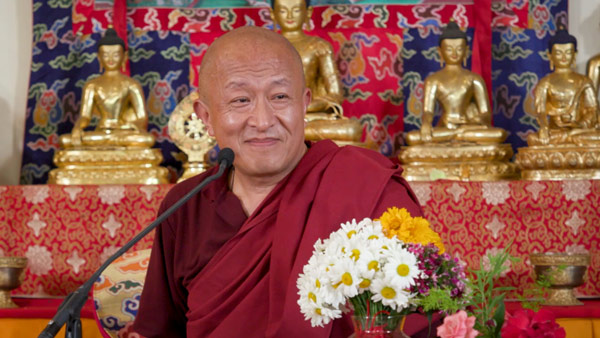
01:02:22
Chokyi Nyima Rinpoche:
Welcome, all of you.
I don't need to tell about Rinpoche.
And I'm lucky,
because Khyentse Chokyi Lodro
is my late father's teacher.
One of his root guru. Also I got teaching
and in Gangtok I got Nyingthig Yabshi,
from Khyentse Chokyi Lodro
So, he's a reincarnation.
I know him when he was child and now his
activities going all over the world.
So I'm so happy.
So welcome Rinpoche.
Thank you.
Dzongsar Khyentse Rinpoche: Okay. Well, there's always a surprise in Nepal.
First of all, I was told I was only speaking to Rangjung Yeshe students. As much as Rangjung Yeshe Institute is a very, very good and flourishing and successful institute, I don't believe that there's this much students.
The other element is I was never told that this guy is going to be here.
Anyway, as Rinpoche said earlier,
in many different levels, we are related, connected and
I have been very fortunate working with Rinpoche and the institute for several years now, namely such as 84,000 translation projects and also on the academic level.
Thank you for inviting me. I don't know what I can do,
but I will try to answer some of the questions that you have raised.
I'm a very disorganized person, so I've made a few notes and the questions are here, so I will try to... I try my best to answer these questions in one way or another.
If I can just sort of quickly summarize the questions, there are three questions. They are very important questions, I believe.
I think addressing to me, you have been critical of academic scholars from the West especially, but also said that academic study of Buddhism will be important for the future of the Buddha Dharma. What is the role the academic study of Buddhism in its transformation? How can academic studies help preserve and transmit the Dharma teaching? And the other question is, does being a modern scholar practitioner mean studying only Sūtra and Indian and Tibetan Śāstras or does it mean also studying other current areas of knowledge? And the third question is, how to combine devotion and critical analysis? Now this is a very, very big subject and kind of a deep and vast thing to cover. I don't think we will be successful entirely, but anyway we can...
I don't know, I will try to sort of answer these in a very chaotic way. I think academic study is really important, whether you are a practitioner or not. Well, to begin with, academic study gives us the illusion of studying things objectively.
As you notice, we don't even know whether there is such thing called objective. But nevertheless, I think that's really important. Of course, for the non-believer or just a pure, I don't know, pursuit of study of Asian culture and thinking and wisdom, etc. But specially, I think it's important for practitioners because it could really give us confidence on our path. Even in the strategy, the classic Buddhist strategy to study, we always talk about ... , so we begin with a hearing and then contemplation, which is really a lot to do with academic studies. And after that, we try to engage ourselves into practice.
I'm trying to get rid of him, but he's going to be here.
If we have had a proper Buddhist studies, academically or in any form, we would have at least had less of problems such as what we had experienced recently, such as what has happened with the Sogyal Rinpoche and the Rigpa and the Sakyong and the Shambhala, etc, etc...
Now, there's a lot of elements in this. I was just talking to somebody, just now that how the Buddha Dharma sort of came to the West is actually quite touching. It's really, really touching and it's really inspiring. And here, I think I would say that Tibetan lamas may have failed a lot.
The way it was introduced or the way it was adopted, Buddhism was adopted or introduced or established in the West is a very, very haphazard way. It came through, I don't know, 60's, beat generations, Beatles, and a lot to do with weeds, probably.
A lot to do with, I don't know, baby boomers, etc. And there was never a real systematic sort of support or facilities. And I think, well,
it may have some positive sort of effect, but it has created so much sort of misconceptions in many, many different levels. I think this is something that the academic students here, I think maybe you should actually even do a thesis or a proper analysis on that, how the Dharma actually came to the West. Of course, after the Vietnam War, then maybe, like for instance, like in America, maybe then we had institutionalized Buddhism for the first time because there was all these Vietnamese refugees and all that.
But, OK, One thing in the pursuit of Buddhist study we need to keep in our mind is that culture or the tradition or the custom and Dharma is different. These two are two separate things. This is really, really important. As important as it is, it is something that we always end up ignoring, no matter how seasoned you are. And there is a reason for that, which we probably will, I don't know, if my chain of thoughts are not distracted, maybe we can visit this one. There's a famous analogy of the moon and the finger that is pointing at the moon. The finger is always more attracted or equally attracted to the moon. And this is always, this is challenging, this is going to be challenging. The reason why it is challenging is because the culture or the tradition or the custom is a really, really good vessel. I mean, it's a necessary vessel. It's the only medium we got. I mean, to begin with, we have to speak. When we speak, we are using a language and language is really, really powerful. For instance, you know, if you go to East Bhutan, they don't have the word such as I love you. But they have an incredible phrase. They say, they say, you know, Jang Sem Shorba, which is such a beautiful, you know, expression, which means, you know, you robbed my mind.
So, you know how, you know, the language, language plays a very important. So I think this is another thing that the Rangjung Yeshe Institute students might want to pay some attention on philology. Now or maybe in the future or I don't know. And then the symbolism. I mean, humans have always used symbol to express things all the time. Some of them are so pathetic, some of them are really colorful, some of them are very, I don't know, like such as sending a flower to a birthday person. What is that? You know, the flower is really probably one of the most useless thing to have. You can't cook, you can't... But, you know, the symbolism of the flower, it really touches the hearts and the mind of the people, you know. So symbolism, we use a lot of symbolism. So you see, culture and the tradition always ends up becoming important. Now we need to know culture and the tradition is always something habitual, whereas dharma is not. In fact, if you were to ask me, who is the enemy of Buddhism? You know, every religion has an enemy, Satan or a demon or whatever, whatever. If you were to ask me, who is the real enemy of Buddhism? Habit, isn't it? We are always supposedly trying to topple the habit. The kingdom of the habit is what we need to destroy. Yet, culture is habit. You see, so...
It's difficult. And some of the culture and the tradition are very meaningful. And it's very useful. Last night, a woman asked me, what do I think about Osho and Krishnamurti? Well, to begin with, I prefer Osho. I really like him, I have to say. But
I have, at the end of the day, I have a little bit of a problem with him. And the reason why I have a problem with him is I never hear him talking about his guru. You know what I mean? So for me, okay, he's talking all this and he's sort of claiming it's like coming from him, revelation, etc., etc.
Now, this is a problem for me. You see, I am brought up in a culture and a tradition or a habit, habitual pattern where you want to test. I want to ask my guru, so where did you get this one from? You know, so we have this illustrious guru lineage who have done this and done that and some of them have sat in the cave for 20 years. Those things impresses me. You know, so all the way and you go to the Buddha Shakyamuni and who begged food in the Mangadath street without even needing a slipper. All of this is necessary for me. I know it is a cultural thing, it is a habitual thing, but to me it is something quite important. But we need to know sometimes that Tibetans, not only Tibetans actually, Asians in general, we teach culture excessively, excessively. I will give you one good reason, one good example. Recently some khenpos and tulkus have asked me to give them a crash course on how to teach Westerners or the non-Tibetan anyway. So what I did was I wrote Shakespeare's sonnet in Tibetan, phonetic of course, phonetic, you know, like in phonetic, you know. And then I told him, you know, there was about like 30, 40 tulkus and khenpos. I told them all to read one go. You know, things like, parting is so... You know, like things like, you know, Shakespeare's sonnet. So because most of them don't speak English or read English, but they read Tibetan. And then after reading I said, okay, what do you think? They said it is ridiculous.
So then my first lesson to them is this is what happens when we, the Tibetan lamas, tell the Westerners to read hung orgyen yülgi nupjang tsam You know, this is what happens. They don't understand meaning. They don't know what is going on. But we, the Tibetans, we think our language is so precious and so holy and etc, etc. And we are imposing.
The worst is the Kata, but I don't want to go in there.
So here, here for the Rangjung Yeshe Institute students, here academic studies becomes important. You see, to differentiate these things. Now, bear in mind, okay, so I'm talking about, okay, so maybe the Asians should not be imposing their culture, so on and so forth. But keep in mind, Westerners or Chinese or whoever, you will bring your culture and your tradition and your habit, which is also not right. You understand? This is really important. For instance, a lot of the Western Dharma students, you know, habit is always difficult to get rid of. What's the expression? Habit is, what?
The old habit is difficult to die or something like that? Hard to break. Habit is so strong, it is so invisible, it's embedded. So we know, you know, there's so many, among the Buddhists, you can sort of hear sort of pseudo-Jewish Buddhist, pseudo-Protestant Buddhist, pseudo-Catholic Buddhist, you know, sort of very moralistic, puritanical. You understand? So there you have to be careful. You have to be careful on that one. And OK, some of you may say, oh, well, I don't have any religious background. My grandfather was an atheist, my father was a quantum physicist, et cetera, et cetera, et cetera. But
let's talk about the West, OK? I think it's a classic period, right? Classic period before the romanticism. I think the West suddenly had this big love affair with rationalism. Rationalism. Everything has to be rational, rational, rational, rationalism. Ah, you have to be careful. If you are studying in the Rangjung Yeshe Institute and if you are studying Mādhyamika, if you are studying Chandrakirti, if you are studying Prāsaṅgika Mādhyamika,
yes, Buddhism, even the Buddha said, oh, you have to analyze. You should not just believe it because I said so, et cetera, et cetera. But bear in mind,
of course, while Buddhism is not promoting irrational blind belief, but as you know, Chandrakirti say, oh, you know, my logic is your logic. Remember? That's what consequentialist means. I'm only using your logic to defeat you. Me, I don't believe in logic. I am not, you know, I am not bound by rationalism. This is something important, you know. You don't want to get stuck with rational, the culture and the habit of rationalism. So important, especially if you are studying Tantra.
Because, wow, yes, getting rid of the Abrahamic baggage, God, morality, all of that, you know, smelly stuff, old stuff, archaic stuff may be easy, but you may be very, oh, I'm a very irrational person.
Chandrakirti doesn't like that. This is something important. And then not just that, but you call it empiricism. Oh, empiricism, observation.
How much should you really be stuck with empiricism?
Because we are talking about a subject and object, right? We are talking about, like,
maybe I'm going too many different tracks here, but
bottom line is this. Habit in the culture is always changing.
It changes all the time. Well, not the dharma. All compounded things are impermanent.
Not going to change this one. I think it has always been like that. All compounded things are impermanent before the Buddha. And after 2500 years, it is still impermanent.
How things appear is not what it is. That is one of the truths of the Buddha dharma.
It's always going to be like this. How things appear is not what it is. That truth is true in Rome, it is true in Kathmandu, it is true in New York.
These are some of the truths. Culture and the habitual patterns changes, but not the truth.
So, within this context, within this context, it's really important for those who are studying Buddhism to make note that to be a Buddhist is really... You know, the aim of being a Buddhist is got nothing to do with becoming a good boy or a good girl. Really important. Who cares?
Aim of a Buddhist should also never be to be a non-violent. Never. Write that down. Aim of a Buddhist should also never be to collect good karma. Remember, some of you have read Chandrakirti? Right? How many have read Chandrakirti? Please raise your hand. Rangjung Yeshe Institute? Okay. See, I told you, most of them are... What did Chandrakirti say? If you are an idiot, you will do bad things and go to hell. And if you are an idiot, you will do good things and go to heaven. Both are idiot. Only if you are wise, you go beyond good and bad and then go to liberation. So aim of being Buddhist has got nothing to do with being non-violent. I'm not...By the way, I'm not promoting violence.
Aim... you know, the final aim of Buddhism is got nothing to do with believing in karma.
All this beloved Buddhist stuff. Aim of... final aim of Buddhism is got nothing to do with believing in reincarnation. Important. This one is going to make you really unhappy.
Aim of Buddhism is got nothing to do with mindful.
None. Remember the finger and the moon. Mindfulness is finger. Moon is different.
Aim of... lot of movements. Okay, anyway.
So what is it that Buddhism is really, really trying to comprehend or decipher? Oh, this is difficult. This is difficult.
The truth of all phenomena is difficult to express.
But this is always heard when you say, oh, you know...
You know, the Shunyata is beyond expressions, beyond thinking, blah, blah, blah. When you hear this, some of you may think, oh, well, this is Buddhist excuse. You know, sort of cop out. No.
In fact, the statement that this is inexpressible itself is a very, very profound answer. And this is something that you need to know in the... This is something that you will learn in the Mādhyamika and the Prajñāpāramitā.
To communicate just for this morning, for...
To have a sort of a... just for the... as a discussion point,
you can say to really study Buddhism is to study the world of paradox and use paradox as a path. Probably this might help you.
Okay, so I use this example sometimes. Say you ask me, okay, what's the definition of a moment? A moment, you know, a moment.
This is how likely a Buddhist, a proper, you know, sort of someone who has a time and probably a bit of, you know, attention, compassion, but someone who will... who has such kind of faculty may answer. Okay, so your question is what is a moment in Buddhism?
Every hundred years, a pigeon from Boudhanath lifts this flower, goes to Mount Everest and touches the tip of the Mount Everest. Okay, every hundred years. And every time it touches, it erodes. There's a friction. Many, many, many, many, many, many hundred years later, because the, you know, the pigeon has been doing this every hundred years, Everest becomes flattened. This whole process from the day one to the flattening Everest day is one moment.
It's a very... you know, it sounds like a fairy tale, but it's a really, really
fantastic, brilliant way to talk about world of paradox. Have you thought about paradox? What do you feel when... what do you think when you hear words like, Oh, by the way,I always lie.
What do you think? If somebody says, you know, I always lie, by the way, then what do you think? Do you believe or not?
Do you believe that he's lying? Exact... well, you know, he's always lying, right? He's always lying. So it's a paradox. By the way, I'm always lying. Is that the truth?
Okay. So what happened? The way it is presented, this is the world of paradox, the way it is presented to the world in Buddhism, and especially in the Mahayana Buddhism, gets categorized into, let's say, four, sometimes three, but let's categorize four. Tawa, Gompa, Chopa, Drebu I'm just giving these words so that for the students, you have a reference, philology, you know. Tawa, the view. Gompa, meditation is never a good thing, good word. I will say practice for now. Chepa, behavior, behavior. And then Drebu, which is the result.
Okay, so this is how it is categorized. Now you have to... Okay, so what is Buddhist view? What is it? Buddhist view, Tawa. A Buddhist view has to be, no matter which Buddhist you are, Theravada all the way to the Tantrayana. A Buddhist view has to be view of non-duality. Very important you need to know this. Okay, what is Buddhist practice? Now this is something that I really want to emphasize. What is Buddhist practice? Buddhist practice must go against duality.
Can you see? All the mindfulness camp is gone now. You know? All those, you know, weekend mindfulness in the four season resort that they do. The Vipassanā, blah blah blah, that they do in Goa. I don't know, whatever. I can't generalize, of course. But if your meditation or if your practice is not going against duality, it's not the Buddhist practice. It's just a... Yeah, of course, mindfulness will calm your mind. It will make you have your good sleep. Probably it will help you parenting. I don't know, probably it will help you managing the business. So, okay, Friday, Saturday and Sunday you do a mindfulness and come Monday you will begin to destroy the world.
This, so...
Mindfulness?
Buddhist practice must go against duality. Okay, what is Buddhist view? I mean, behavior. This is Jamgon Kongtrul Lodro Thaye said,
non-extreme. And now this is a really kind of a difficult subject, but just to give you an example. Okay, here in Nepal... Oh, Nepal is maybe a good example. Here you have Buddhist... Okay, so this is, you know, there's a lot of Buddhists here in Kathmandu, I mean in Boudha. Just go there, you will see. And there's all these monks and nuns who are diligently shaving their hair as if the hair is the biggest hindrance to the enlightenment. Right? So you see that. You see that. So the shaved head, monks and nuns. But suddenly you see these yogis who are so afraid of losing hair that they keep hair every single lock. They say, oh, this is a dakinis, dakinis, dakinis, blah, blah, blah, all of that. Okay, so you see this?
See, so Buddhist behavior is never narrowed down to, you know, okay, all Buddhists. As a Buddhist, you can't eat chicken. As a Buddhist, you can't... You have to pray five times a day. You don't see that. Buddhists do all kinds of things. Not only the practitioners, even here, you know, look at this.
You know, the big boss himself, monk, begging bowl, bare feet, gently walking, serene, Saint Francis of Assisi, remember, for those who have that kind of background, sort of, you know, very serene, wholesome, you know, moralistic, puritanical. But then suddenly we have these guys. They have earrings, nose rings, bracelets, they have wives, some of them have like more than few partners, etc, etc. You understand? So all these are accepted. So I think that will do for now. Okay, what is the Buddhist result? Remember, view, practice, behavior. What is Buddhist result? This is something interesting. For those who are studying here, how many of you have studied Uttaratantra? Uttaratantra? Yeah. This is where you can pay some attention. Buddhist result is never defined by what you get.
Never defined by what you get. How do we define Buddhist result?
elimination. Buddhist result is always defined by how much you eliminate it.
Even the word Buddha says it. Sang, you know, Buddha, awakened. You know, something to do with elimination, getting rid of. Okay. Now, we have still some time, I think.
Okay, but I think in the Rangjung Yeshe Institute, you will be spending as academic study, academic institute, you will be studying, I guess,
I mean, aside from cappuccino and sometimes some other... Maybe I shouldn't be telling this in front of you. But anyway, aside from that, you are studying Buddhist view, isn't it? Buddhist view. So when we talk about a Buddhist view,
out of necessity, out of necessity,
Buddhists talk about two truths.
You understand two truths? Out of necessity. You must underline this word, out of necessity. It's not like Buddhists are in love with the two truths. Just imagine, somebody's pointing a gun at you, and force you to say, well, if you don't tell me that this is a swimming pool, I'm going to kill you. What would you do? You say, yes, yes, yes, this is a swimming pool.
That's basically, that's what it is. We, the sentient being, have, point gun of emotion and suffering to the Buddha, and out of his compassion, out of necessity, he categorized the two truths. You understand? So two truths.
Now this is a really big subject. And I want to just give you some food for thoughts. I think the two truths, the approaching, approaching the reality, using the tool of two truths is a very Asian and especially Indian, is a very Indian thing to do. I don't think it is, I mean, of course it is there in the Western system, but I don't think they really talk this way. You understand what I mean? So for instance, when a... when a physicist, what do you call it, astrophysicist, they say, oh, the Big Bang.
I think they are talking about, I mean, from the Buddhist point of view, we will say, okay, you are talking, do you believe in a Big Bang? After analysis, remember in the Chandrakirti's, after analysis, after thorough, thorough, thorough analysis, then you come up with a Big Bang. Okay, now you are talking about the ultimate truth. See, this is how the Buddhists understand.
So this tool is something that Rangjung Yeshe student must get used to, especially from the West. I mean, I guess basically everyone now. I mean, you really have to get used to study of this study, the sort of the art and the technique of the two truths. It's kind of important, this one.
And it's kind of complicated also.
Because you know, when we talk about the two truths, oh, the ultimate truth, something that needs to be realized. You know, we use this kind of phrases, relative truth, kun, zok, lie, deception, blah, blah, blah. But then again, we hear, oh, they're like one. Ah, paradoxy. Remember, I was talking about paradoxy? This is it. So it gets really, really confusing. And this is where you have to pay attention. I will give you one tip which might help you. This is the thing to do. Many times we use, we use a tool. OK, let's say this tool, which is meant to study, meant to analyze relative truth. OK, this this tool is to for meant and designed to analyze the relative truth. But somehow the philosophy students, they end up using this tool and analyze the ultimate truth. You still think you are analyzing the relative truth. Don't do that. Yeah, vice versa. There's a technique to analyze the ultimate truth. And sometimes people end up using this tool, end up using on the relative truth. This happens a lot, really, really a lot.
OK.
Because, you know, there's even a sutra, a very beautiful sutra called the meeting the father and the son. It's a very important sutra. And there Buddha said, you know, whatever ordinary people, you know, they assert, I also say, people have problem with me, I have no problem with them. And, you know, things like that. And then especially if you are studying Chandrakirti, you can... the consequentialist who really accepts the conventional truth. It is amazing.
Just to give you some idea, let me extend this a little bit.
OK. Actually, it even consists in the way how Buddha taught, by the way. And I've used this dialogue several times, the way Buddha taught. You should notice this. Not everything what he taught, he meant it.
Please, write this down. Not everything he said, he meant it.
Basically, you could almost say he lied. But, you know, I don't want to be, I don't want to be too stigmatized here. But, you know, ..., expedient teaching.
OK, some of you may be curious. Oh, now that's interesting. What is it that he really taught us that he did not really meant it?
Everything almost.
Samsara nirvana. Path.
Ten virtuous things. Ten non-virtuous things. All of this. And especially some of them are blatantly, blatantly not meant. Once upon a time, when I was a monkey. Once upon a time, when I was a king, etc., etc., he said this. And there is a reason. Remember, I was giving you the example of gunpoint? Why did he say these things? Because out of compassion, for the sake of sentient beings, it works. It works. It works wonderfully.
So things like karma, nonviolence, mindfulness, reincarnation, hell realm, hungry ghost realm, heaven, all these are taught on the relative level. You know that. Did not meant it. Remember? This is important that you know. Now. I'm sorry, I can't help it, but I have to say this. Lot of Western Buddhist study students in the past, not so much now, maybe. Especially from land of, great land of Britain.
Okay, I'm sure by now everybody knows who I'm talking about. Some people like Stephen Batchelor have... You know what these guys, they say is like this. Okay, so here this is like this. Okay, so this is a Buddhist teaching. This is a relative truth table. Okay, this is a relative truth table. We are not talking about ultimate truth. So there's a nonviolence, there's mindfulness, there's generosity, there's a discipline, there's a mantra, there's a puja, there's, I don't know, all that. Okay. So then the British will come and say, okay, this is such a sort of colonial, sort of imperialist attitude, you know. We will have to improve this, you know, like... Oh, oh, oh, the reincarnation bit. Oh, oh, oh.
This is, this is just, you know, sort of Asian superstition thing, you know. Oh, the karma, oh yeah, that's... It could be okay for here and there. And then suddenly they find the mindfulness. Oh, this is jolly good, you know. This is jolly good.
Okay, you are looking at a mirror, you are looking at a mirror and inside the mirror there's two reflections. There's a reflection of a nice cheese hamburger and there's a reflection of a shit.
You are choosing the hamburger. How pathetic is that?
They are equally non-existent. But are they really non-existent? No, they're there. They're blatantly, clearly... the shit is steamingly there and the cheese sandwich is so mouthwateringly there. You understand? The paradox, the study of paradox. This is something that you really need to know. I'm sorry, I have this habit of sort of, you know, being mean. It's something that I need to get rid of, but...
So... Where did I go now? Okay, Look at the questions...
Yeah. Okay. Now... The other question is about current knowledge. Yes. Especially... If you are... If you are a... If you are a Buddhist, you have to... You must, I encourage you. And I'm sure immediately when I say this, you will think, oh, okay, I will study Buddhism and I will study science. You will think, oh, they compliment.
Please.
Buddhists should never, ever try to be complimentary to science. It's the last thing you want to do. If the scientists come to us, yes. We will welcome them and talk to them and all of that. But there is no reason to surrender. None. Not whatsoever. I know the world of algorithm, artificial intelligence, all of that is happening. The Buddhist view of relative truth and ultimate truth stays just like a Mount Meru. Nothing to be feared. Nothing whatsoever. We can talk about that maybe some another time. But anyway, for now, this will do.
Actually, I would encourage you for those who are Buddhist students, and if you are asking me, what should you study, science or astrophysics? Yes, yes, yes, all of that, but you should study money. You should study economy. You should study political science. Really, really, really important. Let's say you are an American.
You should study these things. When the day, when the day comes in America, people, the type of people who would vote for Trump are also Buddhist. I will be very happy.
At the moment,
most of the Buddhists are these people who read New York Times, people who have time to do yoga.
Buddhism has got nothing to do with liberalism. You have to really, really... I mean, if you have a space, please tattoo it on somewhere on your body or something like this. It's got nothing to do with liberalism, because liberalism is something to do with the individualism. If you believe in individualism, if you believe in individualism, you are believing in soul, isn't it? You see, this is what I'm talking about.
Abrahamic influence. If you believe, if you have the Abrahamic tendency, then you believe in soul, then you believe in individualism, and then you believe in individual rights, and then you believe in democracy.
Buddhists don't even believe in individual. Where is liberalism? You understand? So I think you should study not only science, money. Because study of money is one of the most practical way to study illusion. You can really ask most of the Americans who are spending money here in Boudha with the money they don't even have. Ask the Americans, they will know this. Credit, you know?
Okay?
Last one. How to combine devotion and critical analysis?
Doubt is a very good thing. Critical thinking is a very, very good thing. Actually, you know like, let's say, you know, you have a coffee, right? You have a coffee and the big part of the ingredient of the coffee, if you are drinking coffee or that is of course, is water, isn't it? If you don't have water, you can just sort of munch coffee beans. I guess, I suppose you can, but let's say you are just beginning to drink coffee. You should have a big part of the ingredient is water. Milk, not essential. Sugar, not essential. Water and hot water probably. Just like that, ingredient of a devotion, big part of the ingredient of a devotion is critical thinking. It's a doubt. The doubt? You think you have a doubt? No. You want to learn how to have a doubt? Chandrakirti, ask him. He will teach you how to have a proper doubt. It's far, far, far more sophisticated than something that you get it from New York Times or a Guardian. It's really, really, really good. I mean, I told you already, remember? These guys don't even believe in rationalism. This is how I studied. When I studied Buddhist logic, Tsema, Mike Campbell said that the first thing he told me is, okay, be prepared to be prepared to know that the logic is the perfect way to, you know, perfect system or a way to become the most idiot. Because you become so narrow, so critical thinking is very, very important.
Devotion.
And I think this will, I mean, this is such a big subject. I don't think I will have much time to express this.
But I want to sort of end this with a, you know, because I've been talking too much and I've been telling all the things that probably you can't even sort of, what do you call it, essentialize anymore because it's been a sound basically. But I want to say something practical maybe. Devotion.
How to have devotion?
As strange as it may sound, you should pray. pray Pray that you will have a devotion. It's like that, what to do. Well, I have a duty calling, so I'll have to end here. We wish that this man live long.
And we wish that the legacy of his father will live long. After Khyabje Dilgo Khyentse Rinpoche passed away, you know, sometimes, you know, I don't practice at all, but sometimes once in a blue moon I do some practice and then there's a doubt comes. And then he happened to be one of the very few that I trust because I have, as you can already see, I have so much ego, I'm so critical, I have no pure perception, I don't buy a lot of people. But this man, you know, his father, you know, I had so much respect and devotion, you know, later. And I used to go to his place, Nagi Gompa. Those days, no car, you have to walk. And I would reach there.
And I have, like, a few pages of questions to ask, you know. And I would go there. And I would stay there, like, two, three hours. Out of two, three hours, an hour and a half is mostly about Tulku Urgyen Rinpoche sort of scolding his nun attendants like, oh, you know, Rinpoche, you know, you are not bringing Rinpoche enough chapati or, you know, like, my food. He put so much, you know, you have something to eat, drink, blah, blah, blah. All that, that's it. That's about an hour and a half. And then the next, maybe about one hour is all about what's happening, you know, during those days. Like, I don't know which president of America it was. Anyway, this is the politics. And I don't know, somehow the lamas like Chatral Rinpoche and Tulku Urgyen Rinpoche, they always see me as some sort of a news source.
You know, probably they realize that this man is not a dharma practitioner anyway. So that's it. So then, you know, I have a list of questions. Of course, never have the chance. But then Tulku Urgyen Rinpoche will say in his Nangchen dialect, Nangchen dialect, he will say, .... That's what he will say. I've repeated this exactly like this. Don't worry, you know, you're all right. That's it. Don't worry, you're all right.
And of course, you know, sometimes six months, sometimes even a year, it recharges you, just like the phone.
Just questions that I have written down all looks ridiculous. And I was, you know, I felt even very, you know, like, when later on when I was reading the questions, like, you know, like, I didn't ask, it would be so embarrassing. Anyway, so may Tulku Urgyen Rinpoche's legacy live long, and may this man live long. We need him for the 84,000. Did you hear that? and Rangjung Yeshe.
CNR: We're all so happy Rinpoche came and gave very touching talks, very openly touching talks. So it's very helpful for all of us.
Bottom line, what Rinpoche is saying is, all of us, we need to know the one logic, undeniable.
So this is very important, number one. If we know that, then we will get guts and interest to study and practice. If we not know the Sarva Dharma is ...., then our proud, jealousy, anger, all negative emotion will be there. So we need to become, we need to become, how you say, not in, not in trip, not in trip. We, if we know the how, how the impermanent, then we become very grounded. We become very intelligent. So thank you all for your teaching. Thank you very much.
Dzongsar Khyentse Rinpoche: Okay. Well, there's always a surprise in Nepal.
First of all, I was told I was only speaking to Rangjung Yeshe students. As much as Rangjung Yeshe Institute is a very, very good and flourishing and successful institute, I don't believe that there's this much students.
The other element is I was never told that this guy is going to be here.
Anyway, as Rinpoche said earlier,
in many different levels, we are related, connected and
I have been very fortunate working with Rinpoche and the institute for several years now, namely such as 84,000 translation projects and also on the academic level.
Thank you for inviting me. I don't know what I can do,
but I will try to answer some of the questions that you have raised.
I'm a very disorganized person, so I've made a few notes and the questions are here, so I will try to... I try my best to answer these questions in one way or another.
If I can just sort of quickly summarize the questions, there are three questions. They are very important questions, I believe.
I think addressing to me, you have been critical of academic scholars from the West especially, but also said that academic study of Buddhism will be important for the future of the Buddha Dharma. What is the role the academic study of Buddhism in its transformation? How can academic studies help preserve and transmit the Dharma teaching? And the other question is, does being a modern scholar practitioner mean studying only Sūtra and Indian and Tibetan Śāstras or does it mean also studying other current areas of knowledge? And the third question is, how to combine devotion and critical analysis? Now this is a very, very big subject and kind of a deep and vast thing to cover. I don't think we will be successful entirely, but anyway we can...
I don't know, I will try to sort of answer these in a very chaotic way. I think academic study is really important, whether you are a practitioner or not. Well, to begin with, academic study gives us the illusion of studying things objectively.
As you notice, we don't even know whether there is such thing called objective. But nevertheless, I think that's really important. Of course, for the non-believer or just a pure, I don't know, pursuit of study of Asian culture and thinking and wisdom, etc. But specially, I think it's important for practitioners because it could really give us confidence on our path. Even in the strategy, the classic Buddhist strategy to study, we always talk about ... , so we begin with a hearing and then contemplation, which is really a lot to do with academic studies. And after that, we try to engage ourselves into practice.
I'm trying to get rid of him, but he's going to be here.
If we have had a proper Buddhist studies, academically or in any form, we would have at least had less of problems such as what we had experienced recently, such as what has happened with the Sogyal Rinpoche and the Rigpa and the Sakyong and the Shambhala, etc, etc...
Now, there's a lot of elements in this. I was just talking to somebody, just now that how the Buddha Dharma sort of came to the West is actually quite touching. It's really, really touching and it's really inspiring. And here, I think I would say that Tibetan lamas may have failed a lot.
The way it was introduced or the way it was adopted, Buddhism was adopted or introduced or established in the West is a very, very haphazard way. It came through, I don't know, 60's, beat generations, Beatles, and a lot to do with weeds, probably.
A lot to do with, I don't know, baby boomers, etc. And there was never a real systematic sort of support or facilities. And I think, well,
it may have some positive sort of effect, but it has created so much sort of misconceptions in many, many different levels. I think this is something that the academic students here, I think maybe you should actually even do a thesis or a proper analysis on that, how the Dharma actually came to the West. Of course, after the Vietnam War, then maybe, like for instance, like in America, maybe then we had institutionalized Buddhism for the first time because there was all these Vietnamese refugees and all that.
But, OK, One thing in the pursuit of Buddhist study we need to keep in our mind is that culture or the tradition or the custom and Dharma is different. These two are two separate things. This is really, really important. As important as it is, it is something that we always end up ignoring, no matter how seasoned you are. And there is a reason for that, which we probably will, I don't know, if my chain of thoughts are not distracted, maybe we can visit this one. There's a famous analogy of the moon and the finger that is pointing at the moon. The finger is always more attracted or equally attracted to the moon. And this is always, this is challenging, this is going to be challenging. The reason why it is challenging is because the culture or the tradition or the custom is a really, really good vessel. I mean, it's a necessary vessel. It's the only medium we got. I mean, to begin with, we have to speak. When we speak, we are using a language and language is really, really powerful. For instance, you know, if you go to East Bhutan, they don't have the word such as I love you. But they have an incredible phrase. They say, they say, you know, Jang Sem Shorba, which is such a beautiful, you know, expression, which means, you know, you robbed my mind.
So, you know how, you know, the language, language plays a very important. So I think this is another thing that the Rangjung Yeshe Institute students might want to pay some attention on philology. Now or maybe in the future or I don't know. And then the symbolism. I mean, humans have always used symbol to express things all the time. Some of them are so pathetic, some of them are really colorful, some of them are very, I don't know, like such as sending a flower to a birthday person. What is that? You know, the flower is really probably one of the most useless thing to have. You can't cook, you can't... But, you know, the symbolism of the flower, it really touches the hearts and the mind of the people, you know. So symbolism, we use a lot of symbolism. So you see, culture and the tradition always ends up becoming important. Now we need to know culture and the tradition is always something habitual, whereas dharma is not. In fact, if you were to ask me, who is the enemy of Buddhism? You know, every religion has an enemy, Satan or a demon or whatever, whatever. If you were to ask me, who is the real enemy of Buddhism? Habit, isn't it? We are always supposedly trying to topple the habit. The kingdom of the habit is what we need to destroy. Yet, culture is habit. You see, so...
It's difficult. And some of the culture and the tradition are very meaningful. And it's very useful. Last night, a woman asked me, what do I think about Osho and Krishnamurti? Well, to begin with, I prefer Osho. I really like him, I have to say. But
I have, at the end of the day, I have a little bit of a problem with him. And the reason why I have a problem with him is I never hear him talking about his guru. You know what I mean? So for me, okay, he's talking all this and he's sort of claiming it's like coming from him, revelation, etc., etc.
Now, this is a problem for me. You see, I am brought up in a culture and a tradition or a habit, habitual pattern where you want to test. I want to ask my guru, so where did you get this one from? You know, so we have this illustrious guru lineage who have done this and done that and some of them have sat in the cave for 20 years. Those things impresses me. You know, so all the way and you go to the Buddha Shakyamuni and who begged food in the Mangadath street without even needing a slipper. All of this is necessary for me. I know it is a cultural thing, it is a habitual thing, but to me it is something quite important. But we need to know sometimes that Tibetans, not only Tibetans actually, Asians in general, we teach culture excessively, excessively. I will give you one good reason, one good example. Recently some khenpos and tulkus have asked me to give them a crash course on how to teach Westerners or the non-Tibetan anyway. So what I did was I wrote Shakespeare's sonnet in Tibetan, phonetic of course, phonetic, you know, like in phonetic, you know. And then I told him, you know, there was about like 30, 40 tulkus and khenpos. I told them all to read one go. You know, things like, parting is so... You know, like things like, you know, Shakespeare's sonnet. So because most of them don't speak English or read English, but they read Tibetan. And then after reading I said, okay, what do you think? They said it is ridiculous.
So then my first lesson to them is this is what happens when we, the Tibetan lamas, tell the Westerners to read hung orgyen yülgi nupjang tsam You know, this is what happens. They don't understand meaning. They don't know what is going on. But we, the Tibetans, we think our language is so precious and so holy and etc, etc. And we are imposing.
The worst is the Kata, but I don't want to go in there.
So here, here for the Rangjung Yeshe Institute students, here academic studies becomes important. You see, to differentiate these things. Now, bear in mind, okay, so I'm talking about, okay, so maybe the Asians should not be imposing their culture, so on and so forth. But keep in mind, Westerners or Chinese or whoever, you will bring your culture and your tradition and your habit, which is also not right. You understand? This is really important. For instance, a lot of the Western Dharma students, you know, habit is always difficult to get rid of. What's the expression? Habit is, what?
The old habit is difficult to die or something like that? Hard to break. Habit is so strong, it is so invisible, it's embedded. So we know, you know, there's so many, among the Buddhists, you can sort of hear sort of pseudo-Jewish Buddhist, pseudo-Protestant Buddhist, pseudo-Catholic Buddhist, you know, sort of very moralistic, puritanical. You understand? So there you have to be careful. You have to be careful on that one. And OK, some of you may say, oh, well, I don't have any religious background. My grandfather was an atheist, my father was a quantum physicist, et cetera, et cetera, et cetera. But
let's talk about the West, OK? I think it's a classic period, right? Classic period before the romanticism. I think the West suddenly had this big love affair with rationalism. Rationalism. Everything has to be rational, rational, rational, rationalism. Ah, you have to be careful. If you are studying in the Rangjung Yeshe Institute and if you are studying Mādhyamika, if you are studying Chandrakirti, if you are studying Prāsaṅgika Mādhyamika,
yes, Buddhism, even the Buddha said, oh, you have to analyze. You should not just believe it because I said so, et cetera, et cetera. But bear in mind,
of course, while Buddhism is not promoting irrational blind belief, but as you know, Chandrakirti say, oh, you know, my logic is your logic. Remember? That's what consequentialist means. I'm only using your logic to defeat you. Me, I don't believe in logic. I am not, you know, I am not bound by rationalism. This is something important, you know. You don't want to get stuck with rational, the culture and the habit of rationalism. So important, especially if you are studying Tantra.
Because, wow, yes, getting rid of the Abrahamic baggage, God, morality, all of that, you know, smelly stuff, old stuff, archaic stuff may be easy, but you may be very, oh, I'm a very irrational person.
Chandrakirti doesn't like that. This is something important. And then not just that, but you call it empiricism. Oh, empiricism, observation.
How much should you really be stuck with empiricism?
Because we are talking about a subject and object, right? We are talking about, like,
maybe I'm going too many different tracks here, but
bottom line is this. Habit in the culture is always changing.
It changes all the time. Well, not the dharma. All compounded things are impermanent.
Not going to change this one. I think it has always been like that. All compounded things are impermanent before the Buddha. And after 2500 years, it is still impermanent.
How things appear is not what it is. That is one of the truths of the Buddha dharma.
It's always going to be like this. How things appear is not what it is. That truth is true in Rome, it is true in Kathmandu, it is true in New York.
These are some of the truths. Culture and the habitual patterns changes, but not the truth.
So, within this context, within this context, it's really important for those who are studying Buddhism to make note that to be a Buddhist is really... You know, the aim of being a Buddhist is got nothing to do with becoming a good boy or a good girl. Really important. Who cares?
Aim of a Buddhist should also never be to be a non-violent. Never. Write that down. Aim of a Buddhist should also never be to collect good karma. Remember, some of you have read Chandrakirti? Right? How many have read Chandrakirti? Please raise your hand. Rangjung Yeshe Institute? Okay. See, I told you, most of them are... What did Chandrakirti say? If you are an idiot, you will do bad things and go to hell. And if you are an idiot, you will do good things and go to heaven. Both are idiot. Only if you are wise, you go beyond good and bad and then go to liberation. So aim of being Buddhist has got nothing to do with being non-violent. I'm not...By the way, I'm not promoting violence.
Aim... you know, the final aim of Buddhism is got nothing to do with believing in karma.
All this beloved Buddhist stuff. Aim of... final aim of Buddhism is got nothing to do with believing in reincarnation. Important. This one is going to make you really unhappy.
Aim of Buddhism is got nothing to do with mindful.
None. Remember the finger and the moon. Mindfulness is finger. Moon is different.
Aim of... lot of movements. Okay, anyway.
So what is it that Buddhism is really, really trying to comprehend or decipher? Oh, this is difficult. This is difficult.
The truth of all phenomena is difficult to express.
But this is always heard when you say, oh, you know...
You know, the Shunyata is beyond expressions, beyond thinking, blah, blah, blah. When you hear this, some of you may think, oh, well, this is Buddhist excuse. You know, sort of cop out. No.
In fact, the statement that this is inexpressible itself is a very, very profound answer. And this is something that you need to know in the... This is something that you will learn in the Mādhyamika and the Prajñāpāramitā.
To communicate just for this morning, for...
To have a sort of a... just for the... as a discussion point,
you can say to really study Buddhism is to study the world of paradox and use paradox as a path. Probably this might help you.
Okay, so I use this example sometimes. Say you ask me, okay, what's the definition of a moment? A moment, you know, a moment.
This is how likely a Buddhist, a proper, you know, sort of someone who has a time and probably a bit of, you know, attention, compassion, but someone who will... who has such kind of faculty may answer. Okay, so your question is what is a moment in Buddhism?
Every hundred years, a pigeon from Boudhanath lifts this flower, goes to Mount Everest and touches the tip of the Mount Everest. Okay, every hundred years. And every time it touches, it erodes. There's a friction. Many, many, many, many, many, many hundred years later, because the, you know, the pigeon has been doing this every hundred years, Everest becomes flattened. This whole process from the day one to the flattening Everest day is one moment.
It's a very... you know, it sounds like a fairy tale, but it's a really, really
fantastic, brilliant way to talk about world of paradox. Have you thought about paradox? What do you feel when... what do you think when you hear words like, Oh, by the way,I always lie.
What do you think? If somebody says, you know, I always lie, by the way, then what do you think? Do you believe or not?
Do you believe that he's lying? Exact... well, you know, he's always lying, right? He's always lying. So it's a paradox. By the way, I'm always lying. Is that the truth?
Okay. So what happened? The way it is presented, this is the world of paradox, the way it is presented to the world in Buddhism, and especially in the Mahayana Buddhism, gets categorized into, let's say, four, sometimes three, but let's categorize four. Tawa, Gompa, Chopa, Drebu I'm just giving these words so that for the students, you have a reference, philology, you know. Tawa, the view. Gompa, meditation is never a good thing, good word. I will say practice for now. Chepa, behavior, behavior. And then Drebu, which is the result.
Okay, so this is how it is categorized. Now you have to... Okay, so what is Buddhist view? What is it? Buddhist view, Tawa. A Buddhist view has to be, no matter which Buddhist you are, Theravada all the way to the Tantrayana. A Buddhist view has to be view of non-duality. Very important you need to know this. Okay, what is Buddhist practice? Now this is something that I really want to emphasize. What is Buddhist practice? Buddhist practice must go against duality.
Can you see? All the mindfulness camp is gone now. You know? All those, you know, weekend mindfulness in the four season resort that they do. The Vipassanā, blah blah blah, that they do in Goa. I don't know, whatever. I can't generalize, of course. But if your meditation or if your practice is not going against duality, it's not the Buddhist practice. It's just a... Yeah, of course, mindfulness will calm your mind. It will make you have your good sleep. Probably it will help you parenting. I don't know, probably it will help you managing the business. So, okay, Friday, Saturday and Sunday you do a mindfulness and come Monday you will begin to destroy the world.
This, so...
Mindfulness?
Buddhist practice must go against duality. Okay, what is Buddhist view? I mean, behavior. This is Jamgon Kongtrul Lodro Thaye said,
non-extreme. And now this is a really kind of a difficult subject, but just to give you an example. Okay, here in Nepal... Oh, Nepal is maybe a good example. Here you have Buddhist... Okay, so this is, you know, there's a lot of Buddhists here in Kathmandu, I mean in Boudha. Just go there, you will see. And there's all these monks and nuns who are diligently shaving their hair as if the hair is the biggest hindrance to the enlightenment. Right? So you see that. You see that. So the shaved head, monks and nuns. But suddenly you see these yogis who are so afraid of losing hair that they keep hair every single lock. They say, oh, this is a dakinis, dakinis, dakinis, blah, blah, blah, all of that. Okay, so you see this?
See, so Buddhist behavior is never narrowed down to, you know, okay, all Buddhists. As a Buddhist, you can't eat chicken. As a Buddhist, you can't... You have to pray five times a day. You don't see that. Buddhists do all kinds of things. Not only the practitioners, even here, you know, look at this.
You know, the big boss himself, monk, begging bowl, bare feet, gently walking, serene, Saint Francis of Assisi, remember, for those who have that kind of background, sort of, you know, very serene, wholesome, you know, moralistic, puritanical. But then suddenly we have these guys. They have earrings, nose rings, bracelets, they have wives, some of them have like more than few partners, etc, etc. You understand? So all these are accepted. So I think that will do for now. Okay, what is the Buddhist result? Remember, view, practice, behavior. What is Buddhist result? This is something interesting. For those who are studying here, how many of you have studied Uttaratantra? Uttaratantra? Yeah. This is where you can pay some attention. Buddhist result is never defined by what you get.
Never defined by what you get. How do we define Buddhist result?
elimination. Buddhist result is always defined by how much you eliminate it.
Even the word Buddha says it. Sang, you know, Buddha, awakened. You know, something to do with elimination, getting rid of. Okay. Now, we have still some time, I think.
Okay, but I think in the Rangjung Yeshe Institute, you will be spending as academic study, academic institute, you will be studying, I guess,
I mean, aside from cappuccino and sometimes some other... Maybe I shouldn't be telling this in front of you. But anyway, aside from that, you are studying Buddhist view, isn't it? Buddhist view. So when we talk about a Buddhist view,
out of necessity, out of necessity,
Buddhists talk about two truths.
You understand two truths? Out of necessity. You must underline this word, out of necessity. It's not like Buddhists are in love with the two truths. Just imagine, somebody's pointing a gun at you, and force you to say, well, if you don't tell me that this is a swimming pool, I'm going to kill you. What would you do? You say, yes, yes, yes, this is a swimming pool.
That's basically, that's what it is. We, the sentient being, have, point gun of emotion and suffering to the Buddha, and out of his compassion, out of necessity, he categorized the two truths. You understand? So two truths.
Now this is a really big subject. And I want to just give you some food for thoughts. I think the two truths, the approaching, approaching the reality, using the tool of two truths is a very Asian and especially Indian, is a very Indian thing to do. I don't think it is, I mean, of course it is there in the Western system, but I don't think they really talk this way. You understand what I mean? So for instance, when a... when a physicist, what do you call it, astrophysicist, they say, oh, the Big Bang.
I think they are talking about, I mean, from the Buddhist point of view, we will say, okay, you are talking, do you believe in a Big Bang? After analysis, remember in the Chandrakirti's, after analysis, after thorough, thorough, thorough analysis, then you come up with a Big Bang. Okay, now you are talking about the ultimate truth. See, this is how the Buddhists understand.
So this tool is something that Rangjung Yeshe student must get used to, especially from the West. I mean, I guess basically everyone now. I mean, you really have to get used to study of this study, the sort of the art and the technique of the two truths. It's kind of important, this one.
And it's kind of complicated also.
Because you know, when we talk about the two truths, oh, the ultimate truth, something that needs to be realized. You know, we use this kind of phrases, relative truth, kun, zok, lie, deception, blah, blah, blah. But then again, we hear, oh, they're like one. Ah, paradoxy. Remember, I was talking about paradoxy? This is it. So it gets really, really confusing. And this is where you have to pay attention. I will give you one tip which might help you. This is the thing to do. Many times we use, we use a tool. OK, let's say this tool, which is meant to study, meant to analyze relative truth. OK, this this tool is to for meant and designed to analyze the relative truth. But somehow the philosophy students, they end up using this tool and analyze the ultimate truth. You still think you are analyzing the relative truth. Don't do that. Yeah, vice versa. There's a technique to analyze the ultimate truth. And sometimes people end up using this tool, end up using on the relative truth. This happens a lot, really, really a lot.
OK.
Because, you know, there's even a sutra, a very beautiful sutra called the meeting the father and the son. It's a very important sutra. And there Buddha said, you know, whatever ordinary people, you know, they assert, I also say, people have problem with me, I have no problem with them. And, you know, things like that. And then especially if you are studying Chandrakirti, you can... the consequentialist who really accepts the conventional truth. It is amazing.
Just to give you some idea, let me extend this a little bit.
OK. Actually, it even consists in the way how Buddha taught, by the way. And I've used this dialogue several times, the way Buddha taught. You should notice this. Not everything what he taught, he meant it.
Please, write this down. Not everything he said, he meant it.
Basically, you could almost say he lied. But, you know, I don't want to be, I don't want to be too stigmatized here. But, you know, ..., expedient teaching.
OK, some of you may be curious. Oh, now that's interesting. What is it that he really taught us that he did not really meant it?
Everything almost.
Samsara nirvana. Path.
Ten virtuous things. Ten non-virtuous things. All of this. And especially some of them are blatantly, blatantly not meant. Once upon a time, when I was a monkey. Once upon a time, when I was a king, etc., etc., he said this. And there is a reason. Remember, I was giving you the example of gunpoint? Why did he say these things? Because out of compassion, for the sake of sentient beings, it works. It works. It works wonderfully.
So things like karma, nonviolence, mindfulness, reincarnation, hell realm, hungry ghost realm, heaven, all these are taught on the relative level. You know that. Did not meant it. Remember? This is important that you know. Now. I'm sorry, I can't help it, but I have to say this. Lot of Western Buddhist study students in the past, not so much now, maybe. Especially from land of, great land of Britain.
Okay, I'm sure by now everybody knows who I'm talking about. Some people like Stephen Batchelor have... You know what these guys, they say is like this. Okay, so here this is like this. Okay, so this is a Buddhist teaching. This is a relative truth table. Okay, this is a relative truth table. We are not talking about ultimate truth. So there's a nonviolence, there's mindfulness, there's generosity, there's a discipline, there's a mantra, there's a puja, there's, I don't know, all that. Okay. So then the British will come and say, okay, this is such a sort of colonial, sort of imperialist attitude, you know. We will have to improve this, you know, like... Oh, oh, oh, the reincarnation bit. Oh, oh, oh.
This is, this is just, you know, sort of Asian superstition thing, you know. Oh, the karma, oh yeah, that's... It could be okay for here and there. And then suddenly they find the mindfulness. Oh, this is jolly good, you know. This is jolly good.
Okay, you are looking at a mirror, you are looking at a mirror and inside the mirror there's two reflections. There's a reflection of a nice cheese hamburger and there's a reflection of a shit.
You are choosing the hamburger. How pathetic is that?
They are equally non-existent. But are they really non-existent? No, they're there. They're blatantly, clearly... the shit is steamingly there and the cheese sandwich is so mouthwateringly there. You understand? The paradox, the study of paradox. This is something that you really need to know. I'm sorry, I have this habit of sort of, you know, being mean. It's something that I need to get rid of, but...
So... Where did I go now? Okay, Look at the questions...
Yeah. Okay. Now... The other question is about current knowledge. Yes. Especially... If you are... If you are a... If you are a Buddhist, you have to... You must, I encourage you. And I'm sure immediately when I say this, you will think, oh, okay, I will study Buddhism and I will study science. You will think, oh, they compliment.
Please.
Buddhists should never, ever try to be complimentary to science. It's the last thing you want to do. If the scientists come to us, yes. We will welcome them and talk to them and all of that. But there is no reason to surrender. None. Not whatsoever. I know the world of algorithm, artificial intelligence, all of that is happening. The Buddhist view of relative truth and ultimate truth stays just like a Mount Meru. Nothing to be feared. Nothing whatsoever. We can talk about that maybe some another time. But anyway, for now, this will do.
Actually, I would encourage you for those who are Buddhist students, and if you are asking me, what should you study, science or astrophysics? Yes, yes, yes, all of that, but you should study money. You should study economy. You should study political science. Really, really, really important. Let's say you are an American.
You should study these things. When the day, when the day comes in America, people, the type of people who would vote for Trump are also Buddhist. I will be very happy.
At the moment,
most of the Buddhists are these people who read New York Times, people who have time to do yoga.
Buddhism has got nothing to do with liberalism. You have to really, really... I mean, if you have a space, please tattoo it on somewhere on your body or something like this. It's got nothing to do with liberalism, because liberalism is something to do with the individualism. If you believe in individualism, if you believe in individualism, you are believing in soul, isn't it? You see, this is what I'm talking about.
Abrahamic influence. If you believe, if you have the Abrahamic tendency, then you believe in soul, then you believe in individualism, and then you believe in individual rights, and then you believe in democracy.
Buddhists don't even believe in individual. Where is liberalism? You understand? So I think you should study not only science, money. Because study of money is one of the most practical way to study illusion. You can really ask most of the Americans who are spending money here in Boudha with the money they don't even have. Ask the Americans, they will know this. Credit, you know?
Okay?
Last one. How to combine devotion and critical analysis?
Doubt is a very good thing. Critical thinking is a very, very good thing. Actually, you know like, let's say, you know, you have a coffee, right? You have a coffee and the big part of the ingredient of the coffee, if you are drinking coffee or that is of course, is water, isn't it? If you don't have water, you can just sort of munch coffee beans. I guess, I suppose you can, but let's say you are just beginning to drink coffee. You should have a big part of the ingredient is water. Milk, not essential. Sugar, not essential. Water and hot water probably. Just like that, ingredient of a devotion, big part of the ingredient of a devotion is critical thinking. It's a doubt. The doubt? You think you have a doubt? No. You want to learn how to have a doubt? Chandrakirti, ask him. He will teach you how to have a proper doubt. It's far, far, far more sophisticated than something that you get it from New York Times or a Guardian. It's really, really, really good. I mean, I told you already, remember? These guys don't even believe in rationalism. This is how I studied. When I studied Buddhist logic, Tsema, Mike Campbell said that the first thing he told me is, okay, be prepared to be prepared to know that the logic is the perfect way to, you know, perfect system or a way to become the most idiot. Because you become so narrow, so critical thinking is very, very important.
Devotion.
And I think this will, I mean, this is such a big subject. I don't think I will have much time to express this.
But I want to sort of end this with a, you know, because I've been talking too much and I've been telling all the things that probably you can't even sort of, what do you call it, essentialize anymore because it's been a sound basically. But I want to say something practical maybe. Devotion.
How to have devotion?
As strange as it may sound, you should pray. pray Pray that you will have a devotion. It's like that, what to do. Well, I have a duty calling, so I'll have to end here. We wish that this man live long.
And we wish that the legacy of his father will live long. After Khyabje Dilgo Khyentse Rinpoche passed away, you know, sometimes, you know, I don't practice at all, but sometimes once in a blue moon I do some practice and then there's a doubt comes. And then he happened to be one of the very few that I trust because I have, as you can already see, I have so much ego, I'm so critical, I have no pure perception, I don't buy a lot of people. But this man, you know, his father, you know, I had so much respect and devotion, you know, later. And I used to go to his place, Nagi Gompa. Those days, no car, you have to walk. And I would reach there.
And I have, like, a few pages of questions to ask, you know. And I would go there. And I would stay there, like, two, three hours. Out of two, three hours, an hour and a half is mostly about Tulku Urgyen Rinpoche sort of scolding his nun attendants like, oh, you know, Rinpoche, you know, you are not bringing Rinpoche enough chapati or, you know, like, my food. He put so much, you know, you have something to eat, drink, blah, blah, blah. All that, that's it. That's about an hour and a half. And then the next, maybe about one hour is all about what's happening, you know, during those days. Like, I don't know which president of America it was. Anyway, this is the politics. And I don't know, somehow the lamas like Chatral Rinpoche and Tulku Urgyen Rinpoche, they always see me as some sort of a news source.
You know, probably they realize that this man is not a dharma practitioner anyway. So that's it. So then, you know, I have a list of questions. Of course, never have the chance. But then Tulku Urgyen Rinpoche will say in his Nangchen dialect, Nangchen dialect, he will say, .... That's what he will say. I've repeated this exactly like this. Don't worry, you know, you're all right. That's it. Don't worry, you're all right.
And of course, you know, sometimes six months, sometimes even a year, it recharges you, just like the phone.
Just questions that I have written down all looks ridiculous. And I was, you know, I felt even very, you know, like, when later on when I was reading the questions, like, you know, like, I didn't ask, it would be so embarrassing. Anyway, so may Tulku Urgyen Rinpoche's legacy live long, and may this man live long. We need him for the 84,000. Did you hear that? and Rangjung Yeshe.
CNR: We're all so happy Rinpoche came and gave very touching talks, very openly touching talks. So it's very helpful for all of us.
Bottom line, what Rinpoche is saying is, all of us, we need to know the one logic, undeniable.
So this is very important, number one. If we know that, then we will get guts and interest to study and practice. If we not know the Sarva Dharma is ...., then our proud, jealousy, anger, all negative emotion will be there. So we need to become, we need to become, how you say, not in, not in trip, not in trip. We, if we know the how, how the impermanent, then we become very grounded. We become very intelligent. So thank you all for your teaching. Thank you very much.
01:02:21
Chokyi Nyima Rinpoche:
Welcome, all of you.
I don't need to tell about Rinpoche.
And I'm lucky,
because Khyentse Chokyi Lodro
is my late father's teacher.
One of his root guru. Also I got teaching
and in Gangtok I got Nyingthig Yabshi,
from Khyentse Chokyi Lodro
So, he's a reincarnation.
I know him when he was child and now his
activities going all over the world.
So I'm so happy.
So welcome Rinpoche.
Thank you.
Dzongsar Khyentse Rinpoche: Okay. Well, there's always a surprise in Nepal.
First of all, I was told I was only speaking to Rangjung Yeshe students. As much as Rangjung Yeshe Institute is a very, very good and flourishing and successful institute, I don't believe that there's this much students.
The other element is I was never told that this guy is going to be here.
Anyway, as Rinpoche said earlier,
in many different levels, we are related, connected and
I have been very fortunate working with Rinpoche and the institute for several years now, namely such as 84,000 translation projects and also on the academic level.
Thank you for inviting me. I don't know what I can do,
but I will try to answer some of the questions that you have raised.
I'm a very disorganized person, so I've made a few notes and the questions are here, so I will try to... I try my best to answer these questions in one way or another.
If I can just sort of quickly summarize the questions, there are three questions. They are very important questions, I believe.
I think addressing to me, you have been critical of academic scholars from the West especially, but also said that academic study of Buddhism will be important for the future of the Buddha Dharma. What is the role the academic study of Buddhism in its transformation? How can academic studies help preserve and transmit the Dharma teaching? And the other question is, does being a modern scholar practitioner mean studying only Sūtra and Indian and Tibetan Śāstras or does it mean also studying other current areas of knowledge? And the third question is, how to combine devotion and critical analysis? Now this is a very, very big subject and kind of a deep and vast thing to cover. I don't think we will be successful entirely, but anyway we can...
I don't know, I will try to sort of answer these in a very chaotic way. I think academic study is really important, whether you are a practitioner or not. Well, to begin with, academic study gives us the illusion of studying things objectively.
As you notice, we don't even know whether there is such thing called objective. But nevertheless, I think that's really important. Of course, for the non-believer or just a pure, I don't know, pursuit of study of Asian culture and thinking and wisdom, etc. But specially, I think it's important for practitioners because it could really give us confidence on our path. Even in the strategy, the classic Buddhist strategy to study, we always talk about ... , so we begin with a hearing and then contemplation, which is really a lot to do with academic studies. And after that, we try to engage ourselves into practice.
I'm trying to get rid of him, but he's going to be here.
If we have had a proper Buddhist studies, academically or in any form, we would have at least had less of problems such as what we had experienced recently, such as what has happened with the Sogyal Rinpoche and the Rigpa and the Sakyong and the Shambhala, etc, etc...
Now, there's a lot of elements in this. I was just talking to somebody, just now that how the Buddha Dharma sort of came to the West is actually quite touching. It's really, really touching and it's really inspiring. And here, I think I would say that Tibetan lamas may have failed a lot.
The way it was introduced or the way it was adopted, Buddhism was adopted or introduced or established in the West is a very, very haphazard way. It came through, I don't know, 60's, beat generations, Beatles, and a lot to do with weeds, probably.
A lot to do with, I don't know, baby boomers, etc. And there was never a real systematic sort of support or facilities. And I think, well,
it may have some positive sort of effect, but it has created so much sort of misconceptions in many, many different levels. I think this is something that the academic students here, I think maybe you should actually even do a thesis or a proper analysis on that, how the Dharma actually came to the West. Of course, after the Vietnam War, then maybe, like for instance, like in America, maybe then we had institutionalized Buddhism for the first time because there was all these Vietnamese refugees and all that.
But, OK, One thing in the pursuit of Buddhist study we need to keep in our mind is that culture or the tradition or the custom and Dharma is different. These two are two separate things. This is really, really important. As important as it is, it is something that we always end up ignoring, no matter how seasoned you are. And there is a reason for that, which we probably will, I don't know, if my chain of thoughts are not distracted, maybe we can visit this one. There's a famous analogy of the moon and the finger that is pointing at the moon. The finger is always more attracted or equally attracted to the moon. And this is always, this is challenging, this is going to be challenging. The reason why it is challenging is because the culture or the tradition or the custom is a really, really good vessel. I mean, it's a necessary vessel. It's the only medium we got. I mean, to begin with, we have to speak. When we speak, we are using a language and language is really, really powerful. For instance, you know, if you go to East Bhutan, they don't have the word such as I love you. But they have an incredible phrase. They say, they say, you know, Jang Sem Shorba, which is such a beautiful, you know, expression, which means, you know, you robbed my mind.
So, you know how, you know, the language, language plays a very important. So I think this is another thing that the Rangjung Yeshe Institute students might want to pay some attention on philology. Now or maybe in the future or I don't know. And then the symbolism. I mean, humans have always used symbol to express things all the time. Some of them are so pathetic, some of them are really colorful, some of them are very, I don't know, like such as sending a flower to a birthday person. What is that? You know, the flower is really probably one of the most useless thing to have. You can't cook, you can't... But, you know, the symbolism of the flower, it really touches the hearts and the mind of the people, you know. So symbolism, we use a lot of symbolism. So you see, culture and the tradition always ends up becoming important. Now we need to know culture and the tradition is always something habitual, whereas dharma is not. In fact, if you were to ask me, who is the enemy of Buddhism? You know, every religion has an enemy, Satan or a demon or whatever, whatever. If you were to ask me, who is the real enemy of Buddhism? Habit, isn't it? We are always supposedly trying to topple the habit. The kingdom of the habit is what we need to destroy. Yet, culture is habit. You see, so...
It's difficult. And some of the culture and the tradition are very meaningful. And it's very useful. Last night, a woman asked me, what do I think about Osho and Krishnamurti? Well, to begin with, I prefer Osho. I really like him, I have to say. But
I have, at the end of the day, I have a little bit of a problem with him. And the reason why I have a problem with him is I never hear him talking about his guru. You know what I mean? So for me, okay, he's talking all this and he's sort of claiming it's like coming from him, revelation, etc., etc.
Now, this is a problem for me. You see, I am brought up in a culture and a tradition or a habit, habitual pattern where you want to test. I want to ask my guru, so where did you get this one from? You know, so we have this illustrious guru lineage who have done this and done that and some of them have sat in the cave for 20 years. Those things impresses me. You know, so all the way and you go to the Buddha Shakyamuni and who begged food in the Mangadath street without even needing a slipper. All of this is necessary for me. I know it is a cultural thing, it is a habitual thing, but to me it is something quite important. But we need to know sometimes that Tibetans, not only Tibetans actually, Asians in general, we teach culture excessively, excessively. I will give you one good reason, one good example. Recently some khenpos and tulkus have asked me to give them a crash course on how to teach Westerners or the non-Tibetan anyway. So what I did was I wrote Shakespeare's sonnet in Tibetan, phonetic of course, phonetic, you know, like in phonetic, you know. And then I told him, you know, there was about like 30, 40 tulkus and khenpos. I told them all to read one go. You know, things like, parting is so... You know, like things like, you know, Shakespeare's sonnet. So because most of them don't speak English or read English, but they read Tibetan. And then after reading I said, okay, what do you think? They said it is ridiculous.
So then my first lesson to them is this is what happens when we, the Tibetan lamas, tell the Westerners to read hung orgyen yülgi nupjang tsam You know, this is what happens. They don't understand meaning. They don't know what is going on. But we, the Tibetans, we think our language is so precious and so holy and etc, etc. And we are imposing.
The worst is the Kata, but I don't want to go in there.
So here, here for the Rangjung Yeshe Institute students, here academic studies becomes important. You see, to differentiate these things. Now, bear in mind, okay, so I'm talking about, okay, so maybe the Asians should not be imposing their culture, so on and so forth. But keep in mind, Westerners or Chinese or whoever, you will bring your culture and your tradition and your habit, which is also not right. You understand? This is really important. For instance, a lot of the Western Dharma students, you know, habit is always difficult to get rid of. What's the expression? Habit is, what?
The old habit is difficult to die or something like that? Hard to break. Habit is so strong, it is so invisible, it's embedded. So we know, you know, there's so many, among the Buddhists, you can sort of hear sort of pseudo-Jewish Buddhist, pseudo-Protestant Buddhist, pseudo-Catholic Buddhist, you know, sort of very moralistic, puritanical. You understand? So there you have to be careful. You have to be careful on that one. And OK, some of you may say, oh, well, I don't have any religious background. My grandfather was an atheist, my father was a quantum physicist, et cetera, et cetera, et cetera. But
let's talk about the West, OK? I think it's a classic period, right? Classic period before the romanticism. I think the West suddenly had this big love affair with rationalism. Rationalism. Everything has to be rational, rational, rational, rationalism. Ah, you have to be careful. If you are studying in the Rangjung Yeshe Institute and if you are studying Mādhyamika, if you are studying Chandrakirti, if you are studying Prāsaṅgika Mādhyamika,
yes, Buddhism, even the Buddha said, oh, you have to analyze. You should not just believe it because I said so, et cetera, et cetera. But bear in mind,
of course, while Buddhism is not promoting irrational blind belief, but as you know, Chandrakirti say, oh, you know, my logic is your logic. Remember? That's what consequentialist means. I'm only using your logic to defeat you. Me, I don't believe in logic. I am not, you know, I am not bound by rationalism. This is something important, you know. You don't want to get stuck with rational, the culture and the habit of rationalism. So important, especially if you are studying Tantra.
Because, wow, yes, getting rid of the Abrahamic baggage, God, morality, all of that, you know, smelly stuff, old stuff, archaic stuff may be easy, but you may be very, oh, I'm a very irrational person.
Chandrakirti doesn't like that. This is something important. And then not just that, but you call it empiricism. Oh, empiricism, observation.
How much should you really be stuck with empiricism?
Because we are talking about a subject and object, right? We are talking about, like,
maybe I'm going too many different tracks here, but
bottom line is this. Habit in the culture is always changing.
It changes all the time. Well, not the dharma. All compounded things are impermanent.
Not going to change this one. I think it has always been like that. All compounded things are impermanent before the Buddha. And after 2500 years, it is still impermanent.
How things appear is not what it is. That is one of the truths of the Buddha dharma.
It's always going to be like this. How things appear is not what it is. That truth is true in Rome, it is true in Kathmandu, it is true in New York.
These are some of the truths. Culture and the habitual patterns changes, but not the truth.
So, within this context, within this context, it's really important for those who are studying Buddhism to make note that to be a Buddhist is really... You know, the aim of being a Buddhist is got nothing to do with becoming a good boy or a good girl. Really important. Who cares?
Aim of a Buddhist should also never be to be a non-violent. Never. Write that down. Aim of a Buddhist should also never be to collect good karma. Remember, some of you have read Chandrakirti? Right? How many have read Chandrakirti? Please raise your hand. Rangjung Yeshe Institute? Okay. See, I told you, most of them are... What did Chandrakirti say? If you are an idiot, you will do bad things and go to hell. And if you are an idiot, you will do good things and go to heaven. Both are idiot. Only if you are wise, you go beyond good and bad and then go to liberation. So aim of being Buddhist has got nothing to do with being non-violent. I'm not...By the way, I'm not promoting violence.
Aim... you know, the final aim of Buddhism is got nothing to do with believing in karma.
All this beloved Buddhist stuff. Aim of... final aim of Buddhism is got nothing to do with believing in reincarnation. Important. This one is going to make you really unhappy.
Aim of Buddhism is got nothing to do with mindful.
None. Remember the finger and the moon. Mindfulness is finger. Moon is different.
Aim of... lot of movements. Okay, anyway.
So what is it that Buddhism is really, really trying to comprehend or decipher? Oh, this is difficult. This is difficult.
The truth of all phenomena is difficult to express.
But this is always heard when you say, oh, you know...
You know, the Shunyata is beyond expressions, beyond thinking, blah, blah, blah. When you hear this, some of you may think, oh, well, this is Buddhist excuse. You know, sort of cop out. No.
In fact, the statement that this is inexpressible itself is a very, very profound answer. And this is something that you need to know in the... This is something that you will learn in the Mādhyamika and the Prajñāpāramitā.
To communicate just for this morning, for...
To have a sort of a... just for the... as a discussion point,
you can say to really study Buddhism is to study the world of paradox and use paradox as a path. Probably this might help you.
Okay, so I use this example sometimes. Say you ask me, okay, what's the definition of a moment? A moment, you know, a moment.
This is how likely a Buddhist, a proper, you know, sort of someone who has a time and probably a bit of, you know, attention, compassion, but someone who will... who has such kind of faculty may answer. Okay, so your question is what is a moment in Buddhism?
Every hundred years, a pigeon from Boudhanath lifts this flower, goes to Mount Everest and touches the tip of the Mount Everest. Okay, every hundred years. And every time it touches, it erodes. There's a friction. Many, many, many, many, many, many hundred years later, because the, you know, the pigeon has been doing this every hundred years, Everest becomes flattened. This whole process from the day one to the flattening Everest day is one moment.
It's a very... you know, it sounds like a fairy tale, but it's a really, really
fantastic, brilliant way to talk about world of paradox. Have you thought about paradox? What do you feel when... what do you think when you hear words like, Oh, by the way,I always lie.
What do you think? If somebody says, you know, I always lie, by the way, then what do you think? Do you believe or not?
Do you believe that he's lying? Exact... well, you know, he's always lying, right? He's always lying. So it's a paradox. By the way, I'm always lying. Is that the truth?
Okay. So what happened? The way it is presented, this is the world of paradox, the way it is presented to the world in Buddhism, and especially in the Mahayana Buddhism, gets categorized into, let's say, four, sometimes three, but let's categorize four. Tawa, Gompa, Chopa, Drebu I'm just giving these words so that for the students, you have a reference, philology, you know. Tawa, the view. Gompa, meditation is never a good thing, good word. I will say practice for now. Chepa, behavior, behavior. And then Drebu, which is the result.
Okay, so this is how it is categorized. Now you have to... Okay, so what is Buddhist view? What is it? Buddhist view, Tawa. A Buddhist view has to be, no matter which Buddhist you are, Theravada all the way to the Tantrayana. A Buddhist view has to be view of non-duality. Very important you need to know this. Okay, what is Buddhist practice? Now this is something that I really want to emphasize. What is Buddhist practice? Buddhist practice must go against duality.
Can you see? All the mindfulness camp is gone now. You know? All those, you know, weekend mindfulness in the four season resort that they do. The Vipassanā, blah blah blah, that they do in Goa. I don't know, whatever. I can't generalize, of course. But if your meditation or if your practice is not going against duality, it's not the Buddhist practice. It's just a... Yeah, of course, mindfulness will calm your mind. It will make you have your good sleep. Probably it will help you parenting. I don't know, probably it will help you managing the business. So, okay, Friday, Saturday and Sunday you do a mindfulness and come Monday you will begin to destroy the world.
This, so...
Mindfulness?
Buddhist practice must go against duality. Okay, what is Buddhist view? I mean, behavior. This is Jamgon Kongtrul Lodro Thaye said,
non-extreme. And now this is a really kind of a difficult subject, but just to give you an example. Okay, here in Nepal... Oh, Nepal is maybe a good example. Here you have Buddhist... Okay, so this is, you know, there's a lot of Buddhists here in Kathmandu, I mean in Boudha. Just go there, you will see. And there's all these monks and nuns who are diligently shaving their hair as if the hair is the biggest hindrance to the enlightenment. Right? So you see that. You see that. So the shaved head, monks and nuns. But suddenly you see these yogis who are so afraid of losing hair that they keep hair every single lock. They say, oh, this is a dakinis, dakinis, dakinis, blah, blah, blah, all of that. Okay, so you see this?
See, so Buddhist behavior is never narrowed down to, you know, okay, all Buddhists. As a Buddhist, you can't eat chicken. As a Buddhist, you can't... You have to pray five times a day. You don't see that. Buddhists do all kinds of things. Not only the practitioners, even here, you know, look at this.
You know, the big boss himself, monk, begging bowl, bare feet, gently walking, serene, Saint Francis of Assisi, remember, for those who have that kind of background, sort of, you know, very serene, wholesome, you know, moralistic, puritanical. But then suddenly we have these guys. They have earrings, nose rings, bracelets, they have wives, some of them have like more than few partners, etc, etc. You understand? So all these are accepted. So I think that will do for now. Okay, what is the Buddhist result? Remember, view, practice, behavior. What is Buddhist result? This is something interesting. For those who are studying here, how many of you have studied Uttaratantra? Uttaratantra? Yeah. This is where you can pay some attention. Buddhist result is never defined by what you get.
Never defined by what you get. How do we define Buddhist result?
elimination. Buddhist result is always defined by how much you eliminate it.
Even the word Buddha says it. Sang, you know, Buddha, awakened. You know, something to do with elimination, getting rid of. Okay. Now, we have still some time, I think.
Okay, but I think in the Rangjung Yeshe Institute, you will be spending as academic study, academic institute, you will be studying, I guess,
I mean, aside from cappuccino and sometimes some other... Maybe I shouldn't be telling this in front of you. But anyway, aside from that, you are studying Buddhist view, isn't it? Buddhist view. So when we talk about a Buddhist view,
out of necessity, out of necessity,
Buddhists talk about two truths.
You understand two truths? Out of necessity. You must underline this word, out of necessity. It's not like Buddhists are in love with the two truths. Just imagine, somebody's pointing a gun at you, and force you to say, well, if you don't tell me that this is a swimming pool, I'm going to kill you. What would you do? You say, yes, yes, yes, this is a swimming pool.
That's basically, that's what it is. We, the sentient being, have, point gun of emotion and suffering to the Buddha, and out of his compassion, out of necessity, he categorized the two truths. You understand? So two truths.
Now this is a really big subject. And I want to just give you some food for thoughts. I think the two truths, the approaching, approaching the reality, using the tool of two truths is a very Asian and especially Indian, is a very Indian thing to do. I don't think it is, I mean, of course it is there in the Western system, but I don't think they really talk this way. You understand what I mean? So for instance, when a... when a physicist, what do you call it, astrophysicist, they say, oh, the Big Bang.
I think they are talking about, I mean, from the Buddhist point of view, we will say, okay, you are talking, do you believe in a Big Bang? After analysis, remember in the Chandrakirti's, after analysis, after thorough, thorough, thorough analysis, then you come up with a Big Bang. Okay, now you are talking about the ultimate truth. See, this is how the Buddhists understand.
So this tool is something that Rangjung Yeshe student must get used to, especially from the West. I mean, I guess basically everyone now. I mean, you really have to get used to study of this study, the sort of the art and the technique of the two truths. It's kind of important, this one.
And it's kind of complicated also.
Because you know, when we talk about the two truths, oh, the ultimate truth, something that needs to be realized. You know, we use this kind of phrases, relative truth, kun, zok, lie, deception, blah, blah, blah. But then again, we hear, oh, they're like one. Ah, paradoxy. Remember, I was talking about paradoxy? This is it. So it gets really, really confusing. And this is where you have to pay attention. I will give you one tip which might help you. This is the thing to do. Many times we use, we use a tool. OK, let's say this tool, which is meant to study, meant to analyze relative truth. OK, this this tool is to for meant and designed to analyze the relative truth. But somehow the philosophy students, they end up using this tool and analyze the ultimate truth. You still think you are analyzing the relative truth. Don't do that. Yeah, vice versa. There's a technique to analyze the ultimate truth. And sometimes people end up using this tool, end up using on the relative truth. This happens a lot, really, really a lot.
OK.
Because, you know, there's even a sutra, a very beautiful sutra called the meeting the father and the son. It's a very important sutra. And there Buddha said, you know, whatever ordinary people, you know, they assert, I also say, people have problem with me, I have no problem with them. And, you know, things like that. And then especially if you are studying Chandrakirti, you can... the consequentialist who really accepts the conventional truth. It is amazing.
Just to give you some idea, let me extend this a little bit.
OK. Actually, it even consists in the way how Buddha taught, by the way. And I've used this dialogue several times, the way Buddha taught. You should notice this. Not everything what he taught, he meant it.
Please, write this down. Not everything he said, he meant it.
Basically, you could almost say he lied. But, you know, I don't want to be, I don't want to be too stigmatized here. But, you know, ..., expedient teaching.
OK, some of you may be curious. Oh, now that's interesting. What is it that he really taught us that he did not really meant it?
Everything almost.
Samsara nirvana. Path.
Ten virtuous things. Ten non-virtuous things. All of this. And especially some of them are blatantly, blatantly not meant. Once upon a time, when I was a monkey. Once upon a time, when I was a king, etc., etc., he said this. And there is a reason. Remember, I was giving you the example of gunpoint? Why did he say these things? Because out of compassion, for the sake of sentient beings, it works. It works. It works wonderfully.
So things like karma, nonviolence, mindfulness, reincarnation, hell realm, hungry ghost realm, heaven, all these are taught on the relative level. You know that. Did not meant it. Remember? This is important that you know. Now. I'm sorry, I can't help it, but I have to say this. Lot of Western Buddhist study students in the past, not so much now, maybe. Especially from land of, great land of Britain.
Okay, I'm sure by now everybody knows who I'm talking about. Some people like Stephen Batchelor have... You know what these guys, they say is like this. Okay, so here this is like this. Okay, so this is a Buddhist teaching. This is a relative truth table. Okay, this is a relative truth table. We are not talking about ultimate truth. So there's a nonviolence, there's mindfulness, there's generosity, there's a discipline, there's a mantra, there's a puja, there's, I don't know, all that. Okay. So then the British will come and say, okay, this is such a sort of colonial, sort of imperialist attitude, you know. We will have to improve this, you know, like... Oh, oh, oh, the reincarnation bit. Oh, oh, oh.
This is, this is just, you know, sort of Asian superstition thing, you know. Oh, the karma, oh yeah, that's... It could be okay for here and there. And then suddenly they find the mindfulness. Oh, this is jolly good, you know. This is jolly good.
Okay, you are looking at a mirror, you are looking at a mirror and inside the mirror there's two reflections. There's a reflection of a nice cheese hamburger and there's a reflection of a shit.
You are choosing the hamburger. How pathetic is that?
They are equally non-existent. But are they really non-existent? No, they're there. They're blatantly, clearly... the shit is steamingly there and the cheese sandwich is so mouthwateringly there. You understand? The paradox, the study of paradox. This is something that you really need to know. I'm sorry, I have this habit of sort of, you know, being mean. It's something that I need to get rid of, but...
So... Where did I go now? Okay, Look at the questions...
Yeah. Okay. Now... The other question is about current knowledge. Yes. Especially... If you are... If you are a... If you are a Buddhist, you have to... You must, I encourage you. And I'm sure immediately when I say this, you will think, oh, okay, I will study Buddhism and I will study science. You will think, oh, they compliment.
Please.
Buddhists should never, ever try to be complimentary to science. It's the last thing you want to do. If the scientists come to us, yes. We will welcome them and talk to them and all of that. But there is no reason to surrender. None. Not whatsoever. I know the world of algorithm, artificial intelligence, all of that is happening. The Buddhist view of relative truth and ultimate truth stays just like a Mount Meru. Nothing to be feared. Nothing whatsoever. We can talk about that maybe some another time. But anyway, for now, this will do.
Actually, I would encourage you for those who are Buddhist students, and if you are asking me, what should you study, science or astrophysics? Yes, yes, yes, all of that, but you should study money. You should study economy. You should study political science. Really, really, really important. Let's say you are an American.
You should study these things. When the day, when the day comes in America, people, the type of people who would vote for Trump are also Buddhist. I will be very happy.
At the moment,
most of the Buddhists are these people who read New York Times, people who have time to do yoga.
Buddhism has got nothing to do with liberalism. You have to really, really... I mean, if you have a space, please tattoo it on somewhere on your body or something like this. It's got nothing to do with liberalism, because liberalism is something to do with the individualism. If you believe in individualism, if you believe in individualism, you are believing in soul, isn't it? You see, this is what I'm talking about.
Abrahamic influence. If you believe, if you have the Abrahamic tendency, then you believe in soul, then you believe in individualism, and then you believe in individual rights, and then you believe in democracy.
Buddhists don't even believe in individual. Where is liberalism? You understand? So I think you should study not only science, money. Because study of money is one of the most practical way to study illusion. You can really ask most of the Americans who are spending money here in Boudha with the money they don't even have. Ask the Americans, they will know this. Credit, you know?
Okay?
Last one. How to combine devotion and critical analysis?
Doubt is a very good thing. Critical thinking is a very, very good thing. Actually, you know like, let's say, you know, you have a coffee, right? You have a coffee and the big part of the ingredient of the coffee, if you are drinking coffee or that is of course, is water, isn't it? If you don't have water, you can just sort of munch coffee beans. I guess, I suppose you can, but let's say you are just beginning to drink coffee. You should have a big part of the ingredient is water. Milk, not essential. Sugar, not essential. Water and hot water probably. Just like that, ingredient of a devotion, big part of the ingredient of a devotion is critical thinking. It's a doubt. The doubt? You think you have a doubt? No. You want to learn how to have a doubt? Chandrakirti, ask him. He will teach you how to have a proper doubt. It's far, far, far more sophisticated than something that you get it from New York Times or a Guardian. It's really, really, really good. I mean, I told you already, remember? These guys don't even believe in rationalism. This is how I studied. When I studied Buddhist logic, Tsema, Mike Campbell said that the first thing he told me is, okay, be prepared to be prepared to know that the logic is the perfect way to, you know, perfect system or a way to become the most idiot. Because you become so narrow, so critical thinking is very, very important.
Devotion.
And I think this will, I mean, this is such a big subject. I don't think I will have much time to express this.
But I want to sort of end this with a, you know, because I've been talking too much and I've been telling all the things that probably you can't even sort of, what do you call it, essentialize anymore because it's been a sound basically. But I want to say something practical maybe. Devotion.
How to have devotion?
As strange as it may sound, you should pray. pray Pray that you will have a devotion. It's like that, what to do. Well, I have a duty calling, so I'll have to end here. We wish that this man live long.
And we wish that the legacy of his father will live long. After Khyabje Dilgo Khyentse Rinpoche passed away, you know, sometimes, you know, I don't practice at all, but sometimes once in a blue moon I do some practice and then there's a doubt comes. And then he happened to be one of the very few that I trust because I have, as you can already see, I have so much ego, I'm so critical, I have no pure perception, I don't buy a lot of people. But this man, you know, his father, you know, I had so much respect and devotion, you know, later. And I used to go to his place, Nagi Gompa. Those days, no car, you have to walk. And I would reach there.
And I have, like, a few pages of questions to ask, you know. And I would go there. And I would stay there, like, two, three hours. Out of two, three hours, an hour and a half is mostly about Tulku Urgyen Rinpoche sort of scolding his nun attendants like, oh, you know, Rinpoche, you know, you are not bringing Rinpoche enough chapati or, you know, like, my food. He put so much, you know, you have something to eat, drink, blah, blah, blah. All that, that's it. That's about an hour and a half. And then the next, maybe about one hour is all about what's happening, you know, during those days. Like, I don't know which president of America it was. Anyway, this is the politics. And I don't know, somehow the lamas like Chatral Rinpoche and Tulku Urgyen Rinpoche, they always see me as some sort of a news source.
You know, probably they realize that this man is not a dharma practitioner anyway. So that's it. So then, you know, I have a list of questions. Of course, never have the chance. But then Tulku Urgyen Rinpoche will say in his Nangchen dialect, Nangchen dialect, he will say, .... That's what he will say. I've repeated this exactly like this. Don't worry, you know, you're all right. That's it. Don't worry, you're all right.
And of course, you know, sometimes six months, sometimes even a year, it recharges you, just like the phone.
Just questions that I have written down all looks ridiculous. And I was, you know, I felt even very, you know, like, when later on when I was reading the questions, like, you know, like, I didn't ask, it would be so embarrassing. Anyway, so may Tulku Urgyen Rinpoche's legacy live long, and may this man live long. We need him for the 84,000. Did you hear that? and Rangjung Yeshe.
CNR: We're all so happy Rinpoche came and gave very touching talks, very openly touching talks. So it's very helpful for all of us.
Bottom line, what Rinpoche is saying is, all of us, we need to know the one logic, undeniable.
So this is very important, number one. If we know that, then we will get guts and interest to study and practice. If we not know the Sarva Dharma is ...., then our proud, jealousy, anger, all negative emotion will be there. So we need to become, we need to become, how you say, not in, not in trip, not in trip. We, if we know the how, how the impermanent, then we become very grounded. We become very intelligent. So thank you all for your teaching. Thank you very much.
Dzongsar Khyentse Rinpoche: Okay. Well, there's always a surprise in Nepal.
First of all, I was told I was only speaking to Rangjung Yeshe students. As much as Rangjung Yeshe Institute is a very, very good and flourishing and successful institute, I don't believe that there's this much students.
The other element is I was never told that this guy is going to be here.
Anyway, as Rinpoche said earlier,
in many different levels, we are related, connected and
I have been very fortunate working with Rinpoche and the institute for several years now, namely such as 84,000 translation projects and also on the academic level.
Thank you for inviting me. I don't know what I can do,
but I will try to answer some of the questions that you have raised.
I'm a very disorganized person, so I've made a few notes and the questions are here, so I will try to... I try my best to answer these questions in one way or another.
If I can just sort of quickly summarize the questions, there are three questions. They are very important questions, I believe.
I think addressing to me, you have been critical of academic scholars from the West especially, but also said that academic study of Buddhism will be important for the future of the Buddha Dharma. What is the role the academic study of Buddhism in its transformation? How can academic studies help preserve and transmit the Dharma teaching? And the other question is, does being a modern scholar practitioner mean studying only Sūtra and Indian and Tibetan Śāstras or does it mean also studying other current areas of knowledge? And the third question is, how to combine devotion and critical analysis? Now this is a very, very big subject and kind of a deep and vast thing to cover. I don't think we will be successful entirely, but anyway we can...
I don't know, I will try to sort of answer these in a very chaotic way. I think academic study is really important, whether you are a practitioner or not. Well, to begin with, academic study gives us the illusion of studying things objectively.
As you notice, we don't even know whether there is such thing called objective. But nevertheless, I think that's really important. Of course, for the non-believer or just a pure, I don't know, pursuit of study of Asian culture and thinking and wisdom, etc. But specially, I think it's important for practitioners because it could really give us confidence on our path. Even in the strategy, the classic Buddhist strategy to study, we always talk about ... , so we begin with a hearing and then contemplation, which is really a lot to do with academic studies. And after that, we try to engage ourselves into practice.
I'm trying to get rid of him, but he's going to be here.
If we have had a proper Buddhist studies, academically or in any form, we would have at least had less of problems such as what we had experienced recently, such as what has happened with the Sogyal Rinpoche and the Rigpa and the Sakyong and the Shambhala, etc, etc...
Now, there's a lot of elements in this. I was just talking to somebody, just now that how the Buddha Dharma sort of came to the West is actually quite touching. It's really, really touching and it's really inspiring. And here, I think I would say that Tibetan lamas may have failed a lot.
The way it was introduced or the way it was adopted, Buddhism was adopted or introduced or established in the West is a very, very haphazard way. It came through, I don't know, 60's, beat generations, Beatles, and a lot to do with weeds, probably.
A lot to do with, I don't know, baby boomers, etc. And there was never a real systematic sort of support or facilities. And I think, well,
it may have some positive sort of effect, but it has created so much sort of misconceptions in many, many different levels. I think this is something that the academic students here, I think maybe you should actually even do a thesis or a proper analysis on that, how the Dharma actually came to the West. Of course, after the Vietnam War, then maybe, like for instance, like in America, maybe then we had institutionalized Buddhism for the first time because there was all these Vietnamese refugees and all that.
But, OK, One thing in the pursuit of Buddhist study we need to keep in our mind is that culture or the tradition or the custom and Dharma is different. These two are two separate things. This is really, really important. As important as it is, it is something that we always end up ignoring, no matter how seasoned you are. And there is a reason for that, which we probably will, I don't know, if my chain of thoughts are not distracted, maybe we can visit this one. There's a famous analogy of the moon and the finger that is pointing at the moon. The finger is always more attracted or equally attracted to the moon. And this is always, this is challenging, this is going to be challenging. The reason why it is challenging is because the culture or the tradition or the custom is a really, really good vessel. I mean, it's a necessary vessel. It's the only medium we got. I mean, to begin with, we have to speak. When we speak, we are using a language and language is really, really powerful. For instance, you know, if you go to East Bhutan, they don't have the word such as I love you. But they have an incredible phrase. They say, they say, you know, Jang Sem Shorba, which is such a beautiful, you know, expression, which means, you know, you robbed my mind.
So, you know how, you know, the language, language plays a very important. So I think this is another thing that the Rangjung Yeshe Institute students might want to pay some attention on philology. Now or maybe in the future or I don't know. And then the symbolism. I mean, humans have always used symbol to express things all the time. Some of them are so pathetic, some of them are really colorful, some of them are very, I don't know, like such as sending a flower to a birthday person. What is that? You know, the flower is really probably one of the most useless thing to have. You can't cook, you can't... But, you know, the symbolism of the flower, it really touches the hearts and the mind of the people, you know. So symbolism, we use a lot of symbolism. So you see, culture and the tradition always ends up becoming important. Now we need to know culture and the tradition is always something habitual, whereas dharma is not. In fact, if you were to ask me, who is the enemy of Buddhism? You know, every religion has an enemy, Satan or a demon or whatever, whatever. If you were to ask me, who is the real enemy of Buddhism? Habit, isn't it? We are always supposedly trying to topple the habit. The kingdom of the habit is what we need to destroy. Yet, culture is habit. You see, so...
It's difficult. And some of the culture and the tradition are very meaningful. And it's very useful. Last night, a woman asked me, what do I think about Osho and Krishnamurti? Well, to begin with, I prefer Osho. I really like him, I have to say. But
I have, at the end of the day, I have a little bit of a problem with him. And the reason why I have a problem with him is I never hear him talking about his guru. You know what I mean? So for me, okay, he's talking all this and he's sort of claiming it's like coming from him, revelation, etc., etc.
Now, this is a problem for me. You see, I am brought up in a culture and a tradition or a habit, habitual pattern where you want to test. I want to ask my guru, so where did you get this one from? You know, so we have this illustrious guru lineage who have done this and done that and some of them have sat in the cave for 20 years. Those things impresses me. You know, so all the way and you go to the Buddha Shakyamuni and who begged food in the Mangadath street without even needing a slipper. All of this is necessary for me. I know it is a cultural thing, it is a habitual thing, but to me it is something quite important. But we need to know sometimes that Tibetans, not only Tibetans actually, Asians in general, we teach culture excessively, excessively. I will give you one good reason, one good example. Recently some khenpos and tulkus have asked me to give them a crash course on how to teach Westerners or the non-Tibetan anyway. So what I did was I wrote Shakespeare's sonnet in Tibetan, phonetic of course, phonetic, you know, like in phonetic, you know. And then I told him, you know, there was about like 30, 40 tulkus and khenpos. I told them all to read one go. You know, things like, parting is so... You know, like things like, you know, Shakespeare's sonnet. So because most of them don't speak English or read English, but they read Tibetan. And then after reading I said, okay, what do you think? They said it is ridiculous.
So then my first lesson to them is this is what happens when we, the Tibetan lamas, tell the Westerners to read hung orgyen yülgi nupjang tsam You know, this is what happens. They don't understand meaning. They don't know what is going on. But we, the Tibetans, we think our language is so precious and so holy and etc, etc. And we are imposing.
The worst is the Kata, but I don't want to go in there.
So here, here for the Rangjung Yeshe Institute students, here academic studies becomes important. You see, to differentiate these things. Now, bear in mind, okay, so I'm talking about, okay, so maybe the Asians should not be imposing their culture, so on and so forth. But keep in mind, Westerners or Chinese or whoever, you will bring your culture and your tradition and your habit, which is also not right. You understand? This is really important. For instance, a lot of the Western Dharma students, you know, habit is always difficult to get rid of. What's the expression? Habit is, what?
The old habit is difficult to die or something like that? Hard to break. Habit is so strong, it is so invisible, it's embedded. So we know, you know, there's so many, among the Buddhists, you can sort of hear sort of pseudo-Jewish Buddhist, pseudo-Protestant Buddhist, pseudo-Catholic Buddhist, you know, sort of very moralistic, puritanical. You understand? So there you have to be careful. You have to be careful on that one. And OK, some of you may say, oh, well, I don't have any religious background. My grandfather was an atheist, my father was a quantum physicist, et cetera, et cetera, et cetera. But
let's talk about the West, OK? I think it's a classic period, right? Classic period before the romanticism. I think the West suddenly had this big love affair with rationalism. Rationalism. Everything has to be rational, rational, rational, rationalism. Ah, you have to be careful. If you are studying in the Rangjung Yeshe Institute and if you are studying Mādhyamika, if you are studying Chandrakirti, if you are studying Prāsaṅgika Mādhyamika,
yes, Buddhism, even the Buddha said, oh, you have to analyze. You should not just believe it because I said so, et cetera, et cetera. But bear in mind,
of course, while Buddhism is not promoting irrational blind belief, but as you know, Chandrakirti say, oh, you know, my logic is your logic. Remember? That's what consequentialist means. I'm only using your logic to defeat you. Me, I don't believe in logic. I am not, you know, I am not bound by rationalism. This is something important, you know. You don't want to get stuck with rational, the culture and the habit of rationalism. So important, especially if you are studying Tantra.
Because, wow, yes, getting rid of the Abrahamic baggage, God, morality, all of that, you know, smelly stuff, old stuff, archaic stuff may be easy, but you may be very, oh, I'm a very irrational person.
Chandrakirti doesn't like that. This is something important. And then not just that, but you call it empiricism. Oh, empiricism, observation.
How much should you really be stuck with empiricism?
Because we are talking about a subject and object, right? We are talking about, like,
maybe I'm going too many different tracks here, but
bottom line is this. Habit in the culture is always changing.
It changes all the time. Well, not the dharma. All compounded things are impermanent.
Not going to change this one. I think it has always been like that. All compounded things are impermanent before the Buddha. And after 2500 years, it is still impermanent.
How things appear is not what it is. That is one of the truths of the Buddha dharma.
It's always going to be like this. How things appear is not what it is. That truth is true in Rome, it is true in Kathmandu, it is true in New York.
These are some of the truths. Culture and the habitual patterns changes, but not the truth.
So, within this context, within this context, it's really important for those who are studying Buddhism to make note that to be a Buddhist is really... You know, the aim of being a Buddhist is got nothing to do with becoming a good boy or a good girl. Really important. Who cares?
Aim of a Buddhist should also never be to be a non-violent. Never. Write that down. Aim of a Buddhist should also never be to collect good karma. Remember, some of you have read Chandrakirti? Right? How many have read Chandrakirti? Please raise your hand. Rangjung Yeshe Institute? Okay. See, I told you, most of them are... What did Chandrakirti say? If you are an idiot, you will do bad things and go to hell. And if you are an idiot, you will do good things and go to heaven. Both are idiot. Only if you are wise, you go beyond good and bad and then go to liberation. So aim of being Buddhist has got nothing to do with being non-violent. I'm not...By the way, I'm not promoting violence.
Aim... you know, the final aim of Buddhism is got nothing to do with believing in karma.
All this beloved Buddhist stuff. Aim of... final aim of Buddhism is got nothing to do with believing in reincarnation. Important. This one is going to make you really unhappy.
Aim of Buddhism is got nothing to do with mindful.
None. Remember the finger and the moon. Mindfulness is finger. Moon is different.
Aim of... lot of movements. Okay, anyway.
So what is it that Buddhism is really, really trying to comprehend or decipher? Oh, this is difficult. This is difficult.
The truth of all phenomena is difficult to express.
But this is always heard when you say, oh, you know...
You know, the Shunyata is beyond expressions, beyond thinking, blah, blah, blah. When you hear this, some of you may think, oh, well, this is Buddhist excuse. You know, sort of cop out. No.
In fact, the statement that this is inexpressible itself is a very, very profound answer. And this is something that you need to know in the... This is something that you will learn in the Mādhyamika and the Prajñāpāramitā.
To communicate just for this morning, for...
To have a sort of a... just for the... as a discussion point,
you can say to really study Buddhism is to study the world of paradox and use paradox as a path. Probably this might help you.
Okay, so I use this example sometimes. Say you ask me, okay, what's the definition of a moment? A moment, you know, a moment.
This is how likely a Buddhist, a proper, you know, sort of someone who has a time and probably a bit of, you know, attention, compassion, but someone who will... who has such kind of faculty may answer. Okay, so your question is what is a moment in Buddhism?
Every hundred years, a pigeon from Boudhanath lifts this flower, goes to Mount Everest and touches the tip of the Mount Everest. Okay, every hundred years. And every time it touches, it erodes. There's a friction. Many, many, many, many, many, many hundred years later, because the, you know, the pigeon has been doing this every hundred years, Everest becomes flattened. This whole process from the day one to the flattening Everest day is one moment.
It's a very... you know, it sounds like a fairy tale, but it's a really, really
fantastic, brilliant way to talk about world of paradox. Have you thought about paradox? What do you feel when... what do you think when you hear words like, Oh, by the way,I always lie.
What do you think? If somebody says, you know, I always lie, by the way, then what do you think? Do you believe or not?
Do you believe that he's lying? Exact... well, you know, he's always lying, right? He's always lying. So it's a paradox. By the way, I'm always lying. Is that the truth?
Okay. So what happened? The way it is presented, this is the world of paradox, the way it is presented to the world in Buddhism, and especially in the Mahayana Buddhism, gets categorized into, let's say, four, sometimes three, but let's categorize four. Tawa, Gompa, Chopa, Drebu I'm just giving these words so that for the students, you have a reference, philology, you know. Tawa, the view. Gompa, meditation is never a good thing, good word. I will say practice for now. Chepa, behavior, behavior. And then Drebu, which is the result.
Okay, so this is how it is categorized. Now you have to... Okay, so what is Buddhist view? What is it? Buddhist view, Tawa. A Buddhist view has to be, no matter which Buddhist you are, Theravada all the way to the Tantrayana. A Buddhist view has to be view of non-duality. Very important you need to know this. Okay, what is Buddhist practice? Now this is something that I really want to emphasize. What is Buddhist practice? Buddhist practice must go against duality.
Can you see? All the mindfulness camp is gone now. You know? All those, you know, weekend mindfulness in the four season resort that they do. The Vipassanā, blah blah blah, that they do in Goa. I don't know, whatever. I can't generalize, of course. But if your meditation or if your practice is not going against duality, it's not the Buddhist practice. It's just a... Yeah, of course, mindfulness will calm your mind. It will make you have your good sleep. Probably it will help you parenting. I don't know, probably it will help you managing the business. So, okay, Friday, Saturday and Sunday you do a mindfulness and come Monday you will begin to destroy the world.
This, so...
Mindfulness?
Buddhist practice must go against duality. Okay, what is Buddhist view? I mean, behavior. This is Jamgon Kongtrul Lodro Thaye said,
non-extreme. And now this is a really kind of a difficult subject, but just to give you an example. Okay, here in Nepal... Oh, Nepal is maybe a good example. Here you have Buddhist... Okay, so this is, you know, there's a lot of Buddhists here in Kathmandu, I mean in Boudha. Just go there, you will see. And there's all these monks and nuns who are diligently shaving their hair as if the hair is the biggest hindrance to the enlightenment. Right? So you see that. You see that. So the shaved head, monks and nuns. But suddenly you see these yogis who are so afraid of losing hair that they keep hair every single lock. They say, oh, this is a dakinis, dakinis, dakinis, blah, blah, blah, all of that. Okay, so you see this?
See, so Buddhist behavior is never narrowed down to, you know, okay, all Buddhists. As a Buddhist, you can't eat chicken. As a Buddhist, you can't... You have to pray five times a day. You don't see that. Buddhists do all kinds of things. Not only the practitioners, even here, you know, look at this.
You know, the big boss himself, monk, begging bowl, bare feet, gently walking, serene, Saint Francis of Assisi, remember, for those who have that kind of background, sort of, you know, very serene, wholesome, you know, moralistic, puritanical. But then suddenly we have these guys. They have earrings, nose rings, bracelets, they have wives, some of them have like more than few partners, etc, etc. You understand? So all these are accepted. So I think that will do for now. Okay, what is the Buddhist result? Remember, view, practice, behavior. What is Buddhist result? This is something interesting. For those who are studying here, how many of you have studied Uttaratantra? Uttaratantra? Yeah. This is where you can pay some attention. Buddhist result is never defined by what you get.
Never defined by what you get. How do we define Buddhist result?
elimination. Buddhist result is always defined by how much you eliminate it.
Even the word Buddha says it. Sang, you know, Buddha, awakened. You know, something to do with elimination, getting rid of. Okay. Now, we have still some time, I think.
Okay, but I think in the Rangjung Yeshe Institute, you will be spending as academic study, academic institute, you will be studying, I guess,
I mean, aside from cappuccino and sometimes some other... Maybe I shouldn't be telling this in front of you. But anyway, aside from that, you are studying Buddhist view, isn't it? Buddhist view. So when we talk about a Buddhist view,
out of necessity, out of necessity,
Buddhists talk about two truths.
You understand two truths? Out of necessity. You must underline this word, out of necessity. It's not like Buddhists are in love with the two truths. Just imagine, somebody's pointing a gun at you, and force you to say, well, if you don't tell me that this is a swimming pool, I'm going to kill you. What would you do? You say, yes, yes, yes, this is a swimming pool.
That's basically, that's what it is. We, the sentient being, have, point gun of emotion and suffering to the Buddha, and out of his compassion, out of necessity, he categorized the two truths. You understand? So two truths.
Now this is a really big subject. And I want to just give you some food for thoughts. I think the two truths, the approaching, approaching the reality, using the tool of two truths is a very Asian and especially Indian, is a very Indian thing to do. I don't think it is, I mean, of course it is there in the Western system, but I don't think they really talk this way. You understand what I mean? So for instance, when a... when a physicist, what do you call it, astrophysicist, they say, oh, the Big Bang.
I think they are talking about, I mean, from the Buddhist point of view, we will say, okay, you are talking, do you believe in a Big Bang? After analysis, remember in the Chandrakirti's, after analysis, after thorough, thorough, thorough analysis, then you come up with a Big Bang. Okay, now you are talking about the ultimate truth. See, this is how the Buddhists understand.
So this tool is something that Rangjung Yeshe student must get used to, especially from the West. I mean, I guess basically everyone now. I mean, you really have to get used to study of this study, the sort of the art and the technique of the two truths. It's kind of important, this one.
And it's kind of complicated also.
Because you know, when we talk about the two truths, oh, the ultimate truth, something that needs to be realized. You know, we use this kind of phrases, relative truth, kun, zok, lie, deception, blah, blah, blah. But then again, we hear, oh, they're like one. Ah, paradoxy. Remember, I was talking about paradoxy? This is it. So it gets really, really confusing. And this is where you have to pay attention. I will give you one tip which might help you. This is the thing to do. Many times we use, we use a tool. OK, let's say this tool, which is meant to study, meant to analyze relative truth. OK, this this tool is to for meant and designed to analyze the relative truth. But somehow the philosophy students, they end up using this tool and analyze the ultimate truth. You still think you are analyzing the relative truth. Don't do that. Yeah, vice versa. There's a technique to analyze the ultimate truth. And sometimes people end up using this tool, end up using on the relative truth. This happens a lot, really, really a lot.
OK.
Because, you know, there's even a sutra, a very beautiful sutra called the meeting the father and the son. It's a very important sutra. And there Buddha said, you know, whatever ordinary people, you know, they assert, I also say, people have problem with me, I have no problem with them. And, you know, things like that. And then especially if you are studying Chandrakirti, you can... the consequentialist who really accepts the conventional truth. It is amazing.
Just to give you some idea, let me extend this a little bit.
OK. Actually, it even consists in the way how Buddha taught, by the way. And I've used this dialogue several times, the way Buddha taught. You should notice this. Not everything what he taught, he meant it.
Please, write this down. Not everything he said, he meant it.
Basically, you could almost say he lied. But, you know, I don't want to be, I don't want to be too stigmatized here. But, you know, ..., expedient teaching.
OK, some of you may be curious. Oh, now that's interesting. What is it that he really taught us that he did not really meant it?
Everything almost.
Samsara nirvana. Path.
Ten virtuous things. Ten non-virtuous things. All of this. And especially some of them are blatantly, blatantly not meant. Once upon a time, when I was a monkey. Once upon a time, when I was a king, etc., etc., he said this. And there is a reason. Remember, I was giving you the example of gunpoint? Why did he say these things? Because out of compassion, for the sake of sentient beings, it works. It works. It works wonderfully.
So things like karma, nonviolence, mindfulness, reincarnation, hell realm, hungry ghost realm, heaven, all these are taught on the relative level. You know that. Did not meant it. Remember? This is important that you know. Now. I'm sorry, I can't help it, but I have to say this. Lot of Western Buddhist study students in the past, not so much now, maybe. Especially from land of, great land of Britain.
Okay, I'm sure by now everybody knows who I'm talking about. Some people like Stephen Batchelor have... You know what these guys, they say is like this. Okay, so here this is like this. Okay, so this is a Buddhist teaching. This is a relative truth table. Okay, this is a relative truth table. We are not talking about ultimate truth. So there's a nonviolence, there's mindfulness, there's generosity, there's a discipline, there's a mantra, there's a puja, there's, I don't know, all that. Okay. So then the British will come and say, okay, this is such a sort of colonial, sort of imperialist attitude, you know. We will have to improve this, you know, like... Oh, oh, oh, the reincarnation bit. Oh, oh, oh.
This is, this is just, you know, sort of Asian superstition thing, you know. Oh, the karma, oh yeah, that's... It could be okay for here and there. And then suddenly they find the mindfulness. Oh, this is jolly good, you know. This is jolly good.
Okay, you are looking at a mirror, you are looking at a mirror and inside the mirror there's two reflections. There's a reflection of a nice cheese hamburger and there's a reflection of a shit.
You are choosing the hamburger. How pathetic is that?
They are equally non-existent. But are they really non-existent? No, they're there. They're blatantly, clearly... the shit is steamingly there and the cheese sandwich is so mouthwateringly there. You understand? The paradox, the study of paradox. This is something that you really need to know. I'm sorry, I have this habit of sort of, you know, being mean. It's something that I need to get rid of, but...
So... Where did I go now? Okay, Look at the questions...
Yeah. Okay. Now... The other question is about current knowledge. Yes. Especially... If you are... If you are a... If you are a Buddhist, you have to... You must, I encourage you. And I'm sure immediately when I say this, you will think, oh, okay, I will study Buddhism and I will study science. You will think, oh, they compliment.
Please.
Buddhists should never, ever try to be complimentary to science. It's the last thing you want to do. If the scientists come to us, yes. We will welcome them and talk to them and all of that. But there is no reason to surrender. None. Not whatsoever. I know the world of algorithm, artificial intelligence, all of that is happening. The Buddhist view of relative truth and ultimate truth stays just like a Mount Meru. Nothing to be feared. Nothing whatsoever. We can talk about that maybe some another time. But anyway, for now, this will do.
Actually, I would encourage you for those who are Buddhist students, and if you are asking me, what should you study, science or astrophysics? Yes, yes, yes, all of that, but you should study money. You should study economy. You should study political science. Really, really, really important. Let's say you are an American.
You should study these things. When the day, when the day comes in America, people, the type of people who would vote for Trump are also Buddhist. I will be very happy.
At the moment,
most of the Buddhists are these people who read New York Times, people who have time to do yoga.
Buddhism has got nothing to do with liberalism. You have to really, really... I mean, if you have a space, please tattoo it on somewhere on your body or something like this. It's got nothing to do with liberalism, because liberalism is something to do with the individualism. If you believe in individualism, if you believe in individualism, you are believing in soul, isn't it? You see, this is what I'm talking about.
Abrahamic influence. If you believe, if you have the Abrahamic tendency, then you believe in soul, then you believe in individualism, and then you believe in individual rights, and then you believe in democracy.
Buddhists don't even believe in individual. Where is liberalism? You understand? So I think you should study not only science, money. Because study of money is one of the most practical way to study illusion. You can really ask most of the Americans who are spending money here in Boudha with the money they don't even have. Ask the Americans, they will know this. Credit, you know?
Okay?
Last one. How to combine devotion and critical analysis?
Doubt is a very good thing. Critical thinking is a very, very good thing. Actually, you know like, let's say, you know, you have a coffee, right? You have a coffee and the big part of the ingredient of the coffee, if you are drinking coffee or that is of course, is water, isn't it? If you don't have water, you can just sort of munch coffee beans. I guess, I suppose you can, but let's say you are just beginning to drink coffee. You should have a big part of the ingredient is water. Milk, not essential. Sugar, not essential. Water and hot water probably. Just like that, ingredient of a devotion, big part of the ingredient of a devotion is critical thinking. It's a doubt. The doubt? You think you have a doubt? No. You want to learn how to have a doubt? Chandrakirti, ask him. He will teach you how to have a proper doubt. It's far, far, far more sophisticated than something that you get it from New York Times or a Guardian. It's really, really, really good. I mean, I told you already, remember? These guys don't even believe in rationalism. This is how I studied. When I studied Buddhist logic, Tsema, Mike Campbell said that the first thing he told me is, okay, be prepared to be prepared to know that the logic is the perfect way to, you know, perfect system or a way to become the most idiot. Because you become so narrow, so critical thinking is very, very important.
Devotion.
And I think this will, I mean, this is such a big subject. I don't think I will have much time to express this.
But I want to sort of end this with a, you know, because I've been talking too much and I've been telling all the things that probably you can't even sort of, what do you call it, essentialize anymore because it's been a sound basically. But I want to say something practical maybe. Devotion.
How to have devotion?
As strange as it may sound, you should pray. pray Pray that you will have a devotion. It's like that, what to do. Well, I have a duty calling, so I'll have to end here. We wish that this man live long.
And we wish that the legacy of his father will live long. After Khyabje Dilgo Khyentse Rinpoche passed away, you know, sometimes, you know, I don't practice at all, but sometimes once in a blue moon I do some practice and then there's a doubt comes. And then he happened to be one of the very few that I trust because I have, as you can already see, I have so much ego, I'm so critical, I have no pure perception, I don't buy a lot of people. But this man, you know, his father, you know, I had so much respect and devotion, you know, later. And I used to go to his place, Nagi Gompa. Those days, no car, you have to walk. And I would reach there.
And I have, like, a few pages of questions to ask, you know. And I would go there. And I would stay there, like, two, three hours. Out of two, three hours, an hour and a half is mostly about Tulku Urgyen Rinpoche sort of scolding his nun attendants like, oh, you know, Rinpoche, you know, you are not bringing Rinpoche enough chapati or, you know, like, my food. He put so much, you know, you have something to eat, drink, blah, blah, blah. All that, that's it. That's about an hour and a half. And then the next, maybe about one hour is all about what's happening, you know, during those days. Like, I don't know which president of America it was. Anyway, this is the politics. And I don't know, somehow the lamas like Chatral Rinpoche and Tulku Urgyen Rinpoche, they always see me as some sort of a news source.
You know, probably they realize that this man is not a dharma practitioner anyway. So that's it. So then, you know, I have a list of questions. Of course, never have the chance. But then Tulku Urgyen Rinpoche will say in his Nangchen dialect, Nangchen dialect, he will say, .... That's what he will say. I've repeated this exactly like this. Don't worry, you know, you're all right. That's it. Don't worry, you're all right.
And of course, you know, sometimes six months, sometimes even a year, it recharges you, just like the phone.
Just questions that I have written down all looks ridiculous. And I was, you know, I felt even very, you know, like, when later on when I was reading the questions, like, you know, like, I didn't ask, it would be so embarrassing. Anyway, so may Tulku Urgyen Rinpoche's legacy live long, and may this man live long. We need him for the 84,000. Did you hear that? and Rangjung Yeshe.
CNR: We're all so happy Rinpoche came and gave very touching talks, very openly touching talks. So it's very helpful for all of us.
Bottom line, what Rinpoche is saying is, all of us, we need to know the one logic, undeniable.
So this is very important, number one. If we know that, then we will get guts and interest to study and practice. If we not know the Sarva Dharma is ...., then our proud, jealousy, anger, all negative emotion will be there. So we need to become, we need to become, how you say, not in, not in trip, not in trip. We, if we know the how, how the impermanent, then we become very grounded. We become very intelligent. So thank you all for your teaching. Thank you very much.
