
Video
Audio
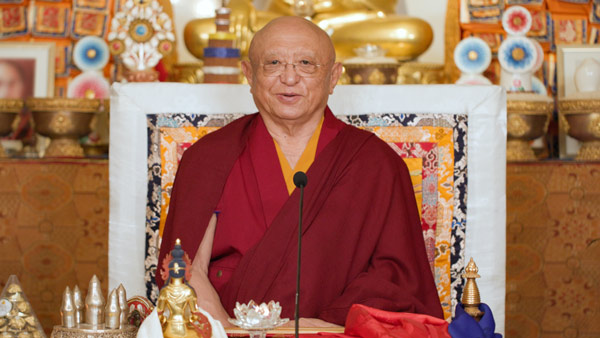
45:25
Guru yoga.
How should we understand what that means?
Well, here the word for Guru
in Tibetan is Lama.
And this syllable, La, gives us the sense
of unsurpassed, unsurpassed wisdom.
What is unsurpassed wisdom?
Unsurpassed wisdom is the knowing of the
basic nature of all sentient beings.
Suchness, that nature
that is the basic nature
of all sentient beings
without exception.
And also what is unsurpassed
is compassion.
How can we understand what is meant by
unsurpassed compassion?
It is the kind of
compassion that arises due
to training in that basic
nature of suchness.
The kind of compassion we are talking
about is not like our compassion,
which has limits, which is directed only
at some but not at others.
Here we are talking about a compassion
which is completely unbiased and also a
compassion which is completely effortless
and is directed towards everything,
everyone.
So this is what is meant by
unsurpassed compassion.
So that is what is meant by Guru here. This unsurpassed wisdom and compassion. What about yoga? The word yoga gives us the sense of connecting with what is real. What's real. The genuine, the authentic, the actual real thing, our nature, the natural state, just as it is. The genuine real actual nature, our true nature. We need to train in that. We need to connect with that. We have to attain that state.
So do you understand now what is meant by guru yoga?
Where is that present, that natural, genuine, real, true nature? Who's mind stream holds that? Where is it present? It present is in the realisation of the Buddhas of the Three times.
It is not only present in the realization of the Buddhas of the Three times, it is also present, the realization of that nauture, in bodhisattvas who remain on the bodhisattva-bumis, male and female bodhisattvas. It is present also in the awareness holders, male and female, that we speak of in a Vajrayana context. It is also present within, it must be present, it has to be present, within the realization of the gurus who hold the lineage up until the present moment. Because without that realization, it's not possible to really bring benefit to sentient beings and to the Dharma. Without that realization, the gurus, our gurus, would not be capable of, they wouldn't know how to help sentient beings, to help others and to support the Dharma. So this realization of this basic nature, suchness, the natural state, just as it is, is what a guru needs to come to realize and gain familiarity with themselves. And that then is what a guru must be skilled in bringing others to come to realize. That's what a guru is, that's what a lama is, someone who does that.
It is for this reason that our teacher, the Buddha said:
The sages cannot wash away the sins, the misdeeds of beings with water. That means the Buddhas of the past, the Buddhas of the present, the Buddhas of the future, all Buddhas, without any exception, cannot just wash away your misdeeds with water. They cannot. They cannot wipe away the suffering of beings with their hand. They cannot transfer their realization, just hand it over to you. But through teaching the truth of suchness, when you receive those teachings, you can be freed. So through teaching the truth of suchness, what does that mean? Well, it means the teachings on suchness itself, as they're given in the general vehicle of the Buddha Dharma, starting there, including the teachings given in the vehicle of the perfections, and especially here in the context of Vajrayana, the teachings on the truth of suchness are teachings on uncompounded luminosity, teachings on the nature which has its unique essence, nature and capacity, on the natural state which has as its identity the three kayas or the five kayas. Suchness, the natural state, which is the nature of all beings, every single sentient being of the six classes. It is the nature of all beings. It has always been the nature of all beings. And it is naturally present as the nature of every single sentient being, without exception. However, it's obscured, covered over by the two obscurations. And if we don't purify or clear away those two obscurations, then the two wisdoms also cannot be perfected. They cannot unfold. And so in order to be able to purify our obscurations, we also have to train in the practice of gathering the accumulations. Because when we gather the two accumulations, then our two obscurations do naturally decrease. And when that happens, then the two wisdoms then can be perfected, can unfold, and then we can attain the two kayas of perfect awakening. This is due to interdependent connection. All phenomena arise interdependently, right? And in relation to one another. So these days, you all have been contemplating the Four Mind-Changings. And due to the contemplation of these Four Mind-Changings, your attachment to the things of this life is decreasing, right? That's what happens when we contemplate the Four Mind-Changings. In short, our attachments to the things of this life decrease. And then you you've been training in taking refuge, in cultivating bodhicitta, you have been doing prostrations, you have been doing the practice of Vajrasattva, the practice of making offerings of the mandala, mandala offerings. Each one of these practices serves to reduce the negative emotions, to clear away obscurations. Then we come to the practice of Guru Yoga, which purifies the subtle aspects of afflictive emotions, evil deeds, breakages of vows and misdeeds that are connected with body, speech and mind, altogether. And Guru Yoga, this practice, which does this, is very powerful and very blessed. There are a lot of blessings connected with Guru Yoga practice. When we practice Guru Yoga authentically, this practice can purify our misdeeds and obscurations very quickly, very effectively and quickly. But what is really essential in order for that purification to happen, is pure perception and devotion. And this is difficult because what we're talking about here is pure perception, which is unchanging, devotion which is stable, unchanging. Because when we have those two, that kind of devotion and that kind of pure perception, then we can purify our evil deeds, our two obscurations and all of the habit patterns connected with that. We can do this also through the practice of gathering the two accumulations. And then when we gather those accumulations and purify those obscurations, then we become capable of giving rise to or perfecting the two wisdoms. That's why Guru Yoga is so important. Guru Yoga can be practiced in an extensive form, a medium length form, and a condensed form. And there are different aspects of the practice that we do. There's the aspect of supplication, and then the aspect of receiving the four empowerments, and then mingling the mind with the mind of the Guru.
We human beings have so many different thoughts, and there are two that have truly inconceivable good qualities. One is bodhichitta, the precious bodhichitta where we genuinely consider others more important than we consider ourselves.
When we have that kind of precious attitude of bodhichitta, we are able to very naturally, we will very naturally, refrain from harming others. Physically, verbally, and mentally. We won't harm. And we will also very naturally take up actions with our body, speech, and mind that really benefit others, that really help them. So what is it that makes it possible for bodhisattvas, male and female bodhisattvas, to benefit sentient beings lifetime after lifetime, rebirth after rebirth, to continually engage in actions that help and serve and benefit beings? What makes that possible? It's bodhichitta. It's that altruistic attitude of bodhichitta, it's the blessings and the power and the qualities of bodhichitta that are at the root of the bodhisattva's capacity to benefit beings in that way.
The second of these thoughts that is particularly important is to have faith. In general, we talk about faith, right? All religions actually are faith-based. You can say if someone is a faith-based person, then that means, by definition, that they are a religious person. You can say it like that. In the Buddhist tradition, we talk about different kinds of faith. We talk about the faith of sincere interest. We talk about longing faith. We talk about confident faith and irreversible faith. And each of these can be explained in a very profound way. But in particular, in the Vajrayana, when we talk about faith, when we talk about coming to recognize the natural state of uncompounded luminosity, I've talked a lot about that. You've heard me speak often about that. And when we speak about this wisdom, which is the true meaning of empowerment, you've also heard about that, I know. The ability to come to recognize that, depends on pure perception and intense, overwhelming devotion. And pure perception, genuine pure perception, is difficult. And when we're talking here about overwhelming devotion, we're talking about something that is so strong that there is no other thought there. All other thoughts are gone. And that devotion is so intense that you are almost at the verge of fainting, almost at the verge of passing out due to that intensity of that devotion. That kind of devotion can be a condition that brings you directly to the recognition of suchness, of your true nature. And there have been countless practitioners, who have recognized their nature that way. This kind of intense devotion, the reason why this happens is that this intense overwhelming, overwhelming devotion itself gathers the accumulations and this itself purifies our obscurations. And this becomes then the root of coming directly to a recognition of the natural state of suchness, that kind of intense devotion. But it's also difficult. It's difficult to give rise to that kind of devotion. It's not enough to just say, oh, well, it's hard. You can't just do that. We can't do that. We have to rely upon some kind of method to make it possible for us. And there are a lot of methods, like the Four Mind-Changings, like the five times a hundred thousand accumulations of the ngondro, like the Generation Stage, like recitation, like the Perfection Stage practices. All of these are help, helpers. They all help or benefit our capacity for giving rise to that kind of intense devotion. And if we know that, if we understand that these are all conditions that can help us with something that will bring us to the recognition of our nature, then we will do them happily. We will do them with delight. We will do them willingly, joyfully. If we don't know why, then sometimes we feel a little aversion to those kind of practices. It can happen.
The question is, devoted to what?
Rinpoche says, now I'm going to enjoy my tea. What kind of faith are we talking about here? When we talk about faith and longing, longing to what? Towards what? We're speaking about an overwhelming longing to recognize the natural state. And what is that kind of longing like? If we imagine a person who has not had anything to eat or to drink for days, that person has one pointed longing for food and drink. That's the only thing that they can think about. It's the only thing that they have any interest in at all. So this type of longing to recognize our nature is like this. This kind of overwhelming longing, faith, devotion towards that recognition. This becomes a condition that allows for the realization of the wisdom of realization, the realization of that to be transferred directly into our experience, to arise directly within our experience, that realization. How does it work? It works because of karmic cause and effect. Again, we're back to karmic cause and effect. It's because of having gathered the accumulations and purified obscurations extensively in previous lifetimes, for example, that the power, the strength of that person's misdeeds and obscurations and those habit patterns connected with that have been reduced. And that's what makes it possible to even be able to give rise to the intensity, that kind of intensity of devotion. That's what makes it even possible to give rise to that. So where does that capacity come from? It comes either from having gathered accumulations and purified obscurations for many, many, many lifetimes, or spent a lot of time in this life doing it. Gathering the accumulations, purifying our obscurations. It depends upon that. That is the condition that makes it possible to give rise to the intense devotion that makes it possible to come to the recognition of the natural state. That makes it possible even to give rise to this kind of effortless compassion that comes out of that recognition. All of that is not possible without gathering the accumulations and purifying our obscurations. Without that we can't give rise to that kind of overwhelming devotion that brings us close to the recognition and brings us into the recognition of our nature. Or to give rise to real, genuine love and compassion of Bodhicitta. If we haven't studied the Dharma, then these kind of practices of making, doing prostrations, offering the mandala, that kind of thing, it maybe looks just kind of like a game, like a children's game. Like what is even happening there, right? But it's not. If we understand the reason for these kind of practices, we can understand how incredibly essential they are for our Dharma practice. Because this is what makes it possible to give rise to the devotion, which is the condition that brings us directly to a recognition of our nature, the natural state. And then what is it like when that happens? That's important too. Here we can imagine a young child, very young, maybe not even quite barely able to speak, to walk, that kind of child, very, very young. Imagine - a child that age just completely loses sight of their mother. They cannot find their mother. The terror, the fear that is present in the mind of that child is inconceivable. But then, all of a sudden, they meet their mother. And all of that fear is instantly gone, instantly. And it is also accompanied by an overwhelming sense of joy. An overwhelming sense of joy at meeting mom again. An inconceivable sense of joy and freedom from fear. That's what it's like when we recognize the natural state. And this is something that's extremely important. This is something that we become capable of coming to recognize when we are able to give rise to genuine faith and devotion. And when we have that recognition at that point, then the kind of faith and trust that we have in general in the Buddha, the Dharma, and the Sangha, and in particular in the person who pointed out that nature so that we came to recognize it, the appreciation that we have, the very strong, intense appreciation we have for the kindness, for the qualities, that kind of appreciation unfolds into devotion. It increases our devotion more and more and more for the Three Jewels, for the teacher who pointed the nature out to us. And that devotion further increases our experience and our realization. This is how it works. So these things are all so important for us as Dharma practitioners. What kind of practitioner is capable of practicing like this? It is someone who is of very sharp faculties. Who is someone who has sharp faculties? It's someone who is capable of giving rise to unbearable compassion and unbearable devotion. Those are the characteristics of a person who has the highest capacity for practice. What makes that possible? What is the cause for being able to do that? Gathering the accumulations, purifying our obscurations. Is it clear? Is that clear? Clear? Now you all know why you are doing ngondro. Now you know so clearly. So today's talk is very important. Please listen a few times. Okay?
In Nepali, this is chalanka. means, it makes very clearly why we practice Vajrayana. It makes very clearly. Okay, so I stop here.
This isn't just my idea. This is something that is also an idea of many very intelligent and learned people who understand that a system that is in accordance with the view of science, the scientific perspective, is really important also in our world. Specifically, the view of emptiness and interdependence to the more people that have an understanding of that view, who know that view, the more people will be kind, will physically, verbally, and mentally do things that are kind and helpful, and will physically, verbally, and mentally avoid harming others. And so this is why this kind of view of emptiness and interdependence, it's very important that an understanding of that becomes increasingly present in our world.
The deluded experience of sentient beings. Is that true? Is that real? Or not? Are we confused? Are we deluded? And if so, how can we clear away that delusion? Through giving rise to an understanding of this view of emptiness and interdependence. Because otherwise people don't know. People don't understand that that is the cause that purifies our delusion. And that as long as we are caught up in the three poisons, attachment and aversion and confusion, for that long, we will suffer. We ourselves will suffer and we will bring suffering upon others. But due to our delusion, people are not even aware of that fact.
So the Lama Khenpo asked me to read this whole, what you're doing ngondro, Morning, afternoon, the whole set. I give wang, now I give lung. Also tri about the guru yoga, the main important point.
When we have love and compassion and bodhicitta and when we are able to give rise to a very strong overwhelming, intense devotion, then these factors are what allow us to come to a direct recognition of the natural state of suchness itself. This is something that is true. It's also something that makes sense, logically. We can understand that that is the case. And I've explained that quite clearly.
In the general vehicle of the Buddha Dharma, there is a focus on the type of faith that is sincere interest and even the faith that is a form of longing. But faith, which is this kind of confident faith and irreversible faith, is not emphasized so clearly in that tradition. In the Mahayana, we hear about the faith which is sincere interest, this kind of longing faith and confident faith. But this kind of intense devotion, overwhelming devotion that I have been speaking about today, this is really highlighted just in the Vajrayana. It's really highlighted and focused upon just in the Vajrayana. We don't find reference to that type of devotion in the general vehicle of the Buddha Dharma or in the vehicle of the perfections. The words and the meaning about this type of devotion we don't find there.
This kind of devotion where you are at the verge of fainting, at the verge of passing out, that kind of instruction, that is a pith instruction. Okay, thank you.
So that is what is meant by Guru here. This unsurpassed wisdom and compassion. What about yoga? The word yoga gives us the sense of connecting with what is real. What's real. The genuine, the authentic, the actual real thing, our nature, the natural state, just as it is. The genuine real actual nature, our true nature. We need to train in that. We need to connect with that. We have to attain that state.
So do you understand now what is meant by guru yoga?
Where is that present, that natural, genuine, real, true nature? Who's mind stream holds that? Where is it present? It present is in the realisation of the Buddhas of the Three times.
It is not only present in the realization of the Buddhas of the Three times, it is also present, the realization of that nauture, in bodhisattvas who remain on the bodhisattva-bumis, male and female bodhisattvas. It is present also in the awareness holders, male and female, that we speak of in a Vajrayana context. It is also present within, it must be present, it has to be present, within the realization of the gurus who hold the lineage up until the present moment. Because without that realization, it's not possible to really bring benefit to sentient beings and to the Dharma. Without that realization, the gurus, our gurus, would not be capable of, they wouldn't know how to help sentient beings, to help others and to support the Dharma. So this realization of this basic nature, suchness, the natural state, just as it is, is what a guru needs to come to realize and gain familiarity with themselves. And that then is what a guru must be skilled in bringing others to come to realize. That's what a guru is, that's what a lama is, someone who does that.
It is for this reason that our teacher, the Buddha said:
The sages cannot wash away the sins, the misdeeds of beings with water. That means the Buddhas of the past, the Buddhas of the present, the Buddhas of the future, all Buddhas, without any exception, cannot just wash away your misdeeds with water. They cannot. They cannot wipe away the suffering of beings with their hand. They cannot transfer their realization, just hand it over to you. But through teaching the truth of suchness, when you receive those teachings, you can be freed. So through teaching the truth of suchness, what does that mean? Well, it means the teachings on suchness itself, as they're given in the general vehicle of the Buddha Dharma, starting there, including the teachings given in the vehicle of the perfections, and especially here in the context of Vajrayana, the teachings on the truth of suchness are teachings on uncompounded luminosity, teachings on the nature which has its unique essence, nature and capacity, on the natural state which has as its identity the three kayas or the five kayas. Suchness, the natural state, which is the nature of all beings, every single sentient being of the six classes. It is the nature of all beings. It has always been the nature of all beings. And it is naturally present as the nature of every single sentient being, without exception. However, it's obscured, covered over by the two obscurations. And if we don't purify or clear away those two obscurations, then the two wisdoms also cannot be perfected. They cannot unfold. And so in order to be able to purify our obscurations, we also have to train in the practice of gathering the accumulations. Because when we gather the two accumulations, then our two obscurations do naturally decrease. And when that happens, then the two wisdoms then can be perfected, can unfold, and then we can attain the two kayas of perfect awakening. This is due to interdependent connection. All phenomena arise interdependently, right? And in relation to one another. So these days, you all have been contemplating the Four Mind-Changings. And due to the contemplation of these Four Mind-Changings, your attachment to the things of this life is decreasing, right? That's what happens when we contemplate the Four Mind-Changings. In short, our attachments to the things of this life decrease. And then you you've been training in taking refuge, in cultivating bodhicitta, you have been doing prostrations, you have been doing the practice of Vajrasattva, the practice of making offerings of the mandala, mandala offerings. Each one of these practices serves to reduce the negative emotions, to clear away obscurations. Then we come to the practice of Guru Yoga, which purifies the subtle aspects of afflictive emotions, evil deeds, breakages of vows and misdeeds that are connected with body, speech and mind, altogether. And Guru Yoga, this practice, which does this, is very powerful and very blessed. There are a lot of blessings connected with Guru Yoga practice. When we practice Guru Yoga authentically, this practice can purify our misdeeds and obscurations very quickly, very effectively and quickly. But what is really essential in order for that purification to happen, is pure perception and devotion. And this is difficult because what we're talking about here is pure perception, which is unchanging, devotion which is stable, unchanging. Because when we have those two, that kind of devotion and that kind of pure perception, then we can purify our evil deeds, our two obscurations and all of the habit patterns connected with that. We can do this also through the practice of gathering the two accumulations. And then when we gather those accumulations and purify those obscurations, then we become capable of giving rise to or perfecting the two wisdoms. That's why Guru Yoga is so important. Guru Yoga can be practiced in an extensive form, a medium length form, and a condensed form. And there are different aspects of the practice that we do. There's the aspect of supplication, and then the aspect of receiving the four empowerments, and then mingling the mind with the mind of the Guru.
We human beings have so many different thoughts, and there are two that have truly inconceivable good qualities. One is bodhichitta, the precious bodhichitta where we genuinely consider others more important than we consider ourselves.
When we have that kind of precious attitude of bodhichitta, we are able to very naturally, we will very naturally, refrain from harming others. Physically, verbally, and mentally. We won't harm. And we will also very naturally take up actions with our body, speech, and mind that really benefit others, that really help them. So what is it that makes it possible for bodhisattvas, male and female bodhisattvas, to benefit sentient beings lifetime after lifetime, rebirth after rebirth, to continually engage in actions that help and serve and benefit beings? What makes that possible? It's bodhichitta. It's that altruistic attitude of bodhichitta, it's the blessings and the power and the qualities of bodhichitta that are at the root of the bodhisattva's capacity to benefit beings in that way.
The second of these thoughts that is particularly important is to have faith. In general, we talk about faith, right? All religions actually are faith-based. You can say if someone is a faith-based person, then that means, by definition, that they are a religious person. You can say it like that. In the Buddhist tradition, we talk about different kinds of faith. We talk about the faith of sincere interest. We talk about longing faith. We talk about confident faith and irreversible faith. And each of these can be explained in a very profound way. But in particular, in the Vajrayana, when we talk about faith, when we talk about coming to recognize the natural state of uncompounded luminosity, I've talked a lot about that. You've heard me speak often about that. And when we speak about this wisdom, which is the true meaning of empowerment, you've also heard about that, I know. The ability to come to recognize that, depends on pure perception and intense, overwhelming devotion. And pure perception, genuine pure perception, is difficult. And when we're talking here about overwhelming devotion, we're talking about something that is so strong that there is no other thought there. All other thoughts are gone. And that devotion is so intense that you are almost at the verge of fainting, almost at the verge of passing out due to that intensity of that devotion. That kind of devotion can be a condition that brings you directly to the recognition of suchness, of your true nature. And there have been countless practitioners, who have recognized their nature that way. This kind of intense devotion, the reason why this happens is that this intense overwhelming, overwhelming devotion itself gathers the accumulations and this itself purifies our obscurations. And this becomes then the root of coming directly to a recognition of the natural state of suchness, that kind of intense devotion. But it's also difficult. It's difficult to give rise to that kind of devotion. It's not enough to just say, oh, well, it's hard. You can't just do that. We can't do that. We have to rely upon some kind of method to make it possible for us. And there are a lot of methods, like the Four Mind-Changings, like the five times a hundred thousand accumulations of the ngondro, like the Generation Stage, like recitation, like the Perfection Stage practices. All of these are help, helpers. They all help or benefit our capacity for giving rise to that kind of intense devotion. And if we know that, if we understand that these are all conditions that can help us with something that will bring us to the recognition of our nature, then we will do them happily. We will do them with delight. We will do them willingly, joyfully. If we don't know why, then sometimes we feel a little aversion to those kind of practices. It can happen.
The question is, devoted to what?
Rinpoche says, now I'm going to enjoy my tea. What kind of faith are we talking about here? When we talk about faith and longing, longing to what? Towards what? We're speaking about an overwhelming longing to recognize the natural state. And what is that kind of longing like? If we imagine a person who has not had anything to eat or to drink for days, that person has one pointed longing for food and drink. That's the only thing that they can think about. It's the only thing that they have any interest in at all. So this type of longing to recognize our nature is like this. This kind of overwhelming longing, faith, devotion towards that recognition. This becomes a condition that allows for the realization of the wisdom of realization, the realization of that to be transferred directly into our experience, to arise directly within our experience, that realization. How does it work? It works because of karmic cause and effect. Again, we're back to karmic cause and effect. It's because of having gathered the accumulations and purified obscurations extensively in previous lifetimes, for example, that the power, the strength of that person's misdeeds and obscurations and those habit patterns connected with that have been reduced. And that's what makes it possible to even be able to give rise to the intensity, that kind of intensity of devotion. That's what makes it even possible to give rise to that. So where does that capacity come from? It comes either from having gathered accumulations and purified obscurations for many, many, many lifetimes, or spent a lot of time in this life doing it. Gathering the accumulations, purifying our obscurations. It depends upon that. That is the condition that makes it possible to give rise to the intense devotion that makes it possible to come to the recognition of the natural state. That makes it possible even to give rise to this kind of effortless compassion that comes out of that recognition. All of that is not possible without gathering the accumulations and purifying our obscurations. Without that we can't give rise to that kind of overwhelming devotion that brings us close to the recognition and brings us into the recognition of our nature. Or to give rise to real, genuine love and compassion of Bodhicitta. If we haven't studied the Dharma, then these kind of practices of making, doing prostrations, offering the mandala, that kind of thing, it maybe looks just kind of like a game, like a children's game. Like what is even happening there, right? But it's not. If we understand the reason for these kind of practices, we can understand how incredibly essential they are for our Dharma practice. Because this is what makes it possible to give rise to the devotion, which is the condition that brings us directly to a recognition of our nature, the natural state. And then what is it like when that happens? That's important too. Here we can imagine a young child, very young, maybe not even quite barely able to speak, to walk, that kind of child, very, very young. Imagine - a child that age just completely loses sight of their mother. They cannot find their mother. The terror, the fear that is present in the mind of that child is inconceivable. But then, all of a sudden, they meet their mother. And all of that fear is instantly gone, instantly. And it is also accompanied by an overwhelming sense of joy. An overwhelming sense of joy at meeting mom again. An inconceivable sense of joy and freedom from fear. That's what it's like when we recognize the natural state. And this is something that's extremely important. This is something that we become capable of coming to recognize when we are able to give rise to genuine faith and devotion. And when we have that recognition at that point, then the kind of faith and trust that we have in general in the Buddha, the Dharma, and the Sangha, and in particular in the person who pointed out that nature so that we came to recognize it, the appreciation that we have, the very strong, intense appreciation we have for the kindness, for the qualities, that kind of appreciation unfolds into devotion. It increases our devotion more and more and more for the Three Jewels, for the teacher who pointed the nature out to us. And that devotion further increases our experience and our realization. This is how it works. So these things are all so important for us as Dharma practitioners. What kind of practitioner is capable of practicing like this? It is someone who is of very sharp faculties. Who is someone who has sharp faculties? It's someone who is capable of giving rise to unbearable compassion and unbearable devotion. Those are the characteristics of a person who has the highest capacity for practice. What makes that possible? What is the cause for being able to do that? Gathering the accumulations, purifying our obscurations. Is it clear? Is that clear? Clear? Now you all know why you are doing ngondro. Now you know so clearly. So today's talk is very important. Please listen a few times. Okay?
In Nepali, this is chalanka. means, it makes very clearly why we practice Vajrayana. It makes very clearly. Okay, so I stop here.
This isn't just my idea. This is something that is also an idea of many very intelligent and learned people who understand that a system that is in accordance with the view of science, the scientific perspective, is really important also in our world. Specifically, the view of emptiness and interdependence to the more people that have an understanding of that view, who know that view, the more people will be kind, will physically, verbally, and mentally do things that are kind and helpful, and will physically, verbally, and mentally avoid harming others. And so this is why this kind of view of emptiness and interdependence, it's very important that an understanding of that becomes increasingly present in our world.
The deluded experience of sentient beings. Is that true? Is that real? Or not? Are we confused? Are we deluded? And if so, how can we clear away that delusion? Through giving rise to an understanding of this view of emptiness and interdependence. Because otherwise people don't know. People don't understand that that is the cause that purifies our delusion. And that as long as we are caught up in the three poisons, attachment and aversion and confusion, for that long, we will suffer. We ourselves will suffer and we will bring suffering upon others. But due to our delusion, people are not even aware of that fact.
So the Lama Khenpo asked me to read this whole, what you're doing ngondro, Morning, afternoon, the whole set. I give wang, now I give lung. Also tri about the guru yoga, the main important point.
When we have love and compassion and bodhicitta and when we are able to give rise to a very strong overwhelming, intense devotion, then these factors are what allow us to come to a direct recognition of the natural state of suchness itself. This is something that is true. It's also something that makes sense, logically. We can understand that that is the case. And I've explained that quite clearly.
In the general vehicle of the Buddha Dharma, there is a focus on the type of faith that is sincere interest and even the faith that is a form of longing. But faith, which is this kind of confident faith and irreversible faith, is not emphasized so clearly in that tradition. In the Mahayana, we hear about the faith which is sincere interest, this kind of longing faith and confident faith. But this kind of intense devotion, overwhelming devotion that I have been speaking about today, this is really highlighted just in the Vajrayana. It's really highlighted and focused upon just in the Vajrayana. We don't find reference to that type of devotion in the general vehicle of the Buddha Dharma or in the vehicle of the perfections. The words and the meaning about this type of devotion we don't find there.
This kind of devotion where you are at the verge of fainting, at the verge of passing out, that kind of instruction, that is a pith instruction. Okay, thank you.
45:24
Guru yoga.
How should we understand what that means?
Well, here the word for Guru
in Tibetan is Lama.
And this syllable, La, gives us the sense
of unsurpassed, unsurpassed wisdom.
What is unsurpassed wisdom?
Unsurpassed wisdom is the knowing of the
basic nature of all sentient beings.
Suchness, that nature
that is the basic nature
of all sentient beings
without exception.
And also what is unsurpassed
is compassion.
How can we understand what is meant by
unsurpassed compassion?
It is the kind of
compassion that arises due
to training in that basic
nature of suchness.
The kind of compassion we are talking
about is not like our compassion,
which has limits, which is directed only
at some but not at others.
Here we are talking about a compassion
which is completely unbiased and also a
compassion which is completely effortless
and is directed towards everything,
everyone.
So this is what is meant by
unsurpassed compassion.
So that is what is meant by Guru here. This unsurpassed wisdom and compassion. What about yoga? The word yoga gives us the sense of connecting with what is real. What's real. The genuine, the authentic, the actual real thing, our nature, the natural state, just as it is. The genuine real actual nature, our true nature. We need to train in that. We need to connect with that. We have to attain that state.
So do you understand now what is meant by guru yoga?
Where is that present, that natural, genuine, real, true nature? Who's mind stream holds that? Where is it present? It present is in the realisation of the Buddhas of the Three times.
It is not only present in the realization of the Buddhas of the Three times, it is also present, the realization of that nauture, in bodhisattvas who remain on the bodhisattva-bumis, male and female bodhisattvas. It is present also in the awareness holders, male and female, that we speak of in a Vajrayana context. It is also present within, it must be present, it has to be present, within the realization of the gurus who hold the lineage up until the present moment. Because without that realization, it's not possible to really bring benefit to sentient beings and to the Dharma. Without that realization, the gurus, our gurus, would not be capable of, they wouldn't know how to help sentient beings, to help others and to support the Dharma. So this realization of this basic nature, suchness, the natural state, just as it is, is what a guru needs to come to realize and gain familiarity with themselves. And that then is what a guru must be skilled in bringing others to come to realize. That's what a guru is, that's what a lama is, someone who does that.
It is for this reason that our teacher, the Buddha said:
The sages cannot wash away the sins, the misdeeds of beings with water. That means the Buddhas of the past, the Buddhas of the present, the Buddhas of the future, all Buddhas, without any exception, cannot just wash away your misdeeds with water. They cannot. They cannot wipe away the suffering of beings with their hand. They cannot transfer their realization, just hand it over to you. But through teaching the truth of suchness, when you receive those teachings, you can be freed. So through teaching the truth of suchness, what does that mean? Well, it means the teachings on suchness itself, as they're given in the general vehicle of the Buddha Dharma, starting there, including the teachings given in the vehicle of the perfections, and especially here in the context of Vajrayana, the teachings on the truth of suchness are teachings on uncompounded luminosity, teachings on the nature which has its unique essence, nature and capacity, on the natural state which has as its identity the three kayas or the five kayas. Suchness, the natural state, which is the nature of all beings, every single sentient being of the six classes. It is the nature of all beings. It has always been the nature of all beings. And it is naturally present as the nature of every single sentient being, without exception. However, it's obscured, covered over by the two obscurations. And if we don't purify or clear away those two obscurations, then the two wisdoms also cannot be perfected. They cannot unfold. And so in order to be able to purify our obscurations, we also have to train in the practice of gathering the accumulations. Because when we gather the two accumulations, then our two obscurations do naturally decrease. And when that happens, then the two wisdoms then can be perfected, can unfold, and then we can attain the two kayas of perfect awakening. This is due to interdependent connection. All phenomena arise interdependently, right? And in relation to one another. So these days, you all have been contemplating the Four Mind-Changings. And due to the contemplation of these Four Mind-Changings, your attachment to the things of this life is decreasing, right? That's what happens when we contemplate the Four Mind-Changings. In short, our attachments to the things of this life decrease. And then you you've been training in taking refuge, in cultivating bodhicitta, you have been doing prostrations, you have been doing the practice of Vajrasattva, the practice of making offerings of the mandala, mandala offerings. Each one of these practices serves to reduce the negative emotions, to clear away obscurations. Then we come to the practice of Guru Yoga, which purifies the subtle aspects of afflictive emotions, evil deeds, breakages of vows and misdeeds that are connected with body, speech and mind, altogether. And Guru Yoga, this practice, which does this, is very powerful and very blessed. There are a lot of blessings connected with Guru Yoga practice. When we practice Guru Yoga authentically, this practice can purify our misdeeds and obscurations very quickly, very effectively and quickly. But what is really essential in order for that purification to happen, is pure perception and devotion. And this is difficult because what we're talking about here is pure perception, which is unchanging, devotion which is stable, unchanging. Because when we have those two, that kind of devotion and that kind of pure perception, then we can purify our evil deeds, our two obscurations and all of the habit patterns connected with that. We can do this also through the practice of gathering the two accumulations. And then when we gather those accumulations and purify those obscurations, then we become capable of giving rise to or perfecting the two wisdoms. That's why Guru Yoga is so important. Guru Yoga can be practiced in an extensive form, a medium length form, and a condensed form. And there are different aspects of the practice that we do. There's the aspect of supplication, and then the aspect of receiving the four empowerments, and then mingling the mind with the mind of the Guru.
We human beings have so many different thoughts, and there are two that have truly inconceivable good qualities. One is bodhichitta, the precious bodhichitta where we genuinely consider others more important than we consider ourselves.
When we have that kind of precious attitude of bodhichitta, we are able to very naturally, we will very naturally, refrain from harming others. Physically, verbally, and mentally. We won't harm. And we will also very naturally take up actions with our body, speech, and mind that really benefit others, that really help them. So what is it that makes it possible for bodhisattvas, male and female bodhisattvas, to benefit sentient beings lifetime after lifetime, rebirth after rebirth, to continually engage in actions that help and serve and benefit beings? What makes that possible? It's bodhichitta. It's that altruistic attitude of bodhichitta, it's the blessings and the power and the qualities of bodhichitta that are at the root of the bodhisattva's capacity to benefit beings in that way.
The second of these thoughts that is particularly important is to have faith. In general, we talk about faith, right? All religions actually are faith-based. You can say if someone is a faith-based person, then that means, by definition, that they are a religious person. You can say it like that. In the Buddhist tradition, we talk about different kinds of faith. We talk about the faith of sincere interest. We talk about longing faith. We talk about confident faith and irreversible faith. And each of these can be explained in a very profound way. But in particular, in the Vajrayana, when we talk about faith, when we talk about coming to recognize the natural state of uncompounded luminosity, I've talked a lot about that. You've heard me speak often about that. And when we speak about this wisdom, which is the true meaning of empowerment, you've also heard about that, I know. The ability to come to recognize that, depends on pure perception and intense, overwhelming devotion. And pure perception, genuine pure perception, is difficult. And when we're talking here about overwhelming devotion, we're talking about something that is so strong that there is no other thought there. All other thoughts are gone. And that devotion is so intense that you are almost at the verge of fainting, almost at the verge of passing out due to that intensity of that devotion. That kind of devotion can be a condition that brings you directly to the recognition of suchness, of your true nature. And there have been countless practitioners, who have recognized their nature that way. This kind of intense devotion, the reason why this happens is that this intense overwhelming, overwhelming devotion itself gathers the accumulations and this itself purifies our obscurations. And this becomes then the root of coming directly to a recognition of the natural state of suchness, that kind of intense devotion. But it's also difficult. It's difficult to give rise to that kind of devotion. It's not enough to just say, oh, well, it's hard. You can't just do that. We can't do that. We have to rely upon some kind of method to make it possible for us. And there are a lot of methods, like the Four Mind-Changings, like the five times a hundred thousand accumulations of the ngondro, like the Generation Stage, like recitation, like the Perfection Stage practices. All of these are help, helpers. They all help or benefit our capacity for giving rise to that kind of intense devotion. And if we know that, if we understand that these are all conditions that can help us with something that will bring us to the recognition of our nature, then we will do them happily. We will do them with delight. We will do them willingly, joyfully. If we don't know why, then sometimes we feel a little aversion to those kind of practices. It can happen.
The question is, devoted to what?
Rinpoche says, now I'm going to enjoy my tea. What kind of faith are we talking about here? When we talk about faith and longing, longing to what? Towards what? We're speaking about an overwhelming longing to recognize the natural state. And what is that kind of longing like? If we imagine a person who has not had anything to eat or to drink for days, that person has one pointed longing for food and drink. That's the only thing that they can think about. It's the only thing that they have any interest in at all. So this type of longing to recognize our nature is like this. This kind of overwhelming longing, faith, devotion towards that recognition. This becomes a condition that allows for the realization of the wisdom of realization, the realization of that to be transferred directly into our experience, to arise directly within our experience, that realization. How does it work? It works because of karmic cause and effect. Again, we're back to karmic cause and effect. It's because of having gathered the accumulations and purified obscurations extensively in previous lifetimes, for example, that the power, the strength of that person's misdeeds and obscurations and those habit patterns connected with that have been reduced. And that's what makes it possible to even be able to give rise to the intensity, that kind of intensity of devotion. That's what makes it even possible to give rise to that. So where does that capacity come from? It comes either from having gathered accumulations and purified obscurations for many, many, many lifetimes, or spent a lot of time in this life doing it. Gathering the accumulations, purifying our obscurations. It depends upon that. That is the condition that makes it possible to give rise to the intense devotion that makes it possible to come to the recognition of the natural state. That makes it possible even to give rise to this kind of effortless compassion that comes out of that recognition. All of that is not possible without gathering the accumulations and purifying our obscurations. Without that we can't give rise to that kind of overwhelming devotion that brings us close to the recognition and brings us into the recognition of our nature. Or to give rise to real, genuine love and compassion of Bodhicitta. If we haven't studied the Dharma, then these kind of practices of making, doing prostrations, offering the mandala, that kind of thing, it maybe looks just kind of like a game, like a children's game. Like what is even happening there, right? But it's not. If we understand the reason for these kind of practices, we can understand how incredibly essential they are for our Dharma practice. Because this is what makes it possible to give rise to the devotion, which is the condition that brings us directly to a recognition of our nature, the natural state. And then what is it like when that happens? That's important too. Here we can imagine a young child, very young, maybe not even quite barely able to speak, to walk, that kind of child, very, very young. Imagine - a child that age just completely loses sight of their mother. They cannot find their mother. The terror, the fear that is present in the mind of that child is inconceivable. But then, all of a sudden, they meet their mother. And all of that fear is instantly gone, instantly. And it is also accompanied by an overwhelming sense of joy. An overwhelming sense of joy at meeting mom again. An inconceivable sense of joy and freedom from fear. That's what it's like when we recognize the natural state. And this is something that's extremely important. This is something that we become capable of coming to recognize when we are able to give rise to genuine faith and devotion. And when we have that recognition at that point, then the kind of faith and trust that we have in general in the Buddha, the Dharma, and the Sangha, and in particular in the person who pointed out that nature so that we came to recognize it, the appreciation that we have, the very strong, intense appreciation we have for the kindness, for the qualities, that kind of appreciation unfolds into devotion. It increases our devotion more and more and more for the Three Jewels, for the teacher who pointed the nature out to us. And that devotion further increases our experience and our realization. This is how it works. So these things are all so important for us as Dharma practitioners. What kind of practitioner is capable of practicing like this? It is someone who is of very sharp faculties. Who is someone who has sharp faculties? It's someone who is capable of giving rise to unbearable compassion and unbearable devotion. Those are the characteristics of a person who has the highest capacity for practice. What makes that possible? What is the cause for being able to do that? Gathering the accumulations, purifying our obscurations. Is it clear? Is that clear? Clear? Now you all know why you are doing ngondro. Now you know so clearly. So today's talk is very important. Please listen a few times. Okay?
In Nepali, this is chalanka. means, it makes very clearly why we practice Vajrayana. It makes very clearly. Okay, so I stop here.
This isn't just my idea. This is something that is also an idea of many very intelligent and learned people who understand that a system that is in accordance with the view of science, the scientific perspective, is really important also in our world. Specifically, the view of emptiness and interdependence to the more people that have an understanding of that view, who know that view, the more people will be kind, will physically, verbally, and mentally do things that are kind and helpful, and will physically, verbally, and mentally avoid harming others. And so this is why this kind of view of emptiness and interdependence, it's very important that an understanding of that becomes increasingly present in our world.
The deluded experience of sentient beings. Is that true? Is that real? Or not? Are we confused? Are we deluded? And if so, how can we clear away that delusion? Through giving rise to an understanding of this view of emptiness and interdependence. Because otherwise people don't know. People don't understand that that is the cause that purifies our delusion. And that as long as we are caught up in the three poisons, attachment and aversion and confusion, for that long, we will suffer. We ourselves will suffer and we will bring suffering upon others. But due to our delusion, people are not even aware of that fact.
So the Lama Khenpo asked me to read this whole, what you're doing ngondro, Morning, afternoon, the whole set. I give wang, now I give lung. Also tri about the guru yoga, the main important point.
When we have love and compassion and bodhicitta and when we are able to give rise to a very strong overwhelming, intense devotion, then these factors are what allow us to come to a direct recognition of the natural state of suchness itself. This is something that is true. It's also something that makes sense, logically. We can understand that that is the case. And I've explained that quite clearly.
In the general vehicle of the Buddha Dharma, there is a focus on the type of faith that is sincere interest and even the faith that is a form of longing. But faith, which is this kind of confident faith and irreversible faith, is not emphasized so clearly in that tradition. In the Mahayana, we hear about the faith which is sincere interest, this kind of longing faith and confident faith. But this kind of intense devotion, overwhelming devotion that I have been speaking about today, this is really highlighted just in the Vajrayana. It's really highlighted and focused upon just in the Vajrayana. We don't find reference to that type of devotion in the general vehicle of the Buddha Dharma or in the vehicle of the perfections. The words and the meaning about this type of devotion we don't find there.
This kind of devotion where you are at the verge of fainting, at the verge of passing out, that kind of instruction, that is a pith instruction. Okay, thank you.
So that is what is meant by Guru here. This unsurpassed wisdom and compassion. What about yoga? The word yoga gives us the sense of connecting with what is real. What's real. The genuine, the authentic, the actual real thing, our nature, the natural state, just as it is. The genuine real actual nature, our true nature. We need to train in that. We need to connect with that. We have to attain that state.
So do you understand now what is meant by guru yoga?
Where is that present, that natural, genuine, real, true nature? Who's mind stream holds that? Where is it present? It present is in the realisation of the Buddhas of the Three times.
It is not only present in the realization of the Buddhas of the Three times, it is also present, the realization of that nauture, in bodhisattvas who remain on the bodhisattva-bumis, male and female bodhisattvas. It is present also in the awareness holders, male and female, that we speak of in a Vajrayana context. It is also present within, it must be present, it has to be present, within the realization of the gurus who hold the lineage up until the present moment. Because without that realization, it's not possible to really bring benefit to sentient beings and to the Dharma. Without that realization, the gurus, our gurus, would not be capable of, they wouldn't know how to help sentient beings, to help others and to support the Dharma. So this realization of this basic nature, suchness, the natural state, just as it is, is what a guru needs to come to realize and gain familiarity with themselves. And that then is what a guru must be skilled in bringing others to come to realize. That's what a guru is, that's what a lama is, someone who does that.
It is for this reason that our teacher, the Buddha said:
The sages cannot wash away the sins, the misdeeds of beings with water. That means the Buddhas of the past, the Buddhas of the present, the Buddhas of the future, all Buddhas, without any exception, cannot just wash away your misdeeds with water. They cannot. They cannot wipe away the suffering of beings with their hand. They cannot transfer their realization, just hand it over to you. But through teaching the truth of suchness, when you receive those teachings, you can be freed. So through teaching the truth of suchness, what does that mean? Well, it means the teachings on suchness itself, as they're given in the general vehicle of the Buddha Dharma, starting there, including the teachings given in the vehicle of the perfections, and especially here in the context of Vajrayana, the teachings on the truth of suchness are teachings on uncompounded luminosity, teachings on the nature which has its unique essence, nature and capacity, on the natural state which has as its identity the three kayas or the five kayas. Suchness, the natural state, which is the nature of all beings, every single sentient being of the six classes. It is the nature of all beings. It has always been the nature of all beings. And it is naturally present as the nature of every single sentient being, without exception. However, it's obscured, covered over by the two obscurations. And if we don't purify or clear away those two obscurations, then the two wisdoms also cannot be perfected. They cannot unfold. And so in order to be able to purify our obscurations, we also have to train in the practice of gathering the accumulations. Because when we gather the two accumulations, then our two obscurations do naturally decrease. And when that happens, then the two wisdoms then can be perfected, can unfold, and then we can attain the two kayas of perfect awakening. This is due to interdependent connection. All phenomena arise interdependently, right? And in relation to one another. So these days, you all have been contemplating the Four Mind-Changings. And due to the contemplation of these Four Mind-Changings, your attachment to the things of this life is decreasing, right? That's what happens when we contemplate the Four Mind-Changings. In short, our attachments to the things of this life decrease. And then you you've been training in taking refuge, in cultivating bodhicitta, you have been doing prostrations, you have been doing the practice of Vajrasattva, the practice of making offerings of the mandala, mandala offerings. Each one of these practices serves to reduce the negative emotions, to clear away obscurations. Then we come to the practice of Guru Yoga, which purifies the subtle aspects of afflictive emotions, evil deeds, breakages of vows and misdeeds that are connected with body, speech and mind, altogether. And Guru Yoga, this practice, which does this, is very powerful and very blessed. There are a lot of blessings connected with Guru Yoga practice. When we practice Guru Yoga authentically, this practice can purify our misdeeds and obscurations very quickly, very effectively and quickly. But what is really essential in order for that purification to happen, is pure perception and devotion. And this is difficult because what we're talking about here is pure perception, which is unchanging, devotion which is stable, unchanging. Because when we have those two, that kind of devotion and that kind of pure perception, then we can purify our evil deeds, our two obscurations and all of the habit patterns connected with that. We can do this also through the practice of gathering the two accumulations. And then when we gather those accumulations and purify those obscurations, then we become capable of giving rise to or perfecting the two wisdoms. That's why Guru Yoga is so important. Guru Yoga can be practiced in an extensive form, a medium length form, and a condensed form. And there are different aspects of the practice that we do. There's the aspect of supplication, and then the aspect of receiving the four empowerments, and then mingling the mind with the mind of the Guru.
We human beings have so many different thoughts, and there are two that have truly inconceivable good qualities. One is bodhichitta, the precious bodhichitta where we genuinely consider others more important than we consider ourselves.
When we have that kind of precious attitude of bodhichitta, we are able to very naturally, we will very naturally, refrain from harming others. Physically, verbally, and mentally. We won't harm. And we will also very naturally take up actions with our body, speech, and mind that really benefit others, that really help them. So what is it that makes it possible for bodhisattvas, male and female bodhisattvas, to benefit sentient beings lifetime after lifetime, rebirth after rebirth, to continually engage in actions that help and serve and benefit beings? What makes that possible? It's bodhichitta. It's that altruistic attitude of bodhichitta, it's the blessings and the power and the qualities of bodhichitta that are at the root of the bodhisattva's capacity to benefit beings in that way.
The second of these thoughts that is particularly important is to have faith. In general, we talk about faith, right? All religions actually are faith-based. You can say if someone is a faith-based person, then that means, by definition, that they are a religious person. You can say it like that. In the Buddhist tradition, we talk about different kinds of faith. We talk about the faith of sincere interest. We talk about longing faith. We talk about confident faith and irreversible faith. And each of these can be explained in a very profound way. But in particular, in the Vajrayana, when we talk about faith, when we talk about coming to recognize the natural state of uncompounded luminosity, I've talked a lot about that. You've heard me speak often about that. And when we speak about this wisdom, which is the true meaning of empowerment, you've also heard about that, I know. The ability to come to recognize that, depends on pure perception and intense, overwhelming devotion. And pure perception, genuine pure perception, is difficult. And when we're talking here about overwhelming devotion, we're talking about something that is so strong that there is no other thought there. All other thoughts are gone. And that devotion is so intense that you are almost at the verge of fainting, almost at the verge of passing out due to that intensity of that devotion. That kind of devotion can be a condition that brings you directly to the recognition of suchness, of your true nature. And there have been countless practitioners, who have recognized their nature that way. This kind of intense devotion, the reason why this happens is that this intense overwhelming, overwhelming devotion itself gathers the accumulations and this itself purifies our obscurations. And this becomes then the root of coming directly to a recognition of the natural state of suchness, that kind of intense devotion. But it's also difficult. It's difficult to give rise to that kind of devotion. It's not enough to just say, oh, well, it's hard. You can't just do that. We can't do that. We have to rely upon some kind of method to make it possible for us. And there are a lot of methods, like the Four Mind-Changings, like the five times a hundred thousand accumulations of the ngondro, like the Generation Stage, like recitation, like the Perfection Stage practices. All of these are help, helpers. They all help or benefit our capacity for giving rise to that kind of intense devotion. And if we know that, if we understand that these are all conditions that can help us with something that will bring us to the recognition of our nature, then we will do them happily. We will do them with delight. We will do them willingly, joyfully. If we don't know why, then sometimes we feel a little aversion to those kind of practices. It can happen.
The question is, devoted to what?
Rinpoche says, now I'm going to enjoy my tea. What kind of faith are we talking about here? When we talk about faith and longing, longing to what? Towards what? We're speaking about an overwhelming longing to recognize the natural state. And what is that kind of longing like? If we imagine a person who has not had anything to eat or to drink for days, that person has one pointed longing for food and drink. That's the only thing that they can think about. It's the only thing that they have any interest in at all. So this type of longing to recognize our nature is like this. This kind of overwhelming longing, faith, devotion towards that recognition. This becomes a condition that allows for the realization of the wisdom of realization, the realization of that to be transferred directly into our experience, to arise directly within our experience, that realization. How does it work? It works because of karmic cause and effect. Again, we're back to karmic cause and effect. It's because of having gathered the accumulations and purified obscurations extensively in previous lifetimes, for example, that the power, the strength of that person's misdeeds and obscurations and those habit patterns connected with that have been reduced. And that's what makes it possible to even be able to give rise to the intensity, that kind of intensity of devotion. That's what makes it even possible to give rise to that. So where does that capacity come from? It comes either from having gathered accumulations and purified obscurations for many, many, many lifetimes, or spent a lot of time in this life doing it. Gathering the accumulations, purifying our obscurations. It depends upon that. That is the condition that makes it possible to give rise to the intense devotion that makes it possible to come to the recognition of the natural state. That makes it possible even to give rise to this kind of effortless compassion that comes out of that recognition. All of that is not possible without gathering the accumulations and purifying our obscurations. Without that we can't give rise to that kind of overwhelming devotion that brings us close to the recognition and brings us into the recognition of our nature. Or to give rise to real, genuine love and compassion of Bodhicitta. If we haven't studied the Dharma, then these kind of practices of making, doing prostrations, offering the mandala, that kind of thing, it maybe looks just kind of like a game, like a children's game. Like what is even happening there, right? But it's not. If we understand the reason for these kind of practices, we can understand how incredibly essential they are for our Dharma practice. Because this is what makes it possible to give rise to the devotion, which is the condition that brings us directly to a recognition of our nature, the natural state. And then what is it like when that happens? That's important too. Here we can imagine a young child, very young, maybe not even quite barely able to speak, to walk, that kind of child, very, very young. Imagine - a child that age just completely loses sight of their mother. They cannot find their mother. The terror, the fear that is present in the mind of that child is inconceivable. But then, all of a sudden, they meet their mother. And all of that fear is instantly gone, instantly. And it is also accompanied by an overwhelming sense of joy. An overwhelming sense of joy at meeting mom again. An inconceivable sense of joy and freedom from fear. That's what it's like when we recognize the natural state. And this is something that's extremely important. This is something that we become capable of coming to recognize when we are able to give rise to genuine faith and devotion. And when we have that recognition at that point, then the kind of faith and trust that we have in general in the Buddha, the Dharma, and the Sangha, and in particular in the person who pointed out that nature so that we came to recognize it, the appreciation that we have, the very strong, intense appreciation we have for the kindness, for the qualities, that kind of appreciation unfolds into devotion. It increases our devotion more and more and more for the Three Jewels, for the teacher who pointed the nature out to us. And that devotion further increases our experience and our realization. This is how it works. So these things are all so important for us as Dharma practitioners. What kind of practitioner is capable of practicing like this? It is someone who is of very sharp faculties. Who is someone who has sharp faculties? It's someone who is capable of giving rise to unbearable compassion and unbearable devotion. Those are the characteristics of a person who has the highest capacity for practice. What makes that possible? What is the cause for being able to do that? Gathering the accumulations, purifying our obscurations. Is it clear? Is that clear? Clear? Now you all know why you are doing ngondro. Now you know so clearly. So today's talk is very important. Please listen a few times. Okay?
In Nepali, this is chalanka. means, it makes very clearly why we practice Vajrayana. It makes very clearly. Okay, so I stop here.
This isn't just my idea. This is something that is also an idea of many very intelligent and learned people who understand that a system that is in accordance with the view of science, the scientific perspective, is really important also in our world. Specifically, the view of emptiness and interdependence to the more people that have an understanding of that view, who know that view, the more people will be kind, will physically, verbally, and mentally do things that are kind and helpful, and will physically, verbally, and mentally avoid harming others. And so this is why this kind of view of emptiness and interdependence, it's very important that an understanding of that becomes increasingly present in our world.
The deluded experience of sentient beings. Is that true? Is that real? Or not? Are we confused? Are we deluded? And if so, how can we clear away that delusion? Through giving rise to an understanding of this view of emptiness and interdependence. Because otherwise people don't know. People don't understand that that is the cause that purifies our delusion. And that as long as we are caught up in the three poisons, attachment and aversion and confusion, for that long, we will suffer. We ourselves will suffer and we will bring suffering upon others. But due to our delusion, people are not even aware of that fact.
So the Lama Khenpo asked me to read this whole, what you're doing ngondro, Morning, afternoon, the whole set. I give wang, now I give lung. Also tri about the guru yoga, the main important point.
When we have love and compassion and bodhicitta and when we are able to give rise to a very strong overwhelming, intense devotion, then these factors are what allow us to come to a direct recognition of the natural state of suchness itself. This is something that is true. It's also something that makes sense, logically. We can understand that that is the case. And I've explained that quite clearly.
In the general vehicle of the Buddha Dharma, there is a focus on the type of faith that is sincere interest and even the faith that is a form of longing. But faith, which is this kind of confident faith and irreversible faith, is not emphasized so clearly in that tradition. In the Mahayana, we hear about the faith which is sincere interest, this kind of longing faith and confident faith. But this kind of intense devotion, overwhelming devotion that I have been speaking about today, this is really highlighted just in the Vajrayana. It's really highlighted and focused upon just in the Vajrayana. We don't find reference to that type of devotion in the general vehicle of the Buddha Dharma or in the vehicle of the perfections. The words and the meaning about this type of devotion we don't find there.
This kind of devotion where you are at the verge of fainting, at the verge of passing out, that kind of instruction, that is a pith instruction. Okay, thank you.
Video
Audio
29:10
Guru yoga.
How should we understand what that means?
Well, here the word for Guru
in Tibetan is Lama.
And this syllable, La, gives us the sense
of unsurpassed, unsurpassed wisdom.
What is unsurpassed wisdom?
Unsurpassed wisdom is the knowing of the
basic nature of all sentient beings.
Suchness, that nature
that is the basic nature
of all sentient beings
without exception.
And also what is unsurpassed
is compassion.
How can we understand what is meant by
unsurpassed compassion?
It is the kind of
compassion that arises due
to training in that basic
nature of suchness.
The kind of compassion we are talking
about is not like our compassion,
which has limits, which is directed only
at some but not at others.
Here we are talking about a compassion
which is completely unbiased and also a
compassion which is completely effortless
and is directed towards everything,
everyone.
So this is what is meant by
unsurpassed compassion.
So that is what is meant by Guru here. This unsurpassed wisdom and compassion. What about yoga? The word yoga gives us the sense of connecting with what is real. What's real. The genuine, the authentic, the actual real thing, our nature, the natural state, just as it is. The genuine real actual nature, our true nature. We need to train in that. We need to connect with that. We have to attain that state.
So do you understand now what is meant by guru yoga?
Where is that present, that natural, genuine, real, true nature? Who's mind stream holds that? Where is it present? It present is in the realisation of the Buddhas of the Three times. It is not only present in the realization of the Buddhas of the Three times, it is also present, the realization of that nauture, in bodhisattvas who remain on the bodhisattva-bumis, male and female bodhisattvas. It is present also in the awareness holders, male and female, that we speak of in a Vajrayana context. It is also present within, it must be present, it has to be present, within the realization of the gurus who hold the lineage up until the present moment. Because without that realization, it's not possible to really bring benefit to sentient beings and to the Dharma. Without that realization, the gurus, our gurus, would not be capable of, they wouldn't know how to help sentient beings, to help others and to support the Dharma. So this realization of this basic nature, suchness, the natural state, just as it is, is what a guru needs to come to realize and gain familiarity with themselves. And that then is what a guru must be skilled in bringing others to come to realize. That's what a guru is, that's what a lama is, someone who does that.
It is for this reason that our teacher, the Buddha said:
The sages cannot wash away the sins, the misdeeds of beings with water. That means the Buddhas of the past, the Buddhas of the present, the Buddhas of the future, all Buddhas, without any exception, cannot just wash away your misdeeds with water. They cannot. They cannot wipe away the suffering of beings with their hand. They cannot transfer their realization, just hand it over to you. But through teaching the truth of suchness, when you receive those teachings, you can be freed. So through teaching the truth of suchness, what does that mean? Well, it means the teachings on suchness itself, as they're given in the general vehicle of the Buddha Dharma, starting there, including the teachings given in the vehicle of the perfections, and especially here in the context of Vajrayana, the teachings on the truth of suchness are teachings on uncompounded luminosity, teachings on the nature which has its unique essence, nature and capacity, on the natural state which has as its identity the three kayas or the five kayas. Suchness, the natural state, which is the nature of all beings, every single sentient being of the six classes. It is the nature of all beings. It has always been the nature of all beings. And it is naturally present as the nature of every single sentient being, without exception. However, it's obscured, covered over by the two obscurations. And if we don't purify or clear away those two obscurations, then the two wisdoms also cannot be perfected. They cannot unfold. And so in order to be able to purify our obscurations, we also have to train in the practice of gathering the accumulations. Because when we gather the two accumulations, then our two obscurations do naturally decrease. And when that happens, then the two wisdoms then can be perfected, can unfold, and then we can attain the two kayas of perfect awakening. This is due to interdependent connection. All phenomena arise interdependently, right? And in relation to one another. So these days, you all have been contemplating the Four Mind-Changings. And due to the contemplation of these Four Mind-Changings, your attachment to the things of this life is decreasing, right? That's what happens when we contemplate the Four Mind-Changings. In short, our attachments to the things of this life decrease. And then you you've been training in taking refuge, in cultivating bodhicitta, you have been doing prostrations, you have been doing the practice of Vajrasattva, the practice of making offerings of the mandala, mandala offerings. Each one of these practices serves to reduce the negative emotions, to clear away obscurations. Then we come to the practice of Guru Yoga, which purifies the subtle aspects of afflictive emotions, evil deeds, breakages of vows and misdeeds that are connected with body, speech and mind, altogether. And Guru Yoga, this practice, which does this, is very powerful and very blessed. There are a lot of blessings connected with Guru Yoga practice. When we practice Guru Yoga authentically, this practice can purify our misdeeds and obscurations very quickly, very effectively and quickly. But what is really essential in order for that purification to happen, is pure perception and devotion. And this is difficult because what we're talking about here is pure perception, which is unchanging, devotion which is stable, unchanging. Because when we have those two, that kind of devotion and that kind of pure perception, then we can purify our evil deeds, our two obscurations and all of the habit patterns connected with that. We can do this also through the practice of gathering the two accumulations. And then when we gather those accumulations and purify those obscurations, then we become capable of giving rise to or perfecting the two wisdoms. That's why Guru Yoga is so important. Guru Yoga can be practiced in an extensive form, a medium length form, and a condensed form. And there are different aspects of the practice that we do. There's the aspect of supplication, and then the aspect of receiving the four empowerments, and then mingling the mind with the mind of the Guru.
We human beings have so many different thoughts, and there are two that have truly inconceivable good qualities. One is bodhichitta, the precious bodhichitta where we genuinely consider others more important than we consider ourselves.
When we have that kind of precious attitude of bodhichitta, we are able to very naturally, we will very naturally, refrain from harming others. Physically, verbally, and mentally. We won't harm. And we will also very naturally take up actions with our body, speech, and mind that really benefit others, that really help them. So what is it that makes it possible for bodhisattvas, male and female bodhisattvas, to benefit sentient beings lifetime after lifetime, rebirth after rebirth, to continually engage in actions that help and serve and benefit beings? What makes that possible? It's bodhichitta. It's that altruistic attitude of bodhichitta, it's the blessings and the power and the qualities of bodhichitta that are at the root of the bodhisattva's capacity to benefit beings in that way.
The second of these thoughts that is particularly important is to have faith. In general, we talk about faith, right? All religions actually are faith-based. You can say if someone is a faith-based person, then that means, by definition, that they are a religious person. You can say it like that. In the Buddhist tradition, we talk about different kinds of faith. We talk about the faith of sincere interest. We talk about longing faith. We talk about confident faith and irreversible faith. And each of these can be explained in a very profound way. But in particular, in the Vajrayana, when we talk about faith, when we talk about coming to recognize the natural state of uncompounded luminosity, I've talked a lot about that. You've heard me speak often about that. And when we speak about this wisdom, which is the true meaning of empowerment, you've also heard about that, I know. The ability to come to recognize that, depends on pure perception and intense, overwhelming devotion. And pure perception, genuine pure perception, is difficult. And when we're talking here about overwhelming devotion, we're talking about something that is so strong that there is no other thought there. All other thoughts are gone. And that devotion is so intense that you are almost at the verge of fainting, almost at the verge of passing out due to that intensity of that devotion. That kind of devotion can be a condition that brings you directly to the recognition of suchness, of your true nature. And there have been countless practitioners, who have recognized their nature that way. This kind of intense devotion, the reason why this happens is that this intense overwhelming, overwhelming devotion itself gathers the accumulations and this itself purifies our obscurations. And this becomes then the root of coming directly to a recognition of the natural state of suchness, that kind of intense devotion. But it's also difficult. It's difficult to give rise to that kind of devotion. It's not enough to just say, oh, well, it's hard. You can't just do that. We can't do that. We have to rely upon some kind of method to make it possible for us. And there are a lot of methods, like the Four Mind-Changings, like the five times a hundred thousand accumulations of the ngondro, like the Generation Stage, like recitation, like the Perfection Stage practices. All of these are help, helpers. They all help or benefit our capacity for giving rise to that kind of intense devotion. And if we know that, if we understand that these are all conditions that can help us with something that will bring us to the recognition of our nature, then we will do them happily. We will do them with delight. We will do them willingly, joyfully. If we don't know why, then sometimes we feel a little aversion to those kind of practices. It can happen.
The question is, devoted to what?
What kind of faith are we talking about here? When we talk about faith and longing, longing to what? Towards what? We're speaking about an overwhelming longing to recognize the natural state. And what is that kind of longing like? If we imagine a person who has not had anything to eat or to drink for days, that person has one pointed longing for food and drink. That's the only thing that they can think about. It's the only thing that they have any interest in at all. So this type of longing to recognize our nature is like this. This kind of overwhelming longing, faith, devotion towards that recognition. This becomes a condition that allows for the realization of the wisdom of realization, the realization of that to be transferred directly into our experience, to arise directly within our experience, that realization. How does it work? It works because of karmic cause and effect. Again, we're back to karmic cause and effect. It's because of having gathered the accumulations and purified obscurations extensively in previous lifetimes, for example, that the power, the strength of that person's misdeeds and obscurations and those habit patterns connected with that have been reduced. And that's what makes it possible to even be able to give rise to the intensity, that kind of intensity of devotion. That's what makes it even possible to give rise to that. So where does that capacity come from? It comes either from having gathered accumulations and purified obscurations for many, many, many lifetimes, or spent a lot of time in this life doing it. Gathering the accumulations, purifying our obscurations. It depends upon that. That is the condition that makes it possible to give rise to the intense devotion that makes it possible to come to the recognition of the natural state. That makes it possible even to give rise to this kind of effortless compassion that comes out of that recognition. All of that is not possible without gathering the accumulations and purifying our obscurations. Without that we can't give rise to that kind of overwhelming devotion that brings us close to the recognition and brings us into the recognition of our nature. Or to give rise to real, genuine love and compassion of Bodhicitta. If we haven't studied the Dharma, then these kind of practices of making, doing prostrations, offering the mandala, that kind of thing, it maybe looks just kind of like a game, like a children's game. Like what is even happening there, right? But it's not. If we understand the reason for these kind of practices, we can understand how incredibly essential they are for our Dharma practice. Because this is what makes it possible to give rise to the devotion, which is the condition that brings us directly to a recognition of our nature, the natural state. And then what is it like when that happens? That's important too. Here we can imagine a young child, very young, maybe not even quite barely able to speak, to walk, that kind of child, very, very young. Imagine - a child that age just completely loses sight of their mother. They cannot find their mother. The terror, the fear that is present in the mind of that child is inconceivable. But then, all of a sudden, they meet their mother. And all of that fear is instantly gone, instantly. And it is also accompanied by an overwhelming sense of joy. An overwhelming sense of joy at meeting mom again. An inconceivable sense of joy and freedom from fear. That's what it's like when we recognize the natural state. And this is something that's extremely important. This is something that we become capable of coming to recognize when we are able to give rise to genuine faith and devotion. And when we have that recognition at that point, then the kind of faith and trust that we have in general in the Buddha, the Dharma, and the Sangha, and in particular in the person who pointed out that nature so that we came to recognize it, the appreciation that we have, the very strong, intense appreciation we have for the kindness, for the qualities, that kind of appreciation unfolds into devotion. It increases our devotion more and more and more for the Three Jewels, for the teacher who pointed the nature out to us. And that devotion further increases our experience and our realization. This is how it works. So these things are all so important for us as Dharma practitioners. What kind of practitioner is capable of practicing like this? It is someone who is of very sharp faculties. Who is someone who has sharp faculties? It's someone who is capable of giving rise to unbearable compassion and unbearable devotion. Those are the characteristics of a person who has the highest capacity for practice. What makes that possible? What is the cause for being able to do that? Gathering the accumulations, purifying our obscurations. Is it clear? Is that clear? Clear? Now you all know why you are doing ngondro. Now you know so clearly. So today's talk is very important. Please listen a few times. Okay?
In Nepali, this is chalanka. means, it makes very clearly why we practice Vajrayana. It makes very clearly. Okay, so I stop here.
This isn't just my idea. This is something that is also an idea of many very intelligent and learned people who understand that a system that is in accordance with the view of science, the scientific perspective, is really important also in our world. Specifically, the view of emptiness and interdependence to the more people that have an understanding of that view, who know that view, the more people will be kind, will physically, verbally, and mentally do things that are kind and helpful, and will physically, verbally, and mentally avoid harming others. And so this is why this kind of view of emptiness and interdependence, it's very important that an understanding of that becomes increasingly present in our world.
The deluded experience of sentient beings. Is that true? Is that real? Or not? Are we confused? Are we deluded? And if so, how can we clear away that delusion? Through giving rise to an understanding of this view of emptiness and interdependence. Because otherwise people don't know. People don't understand that that is the cause that purifies our delusion. And that as long as we are caught up in the three poisons, attachment and aversion and confusion, for that long, we will suffer. We ourselves will suffer and we will bring suffering upon others. But due to our delusion, people are not even aware of that fact.
The Lama Khenpo asked me to read this whole, what you're doing ngondro, Morning, afternoon, the whole set. I give wang, now I give lung. Also tri about the guru yoga, the main important point.
When we have love and compassion and bodhicitta and when we are able to give rise to a very strong overwhelming, intense devotion, then these factors are what allow us to come to a direct recognition of the natural state of suchness itself. This is something that is true. It's also something that makes sense, logically. We can understand that that is the case. And I've explained that quite clearly.
In the general vehicle of the Buddha Dharma, there is a focus on the type of faith that is sincere interest and even the faith that is a form of longing. But faith, which is this kind of confident faith and irreversible faith, is not emphasized so clearly in that tradition. In the Mahayana, we hear about the faith which is sincere interest, this kind of longing faith and confident faith. But this kind of intense devotion, overwhelming devotion that I have been speaking about today, this is really highlighted just in the Vajrayana. It's really highlighted and focused upon just in the Vajrayana. We don't find reference to that type of devotion in the general vehicle of the Buddha Dharma or in the vehicle of the perfections. The words and the meaning about this type of devotion we don't find there.
This kind of devotion where you are at the verge of fainting, at the verge of passing out, that kind of instruction, that is a pith instruction. Okay, thank you.
So that is what is meant by Guru here. This unsurpassed wisdom and compassion. What about yoga? The word yoga gives us the sense of connecting with what is real. What's real. The genuine, the authentic, the actual real thing, our nature, the natural state, just as it is. The genuine real actual nature, our true nature. We need to train in that. We need to connect with that. We have to attain that state.
So do you understand now what is meant by guru yoga?
Where is that present, that natural, genuine, real, true nature? Who's mind stream holds that? Where is it present? It present is in the realisation of the Buddhas of the Three times. It is not only present in the realization of the Buddhas of the Three times, it is also present, the realization of that nauture, in bodhisattvas who remain on the bodhisattva-bumis, male and female bodhisattvas. It is present also in the awareness holders, male and female, that we speak of in a Vajrayana context. It is also present within, it must be present, it has to be present, within the realization of the gurus who hold the lineage up until the present moment. Because without that realization, it's not possible to really bring benefit to sentient beings and to the Dharma. Without that realization, the gurus, our gurus, would not be capable of, they wouldn't know how to help sentient beings, to help others and to support the Dharma. So this realization of this basic nature, suchness, the natural state, just as it is, is what a guru needs to come to realize and gain familiarity with themselves. And that then is what a guru must be skilled in bringing others to come to realize. That's what a guru is, that's what a lama is, someone who does that.
It is for this reason that our teacher, the Buddha said:
The sages cannot wash away the sins, the misdeeds of beings with water. That means the Buddhas of the past, the Buddhas of the present, the Buddhas of the future, all Buddhas, without any exception, cannot just wash away your misdeeds with water. They cannot. They cannot wipe away the suffering of beings with their hand. They cannot transfer their realization, just hand it over to you. But through teaching the truth of suchness, when you receive those teachings, you can be freed. So through teaching the truth of suchness, what does that mean? Well, it means the teachings on suchness itself, as they're given in the general vehicle of the Buddha Dharma, starting there, including the teachings given in the vehicle of the perfections, and especially here in the context of Vajrayana, the teachings on the truth of suchness are teachings on uncompounded luminosity, teachings on the nature which has its unique essence, nature and capacity, on the natural state which has as its identity the three kayas or the five kayas. Suchness, the natural state, which is the nature of all beings, every single sentient being of the six classes. It is the nature of all beings. It has always been the nature of all beings. And it is naturally present as the nature of every single sentient being, without exception. However, it's obscured, covered over by the two obscurations. And if we don't purify or clear away those two obscurations, then the two wisdoms also cannot be perfected. They cannot unfold. And so in order to be able to purify our obscurations, we also have to train in the practice of gathering the accumulations. Because when we gather the two accumulations, then our two obscurations do naturally decrease. And when that happens, then the two wisdoms then can be perfected, can unfold, and then we can attain the two kayas of perfect awakening. This is due to interdependent connection. All phenomena arise interdependently, right? And in relation to one another. So these days, you all have been contemplating the Four Mind-Changings. And due to the contemplation of these Four Mind-Changings, your attachment to the things of this life is decreasing, right? That's what happens when we contemplate the Four Mind-Changings. In short, our attachments to the things of this life decrease. And then you you've been training in taking refuge, in cultivating bodhicitta, you have been doing prostrations, you have been doing the practice of Vajrasattva, the practice of making offerings of the mandala, mandala offerings. Each one of these practices serves to reduce the negative emotions, to clear away obscurations. Then we come to the practice of Guru Yoga, which purifies the subtle aspects of afflictive emotions, evil deeds, breakages of vows and misdeeds that are connected with body, speech and mind, altogether. And Guru Yoga, this practice, which does this, is very powerful and very blessed. There are a lot of blessings connected with Guru Yoga practice. When we practice Guru Yoga authentically, this practice can purify our misdeeds and obscurations very quickly, very effectively and quickly. But what is really essential in order for that purification to happen, is pure perception and devotion. And this is difficult because what we're talking about here is pure perception, which is unchanging, devotion which is stable, unchanging. Because when we have those two, that kind of devotion and that kind of pure perception, then we can purify our evil deeds, our two obscurations and all of the habit patterns connected with that. We can do this also through the practice of gathering the two accumulations. And then when we gather those accumulations and purify those obscurations, then we become capable of giving rise to or perfecting the two wisdoms. That's why Guru Yoga is so important. Guru Yoga can be practiced in an extensive form, a medium length form, and a condensed form. And there are different aspects of the practice that we do. There's the aspect of supplication, and then the aspect of receiving the four empowerments, and then mingling the mind with the mind of the Guru.
We human beings have so many different thoughts, and there are two that have truly inconceivable good qualities. One is bodhichitta, the precious bodhichitta where we genuinely consider others more important than we consider ourselves.
When we have that kind of precious attitude of bodhichitta, we are able to very naturally, we will very naturally, refrain from harming others. Physically, verbally, and mentally. We won't harm. And we will also very naturally take up actions with our body, speech, and mind that really benefit others, that really help them. So what is it that makes it possible for bodhisattvas, male and female bodhisattvas, to benefit sentient beings lifetime after lifetime, rebirth after rebirth, to continually engage in actions that help and serve and benefit beings? What makes that possible? It's bodhichitta. It's that altruistic attitude of bodhichitta, it's the blessings and the power and the qualities of bodhichitta that are at the root of the bodhisattva's capacity to benefit beings in that way.
The second of these thoughts that is particularly important is to have faith. In general, we talk about faith, right? All religions actually are faith-based. You can say if someone is a faith-based person, then that means, by definition, that they are a religious person. You can say it like that. In the Buddhist tradition, we talk about different kinds of faith. We talk about the faith of sincere interest. We talk about longing faith. We talk about confident faith and irreversible faith. And each of these can be explained in a very profound way. But in particular, in the Vajrayana, when we talk about faith, when we talk about coming to recognize the natural state of uncompounded luminosity, I've talked a lot about that. You've heard me speak often about that. And when we speak about this wisdom, which is the true meaning of empowerment, you've also heard about that, I know. The ability to come to recognize that, depends on pure perception and intense, overwhelming devotion. And pure perception, genuine pure perception, is difficult. And when we're talking here about overwhelming devotion, we're talking about something that is so strong that there is no other thought there. All other thoughts are gone. And that devotion is so intense that you are almost at the verge of fainting, almost at the verge of passing out due to that intensity of that devotion. That kind of devotion can be a condition that brings you directly to the recognition of suchness, of your true nature. And there have been countless practitioners, who have recognized their nature that way. This kind of intense devotion, the reason why this happens is that this intense overwhelming, overwhelming devotion itself gathers the accumulations and this itself purifies our obscurations. And this becomes then the root of coming directly to a recognition of the natural state of suchness, that kind of intense devotion. But it's also difficult. It's difficult to give rise to that kind of devotion. It's not enough to just say, oh, well, it's hard. You can't just do that. We can't do that. We have to rely upon some kind of method to make it possible for us. And there are a lot of methods, like the Four Mind-Changings, like the five times a hundred thousand accumulations of the ngondro, like the Generation Stage, like recitation, like the Perfection Stage practices. All of these are help, helpers. They all help or benefit our capacity for giving rise to that kind of intense devotion. And if we know that, if we understand that these are all conditions that can help us with something that will bring us to the recognition of our nature, then we will do them happily. We will do them with delight. We will do them willingly, joyfully. If we don't know why, then sometimes we feel a little aversion to those kind of practices. It can happen.
The question is, devoted to what?
What kind of faith are we talking about here? When we talk about faith and longing, longing to what? Towards what? We're speaking about an overwhelming longing to recognize the natural state. And what is that kind of longing like? If we imagine a person who has not had anything to eat or to drink for days, that person has one pointed longing for food and drink. That's the only thing that they can think about. It's the only thing that they have any interest in at all. So this type of longing to recognize our nature is like this. This kind of overwhelming longing, faith, devotion towards that recognition. This becomes a condition that allows for the realization of the wisdom of realization, the realization of that to be transferred directly into our experience, to arise directly within our experience, that realization. How does it work? It works because of karmic cause and effect. Again, we're back to karmic cause and effect. It's because of having gathered the accumulations and purified obscurations extensively in previous lifetimes, for example, that the power, the strength of that person's misdeeds and obscurations and those habit patterns connected with that have been reduced. And that's what makes it possible to even be able to give rise to the intensity, that kind of intensity of devotion. That's what makes it even possible to give rise to that. So where does that capacity come from? It comes either from having gathered accumulations and purified obscurations for many, many, many lifetimes, or spent a lot of time in this life doing it. Gathering the accumulations, purifying our obscurations. It depends upon that. That is the condition that makes it possible to give rise to the intense devotion that makes it possible to come to the recognition of the natural state. That makes it possible even to give rise to this kind of effortless compassion that comes out of that recognition. All of that is not possible without gathering the accumulations and purifying our obscurations. Without that we can't give rise to that kind of overwhelming devotion that brings us close to the recognition and brings us into the recognition of our nature. Or to give rise to real, genuine love and compassion of Bodhicitta. If we haven't studied the Dharma, then these kind of practices of making, doing prostrations, offering the mandala, that kind of thing, it maybe looks just kind of like a game, like a children's game. Like what is even happening there, right? But it's not. If we understand the reason for these kind of practices, we can understand how incredibly essential they are for our Dharma practice. Because this is what makes it possible to give rise to the devotion, which is the condition that brings us directly to a recognition of our nature, the natural state. And then what is it like when that happens? That's important too. Here we can imagine a young child, very young, maybe not even quite barely able to speak, to walk, that kind of child, very, very young. Imagine - a child that age just completely loses sight of their mother. They cannot find their mother. The terror, the fear that is present in the mind of that child is inconceivable. But then, all of a sudden, they meet their mother. And all of that fear is instantly gone, instantly. And it is also accompanied by an overwhelming sense of joy. An overwhelming sense of joy at meeting mom again. An inconceivable sense of joy and freedom from fear. That's what it's like when we recognize the natural state. And this is something that's extremely important. This is something that we become capable of coming to recognize when we are able to give rise to genuine faith and devotion. And when we have that recognition at that point, then the kind of faith and trust that we have in general in the Buddha, the Dharma, and the Sangha, and in particular in the person who pointed out that nature so that we came to recognize it, the appreciation that we have, the very strong, intense appreciation we have for the kindness, for the qualities, that kind of appreciation unfolds into devotion. It increases our devotion more and more and more for the Three Jewels, for the teacher who pointed the nature out to us. And that devotion further increases our experience and our realization. This is how it works. So these things are all so important for us as Dharma practitioners. What kind of practitioner is capable of practicing like this? It is someone who is of very sharp faculties. Who is someone who has sharp faculties? It's someone who is capable of giving rise to unbearable compassion and unbearable devotion. Those are the characteristics of a person who has the highest capacity for practice. What makes that possible? What is the cause for being able to do that? Gathering the accumulations, purifying our obscurations. Is it clear? Is that clear? Clear? Now you all know why you are doing ngondro. Now you know so clearly. So today's talk is very important. Please listen a few times. Okay?
In Nepali, this is chalanka. means, it makes very clearly why we practice Vajrayana. It makes very clearly. Okay, so I stop here.
This isn't just my idea. This is something that is also an idea of many very intelligent and learned people who understand that a system that is in accordance with the view of science, the scientific perspective, is really important also in our world. Specifically, the view of emptiness and interdependence to the more people that have an understanding of that view, who know that view, the more people will be kind, will physically, verbally, and mentally do things that are kind and helpful, and will physically, verbally, and mentally avoid harming others. And so this is why this kind of view of emptiness and interdependence, it's very important that an understanding of that becomes increasingly present in our world.
The deluded experience of sentient beings. Is that true? Is that real? Or not? Are we confused? Are we deluded? And if so, how can we clear away that delusion? Through giving rise to an understanding of this view of emptiness and interdependence. Because otherwise people don't know. People don't understand that that is the cause that purifies our delusion. And that as long as we are caught up in the three poisons, attachment and aversion and confusion, for that long, we will suffer. We ourselves will suffer and we will bring suffering upon others. But due to our delusion, people are not even aware of that fact.
The Lama Khenpo asked me to read this whole, what you're doing ngondro, Morning, afternoon, the whole set. I give wang, now I give lung. Also tri about the guru yoga, the main important point.
When we have love and compassion and bodhicitta and when we are able to give rise to a very strong overwhelming, intense devotion, then these factors are what allow us to come to a direct recognition of the natural state of suchness itself. This is something that is true. It's also something that makes sense, logically. We can understand that that is the case. And I've explained that quite clearly.
In the general vehicle of the Buddha Dharma, there is a focus on the type of faith that is sincere interest and even the faith that is a form of longing. But faith, which is this kind of confident faith and irreversible faith, is not emphasized so clearly in that tradition. In the Mahayana, we hear about the faith which is sincere interest, this kind of longing faith and confident faith. But this kind of intense devotion, overwhelming devotion that I have been speaking about today, this is really highlighted just in the Vajrayana. It's really highlighted and focused upon just in the Vajrayana. We don't find reference to that type of devotion in the general vehicle of the Buddha Dharma or in the vehicle of the perfections. The words and the meaning about this type of devotion we don't find there.
This kind of devotion where you are at the verge of fainting, at the verge of passing out, that kind of instruction, that is a pith instruction. Okay, thank you.
29:09
Guru yoga.
How should we understand what that means?
Well, here the word for Guru
in Tibetan is Lama.
And this syllable, La, gives us the sense
of unsurpassed, unsurpassed wisdom.
What is unsurpassed wisdom?
Unsurpassed wisdom is the knowing of the
basic nature of all sentient beings.
Suchness, that nature
that is the basic nature
of all sentient beings
without exception.
And also what is unsurpassed
is compassion.
How can we understand what is meant by
unsurpassed compassion?
It is the kind of
compassion that arises due
to training in that basic
nature of suchness.
The kind of compassion we are talking
about is not like our compassion,
which has limits, which is directed only
at some but not at others.
Here we are talking about a compassion
which is completely unbiased and also a
compassion which is completely effortless
and is directed towards everything,
everyone.
So this is what is meant by
unsurpassed compassion.
So that is what is meant by Guru here. This unsurpassed wisdom and compassion. What about yoga? The word yoga gives us the sense of connecting with what is real. What's real. The genuine, the authentic, the actual real thing, our nature, the natural state, just as it is. The genuine real actual nature, our true nature. We need to train in that. We need to connect with that. We have to attain that state.
So do you understand now what is meant by guru yoga?
Where is that present, that natural, genuine, real, true nature? Who's mind stream holds that? Where is it present? It present is in the realisation of the Buddhas of the Three times. It is not only present in the realization of the Buddhas of the Three times, it is also present, the realization of that nauture, in bodhisattvas who remain on the bodhisattva-bumis, male and female bodhisattvas. It is present also in the awareness holders, male and female, that we speak of in a Vajrayana context. It is also present within, it must be present, it has to be present, within the realization of the gurus who hold the lineage up until the present moment. Because without that realization, it's not possible to really bring benefit to sentient beings and to the Dharma. Without that realization, the gurus, our gurus, would not be capable of, they wouldn't know how to help sentient beings, to help others and to support the Dharma. So this realization of this basic nature, suchness, the natural state, just as it is, is what a guru needs to come to realize and gain familiarity with themselves. And that then is what a guru must be skilled in bringing others to come to realize. That's what a guru is, that's what a lama is, someone who does that.
It is for this reason that our teacher, the Buddha said:
The sages cannot wash away the sins, the misdeeds of beings with water. That means the Buddhas of the past, the Buddhas of the present, the Buddhas of the future, all Buddhas, without any exception, cannot just wash away your misdeeds with water. They cannot. They cannot wipe away the suffering of beings with their hand. They cannot transfer their realization, just hand it over to you. But through teaching the truth of suchness, when you receive those teachings, you can be freed. So through teaching the truth of suchness, what does that mean? Well, it means the teachings on suchness itself, as they're given in the general vehicle of the Buddha Dharma, starting there, including the teachings given in the vehicle of the perfections, and especially here in the context of Vajrayana, the teachings on the truth of suchness are teachings on uncompounded luminosity, teachings on the nature which has its unique essence, nature and capacity, on the natural state which has as its identity the three kayas or the five kayas. Suchness, the natural state, which is the nature of all beings, every single sentient being of the six classes. It is the nature of all beings. It has always been the nature of all beings. And it is naturally present as the nature of every single sentient being, without exception. However, it's obscured, covered over by the two obscurations. And if we don't purify or clear away those two obscurations, then the two wisdoms also cannot be perfected. They cannot unfold. And so in order to be able to purify our obscurations, we also have to train in the practice of gathering the accumulations. Because when we gather the two accumulations, then our two obscurations do naturally decrease. And when that happens, then the two wisdoms then can be perfected, can unfold, and then we can attain the two kayas of perfect awakening. This is due to interdependent connection. All phenomena arise interdependently, right? And in relation to one another. So these days, you all have been contemplating the Four Mind-Changings. And due to the contemplation of these Four Mind-Changings, your attachment to the things of this life is decreasing, right? That's what happens when we contemplate the Four Mind-Changings. In short, our attachments to the things of this life decrease. And then you you've been training in taking refuge, in cultivating bodhicitta, you have been doing prostrations, you have been doing the practice of Vajrasattva, the practice of making offerings of the mandala, mandala offerings. Each one of these practices serves to reduce the negative emotions, to clear away obscurations. Then we come to the practice of Guru Yoga, which purifies the subtle aspects of afflictive emotions, evil deeds, breakages of vows and misdeeds that are connected with body, speech and mind, altogether. And Guru Yoga, this practice, which does this, is very powerful and very blessed. There are a lot of blessings connected with Guru Yoga practice. When we practice Guru Yoga authentically, this practice can purify our misdeeds and obscurations very quickly, very effectively and quickly. But what is really essential in order for that purification to happen, is pure perception and devotion. And this is difficult because what we're talking about here is pure perception, which is unchanging, devotion which is stable, unchanging. Because when we have those two, that kind of devotion and that kind of pure perception, then we can purify our evil deeds, our two obscurations and all of the habit patterns connected with that. We can do this also through the practice of gathering the two accumulations. And then when we gather those accumulations and purify those obscurations, then we become capable of giving rise to or perfecting the two wisdoms. That's why Guru Yoga is so important. Guru Yoga can be practiced in an extensive form, a medium length form, and a condensed form. And there are different aspects of the practice that we do. There's the aspect of supplication, and then the aspect of receiving the four empowerments, and then mingling the mind with the mind of the Guru.
We human beings have so many different thoughts, and there are two that have truly inconceivable good qualities. One is bodhichitta, the precious bodhichitta where we genuinely consider others more important than we consider ourselves.
When we have that kind of precious attitude of bodhichitta, we are able to very naturally, we will very naturally, refrain from harming others. Physically, verbally, and mentally. We won't harm. And we will also very naturally take up actions with our body, speech, and mind that really benefit others, that really help them. So what is it that makes it possible for bodhisattvas, male and female bodhisattvas, to benefit sentient beings lifetime after lifetime, rebirth after rebirth, to continually engage in actions that help and serve and benefit beings? What makes that possible? It's bodhichitta. It's that altruistic attitude of bodhichitta, it's the blessings and the power and the qualities of bodhichitta that are at the root of the bodhisattva's capacity to benefit beings in that way.
The second of these thoughts that is particularly important is to have faith. In general, we talk about faith, right? All religions actually are faith-based. You can say if someone is a faith-based person, then that means, by definition, that they are a religious person. You can say it like that. In the Buddhist tradition, we talk about different kinds of faith. We talk about the faith of sincere interest. We talk about longing faith. We talk about confident faith and irreversible faith. And each of these can be explained in a very profound way. But in particular, in the Vajrayana, when we talk about faith, when we talk about coming to recognize the natural state of uncompounded luminosity, I've talked a lot about that. You've heard me speak often about that. And when we speak about this wisdom, which is the true meaning of empowerment, you've also heard about that, I know. The ability to come to recognize that, depends on pure perception and intense, overwhelming devotion. And pure perception, genuine pure perception, is difficult. And when we're talking here about overwhelming devotion, we're talking about something that is so strong that there is no other thought there. All other thoughts are gone. And that devotion is so intense that you are almost at the verge of fainting, almost at the verge of passing out due to that intensity of that devotion. That kind of devotion can be a condition that brings you directly to the recognition of suchness, of your true nature. And there have been countless practitioners, who have recognized their nature that way. This kind of intense devotion, the reason why this happens is that this intense overwhelming, overwhelming devotion itself gathers the accumulations and this itself purifies our obscurations. And this becomes then the root of coming directly to a recognition of the natural state of suchness, that kind of intense devotion. But it's also difficult. It's difficult to give rise to that kind of devotion. It's not enough to just say, oh, well, it's hard. You can't just do that. We can't do that. We have to rely upon some kind of method to make it possible for us. And there are a lot of methods, like the Four Mind-Changings, like the five times a hundred thousand accumulations of the ngondro, like the Generation Stage, like recitation, like the Perfection Stage practices. All of these are help, helpers. They all help or benefit our capacity for giving rise to that kind of intense devotion. And if we know that, if we understand that these are all conditions that can help us with something that will bring us to the recognition of our nature, then we will do them happily. We will do them with delight. We will do them willingly, joyfully. If we don't know why, then sometimes we feel a little aversion to those kind of practices. It can happen.
The question is, devoted to what?
What kind of faith are we talking about here? When we talk about faith and longing, longing to what? Towards what? We're speaking about an overwhelming longing to recognize the natural state. And what is that kind of longing like? If we imagine a person who has not had anything to eat or to drink for days, that person has one pointed longing for food and drink. That's the only thing that they can think about. It's the only thing that they have any interest in at all. So this type of longing to recognize our nature is like this. This kind of overwhelming longing, faith, devotion towards that recognition. This becomes a condition that allows for the realization of the wisdom of realization, the realization of that to be transferred directly into our experience, to arise directly within our experience, that realization. How does it work? It works because of karmic cause and effect. Again, we're back to karmic cause and effect. It's because of having gathered the accumulations and purified obscurations extensively in previous lifetimes, for example, that the power, the strength of that person's misdeeds and obscurations and those habit patterns connected with that have been reduced. And that's what makes it possible to even be able to give rise to the intensity, that kind of intensity of devotion. That's what makes it even possible to give rise to that. So where does that capacity come from? It comes either from having gathered accumulations and purified obscurations for many, many, many lifetimes, or spent a lot of time in this life doing it. Gathering the accumulations, purifying our obscurations. It depends upon that. That is the condition that makes it possible to give rise to the intense devotion that makes it possible to come to the recognition of the natural state. That makes it possible even to give rise to this kind of effortless compassion that comes out of that recognition. All of that is not possible without gathering the accumulations and purifying our obscurations. Without that we can't give rise to that kind of overwhelming devotion that brings us close to the recognition and brings us into the recognition of our nature. Or to give rise to real, genuine love and compassion of Bodhicitta. If we haven't studied the Dharma, then these kind of practices of making, doing prostrations, offering the mandala, that kind of thing, it maybe looks just kind of like a game, like a children's game. Like what is even happening there, right? But it's not. If we understand the reason for these kind of practices, we can understand how incredibly essential they are for our Dharma practice. Because this is what makes it possible to give rise to the devotion, which is the condition that brings us directly to a recognition of our nature, the natural state. And then what is it like when that happens? That's important too. Here we can imagine a young child, very young, maybe not even quite barely able to speak, to walk, that kind of child, very, very young. Imagine - a child that age just completely loses sight of their mother. They cannot find their mother. The terror, the fear that is present in the mind of that child is inconceivable. But then, all of a sudden, they meet their mother. And all of that fear is instantly gone, instantly. And it is also accompanied by an overwhelming sense of joy. An overwhelming sense of joy at meeting mom again. An inconceivable sense of joy and freedom from fear. That's what it's like when we recognize the natural state. And this is something that's extremely important. This is something that we become capable of coming to recognize when we are able to give rise to genuine faith and devotion. And when we have that recognition at that point, then the kind of faith and trust that we have in general in the Buddha, the Dharma, and the Sangha, and in particular in the person who pointed out that nature so that we came to recognize it, the appreciation that we have, the very strong, intense appreciation we have for the kindness, for the qualities, that kind of appreciation unfolds into devotion. It increases our devotion more and more and more for the Three Jewels, for the teacher who pointed the nature out to us. And that devotion further increases our experience and our realization. This is how it works. So these things are all so important for us as Dharma practitioners. What kind of practitioner is capable of practicing like this? It is someone who is of very sharp faculties. Who is someone who has sharp faculties? It's someone who is capable of giving rise to unbearable compassion and unbearable devotion. Those are the characteristics of a person who has the highest capacity for practice. What makes that possible? What is the cause for being able to do that? Gathering the accumulations, purifying our obscurations. Is it clear? Is that clear? Clear? Now you all know why you are doing ngondro. Now you know so clearly. So today's talk is very important. Please listen a few times. Okay?
In Nepali, this is chalanka. means, it makes very clearly why we practice Vajrayana. It makes very clearly. Okay, so I stop here.
This isn't just my idea. This is something that is also an idea of many very intelligent and learned people who understand that a system that is in accordance with the view of science, the scientific perspective, is really important also in our world. Specifically, the view of emptiness and interdependence to the more people that have an understanding of that view, who know that view, the more people will be kind, will physically, verbally, and mentally do things that are kind and helpful, and will physically, verbally, and mentally avoid harming others. And so this is why this kind of view of emptiness and interdependence, it's very important that an understanding of that becomes increasingly present in our world.
The deluded experience of sentient beings. Is that true? Is that real? Or not? Are we confused? Are we deluded? And if so, how can we clear away that delusion? Through giving rise to an understanding of this view of emptiness and interdependence. Because otherwise people don't know. People don't understand that that is the cause that purifies our delusion. And that as long as we are caught up in the three poisons, attachment and aversion and confusion, for that long, we will suffer. We ourselves will suffer and we will bring suffering upon others. But due to our delusion, people are not even aware of that fact.
The Lama Khenpo asked me to read this whole, what you're doing ngondro, Morning, afternoon, the whole set. I give wang, now I give lung. Also tri about the guru yoga, the main important point.
When we have love and compassion and bodhicitta and when we are able to give rise to a very strong overwhelming, intense devotion, then these factors are what allow us to come to a direct recognition of the natural state of suchness itself. This is something that is true. It's also something that makes sense, logically. We can understand that that is the case. And I've explained that quite clearly.
In the general vehicle of the Buddha Dharma, there is a focus on the type of faith that is sincere interest and even the faith that is a form of longing. But faith, which is this kind of confident faith and irreversible faith, is not emphasized so clearly in that tradition. In the Mahayana, we hear about the faith which is sincere interest, this kind of longing faith and confident faith. But this kind of intense devotion, overwhelming devotion that I have been speaking about today, this is really highlighted just in the Vajrayana. It's really highlighted and focused upon just in the Vajrayana. We don't find reference to that type of devotion in the general vehicle of the Buddha Dharma or in the vehicle of the perfections. The words and the meaning about this type of devotion we don't find there.
This kind of devotion where you are at the verge of fainting, at the verge of passing out, that kind of instruction, that is a pith instruction. Okay, thank you.
So that is what is meant by Guru here. This unsurpassed wisdom and compassion. What about yoga? The word yoga gives us the sense of connecting with what is real. What's real. The genuine, the authentic, the actual real thing, our nature, the natural state, just as it is. The genuine real actual nature, our true nature. We need to train in that. We need to connect with that. We have to attain that state.
So do you understand now what is meant by guru yoga?
Where is that present, that natural, genuine, real, true nature? Who's mind stream holds that? Where is it present? It present is in the realisation of the Buddhas of the Three times. It is not only present in the realization of the Buddhas of the Three times, it is also present, the realization of that nauture, in bodhisattvas who remain on the bodhisattva-bumis, male and female bodhisattvas. It is present also in the awareness holders, male and female, that we speak of in a Vajrayana context. It is also present within, it must be present, it has to be present, within the realization of the gurus who hold the lineage up until the present moment. Because without that realization, it's not possible to really bring benefit to sentient beings and to the Dharma. Without that realization, the gurus, our gurus, would not be capable of, they wouldn't know how to help sentient beings, to help others and to support the Dharma. So this realization of this basic nature, suchness, the natural state, just as it is, is what a guru needs to come to realize and gain familiarity with themselves. And that then is what a guru must be skilled in bringing others to come to realize. That's what a guru is, that's what a lama is, someone who does that.
It is for this reason that our teacher, the Buddha said:
The sages cannot wash away the sins, the misdeeds of beings with water. That means the Buddhas of the past, the Buddhas of the present, the Buddhas of the future, all Buddhas, without any exception, cannot just wash away your misdeeds with water. They cannot. They cannot wipe away the suffering of beings with their hand. They cannot transfer their realization, just hand it over to you. But through teaching the truth of suchness, when you receive those teachings, you can be freed. So through teaching the truth of suchness, what does that mean? Well, it means the teachings on suchness itself, as they're given in the general vehicle of the Buddha Dharma, starting there, including the teachings given in the vehicle of the perfections, and especially here in the context of Vajrayana, the teachings on the truth of suchness are teachings on uncompounded luminosity, teachings on the nature which has its unique essence, nature and capacity, on the natural state which has as its identity the three kayas or the five kayas. Suchness, the natural state, which is the nature of all beings, every single sentient being of the six classes. It is the nature of all beings. It has always been the nature of all beings. And it is naturally present as the nature of every single sentient being, without exception. However, it's obscured, covered over by the two obscurations. And if we don't purify or clear away those two obscurations, then the two wisdoms also cannot be perfected. They cannot unfold. And so in order to be able to purify our obscurations, we also have to train in the practice of gathering the accumulations. Because when we gather the two accumulations, then our two obscurations do naturally decrease. And when that happens, then the two wisdoms then can be perfected, can unfold, and then we can attain the two kayas of perfect awakening. This is due to interdependent connection. All phenomena arise interdependently, right? And in relation to one another. So these days, you all have been contemplating the Four Mind-Changings. And due to the contemplation of these Four Mind-Changings, your attachment to the things of this life is decreasing, right? That's what happens when we contemplate the Four Mind-Changings. In short, our attachments to the things of this life decrease. And then you you've been training in taking refuge, in cultivating bodhicitta, you have been doing prostrations, you have been doing the practice of Vajrasattva, the practice of making offerings of the mandala, mandala offerings. Each one of these practices serves to reduce the negative emotions, to clear away obscurations. Then we come to the practice of Guru Yoga, which purifies the subtle aspects of afflictive emotions, evil deeds, breakages of vows and misdeeds that are connected with body, speech and mind, altogether. And Guru Yoga, this practice, which does this, is very powerful and very blessed. There are a lot of blessings connected with Guru Yoga practice. When we practice Guru Yoga authentically, this practice can purify our misdeeds and obscurations very quickly, very effectively and quickly. But what is really essential in order for that purification to happen, is pure perception and devotion. And this is difficult because what we're talking about here is pure perception, which is unchanging, devotion which is stable, unchanging. Because when we have those two, that kind of devotion and that kind of pure perception, then we can purify our evil deeds, our two obscurations and all of the habit patterns connected with that. We can do this also through the practice of gathering the two accumulations. And then when we gather those accumulations and purify those obscurations, then we become capable of giving rise to or perfecting the two wisdoms. That's why Guru Yoga is so important. Guru Yoga can be practiced in an extensive form, a medium length form, and a condensed form. And there are different aspects of the practice that we do. There's the aspect of supplication, and then the aspect of receiving the four empowerments, and then mingling the mind with the mind of the Guru.
We human beings have so many different thoughts, and there are two that have truly inconceivable good qualities. One is bodhichitta, the precious bodhichitta where we genuinely consider others more important than we consider ourselves.
When we have that kind of precious attitude of bodhichitta, we are able to very naturally, we will very naturally, refrain from harming others. Physically, verbally, and mentally. We won't harm. And we will also very naturally take up actions with our body, speech, and mind that really benefit others, that really help them. So what is it that makes it possible for bodhisattvas, male and female bodhisattvas, to benefit sentient beings lifetime after lifetime, rebirth after rebirth, to continually engage in actions that help and serve and benefit beings? What makes that possible? It's bodhichitta. It's that altruistic attitude of bodhichitta, it's the blessings and the power and the qualities of bodhichitta that are at the root of the bodhisattva's capacity to benefit beings in that way.
The second of these thoughts that is particularly important is to have faith. In general, we talk about faith, right? All religions actually are faith-based. You can say if someone is a faith-based person, then that means, by definition, that they are a religious person. You can say it like that. In the Buddhist tradition, we talk about different kinds of faith. We talk about the faith of sincere interest. We talk about longing faith. We talk about confident faith and irreversible faith. And each of these can be explained in a very profound way. But in particular, in the Vajrayana, when we talk about faith, when we talk about coming to recognize the natural state of uncompounded luminosity, I've talked a lot about that. You've heard me speak often about that. And when we speak about this wisdom, which is the true meaning of empowerment, you've also heard about that, I know. The ability to come to recognize that, depends on pure perception and intense, overwhelming devotion. And pure perception, genuine pure perception, is difficult. And when we're talking here about overwhelming devotion, we're talking about something that is so strong that there is no other thought there. All other thoughts are gone. And that devotion is so intense that you are almost at the verge of fainting, almost at the verge of passing out due to that intensity of that devotion. That kind of devotion can be a condition that brings you directly to the recognition of suchness, of your true nature. And there have been countless practitioners, who have recognized their nature that way. This kind of intense devotion, the reason why this happens is that this intense overwhelming, overwhelming devotion itself gathers the accumulations and this itself purifies our obscurations. And this becomes then the root of coming directly to a recognition of the natural state of suchness, that kind of intense devotion. But it's also difficult. It's difficult to give rise to that kind of devotion. It's not enough to just say, oh, well, it's hard. You can't just do that. We can't do that. We have to rely upon some kind of method to make it possible for us. And there are a lot of methods, like the Four Mind-Changings, like the five times a hundred thousand accumulations of the ngondro, like the Generation Stage, like recitation, like the Perfection Stage practices. All of these are help, helpers. They all help or benefit our capacity for giving rise to that kind of intense devotion. And if we know that, if we understand that these are all conditions that can help us with something that will bring us to the recognition of our nature, then we will do them happily. We will do them with delight. We will do them willingly, joyfully. If we don't know why, then sometimes we feel a little aversion to those kind of practices. It can happen.
The question is, devoted to what?
What kind of faith are we talking about here? When we talk about faith and longing, longing to what? Towards what? We're speaking about an overwhelming longing to recognize the natural state. And what is that kind of longing like? If we imagine a person who has not had anything to eat or to drink for days, that person has one pointed longing for food and drink. That's the only thing that they can think about. It's the only thing that they have any interest in at all. So this type of longing to recognize our nature is like this. This kind of overwhelming longing, faith, devotion towards that recognition. This becomes a condition that allows for the realization of the wisdom of realization, the realization of that to be transferred directly into our experience, to arise directly within our experience, that realization. How does it work? It works because of karmic cause and effect. Again, we're back to karmic cause and effect. It's because of having gathered the accumulations and purified obscurations extensively in previous lifetimes, for example, that the power, the strength of that person's misdeeds and obscurations and those habit patterns connected with that have been reduced. And that's what makes it possible to even be able to give rise to the intensity, that kind of intensity of devotion. That's what makes it even possible to give rise to that. So where does that capacity come from? It comes either from having gathered accumulations and purified obscurations for many, many, many lifetimes, or spent a lot of time in this life doing it. Gathering the accumulations, purifying our obscurations. It depends upon that. That is the condition that makes it possible to give rise to the intense devotion that makes it possible to come to the recognition of the natural state. That makes it possible even to give rise to this kind of effortless compassion that comes out of that recognition. All of that is not possible without gathering the accumulations and purifying our obscurations. Without that we can't give rise to that kind of overwhelming devotion that brings us close to the recognition and brings us into the recognition of our nature. Or to give rise to real, genuine love and compassion of Bodhicitta. If we haven't studied the Dharma, then these kind of practices of making, doing prostrations, offering the mandala, that kind of thing, it maybe looks just kind of like a game, like a children's game. Like what is even happening there, right? But it's not. If we understand the reason for these kind of practices, we can understand how incredibly essential they are for our Dharma practice. Because this is what makes it possible to give rise to the devotion, which is the condition that brings us directly to a recognition of our nature, the natural state. And then what is it like when that happens? That's important too. Here we can imagine a young child, very young, maybe not even quite barely able to speak, to walk, that kind of child, very, very young. Imagine - a child that age just completely loses sight of their mother. They cannot find their mother. The terror, the fear that is present in the mind of that child is inconceivable. But then, all of a sudden, they meet their mother. And all of that fear is instantly gone, instantly. And it is also accompanied by an overwhelming sense of joy. An overwhelming sense of joy at meeting mom again. An inconceivable sense of joy and freedom from fear. That's what it's like when we recognize the natural state. And this is something that's extremely important. This is something that we become capable of coming to recognize when we are able to give rise to genuine faith and devotion. And when we have that recognition at that point, then the kind of faith and trust that we have in general in the Buddha, the Dharma, and the Sangha, and in particular in the person who pointed out that nature so that we came to recognize it, the appreciation that we have, the very strong, intense appreciation we have for the kindness, for the qualities, that kind of appreciation unfolds into devotion. It increases our devotion more and more and more for the Three Jewels, for the teacher who pointed the nature out to us. And that devotion further increases our experience and our realization. This is how it works. So these things are all so important for us as Dharma practitioners. What kind of practitioner is capable of practicing like this? It is someone who is of very sharp faculties. Who is someone who has sharp faculties? It's someone who is capable of giving rise to unbearable compassion and unbearable devotion. Those are the characteristics of a person who has the highest capacity for practice. What makes that possible? What is the cause for being able to do that? Gathering the accumulations, purifying our obscurations. Is it clear? Is that clear? Clear? Now you all know why you are doing ngondro. Now you know so clearly. So today's talk is very important. Please listen a few times. Okay?
In Nepali, this is chalanka. means, it makes very clearly why we practice Vajrayana. It makes very clearly. Okay, so I stop here.
This isn't just my idea. This is something that is also an idea of many very intelligent and learned people who understand that a system that is in accordance with the view of science, the scientific perspective, is really important also in our world. Specifically, the view of emptiness and interdependence to the more people that have an understanding of that view, who know that view, the more people will be kind, will physically, verbally, and mentally do things that are kind and helpful, and will physically, verbally, and mentally avoid harming others. And so this is why this kind of view of emptiness and interdependence, it's very important that an understanding of that becomes increasingly present in our world.
The deluded experience of sentient beings. Is that true? Is that real? Or not? Are we confused? Are we deluded? And if so, how can we clear away that delusion? Through giving rise to an understanding of this view of emptiness and interdependence. Because otherwise people don't know. People don't understand that that is the cause that purifies our delusion. And that as long as we are caught up in the three poisons, attachment and aversion and confusion, for that long, we will suffer. We ourselves will suffer and we will bring suffering upon others. But due to our delusion, people are not even aware of that fact.
The Lama Khenpo asked me to read this whole, what you're doing ngondro, Morning, afternoon, the whole set. I give wang, now I give lung. Also tri about the guru yoga, the main important point.
When we have love and compassion and bodhicitta and when we are able to give rise to a very strong overwhelming, intense devotion, then these factors are what allow us to come to a direct recognition of the natural state of suchness itself. This is something that is true. It's also something that makes sense, logically. We can understand that that is the case. And I've explained that quite clearly.
In the general vehicle of the Buddha Dharma, there is a focus on the type of faith that is sincere interest and even the faith that is a form of longing. But faith, which is this kind of confident faith and irreversible faith, is not emphasized so clearly in that tradition. In the Mahayana, we hear about the faith which is sincere interest, this kind of longing faith and confident faith. But this kind of intense devotion, overwhelming devotion that I have been speaking about today, this is really highlighted just in the Vajrayana. It's really highlighted and focused upon just in the Vajrayana. We don't find reference to that type of devotion in the general vehicle of the Buddha Dharma or in the vehicle of the perfections. The words and the meaning about this type of devotion we don't find there.
This kind of devotion where you are at the verge of fainting, at the verge of passing out, that kind of instruction, that is a pith instruction. Okay, thank you.
