Video
Audio
01:08:00
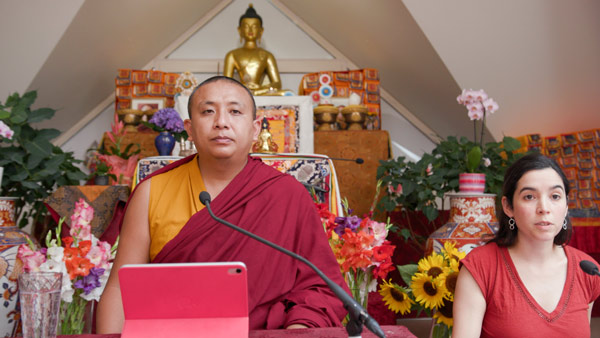
Welcome, everybody,
to this year's shortened
but nevertheless extremely exciting
and wonderful academic summer course
with Professor John Dunne and Khenpo
Pema Namgyal on the middle way philosophy.
We had the wonderful opportunity to have
Chokyi Nyima Rinpoche with us for a week
and so the planned summer course
got condensed into this wonderful week,
with what will be very insightful
discussions on the middle way philosophy.
Professor John Dunne has been teaching here
at Gomde since 2019
and maybe he will say a few
words about his work in general.
We are very proud, honored
that he is here to teach
and we are looking forward
to interesting lectures.
Thank you John for coming.
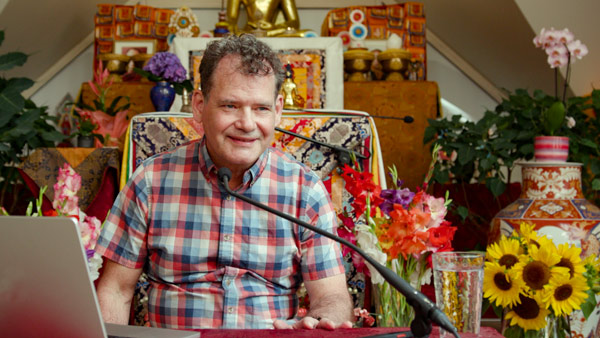
Thank you Bibi.
Go ahead, thanks.
Okay, thank you very much.
It's wonderful to be here at Gomde again.
It is really quite a magical place and we're all very fortunate to have this wonderful institution that we should certainly try to preserve. And it's very important for us to support it in whatever way we can. So let me begin in a kind of traditional way with a short invocation.
And I invite you now just to take a moment. Kind of settled in your place. Just allow the mind to settle down into the body.
And an invitation to bring up your motivation for why you are here.
The Mahāyāna motivation is to attain awakening for the sake of all beings.
All right, so I was in the Ranjung Yeshe Institute in October. Teaching a little bit and doing some other things. And I went to one of the classes actually on the middle way. The Mādhyamika philosophy taught by I think a lopon. He was very good and I forget his name. But he also began with a little meditation. Which I think is something a little different that's happening these days. That was kind of interesting. And so we may do that ourselves a little more, a little longer. But even just to kind of settle the mind for a moment. But fortunately we do have an opportunity here this week. To kind of use multiple different approaches and perspectives. So just want to give you a quick overview of what we are going to be doing. We will have three sessions a day, four sessions a day actually. That is to say, starting this evening and also every morning. We are going to have both a morning and evening meditation session. Led by Eric Solomon, sitting humbly in the back. And we will be talking and maybe trying to coordinate a little bit. But also part of the idea is to for you have different ways of kind of exploring the same kind of content. Because the experiential dimension of Mādhyamika philosophy is actually critically important. And I will say more about that. Then on Tuesday and Wednesday, today around five o' clock Khenpo Pema Namgyal will come and teach. And then on Tuesday and Wednesday morning, Khenpo La will also teach at ten o'clock for two hours. And then I will be teaching every day at four p.m. But then Khenpo La has to leave on Thursday. So I will sort of fill in for him on those mornings. So basically starting tomorrow we will have seven thirty meditation. Then we will have ten o'clock session. Then we will have lunch and so on at the usual times. Then we will have four p.m. session. And then dinner at six And then a seven forty... what time is that? Seven fifteen meditation with Eric. So you have plenty of chances to experience this kind of content in different ways and different perspectives. And as Khenpo will explain today, he is going to be teaching about relying somewhat on a text but also talking independently about sort of five different forms of reasoning that are used in the Mādhyamika philosophy. So there is a great opportunity there to hear something from a traditional Tibetan scholar, but one who has also got a lot of experience teaching Westerners. And I will also be in the afternoons, I will sometimes kind of comment maybe a little bit or try to clarify if something came up in the morning with Khenpo La's session on Tuesday and Wednesday, maybe try to work through some of that if we need to. But I will also be talking somewhat independently about certain kinds of issues. You could say it will be from a somewhat more academic framework, but I think it is important for us to, you know, we call this the academic summer course. But uh... And I should say a little bit about myself so you understand my location, as it were. So I have an endowed chair at the University of Wisconsin-Madison. Uh, I have the uh... The chair is called the Distinguished Chair in Contemplative Humanities. So I am distinguished, in case you didn't notice. And so that's why you should just refer to me as the distinguished one when you see me. Where is the distinguished one? And so that position is actually half in the Center for Healthy Minds, founded by my friend and colleague, Richie Davidson, a neuroscientist, where we work on meditation practices, primarily, and their effects on body and mind with an orientation toward well-being or flourishing. In that context, also, I've been doing a fair amount of work lately on how to enhance flourishing for university students, actually, and I'm involved in a project there that also involves teaching a very large course for first semester university students, the very first semester when they come to the university, called the Art and Science of Human Flourishing. And I do that through my home department, which is the Department of Asian Languages and Cultures. I just finished serving as chair of that department. from a, I did my three-year rotation as chair, and I'm glad that's over. But it went okay, actually, and I learned a lot from that. I was a pandemic chair, so that's always a little stressful, shall we say. Uh...And in that context, I teach, I teach that course on flourishing, but more typically, or you could say what I was really hired to do was to teach courses on Buddhist philosophy, on contemplative theory, somewhat on religious studies more broadly speaking, and then also I teach Tibetan and Sanskrit languages, although primarily to graduate students. So, you know, it's a kind of mixed bag, you could say. You could say that I do both cognitive science and I do kind of Buddhist studies. But cognitive science as a very complicated interdisciplinary field actually includes philosophy. So in a way, you could sort of say that what I do is cognitive science, but I also do things like cultural history and so on and just straight-up Buddhist studies that don't really fit into cognitive science. So I wanted to explain all that because I just want to give you a picture of kind of where I am in the academic world. I have publications both that are kind of typical Buddhist studies publications, but I also have scientific publications. And, but then in the kind of Buddhist world, I've been a student of Chokyi Nyima Rinpoche since 1994 where I met him when I was teaching at the Antioch Buddhist Studies Program in Bodhgaya. And that's been kind of my home base since then. I've been practicing Buddhism since 1981 and originally was a student of a Lama named Tatar Rinpoche, he was a Gelugpa Lama. But, you know, really connected with Rinpoche, as I say, in 94' and haven't gotten away since, as it were. And have taught a few times at Rangjung Yeshe Institute And I think when we talk about those kind of like the academic, the idea of here being academic is not academic in the sense that it would be at my home university. So I don't start my classes at my home university by saying prayers, just in case you're wondering. We might start by doing some meditation, some secular mindfulness style meditation, but we don't, you know, start with Buddhist prayers. And that's fine. It's not that kind of an institution. But what it means for us to be academic here is actually that we're kind of academic in the way, you know, like a Catholic university would be academic, is that we're still very much embedded. The idea here is, and for our future plan of a university here at Gomde, the Buddhist University of Europe, or something titled like that, we haven't figured it out quite yet. Um... But we've done a lot of work, actually, so far. That university will be a Buddhist university, so they will have this kind of very self-conscious and deliberate connection with the tradition. So what does that mean for it to be academic and Buddhist at the same time? Part of what that means is that we're bringing academic methods into the conversation. And in some ways, we are kind of introducing types of questions, um... types of contexts that you don't necessarily find in traditional Buddhist education. So one of the big things is actually history, maybe a bit more attention to the historical context of these materials. That's going to be a difference. Maybe a conversation with modern science. That's the kind of thing that probably will come up a little bit this week, just because of who I am. So those kinds of conversations. And then maybe also asking kinds of things of the text or looking at texts and looking at practices in ways that are especially relevant to us now. So that doesn't mean that we're contradicting the tradition per se, but we are maybe looking at it in a slightly different way and using slightly different methods. So that's why it's really wonderful to have both Khenpo, to first of all have Khenpo and also myself kind of doing in a way Buddhist academics, but in these slightly different contexts. And a really important feature of this that makes, I think, this sort of academic summer course different than the academic course you would take, let's say, at my university or at many universities is that the process of learning has a particular kind of purpose. And some of you, I think most of you were probably at Rinpoche's. Who was not at Rinpoche's seminar this past week? Anybody? Okay, one, two people. Okay. Oh, yeah. Well, I'll just say a few things that may be worth repeating. We talked a lot about the role of learning. We had fairly extensive, I think we had a whole morning where Khenpo and I talked about that and Rinpoche also talked about this. Like, why is it important to engage in learning and what do we mean by learning? So there's a term in Tibetan, is a kind of compound, tösam, which means, literally means hearing and thinking. But the hearing means, because often, you know, and traditionally to learn something was to hear it spoken to you. And even if you had a text, often that text would be recited orally. So, so basically hearing is an act of learning just some material, learning what a text says, learning what its arguments are. And then sampa, which is cintā in Sanskrit, means contemplating. And these are terms that come from Sanskrit. So there's śruti or śrutā, what is heard, and there's cintā, this act of contemplating. And when you're contemplating, you're taking what you've learned and you're thinking about it. Not that complicated, is it? You're trying to get beyond just the words to what those words are pointing to. You're, for example, in the context of philosophy, a lot of what we are doing, and even this week, and especially Khenpo's presentation, will be about certain specific kinds of arguments, actually. So when you're doing cintā, when you're doing sampa or contemplation, you've learned the arguments and now you really try to work through them. And the process of working through them can be just you kind of sitting there thinking or walking or doing whatever. It can also be actually debate, and I encourage you to debate with each other. This is a great way to learn this material. And in the Tibetan formal monastic education, there's formal debate that they engage in quite a lot, very formalized. But you don't need those formal tools in order to talk through the materials. An interesting aspect of debate is also that it get's you, you often have an opportunity to notice one's attachment to your own position. So traditionally, actually, in monastic debate, you try to defend a position and then you have to switch and attack it, and vice versa. So I don't know if you guys want to try that, but I encourage you to try to think. And not... You can think on your own, but you may also want to have a conversation about the kinds of things that are coming up. But do so in a way that's attentive to what's happening emotionally, as it were. But both of these, you could say, happen in a sort of non-Buddhist academic context. So what's the difference between the Buddhist academic context and the other kinds of academic context is that the Buddhist academic context has a purpose. There's always something you can say, like, what's the purpose? In Buddhism, there's always one thing you can say, for sure. Anyone know what it is? Enlightenment, that's good. Enlightenment is pretty good. Nothing is not good. No, it is not nothing. Yes? Yes, decrease suffering or eliminate suffering. That's the one that's guaranteed. Not everyone says they're going for enlightenment, as it turns out, but everyone's going for eliminating suffering. So you can always say that, right? You know? I was hoping someone would say, make money, but no, they didn't say that. So it's about relieving suffering. It's always about relieving suffering. So how do we relieve suffering? Everyone knows this now, because you heard it from Rinpoche and those who... I think many of you have studied a fair bit before. How do we relieve suffering?
Yes, so we certainly have... So this is going to be a kind of way of training. So we have those three forms of training, and you're talking about the first level of training. So I think online may not have heard you. You said basically don't harm others, in body speech and mind. That's correct. Will that eliminate completely suffering?
Probably won't eliminate all suffering. Getting over attachment? Getting over attachment, yes. That will certainly help. What about aversion and anger? Yeah, you could say it's related to attachment. Aversion and anger are related to attachment, yes. But why are we attached to things?
We think they're solid and then real. Yeah. Is that the only reason? Why would we get attached to anything? We think it's real, for sure. But why would we do that? Yes. Because of duality? Because of duality? We probably have lots of... like you know... anything that looks like an object to you is occurring in dualistic cognition, but if you're walking along the trail out here and you see some dog poop, you're probably not attached... I don't think you're attached to it, but... Maybe not averse either. It's just like, oh, you know. So that's still dualistic cognition. Why do we get attached to things? Yes, Rowan? Insight is in the end what we... Yes, why do we need insight? Because we're deluded. We have a deluded perception of the world and we need to... Okay. Why does deluded perception lead us to... to a attachment? What's the relationship between deluded perception and attachment? We are attached because we think... we have a sense of self that's not there and... And? We need to realize the nature of mind so that the ignorance is gone and we don't suffer. So you're so close. So close. Anyone else want to give it a try?
Why do we get a series of relationship that we're very close here. We're deluded about our identity and somehow that's related to attachment and aversion.
We think the things are real. Yes. But even things we're not attached to we think are real. Right?
Yeah, ignorance is what we're getting to. That's right.
Emptiness is another stage. Yes.
Ah, yes? We want to be happy and we don't want to suffer. So the things that we think are going to make us happy we become attached to. And the things that we think are going to stop our happiness we develop aversion to. And so attachment and aversion are actually about our desire to be happy. And on some interpretations of Buddhism there are even people who say that's a problem. But actually in this kind of a tradition that we're sort of embedded in here wanting to be happy and free of suffering is not the problem. The problem is we're confused about our identity. So we think that we misunderstand what the causes of happiness are because we misunderstand our own identity. Right? So one way of thinking about this is you know, if I think that my innermost true essential identity is in the form of a square circle otherwise known as a squircle. If I think that it's like, you know, I've got to make my squircle happy. I've got to find it first. If I find it, that'll also make me happy. That's not going to really work out, right? Because there's no such thing. Not only does it not exist, it can't exist. It's impossible for that kind of identity to exist. So the claim in the Buddhist tradition what we call the common vehicle like this is going all the way through so there are going to be layers. This is going to be a very important idea this week. That there are layers of philosophy, so to speak, and layers of practice. And the baseline layer goes all the way to the top is that we are confused in our ordinary state. We are confused about the nature of our identity. And as a result of that confusion when we try to make ourselves happy, we can't because we're trying to make something non-existent happy. You get it? I will say more about this tomorrow. Okay, let me run through the model. Yes? Student: Online Heidi says - karma. Yeah, we're good. Thank you, Heidi. We're going to get there soon. And we will review some of this tomorrow. I'm going to show you some cool slides. I don't know how cool they are. But I'm going to show you some slides and we're going to go through a basic model. Right? To really clarify some of what I'm talking about now. But the reason I'm mentioning it is that on that account it doesn't actually matter in a sense. Let me restate that. We... What we need in order to eliminate the suffering that comes from never being able to make ourselves happy and never being able to eliminate suffering is to eliminate that confusion. Right? You know, if I think that if I could just find a square circle somewhere like on the internet I'm sure somebody sells squircles on the internet actually but if I could just find them my life would be perfect. But you know that clearly is not going to work out. Right? It's not going to work out. So what we have to... in order to stop that particular suffering I have to recognize that Oh, you know what? There's no such thing as a squircle. And then that suffering is over. Even if I don't eliminate that then everything else I do like, you know, well, when I'm, when I'm really feeling low about not finding any squircles you know, maybe I'll just take a nice walk or, you know, I'll be nice to people who are mean about squircles and who tell me they don't exist I won't get angry, I'll be nice to them and, you know, maybe I have a couple of shots of whiskey or whatever it is, I just like deal with it you know, all of those things that might make me feel better like a little self-love or whatever that might, you know, it'll help for a little while but it's not going to deal with the problem, right? Because the problem is I'm confused about something and until I remove that confusion I'm not going to fix it. So how do I remove the confusion? I see, I recognize what is really the case. That's wisdom. But you have to have a certain kind of wisdom. In the first layer it's called the wisdom of selflessness recognizing that the kind of identity that we think we have a certain kind of self I'll say more about it tomorrow a certain kind of self does not exist. Okay? So this is called the selflessness of persons so that's what needs to... so wisdom at that first layer, and goes all the way through, recognizes that there is no kind of essential absolute self that that kind of identity a very fixed absolute independent identity, we'll talk more, that that does not exist and seeing that is seeing what's writ... is thinking that this somewhere in here, this mind-body system... is like the true me, you know, capital M, you know, or some big capital S self, the absolute, true, fixed, truly real, non-dependent, unchanging, absolute identity. That's the problem, actually. And trying to make that happy, the true me, happy, will never succeed, because it's like trying to, you know, buy squircles. You can probably buy the true me on the internet, too, from to think of it. I'm sure there are a lot of people selling, I'm going to give you the true you. Okay, so what we need to have is wisdom, prajñā, that sees what's really going on, in this case, seeing that there is no such self. But to get that wisdom, it has to be, that self habit is very deep. So just knowing it intellectually is not enough. We need it to know it experientially. And that's the role of meditation, right? We need meditative concentration in order to do that. So that's the second training. And we need an ethical lifestyle to cultivate that kind of meditation, a lifestyle rooted in non-harm. That's the baseline, non-harm. Benefit, if possible, non-harm, at least. So those are the three trainings, ethics, meditative concentration and wisdom. And then how do we get the right kind of wisdom? The wisdom that we need to get is, again, not just a kind of intellectual wisdom, not something just in our head, but an experiential wisdom, if you like. A kind of wisdom that is even kind of more than just experience, something we refer to sometimes as realization or tok-pa And that comes from when we're using philosophy as a root, there are different roots, but when we're using philosophy as a root, then we do our study, we do our contemplation, and that leads to meditation. Okay? In the end, we have to get... the goal is a meditative state. So, coming back to what I was talking about before, the difference between kind of other styles of academics and this style of academics is that when we do medit... when we do hearing, literally, in other words, when we do study and contemplation, it's for the purpose of getting to meditation. Okay? It's for the purpose of getting to meditation. If we're not going there, we may not get there, and probably won't get there right away, but if that isn't where we're headed, then we're not doing Buddhist practice. When it's in that framework, even study and contemplation, like thinking about it, even that is practice. That is practice. You shouldn't think of that as not being practice. Right? Study and contemplation. But it is only practice if it's leading to meditation. Okay? Otherwise, it's just kind of academics, you could say. Ordinary academics. So, and I don't want to disparage ordinary academics. In fact, those of you who really want to know more about Mādhyamika, there's going to be, unfortunately, a conference I can't make, but a number of friends and colleagues and students are going to be in Vienna. A great multi-day conference on Mādhyamika. I can't quite remember the dates now, but I'll share that with you later. So if you're in Vienna or can get there, you may want to check out that conference. I think it's still possible to register and go to the panels. There are going to be a lot of people multi-day. It's really quite an amazing event. And unfortunately, I can't be there. So that's, you know, great stuff. But we're doing something that certainly relates to that. But here, like it's moving toward that meditation. And one way to think for this week about, you know, what does that mean? Just for our purposes is, you learn something like you learn the arguments that Khenpo gives. Then in some of what we'll talk about, and then you think about those arguments. And then at a certain point, you may have this kind of like, oh, I get it. It sort of flips you into a certain kind of state. Right? You kind of know what I mean? Like an aha moment. And that... when you're there, that's when you have the opportunity to drop into meditation. Now, does that make sense? You get your cert... you learn something like an argument, you sort of go through it and you go, oh, right. I can't, I couldn't possibly be an independent self. Like you understand that intellectually, but that comes with a sort of experience. It's like an experience. And that experience is what you try to drop into. So that's one way of thinking about the relationship between study, contemplation and meditation. We'll say more, because there's also something very important and somewhat complex topic around concepts, language and concepts, thought. Uh... but we'll save that for a little later. So I already said that there is this kind of first layer. And by the way, Khenpo is coming around five-ish, I think, or did we say 5:15 in the end? Okay. So, so I already said that there is, so that's how we're doing like this week. The sort of academic is it's Buddhist academics, but it's prac... It is practice, even the study and the contemplation is practice as long as it's going toward that experience. Right? And that's also why we have Eric to give you a kind of other ways. First of all, of some grounding, just grounding your attention. You know, when we say those three trainings, right, of ethics. Why do we need ethics? Because we need meditative concentration. And if our mind is chaotic because we're harming people all the time, we will, as Rinpoche said during his seminar recently, harming others, you harm yourself. We even know that scientifically, really. And so, you know, if I'm constantly engaged in a harmful lifestyle, my mind is going to be too chaotic. To develop a kind of clear, stable kind of awareness that enables me to develop wisdom. So I need ethics. I need at least a lifestyle that is at least not harmful in body, speech and mind. And then I develop meditative concentration. And a big part of meditative concentration, which I'm guessing Eric will also say a little bit about, is just developing something we call samatha, which is, you know, a kind of mental stability that goes with a certain capacity for attention in dealing with distraction. And then on that basis, we can develop wisdom. So we're going to have, because, you know, practice, even the philosophical study, contemplation is practice, if it's moving toward meditation, but also there are more experiential ways to explore some of the same kind of stuff that we're talking about. And so Eric's going to be giving us those opportunities in the morning and evening. So before I go further, let me first say that in my sessions, we'll always have opportunities for questions. I'm not sure if Khenpo will always have a chance to do questions, but we'll also, if there are questions that come up for you during Khenpo's time, we can also do them in my sessions. So we'll take a short little moment here and ask, are there any questions about what I've said so far?
No questions. Everyone understands everything? Or you just want to get out of here? No. Yes?
Ideally, we use the microphone if possible. Yeah.
This bothers me for a long time already. I can understand that there's no fixed self, because if there would be a fixed self, there would be no life. That's uh... That couldn't happen at the same time. But if it hurts, if something hurts, who cares if it hurts me? I don't care if it hurts me, but still it hurts. Saying that you don't have a fixed absolute self. So let me let me try this. Let me try. Let me try this on for size. Let's say that I think there's a squircle in my closet.
And it's actually a living squircle that eats things. It eats people. And I'm like terrified. You know, maybe I've taken too much of something or whatever. So I'm just terrified. And, you know, when you come in and help me, you know, and say, oh, you know, let's let's look for it. We're going to use this metaphor actually tomorrow. I go, where is this squircle going to find it? You're going to help me find it. And then we don't find it. Does that mean that is, do I, if what, what would you think if I then said to you, oh, so there's no closet. Would that make sense? No. So actually everything is all the area, the closet and so on at this level of philosophy. We're not, you know, we were saying, yeah, sure, you have, you know, sensation is occurring. What we call vedanā, pleasant, unpleasant and neutral sensations are occurring in this mind-body system. There isn't just a fixed absolute self that's experiencing them. That's the experiencer of those sensations. But that doesn't mean they're not happening. Student: Yes, that is the problem. Yes, that is the problem. Exactly. And that's exactly what this is supposed to eliminate. Yeah, but the body system, some, some, there's a sensation of pain. Yes. And that's... If there is a fixed self or not. Exactly. But then the question, yes. Okay, sure. So then one of the questions here is like, if you have, if we're talking about physical pain, where does the physical pain come from? Why is it that you have physical pain? If you, another way of thinking about this is if you're having physical pain, why do you interpret it as something that, you know, you need to run away from? Because it doesn't feel good. Yes, it doesn't feel good. Yes. Yeah. Usually people say that. If you're, if you're a cyclist, lots of cycling can involve quite a lot of discomfort, but people seem to do it a lot. It's maybe a little more complicated than that, actually. So we're not saying that, you know, pain isn't occurring or even that pain is an undesirable thing, but there is a sense in which you can, for our purposes right now, you can experience pain in a way that makes it much worse. So in clinical context, we call this catastrophizing. We did a study with, um, with, with advanced meditators. One of whom was actually Mingyur Rinpoche, Chokyi Nyima Rinpoche's brother. And I can say that because he came out publicly and talked about these experiences. Otherwise we don't talk about our subjects. And a... what we did with them is we put a um... a device that creates a very intense feeling of heat on the skin. It really feels like your skin is burning. And we did that with these very advanced meditators and then with ordinary people. And when they, uh, and then the way it worked is you heard a little sound or some, or in one version of this study, it got a little bit warm, and that was a signal like the pain is coming. And then we were looking at certain regions in the brain that are called the pain network or the pain matrix that have to do with the experience of pain. And in brief with ordinary people, when they heard the sound, the pain in matrix in the brain started to activate quite intensely. Like they were already feeling pain and sometimes they'd hear the sound and then the heat wouldn't come. It's like, no, just kidding.
And they'd still get like, even after that, they'd still like, oh, the pain. So, you know, if you look at it in a graph that act pain matrix would activate, like here's the sound ordinary people pain matrix activates, right? Our, our, uh, long-term meditators, they just, that matrix is basically flat. It's not really activating from just being warned. Then when the pain comes, their matrix activates even maybe a little bit more than ordinary people. And then after the pain matrix in ordinary people that keeps activating, like, oh, that hurts so much. Why did you do that to me? I don't know why I signed up to do this study. This is terrible. Like, do I have to do this again? How much are you paying me again? You know, it's like, and then the, uh, the long-term meditators, it just goes down. Okay. So there's a relationship to pain that has to do. And one way to interpret that this is that this is very much about a sense of self. Right? Now there are, you know, notions. I don't know if we'll be able to get into them of physical. So already they're actually very concretely. What's, what's that saying is if you have a different way of relating to pain and a different notion of self, then the pain is less right there. But also perhaps, you know, there are styles of practice and philosophy that kind of even will say in some sense, you can kind of transcend pain. I'm not going to talk about that.
That's kind of above my pay grade. Or let's just say it's not, this isn't the context for that. But I think even if we just say like, I can manage, relate to, physical pain in a very different way. That's key. I think that is key. There's a traditional long list of like the sufferings of samsara and, and, uh, certainly pain is there, but a lot of it involves things like grief and woe and, you know, anxiety, mental suffering. I think it's more easy to handle that. Yeah. But even pain, it's interesting. Pain is very interesting, physical pain, but we won't, we won't go there. At least not now. Okay. So what I wanted to say, if there are other questions, well, that's a great question. Thank you.
John, if that's the way how to, how we can alleviate suffering, then why isn't the first treatment for all problems for, I am especially thinking I am especially thinking about mental health problems, showing a person that they have no self? Well, maybe that should be the first treatment. But so this is then there's a very good question because, um, you know, if I'm a squircle addict and you just tell me, you know, you know, John, there are no squircles.
You really think that's going to work? No. Right? Yeah. Like if I'm really stuck in it, it's unlikely that that's going to work. So that's why we need to prepare. There are two things. You need to have someone who is a very skilful teacher, right? Extremely skilful, who can really see where people are at. And that's one way of thinking what a Buddha is or an advanced Bodhisattva is, is someone who really sees where people are coming from. And, uh, uh, the second is you have, we have to have ways of, so first of all, finding out where people are coming from, and then second relating to them at the level they're coming from. And this leads to this concept that's very important in Buddhism, in the kind of Buddhism that, uh, you know, is gomde is a representative of, which is this idea of upāya kauśalyam in Sanskrit or thab la khepa in Tibetan, skill and means. So the, uh, that first in the common vehicle, there is this idea of selflessness and the Buddha definitely teaches that in the first layer of teachings. But it's said that, uh, he also had another layer of teachings that didn't kind of go public for about 500 years. And this other layer of teachings is you can, so on the, uh, uh, you know, from the standpoint of this later version of teachings that comes to be known as the Mahāyāna, the great vehicle, where a vehicle is a metaphor for, you know, how you traverse the path, how you go along the path that the great vehicle, right, uh, from the, from the perspective of the great vehicle, selflessness is still key. But, and, and also with selflessness, you really can cure your own suffering. But what you cannot do is attain full, complete awakening with selflessness of just by knowing that there's no true, real, absolute, singular, unchanging, fixed personal identity. You cannot achieve full awakening, which also means that you, and what, like, what's full awakening good for? Yeah. Makes you famous. Like if people make statues of you, is that what, you know, what's it good for? It's good for, it, what it does is, is it enables other people to become free of suffering. Right? So there's this, uh, you know, the, the Buddhas are also referred to stages, uh, as sages. And there's a very famous verse, which starts, Thub nam dikpa chuyi mi thru shing... This is a Sanskrit verse, but we only have the Tibetan. And it basically means that the sages do not wash away sins with water. They do not remove suffering by the laying on of hands. They don't transfer, uh, awakening into your mind, but rather they teach, by teaching the nature of reality they liberate beings. But they have to teach exactly in the way that we were just talking about, which is they have to teach what people need to hear based on the level that they're at. And so in the Mahāyāna, some 500 years after the Buddha, or, uh, uh, uh, first taught when he was, during his manifest lifetime in this world, there were, uh, certain teachings that become manifest. You know, the Western academics will say, well, you know, someone kind of basically started to invent these teachings. It seems like we don't really know where they came from. There's a Buddhist tradition that says they were hidden for a long time. Right? In any case, everyone agrees, they don't become public, so to speak, until that period around the start of the common era, some 2100 years ago. And that, uh, though, according to those teachings, actually the Buddha taught many different things. He even taught some people that there is a self, actually, because if you didn't teach them that, they just couldn't handle anything else. He taught some people that there isn't really a self. He taught some people that there is neither a self nor not a self. Right? And we'll see this, because we're going to look at this in a particular text. Why did he teach those things? Because he's trying to lead people further, to at least enable some people to kind of, you know, continue the work, as it were, to become awakened. Because what an awakened being can do is do this, is teach others the nature of reality so they too can alleviate their suffering. In other words, Buddhas are motivated by compassion. They're not just seeking to become free from their own suffering. They're seeking to alleviate the suffering of others, actually all sentient beings. Right? This is an aspiration called bodhicitta, the awakening mind. And in order to do this, there's a deeper level of confusion that blocks us from, in a sense, seeing at that level.
The one way to think about this, I will explain it more tomorrow, is that the first layer of teaching and practice is helping us to see that, well, you know, we're deluded about our personal identity. There isn't this unchanging fixed absolute self. But the second lev... But there's a deeper level of confusion. Even though we might think, oh, there's no fixed absolute self, as we will see, there's a way of doing that that says, there is something really here. It's just not, there's no self in it. Like there really is a bunch of mental and physical stuff. And we can even give you a kind of map of the mind-body system, in which there are these irreducible elements, mental and physical elements that make up the mind-body system. And we look through them, trying to find a self. And we don't. Just like, you know, we go into the closet and you know, and you make a map of the closet, you help me look through and then you don't find a squircle. And I say, oh, okay, there's no squircle. Again, we'll say more tomorrow. But on that account, then, there are real things. Right? And all of, in fact, all those real things that make up the mind-body system and the world, like in this kind of table of elements, the Buddhist table of elements, if you like, those things really exist. They're infinitesimally small, irreducible, momentary bits of matter and mind. That's all that there is on this account. But all of those bits of matter and mind, where did they come from? Who made the world?
There's a very interesting perspective in Buddhist cosmology. We talk about the world, like where did the world come from? Right? Who made the world? The devil. No, sorry. The devil did not make the world.
Who made the world? When did it start?
Trick question. It doesn't, it never started. So first of all, we talk about beginningless worlds, not just one world, a multiverse. Right? So there are beginningless universes, a beginningless multiverse. Universes come into existence, and then they go out of existence over very long periods of time. And the universes are constituted by the beings in the universe. Actually, there's a kind of cute, you know, tongue-in-cheek old text called the Aggañña Sutta in the Pali Canon that talks about this. It says, you know, it's sort of poking fun a little bit at the theists who believe in a creator God. And the idea is that when a universe goes out of existence, right, for a new universe to come into existence, a very powerful mind kind of first pops into this very formless space. It's reborn. So you can be reborn in all different kinds of states, including as a god. So you're reborn in this... So one god, this god-like being is reborn in the universe and is there for a very long time, and then other beings get reborn there. But what produced that universe is just the minds of those beings. But when the other god-like beings get reborn, the one who's there first, you know, is like, oh, I was kind of lonely, you know, and then they say, well, daddy, you know, you made us, you're the creator. And the creator thinks, oh, yeah, I guess I probably must... yeah sure I made you.
I wanted to have friends, you know. And then, you know, there's this whole idea of devolution and like things get worse and worse and eventually, you know, the people have flesh and blood bodies and the beings reborn in there are getting more and more coarse, you know, in some accounts it ends up with this, you know, people started out like a mile high and by the end of it, humans are no bigger than 10 inches, it's kind of an interesting story. But the point of that story is that we are creating... one point is there's no creator. Nobody made it. We make it. And not just humans, obviously. All of the beings in the universe construct the universe mutually. Out of what? Karma. Which means that everything, on, so on that first layer of philosophy, what exists? Infinitesimally small bits of mind and matter. Constantly interacting bits of mind and matter. Where did they come from? Like beginningless time? You know, specific universes have a beginning, but there's no beginning of all the universes. Caused by what? The karma of the beings in those universes. What makes my body? Karma.
So that means if karma... What does karma mean? We'll talk more about it tomorrow. But basically karma means intentions. Cetanā, the intention to act. Ment... Even just mentally acting. That has an intention. An intention to act mentally, vocally or physically. Like, Oh, I want this, or this We'll say more about it tomorrow. But that intention, right, propels in a sense, you know, conditions me. And that intention is contaminated or comes out of like, Why do I want this and I want that? Because I'm trying to make my absolute self happy.
So the further claim is that that is built into that confusion about our identity is something that we are born with. It's... We can get rid of it. But as ordinary beings, we constantly have that. So because our karma is coming out of that confusion, our intentions to act are coming out of that confusion. And our karma is the cause of this world. That means that if we manage to stop that karma, which is causing our suffering, then we can, in a sense, escape. But all the stuff of the world is already been produced by that karma. It's all contaminated.
So this can't be where the escape is. The escape has to be somewhere else. So this is the idea that liberation is a cessation. It's an escape from samsara. So nirvana, this is what's called nirvana as, as a quiescent cessation, just a stopping sometimes called the blowing out of the candle.
But later, in this later member, now we're going to get to a different layer of teaching. This different layer of teaching is going to say, that's a useful way of thinking about things. It helps people to get to an understanding of selflessness. But if you think that in those ways, you won't actually be able to become fully awakened. Because in a sense, you're stuck in a particular reality. And there are multiple realities that beings are inhabiting. You're just stuck in one of them, which seems so real to you. So to get past that, you have to recognize that even all the stuff, the mental and physical bits that make up your mind, your body in the world, all of that also doesn't really exist in the way it appears.
In other words, right? So there's a story from a particular sutra called The Teachings of Vimalakīrti, the Vimalakīrti Nirdeśa Sūtra. And you know, all the Buddhist sutras begin with a whole bunch of kind of people in the audience. There's like, you know, famous people and bodhisattvas and this and that, and like paparazzi taking pictures, you know, and it's like everyone's there all around. And at this particular one,
a particular sort of celestial bodhisattva hears Śāriputra, who in this sutra represents a kind of someone who's a little bit stuck in that earlier view, the early view. And he's looking around and like, you know, there's splendid things and stuff, but you know, Śāriputra is saying to himself, well, this is still the world of suffering, what we call samsara. Look at it, you know, it's just... It's filled with thorn bushes and peaks and valleys and poop. He uses the word aśuci, poop. But, a you know, the... this bodhisattva becomes aware of Śāriputra thinking this. And the Buddha, through the blessing of the Buddha, he says to Śāriputra, Śāriputra, it's your mind that's filled with poop. And then the Buddha touches his big toe to the ground and suddenly it all transforms into this splendid heaven. You know, like singing celestial birds and trees made out of gems and people dancing and singing, like Śāriputra himself is a god, you know, what's going on? And then the Buddha lifts his toe and it goes away. So I can't do that, by the way, in case you're wondering. I have big toes, but they didn't. They don't seem to work. So a... what is that? What's the point of that? The point is, the world can be transformed. It's not stuck in what seems to be a fixed reality. Not only do persons not have some kind of essential identity, all the stuff of the world also doesn't have essential identity. That doesn't mean it's nothing. Nothing is not even really nothing, as you will see.
Right? All things are empty, that's going to be a very important word, are empty of this kind of fixed existence. And the philosophy that uh... that teaches this idea is called, is the philosophy that we're studying this week, the middle way philosophy or the Mādhyamika. And the first person to articulate this in philosophical texts, it was in a number of texts that were sort of revealed during this time. But the philosopher who taught it is named Nāgārjuna. And he was probably living around the second century of the common era. He wrote a number of different texts, one of his most important texts is called just Wisdom. Prajñā, the Root Verses on the Middle Way. And we'll be talking about some of those texts. Khenpo will be referring to those. I'll be talking about that particular text a fair bit. I think Khenpo will also. But that philosophy then also develops in relationship to some other philosophies until it gets to a particular kind of form that becomes very important for this tradition here, the kind of non-dual style of practice that we find in gomde's tradition. So we're going to try to get all the way there this week. But a key aspect of this idea is that we're going to add, last thing I want to say, is we're going to add something to the basic formula that's coming from early Buddhism, from the common vehicle. So the basic formula is why are we suffering? Because we're confused. And that confusion produces attachment and aversion, which leads us to, in a confused way, try to get happy, you know the attachment is like, I want to get this. Aversion is, I'm going to get rid of that or destroy that. And that produces karma, the intentions to do those things that condition us and perpetuate our suffering. Right? So where does... So how do we get rid of, a... suffering? We get rid of karma and the kleshas, the mental afflictions that are causing us to act that way. How do we do that? We're going to uproot the basic confusion. The way Nāgārjuna puts it is that, that karma and klesha actually comes from concepts. Very interesting. You'll see, we'll look at this more carefully tomorrow. Okay, he'll say karma and klesha come from concepts. But just getting rid of concepts, just not thinking, will not solve everything. You know, if it did, then you could just like hit your head self in the head enough and then it'd be all finished like... Like that movie, I heart Huckabees from a long time ago. Just like solve everything, you know. Sadly, or maybe it's a good thing that that doesn't work. Right? And the reason it doesn't work is that concepts come from something else. This is, Nāgārjuna is kind of, not exactly an innovation, but you... cause you see other earlier echoes of it. But in some ways it is, it's coming from this new layer of text that become available. Suffering is produced by karma and klesha, intentions and confused emotions. Karma and klesha come from concepts. Concepts come from, here's a Sanskrit word for you, prapañca, or, tröpa in Tibetan. Okay? And prapañca, which we'll call fabrication. It's very hard to translate. A lot of what I want to do this week is say... What is this thing fabrication? What is prapañca or tröpa? What does that really mean? And that ceases in emptiness.
More precisely, the way I understand this is, it ceases in the experience of emptiness.
Which is not an experience of nothing, because nothing is empty of really being nothing.
We will see. You know what else is empty? Emptiness. Emptiness is empty of really being emptiness. Huh?
It's called, this word in Sanskrit is śūnyatā. So there's also śūnyatā śūnyatā, the emptiness of emptiness. There isn't śūnyatā, śūnyatā, śūnyatā, the emptiness of emptiness of emptiness, because if you don't get it at emptiness of emptiness, there's no point in going on. Really. Okay? So that's what we're going to explore this week. What does it mean that prapañca ceases in the experience? And this is even like a kind of a hard thing to even say, because if I say the experience of emptiness, I'm kind of looking at Eric back there, it sounds like I'm experiencing something. But that already is a problem to talk about it like that. It also doesn't mean you're like unconscious, because you have to be aware. This is wisdom. So like, well, what is it? Not just what is emptiness, but what does it mean to be knowing emptiness? Which sounds like you're knowing something. Okay, so that's where we're headed. Tomorrow I'm going to show you some slides and they had little animations in them, and you know and we're going to talk a little more about some details of this model and and review a little bit more about selflessness of persons and essencelessness of things. And then we'll get into the text and also try to like coordinate with what Khenpo is going to be teaching. But for now, I'm going to stop because I think Khenpo is coming soon. And, uh... should we take like a three minute break? Let people take a short break? Yep. All right, so let's dedicate the merit and then take like a five minute break.
Okay, thank you everybody.
It is really quite a magical place and we're all very fortunate to have this wonderful institution that we should certainly try to preserve. And it's very important for us to support it in whatever way we can. So let me begin in a kind of traditional way with a short invocation.
And I invite you now just to take a moment. Kind of settled in your place. Just allow the mind to settle down into the body.
And an invitation to bring up your motivation for why you are here.
The Mahāyāna motivation is to attain awakening for the sake of all beings.
All right, so I was in the Ranjung Yeshe Institute in October. Teaching a little bit and doing some other things. And I went to one of the classes actually on the middle way. The Mādhyamika philosophy taught by I think a lopon. He was very good and I forget his name. But he also began with a little meditation. Which I think is something a little different that's happening these days. That was kind of interesting. And so we may do that ourselves a little more, a little longer. But even just to kind of settle the mind for a moment. But fortunately we do have an opportunity here this week. To kind of use multiple different approaches and perspectives. So just want to give you a quick overview of what we are going to be doing. We will have three sessions a day, four sessions a day actually. That is to say, starting this evening and also every morning. We are going to have both a morning and evening meditation session. Led by Eric Solomon, sitting humbly in the back. And we will be talking and maybe trying to coordinate a little bit. But also part of the idea is to for you have different ways of kind of exploring the same kind of content. Because the experiential dimension of Mādhyamika philosophy is actually critically important. And I will say more about that. Then on Tuesday and Wednesday, today around five o' clock Khenpo Pema Namgyal will come and teach. And then on Tuesday and Wednesday morning, Khenpo La will also teach at ten o'clock for two hours. And then I will be teaching every day at four p.m. But then Khenpo La has to leave on Thursday. So I will sort of fill in for him on those mornings. So basically starting tomorrow we will have seven thirty meditation. Then we will have ten o'clock session. Then we will have lunch and so on at the usual times. Then we will have four p.m. session. And then dinner at six And then a seven forty... what time is that? Seven fifteen meditation with Eric. So you have plenty of chances to experience this kind of content in different ways and different perspectives. And as Khenpo will explain today, he is going to be teaching about relying somewhat on a text but also talking independently about sort of five different forms of reasoning that are used in the Mādhyamika philosophy. So there is a great opportunity there to hear something from a traditional Tibetan scholar, but one who has also got a lot of experience teaching Westerners. And I will also be in the afternoons, I will sometimes kind of comment maybe a little bit or try to clarify if something came up in the morning with Khenpo La's session on Tuesday and Wednesday, maybe try to work through some of that if we need to. But I will also be talking somewhat independently about certain kinds of issues. You could say it will be from a somewhat more academic framework, but I think it is important for us to, you know, we call this the academic summer course. But uh... And I should say a little bit about myself so you understand my location, as it were. So I have an endowed chair at the University of Wisconsin-Madison. Uh, I have the uh... The chair is called the Distinguished Chair in Contemplative Humanities. So I am distinguished, in case you didn't notice. And so that's why you should just refer to me as the distinguished one when you see me. Where is the distinguished one? And so that position is actually half in the Center for Healthy Minds, founded by my friend and colleague, Richie Davidson, a neuroscientist, where we work on meditation practices, primarily, and their effects on body and mind with an orientation toward well-being or flourishing. In that context, also, I've been doing a fair amount of work lately on how to enhance flourishing for university students, actually, and I'm involved in a project there that also involves teaching a very large course for first semester university students, the very first semester when they come to the university, called the Art and Science of Human Flourishing. And I do that through my home department, which is the Department of Asian Languages and Cultures. I just finished serving as chair of that department. from a, I did my three-year rotation as chair, and I'm glad that's over. But it went okay, actually, and I learned a lot from that. I was a pandemic chair, so that's always a little stressful, shall we say. Uh...And in that context, I teach, I teach that course on flourishing, but more typically, or you could say what I was really hired to do was to teach courses on Buddhist philosophy, on contemplative theory, somewhat on religious studies more broadly speaking, and then also I teach Tibetan and Sanskrit languages, although primarily to graduate students. So, you know, it's a kind of mixed bag, you could say. You could say that I do both cognitive science and I do kind of Buddhist studies. But cognitive science as a very complicated interdisciplinary field actually includes philosophy. So in a way, you could sort of say that what I do is cognitive science, but I also do things like cultural history and so on and just straight-up Buddhist studies that don't really fit into cognitive science. So I wanted to explain all that because I just want to give you a picture of kind of where I am in the academic world. I have publications both that are kind of typical Buddhist studies publications, but I also have scientific publications. And, but then in the kind of Buddhist world, I've been a student of Chokyi Nyima Rinpoche since 1994 where I met him when I was teaching at the Antioch Buddhist Studies Program in Bodhgaya. And that's been kind of my home base since then. I've been practicing Buddhism since 1981 and originally was a student of a Lama named Tatar Rinpoche, he was a Gelugpa Lama. But, you know, really connected with Rinpoche, as I say, in 94' and haven't gotten away since, as it were. And have taught a few times at Rangjung Yeshe Institute And I think when we talk about those kind of like the academic, the idea of here being academic is not academic in the sense that it would be at my home university. So I don't start my classes at my home university by saying prayers, just in case you're wondering. We might start by doing some meditation, some secular mindfulness style meditation, but we don't, you know, start with Buddhist prayers. And that's fine. It's not that kind of an institution. But what it means for us to be academic here is actually that we're kind of academic in the way, you know, like a Catholic university would be academic, is that we're still very much embedded. The idea here is, and for our future plan of a university here at Gomde, the Buddhist University of Europe, or something titled like that, we haven't figured it out quite yet. Um... But we've done a lot of work, actually, so far. That university will be a Buddhist university, so they will have this kind of very self-conscious and deliberate connection with the tradition. So what does that mean for it to be academic and Buddhist at the same time? Part of what that means is that we're bringing academic methods into the conversation. And in some ways, we are kind of introducing types of questions, um... types of contexts that you don't necessarily find in traditional Buddhist education. So one of the big things is actually history, maybe a bit more attention to the historical context of these materials. That's going to be a difference. Maybe a conversation with modern science. That's the kind of thing that probably will come up a little bit this week, just because of who I am. So those kinds of conversations. And then maybe also asking kinds of things of the text or looking at texts and looking at practices in ways that are especially relevant to us now. So that doesn't mean that we're contradicting the tradition per se, but we are maybe looking at it in a slightly different way and using slightly different methods. So that's why it's really wonderful to have both Khenpo, to first of all have Khenpo and also myself kind of doing in a way Buddhist academics, but in these slightly different contexts. And a really important feature of this that makes, I think, this sort of academic summer course different than the academic course you would take, let's say, at my university or at many universities is that the process of learning has a particular kind of purpose. And some of you, I think most of you were probably at Rinpoche's. Who was not at Rinpoche's seminar this past week? Anybody? Okay, one, two people. Okay. Oh, yeah. Well, I'll just say a few things that may be worth repeating. We talked a lot about the role of learning. We had fairly extensive, I think we had a whole morning where Khenpo and I talked about that and Rinpoche also talked about this. Like, why is it important to engage in learning and what do we mean by learning? So there's a term in Tibetan, is a kind of compound, tösam, which means, literally means hearing and thinking. But the hearing means, because often, you know, and traditionally to learn something was to hear it spoken to you. And even if you had a text, often that text would be recited orally. So, so basically hearing is an act of learning just some material, learning what a text says, learning what its arguments are. And then sampa, which is cintā in Sanskrit, means contemplating. And these are terms that come from Sanskrit. So there's śruti or śrutā, what is heard, and there's cintā, this act of contemplating. And when you're contemplating, you're taking what you've learned and you're thinking about it. Not that complicated, is it? You're trying to get beyond just the words to what those words are pointing to. You're, for example, in the context of philosophy, a lot of what we are doing, and even this week, and especially Khenpo's presentation, will be about certain specific kinds of arguments, actually. So when you're doing cintā, when you're doing sampa or contemplation, you've learned the arguments and now you really try to work through them. And the process of working through them can be just you kind of sitting there thinking or walking or doing whatever. It can also be actually debate, and I encourage you to debate with each other. This is a great way to learn this material. And in the Tibetan formal monastic education, there's formal debate that they engage in quite a lot, very formalized. But you don't need those formal tools in order to talk through the materials. An interesting aspect of debate is also that it get's you, you often have an opportunity to notice one's attachment to your own position. So traditionally, actually, in monastic debate, you try to defend a position and then you have to switch and attack it, and vice versa. So I don't know if you guys want to try that, but I encourage you to try to think. And not... You can think on your own, but you may also want to have a conversation about the kinds of things that are coming up. But do so in a way that's attentive to what's happening emotionally, as it were. But both of these, you could say, happen in a sort of non-Buddhist academic context. So what's the difference between the Buddhist academic context and the other kinds of academic context is that the Buddhist academic context has a purpose. There's always something you can say, like, what's the purpose? In Buddhism, there's always one thing you can say, for sure. Anyone know what it is? Enlightenment, that's good. Enlightenment is pretty good. Nothing is not good. No, it is not nothing. Yes? Yes, decrease suffering or eliminate suffering. That's the one that's guaranteed. Not everyone says they're going for enlightenment, as it turns out, but everyone's going for eliminating suffering. So you can always say that, right? You know? I was hoping someone would say, make money, but no, they didn't say that. So it's about relieving suffering. It's always about relieving suffering. So how do we relieve suffering? Everyone knows this now, because you heard it from Rinpoche and those who... I think many of you have studied a fair bit before. How do we relieve suffering?
Yes, so we certainly have... So this is going to be a kind of way of training. So we have those three forms of training, and you're talking about the first level of training. So I think online may not have heard you. You said basically don't harm others, in body speech and mind. That's correct. Will that eliminate completely suffering?
Probably won't eliminate all suffering. Getting over attachment? Getting over attachment, yes. That will certainly help. What about aversion and anger? Yeah, you could say it's related to attachment. Aversion and anger are related to attachment, yes. But why are we attached to things?
We think they're solid and then real. Yeah. Is that the only reason? Why would we get attached to anything? We think it's real, for sure. But why would we do that? Yes. Because of duality? Because of duality? We probably have lots of... like you know... anything that looks like an object to you is occurring in dualistic cognition, but if you're walking along the trail out here and you see some dog poop, you're probably not attached... I don't think you're attached to it, but... Maybe not averse either. It's just like, oh, you know. So that's still dualistic cognition. Why do we get attached to things? Yes, Rowan? Insight is in the end what we... Yes, why do we need insight? Because we're deluded. We have a deluded perception of the world and we need to... Okay. Why does deluded perception lead us to... to a attachment? What's the relationship between deluded perception and attachment? We are attached because we think... we have a sense of self that's not there and... And? We need to realize the nature of mind so that the ignorance is gone and we don't suffer. So you're so close. So close. Anyone else want to give it a try?
Why do we get a series of relationship that we're very close here. We're deluded about our identity and somehow that's related to attachment and aversion.
We think the things are real. Yes. But even things we're not attached to we think are real. Right?
Yeah, ignorance is what we're getting to. That's right.
Emptiness is another stage. Yes.
Ah, yes? We want to be happy and we don't want to suffer. So the things that we think are going to make us happy we become attached to. And the things that we think are going to stop our happiness we develop aversion to. And so attachment and aversion are actually about our desire to be happy. And on some interpretations of Buddhism there are even people who say that's a problem. But actually in this kind of a tradition that we're sort of embedded in here wanting to be happy and free of suffering is not the problem. The problem is we're confused about our identity. So we think that we misunderstand what the causes of happiness are because we misunderstand our own identity. Right? So one way of thinking about this is you know, if I think that my innermost true essential identity is in the form of a square circle otherwise known as a squircle. If I think that it's like, you know, I've got to make my squircle happy. I've got to find it first. If I find it, that'll also make me happy. That's not going to really work out, right? Because there's no such thing. Not only does it not exist, it can't exist. It's impossible for that kind of identity to exist. So the claim in the Buddhist tradition what we call the common vehicle like this is going all the way through so there are going to be layers. This is going to be a very important idea this week. That there are layers of philosophy, so to speak, and layers of practice. And the baseline layer goes all the way to the top is that we are confused in our ordinary state. We are confused about the nature of our identity. And as a result of that confusion when we try to make ourselves happy, we can't because we're trying to make something non-existent happy. You get it? I will say more about this tomorrow. Okay, let me run through the model. Yes? Student: Online Heidi says - karma. Yeah, we're good. Thank you, Heidi. We're going to get there soon. And we will review some of this tomorrow. I'm going to show you some cool slides. I don't know how cool they are. But I'm going to show you some slides and we're going to go through a basic model. Right? To really clarify some of what I'm talking about now. But the reason I'm mentioning it is that on that account it doesn't actually matter in a sense. Let me restate that. We... What we need in order to eliminate the suffering that comes from never being able to make ourselves happy and never being able to eliminate suffering is to eliminate that confusion. Right? You know, if I think that if I could just find a square circle somewhere like on the internet I'm sure somebody sells squircles on the internet actually but if I could just find them my life would be perfect. But you know that clearly is not going to work out. Right? It's not going to work out. So what we have to... in order to stop that particular suffering I have to recognize that Oh, you know what? There's no such thing as a squircle. And then that suffering is over. Even if I don't eliminate that then everything else I do like, you know, well, when I'm, when I'm really feeling low about not finding any squircles you know, maybe I'll just take a nice walk or, you know, I'll be nice to people who are mean about squircles and who tell me they don't exist I won't get angry, I'll be nice to them and, you know, maybe I have a couple of shots of whiskey or whatever it is, I just like deal with it you know, all of those things that might make me feel better like a little self-love or whatever that might, you know, it'll help for a little while but it's not going to deal with the problem, right? Because the problem is I'm confused about something and until I remove that confusion I'm not going to fix it. So how do I remove the confusion? I see, I recognize what is really the case. That's wisdom. But you have to have a certain kind of wisdom. In the first layer it's called the wisdom of selflessness recognizing that the kind of identity that we think we have a certain kind of self I'll say more about it tomorrow a certain kind of self does not exist. Okay? So this is called the selflessness of persons so that's what needs to... so wisdom at that first layer, and goes all the way through, recognizes that there is no kind of essential absolute self that that kind of identity a very fixed absolute independent identity, we'll talk more, that that does not exist and seeing that is seeing what's writ... is thinking that this somewhere in here, this mind-body system... is like the true me, you know, capital M, you know, or some big capital S self, the absolute, true, fixed, truly real, non-dependent, unchanging, absolute identity. That's the problem, actually. And trying to make that happy, the true me, happy, will never succeed, because it's like trying to, you know, buy squircles. You can probably buy the true me on the internet, too, from to think of it. I'm sure there are a lot of people selling, I'm going to give you the true you. Okay, so what we need to have is wisdom, prajñā, that sees what's really going on, in this case, seeing that there is no such self. But to get that wisdom, it has to be, that self habit is very deep. So just knowing it intellectually is not enough. We need it to know it experientially. And that's the role of meditation, right? We need meditative concentration in order to do that. So that's the second training. And we need an ethical lifestyle to cultivate that kind of meditation, a lifestyle rooted in non-harm. That's the baseline, non-harm. Benefit, if possible, non-harm, at least. So those are the three trainings, ethics, meditative concentration and wisdom. And then how do we get the right kind of wisdom? The wisdom that we need to get is, again, not just a kind of intellectual wisdom, not something just in our head, but an experiential wisdom, if you like. A kind of wisdom that is even kind of more than just experience, something we refer to sometimes as realization or tok-pa And that comes from when we're using philosophy as a root, there are different roots, but when we're using philosophy as a root, then we do our study, we do our contemplation, and that leads to meditation. Okay? In the end, we have to get... the goal is a meditative state. So, coming back to what I was talking about before, the difference between kind of other styles of academics and this style of academics is that when we do medit... when we do hearing, literally, in other words, when we do study and contemplation, it's for the purpose of getting to meditation. Okay? It's for the purpose of getting to meditation. If we're not going there, we may not get there, and probably won't get there right away, but if that isn't where we're headed, then we're not doing Buddhist practice. When it's in that framework, even study and contemplation, like thinking about it, even that is practice. That is practice. You shouldn't think of that as not being practice. Right? Study and contemplation. But it is only practice if it's leading to meditation. Okay? Otherwise, it's just kind of academics, you could say. Ordinary academics. So, and I don't want to disparage ordinary academics. In fact, those of you who really want to know more about Mādhyamika, there's going to be, unfortunately, a conference I can't make, but a number of friends and colleagues and students are going to be in Vienna. A great multi-day conference on Mādhyamika. I can't quite remember the dates now, but I'll share that with you later. So if you're in Vienna or can get there, you may want to check out that conference. I think it's still possible to register and go to the panels. There are going to be a lot of people multi-day. It's really quite an amazing event. And unfortunately, I can't be there. So that's, you know, great stuff. But we're doing something that certainly relates to that. But here, like it's moving toward that meditation. And one way to think for this week about, you know, what does that mean? Just for our purposes is, you learn something like you learn the arguments that Khenpo gives. Then in some of what we'll talk about, and then you think about those arguments. And then at a certain point, you may have this kind of like, oh, I get it. It sort of flips you into a certain kind of state. Right? You kind of know what I mean? Like an aha moment. And that... when you're there, that's when you have the opportunity to drop into meditation. Now, does that make sense? You get your cert... you learn something like an argument, you sort of go through it and you go, oh, right. I can't, I couldn't possibly be an independent self. Like you understand that intellectually, but that comes with a sort of experience. It's like an experience. And that experience is what you try to drop into. So that's one way of thinking about the relationship between study, contemplation and meditation. We'll say more, because there's also something very important and somewhat complex topic around concepts, language and concepts, thought. Uh... but we'll save that for a little later. So I already said that there is this kind of first layer. And by the way, Khenpo is coming around five-ish, I think, or did we say 5:15 in the end? Okay. So, so I already said that there is, so that's how we're doing like this week. The sort of academic is it's Buddhist academics, but it's prac... It is practice, even the study and the contemplation is practice as long as it's going toward that experience. Right? And that's also why we have Eric to give you a kind of other ways. First of all, of some grounding, just grounding your attention. You know, when we say those three trainings, right, of ethics. Why do we need ethics? Because we need meditative concentration. And if our mind is chaotic because we're harming people all the time, we will, as Rinpoche said during his seminar recently, harming others, you harm yourself. We even know that scientifically, really. And so, you know, if I'm constantly engaged in a harmful lifestyle, my mind is going to be too chaotic. To develop a kind of clear, stable kind of awareness that enables me to develop wisdom. So I need ethics. I need at least a lifestyle that is at least not harmful in body, speech and mind. And then I develop meditative concentration. And a big part of meditative concentration, which I'm guessing Eric will also say a little bit about, is just developing something we call samatha, which is, you know, a kind of mental stability that goes with a certain capacity for attention in dealing with distraction. And then on that basis, we can develop wisdom. So we're going to have, because, you know, practice, even the philosophical study, contemplation is practice, if it's moving toward meditation, but also there are more experiential ways to explore some of the same kind of stuff that we're talking about. And so Eric's going to be giving us those opportunities in the morning and evening. So before I go further, let me first say that in my sessions, we'll always have opportunities for questions. I'm not sure if Khenpo will always have a chance to do questions, but we'll also, if there are questions that come up for you during Khenpo's time, we can also do them in my sessions. So we'll take a short little moment here and ask, are there any questions about what I've said so far?
No questions. Everyone understands everything? Or you just want to get out of here? No. Yes?
Ideally, we use the microphone if possible. Yeah.
This bothers me for a long time already. I can understand that there's no fixed self, because if there would be a fixed self, there would be no life. That's uh... That couldn't happen at the same time. But if it hurts, if something hurts, who cares if it hurts me? I don't care if it hurts me, but still it hurts. Saying that you don't have a fixed absolute self. So let me let me try this. Let me try. Let me try this on for size. Let's say that I think there's a squircle in my closet.
And it's actually a living squircle that eats things. It eats people. And I'm like terrified. You know, maybe I've taken too much of something or whatever. So I'm just terrified. And, you know, when you come in and help me, you know, and say, oh, you know, let's let's look for it. We're going to use this metaphor actually tomorrow. I go, where is this squircle going to find it? You're going to help me find it. And then we don't find it. Does that mean that is, do I, if what, what would you think if I then said to you, oh, so there's no closet. Would that make sense? No. So actually everything is all the area, the closet and so on at this level of philosophy. We're not, you know, we were saying, yeah, sure, you have, you know, sensation is occurring. What we call vedanā, pleasant, unpleasant and neutral sensations are occurring in this mind-body system. There isn't just a fixed absolute self that's experiencing them. That's the experiencer of those sensations. But that doesn't mean they're not happening. Student: Yes, that is the problem. Yes, that is the problem. Exactly. And that's exactly what this is supposed to eliminate. Yeah, but the body system, some, some, there's a sensation of pain. Yes. And that's... If there is a fixed self or not. Exactly. But then the question, yes. Okay, sure. So then one of the questions here is like, if you have, if we're talking about physical pain, where does the physical pain come from? Why is it that you have physical pain? If you, another way of thinking about this is if you're having physical pain, why do you interpret it as something that, you know, you need to run away from? Because it doesn't feel good. Yes, it doesn't feel good. Yes. Yeah. Usually people say that. If you're, if you're a cyclist, lots of cycling can involve quite a lot of discomfort, but people seem to do it a lot. It's maybe a little more complicated than that, actually. So we're not saying that, you know, pain isn't occurring or even that pain is an undesirable thing, but there is a sense in which you can, for our purposes right now, you can experience pain in a way that makes it much worse. So in clinical context, we call this catastrophizing. We did a study with, um, with, with advanced meditators. One of whom was actually Mingyur Rinpoche, Chokyi Nyima Rinpoche's brother. And I can say that because he came out publicly and talked about these experiences. Otherwise we don't talk about our subjects. And a... what we did with them is we put a um... a device that creates a very intense feeling of heat on the skin. It really feels like your skin is burning. And we did that with these very advanced meditators and then with ordinary people. And when they, uh, and then the way it worked is you heard a little sound or some, or in one version of this study, it got a little bit warm, and that was a signal like the pain is coming. And then we were looking at certain regions in the brain that are called the pain network or the pain matrix that have to do with the experience of pain. And in brief with ordinary people, when they heard the sound, the pain in matrix in the brain started to activate quite intensely. Like they were already feeling pain and sometimes they'd hear the sound and then the heat wouldn't come. It's like, no, just kidding.
And they'd still get like, even after that, they'd still like, oh, the pain. So, you know, if you look at it in a graph that act pain matrix would activate, like here's the sound ordinary people pain matrix activates, right? Our, our, uh, long-term meditators, they just, that matrix is basically flat. It's not really activating from just being warned. Then when the pain comes, their matrix activates even maybe a little bit more than ordinary people. And then after the pain matrix in ordinary people that keeps activating, like, oh, that hurts so much. Why did you do that to me? I don't know why I signed up to do this study. This is terrible. Like, do I have to do this again? How much are you paying me again? You know, it's like, and then the, uh, the long-term meditators, it just goes down. Okay. So there's a relationship to pain that has to do. And one way to interpret that this is that this is very much about a sense of self. Right? Now there are, you know, notions. I don't know if we'll be able to get into them of physical. So already they're actually very concretely. What's, what's that saying is if you have a different way of relating to pain and a different notion of self, then the pain is less right there. But also perhaps, you know, there are styles of practice and philosophy that kind of even will say in some sense, you can kind of transcend pain. I'm not going to talk about that.
That's kind of above my pay grade. Or let's just say it's not, this isn't the context for that. But I think even if we just say like, I can manage, relate to, physical pain in a very different way. That's key. I think that is key. There's a traditional long list of like the sufferings of samsara and, and, uh, certainly pain is there, but a lot of it involves things like grief and woe and, you know, anxiety, mental suffering. I think it's more easy to handle that. Yeah. But even pain, it's interesting. Pain is very interesting, physical pain, but we won't, we won't go there. At least not now. Okay. So what I wanted to say, if there are other questions, well, that's a great question. Thank you.
John, if that's the way how to, how we can alleviate suffering, then why isn't the first treatment for all problems for, I am especially thinking I am especially thinking about mental health problems, showing a person that they have no self? Well, maybe that should be the first treatment. But so this is then there's a very good question because, um, you know, if I'm a squircle addict and you just tell me, you know, you know, John, there are no squircles.
You really think that's going to work? No. Right? Yeah. Like if I'm really stuck in it, it's unlikely that that's going to work. So that's why we need to prepare. There are two things. You need to have someone who is a very skilful teacher, right? Extremely skilful, who can really see where people are at. And that's one way of thinking what a Buddha is or an advanced Bodhisattva is, is someone who really sees where people are coming from. And, uh, uh, the second is you have, we have to have ways of, so first of all, finding out where people are coming from, and then second relating to them at the level they're coming from. And this leads to this concept that's very important in Buddhism, in the kind of Buddhism that, uh, you know, is gomde is a representative of, which is this idea of upāya kauśalyam in Sanskrit or thab la khepa in Tibetan, skill and means. So the, uh, that first in the common vehicle, there is this idea of selflessness and the Buddha definitely teaches that in the first layer of teachings. But it's said that, uh, he also had another layer of teachings that didn't kind of go public for about 500 years. And this other layer of teachings is you can, so on the, uh, uh, you know, from the standpoint of this later version of teachings that comes to be known as the Mahāyāna, the great vehicle, where a vehicle is a metaphor for, you know, how you traverse the path, how you go along the path that the great vehicle, right, uh, from the, from the perspective of the great vehicle, selflessness is still key. But, and, and also with selflessness, you really can cure your own suffering. But what you cannot do is attain full, complete awakening with selflessness of just by knowing that there's no true, real, absolute, singular, unchanging, fixed personal identity. You cannot achieve full awakening, which also means that you, and what, like, what's full awakening good for? Yeah. Makes you famous. Like if people make statues of you, is that what, you know, what's it good for? It's good for, it, what it does is, is it enables other people to become free of suffering. Right? So there's this, uh, you know, the, the Buddhas are also referred to stages, uh, as sages. And there's a very famous verse, which starts, Thub nam dikpa chuyi mi thru shing... This is a Sanskrit verse, but we only have the Tibetan. And it basically means that the sages do not wash away sins with water. They do not remove suffering by the laying on of hands. They don't transfer, uh, awakening into your mind, but rather they teach, by teaching the nature of reality they liberate beings. But they have to teach exactly in the way that we were just talking about, which is they have to teach what people need to hear based on the level that they're at. And so in the Mahāyāna, some 500 years after the Buddha, or, uh, uh, uh, first taught when he was, during his manifest lifetime in this world, there were, uh, certain teachings that become manifest. You know, the Western academics will say, well, you know, someone kind of basically started to invent these teachings. It seems like we don't really know where they came from. There's a Buddhist tradition that says they were hidden for a long time. Right? In any case, everyone agrees, they don't become public, so to speak, until that period around the start of the common era, some 2100 years ago. And that, uh, though, according to those teachings, actually the Buddha taught many different things. He even taught some people that there is a self, actually, because if you didn't teach them that, they just couldn't handle anything else. He taught some people that there isn't really a self. He taught some people that there is neither a self nor not a self. Right? And we'll see this, because we're going to look at this in a particular text. Why did he teach those things? Because he's trying to lead people further, to at least enable some people to kind of, you know, continue the work, as it were, to become awakened. Because what an awakened being can do is do this, is teach others the nature of reality so they too can alleviate their suffering. In other words, Buddhas are motivated by compassion. They're not just seeking to become free from their own suffering. They're seeking to alleviate the suffering of others, actually all sentient beings. Right? This is an aspiration called bodhicitta, the awakening mind. And in order to do this, there's a deeper level of confusion that blocks us from, in a sense, seeing at that level.
The one way to think about this, I will explain it more tomorrow, is that the first layer of teaching and practice is helping us to see that, well, you know, we're deluded about our personal identity. There isn't this unchanging fixed absolute self. But the second lev... But there's a deeper level of confusion. Even though we might think, oh, there's no fixed absolute self, as we will see, there's a way of doing that that says, there is something really here. It's just not, there's no self in it. Like there really is a bunch of mental and physical stuff. And we can even give you a kind of map of the mind-body system, in which there are these irreducible elements, mental and physical elements that make up the mind-body system. And we look through them, trying to find a self. And we don't. Just like, you know, we go into the closet and you know, and you make a map of the closet, you help me look through and then you don't find a squircle. And I say, oh, okay, there's no squircle. Again, we'll say more tomorrow. But on that account, then, there are real things. Right? And all of, in fact, all those real things that make up the mind-body system and the world, like in this kind of table of elements, the Buddhist table of elements, if you like, those things really exist. They're infinitesimally small, irreducible, momentary bits of matter and mind. That's all that there is on this account. But all of those bits of matter and mind, where did they come from? Who made the world?
There's a very interesting perspective in Buddhist cosmology. We talk about the world, like where did the world come from? Right? Who made the world? The devil. No, sorry. The devil did not make the world.
Who made the world? When did it start?
Trick question. It doesn't, it never started. So first of all, we talk about beginningless worlds, not just one world, a multiverse. Right? So there are beginningless universes, a beginningless multiverse. Universes come into existence, and then they go out of existence over very long periods of time. And the universes are constituted by the beings in the universe. Actually, there's a kind of cute, you know, tongue-in-cheek old text called the Aggañña Sutta in the Pali Canon that talks about this. It says, you know, it's sort of poking fun a little bit at the theists who believe in a creator God. And the idea is that when a universe goes out of existence, right, for a new universe to come into existence, a very powerful mind kind of first pops into this very formless space. It's reborn. So you can be reborn in all different kinds of states, including as a god. So you're reborn in this... So one god, this god-like being is reborn in the universe and is there for a very long time, and then other beings get reborn there. But what produced that universe is just the minds of those beings. But when the other god-like beings get reborn, the one who's there first, you know, is like, oh, I was kind of lonely, you know, and then they say, well, daddy, you know, you made us, you're the creator. And the creator thinks, oh, yeah, I guess I probably must... yeah sure I made you.
I wanted to have friends, you know. And then, you know, there's this whole idea of devolution and like things get worse and worse and eventually, you know, the people have flesh and blood bodies and the beings reborn in there are getting more and more coarse, you know, in some accounts it ends up with this, you know, people started out like a mile high and by the end of it, humans are no bigger than 10 inches, it's kind of an interesting story. But the point of that story is that we are creating... one point is there's no creator. Nobody made it. We make it. And not just humans, obviously. All of the beings in the universe construct the universe mutually. Out of what? Karma. Which means that everything, on, so on that first layer of philosophy, what exists? Infinitesimally small bits of mind and matter. Constantly interacting bits of mind and matter. Where did they come from? Like beginningless time? You know, specific universes have a beginning, but there's no beginning of all the universes. Caused by what? The karma of the beings in those universes. What makes my body? Karma.
So that means if karma... What does karma mean? We'll talk more about it tomorrow. But basically karma means intentions. Cetanā, the intention to act. Ment... Even just mentally acting. That has an intention. An intention to act mentally, vocally or physically. Like, Oh, I want this, or this We'll say more about it tomorrow. But that intention, right, propels in a sense, you know, conditions me. And that intention is contaminated or comes out of like, Why do I want this and I want that? Because I'm trying to make my absolute self happy.
So the further claim is that that is built into that confusion about our identity is something that we are born with. It's... We can get rid of it. But as ordinary beings, we constantly have that. So because our karma is coming out of that confusion, our intentions to act are coming out of that confusion. And our karma is the cause of this world. That means that if we manage to stop that karma, which is causing our suffering, then we can, in a sense, escape. But all the stuff of the world is already been produced by that karma. It's all contaminated.
So this can't be where the escape is. The escape has to be somewhere else. So this is the idea that liberation is a cessation. It's an escape from samsara. So nirvana, this is what's called nirvana as, as a quiescent cessation, just a stopping sometimes called the blowing out of the candle.
But later, in this later member, now we're going to get to a different layer of teaching. This different layer of teaching is going to say, that's a useful way of thinking about things. It helps people to get to an understanding of selflessness. But if you think that in those ways, you won't actually be able to become fully awakened. Because in a sense, you're stuck in a particular reality. And there are multiple realities that beings are inhabiting. You're just stuck in one of them, which seems so real to you. So to get past that, you have to recognize that even all the stuff, the mental and physical bits that make up your mind, your body in the world, all of that also doesn't really exist in the way it appears.
In other words, right? So there's a story from a particular sutra called The Teachings of Vimalakīrti, the Vimalakīrti Nirdeśa Sūtra. And you know, all the Buddhist sutras begin with a whole bunch of kind of people in the audience. There's like, you know, famous people and bodhisattvas and this and that, and like paparazzi taking pictures, you know, and it's like everyone's there all around. And at this particular one,
a particular sort of celestial bodhisattva hears Śāriputra, who in this sutra represents a kind of someone who's a little bit stuck in that earlier view, the early view. And he's looking around and like, you know, there's splendid things and stuff, but you know, Śāriputra is saying to himself, well, this is still the world of suffering, what we call samsara. Look at it, you know, it's just... It's filled with thorn bushes and peaks and valleys and poop. He uses the word aśuci, poop. But, a you know, the... this bodhisattva becomes aware of Śāriputra thinking this. And the Buddha, through the blessing of the Buddha, he says to Śāriputra, Śāriputra, it's your mind that's filled with poop. And then the Buddha touches his big toe to the ground and suddenly it all transforms into this splendid heaven. You know, like singing celestial birds and trees made out of gems and people dancing and singing, like Śāriputra himself is a god, you know, what's going on? And then the Buddha lifts his toe and it goes away. So I can't do that, by the way, in case you're wondering. I have big toes, but they didn't. They don't seem to work. So a... what is that? What's the point of that? The point is, the world can be transformed. It's not stuck in what seems to be a fixed reality. Not only do persons not have some kind of essential identity, all the stuff of the world also doesn't have essential identity. That doesn't mean it's nothing. Nothing is not even really nothing, as you will see.
Right? All things are empty, that's going to be a very important word, are empty of this kind of fixed existence. And the philosophy that uh... that teaches this idea is called, is the philosophy that we're studying this week, the middle way philosophy or the Mādhyamika. And the first person to articulate this in philosophical texts, it was in a number of texts that were sort of revealed during this time. But the philosopher who taught it is named Nāgārjuna. And he was probably living around the second century of the common era. He wrote a number of different texts, one of his most important texts is called just Wisdom. Prajñā, the Root Verses on the Middle Way. And we'll be talking about some of those texts. Khenpo will be referring to those. I'll be talking about that particular text a fair bit. I think Khenpo will also. But that philosophy then also develops in relationship to some other philosophies until it gets to a particular kind of form that becomes very important for this tradition here, the kind of non-dual style of practice that we find in gomde's tradition. So we're going to try to get all the way there this week. But a key aspect of this idea is that we're going to add, last thing I want to say, is we're going to add something to the basic formula that's coming from early Buddhism, from the common vehicle. So the basic formula is why are we suffering? Because we're confused. And that confusion produces attachment and aversion, which leads us to, in a confused way, try to get happy, you know the attachment is like, I want to get this. Aversion is, I'm going to get rid of that or destroy that. And that produces karma, the intentions to do those things that condition us and perpetuate our suffering. Right? So where does... So how do we get rid of, a... suffering? We get rid of karma and the kleshas, the mental afflictions that are causing us to act that way. How do we do that? We're going to uproot the basic confusion. The way Nāgārjuna puts it is that, that karma and klesha actually comes from concepts. Very interesting. You'll see, we'll look at this more carefully tomorrow. Okay, he'll say karma and klesha come from concepts. But just getting rid of concepts, just not thinking, will not solve everything. You know, if it did, then you could just like hit your head self in the head enough and then it'd be all finished like... Like that movie, I heart Huckabees from a long time ago. Just like solve everything, you know. Sadly, or maybe it's a good thing that that doesn't work. Right? And the reason it doesn't work is that concepts come from something else. This is, Nāgārjuna is kind of, not exactly an innovation, but you... cause you see other earlier echoes of it. But in some ways it is, it's coming from this new layer of text that become available. Suffering is produced by karma and klesha, intentions and confused emotions. Karma and klesha come from concepts. Concepts come from, here's a Sanskrit word for you, prapañca, or, tröpa in Tibetan. Okay? And prapañca, which we'll call fabrication. It's very hard to translate. A lot of what I want to do this week is say... What is this thing fabrication? What is prapañca or tröpa? What does that really mean? And that ceases in emptiness.
More precisely, the way I understand this is, it ceases in the experience of emptiness.
Which is not an experience of nothing, because nothing is empty of really being nothing.
We will see. You know what else is empty? Emptiness. Emptiness is empty of really being emptiness. Huh?
It's called, this word in Sanskrit is śūnyatā. So there's also śūnyatā śūnyatā, the emptiness of emptiness. There isn't śūnyatā, śūnyatā, śūnyatā, the emptiness of emptiness of emptiness, because if you don't get it at emptiness of emptiness, there's no point in going on. Really. Okay? So that's what we're going to explore this week. What does it mean that prapañca ceases in the experience? And this is even like a kind of a hard thing to even say, because if I say the experience of emptiness, I'm kind of looking at Eric back there, it sounds like I'm experiencing something. But that already is a problem to talk about it like that. It also doesn't mean you're like unconscious, because you have to be aware. This is wisdom. So like, well, what is it? Not just what is emptiness, but what does it mean to be knowing emptiness? Which sounds like you're knowing something. Okay, so that's where we're headed. Tomorrow I'm going to show you some slides and they had little animations in them, and you know and we're going to talk a little more about some details of this model and and review a little bit more about selflessness of persons and essencelessness of things. And then we'll get into the text and also try to like coordinate with what Khenpo is going to be teaching. But for now, I'm going to stop because I think Khenpo is coming soon. And, uh... should we take like a three minute break? Let people take a short break? Yep. All right, so let's dedicate the merit and then take like a five minute break.
Okay, thank you everybody.
01:07:59
Welcome, everybody,
to this year's shortened
but nevertheless extremely exciting
and wonderful academic summer course
with Professor John Dunne and Khenpo
Pema Namgyal on the middle way philosophy.
We had the wonderful opportunity to have
Chokyi Nyima Rinpoche with us for a week
and so the planned summer course
got condensed into this wonderful week,
with what will be very insightful
discussions on the middle way philosophy.
Professor John Dunne has been teaching here
at Gomde since 2019
and maybe he will say a few
words about his work in general.
We are very proud, honored
that he is here to teach
and we are looking forward
to interesting lectures.
Thank you John for coming.
Thank you Bibi.
Go ahead, thanks.
Okay, thank you very much.
It's wonderful to be here at Gomde again.
It is really quite a magical place and we're all very fortunate to have this wonderful institution that we should certainly try to preserve. And it's very important for us to support it in whatever way we can. So let me begin in a kind of traditional way with a short invocation.
And I invite you now just to take a moment. Kind of settled in your place. Just allow the mind to settle down into the body.
And an invitation to bring up your motivation for why you are here.
The Mahāyāna motivation is to attain awakening for the sake of all beings.
All right, so I was in the Ranjung Yeshe Institute in October. Teaching a little bit and doing some other things. And I went to one of the classes actually on the middle way. The Mādhyamika philosophy taught by I think a lopon. He was very good and I forget his name. But he also began with a little meditation. Which I think is something a little different that's happening these days. That was kind of interesting. And so we may do that ourselves a little more, a little longer. But even just to kind of settle the mind for a moment. But fortunately we do have an opportunity here this week. To kind of use multiple different approaches and perspectives. So just want to give you a quick overview of what we are going to be doing. We will have three sessions a day, four sessions a day actually. That is to say, starting this evening and also every morning. We are going to have both a morning and evening meditation session. Led by Eric Solomon, sitting humbly in the back. And we will be talking and maybe trying to coordinate a little bit. But also part of the idea is to for you have different ways of kind of exploring the same kind of content. Because the experiential dimension of Mādhyamika philosophy is actually critically important. And I will say more about that. Then on Tuesday and Wednesday, today around five o' clock Khenpo Pema Namgyal will come and teach. And then on Tuesday and Wednesday morning, Khenpo La will also teach at ten o'clock for two hours. And then I will be teaching every day at four p.m. But then Khenpo La has to leave on Thursday. So I will sort of fill in for him on those mornings. So basically starting tomorrow we will have seven thirty meditation. Then we will have ten o'clock session. Then we will have lunch and so on at the usual times. Then we will have four p.m. session. And then dinner at six And then a seven forty... what time is that? Seven fifteen meditation with Eric. So you have plenty of chances to experience this kind of content in different ways and different perspectives. And as Khenpo will explain today, he is going to be teaching about relying somewhat on a text but also talking independently about sort of five different forms of reasoning that are used in the Mādhyamika philosophy. So there is a great opportunity there to hear something from a traditional Tibetan scholar, but one who has also got a lot of experience teaching Westerners. And I will also be in the afternoons, I will sometimes kind of comment maybe a little bit or try to clarify if something came up in the morning with Khenpo La's session on Tuesday and Wednesday, maybe try to work through some of that if we need to. But I will also be talking somewhat independently about certain kinds of issues. You could say it will be from a somewhat more academic framework, but I think it is important for us to, you know, we call this the academic summer course. But uh... And I should say a little bit about myself so you understand my location, as it were. So I have an endowed chair at the University of Wisconsin-Madison. Uh, I have the uh... The chair is called the Distinguished Chair in Contemplative Humanities. So I am distinguished, in case you didn't notice. And so that's why you should just refer to me as the distinguished one when you see me. Where is the distinguished one? And so that position is actually half in the Center for Healthy Minds, founded by my friend and colleague, Richie Davidson, a neuroscientist, where we work on meditation practices, primarily, and their effects on body and mind with an orientation toward well-being or flourishing. In that context, also, I've been doing a fair amount of work lately on how to enhance flourishing for university students, actually, and I'm involved in a project there that also involves teaching a very large course for first semester university students, the very first semester when they come to the university, called the Art and Science of Human Flourishing. And I do that through my home department, which is the Department of Asian Languages and Cultures. I just finished serving as chair of that department. from a, I did my three-year rotation as chair, and I'm glad that's over. But it went okay, actually, and I learned a lot from that. I was a pandemic chair, so that's always a little stressful, shall we say. Uh...And in that context, I teach, I teach that course on flourishing, but more typically, or you could say what I was really hired to do was to teach courses on Buddhist philosophy, on contemplative theory, somewhat on religious studies more broadly speaking, and then also I teach Tibetan and Sanskrit languages, although primarily to graduate students. So, you know, it's a kind of mixed bag, you could say. You could say that I do both cognitive science and I do kind of Buddhist studies. But cognitive science as a very complicated interdisciplinary field actually includes philosophy. So in a way, you could sort of say that what I do is cognitive science, but I also do things like cultural history and so on and just straight-up Buddhist studies that don't really fit into cognitive science. So I wanted to explain all that because I just want to give you a picture of kind of where I am in the academic world. I have publications both that are kind of typical Buddhist studies publications, but I also have scientific publications. And, but then in the kind of Buddhist world, I've been a student of Chokyi Nyima Rinpoche since 1994 where I met him when I was teaching at the Antioch Buddhist Studies Program in Bodhgaya. And that's been kind of my home base since then. I've been practicing Buddhism since 1981 and originally was a student of a Lama named Tatar Rinpoche, he was a Gelugpa Lama. But, you know, really connected with Rinpoche, as I say, in 94' and haven't gotten away since, as it were. And have taught a few times at Rangjung Yeshe Institute And I think when we talk about those kind of like the academic, the idea of here being academic is not academic in the sense that it would be at my home university. So I don't start my classes at my home university by saying prayers, just in case you're wondering. We might start by doing some meditation, some secular mindfulness style meditation, but we don't, you know, start with Buddhist prayers. And that's fine. It's not that kind of an institution. But what it means for us to be academic here is actually that we're kind of academic in the way, you know, like a Catholic university would be academic, is that we're still very much embedded. The idea here is, and for our future plan of a university here at Gomde, the Buddhist University of Europe, or something titled like that, we haven't figured it out quite yet. Um... But we've done a lot of work, actually, so far. That university will be a Buddhist university, so they will have this kind of very self-conscious and deliberate connection with the tradition. So what does that mean for it to be academic and Buddhist at the same time? Part of what that means is that we're bringing academic methods into the conversation. And in some ways, we are kind of introducing types of questions, um... types of contexts that you don't necessarily find in traditional Buddhist education. So one of the big things is actually history, maybe a bit more attention to the historical context of these materials. That's going to be a difference. Maybe a conversation with modern science. That's the kind of thing that probably will come up a little bit this week, just because of who I am. So those kinds of conversations. And then maybe also asking kinds of things of the text or looking at texts and looking at practices in ways that are especially relevant to us now. So that doesn't mean that we're contradicting the tradition per se, but we are maybe looking at it in a slightly different way and using slightly different methods. So that's why it's really wonderful to have both Khenpo, to first of all have Khenpo and also myself kind of doing in a way Buddhist academics, but in these slightly different contexts. And a really important feature of this that makes, I think, this sort of academic summer course different than the academic course you would take, let's say, at my university or at many universities is that the process of learning has a particular kind of purpose. And some of you, I think most of you were probably at Rinpoche's. Who was not at Rinpoche's seminar this past week? Anybody? Okay, one, two people. Okay. Oh, yeah. Well, I'll just say a few things that may be worth repeating. We talked a lot about the role of learning. We had fairly extensive, I think we had a whole morning where Khenpo and I talked about that and Rinpoche also talked about this. Like, why is it important to engage in learning and what do we mean by learning? So there's a term in Tibetan, is a kind of compound, tösam, which means, literally means hearing and thinking. But the hearing means, because often, you know, and traditionally to learn something was to hear it spoken to you. And even if you had a text, often that text would be recited orally. So, so basically hearing is an act of learning just some material, learning what a text says, learning what its arguments are. And then sampa, which is cintā in Sanskrit, means contemplating. And these are terms that come from Sanskrit. So there's śruti or śrutā, what is heard, and there's cintā, this act of contemplating. And when you're contemplating, you're taking what you've learned and you're thinking about it. Not that complicated, is it? You're trying to get beyond just the words to what those words are pointing to. You're, for example, in the context of philosophy, a lot of what we are doing, and even this week, and especially Khenpo's presentation, will be about certain specific kinds of arguments, actually. So when you're doing cintā, when you're doing sampa or contemplation, you've learned the arguments and now you really try to work through them. And the process of working through them can be just you kind of sitting there thinking or walking or doing whatever. It can also be actually debate, and I encourage you to debate with each other. This is a great way to learn this material. And in the Tibetan formal monastic education, there's formal debate that they engage in quite a lot, very formalized. But you don't need those formal tools in order to talk through the materials. An interesting aspect of debate is also that it get's you, you often have an opportunity to notice one's attachment to your own position. So traditionally, actually, in monastic debate, you try to defend a position and then you have to switch and attack it, and vice versa. So I don't know if you guys want to try that, but I encourage you to try to think. And not... You can think on your own, but you may also want to have a conversation about the kinds of things that are coming up. But do so in a way that's attentive to what's happening emotionally, as it were. But both of these, you could say, happen in a sort of non-Buddhist academic context. So what's the difference between the Buddhist academic context and the other kinds of academic context is that the Buddhist academic context has a purpose. There's always something you can say, like, what's the purpose? In Buddhism, there's always one thing you can say, for sure. Anyone know what it is? Enlightenment, that's good. Enlightenment is pretty good. Nothing is not good. No, it is not nothing. Yes? Yes, decrease suffering or eliminate suffering. That's the one that's guaranteed. Not everyone says they're going for enlightenment, as it turns out, but everyone's going for eliminating suffering. So you can always say that, right? You know? I was hoping someone would say, make money, but no, they didn't say that. So it's about relieving suffering. It's always about relieving suffering. So how do we relieve suffering? Everyone knows this now, because you heard it from Rinpoche and those who... I think many of you have studied a fair bit before. How do we relieve suffering?
Yes, so we certainly have... So this is going to be a kind of way of training. So we have those three forms of training, and you're talking about the first level of training. So I think online may not have heard you. You said basically don't harm others, in body speech and mind. That's correct. Will that eliminate completely suffering?
Probably won't eliminate all suffering. Getting over attachment? Getting over attachment, yes. That will certainly help. What about aversion and anger? Yeah, you could say it's related to attachment. Aversion and anger are related to attachment, yes. But why are we attached to things?
We think they're solid and then real. Yeah. Is that the only reason? Why would we get attached to anything? We think it's real, for sure. But why would we do that? Yes. Because of duality? Because of duality? We probably have lots of... like you know... anything that looks like an object to you is occurring in dualistic cognition, but if you're walking along the trail out here and you see some dog poop, you're probably not attached... I don't think you're attached to it, but... Maybe not averse either. It's just like, oh, you know. So that's still dualistic cognition. Why do we get attached to things? Yes, Rowan? Insight is in the end what we... Yes, why do we need insight? Because we're deluded. We have a deluded perception of the world and we need to... Okay. Why does deluded perception lead us to... to a attachment? What's the relationship between deluded perception and attachment? We are attached because we think... we have a sense of self that's not there and... And? We need to realize the nature of mind so that the ignorance is gone and we don't suffer. So you're so close. So close. Anyone else want to give it a try?
Why do we get a series of relationship that we're very close here. We're deluded about our identity and somehow that's related to attachment and aversion.
We think the things are real. Yes. But even things we're not attached to we think are real. Right?
Yeah, ignorance is what we're getting to. That's right.
Emptiness is another stage. Yes.
Ah, yes? We want to be happy and we don't want to suffer. So the things that we think are going to make us happy we become attached to. And the things that we think are going to stop our happiness we develop aversion to. And so attachment and aversion are actually about our desire to be happy. And on some interpretations of Buddhism there are even people who say that's a problem. But actually in this kind of a tradition that we're sort of embedded in here wanting to be happy and free of suffering is not the problem. The problem is we're confused about our identity. So we think that we misunderstand what the causes of happiness are because we misunderstand our own identity. Right? So one way of thinking about this is you know, if I think that my innermost true essential identity is in the form of a square circle otherwise known as a squircle. If I think that it's like, you know, I've got to make my squircle happy. I've got to find it first. If I find it, that'll also make me happy. That's not going to really work out, right? Because there's no such thing. Not only does it not exist, it can't exist. It's impossible for that kind of identity to exist. So the claim in the Buddhist tradition what we call the common vehicle like this is going all the way through so there are going to be layers. This is going to be a very important idea this week. That there are layers of philosophy, so to speak, and layers of practice. And the baseline layer goes all the way to the top is that we are confused in our ordinary state. We are confused about the nature of our identity. And as a result of that confusion when we try to make ourselves happy, we can't because we're trying to make something non-existent happy. You get it? I will say more about this tomorrow. Okay, let me run through the model. Yes? Student: Online Heidi says - karma. Yeah, we're good. Thank you, Heidi. We're going to get there soon. And we will review some of this tomorrow. I'm going to show you some cool slides. I don't know how cool they are. But I'm going to show you some slides and we're going to go through a basic model. Right? To really clarify some of what I'm talking about now. But the reason I'm mentioning it is that on that account it doesn't actually matter in a sense. Let me restate that. We... What we need in order to eliminate the suffering that comes from never being able to make ourselves happy and never being able to eliminate suffering is to eliminate that confusion. Right? You know, if I think that if I could just find a square circle somewhere like on the internet I'm sure somebody sells squircles on the internet actually but if I could just find them my life would be perfect. But you know that clearly is not going to work out. Right? It's not going to work out. So what we have to... in order to stop that particular suffering I have to recognize that Oh, you know what? There's no such thing as a squircle. And then that suffering is over. Even if I don't eliminate that then everything else I do like, you know, well, when I'm, when I'm really feeling low about not finding any squircles you know, maybe I'll just take a nice walk or, you know, I'll be nice to people who are mean about squircles and who tell me they don't exist I won't get angry, I'll be nice to them and, you know, maybe I have a couple of shots of whiskey or whatever it is, I just like deal with it you know, all of those things that might make me feel better like a little self-love or whatever that might, you know, it'll help for a little while but it's not going to deal with the problem, right? Because the problem is I'm confused about something and until I remove that confusion I'm not going to fix it. So how do I remove the confusion? I see, I recognize what is really the case. That's wisdom. But you have to have a certain kind of wisdom. In the first layer it's called the wisdom of selflessness recognizing that the kind of identity that we think we have a certain kind of self I'll say more about it tomorrow a certain kind of self does not exist. Okay? So this is called the selflessness of persons so that's what needs to... so wisdom at that first layer, and goes all the way through, recognizes that there is no kind of essential absolute self that that kind of identity a very fixed absolute independent identity, we'll talk more, that that does not exist and seeing that is seeing what's writ... is thinking that this somewhere in here, this mind-body system... is like the true me, you know, capital M, you know, or some big capital S self, the absolute, true, fixed, truly real, non-dependent, unchanging, absolute identity. That's the problem, actually. And trying to make that happy, the true me, happy, will never succeed, because it's like trying to, you know, buy squircles. You can probably buy the true me on the internet, too, from to think of it. I'm sure there are a lot of people selling, I'm going to give you the true you. Okay, so what we need to have is wisdom, prajñā, that sees what's really going on, in this case, seeing that there is no such self. But to get that wisdom, it has to be, that self habit is very deep. So just knowing it intellectually is not enough. We need it to know it experientially. And that's the role of meditation, right? We need meditative concentration in order to do that. So that's the second training. And we need an ethical lifestyle to cultivate that kind of meditation, a lifestyle rooted in non-harm. That's the baseline, non-harm. Benefit, if possible, non-harm, at least. So those are the three trainings, ethics, meditative concentration and wisdom. And then how do we get the right kind of wisdom? The wisdom that we need to get is, again, not just a kind of intellectual wisdom, not something just in our head, but an experiential wisdom, if you like. A kind of wisdom that is even kind of more than just experience, something we refer to sometimes as realization or tok-pa And that comes from when we're using philosophy as a root, there are different roots, but when we're using philosophy as a root, then we do our study, we do our contemplation, and that leads to meditation. Okay? In the end, we have to get... the goal is a meditative state. So, coming back to what I was talking about before, the difference between kind of other styles of academics and this style of academics is that when we do medit... when we do hearing, literally, in other words, when we do study and contemplation, it's for the purpose of getting to meditation. Okay? It's for the purpose of getting to meditation. If we're not going there, we may not get there, and probably won't get there right away, but if that isn't where we're headed, then we're not doing Buddhist practice. When it's in that framework, even study and contemplation, like thinking about it, even that is practice. That is practice. You shouldn't think of that as not being practice. Right? Study and contemplation. But it is only practice if it's leading to meditation. Okay? Otherwise, it's just kind of academics, you could say. Ordinary academics. So, and I don't want to disparage ordinary academics. In fact, those of you who really want to know more about Mādhyamika, there's going to be, unfortunately, a conference I can't make, but a number of friends and colleagues and students are going to be in Vienna. A great multi-day conference on Mādhyamika. I can't quite remember the dates now, but I'll share that with you later. So if you're in Vienna or can get there, you may want to check out that conference. I think it's still possible to register and go to the panels. There are going to be a lot of people multi-day. It's really quite an amazing event. And unfortunately, I can't be there. So that's, you know, great stuff. But we're doing something that certainly relates to that. But here, like it's moving toward that meditation. And one way to think for this week about, you know, what does that mean? Just for our purposes is, you learn something like you learn the arguments that Khenpo gives. Then in some of what we'll talk about, and then you think about those arguments. And then at a certain point, you may have this kind of like, oh, I get it. It sort of flips you into a certain kind of state. Right? You kind of know what I mean? Like an aha moment. And that... when you're there, that's when you have the opportunity to drop into meditation. Now, does that make sense? You get your cert... you learn something like an argument, you sort of go through it and you go, oh, right. I can't, I couldn't possibly be an independent self. Like you understand that intellectually, but that comes with a sort of experience. It's like an experience. And that experience is what you try to drop into. So that's one way of thinking about the relationship between study, contemplation and meditation. We'll say more, because there's also something very important and somewhat complex topic around concepts, language and concepts, thought. Uh... but we'll save that for a little later. So I already said that there is this kind of first layer. And by the way, Khenpo is coming around five-ish, I think, or did we say 5:15 in the end? Okay. So, so I already said that there is, so that's how we're doing like this week. The sort of academic is it's Buddhist academics, but it's prac... It is practice, even the study and the contemplation is practice as long as it's going toward that experience. Right? And that's also why we have Eric to give you a kind of other ways. First of all, of some grounding, just grounding your attention. You know, when we say those three trainings, right, of ethics. Why do we need ethics? Because we need meditative concentration. And if our mind is chaotic because we're harming people all the time, we will, as Rinpoche said during his seminar recently, harming others, you harm yourself. We even know that scientifically, really. And so, you know, if I'm constantly engaged in a harmful lifestyle, my mind is going to be too chaotic. To develop a kind of clear, stable kind of awareness that enables me to develop wisdom. So I need ethics. I need at least a lifestyle that is at least not harmful in body, speech and mind. And then I develop meditative concentration. And a big part of meditative concentration, which I'm guessing Eric will also say a little bit about, is just developing something we call samatha, which is, you know, a kind of mental stability that goes with a certain capacity for attention in dealing with distraction. And then on that basis, we can develop wisdom. So we're going to have, because, you know, practice, even the philosophical study, contemplation is practice, if it's moving toward meditation, but also there are more experiential ways to explore some of the same kind of stuff that we're talking about. And so Eric's going to be giving us those opportunities in the morning and evening. So before I go further, let me first say that in my sessions, we'll always have opportunities for questions. I'm not sure if Khenpo will always have a chance to do questions, but we'll also, if there are questions that come up for you during Khenpo's time, we can also do them in my sessions. So we'll take a short little moment here and ask, are there any questions about what I've said so far?
No questions. Everyone understands everything? Or you just want to get out of here? No. Yes?
Ideally, we use the microphone if possible. Yeah.
This bothers me for a long time already. I can understand that there's no fixed self, because if there would be a fixed self, there would be no life. That's uh... That couldn't happen at the same time. But if it hurts, if something hurts, who cares if it hurts me? I don't care if it hurts me, but still it hurts. Saying that you don't have a fixed absolute self. So let me let me try this. Let me try. Let me try this on for size. Let's say that I think there's a squircle in my closet.
And it's actually a living squircle that eats things. It eats people. And I'm like terrified. You know, maybe I've taken too much of something or whatever. So I'm just terrified. And, you know, when you come in and help me, you know, and say, oh, you know, let's let's look for it. We're going to use this metaphor actually tomorrow. I go, where is this squircle going to find it? You're going to help me find it. And then we don't find it. Does that mean that is, do I, if what, what would you think if I then said to you, oh, so there's no closet. Would that make sense? No. So actually everything is all the area, the closet and so on at this level of philosophy. We're not, you know, we were saying, yeah, sure, you have, you know, sensation is occurring. What we call vedanā, pleasant, unpleasant and neutral sensations are occurring in this mind-body system. There isn't just a fixed absolute self that's experiencing them. That's the experiencer of those sensations. But that doesn't mean they're not happening. Student: Yes, that is the problem. Yes, that is the problem. Exactly. And that's exactly what this is supposed to eliminate. Yeah, but the body system, some, some, there's a sensation of pain. Yes. And that's... If there is a fixed self or not. Exactly. But then the question, yes. Okay, sure. So then one of the questions here is like, if you have, if we're talking about physical pain, where does the physical pain come from? Why is it that you have physical pain? If you, another way of thinking about this is if you're having physical pain, why do you interpret it as something that, you know, you need to run away from? Because it doesn't feel good. Yes, it doesn't feel good. Yes. Yeah. Usually people say that. If you're, if you're a cyclist, lots of cycling can involve quite a lot of discomfort, but people seem to do it a lot. It's maybe a little more complicated than that, actually. So we're not saying that, you know, pain isn't occurring or even that pain is an undesirable thing, but there is a sense in which you can, for our purposes right now, you can experience pain in a way that makes it much worse. So in clinical context, we call this catastrophizing. We did a study with, um, with, with advanced meditators. One of whom was actually Mingyur Rinpoche, Chokyi Nyima Rinpoche's brother. And I can say that because he came out publicly and talked about these experiences. Otherwise we don't talk about our subjects. And a... what we did with them is we put a um... a device that creates a very intense feeling of heat on the skin. It really feels like your skin is burning. And we did that with these very advanced meditators and then with ordinary people. And when they, uh, and then the way it worked is you heard a little sound or some, or in one version of this study, it got a little bit warm, and that was a signal like the pain is coming. And then we were looking at certain regions in the brain that are called the pain network or the pain matrix that have to do with the experience of pain. And in brief with ordinary people, when they heard the sound, the pain in matrix in the brain started to activate quite intensely. Like they were already feeling pain and sometimes they'd hear the sound and then the heat wouldn't come. It's like, no, just kidding.
And they'd still get like, even after that, they'd still like, oh, the pain. So, you know, if you look at it in a graph that act pain matrix would activate, like here's the sound ordinary people pain matrix activates, right? Our, our, uh, long-term meditators, they just, that matrix is basically flat. It's not really activating from just being warned. Then when the pain comes, their matrix activates even maybe a little bit more than ordinary people. And then after the pain matrix in ordinary people that keeps activating, like, oh, that hurts so much. Why did you do that to me? I don't know why I signed up to do this study. This is terrible. Like, do I have to do this again? How much are you paying me again? You know, it's like, and then the, uh, the long-term meditators, it just goes down. Okay. So there's a relationship to pain that has to do. And one way to interpret that this is that this is very much about a sense of self. Right? Now there are, you know, notions. I don't know if we'll be able to get into them of physical. So already they're actually very concretely. What's, what's that saying is if you have a different way of relating to pain and a different notion of self, then the pain is less right there. But also perhaps, you know, there are styles of practice and philosophy that kind of even will say in some sense, you can kind of transcend pain. I'm not going to talk about that.
That's kind of above my pay grade. Or let's just say it's not, this isn't the context for that. But I think even if we just say like, I can manage, relate to, physical pain in a very different way. That's key. I think that is key. There's a traditional long list of like the sufferings of samsara and, and, uh, certainly pain is there, but a lot of it involves things like grief and woe and, you know, anxiety, mental suffering. I think it's more easy to handle that. Yeah. But even pain, it's interesting. Pain is very interesting, physical pain, but we won't, we won't go there. At least not now. Okay. So what I wanted to say, if there are other questions, well, that's a great question. Thank you.
John, if that's the way how to, how we can alleviate suffering, then why isn't the first treatment for all problems for, I am especially thinking I am especially thinking about mental health problems, showing a person that they have no self? Well, maybe that should be the first treatment. But so this is then there's a very good question because, um, you know, if I'm a squircle addict and you just tell me, you know, you know, John, there are no squircles.
You really think that's going to work? No. Right? Yeah. Like if I'm really stuck in it, it's unlikely that that's going to work. So that's why we need to prepare. There are two things. You need to have someone who is a very skilful teacher, right? Extremely skilful, who can really see where people are at. And that's one way of thinking what a Buddha is or an advanced Bodhisattva is, is someone who really sees where people are coming from. And, uh, uh, the second is you have, we have to have ways of, so first of all, finding out where people are coming from, and then second relating to them at the level they're coming from. And this leads to this concept that's very important in Buddhism, in the kind of Buddhism that, uh, you know, is gomde is a representative of, which is this idea of upāya kauśalyam in Sanskrit or thab la khepa in Tibetan, skill and means. So the, uh, that first in the common vehicle, there is this idea of selflessness and the Buddha definitely teaches that in the first layer of teachings. But it's said that, uh, he also had another layer of teachings that didn't kind of go public for about 500 years. And this other layer of teachings is you can, so on the, uh, uh, you know, from the standpoint of this later version of teachings that comes to be known as the Mahāyāna, the great vehicle, where a vehicle is a metaphor for, you know, how you traverse the path, how you go along the path that the great vehicle, right, uh, from the, from the perspective of the great vehicle, selflessness is still key. But, and, and also with selflessness, you really can cure your own suffering. But what you cannot do is attain full, complete awakening with selflessness of just by knowing that there's no true, real, absolute, singular, unchanging, fixed personal identity. You cannot achieve full awakening, which also means that you, and what, like, what's full awakening good for? Yeah. Makes you famous. Like if people make statues of you, is that what, you know, what's it good for? It's good for, it, what it does is, is it enables other people to become free of suffering. Right? So there's this, uh, you know, the, the Buddhas are also referred to stages, uh, as sages. And there's a very famous verse, which starts, Thub nam dikpa chuyi mi thru shing... This is a Sanskrit verse, but we only have the Tibetan. And it basically means that the sages do not wash away sins with water. They do not remove suffering by the laying on of hands. They don't transfer, uh, awakening into your mind, but rather they teach, by teaching the nature of reality they liberate beings. But they have to teach exactly in the way that we were just talking about, which is they have to teach what people need to hear based on the level that they're at. And so in the Mahāyāna, some 500 years after the Buddha, or, uh, uh, uh, first taught when he was, during his manifest lifetime in this world, there were, uh, certain teachings that become manifest. You know, the Western academics will say, well, you know, someone kind of basically started to invent these teachings. It seems like we don't really know where they came from. There's a Buddhist tradition that says they were hidden for a long time. Right? In any case, everyone agrees, they don't become public, so to speak, until that period around the start of the common era, some 2100 years ago. And that, uh, though, according to those teachings, actually the Buddha taught many different things. He even taught some people that there is a self, actually, because if you didn't teach them that, they just couldn't handle anything else. He taught some people that there isn't really a self. He taught some people that there is neither a self nor not a self. Right? And we'll see this, because we're going to look at this in a particular text. Why did he teach those things? Because he's trying to lead people further, to at least enable some people to kind of, you know, continue the work, as it were, to become awakened. Because what an awakened being can do is do this, is teach others the nature of reality so they too can alleviate their suffering. In other words, Buddhas are motivated by compassion. They're not just seeking to become free from their own suffering. They're seeking to alleviate the suffering of others, actually all sentient beings. Right? This is an aspiration called bodhicitta, the awakening mind. And in order to do this, there's a deeper level of confusion that blocks us from, in a sense, seeing at that level.
The one way to think about this, I will explain it more tomorrow, is that the first layer of teaching and practice is helping us to see that, well, you know, we're deluded about our personal identity. There isn't this unchanging fixed absolute self. But the second lev... But there's a deeper level of confusion. Even though we might think, oh, there's no fixed absolute self, as we will see, there's a way of doing that that says, there is something really here. It's just not, there's no self in it. Like there really is a bunch of mental and physical stuff. And we can even give you a kind of map of the mind-body system, in which there are these irreducible elements, mental and physical elements that make up the mind-body system. And we look through them, trying to find a self. And we don't. Just like, you know, we go into the closet and you know, and you make a map of the closet, you help me look through and then you don't find a squircle. And I say, oh, okay, there's no squircle. Again, we'll say more tomorrow. But on that account, then, there are real things. Right? And all of, in fact, all those real things that make up the mind-body system and the world, like in this kind of table of elements, the Buddhist table of elements, if you like, those things really exist. They're infinitesimally small, irreducible, momentary bits of matter and mind. That's all that there is on this account. But all of those bits of matter and mind, where did they come from? Who made the world?
There's a very interesting perspective in Buddhist cosmology. We talk about the world, like where did the world come from? Right? Who made the world? The devil. No, sorry. The devil did not make the world.
Who made the world? When did it start?
Trick question. It doesn't, it never started. So first of all, we talk about beginningless worlds, not just one world, a multiverse. Right? So there are beginningless universes, a beginningless multiverse. Universes come into existence, and then they go out of existence over very long periods of time. And the universes are constituted by the beings in the universe. Actually, there's a kind of cute, you know, tongue-in-cheek old text called the Aggañña Sutta in the Pali Canon that talks about this. It says, you know, it's sort of poking fun a little bit at the theists who believe in a creator God. And the idea is that when a universe goes out of existence, right, for a new universe to come into existence, a very powerful mind kind of first pops into this very formless space. It's reborn. So you can be reborn in all different kinds of states, including as a god. So you're reborn in this... So one god, this god-like being is reborn in the universe and is there for a very long time, and then other beings get reborn there. But what produced that universe is just the minds of those beings. But when the other god-like beings get reborn, the one who's there first, you know, is like, oh, I was kind of lonely, you know, and then they say, well, daddy, you know, you made us, you're the creator. And the creator thinks, oh, yeah, I guess I probably must... yeah sure I made you.
I wanted to have friends, you know. And then, you know, there's this whole idea of devolution and like things get worse and worse and eventually, you know, the people have flesh and blood bodies and the beings reborn in there are getting more and more coarse, you know, in some accounts it ends up with this, you know, people started out like a mile high and by the end of it, humans are no bigger than 10 inches, it's kind of an interesting story. But the point of that story is that we are creating... one point is there's no creator. Nobody made it. We make it. And not just humans, obviously. All of the beings in the universe construct the universe mutually. Out of what? Karma. Which means that everything, on, so on that first layer of philosophy, what exists? Infinitesimally small bits of mind and matter. Constantly interacting bits of mind and matter. Where did they come from? Like beginningless time? You know, specific universes have a beginning, but there's no beginning of all the universes. Caused by what? The karma of the beings in those universes. What makes my body? Karma.
So that means if karma... What does karma mean? We'll talk more about it tomorrow. But basically karma means intentions. Cetanā, the intention to act. Ment... Even just mentally acting. That has an intention. An intention to act mentally, vocally or physically. Like, Oh, I want this, or this We'll say more about it tomorrow. But that intention, right, propels in a sense, you know, conditions me. And that intention is contaminated or comes out of like, Why do I want this and I want that? Because I'm trying to make my absolute self happy.
So the further claim is that that is built into that confusion about our identity is something that we are born with. It's... We can get rid of it. But as ordinary beings, we constantly have that. So because our karma is coming out of that confusion, our intentions to act are coming out of that confusion. And our karma is the cause of this world. That means that if we manage to stop that karma, which is causing our suffering, then we can, in a sense, escape. But all the stuff of the world is already been produced by that karma. It's all contaminated.
So this can't be where the escape is. The escape has to be somewhere else. So this is the idea that liberation is a cessation. It's an escape from samsara. So nirvana, this is what's called nirvana as, as a quiescent cessation, just a stopping sometimes called the blowing out of the candle.
But later, in this later member, now we're going to get to a different layer of teaching. This different layer of teaching is going to say, that's a useful way of thinking about things. It helps people to get to an understanding of selflessness. But if you think that in those ways, you won't actually be able to become fully awakened. Because in a sense, you're stuck in a particular reality. And there are multiple realities that beings are inhabiting. You're just stuck in one of them, which seems so real to you. So to get past that, you have to recognize that even all the stuff, the mental and physical bits that make up your mind, your body in the world, all of that also doesn't really exist in the way it appears.
In other words, right? So there's a story from a particular sutra called The Teachings of Vimalakīrti, the Vimalakīrti Nirdeśa Sūtra. And you know, all the Buddhist sutras begin with a whole bunch of kind of people in the audience. There's like, you know, famous people and bodhisattvas and this and that, and like paparazzi taking pictures, you know, and it's like everyone's there all around. And at this particular one,
a particular sort of celestial bodhisattva hears Śāriputra, who in this sutra represents a kind of someone who's a little bit stuck in that earlier view, the early view. And he's looking around and like, you know, there's splendid things and stuff, but you know, Śāriputra is saying to himself, well, this is still the world of suffering, what we call samsara. Look at it, you know, it's just... It's filled with thorn bushes and peaks and valleys and poop. He uses the word aśuci, poop. But, a you know, the... this bodhisattva becomes aware of Śāriputra thinking this. And the Buddha, through the blessing of the Buddha, he says to Śāriputra, Śāriputra, it's your mind that's filled with poop. And then the Buddha touches his big toe to the ground and suddenly it all transforms into this splendid heaven. You know, like singing celestial birds and trees made out of gems and people dancing and singing, like Śāriputra himself is a god, you know, what's going on? And then the Buddha lifts his toe and it goes away. So I can't do that, by the way, in case you're wondering. I have big toes, but they didn't. They don't seem to work. So a... what is that? What's the point of that? The point is, the world can be transformed. It's not stuck in what seems to be a fixed reality. Not only do persons not have some kind of essential identity, all the stuff of the world also doesn't have essential identity. That doesn't mean it's nothing. Nothing is not even really nothing, as you will see.
Right? All things are empty, that's going to be a very important word, are empty of this kind of fixed existence. And the philosophy that uh... that teaches this idea is called, is the philosophy that we're studying this week, the middle way philosophy or the Mādhyamika. And the first person to articulate this in philosophical texts, it was in a number of texts that were sort of revealed during this time. But the philosopher who taught it is named Nāgārjuna. And he was probably living around the second century of the common era. He wrote a number of different texts, one of his most important texts is called just Wisdom. Prajñā, the Root Verses on the Middle Way. And we'll be talking about some of those texts. Khenpo will be referring to those. I'll be talking about that particular text a fair bit. I think Khenpo will also. But that philosophy then also develops in relationship to some other philosophies until it gets to a particular kind of form that becomes very important for this tradition here, the kind of non-dual style of practice that we find in gomde's tradition. So we're going to try to get all the way there this week. But a key aspect of this idea is that we're going to add, last thing I want to say, is we're going to add something to the basic formula that's coming from early Buddhism, from the common vehicle. So the basic formula is why are we suffering? Because we're confused. And that confusion produces attachment and aversion, which leads us to, in a confused way, try to get happy, you know the attachment is like, I want to get this. Aversion is, I'm going to get rid of that or destroy that. And that produces karma, the intentions to do those things that condition us and perpetuate our suffering. Right? So where does... So how do we get rid of, a... suffering? We get rid of karma and the kleshas, the mental afflictions that are causing us to act that way. How do we do that? We're going to uproot the basic confusion. The way Nāgārjuna puts it is that, that karma and klesha actually comes from concepts. Very interesting. You'll see, we'll look at this more carefully tomorrow. Okay, he'll say karma and klesha come from concepts. But just getting rid of concepts, just not thinking, will not solve everything. You know, if it did, then you could just like hit your head self in the head enough and then it'd be all finished like... Like that movie, I heart Huckabees from a long time ago. Just like solve everything, you know. Sadly, or maybe it's a good thing that that doesn't work. Right? And the reason it doesn't work is that concepts come from something else. This is, Nāgārjuna is kind of, not exactly an innovation, but you... cause you see other earlier echoes of it. But in some ways it is, it's coming from this new layer of text that become available. Suffering is produced by karma and klesha, intentions and confused emotions. Karma and klesha come from concepts. Concepts come from, here's a Sanskrit word for you, prapañca, or, tröpa in Tibetan. Okay? And prapañca, which we'll call fabrication. It's very hard to translate. A lot of what I want to do this week is say... What is this thing fabrication? What is prapañca or tröpa? What does that really mean? And that ceases in emptiness.
More precisely, the way I understand this is, it ceases in the experience of emptiness.
Which is not an experience of nothing, because nothing is empty of really being nothing.
We will see. You know what else is empty? Emptiness. Emptiness is empty of really being emptiness. Huh?
It's called, this word in Sanskrit is śūnyatā. So there's also śūnyatā śūnyatā, the emptiness of emptiness. There isn't śūnyatā, śūnyatā, śūnyatā, the emptiness of emptiness of emptiness, because if you don't get it at emptiness of emptiness, there's no point in going on. Really. Okay? So that's what we're going to explore this week. What does it mean that prapañca ceases in the experience? And this is even like a kind of a hard thing to even say, because if I say the experience of emptiness, I'm kind of looking at Eric back there, it sounds like I'm experiencing something. But that already is a problem to talk about it like that. It also doesn't mean you're like unconscious, because you have to be aware. This is wisdom. So like, well, what is it? Not just what is emptiness, but what does it mean to be knowing emptiness? Which sounds like you're knowing something. Okay, so that's where we're headed. Tomorrow I'm going to show you some slides and they had little animations in them, and you know and we're going to talk a little more about some details of this model and and review a little bit more about selflessness of persons and essencelessness of things. And then we'll get into the text and also try to like coordinate with what Khenpo is going to be teaching. But for now, I'm going to stop because I think Khenpo is coming soon. And, uh... should we take like a three minute break? Let people take a short break? Yep. All right, so let's dedicate the merit and then take like a five minute break.
Okay, thank you everybody.
It is really quite a magical place and we're all very fortunate to have this wonderful institution that we should certainly try to preserve. And it's very important for us to support it in whatever way we can. So let me begin in a kind of traditional way with a short invocation.
And I invite you now just to take a moment. Kind of settled in your place. Just allow the mind to settle down into the body.
And an invitation to bring up your motivation for why you are here.
The Mahāyāna motivation is to attain awakening for the sake of all beings.
All right, so I was in the Ranjung Yeshe Institute in October. Teaching a little bit and doing some other things. And I went to one of the classes actually on the middle way. The Mādhyamika philosophy taught by I think a lopon. He was very good and I forget his name. But he also began with a little meditation. Which I think is something a little different that's happening these days. That was kind of interesting. And so we may do that ourselves a little more, a little longer. But even just to kind of settle the mind for a moment. But fortunately we do have an opportunity here this week. To kind of use multiple different approaches and perspectives. So just want to give you a quick overview of what we are going to be doing. We will have three sessions a day, four sessions a day actually. That is to say, starting this evening and also every morning. We are going to have both a morning and evening meditation session. Led by Eric Solomon, sitting humbly in the back. And we will be talking and maybe trying to coordinate a little bit. But also part of the idea is to for you have different ways of kind of exploring the same kind of content. Because the experiential dimension of Mādhyamika philosophy is actually critically important. And I will say more about that. Then on Tuesday and Wednesday, today around five o' clock Khenpo Pema Namgyal will come and teach. And then on Tuesday and Wednesday morning, Khenpo La will also teach at ten o'clock for two hours. And then I will be teaching every day at four p.m. But then Khenpo La has to leave on Thursday. So I will sort of fill in for him on those mornings. So basically starting tomorrow we will have seven thirty meditation. Then we will have ten o'clock session. Then we will have lunch and so on at the usual times. Then we will have four p.m. session. And then dinner at six And then a seven forty... what time is that? Seven fifteen meditation with Eric. So you have plenty of chances to experience this kind of content in different ways and different perspectives. And as Khenpo will explain today, he is going to be teaching about relying somewhat on a text but also talking independently about sort of five different forms of reasoning that are used in the Mādhyamika philosophy. So there is a great opportunity there to hear something from a traditional Tibetan scholar, but one who has also got a lot of experience teaching Westerners. And I will also be in the afternoons, I will sometimes kind of comment maybe a little bit or try to clarify if something came up in the morning with Khenpo La's session on Tuesday and Wednesday, maybe try to work through some of that if we need to. But I will also be talking somewhat independently about certain kinds of issues. You could say it will be from a somewhat more academic framework, but I think it is important for us to, you know, we call this the academic summer course. But uh... And I should say a little bit about myself so you understand my location, as it were. So I have an endowed chair at the University of Wisconsin-Madison. Uh, I have the uh... The chair is called the Distinguished Chair in Contemplative Humanities. So I am distinguished, in case you didn't notice. And so that's why you should just refer to me as the distinguished one when you see me. Where is the distinguished one? And so that position is actually half in the Center for Healthy Minds, founded by my friend and colleague, Richie Davidson, a neuroscientist, where we work on meditation practices, primarily, and their effects on body and mind with an orientation toward well-being or flourishing. In that context, also, I've been doing a fair amount of work lately on how to enhance flourishing for university students, actually, and I'm involved in a project there that also involves teaching a very large course for first semester university students, the very first semester when they come to the university, called the Art and Science of Human Flourishing. And I do that through my home department, which is the Department of Asian Languages and Cultures. I just finished serving as chair of that department. from a, I did my three-year rotation as chair, and I'm glad that's over. But it went okay, actually, and I learned a lot from that. I was a pandemic chair, so that's always a little stressful, shall we say. Uh...And in that context, I teach, I teach that course on flourishing, but more typically, or you could say what I was really hired to do was to teach courses on Buddhist philosophy, on contemplative theory, somewhat on religious studies more broadly speaking, and then also I teach Tibetan and Sanskrit languages, although primarily to graduate students. So, you know, it's a kind of mixed bag, you could say. You could say that I do both cognitive science and I do kind of Buddhist studies. But cognitive science as a very complicated interdisciplinary field actually includes philosophy. So in a way, you could sort of say that what I do is cognitive science, but I also do things like cultural history and so on and just straight-up Buddhist studies that don't really fit into cognitive science. So I wanted to explain all that because I just want to give you a picture of kind of where I am in the academic world. I have publications both that are kind of typical Buddhist studies publications, but I also have scientific publications. And, but then in the kind of Buddhist world, I've been a student of Chokyi Nyima Rinpoche since 1994 where I met him when I was teaching at the Antioch Buddhist Studies Program in Bodhgaya. And that's been kind of my home base since then. I've been practicing Buddhism since 1981 and originally was a student of a Lama named Tatar Rinpoche, he was a Gelugpa Lama. But, you know, really connected with Rinpoche, as I say, in 94' and haven't gotten away since, as it were. And have taught a few times at Rangjung Yeshe Institute And I think when we talk about those kind of like the academic, the idea of here being academic is not academic in the sense that it would be at my home university. So I don't start my classes at my home university by saying prayers, just in case you're wondering. We might start by doing some meditation, some secular mindfulness style meditation, but we don't, you know, start with Buddhist prayers. And that's fine. It's not that kind of an institution. But what it means for us to be academic here is actually that we're kind of academic in the way, you know, like a Catholic university would be academic, is that we're still very much embedded. The idea here is, and for our future plan of a university here at Gomde, the Buddhist University of Europe, or something titled like that, we haven't figured it out quite yet. Um... But we've done a lot of work, actually, so far. That university will be a Buddhist university, so they will have this kind of very self-conscious and deliberate connection with the tradition. So what does that mean for it to be academic and Buddhist at the same time? Part of what that means is that we're bringing academic methods into the conversation. And in some ways, we are kind of introducing types of questions, um... types of contexts that you don't necessarily find in traditional Buddhist education. So one of the big things is actually history, maybe a bit more attention to the historical context of these materials. That's going to be a difference. Maybe a conversation with modern science. That's the kind of thing that probably will come up a little bit this week, just because of who I am. So those kinds of conversations. And then maybe also asking kinds of things of the text or looking at texts and looking at practices in ways that are especially relevant to us now. So that doesn't mean that we're contradicting the tradition per se, but we are maybe looking at it in a slightly different way and using slightly different methods. So that's why it's really wonderful to have both Khenpo, to first of all have Khenpo and also myself kind of doing in a way Buddhist academics, but in these slightly different contexts. And a really important feature of this that makes, I think, this sort of academic summer course different than the academic course you would take, let's say, at my university or at many universities is that the process of learning has a particular kind of purpose. And some of you, I think most of you were probably at Rinpoche's. Who was not at Rinpoche's seminar this past week? Anybody? Okay, one, two people. Okay. Oh, yeah. Well, I'll just say a few things that may be worth repeating. We talked a lot about the role of learning. We had fairly extensive, I think we had a whole morning where Khenpo and I talked about that and Rinpoche also talked about this. Like, why is it important to engage in learning and what do we mean by learning? So there's a term in Tibetan, is a kind of compound, tösam, which means, literally means hearing and thinking. But the hearing means, because often, you know, and traditionally to learn something was to hear it spoken to you. And even if you had a text, often that text would be recited orally. So, so basically hearing is an act of learning just some material, learning what a text says, learning what its arguments are. And then sampa, which is cintā in Sanskrit, means contemplating. And these are terms that come from Sanskrit. So there's śruti or śrutā, what is heard, and there's cintā, this act of contemplating. And when you're contemplating, you're taking what you've learned and you're thinking about it. Not that complicated, is it? You're trying to get beyond just the words to what those words are pointing to. You're, for example, in the context of philosophy, a lot of what we are doing, and even this week, and especially Khenpo's presentation, will be about certain specific kinds of arguments, actually. So when you're doing cintā, when you're doing sampa or contemplation, you've learned the arguments and now you really try to work through them. And the process of working through them can be just you kind of sitting there thinking or walking or doing whatever. It can also be actually debate, and I encourage you to debate with each other. This is a great way to learn this material. And in the Tibetan formal monastic education, there's formal debate that they engage in quite a lot, very formalized. But you don't need those formal tools in order to talk through the materials. An interesting aspect of debate is also that it get's you, you often have an opportunity to notice one's attachment to your own position. So traditionally, actually, in monastic debate, you try to defend a position and then you have to switch and attack it, and vice versa. So I don't know if you guys want to try that, but I encourage you to try to think. And not... You can think on your own, but you may also want to have a conversation about the kinds of things that are coming up. But do so in a way that's attentive to what's happening emotionally, as it were. But both of these, you could say, happen in a sort of non-Buddhist academic context. So what's the difference between the Buddhist academic context and the other kinds of academic context is that the Buddhist academic context has a purpose. There's always something you can say, like, what's the purpose? In Buddhism, there's always one thing you can say, for sure. Anyone know what it is? Enlightenment, that's good. Enlightenment is pretty good. Nothing is not good. No, it is not nothing. Yes? Yes, decrease suffering or eliminate suffering. That's the one that's guaranteed. Not everyone says they're going for enlightenment, as it turns out, but everyone's going for eliminating suffering. So you can always say that, right? You know? I was hoping someone would say, make money, but no, they didn't say that. So it's about relieving suffering. It's always about relieving suffering. So how do we relieve suffering? Everyone knows this now, because you heard it from Rinpoche and those who... I think many of you have studied a fair bit before. How do we relieve suffering?
Yes, so we certainly have... So this is going to be a kind of way of training. So we have those three forms of training, and you're talking about the first level of training. So I think online may not have heard you. You said basically don't harm others, in body speech and mind. That's correct. Will that eliminate completely suffering?
Probably won't eliminate all suffering. Getting over attachment? Getting over attachment, yes. That will certainly help. What about aversion and anger? Yeah, you could say it's related to attachment. Aversion and anger are related to attachment, yes. But why are we attached to things?
We think they're solid and then real. Yeah. Is that the only reason? Why would we get attached to anything? We think it's real, for sure. But why would we do that? Yes. Because of duality? Because of duality? We probably have lots of... like you know... anything that looks like an object to you is occurring in dualistic cognition, but if you're walking along the trail out here and you see some dog poop, you're probably not attached... I don't think you're attached to it, but... Maybe not averse either. It's just like, oh, you know. So that's still dualistic cognition. Why do we get attached to things? Yes, Rowan? Insight is in the end what we... Yes, why do we need insight? Because we're deluded. We have a deluded perception of the world and we need to... Okay. Why does deluded perception lead us to... to a attachment? What's the relationship between deluded perception and attachment? We are attached because we think... we have a sense of self that's not there and... And? We need to realize the nature of mind so that the ignorance is gone and we don't suffer. So you're so close. So close. Anyone else want to give it a try?
Why do we get a series of relationship that we're very close here. We're deluded about our identity and somehow that's related to attachment and aversion.
We think the things are real. Yes. But even things we're not attached to we think are real. Right?
Yeah, ignorance is what we're getting to. That's right.
Emptiness is another stage. Yes.
Ah, yes? We want to be happy and we don't want to suffer. So the things that we think are going to make us happy we become attached to. And the things that we think are going to stop our happiness we develop aversion to. And so attachment and aversion are actually about our desire to be happy. And on some interpretations of Buddhism there are even people who say that's a problem. But actually in this kind of a tradition that we're sort of embedded in here wanting to be happy and free of suffering is not the problem. The problem is we're confused about our identity. So we think that we misunderstand what the causes of happiness are because we misunderstand our own identity. Right? So one way of thinking about this is you know, if I think that my innermost true essential identity is in the form of a square circle otherwise known as a squircle. If I think that it's like, you know, I've got to make my squircle happy. I've got to find it first. If I find it, that'll also make me happy. That's not going to really work out, right? Because there's no such thing. Not only does it not exist, it can't exist. It's impossible for that kind of identity to exist. So the claim in the Buddhist tradition what we call the common vehicle like this is going all the way through so there are going to be layers. This is going to be a very important idea this week. That there are layers of philosophy, so to speak, and layers of practice. And the baseline layer goes all the way to the top is that we are confused in our ordinary state. We are confused about the nature of our identity. And as a result of that confusion when we try to make ourselves happy, we can't because we're trying to make something non-existent happy. You get it? I will say more about this tomorrow. Okay, let me run through the model. Yes? Student: Online Heidi says - karma. Yeah, we're good. Thank you, Heidi. We're going to get there soon. And we will review some of this tomorrow. I'm going to show you some cool slides. I don't know how cool they are. But I'm going to show you some slides and we're going to go through a basic model. Right? To really clarify some of what I'm talking about now. But the reason I'm mentioning it is that on that account it doesn't actually matter in a sense. Let me restate that. We... What we need in order to eliminate the suffering that comes from never being able to make ourselves happy and never being able to eliminate suffering is to eliminate that confusion. Right? You know, if I think that if I could just find a square circle somewhere like on the internet I'm sure somebody sells squircles on the internet actually but if I could just find them my life would be perfect. But you know that clearly is not going to work out. Right? It's not going to work out. So what we have to... in order to stop that particular suffering I have to recognize that Oh, you know what? There's no such thing as a squircle. And then that suffering is over. Even if I don't eliminate that then everything else I do like, you know, well, when I'm, when I'm really feeling low about not finding any squircles you know, maybe I'll just take a nice walk or, you know, I'll be nice to people who are mean about squircles and who tell me they don't exist I won't get angry, I'll be nice to them and, you know, maybe I have a couple of shots of whiskey or whatever it is, I just like deal with it you know, all of those things that might make me feel better like a little self-love or whatever that might, you know, it'll help for a little while but it's not going to deal with the problem, right? Because the problem is I'm confused about something and until I remove that confusion I'm not going to fix it. So how do I remove the confusion? I see, I recognize what is really the case. That's wisdom. But you have to have a certain kind of wisdom. In the first layer it's called the wisdom of selflessness recognizing that the kind of identity that we think we have a certain kind of self I'll say more about it tomorrow a certain kind of self does not exist. Okay? So this is called the selflessness of persons so that's what needs to... so wisdom at that first layer, and goes all the way through, recognizes that there is no kind of essential absolute self that that kind of identity a very fixed absolute independent identity, we'll talk more, that that does not exist and seeing that is seeing what's writ... is thinking that this somewhere in here, this mind-body system... is like the true me, you know, capital M, you know, or some big capital S self, the absolute, true, fixed, truly real, non-dependent, unchanging, absolute identity. That's the problem, actually. And trying to make that happy, the true me, happy, will never succeed, because it's like trying to, you know, buy squircles. You can probably buy the true me on the internet, too, from to think of it. I'm sure there are a lot of people selling, I'm going to give you the true you. Okay, so what we need to have is wisdom, prajñā, that sees what's really going on, in this case, seeing that there is no such self. But to get that wisdom, it has to be, that self habit is very deep. So just knowing it intellectually is not enough. We need it to know it experientially. And that's the role of meditation, right? We need meditative concentration in order to do that. So that's the second training. And we need an ethical lifestyle to cultivate that kind of meditation, a lifestyle rooted in non-harm. That's the baseline, non-harm. Benefit, if possible, non-harm, at least. So those are the three trainings, ethics, meditative concentration and wisdom. And then how do we get the right kind of wisdom? The wisdom that we need to get is, again, not just a kind of intellectual wisdom, not something just in our head, but an experiential wisdom, if you like. A kind of wisdom that is even kind of more than just experience, something we refer to sometimes as realization or tok-pa And that comes from when we're using philosophy as a root, there are different roots, but when we're using philosophy as a root, then we do our study, we do our contemplation, and that leads to meditation. Okay? In the end, we have to get... the goal is a meditative state. So, coming back to what I was talking about before, the difference between kind of other styles of academics and this style of academics is that when we do medit... when we do hearing, literally, in other words, when we do study and contemplation, it's for the purpose of getting to meditation. Okay? It's for the purpose of getting to meditation. If we're not going there, we may not get there, and probably won't get there right away, but if that isn't where we're headed, then we're not doing Buddhist practice. When it's in that framework, even study and contemplation, like thinking about it, even that is practice. That is practice. You shouldn't think of that as not being practice. Right? Study and contemplation. But it is only practice if it's leading to meditation. Okay? Otherwise, it's just kind of academics, you could say. Ordinary academics. So, and I don't want to disparage ordinary academics. In fact, those of you who really want to know more about Mādhyamika, there's going to be, unfortunately, a conference I can't make, but a number of friends and colleagues and students are going to be in Vienna. A great multi-day conference on Mādhyamika. I can't quite remember the dates now, but I'll share that with you later. So if you're in Vienna or can get there, you may want to check out that conference. I think it's still possible to register and go to the panels. There are going to be a lot of people multi-day. It's really quite an amazing event. And unfortunately, I can't be there. So that's, you know, great stuff. But we're doing something that certainly relates to that. But here, like it's moving toward that meditation. And one way to think for this week about, you know, what does that mean? Just for our purposes is, you learn something like you learn the arguments that Khenpo gives. Then in some of what we'll talk about, and then you think about those arguments. And then at a certain point, you may have this kind of like, oh, I get it. It sort of flips you into a certain kind of state. Right? You kind of know what I mean? Like an aha moment. And that... when you're there, that's when you have the opportunity to drop into meditation. Now, does that make sense? You get your cert... you learn something like an argument, you sort of go through it and you go, oh, right. I can't, I couldn't possibly be an independent self. Like you understand that intellectually, but that comes with a sort of experience. It's like an experience. And that experience is what you try to drop into. So that's one way of thinking about the relationship between study, contemplation and meditation. We'll say more, because there's also something very important and somewhat complex topic around concepts, language and concepts, thought. Uh... but we'll save that for a little later. So I already said that there is this kind of first layer. And by the way, Khenpo is coming around five-ish, I think, or did we say 5:15 in the end? Okay. So, so I already said that there is, so that's how we're doing like this week. The sort of academic is it's Buddhist academics, but it's prac... It is practice, even the study and the contemplation is practice as long as it's going toward that experience. Right? And that's also why we have Eric to give you a kind of other ways. First of all, of some grounding, just grounding your attention. You know, when we say those three trainings, right, of ethics. Why do we need ethics? Because we need meditative concentration. And if our mind is chaotic because we're harming people all the time, we will, as Rinpoche said during his seminar recently, harming others, you harm yourself. We even know that scientifically, really. And so, you know, if I'm constantly engaged in a harmful lifestyle, my mind is going to be too chaotic. To develop a kind of clear, stable kind of awareness that enables me to develop wisdom. So I need ethics. I need at least a lifestyle that is at least not harmful in body, speech and mind. And then I develop meditative concentration. And a big part of meditative concentration, which I'm guessing Eric will also say a little bit about, is just developing something we call samatha, which is, you know, a kind of mental stability that goes with a certain capacity for attention in dealing with distraction. And then on that basis, we can develop wisdom. So we're going to have, because, you know, practice, even the philosophical study, contemplation is practice, if it's moving toward meditation, but also there are more experiential ways to explore some of the same kind of stuff that we're talking about. And so Eric's going to be giving us those opportunities in the morning and evening. So before I go further, let me first say that in my sessions, we'll always have opportunities for questions. I'm not sure if Khenpo will always have a chance to do questions, but we'll also, if there are questions that come up for you during Khenpo's time, we can also do them in my sessions. So we'll take a short little moment here and ask, are there any questions about what I've said so far?
No questions. Everyone understands everything? Or you just want to get out of here? No. Yes?
Ideally, we use the microphone if possible. Yeah.
This bothers me for a long time already. I can understand that there's no fixed self, because if there would be a fixed self, there would be no life. That's uh... That couldn't happen at the same time. But if it hurts, if something hurts, who cares if it hurts me? I don't care if it hurts me, but still it hurts. Saying that you don't have a fixed absolute self. So let me let me try this. Let me try. Let me try this on for size. Let's say that I think there's a squircle in my closet.
And it's actually a living squircle that eats things. It eats people. And I'm like terrified. You know, maybe I've taken too much of something or whatever. So I'm just terrified. And, you know, when you come in and help me, you know, and say, oh, you know, let's let's look for it. We're going to use this metaphor actually tomorrow. I go, where is this squircle going to find it? You're going to help me find it. And then we don't find it. Does that mean that is, do I, if what, what would you think if I then said to you, oh, so there's no closet. Would that make sense? No. So actually everything is all the area, the closet and so on at this level of philosophy. We're not, you know, we were saying, yeah, sure, you have, you know, sensation is occurring. What we call vedanā, pleasant, unpleasant and neutral sensations are occurring in this mind-body system. There isn't just a fixed absolute self that's experiencing them. That's the experiencer of those sensations. But that doesn't mean they're not happening. Student: Yes, that is the problem. Yes, that is the problem. Exactly. And that's exactly what this is supposed to eliminate. Yeah, but the body system, some, some, there's a sensation of pain. Yes. And that's... If there is a fixed self or not. Exactly. But then the question, yes. Okay, sure. So then one of the questions here is like, if you have, if we're talking about physical pain, where does the physical pain come from? Why is it that you have physical pain? If you, another way of thinking about this is if you're having physical pain, why do you interpret it as something that, you know, you need to run away from? Because it doesn't feel good. Yes, it doesn't feel good. Yes. Yeah. Usually people say that. If you're, if you're a cyclist, lots of cycling can involve quite a lot of discomfort, but people seem to do it a lot. It's maybe a little more complicated than that, actually. So we're not saying that, you know, pain isn't occurring or even that pain is an undesirable thing, but there is a sense in which you can, for our purposes right now, you can experience pain in a way that makes it much worse. So in clinical context, we call this catastrophizing. We did a study with, um, with, with advanced meditators. One of whom was actually Mingyur Rinpoche, Chokyi Nyima Rinpoche's brother. And I can say that because he came out publicly and talked about these experiences. Otherwise we don't talk about our subjects. And a... what we did with them is we put a um... a device that creates a very intense feeling of heat on the skin. It really feels like your skin is burning. And we did that with these very advanced meditators and then with ordinary people. And when they, uh, and then the way it worked is you heard a little sound or some, or in one version of this study, it got a little bit warm, and that was a signal like the pain is coming. And then we were looking at certain regions in the brain that are called the pain network or the pain matrix that have to do with the experience of pain. And in brief with ordinary people, when they heard the sound, the pain in matrix in the brain started to activate quite intensely. Like they were already feeling pain and sometimes they'd hear the sound and then the heat wouldn't come. It's like, no, just kidding.
And they'd still get like, even after that, they'd still like, oh, the pain. So, you know, if you look at it in a graph that act pain matrix would activate, like here's the sound ordinary people pain matrix activates, right? Our, our, uh, long-term meditators, they just, that matrix is basically flat. It's not really activating from just being warned. Then when the pain comes, their matrix activates even maybe a little bit more than ordinary people. And then after the pain matrix in ordinary people that keeps activating, like, oh, that hurts so much. Why did you do that to me? I don't know why I signed up to do this study. This is terrible. Like, do I have to do this again? How much are you paying me again? You know, it's like, and then the, uh, the long-term meditators, it just goes down. Okay. So there's a relationship to pain that has to do. And one way to interpret that this is that this is very much about a sense of self. Right? Now there are, you know, notions. I don't know if we'll be able to get into them of physical. So already they're actually very concretely. What's, what's that saying is if you have a different way of relating to pain and a different notion of self, then the pain is less right there. But also perhaps, you know, there are styles of practice and philosophy that kind of even will say in some sense, you can kind of transcend pain. I'm not going to talk about that.
That's kind of above my pay grade. Or let's just say it's not, this isn't the context for that. But I think even if we just say like, I can manage, relate to, physical pain in a very different way. That's key. I think that is key. There's a traditional long list of like the sufferings of samsara and, and, uh, certainly pain is there, but a lot of it involves things like grief and woe and, you know, anxiety, mental suffering. I think it's more easy to handle that. Yeah. But even pain, it's interesting. Pain is very interesting, physical pain, but we won't, we won't go there. At least not now. Okay. So what I wanted to say, if there are other questions, well, that's a great question. Thank you.
John, if that's the way how to, how we can alleviate suffering, then why isn't the first treatment for all problems for, I am especially thinking I am especially thinking about mental health problems, showing a person that they have no self? Well, maybe that should be the first treatment. But so this is then there's a very good question because, um, you know, if I'm a squircle addict and you just tell me, you know, you know, John, there are no squircles.
You really think that's going to work? No. Right? Yeah. Like if I'm really stuck in it, it's unlikely that that's going to work. So that's why we need to prepare. There are two things. You need to have someone who is a very skilful teacher, right? Extremely skilful, who can really see where people are at. And that's one way of thinking what a Buddha is or an advanced Bodhisattva is, is someone who really sees where people are coming from. And, uh, uh, the second is you have, we have to have ways of, so first of all, finding out where people are coming from, and then second relating to them at the level they're coming from. And this leads to this concept that's very important in Buddhism, in the kind of Buddhism that, uh, you know, is gomde is a representative of, which is this idea of upāya kauśalyam in Sanskrit or thab la khepa in Tibetan, skill and means. So the, uh, that first in the common vehicle, there is this idea of selflessness and the Buddha definitely teaches that in the first layer of teachings. But it's said that, uh, he also had another layer of teachings that didn't kind of go public for about 500 years. And this other layer of teachings is you can, so on the, uh, uh, you know, from the standpoint of this later version of teachings that comes to be known as the Mahāyāna, the great vehicle, where a vehicle is a metaphor for, you know, how you traverse the path, how you go along the path that the great vehicle, right, uh, from the, from the perspective of the great vehicle, selflessness is still key. But, and, and also with selflessness, you really can cure your own suffering. But what you cannot do is attain full, complete awakening with selflessness of just by knowing that there's no true, real, absolute, singular, unchanging, fixed personal identity. You cannot achieve full awakening, which also means that you, and what, like, what's full awakening good for? Yeah. Makes you famous. Like if people make statues of you, is that what, you know, what's it good for? It's good for, it, what it does is, is it enables other people to become free of suffering. Right? So there's this, uh, you know, the, the Buddhas are also referred to stages, uh, as sages. And there's a very famous verse, which starts, Thub nam dikpa chuyi mi thru shing... This is a Sanskrit verse, but we only have the Tibetan. And it basically means that the sages do not wash away sins with water. They do not remove suffering by the laying on of hands. They don't transfer, uh, awakening into your mind, but rather they teach, by teaching the nature of reality they liberate beings. But they have to teach exactly in the way that we were just talking about, which is they have to teach what people need to hear based on the level that they're at. And so in the Mahāyāna, some 500 years after the Buddha, or, uh, uh, uh, first taught when he was, during his manifest lifetime in this world, there were, uh, certain teachings that become manifest. You know, the Western academics will say, well, you know, someone kind of basically started to invent these teachings. It seems like we don't really know where they came from. There's a Buddhist tradition that says they were hidden for a long time. Right? In any case, everyone agrees, they don't become public, so to speak, until that period around the start of the common era, some 2100 years ago. And that, uh, though, according to those teachings, actually the Buddha taught many different things. He even taught some people that there is a self, actually, because if you didn't teach them that, they just couldn't handle anything else. He taught some people that there isn't really a self. He taught some people that there is neither a self nor not a self. Right? And we'll see this, because we're going to look at this in a particular text. Why did he teach those things? Because he's trying to lead people further, to at least enable some people to kind of, you know, continue the work, as it were, to become awakened. Because what an awakened being can do is do this, is teach others the nature of reality so they too can alleviate their suffering. In other words, Buddhas are motivated by compassion. They're not just seeking to become free from their own suffering. They're seeking to alleviate the suffering of others, actually all sentient beings. Right? This is an aspiration called bodhicitta, the awakening mind. And in order to do this, there's a deeper level of confusion that blocks us from, in a sense, seeing at that level.
The one way to think about this, I will explain it more tomorrow, is that the first layer of teaching and practice is helping us to see that, well, you know, we're deluded about our personal identity. There isn't this unchanging fixed absolute self. But the second lev... But there's a deeper level of confusion. Even though we might think, oh, there's no fixed absolute self, as we will see, there's a way of doing that that says, there is something really here. It's just not, there's no self in it. Like there really is a bunch of mental and physical stuff. And we can even give you a kind of map of the mind-body system, in which there are these irreducible elements, mental and physical elements that make up the mind-body system. And we look through them, trying to find a self. And we don't. Just like, you know, we go into the closet and you know, and you make a map of the closet, you help me look through and then you don't find a squircle. And I say, oh, okay, there's no squircle. Again, we'll say more tomorrow. But on that account, then, there are real things. Right? And all of, in fact, all those real things that make up the mind-body system and the world, like in this kind of table of elements, the Buddhist table of elements, if you like, those things really exist. They're infinitesimally small, irreducible, momentary bits of matter and mind. That's all that there is on this account. But all of those bits of matter and mind, where did they come from? Who made the world?
There's a very interesting perspective in Buddhist cosmology. We talk about the world, like where did the world come from? Right? Who made the world? The devil. No, sorry. The devil did not make the world.
Who made the world? When did it start?
Trick question. It doesn't, it never started. So first of all, we talk about beginningless worlds, not just one world, a multiverse. Right? So there are beginningless universes, a beginningless multiverse. Universes come into existence, and then they go out of existence over very long periods of time. And the universes are constituted by the beings in the universe. Actually, there's a kind of cute, you know, tongue-in-cheek old text called the Aggañña Sutta in the Pali Canon that talks about this. It says, you know, it's sort of poking fun a little bit at the theists who believe in a creator God. And the idea is that when a universe goes out of existence, right, for a new universe to come into existence, a very powerful mind kind of first pops into this very formless space. It's reborn. So you can be reborn in all different kinds of states, including as a god. So you're reborn in this... So one god, this god-like being is reborn in the universe and is there for a very long time, and then other beings get reborn there. But what produced that universe is just the minds of those beings. But when the other god-like beings get reborn, the one who's there first, you know, is like, oh, I was kind of lonely, you know, and then they say, well, daddy, you know, you made us, you're the creator. And the creator thinks, oh, yeah, I guess I probably must... yeah sure I made you.
I wanted to have friends, you know. And then, you know, there's this whole idea of devolution and like things get worse and worse and eventually, you know, the people have flesh and blood bodies and the beings reborn in there are getting more and more coarse, you know, in some accounts it ends up with this, you know, people started out like a mile high and by the end of it, humans are no bigger than 10 inches, it's kind of an interesting story. But the point of that story is that we are creating... one point is there's no creator. Nobody made it. We make it. And not just humans, obviously. All of the beings in the universe construct the universe mutually. Out of what? Karma. Which means that everything, on, so on that first layer of philosophy, what exists? Infinitesimally small bits of mind and matter. Constantly interacting bits of mind and matter. Where did they come from? Like beginningless time? You know, specific universes have a beginning, but there's no beginning of all the universes. Caused by what? The karma of the beings in those universes. What makes my body? Karma.
So that means if karma... What does karma mean? We'll talk more about it tomorrow. But basically karma means intentions. Cetanā, the intention to act. Ment... Even just mentally acting. That has an intention. An intention to act mentally, vocally or physically. Like, Oh, I want this, or this We'll say more about it tomorrow. But that intention, right, propels in a sense, you know, conditions me. And that intention is contaminated or comes out of like, Why do I want this and I want that? Because I'm trying to make my absolute self happy.
So the further claim is that that is built into that confusion about our identity is something that we are born with. It's... We can get rid of it. But as ordinary beings, we constantly have that. So because our karma is coming out of that confusion, our intentions to act are coming out of that confusion. And our karma is the cause of this world. That means that if we manage to stop that karma, which is causing our suffering, then we can, in a sense, escape. But all the stuff of the world is already been produced by that karma. It's all contaminated.
So this can't be where the escape is. The escape has to be somewhere else. So this is the idea that liberation is a cessation. It's an escape from samsara. So nirvana, this is what's called nirvana as, as a quiescent cessation, just a stopping sometimes called the blowing out of the candle.
But later, in this later member, now we're going to get to a different layer of teaching. This different layer of teaching is going to say, that's a useful way of thinking about things. It helps people to get to an understanding of selflessness. But if you think that in those ways, you won't actually be able to become fully awakened. Because in a sense, you're stuck in a particular reality. And there are multiple realities that beings are inhabiting. You're just stuck in one of them, which seems so real to you. So to get past that, you have to recognize that even all the stuff, the mental and physical bits that make up your mind, your body in the world, all of that also doesn't really exist in the way it appears.
In other words, right? So there's a story from a particular sutra called The Teachings of Vimalakīrti, the Vimalakīrti Nirdeśa Sūtra. And you know, all the Buddhist sutras begin with a whole bunch of kind of people in the audience. There's like, you know, famous people and bodhisattvas and this and that, and like paparazzi taking pictures, you know, and it's like everyone's there all around. And at this particular one,
a particular sort of celestial bodhisattva hears Śāriputra, who in this sutra represents a kind of someone who's a little bit stuck in that earlier view, the early view. And he's looking around and like, you know, there's splendid things and stuff, but you know, Śāriputra is saying to himself, well, this is still the world of suffering, what we call samsara. Look at it, you know, it's just... It's filled with thorn bushes and peaks and valleys and poop. He uses the word aśuci, poop. But, a you know, the... this bodhisattva becomes aware of Śāriputra thinking this. And the Buddha, through the blessing of the Buddha, he says to Śāriputra, Śāriputra, it's your mind that's filled with poop. And then the Buddha touches his big toe to the ground and suddenly it all transforms into this splendid heaven. You know, like singing celestial birds and trees made out of gems and people dancing and singing, like Śāriputra himself is a god, you know, what's going on? And then the Buddha lifts his toe and it goes away. So I can't do that, by the way, in case you're wondering. I have big toes, but they didn't. They don't seem to work. So a... what is that? What's the point of that? The point is, the world can be transformed. It's not stuck in what seems to be a fixed reality. Not only do persons not have some kind of essential identity, all the stuff of the world also doesn't have essential identity. That doesn't mean it's nothing. Nothing is not even really nothing, as you will see.
Right? All things are empty, that's going to be a very important word, are empty of this kind of fixed existence. And the philosophy that uh... that teaches this idea is called, is the philosophy that we're studying this week, the middle way philosophy or the Mādhyamika. And the first person to articulate this in philosophical texts, it was in a number of texts that were sort of revealed during this time. But the philosopher who taught it is named Nāgārjuna. And he was probably living around the second century of the common era. He wrote a number of different texts, one of his most important texts is called just Wisdom. Prajñā, the Root Verses on the Middle Way. And we'll be talking about some of those texts. Khenpo will be referring to those. I'll be talking about that particular text a fair bit. I think Khenpo will also. But that philosophy then also develops in relationship to some other philosophies until it gets to a particular kind of form that becomes very important for this tradition here, the kind of non-dual style of practice that we find in gomde's tradition. So we're going to try to get all the way there this week. But a key aspect of this idea is that we're going to add, last thing I want to say, is we're going to add something to the basic formula that's coming from early Buddhism, from the common vehicle. So the basic formula is why are we suffering? Because we're confused. And that confusion produces attachment and aversion, which leads us to, in a confused way, try to get happy, you know the attachment is like, I want to get this. Aversion is, I'm going to get rid of that or destroy that. And that produces karma, the intentions to do those things that condition us and perpetuate our suffering. Right? So where does... So how do we get rid of, a... suffering? We get rid of karma and the kleshas, the mental afflictions that are causing us to act that way. How do we do that? We're going to uproot the basic confusion. The way Nāgārjuna puts it is that, that karma and klesha actually comes from concepts. Very interesting. You'll see, we'll look at this more carefully tomorrow. Okay, he'll say karma and klesha come from concepts. But just getting rid of concepts, just not thinking, will not solve everything. You know, if it did, then you could just like hit your head self in the head enough and then it'd be all finished like... Like that movie, I heart Huckabees from a long time ago. Just like solve everything, you know. Sadly, or maybe it's a good thing that that doesn't work. Right? And the reason it doesn't work is that concepts come from something else. This is, Nāgārjuna is kind of, not exactly an innovation, but you... cause you see other earlier echoes of it. But in some ways it is, it's coming from this new layer of text that become available. Suffering is produced by karma and klesha, intentions and confused emotions. Karma and klesha come from concepts. Concepts come from, here's a Sanskrit word for you, prapañca, or, tröpa in Tibetan. Okay? And prapañca, which we'll call fabrication. It's very hard to translate. A lot of what I want to do this week is say... What is this thing fabrication? What is prapañca or tröpa? What does that really mean? And that ceases in emptiness.
More precisely, the way I understand this is, it ceases in the experience of emptiness.
Which is not an experience of nothing, because nothing is empty of really being nothing.
We will see. You know what else is empty? Emptiness. Emptiness is empty of really being emptiness. Huh?
It's called, this word in Sanskrit is śūnyatā. So there's also śūnyatā śūnyatā, the emptiness of emptiness. There isn't śūnyatā, śūnyatā, śūnyatā, the emptiness of emptiness of emptiness, because if you don't get it at emptiness of emptiness, there's no point in going on. Really. Okay? So that's what we're going to explore this week. What does it mean that prapañca ceases in the experience? And this is even like a kind of a hard thing to even say, because if I say the experience of emptiness, I'm kind of looking at Eric back there, it sounds like I'm experiencing something. But that already is a problem to talk about it like that. It also doesn't mean you're like unconscious, because you have to be aware. This is wisdom. So like, well, what is it? Not just what is emptiness, but what does it mean to be knowing emptiness? Which sounds like you're knowing something. Okay, so that's where we're headed. Tomorrow I'm going to show you some slides and they had little animations in them, and you know and we're going to talk a little more about some details of this model and and review a little bit more about selflessness of persons and essencelessness of things. And then we'll get into the text and also try to like coordinate with what Khenpo is going to be teaching. But for now, I'm going to stop because I think Khenpo is coming soon. And, uh... should we take like a three minute break? Let people take a short break? Yep. All right, so let's dedicate the merit and then take like a five minute break.
Okay, thank you everybody.