
Video
Audio
39:11
Welcome, everyone, to the second part of
today's teachings and lectures.
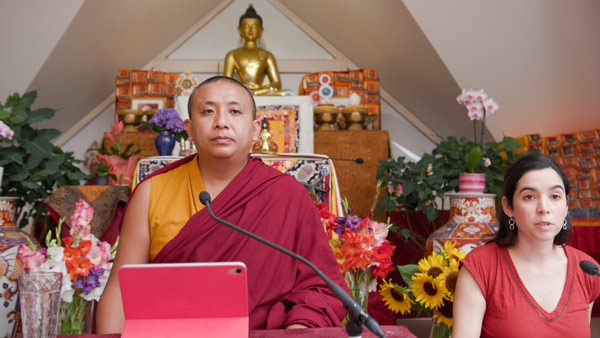
I just want to present our teacher,
Khenpo Pema Namgyal.
Khenpo means that he has gone through
rigorous monastic academic training.
I think you spent at least nine years in
the Shedra, or more?
Twelve?
How many?
Nine.
Nine years. And he has lots of
experience in teaching,
as you will see, and is very well
versed in all Buddhist philosophy,
as he is in practice, and as the assistant
of Chokyi Nyima Rinpoche and former tutor of
Tulku Urgyen Yangsi Rinpoche, I think he has
lots of precious insight to share with us.
Thank you very much for teaching.
And this is Ceci Pla, she will be...
She's one of the three translators
we have for you in this course,
and all three of them were
trained at Rangjung Yeshe Institute,
so, um, yeah, which is a great institution
in Nepal for translator training,
for example, and to learn Himalayan
languages as well as Buddhist studies.
Please enjoy.
So today we will discuss, we will talk about the subject of our talk is about the Mādhyamika. And specifically we will refer to the reasonings, the Mādhyamika reasonings.
So the question that arises is like, why? Why to study the middle way philosophy? So when we speak on the Mahāyāna context, we say that all phenomena, absolutely all phenomena are not truly established. They don't have a fixed nature or identity of their own. But this is something that we need to study, we need to hear about, we need to contemplate, we need to meditate. And in that way we can gain understanding and we can also come to know, is that really the case or not? Because this was spoken by the Buddha and there is a great benefit to coming to study, contemplating and meditating on this topic so that we really gain, um... we know it, but not just know it, we gain certainty on it. And in that behalf it's extremely important that we pay attention, that we give rise to interest on this topic. Because through this topic, through this that we will be studying these days, we can come to know why is the case that all phenomena are not truly established? Why is it that they don't have an inherent existence? And this is the heart, this is the heart that we can study, we can learn about and we can recognize by ourselves whether this is the case.
And what happens actually when we come to know that phenomena are not truly established? The result is that our grasping, our attachment diminishes.
Because the situation is that in general when we see objects, we cling to them, we attach to them. But why does that happen? It happens because we hold these objects to be real, to be true, to be there. And that attachment arises on the basis of this being this dualistic type of fixation.
So we actually believe things to be real, to be truly existent, to have a nature of their own. And it is on that behalf that we use the middle way reasonings, the Mādhyamika reasonings, in order to examine. And as we come to examine phenomena, we come to recognize that they are not truly established, they are not inherently existent. And they appear, but as we learn to um, experience phenomena in not such a rarefied manner, what happens is that we, wisdom develops, it is through wisdom that we can come to this recognition. And we tend to, the effect of this is that we give less importance. We are not so swayed away by appearances, because we don't hold them to be real, true, um, really existent there. So they kind of become like a dream, something that appears, but it doesn't hold as completely true. And there's um, things that appear become less, um, mmm, less important.
The point is that when we hold something to be true, what follows is that we attach to it.
It's attachment that arises and it's aversion that arises.
The moment that we recognize something to be not true, attachment and aversion diminishes.
So we hear about the example of a dream. So while the dream is happening, while we're dreaming, there's all types of appearances that happen. And in that moment we hold them to be true, we think the appearances of the dream are actually happening. And then what follows is that we have attachment, we have aversion, we have all types of feelings, experiences going on. But this changes the moment that we wake up. When we wake up and we say, oh, it was just a dream, then all those feelings connected to attachment, aversion and so forth, they just dissipate in that moment. Why is that the case? Because we recognize when we say we woke up from the dream, we recognize that it's not true as we thought it to be. And in a similar manner, when we refer to objects, we think objects, they are true, they are there, and based on that we develop attachment, we develop aversion. And through the Mādhyamika path, through the Mādhyamika reasonings, we can come to know how phenomena actually are. And through knowing that phenomena are not truly established, they're not really inherently there, what happens is that when we think on this again and again and again, we need to investigate this again and again and again, what happens is that our attachment and aversion diminishes. So to say brief, is as if we would compare the moment where we are inside a dream, we're dreaming in the dream, and when we awaken from the dream.
Said briefly, perceiving in a wise manner means to be devoid of this attachment and aversion.
So when we speak about considering objects to be true, we're actually distinguishing between considering objects to be real or to be not real. But in general, people think of objects as being real.
So when we hold objects to be real, what follows is that we investigate how objects arise. So for example, we think that objects arise from a cause. Is that the case or not? So this is, the presentation on this reasoning investigates in this manner, the arising of objects in terms of causes and effects.
Also through the Mādhyamika reasonings, we come to investigate whether objects, phenomena, they are naturally arising, how do they arise, how do they come about, and we come to know if there's any root or any basis that enables their arising.
So in this, on the following days, starting from today, we will investigate particularly uh, notes on five logical reasonings that they come from Jamyang Khyentse Wangpo, and we will specifically discuss these five reasonings.
So the text starts by saying, Namo Manjugochaya and this is a way of paying homage to Mañjuśrī.
So there are five great logical arguments of the Middle Way, and which ones are they? The first one will investigate the cause, and this argument is called the diamond splinters. The second one that investigates on the result, it's called refuting existent or non-existent effects. The third one that investigates both, here both means the cause and the result, it's called refuting the four permutations of arising. The fourth one, investigation of essential identity, is called neither one nor many. And the fifth one, the logical argument of great interdependence.
So there's two ways of approaching it in general. Hmm. So we either consider that arising, something that comes about, it happens through a...
through a cause that is existing, or through a cause that is non-existent.
So if something arises from a cause that is inherently a cause, then that's something that doesn't make sense. Inherently established cause. Inherently established cause, it's something that doesn't make sense, or it does not follow.
But if we would say the opposite, something arising from something that is completely non-existent, or arises without a cause, that it's even more, it makes less sense. It's overextended.
There are many consequences, it's too extended. There are many unwanted consequences that follow from that, overextended type of consequences.
So when we speak about all these tenet systems, or these philosophical perspectives that are investigating upon arising, what we are actually investigating, whether it arises from a cause that is existent, non-existent and so forth, is ultimate type of existence arising. Like a truly inherently existent ultimate type of arising. That's what we are trying to find or investigate.
So when we speak about investigating arising in terms of causes, so, we um, are refuting the possibility of arising or curing from inherently existent causes. And for that we look at the first of these five reasonings, that is called the Diamond Splinters. And in, in the root verses of the Middle Way, that is a text composed by ācārya Nāgārjuna, it says, not from itself, not from another, not from both, nor without a cause, does anything anywhere ever arise.
And in this verse there's four reasonings that are included.
So when we speak of arising through a cause, is that cause the self? Does arising happen through a cause that is itself? Yeah, the effect of, that uh, yeah... Does the effect arise from a cause that is itself? Yeah.
If something would, the effect would arise from a cause that is itself, that means that there is no other circumstances or conditions that need to be there.
So if something would arise from a cause that is itself is the cause, then as soon as it arises, it continues to arise, because it would not give the chance for something different to arise, rather than itself.
So if something arises from a cause that is itself, usually we say that there are other conditions or circumstances that enable that arising to happen, we think in this way. But then those other conditions or circumstances would actually in itself be the cause for itself to arise. So it means you would just have the continuation of the causal itself cause arising as an effect. Something like that? John, do you want to... If it, if all it could ever do is just continually do the same thing. Said simple. All we could ever do is just continue doing the same thing.
Also what happens is that there would actually not be a chance for an effect to arise. It would just be the continuation of the cause itself.
So when we speak about cause and effect, we need to investigate whether it arises or it doesn't arise.
So if it, if from a cause we have an effect that it has already arisen, means it's already there, there, then there is no more meaning for that cause. That cause becomes meaningless because the effect is already there.
And if we say, okay, the effect does not come from that cause, but the ef... the effect is already there, then the cause becomes meaningless.
If the effect is producing a not... if the cause is producing an effect that does not exist, then it can't do anything to something that doesn't exist. It can't support something that doesn't exist. Can I give you the microphone? Sorry. Also I think I confused you earlier. The first question was, if a cause is self-arisen, then a self-arisen cause can't produce effects. So that was the first thing, because it would just continually just produce itself. And then if the cause is producing an effect, if it's producing an existent effect, then as you already said, it's pointless because it already exists. If it's producing a non-existent effect, something that doesn't exist yet, then how can it do something to that something which is non-existent? How can it support something that's non-existent?
So in general, when we speak about a cause and effect, there is a relationship between cause and effect, in the sense that cause has the activity of giving rise to an effect, and an effect comes on the basis of a cause. That's how we think about it normally.
Okay, so when um... I don't know if I can do this. When we speak of an effect that has a reason, then the cause has no longer any purpose, because the effect is already there. So there is no point to having a cause when the effect is already there. On the other side, if the cause is there, but the effect has not arisen, then there is no purpose either for that cause, because it's not leading to any effect. It doesn't benefit, or it doesn't... It can't do any work. It's jobless. It cannot operate on a non-existent thing. Okay, it cannot operate on a non-existent thing.
So, through this first investigation of this first argument, we come to recognize that things do not arise from their self, from itself.
So we speak about a cause, you can think of it like a seed, and an effect as a sprout.
Now I have a question. Is the nature of this cause seed and effect sprout the same or different?
So if the nature of both the seed and the sprout would be the same, the moment that the seed ceases to be, then um, what's happening to the sprout?
So the question again is whether the nature of the seed and the sprout, for example the nature of the seed in terms of the form, in terms of its shape, in terms of its capacity, and the nature of the sprout in terms of forms, shapes, capacity, whether it's the same or not.
So in general we speak of them as being different. No? We say like, oh the color, the size of the seed is different than, than the color and the size or the shape of the sprout.
So if we say that they are different, then arising cannot happen from something that is other, that is different.
If their nature is different, then we are already assuming that the seed does not, the sprout does not arise from itself. It arises from something different. We are already assuming that.
So if we, I just say, I don't know if the online people are hearing and then you can correct again. So if we say that the um, it does not arise from itself, then what follows is that it arrives from something different, which that means the normal way we speak about causes and effect, seed and sprout. We assume that it does not arise from itself, but it arises from something different than itself, from something other.
Lhaso. So if we say there are two different things, the seed and the sprout are two different things, then we are assuming that that arising happens from something that other than itself, means from something different.
Because if they were the same, that doesn't make sense. Hmm. They would have the same root or the same basis. Not so many, just at all. At all. Pointless.
And why is that the case? Because if it would be the same, then at the moment of it being an effect, say for example the sprout, it would have to have the same form, shape and color than the seed.
Mm hmm. But this is not the case, this is not, this doesn't make sense.
So to say that something arises from itself, it's not feasible, it's not tenable.
So when we approximate this argument, we investigate how things do not arise from itself, and that is something that we need to gain certainty, we need to understand.
The moment we can recognize that things do not arise from itself, then we say, okay, maybe they arise from other. And then that other, we investigate if that arising is occurring.
So we will go investigate more whether arising occurs from another, from tomorrow onwards, but just to state it brief, when we speak of arising from another, what are we referring to?
So now I have a question. When we say, okay, it doesn't arise from itself, then it arises from another. When we say that other, what are we referring to with this other? Is it like anything? Any other thing that is not itself?
Because that's not something that we, we say, it's the case. No, it's not the case that something arises from anything other else.
So to give an example, we say we can think of like the light that emerges from a candle, from a butter lump. And we speak of light as being different or being other than darkness. But if we put this together, we would never say, oh, darkness emerges from other, being that other light.
Mm hmm. It's not correct or it's not feasible to say that uh, darkness arises from light.
So when we speak of arising from an other, we don't mean any other thing, something that is completely different. We normally speak in terms of like, something that is connected, like a cause and effect. There is some... A specific effect comes from a specific cause. Yes, a specific effect comes from a specific cause.
And we will examine if that's the case, if that's true. We see that as being true generally. Yeah, we see that seems to be true in general.
But according to the reasonings of the Middle Way, to say that they are um, truly existent or inherent causes and effects, that's something that is not the case.
And tomorrow we will continue examining this.
So to state what we spoke about today when we examined arising, as arising from itself. So we say that arising from itself is not the case because when something arises from itself, it's already there. So there is no... um, how do you say... nothing comes from itself because itself is already there. Nothing follows. There's no effect coming from something that is already there. And on the other side, when we examine the nature of cause and effect, we cannot say that they have the same nature. For example, in terms of the same color, the same shape, the same form and so forth. So through that, we can come to know that arising from itself is not tenable.
So in this presentation of the Middle Way, we are examining how arising takes place and we are examining it in terms of four ways. One, we are examining whether arising happens from itself, whether it happens from other, something different. Whether it happens from both itself and other or causeless, none of this. And as we investigate, we come to know that arising does not happen in the manner that we think it does, and to that we can gain certainty.
We examine arising in terms of causes and effects. And what comes, what follows is that we come to recognize how all phenomena are not truly established.
And the moment that we come to recognize that all phenomena are not truly established and we gain certainty in this, what follows is that attachment, aversion and so forth, they all diminish, or become, we are absent of that.
Upon being free from afflictive emotions, karma also does not arise.
And upon being free from afflictive emotions and not generating karma, We are also not, uh. samsara is discontinued, we are not roaming in samsara.
Mm hmm. So this the... what the text is teaching us or not, teaching about, about this path.
And mainly it's a way to dissipate our grasping, our clinging, to get, yeah to, to vanish all types of fixations and graspings.
39:10
Welcome, everyone, to the second part of
today's teachings and lectures.
I just want to present our teacher,
Khenpo Pema Namgyal.
Khenpo means that he has gone through
rigorous monastic academic training.
I think you spent at least nine years in
the Shedra, or more?
Twelve?
How many?
Nine.
Nine years. And he has lots of
experience in teaching,
as you will see, and is very well
versed in all Buddhist philosophy,
as he is in practice, and as the assistant
of Chokyi Nyima Rinpoche and former tutor of
Tulku Urgyen Yangsi Rinpoche, I think he has
lots of precious insight to share with us.
Thank you very much for teaching.
And this is Ceci Pla, she will be...
She's one of the three translators
we have for you in this course,
and all three of them were
trained at Rangjung Yeshe Institute,
so, um, yeah, which is a great institution
in Nepal for translator training,
for example, and to learn Himalayan
languages as well as Buddhist studies.
Please enjoy.
So today we will discuss, we will talk about the subject of our talk is about the Mādhyamika. And specifically we will refer to the reasonings, the Mādhyamika reasonings.
So the question that arises is like, why? Why to study the middle way philosophy? So when we speak on the Mahāyāna context, we say that all phenomena, absolutely all phenomena are not truly established. They don't have a fixed nature or identity of their own. But this is something that we need to study, we need to hear about, we need to contemplate, we need to meditate. And in that way we can gain understanding and we can also come to know, is that really the case or not? Because this was spoken by the Buddha and there is a great benefit to coming to study, contemplating and meditating on this topic so that we really gain, um... we know it, but not just know it, we gain certainty on it. And in that behalf it's extremely important that we pay attention, that we give rise to interest on this topic. Because through this topic, through this that we will be studying these days, we can come to know why is the case that all phenomena are not truly established? Why is it that they don't have an inherent existence? And this is the heart, this is the heart that we can study, we can learn about and we can recognize by ourselves whether this is the case.
And what happens actually when we come to know that phenomena are not truly established? The result is that our grasping, our attachment diminishes.
Because the situation is that in general when we see objects, we cling to them, we attach to them. But why does that happen? It happens because we hold these objects to be real, to be true, to be there. And that attachment arises on the basis of this being this dualistic type of fixation.
So we actually believe things to be real, to be truly existent, to have a nature of their own. And it is on that behalf that we use the middle way reasonings, the Mādhyamika reasonings, in order to examine. And as we come to examine phenomena, we come to recognize that they are not truly established, they are not inherently existent. And they appear, but as we learn to um, experience phenomena in not such a rarefied manner, what happens is that we, wisdom develops, it is through wisdom that we can come to this recognition. And we tend to, the effect of this is that we give less importance. We are not so swayed away by appearances, because we don't hold them to be real, true, um, really existent there. So they kind of become like a dream, something that appears, but it doesn't hold as completely true. And there's um, things that appear become less, um, mmm, less important.
The point is that when we hold something to be true, what follows is that we attach to it.
It's attachment that arises and it's aversion that arises.
The moment that we recognize something to be not true, attachment and aversion diminishes.
So we hear about the example of a dream. So while the dream is happening, while we're dreaming, there's all types of appearances that happen. And in that moment we hold them to be true, we think the appearances of the dream are actually happening. And then what follows is that we have attachment, we have aversion, we have all types of feelings, experiences going on. But this changes the moment that we wake up. When we wake up and we say, oh, it was just a dream, then all those feelings connected to attachment, aversion and so forth, they just dissipate in that moment. Why is that the case? Because we recognize when we say we woke up from the dream, we recognize that it's not true as we thought it to be. And in a similar manner, when we refer to objects, we think objects, they are true, they are there, and based on that we develop attachment, we develop aversion. And through the Mādhyamika path, through the Mādhyamika reasonings, we can come to know how phenomena actually are. And through knowing that phenomena are not truly established, they're not really inherently there, what happens is that when we think on this again and again and again, we need to investigate this again and again and again, what happens is that our attachment and aversion diminishes. So to say brief, is as if we would compare the moment where we are inside a dream, we're dreaming in the dream, and when we awaken from the dream.
Said briefly, perceiving in a wise manner means to be devoid of this attachment and aversion.
So when we speak about considering objects to be true, we're actually distinguishing between considering objects to be real or to be not real. But in general, people think of objects as being real.
So when we hold objects to be real, what follows is that we investigate how objects arise. So for example, we think that objects arise from a cause. Is that the case or not? So this is, the presentation on this reasoning investigates in this manner, the arising of objects in terms of causes and effects.
Also through the Mādhyamika reasonings, we come to investigate whether objects, phenomena, they are naturally arising, how do they arise, how do they come about, and we come to know if there's any root or any basis that enables their arising.
So in this, on the following days, starting from today, we will investigate particularly uh, notes on five logical reasonings that they come from Jamyang Khyentse Wangpo, and we will specifically discuss these five reasonings.
So the text starts by saying, Namo Manjugochaya and this is a way of paying homage to Mañjuśrī.
So there are five great logical arguments of the Middle Way, and which ones are they? The first one will investigate the cause, and this argument is called the diamond splinters. The second one that investigates on the result, it's called refuting existent or non-existent effects. The third one that investigates both, here both means the cause and the result, it's called refuting the four permutations of arising. The fourth one, investigation of essential identity, is called neither one nor many. And the fifth one, the logical argument of great interdependence.
So there's two ways of approaching it in general. Hmm. So we either consider that arising, something that comes about, it happens through a...
through a cause that is existing, or through a cause that is non-existent.
So if something arises from a cause that is inherently a cause, then that's something that doesn't make sense. Inherently established cause. Inherently established cause, it's something that doesn't make sense, or it does not follow.
But if we would say the opposite, something arising from something that is completely non-existent, or arises without a cause, that it's even more, it makes less sense. It's overextended.
There are many consequences, it's too extended. There are many unwanted consequences that follow from that, overextended type of consequences.
So when we speak about all these tenet systems, or these philosophical perspectives that are investigating upon arising, what we are actually investigating, whether it arises from a cause that is existent, non-existent and so forth, is ultimate type of existence arising. Like a truly inherently existent ultimate type of arising. That's what we are trying to find or investigate.
So when we speak about investigating arising in terms of causes, so, we um, are refuting the possibility of arising or curing from inherently existent causes. And for that we look at the first of these five reasonings, that is called the Diamond Splinters. And in, in the root verses of the Middle Way, that is a text composed by ācārya Nāgārjuna, it says, not from itself, not from another, not from both, nor without a cause, does anything anywhere ever arise.
And in this verse there's four reasonings that are included.
So when we speak of arising through a cause, is that cause the self? Does arising happen through a cause that is itself? Yeah, the effect of, that uh, yeah... Does the effect arise from a cause that is itself? Yeah.
If something would, the effect would arise from a cause that is itself, that means that there is no other circumstances or conditions that need to be there.
So if something would arise from a cause that is itself is the cause, then as soon as it arises, it continues to arise, because it would not give the chance for something different to arise, rather than itself.
So if something arises from a cause that is itself, usually we say that there are other conditions or circumstances that enable that arising to happen, we think in this way. But then those other conditions or circumstances would actually in itself be the cause for itself to arise. So it means you would just have the continuation of the causal itself cause arising as an effect. Something like that? John, do you want to... If it, if all it could ever do is just continually do the same thing. Said simple. All we could ever do is just continue doing the same thing.
Also what happens is that there would actually not be a chance for an effect to arise. It would just be the continuation of the cause itself.
So when we speak about cause and effect, we need to investigate whether it arises or it doesn't arise.
So if it, if from a cause we have an effect that it has already arisen, means it's already there, there, then there is no more meaning for that cause. That cause becomes meaningless because the effect is already there.
And if we say, okay, the effect does not come from that cause, but the ef... the effect is already there, then the cause becomes meaningless.
If the effect is producing a not... if the cause is producing an effect that does not exist, then it can't do anything to something that doesn't exist. It can't support something that doesn't exist. Can I give you the microphone? Sorry. Also I think I confused you earlier. The first question was, if a cause is self-arisen, then a self-arisen cause can't produce effects. So that was the first thing, because it would just continually just produce itself. And then if the cause is producing an effect, if it's producing an existent effect, then as you already said, it's pointless because it already exists. If it's producing a non-existent effect, something that doesn't exist yet, then how can it do something to that something which is non-existent? How can it support something that's non-existent?
So in general, when we speak about a cause and effect, there is a relationship between cause and effect, in the sense that cause has the activity of giving rise to an effect, and an effect comes on the basis of a cause. That's how we think about it normally.
Okay, so when um... I don't know if I can do this. When we speak of an effect that has a reason, then the cause has no longer any purpose, because the effect is already there. So there is no point to having a cause when the effect is already there. On the other side, if the cause is there, but the effect has not arisen, then there is no purpose either for that cause, because it's not leading to any effect. It doesn't benefit, or it doesn't... It can't do any work. It's jobless. It cannot operate on a non-existent thing. Okay, it cannot operate on a non-existent thing.
So, through this first investigation of this first argument, we come to recognize that things do not arise from their self, from itself.
So we speak about a cause, you can think of it like a seed, and an effect as a sprout.
Now I have a question. Is the nature of this cause seed and effect sprout the same or different?
So if the nature of both the seed and the sprout would be the same, the moment that the seed ceases to be, then um, what's happening to the sprout?
So the question again is whether the nature of the seed and the sprout, for example the nature of the seed in terms of the form, in terms of its shape, in terms of its capacity, and the nature of the sprout in terms of forms, shapes, capacity, whether it's the same or not.
So in general we speak of them as being different. No? We say like, oh the color, the size of the seed is different than, than the color and the size or the shape of the sprout.
So if we say that they are different, then arising cannot happen from something that is other, that is different.
If their nature is different, then we are already assuming that the seed does not, the sprout does not arise from itself. It arises from something different. We are already assuming that.
So if we, I just say, I don't know if the online people are hearing and then you can correct again. So if we say that the um, it does not arise from itself, then what follows is that it arrives from something different, which that means the normal way we speak about causes and effect, seed and sprout. We assume that it does not arise from itself, but it arises from something different than itself, from something other.
Lhaso. So if we say there are two different things, the seed and the sprout are two different things, then we are assuming that that arising happens from something that other than itself, means from something different.
Because if they were the same, that doesn't make sense. Hmm. They would have the same root or the same basis. Not so many, just at all. At all. Pointless.
And why is that the case? Because if it would be the same, then at the moment of it being an effect, say for example the sprout, it would have to have the same form, shape and color than the seed.
Mm hmm. But this is not the case, this is not, this doesn't make sense.
So to say that something arises from itself, it's not feasible, it's not tenable.
So when we approximate this argument, we investigate how things do not arise from itself, and that is something that we need to gain certainty, we need to understand.
The moment we can recognize that things do not arise from itself, then we say, okay, maybe they arise from other. And then that other, we investigate if that arising is occurring.
So we will go investigate more whether arising occurs from another, from tomorrow onwards, but just to state it brief, when we speak of arising from another, what are we referring to?
So now I have a question. When we say, okay, it doesn't arise from itself, then it arises from another. When we say that other, what are we referring to with this other? Is it like anything? Any other thing that is not itself?
Because that's not something that we, we say, it's the case. No, it's not the case that something arises from anything other else.
So to give an example, we say we can think of like the light that emerges from a candle, from a butter lump. And we speak of light as being different or being other than darkness. But if we put this together, we would never say, oh, darkness emerges from other, being that other light.
Mm hmm. It's not correct or it's not feasible to say that uh, darkness arises from light.
So when we speak of arising from an other, we don't mean any other thing, something that is completely different. We normally speak in terms of like, something that is connected, like a cause and effect. There is some... A specific effect comes from a specific cause. Yes, a specific effect comes from a specific cause.
And we will examine if that's the case, if that's true. We see that as being true generally. Yeah, we see that seems to be true in general.
But according to the reasonings of the Middle Way, to say that they are um, truly existent or inherent causes and effects, that's something that is not the case.
And tomorrow we will continue examining this.
So to state what we spoke about today when we examined arising, as arising from itself. So we say that arising from itself is not the case because when something arises from itself, it's already there. So there is no... um, how do you say... nothing comes from itself because itself is already there. Nothing follows. There's no effect coming from something that is already there. And on the other side, when we examine the nature of cause and effect, we cannot say that they have the same nature. For example, in terms of the same color, the same shape, the same form and so forth. So through that, we can come to know that arising from itself is not tenable.
So in this presentation of the Middle Way, we are examining how arising takes place and we are examining it in terms of four ways. One, we are examining whether arising happens from itself, whether it happens from other, something different. Whether it happens from both itself and other or causeless, none of this. And as we investigate, we come to know that arising does not happen in the manner that we think it does, and to that we can gain certainty.
We examine arising in terms of causes and effects. And what comes, what follows is that we come to recognize how all phenomena are not truly established.
And the moment that we come to recognize that all phenomena are not truly established and we gain certainty in this, what follows is that attachment, aversion and so forth, they all diminish, or become, we are absent of that.
Upon being free from afflictive emotions, karma also does not arise.
And upon being free from afflictive emotions and not generating karma, We are also not, uh. samsara is discontinued, we are not roaming in samsara.
Mm hmm. So this the... what the text is teaching us or not, teaching about, about this path.
And mainly it's a way to dissipate our grasping, our clinging, to get, yeah to, to vanish all types of fixations and graspings.
So today we will discuss, we will talk about the subject of our talk is about the Mādhyamika. And specifically we will refer to the reasonings, the Mādhyamika reasonings.
So the question that arises is like, why? Why to study the middle way philosophy? So when we speak on the Mahāyāna context, we say that all phenomena, absolutely all phenomena are not truly established. They don't have a fixed nature or identity of their own. But this is something that we need to study, we need to hear about, we need to contemplate, we need to meditate. And in that way we can gain understanding and we can also come to know, is that really the case or not? Because this was spoken by the Buddha and there is a great benefit to coming to study, contemplating and meditating on this topic so that we really gain, um... we know it, but not just know it, we gain certainty on it. And in that behalf it's extremely important that we pay attention, that we give rise to interest on this topic. Because through this topic, through this that we will be studying these days, we can come to know why is the case that all phenomena are not truly established? Why is it that they don't have an inherent existence? And this is the heart, this is the heart that we can study, we can learn about and we can recognize by ourselves whether this is the case.
And what happens actually when we come to know that phenomena are not truly established? The result is that our grasping, our attachment diminishes.
Because the situation is that in general when we see objects, we cling to them, we attach to them. But why does that happen? It happens because we hold these objects to be real, to be true, to be there. And that attachment arises on the basis of this being this dualistic type of fixation.
So we actually believe things to be real, to be truly existent, to have a nature of their own. And it is on that behalf that we use the middle way reasonings, the Mādhyamika reasonings, in order to examine. And as we come to examine phenomena, we come to recognize that they are not truly established, they are not inherently existent. And they appear, but as we learn to um, experience phenomena in not such a rarefied manner, what happens is that we, wisdom develops, it is through wisdom that we can come to this recognition. And we tend to, the effect of this is that we give less importance. We are not so swayed away by appearances, because we don't hold them to be real, true, um, really existent there. So they kind of become like a dream, something that appears, but it doesn't hold as completely true. And there's um, things that appear become less, um, mmm, less important.
The point is that when we hold something to be true, what follows is that we attach to it.
It's attachment that arises and it's aversion that arises.
The moment that we recognize something to be not true, attachment and aversion diminishes.
So we hear about the example of a dream. So while the dream is happening, while we're dreaming, there's all types of appearances that happen. And in that moment we hold them to be true, we think the appearances of the dream are actually happening. And then what follows is that we have attachment, we have aversion, we have all types of feelings, experiences going on. But this changes the moment that we wake up. When we wake up and we say, oh, it was just a dream, then all those feelings connected to attachment, aversion and so forth, they just dissipate in that moment. Why is that the case? Because we recognize when we say we woke up from the dream, we recognize that it's not true as we thought it to be. And in a similar manner, when we refer to objects, we think objects, they are true, they are there, and based on that we develop attachment, we develop aversion. And through the Mādhyamika path, through the Mādhyamika reasonings, we can come to know how phenomena actually are. And through knowing that phenomena are not truly established, they're not really inherently there, what happens is that when we think on this again and again and again, we need to investigate this again and again and again, what happens is that our attachment and aversion diminishes. So to say brief, is as if we would compare the moment where we are inside a dream, we're dreaming in the dream, and when we awaken from the dream.
Said briefly, perceiving in a wise manner means to be devoid of this attachment and aversion.
So when we speak about considering objects to be true, we're actually distinguishing between considering objects to be real or to be not real. But in general, people think of objects as being real.
So when we hold objects to be real, what follows is that we investigate how objects arise. So for example, we think that objects arise from a cause. Is that the case or not? So this is, the presentation on this reasoning investigates in this manner, the arising of objects in terms of causes and effects.
Also through the Mādhyamika reasonings, we come to investigate whether objects, phenomena, they are naturally arising, how do they arise, how do they come about, and we come to know if there's any root or any basis that enables their arising.
So in this, on the following days, starting from today, we will investigate particularly uh, notes on five logical reasonings that they come from Jamyang Khyentse Wangpo, and we will specifically discuss these five reasonings.
So the text starts by saying, Namo Manjugochaya and this is a way of paying homage to Mañjuśrī.
So there are five great logical arguments of the Middle Way, and which ones are they? The first one will investigate the cause, and this argument is called the diamond splinters. The second one that investigates on the result, it's called refuting existent or non-existent effects. The third one that investigates both, here both means the cause and the result, it's called refuting the four permutations of arising. The fourth one, investigation of essential identity, is called neither one nor many. And the fifth one, the logical argument of great interdependence.
So there's two ways of approaching it in general. Hmm. So we either consider that arising, something that comes about, it happens through a...
through a cause that is existing, or through a cause that is non-existent.
So if something arises from a cause that is inherently a cause, then that's something that doesn't make sense. Inherently established cause. Inherently established cause, it's something that doesn't make sense, or it does not follow.
But if we would say the opposite, something arising from something that is completely non-existent, or arises without a cause, that it's even more, it makes less sense. It's overextended.
There are many consequences, it's too extended. There are many unwanted consequences that follow from that, overextended type of consequences.
So when we speak about all these tenet systems, or these philosophical perspectives that are investigating upon arising, what we are actually investigating, whether it arises from a cause that is existent, non-existent and so forth, is ultimate type of existence arising. Like a truly inherently existent ultimate type of arising. That's what we are trying to find or investigate.
So when we speak about investigating arising in terms of causes, so, we um, are refuting the possibility of arising or curing from inherently existent causes. And for that we look at the first of these five reasonings, that is called the Diamond Splinters. And in, in the root verses of the Middle Way, that is a text composed by ācārya Nāgārjuna, it says, not from itself, not from another, not from both, nor without a cause, does anything anywhere ever arise.
And in this verse there's four reasonings that are included.
So when we speak of arising through a cause, is that cause the self? Does arising happen through a cause that is itself? Yeah, the effect of, that uh, yeah... Does the effect arise from a cause that is itself? Yeah.
If something would, the effect would arise from a cause that is itself, that means that there is no other circumstances or conditions that need to be there.
So if something would arise from a cause that is itself is the cause, then as soon as it arises, it continues to arise, because it would not give the chance for something different to arise, rather than itself.
So if something arises from a cause that is itself, usually we say that there are other conditions or circumstances that enable that arising to happen, we think in this way. But then those other conditions or circumstances would actually in itself be the cause for itself to arise. So it means you would just have the continuation of the causal itself cause arising as an effect. Something like that? John, do you want to... If it, if all it could ever do is just continually do the same thing. Said simple. All we could ever do is just continue doing the same thing.
Also what happens is that there would actually not be a chance for an effect to arise. It would just be the continuation of the cause itself.
So when we speak about cause and effect, we need to investigate whether it arises or it doesn't arise.
So if it, if from a cause we have an effect that it has already arisen, means it's already there, there, then there is no more meaning for that cause. That cause becomes meaningless because the effect is already there.
And if we say, okay, the effect does not come from that cause, but the ef... the effect is already there, then the cause becomes meaningless.
If the effect is producing a not... if the cause is producing an effect that does not exist, then it can't do anything to something that doesn't exist. It can't support something that doesn't exist. Can I give you the microphone? Sorry. Also I think I confused you earlier. The first question was, if a cause is self-arisen, then a self-arisen cause can't produce effects. So that was the first thing, because it would just continually just produce itself. And then if the cause is producing an effect, if it's producing an existent effect, then as you already said, it's pointless because it already exists. If it's producing a non-existent effect, something that doesn't exist yet, then how can it do something to that something which is non-existent? How can it support something that's non-existent?
So in general, when we speak about a cause and effect, there is a relationship between cause and effect, in the sense that cause has the activity of giving rise to an effect, and an effect comes on the basis of a cause. That's how we think about it normally.
Okay, so when um... I don't know if I can do this. When we speak of an effect that has a reason, then the cause has no longer any purpose, because the effect is already there. So there is no point to having a cause when the effect is already there. On the other side, if the cause is there, but the effect has not arisen, then there is no purpose either for that cause, because it's not leading to any effect. It doesn't benefit, or it doesn't... It can't do any work. It's jobless. It cannot operate on a non-existent thing. Okay, it cannot operate on a non-existent thing.
So, through this first investigation of this first argument, we come to recognize that things do not arise from their self, from itself.
So we speak about a cause, you can think of it like a seed, and an effect as a sprout.
Now I have a question. Is the nature of this cause seed and effect sprout the same or different?
So if the nature of both the seed and the sprout would be the same, the moment that the seed ceases to be, then um, what's happening to the sprout?
So the question again is whether the nature of the seed and the sprout, for example the nature of the seed in terms of the form, in terms of its shape, in terms of its capacity, and the nature of the sprout in terms of forms, shapes, capacity, whether it's the same or not.
So in general we speak of them as being different. No? We say like, oh the color, the size of the seed is different than, than the color and the size or the shape of the sprout.
So if we say that they are different, then arising cannot happen from something that is other, that is different.
If their nature is different, then we are already assuming that the seed does not, the sprout does not arise from itself. It arises from something different. We are already assuming that.
So if we, I just say, I don't know if the online people are hearing and then you can correct again. So if we say that the um, it does not arise from itself, then what follows is that it arrives from something different, which that means the normal way we speak about causes and effect, seed and sprout. We assume that it does not arise from itself, but it arises from something different than itself, from something other.
Lhaso. So if we say there are two different things, the seed and the sprout are two different things, then we are assuming that that arising happens from something that other than itself, means from something different.
Because if they were the same, that doesn't make sense. Hmm. They would have the same root or the same basis. Not so many, just at all. At all. Pointless.
And why is that the case? Because if it would be the same, then at the moment of it being an effect, say for example the sprout, it would have to have the same form, shape and color than the seed.
Mm hmm. But this is not the case, this is not, this doesn't make sense.
So to say that something arises from itself, it's not feasible, it's not tenable.
So when we approximate this argument, we investigate how things do not arise from itself, and that is something that we need to gain certainty, we need to understand.
The moment we can recognize that things do not arise from itself, then we say, okay, maybe they arise from other. And then that other, we investigate if that arising is occurring.
So we will go investigate more whether arising occurs from another, from tomorrow onwards, but just to state it brief, when we speak of arising from another, what are we referring to?
So now I have a question. When we say, okay, it doesn't arise from itself, then it arises from another. When we say that other, what are we referring to with this other? Is it like anything? Any other thing that is not itself?
Because that's not something that we, we say, it's the case. No, it's not the case that something arises from anything other else.
So to give an example, we say we can think of like the light that emerges from a candle, from a butter lump. And we speak of light as being different or being other than darkness. But if we put this together, we would never say, oh, darkness emerges from other, being that other light.
Mm hmm. It's not correct or it's not feasible to say that uh, darkness arises from light.
So when we speak of arising from an other, we don't mean any other thing, something that is completely different. We normally speak in terms of like, something that is connected, like a cause and effect. There is some... A specific effect comes from a specific cause. Yes, a specific effect comes from a specific cause.
And we will examine if that's the case, if that's true. We see that as being true generally. Yeah, we see that seems to be true in general.
But according to the reasonings of the Middle Way, to say that they are um, truly existent or inherent causes and effects, that's something that is not the case.
And tomorrow we will continue examining this.
So to state what we spoke about today when we examined arising, as arising from itself. So we say that arising from itself is not the case because when something arises from itself, it's already there. So there is no... um, how do you say... nothing comes from itself because itself is already there. Nothing follows. There's no effect coming from something that is already there. And on the other side, when we examine the nature of cause and effect, we cannot say that they have the same nature. For example, in terms of the same color, the same shape, the same form and so forth. So through that, we can come to know that arising from itself is not tenable.
So in this presentation of the Middle Way, we are examining how arising takes place and we are examining it in terms of four ways. One, we are examining whether arising happens from itself, whether it happens from other, something different. Whether it happens from both itself and other or causeless, none of this. And as we investigate, we come to know that arising does not happen in the manner that we think it does, and to that we can gain certainty.
We examine arising in terms of causes and effects. And what comes, what follows is that we come to recognize how all phenomena are not truly established.
And the moment that we come to recognize that all phenomena are not truly established and we gain certainty in this, what follows is that attachment, aversion and so forth, they all diminish, or become, we are absent of that.
Upon being free from afflictive emotions, karma also does not arise.
And upon being free from afflictive emotions and not generating karma, We are also not, uh. samsara is discontinued, we are not roaming in samsara.
Mm hmm. So this the... what the text is teaching us or not, teaching about, about this path.
And mainly it's a way to dissipate our grasping, our clinging, to get, yeah to, to vanish all types of fixations and graspings.
