
Video
Audio
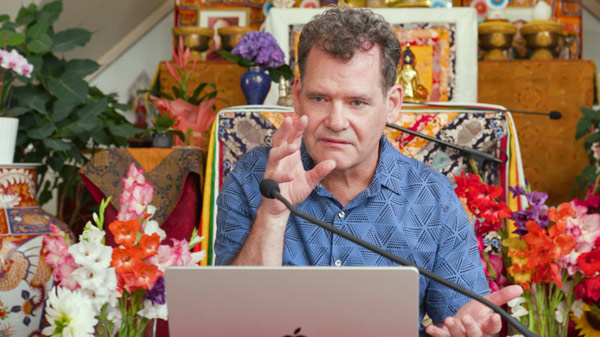
49:54
So, um...
the, uh...
So what, when...
so what we've been talking about actually
continues through, uh in, in Buddhism,
so in that sense the common vehicle.
Its focus, if we go back to this model,
what we're trying to do
is we're really like this...
we have a problem, right?
In the way we're interacting, in the way we're
acting in the world. And it's unsuccessful.
So the main target actually is the
interpretation.
So this is, in other words, and the
interpretation is conceptual.
So at this point, the main target of this
type of analysis is conceptual.
It's definitely dealing with a kind of
intuitive self model that's flawed.
But the way that self model is
manifesting here is that it is uh,
it is a, causing our
conceptualizations to be unsuccessful.
Okay?
So we're really kind of trying to unpack,
get clear about
the flaws in our conceptualizations
that are caused by that self model.
And we're going to see eventually
that this, even at this level,
but especially for Nāgārjuna, there's also
going to be distortions even at this level.
You could say that there's a kind of
intuitive aspect of that self model which
emerges when you conceptualize, like
this is a flower and that's a good thing.
Oh, I want this.
Right?
Remember, so those who had Rinpoche's talk
seminar last week, like,
even just going, Oh, that's nice. That's
already this kind of conceptualizat...
Nice is, it's, you know,
something nice for me.
It's already karmic.
Right?
So already producing karmic conditioning.
And, but when I go that's nice, that's
a concept, that's an interpretation.
And the idea here is that there is some
kind of pre conceptual,
right, experiential level
that is then being interpreted
through a faulty interpretive framework.
And that interpretive framework is faulty
because of the self model.
But it also, as we will see, ways in which we can talk about even the pre conceptual experience also being faulty.
And we'll get to that later. But I just want to say that we're going to get to that. But a lot of philosophy, you know, if we don't undo the false interpretations, if we don't really dig down into the way in which our conceptual model you know, and there are all kinds of conceptual models, there are linguistic conceptual models, there are mathematical conceptual models, all kinds of conceptual models, those are all, you know, models. Uh, and uh, And what their modeling is, on this kind of diagram, this schematic diagram, this is a map for this territory, the interpretation is using a conceptual map to try to understand this pre conceptual territory, so to speak. You understand? So you have your kind of pre conceptual territory is just your experience. And then you've got a map, which is a conceptual framework that you're using to make sense of that, so that you can, you know, get what you want and avoid what you don't want. Which is the baseline that's motivating your conceptualizations. So this is distinct from a kind of platonic position, which would be your conceptualizations are just picking out real things in the world. You know, when I say flower, I'm just kind of seeing that's a flower, that's a flower, this is a petal, that's a petal. I'm just, you know, picking out real categories in the world. The category flower, or, you know, flower, flower, flower flower, or petal, petal, petal petal, that those categories exist as real things in the world, and I'm just picking them out. Sort of passively, as if I, you know, I just do it, I don't know, automatically. But here, the idea is that those categories do not exist in the world, they have to be produced. And the reason they're produced is, we're trying to act in the world. We're trying to make sense of the world, we're trying to do things in the world. Right, and we could be doing something like trying to find water, or we could be doing something like, you know, running a quantum level experiment about entanglement. And so we have models that are regulating the experiences we're having while we're doing these things. And they can be very coarse models or very subtle models. But they're models about experience in the world, in the end. And they emerge from, those models emerge from experience in the world. Okay, so that's the kind of position that we have here, a little anachronistic in the way I'm talking about it in terms of the development of, of a Buddhist philosophy, but good enough, I think, for our purposes. So Nāgārjuna is also going to be doing the same thing. So this first level of distortion is that there's a self model that's a problem. And if you really work with that self model, you can actually end suffering. You can attain what's called the state of being an Arhat, you can attain nirvāṇa. All right. So strictly speaking, on this perspective, there is some disagreement about this, but I'm going to endorse the position that says, you don't have to really have a realization of Nāgārjuna's version of emptiness in order to become free from suffering and attain a kind of nirvāṇa that's the cessation of saṃsāra. So that's very important to know. Like, that's a very typical interpretation. There are some competing, some will say you have to have at least some realization of... some degree of realization of Nāgārjuna's notion of emptiness. But on this model, I'm saying, no, I'm following the interpretation that says you don't really need that in order to fix the self model, or really like get rid of that self model. The one that says there's an absolute controlling, permanent, a, a, self. You know the... The self that's in charge. But as we get into this second period, there's some very important things that happen historically. And the tradition says, as I mentioned before, that there were perspectives, there were sutras, teachings of the Buddha that have been kept secret. You know, western academics will say, well, they just somehow were produced in this period. And it doesn't really... I think for our purposes, we don't really need to come down on one side or another. What we do want to recognize, though, is that there's a change that happens. And I told you that story from the Vimalakīrti Nirdeśa Sūtra which is very popular in China. So I, here's a Chinese depiction of Vimalakīrti, the Bodhisattva. And part of the idea of Vimalakīrti is he's kind of in that sutra, there is this character Śāriputra, who's one of the Buddha's great disciples. And he acts as kind of like a straw man or a fall guy for Vimalakīrti, representing this very conservative attitude. And Vimalakīrti is not a monk, he's a lay person. You know he goes to, he teaches the dharma in brothels. Uh, he's in a, he eh... He goes to the bars and expresses his compassion. So he's in a different kind of category, right? What's this change that happens? Well, part of it is that I told you that story about how Śāriputra is at the beginning of the sutra, you know, in this place. And part of what's happening here is this idea of the buddhakṣetra, the Buddha realm, and that we are actually in the Buddha realm, this kind of realm in which the suffering of saṃsāra has been transformed. And Śāriputra says, you know, he's in quite, another celestial bodhisattva, sort of knows that Śāriputra is having doubts about this, and says, you know, what do you think? He says, well, I see this place is filled with cesspools and thorns and mountains and valleys, and this doesn't look like a beautiful Buddha realm to me. And then the Buddha touches his toe to the ground, remember that, and then suddenly, boof, there it is. And then he lifts his toe and it's gone. So what's the idea of that? Why is that necessary? What's going on here, if you think about it carefully, on the model we said, we've said that there are psycho physical elements that are ultimately real, right? We can reduce, we can't break them down further, we do that reductionist analysis, and there are infinitesimal small physical and mental bits of reality that are called dharmas. And these dharmas are ultimately real. And they are produced, they are saṃskṛta in Sanskrit, they are conditioned. Some people translate it as compounded, which is not great, I don't think, in this context. So they're causally conditioned, these dharmas. They're in a causal chain, they're actually in this kind of, just this same kind of causal chain, like the mental dharmas are in that causal chain, right? This causal chain of mental moments, I represent this as a single circle, but this mental moment is actually a whole bundle of different a, a, dharmas, mental dharmas, mental elements. So they're producing the next, and the next, and the next, and the next, right? So all of that stuff is flowing along causally, and that stuff is real. But also, that stuff is conditioned by ignorance. So if all of that stuff, and in fact the world, even the physical stuff, is conditioned by the karma of the beings in that world, and the karma has come from the kleśas, which come, which are rooted in the root kleśa, ignorance, that means all of the stuff of the world is, is already like fixed in its nature by that causal process. Each of them has what's called a svabhāva, that's going to be a very important term, and I'll put it up there soon, an essence. And so they are, so the nature, like if you plant an apple seed, you don't get a banana tree. Right? The... And the apple tree that comes from it produces apples that produce apple seeds. They don't produce Ferrari’s. Right? Wouldn't that be nice? Oh, look, I've got a Ferrari tree. No, it doesn't work that way. Not sure if it would be nice. But anyway, so very expensive upkeep. Uh, so... You know, what... with like, so this causal regularity, and things, nature is fixed by that causal regularity, which means, yes, you can stop the dysfunctional causal process that's producing suffering, but all of this stuff you have now, your aggregates, have already been produced by karma and kleśa. So when you attain cessation on this model, you attain a kind of cessation that's called nirvāṇa with a remainder.
Uh, nirupadhiśeṣa nirvāṇa, sorry, sorry, sopadhiśeṣa nirvāṇa, and then when you die, you attain a kind of final nirvāṇa that's called nirupadhiśeṣa nirvāṇa. So when you become, when you attain nirvāṇa, you're an Arhat, is the term for that, and you are in nirvāṇa, the causes of saṃsāra have stopped, or you're not producing new causes of saṃsāra, but the present causes of saṃsāra, in one word, so saṃsāra is the world of suffering, it literally means flowing together, it's the opposite of nirvāṇa, for now it's the opposite of nirvāṇa, the flowing together of what? Of these aggregates, right? This is saṃsāra. So once you eliminate the ignorance, which is that self model, you're no longer producing the causes for this to continue, but what causes are still remaining have to run out, the karma runs out, then you die, now you're in nirupadhiśeṣa nirvāṇa, nirvāṇa without a remainder. Which is the end point, right? So it's kind of like final nirvāṇa is you're a dead Arhat. It's a terrible thing to say, but in a way it's kind of what it is. Now, you know, this is famously one of the questions the Buddha refused to answer, like once the Arhat dies, then what? And the Buddha said, oh, look at the bird. He's like, I'm not going to answer that. And there are different interpretations of why, but one of them is, of course, like if you give an answer to that, people are not going to understand it, or they're going to ontologize it, or they're just going to, you know, turn it into some new problem.
So uh, this is famously one of the things he doesn't answer. But in the, in the uh, as we get into the next phase, right? And that story of Vimalakīrti, the point of that story of Vimalakīrti is that the elements that this earlier model say are fixed in their nature by that causal process, that they have a fixed identity or essence, a svabhāva, an own being or essence that comes from that causal process, apple seeds produce apple trees, produce apples, produce apple seeds, like that, that's not true. The stuff of the world is not fixed in its essence. Because as you found out from Khenpo, causality is not ultimately real.
Right? So how could it produce ultimately real things that are fixed in their character and their identities by causality? Which means that the world can be completely transformed, radical transformation. So this is gonna, so that's going to change a number of things. Right? One of the things it's going to change is like how we conceptualize what practice is about. So in the so-called Hīnayāna, maybe not the best term, the lesser vehicle, maybe common vehicle, the idol practitioner is actually a monk known as a Śrāvaka or listener. The goal is to become an Arhat, one who has obtained quiescent nirvāṇa. This is from the standpoint of Nāgārjuna's, of Mahāyāna, the great vehicle. Right? The kind of philosophy and practice that Nāgārjuna is doing. And because they wouldn't think of it as an escape, it's like, well, that's all there is. It's not like you can, you know, once you obtain cessation of saṃsāra, that's it. It's not like you can stay or stick around because it's over. And saṃsāra is all contaminated by ignorance. So, and you don't have that causes anymore. So you're out of here. Okay. But now in Mahāyāna, the idea of practitioner, whether a lay person or a monk, but now lay practice becomes a kind of more important. It also becomes a literary trope, a way of emphasizing the role of uh, this change where lay practitioners like Vimalakīrti is a lay person. You see that in the Mahāyāna literature. This person, the idea of practitioner is called a Bodhisattva. That's a term that you have in earlier Buddhism too. It means a being who is, literally means awakening being, a being who's on the path to full awakening or Buddhahood, who has bodhicitta or awakening mind, the intention to attain Buddhahood for the sake of all beings. And the goal is to become a Buddha, fully awakened one. But the kind of nirvāṇa here is not nirvāṇa as an escape. It's called unlocated nirvāṇa, apratiṣṭhita nirvāṇa, mi né pe nya ngen lé de pa in Tibetan, which is like in the Abhisamayālaṅkāra, the way this is articulated is the Buddha is not in saṃsāra because of wisdom. Wisdom has eliminated the causes of saṃsāra, the wisdom that sees the way things really are has eliminated what perpetuates saṃsāra. What perpetuates saṃsāra is clinging to that self, to the self model. The self model, that confused self model is what perpetuates saṃsāra. Like, you know, if I'm obsessed with collecting square circles, like as long as I'm obsessed with them, I'm just going to keep like, you know, every day I'm on the internet, where's my square circle? you know the packages never arrive, or they arrive they say their empty, you know it's like... Right? Okay, as long as I'm doing that, that keeps going. And we're constantly doing that, trying to make the unreal soul happy.
And so once that stops, right? Saṃsāra would stop. So wisdom keeps the Buddha out of saṃsāra. But compassion keeps the Buddha out of this quiescent nirvāṇa. Into that kind of nirvāṇa that's just an escape. All right. And then in art, you also see this, like early depictions, like from the Sanchi Stupa here on the left hand side, show the Buddha, the way they depict the Buddha is an empty throne, the empty seat under the Bodhi tree. This is the Bodhi tree. And there's some worshippers worshipping the seat. And this is the seat of the Buddha under the Bodhi tree. And it's empty. And then starting around the common era, like 100 or so, you get, I think this is from, well, this is preserved in Sarnath. Uh, I think it's from Vaiśālī. I can't actually remember where its from. I've seen it in person, actually. Uh, so this is the Buddha giving his first sermon, using the gesture called turning the wheel of dharma. And now he's back, like, oh, there he is in form, physical form. Right? So we also see that. And that's where Nāgārjuna comes in. But I'm going to stop now and we'll like get into Nāgārjuna more thoroughly because I want to give us at least 20-some-odd minutes to deal with questions and objections. And I'm sure you're all going to completely win all the debates here.
Um, Yea, isn't, isn't this idea of um, causality as unfeasible, incompatible with this model of infin, uh I don't know the word of infinitesimally, a small moments causing each other, or like one moment causing the next and causing the next? No. Next question? Okay, here's the thing. So this is... Is this the one? No. Okay. This is also in the verses I sent you. Okay. There's uh, in chapter 24 is about the Four Noble Truths. And it begins with a whole series of verses in which an objector says, Nāgārjuna, you're ruining everything. Because you're saying there's no causality. Therefore, like the Four Noble Truths, that doesn't work. Right? How is that possible? So Nāgārjuna, basically, Nāgārjuna's tactic, as we will see, we'll talk more about this tomorrow, but Nāgārjuna's tactic is to kind of go after all of the things that this early system is especially clinging to, like as reality, at least from his standpoint, from Nāgārjuna's standpoint. It's kind of like my mother in her kitchen, she had jars, you know, like honey, cookies, and she had one jar that said, cherished illusions right, and it's like, so he's going after all of the cherished illusions. And one of them is real, ultimately real causality. But as we will see, if we define an ultimately real thing as a thing that exists in and of itself, independently, then causality is impossible. The only way things can be, the only way causality can work. So if we say that an ultimately real thing is a thing with a fixed, absolute independent identity, then a fixed, absolute independent cause cannot actually go through a relational process such that it produces a fixed, absolute autonomous effect. Because if they're fully autonomous, there can't be a relation. Right? So actually, that concept of there being, that things, these elements have autonomous essences, or what are called svabhāva. And actually, like in the Abhidharmakośa, one of the texts that Nāgārjuna is maybe reacting to, but certainly the ideas he's reacting to. He's not reacting to the kośa, but he's reacting to the ideas that are articulated in that text. It says, like it defines, what's a dharma mean? It plays on this verb, dhārayati, dhṛ which means to hold something. So a dharma, which has that sound in it, is what holds dhārayati, its own essence, its own svabhāva, its own fixed independent identity. And Nāgārjuna says, if that's what you mean by a dharma, by, by this kind of irreducible element, then like causality is impossible. So we'll go through some of those verses tomorrow, but he's going to say, if emptiness doesn't make sense to you, nothing's going to make sense. Nothing is possible. All of this stuff is possible because it's empty. Empty of what? Not just like, empty doesn't mean totally non-existent. It means empty of this fixed identity. So he says, in chapter 24 verse 18, he says,... Yaḥ pratītya-samutpādaḥ śūnyatāṃ tāṃ pracakṣmahe We say that, that which is interdependent, excuse me, that which is emptiness... No, I've got it wrong. Yaḥ pratītya-samutpādaḥ śūnyatāṃ tāṃ pracakṣmahe That which is interdependent is empty. Emptiness means interdependence. They're like two sides of the same coin. So to not have a fixed identity is to be interdependent. The only kind of identity that things have is interdependent identities. And we'll come back to that later, because it is a very subtle and important topic, but I kind of, we kind of need to introduce a little bit more about what this idea of śūnyatā, emptiness, is. And we'll do that tomorrow. Or we'll do it now if people are, don't have more questions, but I think there are more questions. Yes?
I was just wondering, how can we know if there is anything at all that is ultimately real or irreducible?
How can we know if there is anything like that if we can just reduce things forever, infinitely? If I say it is, then, then, then that's how you know.
Wouldn't that be terrible? If that's all you had to go on? Yeah, I know. I'm not sure it'd be nice, maybe for a very short time. Um... Uh, so that's an excellent question. Like, what are the criteria for us to kind of basically know what is real? And there's going to be um... You can say that we're going to... We'll probably come back to this later. But one criterion is definitely going to be, whether or not it withstands analysis. Remember that term? In other words the ultimate is what withstands analysis. Right? It's vichāra utsaha in Sanskrit. And there are different kinds of analysis. We're going to see that the early Buddhist analysis we already saw as reductionist. You can take holes and reduce them to something infinitesimally that has no, that is irreducible, like an infinitesimally small, part less, momentary uh, bit of matter. Uh.., But Nāgārjuna is going to do a relational analysis, where the kind of rationality that we use is going to be relational. Okay? And we'll see that more. Khenpo was doing that this morning, like you can't define a cause in absence of an effect. And if the effect doesn't exist at the time of the cause, then what are you defining the cause in relation to? You might as well define it in relation to a square circle. Right? There is no effect. So if this thing's nature is to be a cause, how can you define its nature as having causal nature if there's no effect? Or in, if its nature is to be the effect of something else, if the cause is already gone, how you can define its nature as a causal effect if you're defining it in terms of something that doesn't exist? It only exists as an abstraction in our mind, as part of our conceptual map. But if what it means for something to exist is to be, in some fashion,
causally efficacious, then things that don't exist at all, if that's part of what we're saying is our criterion for existence, then a thing that is in the past doesn't exist.
So if we're defining the present effect in relation to the past, in relation to a past cause, then that doesn't make sense. Because things in the past don't have effects. They're gone.
Like you can't perceive the breath that you took a moment ago. Right? You can infer it but that's this conceptual map.
Or, you know, let's say just time itself. One of the set of verses we're going to look at is time. So there's the present. How do we define the present?
It's what's under the Christmas tree. Sorry.
The present comes after the past and before the future. Correct! Do the past and future exist now in the present? No. So we're defining the present in relation to non-existent things. Right. Does that seem like a problem, possibly? Yeah. Yeah.
Of course if we want to say, oh, what is um... presented causally in experience, which seems to be causal, seems like it's causal, right? We can say that, oh, we can get to the point where we're so dissatisfied with that, that we will insist that past and future objects exist in some fashion, even though of course they're not ostensible. You can't point to them. But in other words, we'll say we'll prefer the map over the territory. We'll get to, that's what that kind of platonic attitude is. Is like we've become so uncomfortable with the way that the map falls apart that we actually will insist on the map being what's real, as opposed to what is presented, what we can actually measure.
Right? So, yes.
Any other questions?
Sorry. You spoke from Vimalakīrti. Yes. I have two questions. The first one, there are some different Tibetan ku, v, v for Vimala. Yeah. And... Sanskrit, actually. Yeah, do they have to do something with that Vimalakīrti? And second question... Okay. Maybe that's the question. Because the second one, there was some kuvi, who visited the father of Rinpoche. And... Some what I am sorry? There was one kuvi who visited the father of Rinpoche? Ku, v? Yeah, the kuvimala. The... So far as I know, he wrote it in his book.
It's kuvimala.
Ku stands for tulku. Oh, I see. And v for vima, vima Vimalamitra. Yeah. So, the vi in Sanskrit is called an upasarga. It's a prefix. And one of the ways it functions is to negate. So, mala in Tibetan is chima. That means, like, defilement, impurity. And so, v mala, or chime in Tibetan, is, uh, means free of impurity. Or pure. So, Vimalakīrti means one who is famous for being pure. And vimala mithra means the pure friend. So, they're just names. Yeah, just names. And last question, sorry, would be if everything is empty, then from this point of view, also this concept of reincarnation or rebirth would be empty. Correct, which means that it works. If it weren't empty, rebirth would be impossible.
If causality had to be ultimate, it would be impossible. That's going to be the key that we will discover. Any, Any other questions? With that, hopefully that will be clear by the end of tomorrow afternoon.
I hope so.
Two questions on... Okay, the first one is, if you could recommend any literature where the way you presented the model can be studied in more detail? I don't know what is meant by the model, but... Uh, yeah, I think...
Just trying to remember...
So there's a...
Oh, really? Sorry, okay, there we go. Thank you for letting me know that. Yes, so on the left-hand side is a book that is a translation of a text that a team of Tibetan scholars put together under the guidance of HH the Dalai Lama that draws on Indian sources like the sources I'm focusing on here about the mind. And then I co-translated this and then I wrote a series of essays for the six parts of this. And uh, some aspects of the model that we've been talking about are also articulated there, so that might be a good place to go. For that, I also have included... I've also, I think we've uploaded a couple of articles, one about Mādhyamika in India and Tibet and one about the four schools that I wrote that hopefully will be helpful. Of course, there are people, lots of people have written a lot of things and it, and you know probably some of them are much better than what I wrote, but I'm lazy, so I'm just giving you the stuff I wrote. But there are, I do cite some other things and there are lots, lots of good work on Mādhyamika, of course. There's not that much work, kind of precisely on like Buddhist cognitive systems, surprisingly, like sort of which really try to understand them rather than get into too many details, but really try to understand them as a model. There's not that much work on that yet, but... There's two more... Two more questions. I'll say them both and you'll decide how you want to answer. Is there a concept of dimension in these teachings? And then another question is, in this case there is not only one mind for all the Buddhas, right? All have the same nature but they are not the same Buddha. Same for us as beings, question mark? So, yeah, you can see my calendar again for a second, isn't that nice?
So, on this, because of this model,
so there's, you know, the old, so what's truly real here is not the one in the many, the flower-ness, the whole, the one thing that endures over time. That is not the real thing. The individual entities, moments and so on, they are the real things. The abstraction is an abstraction extracted out of experience. And when it's well-formed, it's useful because we can use it to do things. And it can be partially well-formed, like a lot of the time, for most of us probably, our concept of a vase does not include the idea that it's constantly changing in every moment. But still, it's good, it's close enough, like for purposes of holding a flower, we can ignore that, in our concept even though it's actually wrong. If the vase is not changing over time, like Brownian motion or whatever, you know, unless we think that the mathematical characterization of the vase is the real vase, which doesn't change, of course, but for most of us, probably don't think like that, you know. So our model of the vase is like, it doesn't change, then it's a problem, but it's not such a big problem in most contexts. Sometimes it becomes a big problem. But basically, that's a conventional construct. And, and one of the ideas here is, that's a map. And one of the basic ideas here is that we take our maps to be reality. Whether they're mathematical characterizations or whatever they are, we think they're the real thing, even though they're actually abstractions based upon our experience and the way our cognitive systems operate, human cognitive systems. Okay, so the concept of dimension, I'm not sure which concept that would mean, but that also, probably any way you would use that word, that's an abstraction that could be useful, depending. But where those abstractions become problematic is, again, when they're ontologized and they become the real thing and we think the map is the territory. Right? Whereas the map can never be the territory because it's incomplete. It has to be incomplete in order to be a map. There's this great uh, there's this great one paragraph story by Jorge Luis Borges called De la Exactitud en la Ciencia, concerning exactitude in science, and basically it says, you know I can't repeat it verbatim, but it basically says, once upon a time in the empire, the map makers became really focused on producing the best possible map, so eventually they succeeded, they produced a map that is the size of the territory.
Of course, it's not a map anymore, right? And then I think it ends by saying, when the map is slowly decaying out of the desert, you know people became bored of this or something, and now the map is slowly decaying everywhere, but you can see little bits of it out in the desert or something like that. Right, so that attitude, like the map is the real thing, which is built into our cognitive system, and just stepping back for a second, if evolutionarily, you know, Buddhists don't really talk about evolution so much, kind of do in some ways, but if we just think of evolution, and we say, okay, why would our cognitive system develop that way, it's actually really useful for survival if we take our cognitive maps, our conceptual maps, as reality. You know, like, for example, I can have a conceptual map that relates causes and effects, and I like to talk about, when I do this, I talk about the philosopher mouse, our ancient prehistoric ancestor, the ancient philosopher mouse, some ancient mammal, and, you know, the philosopher mouse, unfortunately, is not actually our ancestor because he died out, but... So the philosopher mouse has detected that there's a causal relationship between the roar of the saber-toothed tiger and the actual tiger that makes the roar. You know, and then one day, the mouse is, you know, foraging for food, and then here's the roar. He says, ah, that's the roar. And according to my conceptual model, the roar correlates with the tiger. Of course, that's only a model, but...
Whereas if the mouse thinks, oh, that's the tiger, the roar is not the tiger. But if, like, immediately the conceptual map, like, roar, tiger, ah! Then, like, yes, your conceptual map, and by the way, you know, there’s some famous, great famous work in the 60s and 70s on concept use by pigeons, where they taught pigeons how to recognize Charlie Brown. The cartoon character. There's no, that's not an evolution. Charlie Brown is neither a predator nor a food source for pigeons. But, like, yeah, they got really good. So that's concept use. And uh, so animals use concepts. And Buddhists would certainly say that's, you know, they use concepts. But this kind of meaning-making, sense-making of those conceptual models, it's, from an evolutionary standpoint, it's actually really useful, if those models kind of work, if they're reasonably successful in getting food and such and avoiding dangers, then it's good, in a sense, from an evolutionary standpoint, to survive in saṃsāra, it's really useful that you think the model is reality. It kind of is a cognitive shortcut. But, you know, we're not mice. And if all we want to do is just survive in saṃsāra, that's a pretty, like, you know, low-level aspiration. Maybe we can do better than that. So you could say that this feature of human cognition has become maladaptive. And really, in a way, I know I'm a little over, but in a way you could say that it is actually maladaptive, because what you find is that humans take their conceptual systems, and because they think the conceptual system is more real than, like, concrete experience in some fashion, what's actually happening, what's actually measurable, if you like, then they will die for the conceptual system and kill for the conceptual system. Right? They'll have notions of whatever it is, nationhood or, you know, various kinds of religious conceptual systems or whatever they might be, and they'll take those systems to be more important than what is concretely happening in the moment and will die for them. So actually that is pretty maladaptive, since humans can produce, as Rinpoche was saying the other day, some very powerful ways of killing people, killing each other and the rest of the planet.
So that is really, I think, that really seems pretty maladaptive at this point. But one of the challenges of this is that this tendency to take conceptual systems as real when it moves into social spaces is part of what has enabled us to create large-scale societies. I'm not talking about Buddhism now. This is like a very pretty common theory in sort of the cognitive revolution of humans and the socio-cultural evolution of humans is that part of what enables us to create, to live all together in groups larger than 150 or so, is that we have a shared reality that we've created through various cultural processes, many of them identified as connected to religion. And that's what enables us to all, even though you don't know every Austrian, this sort of shared sense of identity with Austrians means you can collaborate in all kinds of ways, like you know in commerce, when driving down the road, when getting on a plane or whatever. Whereas if, as the anthropologist Sarah Herdy once said in her book Mothers and Others,
if you took a hundred chimpanzees who don't know each other, you can take a hundred Austrians who don't know each other and get them to go on a plane very nicely. If you took a hundred chimpanzees who don't know each other and try to get them to get on a plane, there'd be blood everywhere.
Right, so this capacity to cooperate and collaborate emerges in part from us taking the... we think those social conceptual maps of our social identities are real. So when you say, oh, that's not really real, then there's this fear like it's all going to fall apart. But anyway, I'm rambling now. So... Uh, I think we're done. Wait, there was a second online question. What was the second question? Now there's a third one. Which book did you mention from Borges? Oh, it's just a story, a one paragraph story. One paragraph story? Sur la exactitud en la ciencia. Concerning exactitude in science. It might have a different name in English. Well, and the other question we'll probably keep for tomorrow. In case there is not only one mind for all the Buddhas. Oh, right, right, right, yeah. Uh, I think Khenpo is good for those questions. Like it's, you know, one part of this is that when we start to talk about Buddhas, the line between ultimate and conventional can get a little confusing and there are different models. So I think, you know, one of the things that was very interesting that Khenpo-la said today that is really extremely useful in the context of this material is the idea that there's something that is, in a sense, from the perspective of an enlightened being and there's that which is from the perspective of other beings. And, you know, from the standpoint of a Buddha, what seems to be happening from the standpoint of other beings is not what's happening from the standpoint of a Buddha. And there's not a contradiction in that, right? This has to do in part with the idea of, kind of in a sense, inhabiting multiple realities simultaneously in some fashion. But, uh... maybe it's a little late for this stuff. So I think we should probably stop now. And uh, thank you very much for your attention. I appreciate it. I hope it's been helpful today. And we will continue tomorrow. We'll get into... We'll actually talk about Nāgārjuna. Tomorrow we'll get into, we'll get into him and we'll get into... Now we'll get into details of the Mādhyamika system and we'll spend some time with the texts over the next couple of days and then move on to a kind of later permutation that becomes very important for Tibet that combines this system with another Mahāyāna philosophy. Okay. So thank you. Let's dedicate. sönam diyi thamché sikpa nyi thopné nyepai dranam phamjé né kyega nachi balap trukpa yi sipai tsolé drowa drölwar shok tönpa jiktem khamsu jönpa dang tenpa nyi ö shindu salwa dang tenzin phunu shindu tünpa yi tenpa yünring nepai tashi shok Thank you.
49:53
So, um...
the, uh...
So what, when...
so what we've been talking about actually
continues through, uh in, in Buddhism,
so in that sense the common vehicle.
Its focus, if we go back to this model,
what we're trying to do
is we're really like this...
we have a problem, right?
In the way we're interacting, in the way we're
acting in the world. And it's unsuccessful.
So the main target actually is the
interpretation.
So this is, in other words, and the
interpretation is conceptual.
So at this point, the main target of this
type of analysis is conceptual.
It's definitely dealing with a kind of
intuitive self model that's flawed.
But the way that self model is
manifesting here is that it is uh,
it is a, causing our
conceptualizations to be unsuccessful.
Okay?
So we're really kind of trying to unpack,
get clear about
the flaws in our conceptualizations
that are caused by that self model.
And we're going to see eventually
that this, even at this level,
but especially for Nāgārjuna, there's also
going to be distortions even at this level.
You could say that there's a kind of
intuitive aspect of that self model which
emerges when you conceptualize, like
this is a flower and that's a good thing.
Oh, I want this.
Right?
Remember, so those who had Rinpoche's talk
seminar last week, like,
even just going, Oh, that's nice. That's
already this kind of conceptualizat...
Nice is, it's, you know,
something nice for me.
It's already karmic.
Right?
So already producing karmic conditioning.
And, but when I go that's nice, that's
a concept, that's an interpretation.
And the idea here is that there is some
kind of pre conceptual,
right, experiential level
that is then being interpreted
through a faulty interpretive framework.
And that interpretive framework is faulty
because of the self model.
But it also, as we will see, ways in which we can talk about even the pre conceptual experience also being faulty.
And we'll get to that later. But I just want to say that we're going to get to that. But a lot of philosophy, you know, if we don't undo the false interpretations, if we don't really dig down into the way in which our conceptual model you know, and there are all kinds of conceptual models, there are linguistic conceptual models, there are mathematical conceptual models, all kinds of conceptual models, those are all, you know, models. Uh, and uh, And what their modeling is, on this kind of diagram, this schematic diagram, this is a map for this territory, the interpretation is using a conceptual map to try to understand this pre conceptual territory, so to speak. You understand? So you have your kind of pre conceptual territory is just your experience. And then you've got a map, which is a conceptual framework that you're using to make sense of that, so that you can, you know, get what you want and avoid what you don't want. Which is the baseline that's motivating your conceptualizations. So this is distinct from a kind of platonic position, which would be your conceptualizations are just picking out real things in the world. You know, when I say flower, I'm just kind of seeing that's a flower, that's a flower, this is a petal, that's a petal. I'm just, you know, picking out real categories in the world. The category flower, or, you know, flower, flower, flower flower, or petal, petal, petal petal, that those categories exist as real things in the world, and I'm just picking them out. Sort of passively, as if I, you know, I just do it, I don't know, automatically. But here, the idea is that those categories do not exist in the world, they have to be produced. And the reason they're produced is, we're trying to act in the world. We're trying to make sense of the world, we're trying to do things in the world. Right, and we could be doing something like trying to find water, or we could be doing something like, you know, running a quantum level experiment about entanglement. And so we have models that are regulating the experiences we're having while we're doing these things. And they can be very coarse models or very subtle models. But they're models about experience in the world, in the end. And they emerge from, those models emerge from experience in the world. Okay, so that's the kind of position that we have here, a little anachronistic in the way I'm talking about it in terms of the development of, of a Buddhist philosophy, but good enough, I think, for our purposes. So Nāgārjuna is also going to be doing the same thing. So this first level of distortion is that there's a self model that's a problem. And if you really work with that self model, you can actually end suffering. You can attain what's called the state of being an Arhat, you can attain nirvāṇa. All right. So strictly speaking, on this perspective, there is some disagreement about this, but I'm going to endorse the position that says, you don't have to really have a realization of Nāgārjuna's version of emptiness in order to become free from suffering and attain a kind of nirvāṇa that's the cessation of saṃsāra. So that's very important to know. Like, that's a very typical interpretation. There are some competing, some will say you have to have at least some realization of... some degree of realization of Nāgārjuna's notion of emptiness. But on this model, I'm saying, no, I'm following the interpretation that says you don't really need that in order to fix the self model, or really like get rid of that self model. The one that says there's an absolute controlling, permanent, a, a, self. You know the... The self that's in charge. But as we get into this second period, there's some very important things that happen historically. And the tradition says, as I mentioned before, that there were perspectives, there were sutras, teachings of the Buddha that have been kept secret. You know, western academics will say, well, they just somehow were produced in this period. And it doesn't really... I think for our purposes, we don't really need to come down on one side or another. What we do want to recognize, though, is that there's a change that happens. And I told you that story from the Vimalakīrti Nirdeśa Sūtra which is very popular in China. So I, here's a Chinese depiction of Vimalakīrti, the Bodhisattva. And part of the idea of Vimalakīrti is he's kind of in that sutra, there is this character Śāriputra, who's one of the Buddha's great disciples. And he acts as kind of like a straw man or a fall guy for Vimalakīrti, representing this very conservative attitude. And Vimalakīrti is not a monk, he's a lay person. You know he goes to, he teaches the dharma in brothels. Uh, he's in a, he eh... He goes to the bars and expresses his compassion. So he's in a different kind of category, right? What's this change that happens? Well, part of it is that I told you that story about how Śāriputra is at the beginning of the sutra, you know, in this place. And part of what's happening here is this idea of the buddhakṣetra, the Buddha realm, and that we are actually in the Buddha realm, this kind of realm in which the suffering of saṃsāra has been transformed. And Śāriputra says, you know, he's in quite, another celestial bodhisattva, sort of knows that Śāriputra is having doubts about this, and says, you know, what do you think? He says, well, I see this place is filled with cesspools and thorns and mountains and valleys, and this doesn't look like a beautiful Buddha realm to me. And then the Buddha touches his toe to the ground, remember that, and then suddenly, boof, there it is. And then he lifts his toe and it's gone. So what's the idea of that? Why is that necessary? What's going on here, if you think about it carefully, on the model we said, we've said that there are psycho physical elements that are ultimately real, right? We can reduce, we can't break them down further, we do that reductionist analysis, and there are infinitesimal small physical and mental bits of reality that are called dharmas. And these dharmas are ultimately real. And they are produced, they are saṃskṛta in Sanskrit, they are conditioned. Some people translate it as compounded, which is not great, I don't think, in this context. So they're causally conditioned, these dharmas. They're in a causal chain, they're actually in this kind of, just this same kind of causal chain, like the mental dharmas are in that causal chain, right? This causal chain of mental moments, I represent this as a single circle, but this mental moment is actually a whole bundle of different a, a, dharmas, mental dharmas, mental elements. So they're producing the next, and the next, and the next, and the next, right? So all of that stuff is flowing along causally, and that stuff is real. But also, that stuff is conditioned by ignorance. So if all of that stuff, and in fact the world, even the physical stuff, is conditioned by the karma of the beings in that world, and the karma has come from the kleśas, which come, which are rooted in the root kleśa, ignorance, that means all of the stuff of the world is, is already like fixed in its nature by that causal process. Each of them has what's called a svabhāva, that's going to be a very important term, and I'll put it up there soon, an essence. And so they are, so the nature, like if you plant an apple seed, you don't get a banana tree. Right? The... And the apple tree that comes from it produces apples that produce apple seeds. They don't produce Ferrari’s. Right? Wouldn't that be nice? Oh, look, I've got a Ferrari tree. No, it doesn't work that way. Not sure if it would be nice. But anyway, so very expensive upkeep. Uh, so... You know, what... with like, so this causal regularity, and things, nature is fixed by that causal regularity, which means, yes, you can stop the dysfunctional causal process that's producing suffering, but all of this stuff you have now, your aggregates, have already been produced by karma and kleśa. So when you attain cessation on this model, you attain a kind of cessation that's called nirvāṇa with a remainder.
Uh, nirupadhiśeṣa nirvāṇa, sorry, sorry, sopadhiśeṣa nirvāṇa, and then when you die, you attain a kind of final nirvāṇa that's called nirupadhiśeṣa nirvāṇa. So when you become, when you attain nirvāṇa, you're an Arhat, is the term for that, and you are in nirvāṇa, the causes of saṃsāra have stopped, or you're not producing new causes of saṃsāra, but the present causes of saṃsāra, in one word, so saṃsāra is the world of suffering, it literally means flowing together, it's the opposite of nirvāṇa, for now it's the opposite of nirvāṇa, the flowing together of what? Of these aggregates, right? This is saṃsāra. So once you eliminate the ignorance, which is that self model, you're no longer producing the causes for this to continue, but what causes are still remaining have to run out, the karma runs out, then you die, now you're in nirupadhiśeṣa nirvāṇa, nirvāṇa without a remainder. Which is the end point, right? So it's kind of like final nirvāṇa is you're a dead Arhat. It's a terrible thing to say, but in a way it's kind of what it is. Now, you know, this is famously one of the questions the Buddha refused to answer, like once the Arhat dies, then what? And the Buddha said, oh, look at the bird. He's like, I'm not going to answer that. And there are different interpretations of why, but one of them is, of course, like if you give an answer to that, people are not going to understand it, or they're going to ontologize it, or they're just going to, you know, turn it into some new problem.
So uh, this is famously one of the things he doesn't answer. But in the, in the uh, as we get into the next phase, right? And that story of Vimalakīrti, the point of that story of Vimalakīrti is that the elements that this earlier model say are fixed in their nature by that causal process, that they have a fixed identity or essence, a svabhāva, an own being or essence that comes from that causal process, apple seeds produce apple trees, produce apples, produce apple seeds, like that, that's not true. The stuff of the world is not fixed in its essence. Because as you found out from Khenpo, causality is not ultimately real.
Right? So how could it produce ultimately real things that are fixed in their character and their identities by causality? Which means that the world can be completely transformed, radical transformation. So this is gonna, so that's going to change a number of things. Right? One of the things it's going to change is like how we conceptualize what practice is about. So in the so-called Hīnayāna, maybe not the best term, the lesser vehicle, maybe common vehicle, the idol practitioner is actually a monk known as a Śrāvaka or listener. The goal is to become an Arhat, one who has obtained quiescent nirvāṇa. This is from the standpoint of Nāgārjuna's, of Mahāyāna, the great vehicle. Right? The kind of philosophy and practice that Nāgārjuna is doing. And because they wouldn't think of it as an escape, it's like, well, that's all there is. It's not like you can, you know, once you obtain cessation of saṃsāra, that's it. It's not like you can stay or stick around because it's over. And saṃsāra is all contaminated by ignorance. So, and you don't have that causes anymore. So you're out of here. Okay. But now in Mahāyāna, the idea of practitioner, whether a lay person or a monk, but now lay practice becomes a kind of more important. It also becomes a literary trope, a way of emphasizing the role of uh, this change where lay practitioners like Vimalakīrti is a lay person. You see that in the Mahāyāna literature. This person, the idea of practitioner is called a Bodhisattva. That's a term that you have in earlier Buddhism too. It means a being who is, literally means awakening being, a being who's on the path to full awakening or Buddhahood, who has bodhicitta or awakening mind, the intention to attain Buddhahood for the sake of all beings. And the goal is to become a Buddha, fully awakened one. But the kind of nirvāṇa here is not nirvāṇa as an escape. It's called unlocated nirvāṇa, apratiṣṭhita nirvāṇa, mi né pe nya ngen lé de pa in Tibetan, which is like in the Abhisamayālaṅkāra, the way this is articulated is the Buddha is not in saṃsāra because of wisdom. Wisdom has eliminated the causes of saṃsāra, the wisdom that sees the way things really are has eliminated what perpetuates saṃsāra. What perpetuates saṃsāra is clinging to that self, to the self model. The self model, that confused self model is what perpetuates saṃsāra. Like, you know, if I'm obsessed with collecting square circles, like as long as I'm obsessed with them, I'm just going to keep like, you know, every day I'm on the internet, where's my square circle? you know the packages never arrive, or they arrive they say their empty, you know it's like... Right? Okay, as long as I'm doing that, that keeps going. And we're constantly doing that, trying to make the unreal soul happy.
And so once that stops, right? Saṃsāra would stop. So wisdom keeps the Buddha out of saṃsāra. But compassion keeps the Buddha out of this quiescent nirvāṇa. Into that kind of nirvāṇa that's just an escape. All right. And then in art, you also see this, like early depictions, like from the Sanchi Stupa here on the left hand side, show the Buddha, the way they depict the Buddha is an empty throne, the empty seat under the Bodhi tree. This is the Bodhi tree. And there's some worshippers worshipping the seat. And this is the seat of the Buddha under the Bodhi tree. And it's empty. And then starting around the common era, like 100 or so, you get, I think this is from, well, this is preserved in Sarnath. Uh, I think it's from Vaiśālī. I can't actually remember where its from. I've seen it in person, actually. Uh, so this is the Buddha giving his first sermon, using the gesture called turning the wheel of dharma. And now he's back, like, oh, there he is in form, physical form. Right? So we also see that. And that's where Nāgārjuna comes in. But I'm going to stop now and we'll like get into Nāgārjuna more thoroughly because I want to give us at least 20-some-odd minutes to deal with questions and objections. And I'm sure you're all going to completely win all the debates here.
Um, Yea, isn't, isn't this idea of um, causality as unfeasible, incompatible with this model of infin, uh I don't know the word of infinitesimally, a small moments causing each other, or like one moment causing the next and causing the next? No. Next question? Okay, here's the thing. So this is... Is this the one? No. Okay. This is also in the verses I sent you. Okay. There's uh, in chapter 24 is about the Four Noble Truths. And it begins with a whole series of verses in which an objector says, Nāgārjuna, you're ruining everything. Because you're saying there's no causality. Therefore, like the Four Noble Truths, that doesn't work. Right? How is that possible? So Nāgārjuna, basically, Nāgārjuna's tactic, as we will see, we'll talk more about this tomorrow, but Nāgārjuna's tactic is to kind of go after all of the things that this early system is especially clinging to, like as reality, at least from his standpoint, from Nāgārjuna's standpoint. It's kind of like my mother in her kitchen, she had jars, you know, like honey, cookies, and she had one jar that said, cherished illusions right, and it's like, so he's going after all of the cherished illusions. And one of them is real, ultimately real causality. But as we will see, if we define an ultimately real thing as a thing that exists in and of itself, independently, then causality is impossible. The only way things can be, the only way causality can work. So if we say that an ultimately real thing is a thing with a fixed, absolute independent identity, then a fixed, absolute independent cause cannot actually go through a relational process such that it produces a fixed, absolute autonomous effect. Because if they're fully autonomous, there can't be a relation. Right? So actually, that concept of there being, that things, these elements have autonomous essences, or what are called svabhāva. And actually, like in the Abhidharmakośa, one of the texts that Nāgārjuna is maybe reacting to, but certainly the ideas he's reacting to. He's not reacting to the kośa, but he's reacting to the ideas that are articulated in that text. It says, like it defines, what's a dharma mean? It plays on this verb, dhārayati, dhṛ which means to hold something. So a dharma, which has that sound in it, is what holds dhārayati, its own essence, its own svabhāva, its own fixed independent identity. And Nāgārjuna says, if that's what you mean by a dharma, by, by this kind of irreducible element, then like causality is impossible. So we'll go through some of those verses tomorrow, but he's going to say, if emptiness doesn't make sense to you, nothing's going to make sense. Nothing is possible. All of this stuff is possible because it's empty. Empty of what? Not just like, empty doesn't mean totally non-existent. It means empty of this fixed identity. So he says, in chapter 24 verse 18, he says,... Yaḥ pratītya-samutpādaḥ śūnyatāṃ tāṃ pracakṣmahe We say that, that which is interdependent, excuse me, that which is emptiness... No, I've got it wrong. Yaḥ pratītya-samutpādaḥ śūnyatāṃ tāṃ pracakṣmahe That which is interdependent is empty. Emptiness means interdependence. They're like two sides of the same coin. So to not have a fixed identity is to be interdependent. The only kind of identity that things have is interdependent identities. And we'll come back to that later, because it is a very subtle and important topic, but I kind of, we kind of need to introduce a little bit more about what this idea of śūnyatā, emptiness, is. And we'll do that tomorrow. Or we'll do it now if people are, don't have more questions, but I think there are more questions. Yes?
I was just wondering, how can we know if there is anything at all that is ultimately real or irreducible?
How can we know if there is anything like that if we can just reduce things forever, infinitely? If I say it is, then, then, then that's how you know.
Wouldn't that be terrible? If that's all you had to go on? Yeah, I know. I'm not sure it'd be nice, maybe for a very short time. Um... Uh, so that's an excellent question. Like, what are the criteria for us to kind of basically know what is real? And there's going to be um... You can say that we're going to... We'll probably come back to this later. But one criterion is definitely going to be, whether or not it withstands analysis. Remember that term? In other words the ultimate is what withstands analysis. Right? It's vichāra utsaha in Sanskrit. And there are different kinds of analysis. We're going to see that the early Buddhist analysis we already saw as reductionist. You can take holes and reduce them to something infinitesimally that has no, that is irreducible, like an infinitesimally small, part less, momentary uh, bit of matter. Uh.., But Nāgārjuna is going to do a relational analysis, where the kind of rationality that we use is going to be relational. Okay? And we'll see that more. Khenpo was doing that this morning, like you can't define a cause in absence of an effect. And if the effect doesn't exist at the time of the cause, then what are you defining the cause in relation to? You might as well define it in relation to a square circle. Right? There is no effect. So if this thing's nature is to be a cause, how can you define its nature as having causal nature if there's no effect? Or in, if its nature is to be the effect of something else, if the cause is already gone, how you can define its nature as a causal effect if you're defining it in terms of something that doesn't exist? It only exists as an abstraction in our mind, as part of our conceptual map. But if what it means for something to exist is to be, in some fashion,
causally efficacious, then things that don't exist at all, if that's part of what we're saying is our criterion for existence, then a thing that is in the past doesn't exist.
So if we're defining the present effect in relation to the past, in relation to a past cause, then that doesn't make sense. Because things in the past don't have effects. They're gone.
Like you can't perceive the breath that you took a moment ago. Right? You can infer it but that's this conceptual map.
Or, you know, let's say just time itself. One of the set of verses we're going to look at is time. So there's the present. How do we define the present?
It's what's under the Christmas tree. Sorry.
The present comes after the past and before the future. Correct! Do the past and future exist now in the present? No. So we're defining the present in relation to non-existent things. Right. Does that seem like a problem, possibly? Yeah. Yeah.
Of course if we want to say, oh, what is um... presented causally in experience, which seems to be causal, seems like it's causal, right? We can say that, oh, we can get to the point where we're so dissatisfied with that, that we will insist that past and future objects exist in some fashion, even though of course they're not ostensible. You can't point to them. But in other words, we'll say we'll prefer the map over the territory. We'll get to, that's what that kind of platonic attitude is. Is like we've become so uncomfortable with the way that the map falls apart that we actually will insist on the map being what's real, as opposed to what is presented, what we can actually measure.
Right? So, yes.
Any other questions?
Sorry. You spoke from Vimalakīrti. Yes. I have two questions. The first one, there are some different Tibetan ku, v, v for Vimala. Yeah. And... Sanskrit, actually. Yeah, do they have to do something with that Vimalakīrti? And second question... Okay. Maybe that's the question. Because the second one, there was some kuvi, who visited the father of Rinpoche. And... Some what I am sorry? There was one kuvi who visited the father of Rinpoche? Ku, v? Yeah, the kuvimala. The... So far as I know, he wrote it in his book.
It's kuvimala.
Ku stands for tulku. Oh, I see. And v for vima, vima Vimalamitra. Yeah. So, the vi in Sanskrit is called an upasarga. It's a prefix. And one of the ways it functions is to negate. So, mala in Tibetan is chima. That means, like, defilement, impurity. And so, v mala, or chime in Tibetan, is, uh, means free of impurity. Or pure. So, Vimalakīrti means one who is famous for being pure. And vimala mithra means the pure friend. So, they're just names. Yeah, just names. And last question, sorry, would be if everything is empty, then from this point of view, also this concept of reincarnation or rebirth would be empty. Correct, which means that it works. If it weren't empty, rebirth would be impossible.
If causality had to be ultimate, it would be impossible. That's going to be the key that we will discover. Any, Any other questions? With that, hopefully that will be clear by the end of tomorrow afternoon.
I hope so.
Two questions on... Okay, the first one is, if you could recommend any literature where the way you presented the model can be studied in more detail? I don't know what is meant by the model, but... Uh, yeah, I think...
Just trying to remember...
So there's a...
Oh, really? Sorry, okay, there we go. Thank you for letting me know that. Yes, so on the left-hand side is a book that is a translation of a text that a team of Tibetan scholars put together under the guidance of HH the Dalai Lama that draws on Indian sources like the sources I'm focusing on here about the mind. And then I co-translated this and then I wrote a series of essays for the six parts of this. And uh, some aspects of the model that we've been talking about are also articulated there, so that might be a good place to go. For that, I also have included... I've also, I think we've uploaded a couple of articles, one about Mādhyamika in India and Tibet and one about the four schools that I wrote that hopefully will be helpful. Of course, there are people, lots of people have written a lot of things and it, and you know probably some of them are much better than what I wrote, but I'm lazy, so I'm just giving you the stuff I wrote. But there are, I do cite some other things and there are lots, lots of good work on Mādhyamika, of course. There's not that much work, kind of precisely on like Buddhist cognitive systems, surprisingly, like sort of which really try to understand them rather than get into too many details, but really try to understand them as a model. There's not that much work on that yet, but... There's two more... Two more questions. I'll say them both and you'll decide how you want to answer. Is there a concept of dimension in these teachings? And then another question is, in this case there is not only one mind for all the Buddhas, right? All have the same nature but they are not the same Buddha. Same for us as beings, question mark? So, yeah, you can see my calendar again for a second, isn't that nice?
So, on this, because of this model,
so there's, you know, the old, so what's truly real here is not the one in the many, the flower-ness, the whole, the one thing that endures over time. That is not the real thing. The individual entities, moments and so on, they are the real things. The abstraction is an abstraction extracted out of experience. And when it's well-formed, it's useful because we can use it to do things. And it can be partially well-formed, like a lot of the time, for most of us probably, our concept of a vase does not include the idea that it's constantly changing in every moment. But still, it's good, it's close enough, like for purposes of holding a flower, we can ignore that, in our concept even though it's actually wrong. If the vase is not changing over time, like Brownian motion or whatever, you know, unless we think that the mathematical characterization of the vase is the real vase, which doesn't change, of course, but for most of us, probably don't think like that, you know. So our model of the vase is like, it doesn't change, then it's a problem, but it's not such a big problem in most contexts. Sometimes it becomes a big problem. But basically, that's a conventional construct. And, and one of the ideas here is, that's a map. And one of the basic ideas here is that we take our maps to be reality. Whether they're mathematical characterizations or whatever they are, we think they're the real thing, even though they're actually abstractions based upon our experience and the way our cognitive systems operate, human cognitive systems. Okay, so the concept of dimension, I'm not sure which concept that would mean, but that also, probably any way you would use that word, that's an abstraction that could be useful, depending. But where those abstractions become problematic is, again, when they're ontologized and they become the real thing and we think the map is the territory. Right? Whereas the map can never be the territory because it's incomplete. It has to be incomplete in order to be a map. There's this great uh, there's this great one paragraph story by Jorge Luis Borges called De la Exactitud en la Ciencia, concerning exactitude in science, and basically it says, you know I can't repeat it verbatim, but it basically says, once upon a time in the empire, the map makers became really focused on producing the best possible map, so eventually they succeeded, they produced a map that is the size of the territory.
Of course, it's not a map anymore, right? And then I think it ends by saying, when the map is slowly decaying out of the desert, you know people became bored of this or something, and now the map is slowly decaying everywhere, but you can see little bits of it out in the desert or something like that. Right, so that attitude, like the map is the real thing, which is built into our cognitive system, and just stepping back for a second, if evolutionarily, you know, Buddhists don't really talk about evolution so much, kind of do in some ways, but if we just think of evolution, and we say, okay, why would our cognitive system develop that way, it's actually really useful for survival if we take our cognitive maps, our conceptual maps, as reality. You know, like, for example, I can have a conceptual map that relates causes and effects, and I like to talk about, when I do this, I talk about the philosopher mouse, our ancient prehistoric ancestor, the ancient philosopher mouse, some ancient mammal, and, you know, the philosopher mouse, unfortunately, is not actually our ancestor because he died out, but... So the philosopher mouse has detected that there's a causal relationship between the roar of the saber-toothed tiger and the actual tiger that makes the roar. You know, and then one day, the mouse is, you know, foraging for food, and then here's the roar. He says, ah, that's the roar. And according to my conceptual model, the roar correlates with the tiger. Of course, that's only a model, but...
Whereas if the mouse thinks, oh, that's the tiger, the roar is not the tiger. But if, like, immediately the conceptual map, like, roar, tiger, ah! Then, like, yes, your conceptual map, and by the way, you know, there’s some famous, great famous work in the 60s and 70s on concept use by pigeons, where they taught pigeons how to recognize Charlie Brown. The cartoon character. There's no, that's not an evolution. Charlie Brown is neither a predator nor a food source for pigeons. But, like, yeah, they got really good. So that's concept use. And uh, so animals use concepts. And Buddhists would certainly say that's, you know, they use concepts. But this kind of meaning-making, sense-making of those conceptual models, it's, from an evolutionary standpoint, it's actually really useful, if those models kind of work, if they're reasonably successful in getting food and such and avoiding dangers, then it's good, in a sense, from an evolutionary standpoint, to survive in saṃsāra, it's really useful that you think the model is reality. It kind of is a cognitive shortcut. But, you know, we're not mice. And if all we want to do is just survive in saṃsāra, that's a pretty, like, you know, low-level aspiration. Maybe we can do better than that. So you could say that this feature of human cognition has become maladaptive. And really, in a way, I know I'm a little over, but in a way you could say that it is actually maladaptive, because what you find is that humans take their conceptual systems, and because they think the conceptual system is more real than, like, concrete experience in some fashion, what's actually happening, what's actually measurable, if you like, then they will die for the conceptual system and kill for the conceptual system. Right? They'll have notions of whatever it is, nationhood or, you know, various kinds of religious conceptual systems or whatever they might be, and they'll take those systems to be more important than what is concretely happening in the moment and will die for them. So actually that is pretty maladaptive, since humans can produce, as Rinpoche was saying the other day, some very powerful ways of killing people, killing each other and the rest of the planet.
So that is really, I think, that really seems pretty maladaptive at this point. But one of the challenges of this is that this tendency to take conceptual systems as real when it moves into social spaces is part of what has enabled us to create large-scale societies. I'm not talking about Buddhism now. This is like a very pretty common theory in sort of the cognitive revolution of humans and the socio-cultural evolution of humans is that part of what enables us to create, to live all together in groups larger than 150 or so, is that we have a shared reality that we've created through various cultural processes, many of them identified as connected to religion. And that's what enables us to all, even though you don't know every Austrian, this sort of shared sense of identity with Austrians means you can collaborate in all kinds of ways, like you know in commerce, when driving down the road, when getting on a plane or whatever. Whereas if, as the anthropologist Sarah Herdy once said in her book Mothers and Others,
if you took a hundred chimpanzees who don't know each other, you can take a hundred Austrians who don't know each other and get them to go on a plane very nicely. If you took a hundred chimpanzees who don't know each other and try to get them to get on a plane, there'd be blood everywhere.
Right, so this capacity to cooperate and collaborate emerges in part from us taking the... we think those social conceptual maps of our social identities are real. So when you say, oh, that's not really real, then there's this fear like it's all going to fall apart. But anyway, I'm rambling now. So... Uh, I think we're done. Wait, there was a second online question. What was the second question? Now there's a third one. Which book did you mention from Borges? Oh, it's just a story, a one paragraph story. One paragraph story? Sur la exactitud en la ciencia. Concerning exactitude in science. It might have a different name in English. Well, and the other question we'll probably keep for tomorrow. In case there is not only one mind for all the Buddhas. Oh, right, right, right, yeah. Uh, I think Khenpo is good for those questions. Like it's, you know, one part of this is that when we start to talk about Buddhas, the line between ultimate and conventional can get a little confusing and there are different models. So I think, you know, one of the things that was very interesting that Khenpo-la said today that is really extremely useful in the context of this material is the idea that there's something that is, in a sense, from the perspective of an enlightened being and there's that which is from the perspective of other beings. And, you know, from the standpoint of a Buddha, what seems to be happening from the standpoint of other beings is not what's happening from the standpoint of a Buddha. And there's not a contradiction in that, right? This has to do in part with the idea of, kind of in a sense, inhabiting multiple realities simultaneously in some fashion. But, uh... maybe it's a little late for this stuff. So I think we should probably stop now. And uh, thank you very much for your attention. I appreciate it. I hope it's been helpful today. And we will continue tomorrow. We'll get into... We'll actually talk about Nāgārjuna. Tomorrow we'll get into, we'll get into him and we'll get into... Now we'll get into details of the Mādhyamika system and we'll spend some time with the texts over the next couple of days and then move on to a kind of later permutation that becomes very important for Tibet that combines this system with another Mahāyāna philosophy. Okay. So thank you. Let's dedicate. sönam diyi thamché sikpa nyi thopné nyepai dranam phamjé né kyega nachi balap trukpa yi sipai tsolé drowa drölwar shok tönpa jiktem khamsu jönpa dang tenpa nyi ö shindu salwa dang tenzin phunu shindu tünpa yi tenpa yünring nepai tashi shok Thank you.
But it also, as we will see, ways in which we can talk about even the pre conceptual experience also being faulty.
And we'll get to that later. But I just want to say that we're going to get to that. But a lot of philosophy, you know, if we don't undo the false interpretations, if we don't really dig down into the way in which our conceptual model you know, and there are all kinds of conceptual models, there are linguistic conceptual models, there are mathematical conceptual models, all kinds of conceptual models, those are all, you know, models. Uh, and uh, And what their modeling is, on this kind of diagram, this schematic diagram, this is a map for this territory, the interpretation is using a conceptual map to try to understand this pre conceptual territory, so to speak. You understand? So you have your kind of pre conceptual territory is just your experience. And then you've got a map, which is a conceptual framework that you're using to make sense of that, so that you can, you know, get what you want and avoid what you don't want. Which is the baseline that's motivating your conceptualizations. So this is distinct from a kind of platonic position, which would be your conceptualizations are just picking out real things in the world. You know, when I say flower, I'm just kind of seeing that's a flower, that's a flower, this is a petal, that's a petal. I'm just, you know, picking out real categories in the world. The category flower, or, you know, flower, flower, flower flower, or petal, petal, petal petal, that those categories exist as real things in the world, and I'm just picking them out. Sort of passively, as if I, you know, I just do it, I don't know, automatically. But here, the idea is that those categories do not exist in the world, they have to be produced. And the reason they're produced is, we're trying to act in the world. We're trying to make sense of the world, we're trying to do things in the world. Right, and we could be doing something like trying to find water, or we could be doing something like, you know, running a quantum level experiment about entanglement. And so we have models that are regulating the experiences we're having while we're doing these things. And they can be very coarse models or very subtle models. But they're models about experience in the world, in the end. And they emerge from, those models emerge from experience in the world. Okay, so that's the kind of position that we have here, a little anachronistic in the way I'm talking about it in terms of the development of, of a Buddhist philosophy, but good enough, I think, for our purposes. So Nāgārjuna is also going to be doing the same thing. So this first level of distortion is that there's a self model that's a problem. And if you really work with that self model, you can actually end suffering. You can attain what's called the state of being an Arhat, you can attain nirvāṇa. All right. So strictly speaking, on this perspective, there is some disagreement about this, but I'm going to endorse the position that says, you don't have to really have a realization of Nāgārjuna's version of emptiness in order to become free from suffering and attain a kind of nirvāṇa that's the cessation of saṃsāra. So that's very important to know. Like, that's a very typical interpretation. There are some competing, some will say you have to have at least some realization of... some degree of realization of Nāgārjuna's notion of emptiness. But on this model, I'm saying, no, I'm following the interpretation that says you don't really need that in order to fix the self model, or really like get rid of that self model. The one that says there's an absolute controlling, permanent, a, a, self. You know the... The self that's in charge. But as we get into this second period, there's some very important things that happen historically. And the tradition says, as I mentioned before, that there were perspectives, there were sutras, teachings of the Buddha that have been kept secret. You know, western academics will say, well, they just somehow were produced in this period. And it doesn't really... I think for our purposes, we don't really need to come down on one side or another. What we do want to recognize, though, is that there's a change that happens. And I told you that story from the Vimalakīrti Nirdeśa Sūtra which is very popular in China. So I, here's a Chinese depiction of Vimalakīrti, the Bodhisattva. And part of the idea of Vimalakīrti is he's kind of in that sutra, there is this character Śāriputra, who's one of the Buddha's great disciples. And he acts as kind of like a straw man or a fall guy for Vimalakīrti, representing this very conservative attitude. And Vimalakīrti is not a monk, he's a lay person. You know he goes to, he teaches the dharma in brothels. Uh, he's in a, he eh... He goes to the bars and expresses his compassion. So he's in a different kind of category, right? What's this change that happens? Well, part of it is that I told you that story about how Śāriputra is at the beginning of the sutra, you know, in this place. And part of what's happening here is this idea of the buddhakṣetra, the Buddha realm, and that we are actually in the Buddha realm, this kind of realm in which the suffering of saṃsāra has been transformed. And Śāriputra says, you know, he's in quite, another celestial bodhisattva, sort of knows that Śāriputra is having doubts about this, and says, you know, what do you think? He says, well, I see this place is filled with cesspools and thorns and mountains and valleys, and this doesn't look like a beautiful Buddha realm to me. And then the Buddha touches his toe to the ground, remember that, and then suddenly, boof, there it is. And then he lifts his toe and it's gone. So what's the idea of that? Why is that necessary? What's going on here, if you think about it carefully, on the model we said, we've said that there are psycho physical elements that are ultimately real, right? We can reduce, we can't break them down further, we do that reductionist analysis, and there are infinitesimal small physical and mental bits of reality that are called dharmas. And these dharmas are ultimately real. And they are produced, they are saṃskṛta in Sanskrit, they are conditioned. Some people translate it as compounded, which is not great, I don't think, in this context. So they're causally conditioned, these dharmas. They're in a causal chain, they're actually in this kind of, just this same kind of causal chain, like the mental dharmas are in that causal chain, right? This causal chain of mental moments, I represent this as a single circle, but this mental moment is actually a whole bundle of different a, a, dharmas, mental dharmas, mental elements. So they're producing the next, and the next, and the next, and the next, right? So all of that stuff is flowing along causally, and that stuff is real. But also, that stuff is conditioned by ignorance. So if all of that stuff, and in fact the world, even the physical stuff, is conditioned by the karma of the beings in that world, and the karma has come from the kleśas, which come, which are rooted in the root kleśa, ignorance, that means all of the stuff of the world is, is already like fixed in its nature by that causal process. Each of them has what's called a svabhāva, that's going to be a very important term, and I'll put it up there soon, an essence. And so they are, so the nature, like if you plant an apple seed, you don't get a banana tree. Right? The... And the apple tree that comes from it produces apples that produce apple seeds. They don't produce Ferrari’s. Right? Wouldn't that be nice? Oh, look, I've got a Ferrari tree. No, it doesn't work that way. Not sure if it would be nice. But anyway, so very expensive upkeep. Uh, so... You know, what... with like, so this causal regularity, and things, nature is fixed by that causal regularity, which means, yes, you can stop the dysfunctional causal process that's producing suffering, but all of this stuff you have now, your aggregates, have already been produced by karma and kleśa. So when you attain cessation on this model, you attain a kind of cessation that's called nirvāṇa with a remainder.
Uh, nirupadhiśeṣa nirvāṇa, sorry, sorry, sopadhiśeṣa nirvāṇa, and then when you die, you attain a kind of final nirvāṇa that's called nirupadhiśeṣa nirvāṇa. So when you become, when you attain nirvāṇa, you're an Arhat, is the term for that, and you are in nirvāṇa, the causes of saṃsāra have stopped, or you're not producing new causes of saṃsāra, but the present causes of saṃsāra, in one word, so saṃsāra is the world of suffering, it literally means flowing together, it's the opposite of nirvāṇa, for now it's the opposite of nirvāṇa, the flowing together of what? Of these aggregates, right? This is saṃsāra. So once you eliminate the ignorance, which is that self model, you're no longer producing the causes for this to continue, but what causes are still remaining have to run out, the karma runs out, then you die, now you're in nirupadhiśeṣa nirvāṇa, nirvāṇa without a remainder. Which is the end point, right? So it's kind of like final nirvāṇa is you're a dead Arhat. It's a terrible thing to say, but in a way it's kind of what it is. Now, you know, this is famously one of the questions the Buddha refused to answer, like once the Arhat dies, then what? And the Buddha said, oh, look at the bird. He's like, I'm not going to answer that. And there are different interpretations of why, but one of them is, of course, like if you give an answer to that, people are not going to understand it, or they're going to ontologize it, or they're just going to, you know, turn it into some new problem.
So uh, this is famously one of the things he doesn't answer. But in the, in the uh, as we get into the next phase, right? And that story of Vimalakīrti, the point of that story of Vimalakīrti is that the elements that this earlier model say are fixed in their nature by that causal process, that they have a fixed identity or essence, a svabhāva, an own being or essence that comes from that causal process, apple seeds produce apple trees, produce apples, produce apple seeds, like that, that's not true. The stuff of the world is not fixed in its essence. Because as you found out from Khenpo, causality is not ultimately real.
Right? So how could it produce ultimately real things that are fixed in their character and their identities by causality? Which means that the world can be completely transformed, radical transformation. So this is gonna, so that's going to change a number of things. Right? One of the things it's going to change is like how we conceptualize what practice is about. So in the so-called Hīnayāna, maybe not the best term, the lesser vehicle, maybe common vehicle, the idol practitioner is actually a monk known as a Śrāvaka or listener. The goal is to become an Arhat, one who has obtained quiescent nirvāṇa. This is from the standpoint of Nāgārjuna's, of Mahāyāna, the great vehicle. Right? The kind of philosophy and practice that Nāgārjuna is doing. And because they wouldn't think of it as an escape, it's like, well, that's all there is. It's not like you can, you know, once you obtain cessation of saṃsāra, that's it. It's not like you can stay or stick around because it's over. And saṃsāra is all contaminated by ignorance. So, and you don't have that causes anymore. So you're out of here. Okay. But now in Mahāyāna, the idea of practitioner, whether a lay person or a monk, but now lay practice becomes a kind of more important. It also becomes a literary trope, a way of emphasizing the role of uh, this change where lay practitioners like Vimalakīrti is a lay person. You see that in the Mahāyāna literature. This person, the idea of practitioner is called a Bodhisattva. That's a term that you have in earlier Buddhism too. It means a being who is, literally means awakening being, a being who's on the path to full awakening or Buddhahood, who has bodhicitta or awakening mind, the intention to attain Buddhahood for the sake of all beings. And the goal is to become a Buddha, fully awakened one. But the kind of nirvāṇa here is not nirvāṇa as an escape. It's called unlocated nirvāṇa, apratiṣṭhita nirvāṇa, mi né pe nya ngen lé de pa in Tibetan, which is like in the Abhisamayālaṅkāra, the way this is articulated is the Buddha is not in saṃsāra because of wisdom. Wisdom has eliminated the causes of saṃsāra, the wisdom that sees the way things really are has eliminated what perpetuates saṃsāra. What perpetuates saṃsāra is clinging to that self, to the self model. The self model, that confused self model is what perpetuates saṃsāra. Like, you know, if I'm obsessed with collecting square circles, like as long as I'm obsessed with them, I'm just going to keep like, you know, every day I'm on the internet, where's my square circle? you know the packages never arrive, or they arrive they say their empty, you know it's like... Right? Okay, as long as I'm doing that, that keeps going. And we're constantly doing that, trying to make the unreal soul happy.
And so once that stops, right? Saṃsāra would stop. So wisdom keeps the Buddha out of saṃsāra. But compassion keeps the Buddha out of this quiescent nirvāṇa. Into that kind of nirvāṇa that's just an escape. All right. And then in art, you also see this, like early depictions, like from the Sanchi Stupa here on the left hand side, show the Buddha, the way they depict the Buddha is an empty throne, the empty seat under the Bodhi tree. This is the Bodhi tree. And there's some worshippers worshipping the seat. And this is the seat of the Buddha under the Bodhi tree. And it's empty. And then starting around the common era, like 100 or so, you get, I think this is from, well, this is preserved in Sarnath. Uh, I think it's from Vaiśālī. I can't actually remember where its from. I've seen it in person, actually. Uh, so this is the Buddha giving his first sermon, using the gesture called turning the wheel of dharma. And now he's back, like, oh, there he is in form, physical form. Right? So we also see that. And that's where Nāgārjuna comes in. But I'm going to stop now and we'll like get into Nāgārjuna more thoroughly because I want to give us at least 20-some-odd minutes to deal with questions and objections. And I'm sure you're all going to completely win all the debates here.
Um, Yea, isn't, isn't this idea of um, causality as unfeasible, incompatible with this model of infin, uh I don't know the word of infinitesimally, a small moments causing each other, or like one moment causing the next and causing the next? No. Next question? Okay, here's the thing. So this is... Is this the one? No. Okay. This is also in the verses I sent you. Okay. There's uh, in chapter 24 is about the Four Noble Truths. And it begins with a whole series of verses in which an objector says, Nāgārjuna, you're ruining everything. Because you're saying there's no causality. Therefore, like the Four Noble Truths, that doesn't work. Right? How is that possible? So Nāgārjuna, basically, Nāgārjuna's tactic, as we will see, we'll talk more about this tomorrow, but Nāgārjuna's tactic is to kind of go after all of the things that this early system is especially clinging to, like as reality, at least from his standpoint, from Nāgārjuna's standpoint. It's kind of like my mother in her kitchen, she had jars, you know, like honey, cookies, and she had one jar that said, cherished illusions right, and it's like, so he's going after all of the cherished illusions. And one of them is real, ultimately real causality. But as we will see, if we define an ultimately real thing as a thing that exists in and of itself, independently, then causality is impossible. The only way things can be, the only way causality can work. So if we say that an ultimately real thing is a thing with a fixed, absolute independent identity, then a fixed, absolute independent cause cannot actually go through a relational process such that it produces a fixed, absolute autonomous effect. Because if they're fully autonomous, there can't be a relation. Right? So actually, that concept of there being, that things, these elements have autonomous essences, or what are called svabhāva. And actually, like in the Abhidharmakośa, one of the texts that Nāgārjuna is maybe reacting to, but certainly the ideas he's reacting to. He's not reacting to the kośa, but he's reacting to the ideas that are articulated in that text. It says, like it defines, what's a dharma mean? It plays on this verb, dhārayati, dhṛ which means to hold something. So a dharma, which has that sound in it, is what holds dhārayati, its own essence, its own svabhāva, its own fixed independent identity. And Nāgārjuna says, if that's what you mean by a dharma, by, by this kind of irreducible element, then like causality is impossible. So we'll go through some of those verses tomorrow, but he's going to say, if emptiness doesn't make sense to you, nothing's going to make sense. Nothing is possible. All of this stuff is possible because it's empty. Empty of what? Not just like, empty doesn't mean totally non-existent. It means empty of this fixed identity. So he says, in chapter 24 verse 18, he says,... Yaḥ pratītya-samutpādaḥ śūnyatāṃ tāṃ pracakṣmahe We say that, that which is interdependent, excuse me, that which is emptiness... No, I've got it wrong. Yaḥ pratītya-samutpādaḥ śūnyatāṃ tāṃ pracakṣmahe That which is interdependent is empty. Emptiness means interdependence. They're like two sides of the same coin. So to not have a fixed identity is to be interdependent. The only kind of identity that things have is interdependent identities. And we'll come back to that later, because it is a very subtle and important topic, but I kind of, we kind of need to introduce a little bit more about what this idea of śūnyatā, emptiness, is. And we'll do that tomorrow. Or we'll do it now if people are, don't have more questions, but I think there are more questions. Yes?
I was just wondering, how can we know if there is anything at all that is ultimately real or irreducible?
How can we know if there is anything like that if we can just reduce things forever, infinitely? If I say it is, then, then, then that's how you know.
Wouldn't that be terrible? If that's all you had to go on? Yeah, I know. I'm not sure it'd be nice, maybe for a very short time. Um... Uh, so that's an excellent question. Like, what are the criteria for us to kind of basically know what is real? And there's going to be um... You can say that we're going to... We'll probably come back to this later. But one criterion is definitely going to be, whether or not it withstands analysis. Remember that term? In other words the ultimate is what withstands analysis. Right? It's vichāra utsaha in Sanskrit. And there are different kinds of analysis. We're going to see that the early Buddhist analysis we already saw as reductionist. You can take holes and reduce them to something infinitesimally that has no, that is irreducible, like an infinitesimally small, part less, momentary uh, bit of matter. Uh.., But Nāgārjuna is going to do a relational analysis, where the kind of rationality that we use is going to be relational. Okay? And we'll see that more. Khenpo was doing that this morning, like you can't define a cause in absence of an effect. And if the effect doesn't exist at the time of the cause, then what are you defining the cause in relation to? You might as well define it in relation to a square circle. Right? There is no effect. So if this thing's nature is to be a cause, how can you define its nature as having causal nature if there's no effect? Or in, if its nature is to be the effect of something else, if the cause is already gone, how you can define its nature as a causal effect if you're defining it in terms of something that doesn't exist? It only exists as an abstraction in our mind, as part of our conceptual map. But if what it means for something to exist is to be, in some fashion,
causally efficacious, then things that don't exist at all, if that's part of what we're saying is our criterion for existence, then a thing that is in the past doesn't exist.
So if we're defining the present effect in relation to the past, in relation to a past cause, then that doesn't make sense. Because things in the past don't have effects. They're gone.
Like you can't perceive the breath that you took a moment ago. Right? You can infer it but that's this conceptual map.
Or, you know, let's say just time itself. One of the set of verses we're going to look at is time. So there's the present. How do we define the present?
It's what's under the Christmas tree. Sorry.
The present comes after the past and before the future. Correct! Do the past and future exist now in the present? No. So we're defining the present in relation to non-existent things. Right. Does that seem like a problem, possibly? Yeah. Yeah.
Of course if we want to say, oh, what is um... presented causally in experience, which seems to be causal, seems like it's causal, right? We can say that, oh, we can get to the point where we're so dissatisfied with that, that we will insist that past and future objects exist in some fashion, even though of course they're not ostensible. You can't point to them. But in other words, we'll say we'll prefer the map over the territory. We'll get to, that's what that kind of platonic attitude is. Is like we've become so uncomfortable with the way that the map falls apart that we actually will insist on the map being what's real, as opposed to what is presented, what we can actually measure.
Right? So, yes.
Any other questions?
Sorry. You spoke from Vimalakīrti. Yes. I have two questions. The first one, there are some different Tibetan ku, v, v for Vimala. Yeah. And... Sanskrit, actually. Yeah, do they have to do something with that Vimalakīrti? And second question... Okay. Maybe that's the question. Because the second one, there was some kuvi, who visited the father of Rinpoche. And... Some what I am sorry? There was one kuvi who visited the father of Rinpoche? Ku, v? Yeah, the kuvimala. The... So far as I know, he wrote it in his book.
It's kuvimala.
Ku stands for tulku. Oh, I see. And v for vima, vima Vimalamitra. Yeah. So, the vi in Sanskrit is called an upasarga. It's a prefix. And one of the ways it functions is to negate. So, mala in Tibetan is chima. That means, like, defilement, impurity. And so, v mala, or chime in Tibetan, is, uh, means free of impurity. Or pure. So, Vimalakīrti means one who is famous for being pure. And vimala mithra means the pure friend. So, they're just names. Yeah, just names. And last question, sorry, would be if everything is empty, then from this point of view, also this concept of reincarnation or rebirth would be empty. Correct, which means that it works. If it weren't empty, rebirth would be impossible.
If causality had to be ultimate, it would be impossible. That's going to be the key that we will discover. Any, Any other questions? With that, hopefully that will be clear by the end of tomorrow afternoon.
I hope so.
Two questions on... Okay, the first one is, if you could recommend any literature where the way you presented the model can be studied in more detail? I don't know what is meant by the model, but... Uh, yeah, I think...
Just trying to remember...
So there's a...
Oh, really? Sorry, okay, there we go. Thank you for letting me know that. Yes, so on the left-hand side is a book that is a translation of a text that a team of Tibetan scholars put together under the guidance of HH the Dalai Lama that draws on Indian sources like the sources I'm focusing on here about the mind. And then I co-translated this and then I wrote a series of essays for the six parts of this. And uh, some aspects of the model that we've been talking about are also articulated there, so that might be a good place to go. For that, I also have included... I've also, I think we've uploaded a couple of articles, one about Mādhyamika in India and Tibet and one about the four schools that I wrote that hopefully will be helpful. Of course, there are people, lots of people have written a lot of things and it, and you know probably some of them are much better than what I wrote, but I'm lazy, so I'm just giving you the stuff I wrote. But there are, I do cite some other things and there are lots, lots of good work on Mādhyamika, of course. There's not that much work, kind of precisely on like Buddhist cognitive systems, surprisingly, like sort of which really try to understand them rather than get into too many details, but really try to understand them as a model. There's not that much work on that yet, but... There's two more... Two more questions. I'll say them both and you'll decide how you want to answer. Is there a concept of dimension in these teachings? And then another question is, in this case there is not only one mind for all the Buddhas, right? All have the same nature but they are not the same Buddha. Same for us as beings, question mark? So, yeah, you can see my calendar again for a second, isn't that nice?
So, on this, because of this model,
so there's, you know, the old, so what's truly real here is not the one in the many, the flower-ness, the whole, the one thing that endures over time. That is not the real thing. The individual entities, moments and so on, they are the real things. The abstraction is an abstraction extracted out of experience. And when it's well-formed, it's useful because we can use it to do things. And it can be partially well-formed, like a lot of the time, for most of us probably, our concept of a vase does not include the idea that it's constantly changing in every moment. But still, it's good, it's close enough, like for purposes of holding a flower, we can ignore that, in our concept even though it's actually wrong. If the vase is not changing over time, like Brownian motion or whatever, you know, unless we think that the mathematical characterization of the vase is the real vase, which doesn't change, of course, but for most of us, probably don't think like that, you know. So our model of the vase is like, it doesn't change, then it's a problem, but it's not such a big problem in most contexts. Sometimes it becomes a big problem. But basically, that's a conventional construct. And, and one of the ideas here is, that's a map. And one of the basic ideas here is that we take our maps to be reality. Whether they're mathematical characterizations or whatever they are, we think they're the real thing, even though they're actually abstractions based upon our experience and the way our cognitive systems operate, human cognitive systems. Okay, so the concept of dimension, I'm not sure which concept that would mean, but that also, probably any way you would use that word, that's an abstraction that could be useful, depending. But where those abstractions become problematic is, again, when they're ontologized and they become the real thing and we think the map is the territory. Right? Whereas the map can never be the territory because it's incomplete. It has to be incomplete in order to be a map. There's this great uh, there's this great one paragraph story by Jorge Luis Borges called De la Exactitud en la Ciencia, concerning exactitude in science, and basically it says, you know I can't repeat it verbatim, but it basically says, once upon a time in the empire, the map makers became really focused on producing the best possible map, so eventually they succeeded, they produced a map that is the size of the territory.
Of course, it's not a map anymore, right? And then I think it ends by saying, when the map is slowly decaying out of the desert, you know people became bored of this or something, and now the map is slowly decaying everywhere, but you can see little bits of it out in the desert or something like that. Right, so that attitude, like the map is the real thing, which is built into our cognitive system, and just stepping back for a second, if evolutionarily, you know, Buddhists don't really talk about evolution so much, kind of do in some ways, but if we just think of evolution, and we say, okay, why would our cognitive system develop that way, it's actually really useful for survival if we take our cognitive maps, our conceptual maps, as reality. You know, like, for example, I can have a conceptual map that relates causes and effects, and I like to talk about, when I do this, I talk about the philosopher mouse, our ancient prehistoric ancestor, the ancient philosopher mouse, some ancient mammal, and, you know, the philosopher mouse, unfortunately, is not actually our ancestor because he died out, but... So the philosopher mouse has detected that there's a causal relationship between the roar of the saber-toothed tiger and the actual tiger that makes the roar. You know, and then one day, the mouse is, you know, foraging for food, and then here's the roar. He says, ah, that's the roar. And according to my conceptual model, the roar correlates with the tiger. Of course, that's only a model, but...
Whereas if the mouse thinks, oh, that's the tiger, the roar is not the tiger. But if, like, immediately the conceptual map, like, roar, tiger, ah! Then, like, yes, your conceptual map, and by the way, you know, there’s some famous, great famous work in the 60s and 70s on concept use by pigeons, where they taught pigeons how to recognize Charlie Brown. The cartoon character. There's no, that's not an evolution. Charlie Brown is neither a predator nor a food source for pigeons. But, like, yeah, they got really good. So that's concept use. And uh, so animals use concepts. And Buddhists would certainly say that's, you know, they use concepts. But this kind of meaning-making, sense-making of those conceptual models, it's, from an evolutionary standpoint, it's actually really useful, if those models kind of work, if they're reasonably successful in getting food and such and avoiding dangers, then it's good, in a sense, from an evolutionary standpoint, to survive in saṃsāra, it's really useful that you think the model is reality. It kind of is a cognitive shortcut. But, you know, we're not mice. And if all we want to do is just survive in saṃsāra, that's a pretty, like, you know, low-level aspiration. Maybe we can do better than that. So you could say that this feature of human cognition has become maladaptive. And really, in a way, I know I'm a little over, but in a way you could say that it is actually maladaptive, because what you find is that humans take their conceptual systems, and because they think the conceptual system is more real than, like, concrete experience in some fashion, what's actually happening, what's actually measurable, if you like, then they will die for the conceptual system and kill for the conceptual system. Right? They'll have notions of whatever it is, nationhood or, you know, various kinds of religious conceptual systems or whatever they might be, and they'll take those systems to be more important than what is concretely happening in the moment and will die for them. So actually that is pretty maladaptive, since humans can produce, as Rinpoche was saying the other day, some very powerful ways of killing people, killing each other and the rest of the planet.
So that is really, I think, that really seems pretty maladaptive at this point. But one of the challenges of this is that this tendency to take conceptual systems as real when it moves into social spaces is part of what has enabled us to create large-scale societies. I'm not talking about Buddhism now. This is like a very pretty common theory in sort of the cognitive revolution of humans and the socio-cultural evolution of humans is that part of what enables us to create, to live all together in groups larger than 150 or so, is that we have a shared reality that we've created through various cultural processes, many of them identified as connected to religion. And that's what enables us to all, even though you don't know every Austrian, this sort of shared sense of identity with Austrians means you can collaborate in all kinds of ways, like you know in commerce, when driving down the road, when getting on a plane or whatever. Whereas if, as the anthropologist Sarah Herdy once said in her book Mothers and Others,
if you took a hundred chimpanzees who don't know each other, you can take a hundred Austrians who don't know each other and get them to go on a plane very nicely. If you took a hundred chimpanzees who don't know each other and try to get them to get on a plane, there'd be blood everywhere.
Right, so this capacity to cooperate and collaborate emerges in part from us taking the... we think those social conceptual maps of our social identities are real. So when you say, oh, that's not really real, then there's this fear like it's all going to fall apart. But anyway, I'm rambling now. So... Uh, I think we're done. Wait, there was a second online question. What was the second question? Now there's a third one. Which book did you mention from Borges? Oh, it's just a story, a one paragraph story. One paragraph story? Sur la exactitud en la ciencia. Concerning exactitude in science. It might have a different name in English. Well, and the other question we'll probably keep for tomorrow. In case there is not only one mind for all the Buddhas. Oh, right, right, right, yeah. Uh, I think Khenpo is good for those questions. Like it's, you know, one part of this is that when we start to talk about Buddhas, the line between ultimate and conventional can get a little confusing and there are different models. So I think, you know, one of the things that was very interesting that Khenpo-la said today that is really extremely useful in the context of this material is the idea that there's something that is, in a sense, from the perspective of an enlightened being and there's that which is from the perspective of other beings. And, you know, from the standpoint of a Buddha, what seems to be happening from the standpoint of other beings is not what's happening from the standpoint of a Buddha. And there's not a contradiction in that, right? This has to do in part with the idea of, kind of in a sense, inhabiting multiple realities simultaneously in some fashion. But, uh... maybe it's a little late for this stuff. So I think we should probably stop now. And uh, thank you very much for your attention. I appreciate it. I hope it's been helpful today. And we will continue tomorrow. We'll get into... We'll actually talk about Nāgārjuna. Tomorrow we'll get into, we'll get into him and we'll get into... Now we'll get into details of the Mādhyamika system and we'll spend some time with the texts over the next couple of days and then move on to a kind of later permutation that becomes very important for Tibet that combines this system with another Mahāyāna philosophy. Okay. So thank you. Let's dedicate. sönam diyi thamché sikpa nyi thopné nyepai dranam phamjé né kyega nachi balap trukpa yi sipai tsolé drowa drölwar shok tönpa jiktem khamsu jönpa dang tenpa nyi ö shindu salwa dang tenzin phunu shindu tünpa yi tenpa yünring nepai tashi shok Thank you.
