
Video
Audio
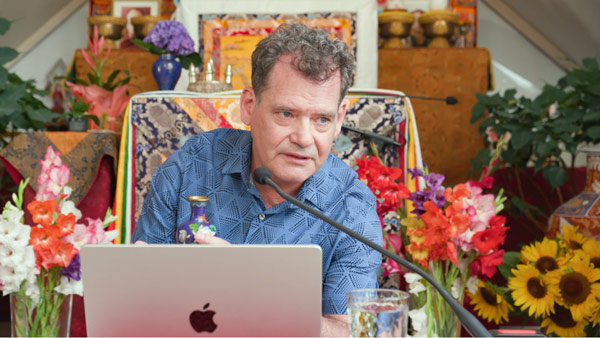
01:08:43
So an invitation to just settle your mind
for a moment.
Finding a position
that is alert but relaxed.
Eric Solomon is leading you in practices and some of these practices are just about stabilizing the mind, what we call samatha. Many different ways to do that. One way is to invite the mind to an anchor for the attention, like the breath.
The mind wishes to jump on the train of thoughts. Just notice the thoughts, see them as thoughts, let go, invite the mind back to the anchor for the attention.
And now bringing to mind our motivation.
In the practice of the great vehicle, the motivation is to attain awakening for the sake of all beings.
Alright, let's begin. So here is a picture, this was taken last year, the day before we started. Michi took this picture. Not adjusted, maybe a little contrast, slight adjustment, but not color adjusted. Pretty amazing, huh? Double or triple rainbow? I don't know. So again, a precious place is Gomde. We were having a tea in the lounge and then someone came running and said, come outside! So it's really a wonderful place and I just want to encourage you again to, to make sure that Gomde continues to flourish. And we're, even though some of us are gathered here, I know there are a lot of people online as well. And hopefully you too will be supporters. And speaking of supporters, I want to also have a shout out to my Dharma friend and great supporter, Fran Oreck, who was online yesterday. I don't know if Fran's online today, but she asked a great question, which was, how would I explain the kind of things we were talking about to my first semester, first year university students? And the answer is, I wouldn't, no. The answer is that there, I mean, one way to say this, Fran, is that things are not the way they seem. That's it. Just things are not the way they appear. There's the way things appear and then there's the way things actually are. And a fundamental kind of claim in Buddhist thought and practice is that things, the way things appear to us, in fact, is not the way, as ordinary beings, is not the way they actually are. And there are various levels of confusion that we can have. We're going to be exploring sort of a first level and then we're going to try to move on to the Mādhyamaka level today. But we may not get there entirely until tomorrow, even though Khenpo la has already been teaching some stuff, has been teaching the Mādhyamaka. But I think it's very important for us to, in a sense, the invitation in that context then is an invitation to a kind of inquiry. Like, okay, is the way things seem to me, is that the way they really are? That's the kind of fundamental inquiry. And the intention here is not to, uh... you know, just fill you with more ideology, to tell you the way things really are. It's for you to figure out the way things really are, perhaps with some suggestions about how to do so. And one of the key features of this, that's really interesting, that will come up today, but I wanted to say something about it now, is what, why is it that we use reasoning so much? What is the role of reasoning or yukti in the context of figuring out the way things really are? And we'll explore that a bit today and continue to explore that. And I also want you to sort of think about that. Like, why, why, why do we do all this reasoning?
So, one way to think about this is actually that reasoning is what enables us to overcome doubt. And we're doing this all the time. We often have times when we probably should have doubt, but we don't. Right? And I'm sure you can examine many instances in your own life when you probably should have had a little doubt about what was going on, and it turns out other than you expected. But also in very mundane ways, we are constantly resolving our doubt. I think there's a very famous example of, a very simple example, you know, let's say it's a bit chilly out and we're in northern India and there's a famous flower whose name I always forget, and I'm forgetting it now, that from a distance looks like fire, actually, like a clump of flowers that look like a fire. And we're cold and we want to go and we want to, you know, feel warmth. Well, until we get close enough to actually test, and that itself, right, is already we're dealing with reasoning, like, well, that looks like fire, but I'm not sure. So I'm in a pla... I'm in a, I'm in a cognitive state of wanting to act in the world, but I'm unsure about whether my actions will be successful. So already I'm employing reasoning, like, well, if that's fire, maybe I can see if there's smoke coming from this fire. And of course, the final test will be when I get close enough to actually feel whether there's heat or a mirage. Likewise, if I see a mirage from afar, I need water. I think, is that water? Then I think about what I might know about mirages, what I might know about water. I try to examine my experience. So part of what that is telling us is that from the standpoint of our ordinary experience, reason plays a very special role that's actually caught up in, from the Buddhist standpoint, is actually caught up in causality. It has to do with the way in which inferential processes work in our minds. Causal inferential processes and how those causal inferential processes are connected to our concepts. Because as we will try to explore a little bit today, we're going to find out that our concepts actually are not about things out there in the world. Well, excuse me, they are about things out there in the world, but they don't refer to what they seem to refer to. So we're going to talk a little bit about that today, because that's actually going to be an important way of understanding the kind of philosophy that actually precedes Nāgārjuna's philosophy of emptiness. So yeah, think about it. What's reasoning? Why would reasoning be so important to us? Why is it so important in this context? Okay, let's talk a little bit about part of what we do more in a sort of Western academic context that can be helpful for us. John Makransky has written a great article about this, the sort of role of history or historicity culturally in Euro-American culture, that in some sense we really pay attention to history. And it can be very helpful for us to try to organize our understanding of Buddhist philosophy and practice by just thinking historically. So here I just want to point out sort of what I often do is these three periods. On the left-hand side there, that's actually the great temple at Bodh Gaya, where the Buddha is said to obtained awakening, the Mahabodhi temple. So there are three phases of Buddhism in South Asia, in what we would call modern-day India, roughly. And although the Buddha was actually born in modern-day Nepal in Lumbini, where Chokyi Nyima Rinpoche just built a new temple. Uh, so the first period we can call Nikāya Buddhism, where Nikāya refers to kind of collections of texts, bodies of texts. And I call this sort of middle period, 100 BCE to about 600 CE, as I call it Sanskritic Buddhism, where in the early period, vernacular languages or sort of semi-quasi-vernacular languages were in use for Buddhist texts. And then they started to use Sanskrit, which is more the lingua franca of that region, extending all the way into Afghanistan and all the way to Indonesia. People were using Sanskrit instead of local languages when they were communicating about scholarly things, as it were. And then the late South Asian period is what we can call syncretic Buddhism. And we're going to try to talk about all three of these periods to some extent, but the period which is key is this period from 100 BCE to 600. That's where Nāgārjuna, as you will soon see, is emerging. And we're going to talk, I'm going to focus on sort of the developments in this sort of sense, in Indian Buddhism, call it that, keep it simple, that lead to the type of philosophy and practice that we find then in Tibet, especially in this Mahāmudrā and Dzogchen traditions, or the sort of combined tradition that we call chak dzog. So sometimes you hear also these terms, Hīnayāna, lesser vehicle, Mahāyāna, great vehicle, you've heard me refer to that, and Vajrayāna, the Vajra vehicle. We'll talk a little bit more about them. Another term for so-called Hīnayāna is also the common vehicle, because a good way of thinking about what's happening in this early period is a kind of some very foundational practices and philosophical perspectives, literatures, ways of being, as it were, ethics, are being established in that period, and they carry through all the way through. So the kinds of monastic vows, for example, you find even in Tibet, are actually established in this early period, for the most part. So one of the things, of course, that is established in this early period is something you've heard already, I think it's familiar to all of you by now, which is this idea of the nobles' four truths. That there is suffering, there are many different kinds of suffering. We can have multiple lists. You know, I already mentioned George Dreyfus's great, great little quip, uh, his little joke, you know, Christians love God and Buddhists love lists. So nobody laughs because you're tired of that joke now. But, so the Four Noble Truths is obviously a list, and then there's the, you know, the kye ga na shi in Tibetan for suffering, you know, birth, old age, sickness and death, or the three kinds of suffering, suffering of suffering, suffering of change, suffering of conditioned existence. And it goes on, there's six sufferings, there's another list of three sufferings, and so on and so forth. Though, I think we kind of understand suffering, but a major way of thinking about suffering that's really going to be key here, is that idea of conditioned existence, like being trapped in your own conditioning. That's a key way of thinking about suffering, because even when you're not in pain, you're still trapped. And where does that come from? There's an origin, and the origin is... karma and kleśa, where kleśa means afflictive mental states, right? And then we're going to discover that there's a root one that's the most important. And then there's cessation, right, which is basically nirvana, and a path to cessation. And you can see, right, of course, one of these, when we talk about, like the key, in some ways, a really key one here is this claim that karma and kleśa are the origin. But also, what we find here is that this is based upon a kind of... what is often celebrated as one of the Buddha's most fundamental insights. And in 500 BCE, you know, this may seem like kind of simple to us now, but in 500 BCE, this very clear way of articulating the role of causality in the relief of suffering and attaining authentic happiness was groundbreaking. And so this is even sometimes referred to as a dhāraṇī, a kind of mantric-like statement or spell. ye dharmā hetuprabhavā hetuṃ teṣāṃ tathāgato hy avadat | teṣāṃ ca yo nirodha evaṃvādī mahāśramaṇaḥ || The Tathāgata, which is an epithet of the Buddha, has stated the cause of those things that have causes, and he has stated their cessation. Thus spoke the great ascetic, right? So, in this context, what is that really about? Well, it's about what we just saw, right? It's like the causes, karma and kleśa, and the cessation is nirvana, and implicit in this statement is also the way to get to that cessation, right? So, in some ways, this statement is actually a kind of another way of talking about the noble's truths. So, what is... so then if we ask, okay, at this first level, like in the common vehicle, we've already said that the key is about, uh is about personal identity. And I just want to review some of that using this diagram, which I often use to go through this, because one of the things that's very important to understand is that the Buddha is not... is in an environment in which the kind of inquiry he's engaged in is not just being done by him. There are many others in this period who are engaged in a similar kind of inquiry. And the inquiry really begins with dhukkha, which we can even just translate as dissatisfaction, when it's not obvious pain, mental or physical pain, and it's not where you're really feeling stuck on the hedonic treadmill that I spoke about the other day, where, you know, for a while it feels good, and then it stops feeling good, and you need more and more and more, and it just doesn't keep working, as our psychologists would say, the hedonic treadmill. But rather that maybe just that sense of like, wow, I'm kind of stuck in my own conditioning. So the problem, that is the problem, right? Fundamentally, this dhukkha, this dissatisfaction, what's it caused by? No matter what I try to get, or what I try to avoid, this kind of activity in the world, grasping and rejecting, getting and avoiding, no matter how much I do it, it doesn't seem to eliminate my suffering and make me happy. Why? Because I think that the stuff I'm trying to get, and the stuff I'm trying to avoid, is somehow involved with my happiness. Right? And why am I doing that? Because I think that those things, like in some fashion or another, are going to satisfy who I truly am. I'm associating my true identity, or Self, and notice the capital S, Self, with these conditioned things of the world. And why am I doing that? Because I'm confused about the nature of the Self. So I think the other day I said, you know, if I think I'm an automobile, and I pull into a gas station, a petrol station, and I, you know, grab the pump and like, that's just not going to really work, is it? Right? Well, it'll have certain effects, but it's unlikely to lead to happiness and the relief of suffering. I'm confused about who I am, and therefore I'm confused about what's going to make me happy. Right? That confusion about my true nature. Like... And again, we're assuming that I have some kind of true, absolute nature, like an essential identity, who I really am. Okay? And how do I solve this problem? I find out, I look for who I really am. So all of this, actually, basic kind of pattern, is very similar across multiple different ancient Indian philosophical, spiritual systems. Okay? You find that across multiple different systems. So you're looking for the real Self, but what the Buddha finds is something very different than what everyone else finds. Like a typical way to express... Whoops, we got a parenthesis out of order there but... What's typical for everyone else is they find some kind of transcendental capital S Self, which is this Sanskrit word, Ātman. And one version of this associates Ātman with Brahman, which can be a non-theistic kind of underlying essential reality, or it can be turned into a god, actually. Right? So and we sometimes you may have heard like Tat Tvam Asi, a famous statement from the Upaniṣads, like, you, that, art, thou. Right? This is you. That's who you really are. You are God, or you are the fundamental essence of reality. That's your true nature. And Buddha's answer to this is, uh... I don't know what you guys found, but I didn't find anything. Right? There's no self like that. That's his answer. And we're going to come back and look a little bit more about that, but that's the key. So this is that sort of radically dif... this is what makes Buddhism radically different from the beginning. Is that unlike other traditions, which still, like, say, the way you need to be happy is you have to figure out what your true nature is, but unlike these other traditions, the Buddha's answer is the kind of true nature that we think we must have. Unchanging, absolute, the experiencer of experiences, the feeler of feelings, the thinker of thinkings, the one who's doing the actions, the agent of activities, that that kind of, you know, somebody in charge, somewhere in there, that that kind of self, unchanging absolute self, does not exist. Right? Some people will even translate this as a soul. That kind of soul or self doesn't exist and actually can't exist. It's impossible for it to exist. And hence, I think of it as being like a squircle, although my friend Paula Wilds pointed out that actually people do use the word squircle to refer to an elliptical thing in design, but I'm still going to use that word to mean an actual square circle. Like, you can't have a squircle, just like you can't have a married bachelor. Right? Well, you know, people object. They say, well, you know, if he's fooling around, maybe he is kind of like a bachelor. So I like square circle because it's clearly logically impossible. OK, so all of this is then comes, emerges in early Buddhism, in the common vehicle, where there's a certain kind of model of consciousness. And when you get done with the details, there are going to be some variations, but these basic ideas work fine. So basically, consciousness flows through time as discrete moments, and each moment is causally producing the next moment. See how important causality is there? And the idea is that since each moment is producing the next moment, each moment is causally conditioning the next moment, right? And that causal conditioning can come in the form of our karmic intentions, our beliefs, our emotions, our expectations, and so on. So this is that, you can say that conditioning, this is when we're starting to point to that very subtlest form of suffering, like just being caught in that conditioning. So the kind of conditioning that is most relevant for us here is ignorance. OK? So I want you to follow, and this is again a little anachronistic, and kind of we're sort of ignoring certain details, but I think as a basic heuristic model, this works fine. So let's say in one moment we have a perception, like you see this. And then in the next moment, there's an interpretation of that perception. And when you have that interpretation of that perception, all of this is occurring within the context of ignorance, actually. Because every moment of consciousness is going to be causally conditioned by ignorance. And ignorance, what is ignorance about? It's about our own personal identity. Why is that, why is that relevant to our interpretation of what we're seeing? Because our fundamental motivations are basically to find affordances, loosely speaking, to make ourselves happy, or to find pleasure, or at least to survive, and to avoid the unpleasant, to avoid dangers, to avoid suffering. For whom? For the self. Once again, as we said before. So when we interpret, the idea here is that as we're interpreting things in the world, we're interpreting them through that filter. Like, I want to be happy, I don't want to suffer. Who? Me. And I have a certain model of the me, I have a self-model that that's being interpreted through. So when I see something that I interpret, I'm interpreting it as, well, is it good for me? Is it bad for me? Or is it irrelevant? Which basically corresponds to, Is it good for me? I become attached to it, attracted to it. Is it bad for me? I become averse to it. Right? And then attachment has various manifestations, like lust and so on. Aversion has various manifestations, like anger and aggression. Or I just think, oh, who cares? And I ignore it. You know, I like the social version of the last one. I can uh... Dan Goleman told me some years ago, and I should look this study up, but there was apparently a study about how people work or how people interact in social contexts. And uh, the higher the status, the more likely they are to literally not see people. Because it's like, oh, there's another low status person. Like they don't even register that that low status person is at the party. And you say, oh, I was at that party. Oh, you were? I didn't see you. Right? You don't count, so I literally didn't see you. And some of you may also be familiar with this, if you've taken like Psychology 101 and the invisible gorilla. Who's seen that? Yeah, right? Everybody, just about, yes, so. What's called inattentional blindness. And there are, again, various versions of that. But the point being, we don't really register something. We don't go to that point of an interpretation that's going to produce an intention to act, unless it's relevant to us. Right? So that relevance to what are our goals? And the fundamental goals? We want more pleasure, more happiness, less pain, less suffering. And everything else is like, oh, who cares? Okay? In our ordinary state. So the intention to act that comes from that interpretation, that is karma. Okay? So that interpretation itself is being driven by, right? Our desires to get something or to avoid something, our attachment and aversion, all of it rooted in a self-model that is a distorted self-model. And so we intend to act, and when we intend to act, we have an action, and we may or may not actually engage in it. We might intend to act physically, like, God, I'd just like to punch that guy in the face. And I don't do that, fortunately. But I still have the imprint of that intention. So even if I don't physically act on an intention, that intention is still reinforcing this conditioning. Right? Since the interpretation is distorted by ignorance, by a faulty self-model, that means the intention is going to be to act, is based on a faulty interpretation, like, I think I'm a car, so I intend to go drink some gasoline. And I don't actually do that. Well, on occasion, no, I don't. And then the action ends in frustration. Why does the action end in frustration? Because I'm not a car. Or because I do not have a fixed, absolute, unchanging, controlling self. Right? But this imprint that always happens, regardless of whether I actually act, that imprint perpetuates the kleśas, especially ignorance itself. Sort of reinforces. Like, oh, it didn't work this time, I'm going to keep trying. Something else will work. Right? So we can think of it in this way, if we just step back and think about that model, how does this ignorance lie at the root? Because it's said that ignorance is the root kleśa, the root problem. First you feel that your true identity consists of this absolutized capit... capsalutized, capital S self, the Ātman, in Sanskrit, right? The way that was sort of generically referred to in various traditions. You try to make that self happy and free it from suffering. You mistakenly interpret objects as either causes of happiness or suffering for that kind of self, right? And you try to get those objects or try to avoid them, even though they can't do what you feel like they should do.
Okay? And the reason they can't do what you feel like they should do is it's like, you know, you are a squircle collector. You're trying to, like, find more square circles. And you think, maybe if I do this, I'll find a square circle, I'll do that, and it never works, because it can't work. Right? You know, the traditional metaphor is um... for this kind of impossible entities, one of them is the horns of a rabbit. But then inevitably, I've had more than one undergraduate student present me with what we in the United States call a jackalope, which is a rabbit with horns on it. It's like, look, you know, I don't think they have jackalopes in Europe, but we do. You can get t-shirts that have, on the one hand, they have Bigfoot, and the other side is a jackalope. So, yeah. Anyway. So, this kind of impossible entity, what kind of self is that? In eliminating the belief that the mind-body system is not the locus of a self, that's what we're talking about. We think that this mind-body system, somewhere in here, is this capital S Self. We're not... So, what we have to do, and this is, there's a very helpful term that comes from the 15th century Tibetan scholar-practitioner Tsongkhapa, the founder of the Gelugpa tradition. A very helpful term that he really popularized, used a lot, is this term, the gak ja nge song wa, recognizing what is to be negated. Like, we're going to look for something and then not finding of that thing, which should be in principle findable, our failure to find it is going to establish that it's not there. But we have to know what we're looking for. Right? That's very important. Like, what underlies, and the claim is, that this self-model, so this is a kind of abstraction, right? Like a philosophical abstraction. But that this philosophical abstraction is pointing to something that is much subtler than just, you know, kind of complicated philosophical thinking. It's the way we feel about our own identity. It's an innate self-model that we walk around with. A sense that, what kind of an identity is it? That somehow it doesn't change. Right? And again, when we reflect on this intellectually, you know, if I say, are you the same person as you? So here's a sound, you know, there's one sound, and then another sound, and then it's like, okay, are you the same person? From first snap to second snap? Huh? What? You know, does anyone feel like they're really a different person? You need a different name now, because... Right? No, we just have this as how we feel. Like, somehow we're the same, that there's somebody, you know, looking out from behind your eyes, who's the experiencer of experiences. You know, there's somebody in charge of these, what we call the aggregates, the constant mental and physical constituents, and that in some sense, it's kind of fully independent, autonomous. You know, like, it exists in and of itself. And that, again, it's who you really are. That last part is more the philosophical bit. Right? If we push you into it, then you start to say, yeah, that must be who I really am, that intuitive sense of self, of self-model. Okay? So that self-model is the cause of suffering, is the root cause of suffering. And this is what ignorance is. It's specifically a kind of error, and it's an error which thinks that somewhere in the psycho physical aggregates, in this mind-body system, somehow is, in a sense, the home of this self. Okay? And the way in early Buddhism we're going to proceed is we're going to look for it. We're going to use an analysis to try to find this self. And there are basically kind of two options. One option is that there's some element within your mind-body system, right, that is that self. The way that, you know, was it Descartes who thought that the pineal gland was the seed of the soul, I think? Right, like there's somewhere, like some thing in there, that's the self. Or that some combination of those things, or maybe all of those things together constitute the self. And that second one is especially important. Okay? So in order to do this, one of these key things is, there are going to be two things that we need to keep in mind about this. One of them is that to do this kind of research, we have to be systematic, because we're dealing with an extremely, this self model is deeply ingrained, and it's not going to go away if we're not systematic. So, you know, I sometimes like to refer to this as, you know, the problem of the blue monster, is one of the metaphors I like to use for this. You know, I think there's a blue monster living in my closet, and you know, Alexandra comes over and finds me like sitting there staring at the closet door, and I've put some, you know, some potato chips outside, and she said, what's wrong? I said, there's a blue monster in my closet, it's the shape of a square circle, and I'm so afraid, I'm trying to make it happy. And, you know, she says, it's okay, don't worry. Here, look, I'll open the door. No, no, it's okay. Then, you know, she opens the door and says, see? I said, oh, okay. And then she comes back the next day and there's like five bags of potato chips there, and, you know, it's like, what happened? We just didn't see it. It was hiding. So what do we have to do? We have to make a map of the closet, right? I think the closet is a blue monster home, so I've got to make a systematic map so I can thoroughly look. And I also have to establish that if blue monster is there, I should be able to perceive it. Right? So that also has this very important claim that it's perceptible. You can detect it. So likewise, we think that this mind-body system is the home, if you like, of this kind of absolutized self, capital S Self, Self or soul. And if we just kind of say, oh, where is it? Oh, I don't know, I can't find it, oh, well, then. That's not going to work. We have to be very systematic. So what early Buddhism does is it systematically presents a kind of map of the mind-body system. And there are different accounts about how many different, what they call elements there are. These elements are called dharmas. So that's a different use of that same word, dharma, like in the Three Jewels, Buddha, Dharma, Sangha. These are called dharmas, or elements. And we're going to use a process of looking for them. But to do that, we're also going to rely on a particular kind of concept. Now, I did upload, or I think has been uploaded for you, some verses from Nāgārjuna's text, Wisdom. And even though we're talking about early Buddhism, Nāgārjuna refers to this concept too, because this is a fundamental concept. Nāgārjuna is going to kind of take, he's going to object to certain aspects of this early position. But this aspect he's not going to object to, which is that there are two truths, and that this is a method that involves rationality. This is a method for us to engage in this search. What are we looking for? So how do I eliminate an error? If I think my closet is a blue monster home, what I need to do is see what's really there. I think that something which is not a blue monster home is a blue monster home, right? You know, if I think like, this is my wife, and you know, she never talks to me, and just seems to just sit there, right? Some people come along and they try to pick her up, it's like, get away. And it's like, okay, I think that something which is not my wife is my wife. So how do I eliminate that error? I see what it really is. How do I eliminate the error thinking that this mind-body system is the home of a capital S Self or soul? I look for it. I look for what's really there. I try to see what's really there. So that's the basic role of Buddhist philosophy. It's like seeing what is really there, yathābhūta darshana. What I'm looking for is what we call the ultimate reality. Okay, the ultimate reality. That's the highest truth, or reality. And we can also then, however, we can have things that we say are true or real for conventional purposes, but they're not ultimately real. So for example, I can even use the word person or even self in a way that is just a convenient designation, something convenient. But of course, we generally don't use it that way. So when we talk about this idea of the two truths, what we're looking for to see what's really there is we're trying to see the ultimate truth. And in this early period, the style of philosophy is called Abhidharma, or Abhidhamma in Pali. And there's going to be a basic kind of dividing line here between ultimate and conventional. Ultimately, real things do not withstand analysis. They're not vichāra utsaha. And what does analysis mean at this level? Analysis is reduction, okay? If a thing can be physically or conceptually broken down into constituents, then it's not ultimately real. But a thing that cannot be broken down is ultimately real. And we're going to review that here. So for early Buddhism, the common vehicle, these ultimately real entities are called dharmas. They're irreducible. They're irreducible mental or physical bits. And for our purposes, we'll also say there are some schools, that as Khenpo was talking about, that sort of suggests that somehow they exist in some fashion in both past, present and future. But we're going to stick to the model that says they only exist for one moment. So they're momentary, irreducible mental and physical stuff, elements of different types, okay? And the Abhidharma, as I said, presents this systematic typology. You could call it a sort of table of elements. Anything made of dharmas is conventionally real and that it accords with our linguistic conventions, okay? So for example, is this flower, just based on what you know now, we're going to review some of this, but is the flower on this model ultimately real or conventionally real?
Yes, conventionally real because I can sit here and take it apart. We don't even... You want to see me do that, don't you? You know, I could do that, but we also just conceptually can see part of the way we know that it can be broken down is it actually has spatial dimensions. Right? It has size, right? What's called sthūlatā. So the fact of it having a spatial extension like that already tells us, oh, okay, that can't be ultimately real. So hypothetically that means then what is ultimately real has to be bits in terms of physical stuff, has to be infinitesimally small bits of matter that lasts for only one instant. So on this view, you know, developed about 2,000 years ago, interestingly, what this consists of is actually a bunch of infinitesimally small particles, right, that are, you know, these are called paramāṇu or sometimes the atyanta paramāṇu and that lasts for just like a moment or boom, boom, boom, boom. It's just a bunch of fizzing infinitesimally small particles is what this actually is. Do you see that? It's a very important thing to keep in mind, and we'll come back to what you see is not the way it actually is, right? Now, of course, that's not so different from some kind of naive like high school physics account of what you're seeing, right? A high school, your high school physics teacher would not say that flowers are irreducible elements of the universe. At least I hope not. I'm sure education in Europe is better than the United States, right? So, right, it's clear? So, but we don't see that, do we? So the way things seem is not the way they are. That's also true of our mind, that on this account, we can actually break our mental experience down into different kinds of irreducible mental stuff, which are also called dharmas. That we can, and again, there are different kinds of lists. One of those lists involves the five aggregates. So there's the physical part of the five aggregates, which is form. And then there's a specific dharma, a mental dharma called vedanā, which means sensation. It's an individual-like atom, so to speak, but it's a mental atom. It's an irreducible mental function. And then there's also a mental function that's called saṃjñā, which is a kind of act of recognition. It's like object selection, nimitta-grahaṇa, grasping the sign, literally. So like selecting an object like that, right? And then there is also then a bundle of dharmas, which are put under the rubric of saṃskāra, which just means conditioning. And that's actually many. And that includes attachment, aversion, and all of their different kinds of permutations, and confusion or ignorance, and all of its different kinds of permutations. And there are complicated lists, but you can basically organize all of those different kinds of conditioning. They're all either basically different forms of attachment, different forms of aversion, or different forms of confusion, with a few that can go different directions, like doubt. You can have kind of youthful doubt, unafflicted doubt, or afflicted doubt, basically. Right? So that's our mind-body system it's just like the flower is just a bunch of, you know, constantly changing elements, interacting, so too the mind is just a bunch of elements interacting. Right? Or at least that's the map. And then the question is, okay, is one of those elements a good candidate for this intuitive sense of self that we have, our self-model? So before we go further, we're going to say the claim is going to be anything that is not even made of dharmas is not even conventionally real. So square circles are not even conventionally real, right? Because they don't exist at all. They're not made out of stuff. You can't... but, but a flower is conventionally real. So when I use the word flower correctly, it's referring to a bunch of atoms, different kinds of atoms, that are interacting in a particular way to function in the way that we speak of as a flower. Like it produces a certain kind of visual perception, for example, or maybe a certain kind of olfactory perception, a certain kind of smell. Right? Or it's capable of producing seeds. Right? So there would be different ways of kind of defining that concept, and then we'll use that concept, even though it suggests that there's just one thing there, what it really is, is that that concept is a way of a convenient designation or a prajñapti for us to refer to a bunch of different kinds of physical elements that are interacting. Okay? That's not the case with the self. At least not according to this analysis. The self, like a square circle, does not exist at all. It's not made out of more fundamental things. The kind of self we're looking for can't be found within this psycho physical bunch of constituents. So let's remember, actually let's go back for a second before we go forward any more. Uhh, so if you remember this, right?
So just, even though we're not going to go through the details of or and then the fifth aggregate, by the way, is consciousness. And there are different kinds of consciousness. You can basically say there are six different kinds of consciousness for this purpose. There are five sensory consciousnesses and the mental consciousness. So let's consider these criteria for our intuitive sense of self. Is there anything in your mind-body system that's a good candidate?
My right big toe is the controller of my aggregates. And the perceiver of perceptions.
And it's permanent. I was born with a toe that size. No.
Usually we think of some kind of a mental thing. Is there a mental thing that's a good candidate?
What about consciousness? Why can't consciousness be the self? This kind of self.
Anybody?
Yeah, because it changes. Right? Right? And how does it, it's like, here look, changing, consciousness changing.
If it didn't change, then it's like you'd see the flower all the time. If there were, you might think, oh, maybe there is some unchanging, absolute consciousness. This is kind of, you know, a version of Sāṃkhya. There's some unchanging, absolute consciousness, or maybe even something beyond consciousness that all of this stuff kind of interacts with and it somehow, like, no, it's the knower, but it never changes. Would that make sense? No. For the same reason. Because even if you try to posit something like behind consciousness, you still have the problem that experience changes, and experience involves change, which means that this perceiver, the subject of experience, if there is one, has to change status. First it's a seer of a flower, then it's the seer of a clock, then it's the seer of, you know, fingers. It's got to change status in order to come into contact with different objects. So if somehow you had a self, a capital S Self, that was totally unchanging, it would be blind and deaf, and, you know, it couldn't do anything. So that's a pretty poor candidate for self, right? Nevertheless, you will find some versions of that, and there are going to be a couple of
couple of ways of thinking about this, and one of them is actually that there's another kind of candidate. And that other kind of candidate is there's a sort of self that is either... that is an absolute self that is somehow, you could say, either depended, on somehow present in, constituted by all of this stuff, like all of this stuff makes up one thing, which is the self, alright? Or, or in some way the self is like somehow owning those things without being constituted by them. But in either case that self is somehow distributed over all of this psycho physical stuff. Now that's maybe a slightly confusing way of thinking about it, so let's think of something, a simpler. Maybe we take the flower again. Okay, so this is a flower, and we're going to kind of ignore, everyone agree that's a flower, and we're going to sort of ignore for the moment all that stuff about atoms and everything, and just say, how many flowers am I holding? One flower. Not trying to trick you yet. Uh, so it is one flower, right? But it's made out of parts, correct? So that's this idea of a distributed entity. The whole is distributed over the parts, okay? Right? The whole is distributed over the parts, just like the glass. The glass has, let's say, a top, a bottom, and sides, you could say. It's got lots of, you know, whatever silicon atoms and other kinds of, you know, carbons that are making up that stuff that it's made out of. But you could just simply say it's top, bottom, and sides. The flower has, you know, I don't know, petals, what is that called, a corona, and a pistil, and a stem. Okay? And those are its parts. So there's one flower in many parts. We can also think of this, right, as it having a kind of shape or a form, maybe even like a mathematical form that we could use to specify what that one thing is. Right? Like we could have a mathematical function that would specify exactly what the shape of that, so there'd be one function and one way of characterizing this mathematically. Okay? Or you could talk about a system, where there'd be a system that we can characterize mathematically and there's one system with a mathematical characterization and there's a bunch of components in that system. Okay? So these are all instances of one thing existing over many things or in relation to many things or constituted by many things. Okay? So another way of doing this actually also is with concepts. So, this is a petal, and this is a petal, and this is a petal, and this is a petal. Is this petal exactly the, is this petal exactly the same as this petal? No, they're a little different, but they're both petals. So there's some kind of petalness. Something about them, right? So when we say petal, even though they're all a little different, somehow the word or concept petal is like there is a petalness that characterizes all of them. So this then moves into what we call a kind of platonic attitude, which we can also have about mathematical objects, where there's this one thing that has many expressions or instantiations. There's the petalness occurring in many petals. And those of you familiar with platonic styles of philosophy will say that, will know that actually that very often, and this is pretty characteristic of a lot of Western culture, that the one, like the ideal form of the petal, or the ideal form of the flower, if I had multiple flowers, I only had one flower today, if I had multiple flowers, it'd be a flower, flower, there's flowers over here, right? Flower, flower, flower, flower, flower. But the real true flower is not the individual physical flowers, but it's like the concept of the flower, the form of the flower, the ideal form of the flower, which, you know, in Plato's cave, some of you familiar with this idea that what we see are just the sort of shadows or reflections on the wall of the cave. We don't have direct access to that, like the pure form. We're just seeing, you know, when we get caught up with our sensory perceptions, we're just seeing the poor physical reflections of the ideal forms. And of course, when you do this, it's especially with mathematics in the context of science, where this becomes especially acute, like in some sense, the real thing is the mathematical characterization of whatever it is, like a system. And then the, you know, the imperfect permutations or presentations or measurable things of the system are just reflections of that ideal form. Okay? So the intuition generally for many, actually, and you might even say built into our cognitive system, and I'm being a little anachronistic because this is really more Dharmakīrti, who's coming later. But you can see this, you can see echoes of this in the earlier philosophy. Built into our cognitive system is kind of a tendency to think that when I say this is petal, this is petal, this is petal, this is petal, that my concept of petal, or my concept of flower, flower, flower, flower is actually out there in the world. So that the concept is referring to something that is repeated out there in the world. Like these individual entities, are each of them instantiating this one thing. Whether it's, so in terms of the flower as a whole or the vase as a whole, right? So we think of it as just one thing and all of the different parts are participating in that one whole. Or all of the different instantiations of a flower are participating in the ideal flower. Okay? So different ways of talking about these distributed entities. And again, our intuition generally is, and perhaps built into our system, is that, that this thing up here in some sense, that distributed entity is real. Not only is it real, maybe it's even the truly real thing, like Plato, or Platonic style of philosophy. But here's the thing in Buddhism, that thing is not real. It's not ultimately real. It's only conventionally real. It's something we fabricate, right? The real stuff is this ultimate irreducible mental and physical stuff. Right? Why is that real stuff? Why is that ultimate, why is that the ultimate stuff? Because we can causally interact with it. Okay? Can you causally interact with the idea of a flower? Can you smell the idea of a flower? Anyone able to do that here? Just checking. Right? You can have mental images and so on, but those are also not the ideal. They're just an image in your mind. What you can actually interact with is this causally, this causal thing, whether it's flower, flower, flower, all those things we're calling flowers, what we actually contact with is this stuff. Can I? How about the vase? So again, the vase is another example, and this is key, the vase is another example of a thing that's a distributed entity. So we might think that's just I'm holding one thing in my hand, right? So here's the typical kind of argument that's used here, is a reductive argument, and it's actually also going to be one of the Mādhyamika arguments that Khenpo hopefully will have time to get through. It's called the neither one nor many argument, or neither the same nor different argument. Okay? Tattvānyatvavicāra is one term for it in Sanskrit. And I just asked, so let's say it has, you know, like a lip, a throat, a side and a bottom. So let's just say, yeah, it's one thing, right? You agree that it's just one thing? It's a whole. W-H-O-L-E, a whole, with parts. So I'm going to say to you that the whole doesn't really exist. There is no one thing here. We conceptualize that, but it's not one thing. So one way to do that is to always ask about being same or different. So is the, so we have a whole, one thing. Is the whole, that's the vase, is it the same as the lip?
No. Is it the same as the side? No. Is it the same as the bottom? No. So I'm going to take the lip, the side and the bottom. I'm just going to put them over here. And I'm going to keep holding the whole.
Does that work?
It doesn't work, does it? If I say the whole is the same as the top, then only this is the vase and this is not. If I say the top and the bottom are the same, then the vase is only that high. If the vase is the same as the top and the vase is the same as the bottom, then the bottom and the top are the same. So the vase is, you know, that high. Right? Amen. Yes?
Yes, you can keep going. You can keep going. The top, right. So already saying top and bottom is already making holes. So until we get down to... So then what we do is we say, is the infinitesimally small part less momentary particle located at this point the same as the whole or different?
It's physically the same? Is the one down here, is the same? Is the one down here also the same? It's the same? So this point in space is the same as this point in space?
Ah, but quantum physics is not relevant here. This is a macro level object. Sorry, that doesn't work.
Okay.
So this is actually... This is a style of what's... This one, neither one nor many analysis is a kind of style of analysis that really goes back way back in Buddhism but also becomes very important all the way through in Mādhyamaka. And what we're demonstrating is that what our intuition like, oh, there's just one thing there. Actually, it seems like the way it appears, oh, it's one thing. That's actually a product of our visual system and our cognitive system glomming things together. There isn't actually one thing there when we do this analysis. In other words, when we engage with non-deviant reasoning, which I'll talk more about later. Now, one of the things as a little aside here, we were talking this morning about systems in equilibrium and causality. And the point here that this is making, is that when you have... Like if you have a system in equilibrium, some of them are causal, some of them it's like a little tough to say whether it's causal or not. But, you know, one kind of way of thinking about that is actually maybe an autonomous dynamical system like a living cell in which the functions of that... It's a kind of closed system in the sense that the functions of that cell that perpetuate it are all being produced within that cell. So that the different elements of the cell are producing the amino acids and so on that are necessary for the cell to continue its existence. And it's you know a living, living organisms still need to be open to their environment. Often that's called, thought of as being a kind of thermodynamic openness to the environment. But in terms of its own maintenance, it's a closed system. So that it's producing, like each element is producing what is needed for the other element, for the other element and so on. Right? But that causality is still happening in time. So elements are acting. So one way of thinking about this is like even with the vase, right? If we think about the vase, the vase is a bunch of atoms that are actually producing their own next moment.
Right? So boom, boom, boom, the boom, boom, they're changing and the conditions are right for them to continue to exist. But they're also interacting in a way that enable them to do things that they couldn't do on their own, like hold water or hold a flower. So one moment is the moments of this, you know, each atom is surrounded by a bunch of other atoms and they are interacting with a bunch of other atoms and those other atoms are acting as conditions for the atom to have a uh, uh, to have a capacity, a special capacity to, with the other atoms around it to like hold water. But we do not have to posit, we don't have to ontologize that system and make it into one thing. Okay? So this is actually where, on this account at least, ideas of kind of ontologized emergence or of systems as real things is rejected. So if a system seems to be in equilibrium, all of its elements, its dynamic equilibrium, all of its elements are changing. A very simple example of dynamic equilibrium is like you know a, a bottle of fizzy water of the you know low gases of carbonated water. So once you pour some of that out, there's going to be a time and eventually the carbon dioxide in the top in gas form is going to come into equilibrium with the carbon dioxide in the water and it's dissolved in the water and that takes a little while and then it's there and then it gets into a kind of equilibrium state. But that equilibrium, what's the same is an abstraction. All of the elements are changing but the sameness, like the sameness of volume, for example, is something that's an abstraction pulled away from. It's exactly an example of this, right? It's a whole... It's a whole abstracted away from its elements. Okay? So that's key, like systems, that doesn't mean that this is completely false. It just means that it's conventional. Okay? That we know, in a sense, when we characterize systems that we're characterizing them on the basis of things like functionality and that's useful for us but then we ontologize them and uh, that kind of ontologization actually, you especially see that with mathematics where like the mathematical characterization of a system is taken to be like a real thing. And one way to talk about that is a surreptitious substitution where the actual measurements that occur in the experience of a scientist which are the basis for the development of a mathematical model that those measurements are kind of ignored and the model itself replaces them as the real thing. And I know I'm speaking in somewhat abstract terms but I'm doing that just to give a plug to this really great book. So Connor, you have to read this book by my friends Adam Frank, Marcelo Glaser and Evan Thompson and I've collaborated... I've kind of done stuff with all three of these guys but especially collaborated in writing with Evan and Adam and I may do something together too other than play video games. But um so uh, uh... This is a really great book that actually addresses some of this and draws a little bit on Nāgārjuna, in fact. So I highly recommend that if you're interested in science or you're a scientist, uh, I highly recommend this book for understanding some of these types of issues that even early Buddhism, leave alone Nāgārjuna, even early Buddhism is really you know, undermining some of our ontologizing of our conceptual... of our conceptual... of our ways of making sense of the world. Okay, let's take a five minute break and we're going to come back and just start kind of Nāgārjuna but also do some, you know, some dialogue. Okay, five minute break. Short break, as Rinpoche would say. I can't quite do his 'short break'.
01:08:42
So an invitation to just settle your mind
for a moment.
Finding a position
that is alert but relaxed.
Eric Solomon is leading you in practices and some of these practices are just about stabilizing the mind, what we call samatha. Many different ways to do that. One way is to invite the mind to an anchor for the attention, like the breath.
The mind wishes to jump on the train of thoughts. Just notice the thoughts, see them as thoughts, let go, invite the mind back to the anchor for the attention.
And now bringing to mind our motivation.
In the practice of the great vehicle, the motivation is to attain awakening for the sake of all beings.
Alright, let's begin. So here is a picture, this was taken last year, the day before we started. Michi took this picture. Not adjusted, maybe a little contrast, slight adjustment, but not color adjusted. Pretty amazing, huh? Double or triple rainbow? I don't know. So again, a precious place is Gomde. We were having a tea in the lounge and then someone came running and said, come outside! So it's really a wonderful place and I just want to encourage you again to, to make sure that Gomde continues to flourish. And we're, even though some of us are gathered here, I know there are a lot of people online as well. And hopefully you too will be supporters. And speaking of supporters, I want to also have a shout out to my Dharma friend and great supporter, Fran Oreck, who was online yesterday. I don't know if Fran's online today, but she asked a great question, which was, how would I explain the kind of things we were talking about to my first semester, first year university students? And the answer is, I wouldn't, no. The answer is that there, I mean, one way to say this, Fran, is that things are not the way they seem. That's it. Just things are not the way they appear. There's the way things appear and then there's the way things actually are. And a fundamental kind of claim in Buddhist thought and practice is that things, the way things appear to us, in fact, is not the way, as ordinary beings, is not the way they actually are. And there are various levels of confusion that we can have. We're going to be exploring sort of a first level and then we're going to try to move on to the Mādhyamaka level today. But we may not get there entirely until tomorrow, even though Khenpo la has already been teaching some stuff, has been teaching the Mādhyamaka. But I think it's very important for us to, in a sense, the invitation in that context then is an invitation to a kind of inquiry. Like, okay, is the way things seem to me, is that the way they really are? That's the kind of fundamental inquiry. And the intention here is not to, uh... you know, just fill you with more ideology, to tell you the way things really are. It's for you to figure out the way things really are, perhaps with some suggestions about how to do so. And one of the key features of this, that's really interesting, that will come up today, but I wanted to say something about it now, is what, why is it that we use reasoning so much? What is the role of reasoning or yukti in the context of figuring out the way things really are? And we'll explore that a bit today and continue to explore that. And I also want you to sort of think about that. Like, why, why, why do we do all this reasoning?
So, one way to think about this is actually that reasoning is what enables us to overcome doubt. And we're doing this all the time. We often have times when we probably should have doubt, but we don't. Right? And I'm sure you can examine many instances in your own life when you probably should have had a little doubt about what was going on, and it turns out other than you expected. But also in very mundane ways, we are constantly resolving our doubt. I think there's a very famous example of, a very simple example, you know, let's say it's a bit chilly out and we're in northern India and there's a famous flower whose name I always forget, and I'm forgetting it now, that from a distance looks like fire, actually, like a clump of flowers that look like a fire. And we're cold and we want to go and we want to, you know, feel warmth. Well, until we get close enough to actually test, and that itself, right, is already we're dealing with reasoning, like, well, that looks like fire, but I'm not sure. So I'm in a pla... I'm in a, I'm in a cognitive state of wanting to act in the world, but I'm unsure about whether my actions will be successful. So already I'm employing reasoning, like, well, if that's fire, maybe I can see if there's smoke coming from this fire. And of course, the final test will be when I get close enough to actually feel whether there's heat or a mirage. Likewise, if I see a mirage from afar, I need water. I think, is that water? Then I think about what I might know about mirages, what I might know about water. I try to examine my experience. So part of what that is telling us is that from the standpoint of our ordinary experience, reason plays a very special role that's actually caught up in, from the Buddhist standpoint, is actually caught up in causality. It has to do with the way in which inferential processes work in our minds. Causal inferential processes and how those causal inferential processes are connected to our concepts. Because as we will try to explore a little bit today, we're going to find out that our concepts actually are not about things out there in the world. Well, excuse me, they are about things out there in the world, but they don't refer to what they seem to refer to. So we're going to talk a little bit about that today, because that's actually going to be an important way of understanding the kind of philosophy that actually precedes Nāgārjuna's philosophy of emptiness. So yeah, think about it. What's reasoning? Why would reasoning be so important to us? Why is it so important in this context? Okay, let's talk a little bit about part of what we do more in a sort of Western academic context that can be helpful for us. John Makransky has written a great article about this, the sort of role of history or historicity culturally in Euro-American culture, that in some sense we really pay attention to history. And it can be very helpful for us to try to organize our understanding of Buddhist philosophy and practice by just thinking historically. So here I just want to point out sort of what I often do is these three periods. On the left-hand side there, that's actually the great temple at Bodh Gaya, where the Buddha is said to obtained awakening, the Mahabodhi temple. So there are three phases of Buddhism in South Asia, in what we would call modern-day India, roughly. And although the Buddha was actually born in modern-day Nepal in Lumbini, where Chokyi Nyima Rinpoche just built a new temple. Uh, so the first period we can call Nikāya Buddhism, where Nikāya refers to kind of collections of texts, bodies of texts. And I call this sort of middle period, 100 BCE to about 600 CE, as I call it Sanskritic Buddhism, where in the early period, vernacular languages or sort of semi-quasi-vernacular languages were in use for Buddhist texts. And then they started to use Sanskrit, which is more the lingua franca of that region, extending all the way into Afghanistan and all the way to Indonesia. People were using Sanskrit instead of local languages when they were communicating about scholarly things, as it were. And then the late South Asian period is what we can call syncretic Buddhism. And we're going to try to talk about all three of these periods to some extent, but the period which is key is this period from 100 BCE to 600. That's where Nāgārjuna, as you will soon see, is emerging. And we're going to talk, I'm going to focus on sort of the developments in this sort of sense, in Indian Buddhism, call it that, keep it simple, that lead to the type of philosophy and practice that we find then in Tibet, especially in this Mahāmudrā and Dzogchen traditions, or the sort of combined tradition that we call chak dzog. So sometimes you hear also these terms, Hīnayāna, lesser vehicle, Mahāyāna, great vehicle, you've heard me refer to that, and Vajrayāna, the Vajra vehicle. We'll talk a little bit more about them. Another term for so-called Hīnayāna is also the common vehicle, because a good way of thinking about what's happening in this early period is a kind of some very foundational practices and philosophical perspectives, literatures, ways of being, as it were, ethics, are being established in that period, and they carry through all the way through. So the kinds of monastic vows, for example, you find even in Tibet, are actually established in this early period, for the most part. So one of the things, of course, that is established in this early period is something you've heard already, I think it's familiar to all of you by now, which is this idea of the nobles' four truths. That there is suffering, there are many different kinds of suffering. We can have multiple lists. You know, I already mentioned George Dreyfus's great, great little quip, uh, his little joke, you know, Christians love God and Buddhists love lists. So nobody laughs because you're tired of that joke now. But, so the Four Noble Truths is obviously a list, and then there's the, you know, the kye ga na shi in Tibetan for suffering, you know, birth, old age, sickness and death, or the three kinds of suffering, suffering of suffering, suffering of change, suffering of conditioned existence. And it goes on, there's six sufferings, there's another list of three sufferings, and so on and so forth. Though, I think we kind of understand suffering, but a major way of thinking about suffering that's really going to be key here, is that idea of conditioned existence, like being trapped in your own conditioning. That's a key way of thinking about suffering, because even when you're not in pain, you're still trapped. And where does that come from? There's an origin, and the origin is... karma and kleśa, where kleśa means afflictive mental states, right? And then we're going to discover that there's a root one that's the most important. And then there's cessation, right, which is basically nirvana, and a path to cessation. And you can see, right, of course, one of these, when we talk about, like the key, in some ways, a really key one here is this claim that karma and kleśa are the origin. But also, what we find here is that this is based upon a kind of... what is often celebrated as one of the Buddha's most fundamental insights. And in 500 BCE, you know, this may seem like kind of simple to us now, but in 500 BCE, this very clear way of articulating the role of causality in the relief of suffering and attaining authentic happiness was groundbreaking. And so this is even sometimes referred to as a dhāraṇī, a kind of mantric-like statement or spell. ye dharmā hetuprabhavā hetuṃ teṣāṃ tathāgato hy avadat | teṣāṃ ca yo nirodha evaṃvādī mahāśramaṇaḥ || The Tathāgata, which is an epithet of the Buddha, has stated the cause of those things that have causes, and he has stated their cessation. Thus spoke the great ascetic, right? So, in this context, what is that really about? Well, it's about what we just saw, right? It's like the causes, karma and kleśa, and the cessation is nirvana, and implicit in this statement is also the way to get to that cessation, right? So, in some ways, this statement is actually a kind of another way of talking about the noble's truths. So, what is... so then if we ask, okay, at this first level, like in the common vehicle, we've already said that the key is about, uh is about personal identity. And I just want to review some of that using this diagram, which I often use to go through this, because one of the things that's very important to understand is that the Buddha is not... is in an environment in which the kind of inquiry he's engaged in is not just being done by him. There are many others in this period who are engaged in a similar kind of inquiry. And the inquiry really begins with dhukkha, which we can even just translate as dissatisfaction, when it's not obvious pain, mental or physical pain, and it's not where you're really feeling stuck on the hedonic treadmill that I spoke about the other day, where, you know, for a while it feels good, and then it stops feeling good, and you need more and more and more, and it just doesn't keep working, as our psychologists would say, the hedonic treadmill. But rather that maybe just that sense of like, wow, I'm kind of stuck in my own conditioning. So the problem, that is the problem, right? Fundamentally, this dhukkha, this dissatisfaction, what's it caused by? No matter what I try to get, or what I try to avoid, this kind of activity in the world, grasping and rejecting, getting and avoiding, no matter how much I do it, it doesn't seem to eliminate my suffering and make me happy. Why? Because I think that the stuff I'm trying to get, and the stuff I'm trying to avoid, is somehow involved with my happiness. Right? And why am I doing that? Because I think that those things, like in some fashion or another, are going to satisfy who I truly am. I'm associating my true identity, or Self, and notice the capital S, Self, with these conditioned things of the world. And why am I doing that? Because I'm confused about the nature of the Self. So I think the other day I said, you know, if I think I'm an automobile, and I pull into a gas station, a petrol station, and I, you know, grab the pump and like, that's just not going to really work, is it? Right? Well, it'll have certain effects, but it's unlikely to lead to happiness and the relief of suffering. I'm confused about who I am, and therefore I'm confused about what's going to make me happy. Right? That confusion about my true nature. Like... And again, we're assuming that I have some kind of true, absolute nature, like an essential identity, who I really am. Okay? And how do I solve this problem? I find out, I look for who I really am. So all of this, actually, basic kind of pattern, is very similar across multiple different ancient Indian philosophical, spiritual systems. Okay? You find that across multiple different systems. So you're looking for the real Self, but what the Buddha finds is something very different than what everyone else finds. Like a typical way to express... Whoops, we got a parenthesis out of order there but... What's typical for everyone else is they find some kind of transcendental capital S Self, which is this Sanskrit word, Ātman. And one version of this associates Ātman with Brahman, which can be a non-theistic kind of underlying essential reality, or it can be turned into a god, actually. Right? So and we sometimes you may have heard like Tat Tvam Asi, a famous statement from the Upaniṣads, like, you, that, art, thou. Right? This is you. That's who you really are. You are God, or you are the fundamental essence of reality. That's your true nature. And Buddha's answer to this is, uh... I don't know what you guys found, but I didn't find anything. Right? There's no self like that. That's his answer. And we're going to come back and look a little bit more about that, but that's the key. So this is that sort of radically dif... this is what makes Buddhism radically different from the beginning. Is that unlike other traditions, which still, like, say, the way you need to be happy is you have to figure out what your true nature is, but unlike these other traditions, the Buddha's answer is the kind of true nature that we think we must have. Unchanging, absolute, the experiencer of experiences, the feeler of feelings, the thinker of thinkings, the one who's doing the actions, the agent of activities, that that kind of, you know, somebody in charge, somewhere in there, that that kind of self, unchanging absolute self, does not exist. Right? Some people will even translate this as a soul. That kind of soul or self doesn't exist and actually can't exist. It's impossible for it to exist. And hence, I think of it as being like a squircle, although my friend Paula Wilds pointed out that actually people do use the word squircle to refer to an elliptical thing in design, but I'm still going to use that word to mean an actual square circle. Like, you can't have a squircle, just like you can't have a married bachelor. Right? Well, you know, people object. They say, well, you know, if he's fooling around, maybe he is kind of like a bachelor. So I like square circle because it's clearly logically impossible. OK, so all of this is then comes, emerges in early Buddhism, in the common vehicle, where there's a certain kind of model of consciousness. And when you get done with the details, there are going to be some variations, but these basic ideas work fine. So basically, consciousness flows through time as discrete moments, and each moment is causally producing the next moment. See how important causality is there? And the idea is that since each moment is producing the next moment, each moment is causally conditioning the next moment, right? And that causal conditioning can come in the form of our karmic intentions, our beliefs, our emotions, our expectations, and so on. So this is that, you can say that conditioning, this is when we're starting to point to that very subtlest form of suffering, like just being caught in that conditioning. So the kind of conditioning that is most relevant for us here is ignorance. OK? So I want you to follow, and this is again a little anachronistic, and kind of we're sort of ignoring certain details, but I think as a basic heuristic model, this works fine. So let's say in one moment we have a perception, like you see this. And then in the next moment, there's an interpretation of that perception. And when you have that interpretation of that perception, all of this is occurring within the context of ignorance, actually. Because every moment of consciousness is going to be causally conditioned by ignorance. And ignorance, what is ignorance about? It's about our own personal identity. Why is that, why is that relevant to our interpretation of what we're seeing? Because our fundamental motivations are basically to find affordances, loosely speaking, to make ourselves happy, or to find pleasure, or at least to survive, and to avoid the unpleasant, to avoid dangers, to avoid suffering. For whom? For the self. Once again, as we said before. So when we interpret, the idea here is that as we're interpreting things in the world, we're interpreting them through that filter. Like, I want to be happy, I don't want to suffer. Who? Me. And I have a certain model of the me, I have a self-model that that's being interpreted through. So when I see something that I interpret, I'm interpreting it as, well, is it good for me? Is it bad for me? Or is it irrelevant? Which basically corresponds to, Is it good for me? I become attached to it, attracted to it. Is it bad for me? I become averse to it. Right? And then attachment has various manifestations, like lust and so on. Aversion has various manifestations, like anger and aggression. Or I just think, oh, who cares? And I ignore it. You know, I like the social version of the last one. I can uh... Dan Goleman told me some years ago, and I should look this study up, but there was apparently a study about how people work or how people interact in social contexts. And uh, the higher the status, the more likely they are to literally not see people. Because it's like, oh, there's another low status person. Like they don't even register that that low status person is at the party. And you say, oh, I was at that party. Oh, you were? I didn't see you. Right? You don't count, so I literally didn't see you. And some of you may also be familiar with this, if you've taken like Psychology 101 and the invisible gorilla. Who's seen that? Yeah, right? Everybody, just about, yes, so. What's called inattentional blindness. And there are, again, various versions of that. But the point being, we don't really register something. We don't go to that point of an interpretation that's going to produce an intention to act, unless it's relevant to us. Right? So that relevance to what are our goals? And the fundamental goals? We want more pleasure, more happiness, less pain, less suffering. And everything else is like, oh, who cares? Okay? In our ordinary state. So the intention to act that comes from that interpretation, that is karma. Okay? So that interpretation itself is being driven by, right? Our desires to get something or to avoid something, our attachment and aversion, all of it rooted in a self-model that is a distorted self-model. And so we intend to act, and when we intend to act, we have an action, and we may or may not actually engage in it. We might intend to act physically, like, God, I'd just like to punch that guy in the face. And I don't do that, fortunately. But I still have the imprint of that intention. So even if I don't physically act on an intention, that intention is still reinforcing this conditioning. Right? Since the interpretation is distorted by ignorance, by a faulty self-model, that means the intention is going to be to act, is based on a faulty interpretation, like, I think I'm a car, so I intend to go drink some gasoline. And I don't actually do that. Well, on occasion, no, I don't. And then the action ends in frustration. Why does the action end in frustration? Because I'm not a car. Or because I do not have a fixed, absolute, unchanging, controlling self. Right? But this imprint that always happens, regardless of whether I actually act, that imprint perpetuates the kleśas, especially ignorance itself. Sort of reinforces. Like, oh, it didn't work this time, I'm going to keep trying. Something else will work. Right? So we can think of it in this way, if we just step back and think about that model, how does this ignorance lie at the root? Because it's said that ignorance is the root kleśa, the root problem. First you feel that your true identity consists of this absolutized capit... capsalutized, capital S self, the Ātman, in Sanskrit, right? The way that was sort of generically referred to in various traditions. You try to make that self happy and free it from suffering. You mistakenly interpret objects as either causes of happiness or suffering for that kind of self, right? And you try to get those objects or try to avoid them, even though they can't do what you feel like they should do.
Okay? And the reason they can't do what you feel like they should do is it's like, you know, you are a squircle collector. You're trying to, like, find more square circles. And you think, maybe if I do this, I'll find a square circle, I'll do that, and it never works, because it can't work. Right? You know, the traditional metaphor is um... for this kind of impossible entities, one of them is the horns of a rabbit. But then inevitably, I've had more than one undergraduate student present me with what we in the United States call a jackalope, which is a rabbit with horns on it. It's like, look, you know, I don't think they have jackalopes in Europe, but we do. You can get t-shirts that have, on the one hand, they have Bigfoot, and the other side is a jackalope. So, yeah. Anyway. So, this kind of impossible entity, what kind of self is that? In eliminating the belief that the mind-body system is not the locus of a self, that's what we're talking about. We think that this mind-body system, somewhere in here, is this capital S Self. We're not... So, what we have to do, and this is, there's a very helpful term that comes from the 15th century Tibetan scholar-practitioner Tsongkhapa, the founder of the Gelugpa tradition. A very helpful term that he really popularized, used a lot, is this term, the gak ja nge song wa, recognizing what is to be negated. Like, we're going to look for something and then not finding of that thing, which should be in principle findable, our failure to find it is going to establish that it's not there. But we have to know what we're looking for. Right? That's very important. Like, what underlies, and the claim is, that this self-model, so this is a kind of abstraction, right? Like a philosophical abstraction. But that this philosophical abstraction is pointing to something that is much subtler than just, you know, kind of complicated philosophical thinking. It's the way we feel about our own identity. It's an innate self-model that we walk around with. A sense that, what kind of an identity is it? That somehow it doesn't change. Right? And again, when we reflect on this intellectually, you know, if I say, are you the same person as you? So here's a sound, you know, there's one sound, and then another sound, and then it's like, okay, are you the same person? From first snap to second snap? Huh? What? You know, does anyone feel like they're really a different person? You need a different name now, because... Right? No, we just have this as how we feel. Like, somehow we're the same, that there's somebody, you know, looking out from behind your eyes, who's the experiencer of experiences. You know, there's somebody in charge of these, what we call the aggregates, the constant mental and physical constituents, and that in some sense, it's kind of fully independent, autonomous. You know, like, it exists in and of itself. And that, again, it's who you really are. That last part is more the philosophical bit. Right? If we push you into it, then you start to say, yeah, that must be who I really am, that intuitive sense of self, of self-model. Okay? So that self-model is the cause of suffering, is the root cause of suffering. And this is what ignorance is. It's specifically a kind of error, and it's an error which thinks that somewhere in the psycho physical aggregates, in this mind-body system, somehow is, in a sense, the home of this self. Okay? And the way in early Buddhism we're going to proceed is we're going to look for it. We're going to use an analysis to try to find this self. And there are basically kind of two options. One option is that there's some element within your mind-body system, right, that is that self. The way that, you know, was it Descartes who thought that the pineal gland was the seed of the soul, I think? Right, like there's somewhere, like some thing in there, that's the self. Or that some combination of those things, or maybe all of those things together constitute the self. And that second one is especially important. Okay? So in order to do this, one of these key things is, there are going to be two things that we need to keep in mind about this. One of them is that to do this kind of research, we have to be systematic, because we're dealing with an extremely, this self model is deeply ingrained, and it's not going to go away if we're not systematic. So, you know, I sometimes like to refer to this as, you know, the problem of the blue monster, is one of the metaphors I like to use for this. You know, I think there's a blue monster living in my closet, and you know, Alexandra comes over and finds me like sitting there staring at the closet door, and I've put some, you know, some potato chips outside, and she said, what's wrong? I said, there's a blue monster in my closet, it's the shape of a square circle, and I'm so afraid, I'm trying to make it happy. And, you know, she says, it's okay, don't worry. Here, look, I'll open the door. No, no, it's okay. Then, you know, she opens the door and says, see? I said, oh, okay. And then she comes back the next day and there's like five bags of potato chips there, and, you know, it's like, what happened? We just didn't see it. It was hiding. So what do we have to do? We have to make a map of the closet, right? I think the closet is a blue monster home, so I've got to make a systematic map so I can thoroughly look. And I also have to establish that if blue monster is there, I should be able to perceive it. Right? So that also has this very important claim that it's perceptible. You can detect it. So likewise, we think that this mind-body system is the home, if you like, of this kind of absolutized self, capital S Self, Self or soul. And if we just kind of say, oh, where is it? Oh, I don't know, I can't find it, oh, well, then. That's not going to work. We have to be very systematic. So what early Buddhism does is it systematically presents a kind of map of the mind-body system. And there are different accounts about how many different, what they call elements there are. These elements are called dharmas. So that's a different use of that same word, dharma, like in the Three Jewels, Buddha, Dharma, Sangha. These are called dharmas, or elements. And we're going to use a process of looking for them. But to do that, we're also going to rely on a particular kind of concept. Now, I did upload, or I think has been uploaded for you, some verses from Nāgārjuna's text, Wisdom. And even though we're talking about early Buddhism, Nāgārjuna refers to this concept too, because this is a fundamental concept. Nāgārjuna is going to kind of take, he's going to object to certain aspects of this early position. But this aspect he's not going to object to, which is that there are two truths, and that this is a method that involves rationality. This is a method for us to engage in this search. What are we looking for? So how do I eliminate an error? If I think my closet is a blue monster home, what I need to do is see what's really there. I think that something which is not a blue monster home is a blue monster home, right? You know, if I think like, this is my wife, and you know, she never talks to me, and just seems to just sit there, right? Some people come along and they try to pick her up, it's like, get away. And it's like, okay, I think that something which is not my wife is my wife. So how do I eliminate that error? I see what it really is. How do I eliminate the error thinking that this mind-body system is the home of a capital S Self or soul? I look for it. I look for what's really there. I try to see what's really there. So that's the basic role of Buddhist philosophy. It's like seeing what is really there, yathābhūta darshana. What I'm looking for is what we call the ultimate reality. Okay, the ultimate reality. That's the highest truth, or reality. And we can also then, however, we can have things that we say are true or real for conventional purposes, but they're not ultimately real. So for example, I can even use the word person or even self in a way that is just a convenient designation, something convenient. But of course, we generally don't use it that way. So when we talk about this idea of the two truths, what we're looking for to see what's really there is we're trying to see the ultimate truth. And in this early period, the style of philosophy is called Abhidharma, or Abhidhamma in Pali. And there's going to be a basic kind of dividing line here between ultimate and conventional. Ultimately, real things do not withstand analysis. They're not vichāra utsaha. And what does analysis mean at this level? Analysis is reduction, okay? If a thing can be physically or conceptually broken down into constituents, then it's not ultimately real. But a thing that cannot be broken down is ultimately real. And we're going to review that here. So for early Buddhism, the common vehicle, these ultimately real entities are called dharmas. They're irreducible. They're irreducible mental or physical bits. And for our purposes, we'll also say there are some schools, that as Khenpo was talking about, that sort of suggests that somehow they exist in some fashion in both past, present and future. But we're going to stick to the model that says they only exist for one moment. So they're momentary, irreducible mental and physical stuff, elements of different types, okay? And the Abhidharma, as I said, presents this systematic typology. You could call it a sort of table of elements. Anything made of dharmas is conventionally real and that it accords with our linguistic conventions, okay? So for example, is this flower, just based on what you know now, we're going to review some of this, but is the flower on this model ultimately real or conventionally real?
Yes, conventionally real because I can sit here and take it apart. We don't even... You want to see me do that, don't you? You know, I could do that, but we also just conceptually can see part of the way we know that it can be broken down is it actually has spatial dimensions. Right? It has size, right? What's called sthūlatā. So the fact of it having a spatial extension like that already tells us, oh, okay, that can't be ultimately real. So hypothetically that means then what is ultimately real has to be bits in terms of physical stuff, has to be infinitesimally small bits of matter that lasts for only one instant. So on this view, you know, developed about 2,000 years ago, interestingly, what this consists of is actually a bunch of infinitesimally small particles, right, that are, you know, these are called paramāṇu or sometimes the atyanta paramāṇu and that lasts for just like a moment or boom, boom, boom, boom. It's just a bunch of fizzing infinitesimally small particles is what this actually is. Do you see that? It's a very important thing to keep in mind, and we'll come back to what you see is not the way it actually is, right? Now, of course, that's not so different from some kind of naive like high school physics account of what you're seeing, right? A high school, your high school physics teacher would not say that flowers are irreducible elements of the universe. At least I hope not. I'm sure education in Europe is better than the United States, right? So, right, it's clear? So, but we don't see that, do we? So the way things seem is not the way they are. That's also true of our mind, that on this account, we can actually break our mental experience down into different kinds of irreducible mental stuff, which are also called dharmas. That we can, and again, there are different kinds of lists. One of those lists involves the five aggregates. So there's the physical part of the five aggregates, which is form. And then there's a specific dharma, a mental dharma called vedanā, which means sensation. It's an individual-like atom, so to speak, but it's a mental atom. It's an irreducible mental function. And then there's also a mental function that's called saṃjñā, which is a kind of act of recognition. It's like object selection, nimitta-grahaṇa, grasping the sign, literally. So like selecting an object like that, right? And then there is also then a bundle of dharmas, which are put under the rubric of saṃskāra, which just means conditioning. And that's actually many. And that includes attachment, aversion, and all of their different kinds of permutations, and confusion or ignorance, and all of its different kinds of permutations. And there are complicated lists, but you can basically organize all of those different kinds of conditioning. They're all either basically different forms of attachment, different forms of aversion, or different forms of confusion, with a few that can go different directions, like doubt. You can have kind of youthful doubt, unafflicted doubt, or afflicted doubt, basically. Right? So that's our mind-body system it's just like the flower is just a bunch of, you know, constantly changing elements, interacting, so too the mind is just a bunch of elements interacting. Right? Or at least that's the map. And then the question is, okay, is one of those elements a good candidate for this intuitive sense of self that we have, our self-model? So before we go further, we're going to say the claim is going to be anything that is not even made of dharmas is not even conventionally real. So square circles are not even conventionally real, right? Because they don't exist at all. They're not made out of stuff. You can't... but, but a flower is conventionally real. So when I use the word flower correctly, it's referring to a bunch of atoms, different kinds of atoms, that are interacting in a particular way to function in the way that we speak of as a flower. Like it produces a certain kind of visual perception, for example, or maybe a certain kind of olfactory perception, a certain kind of smell. Right? Or it's capable of producing seeds. Right? So there would be different ways of kind of defining that concept, and then we'll use that concept, even though it suggests that there's just one thing there, what it really is, is that that concept is a way of a convenient designation or a prajñapti for us to refer to a bunch of different kinds of physical elements that are interacting. Okay? That's not the case with the self. At least not according to this analysis. The self, like a square circle, does not exist at all. It's not made out of more fundamental things. The kind of self we're looking for can't be found within this psycho physical bunch of constituents. So let's remember, actually let's go back for a second before we go forward any more. Uhh, so if you remember this, right?
So just, even though we're not going to go through the details of or and then the fifth aggregate, by the way, is consciousness. And there are different kinds of consciousness. You can basically say there are six different kinds of consciousness for this purpose. There are five sensory consciousnesses and the mental consciousness. So let's consider these criteria for our intuitive sense of self. Is there anything in your mind-body system that's a good candidate?
My right big toe is the controller of my aggregates. And the perceiver of perceptions.
And it's permanent. I was born with a toe that size. No.
Usually we think of some kind of a mental thing. Is there a mental thing that's a good candidate?
What about consciousness? Why can't consciousness be the self? This kind of self.
Anybody?
Yeah, because it changes. Right? Right? And how does it, it's like, here look, changing, consciousness changing.
If it didn't change, then it's like you'd see the flower all the time. If there were, you might think, oh, maybe there is some unchanging, absolute consciousness. This is kind of, you know, a version of Sāṃkhya. There's some unchanging, absolute consciousness, or maybe even something beyond consciousness that all of this stuff kind of interacts with and it somehow, like, no, it's the knower, but it never changes. Would that make sense? No. For the same reason. Because even if you try to posit something like behind consciousness, you still have the problem that experience changes, and experience involves change, which means that this perceiver, the subject of experience, if there is one, has to change status. First it's a seer of a flower, then it's the seer of a clock, then it's the seer of, you know, fingers. It's got to change status in order to come into contact with different objects. So if somehow you had a self, a capital S Self, that was totally unchanging, it would be blind and deaf, and, you know, it couldn't do anything. So that's a pretty poor candidate for self, right? Nevertheless, you will find some versions of that, and there are going to be a couple of
couple of ways of thinking about this, and one of them is actually that there's another kind of candidate. And that other kind of candidate is there's a sort of self that is either... that is an absolute self that is somehow, you could say, either depended, on somehow present in, constituted by all of this stuff, like all of this stuff makes up one thing, which is the self, alright? Or, or in some way the self is like somehow owning those things without being constituted by them. But in either case that self is somehow distributed over all of this psycho physical stuff. Now that's maybe a slightly confusing way of thinking about it, so let's think of something, a simpler. Maybe we take the flower again. Okay, so this is a flower, and we're going to kind of ignore, everyone agree that's a flower, and we're going to sort of ignore for the moment all that stuff about atoms and everything, and just say, how many flowers am I holding? One flower. Not trying to trick you yet. Uh, so it is one flower, right? But it's made out of parts, correct? So that's this idea of a distributed entity. The whole is distributed over the parts, okay? Right? The whole is distributed over the parts, just like the glass. The glass has, let's say, a top, a bottom, and sides, you could say. It's got lots of, you know, whatever silicon atoms and other kinds of, you know, carbons that are making up that stuff that it's made out of. But you could just simply say it's top, bottom, and sides. The flower has, you know, I don't know, petals, what is that called, a corona, and a pistil, and a stem. Okay? And those are its parts. So there's one flower in many parts. We can also think of this, right, as it having a kind of shape or a form, maybe even like a mathematical form that we could use to specify what that one thing is. Right? Like we could have a mathematical function that would specify exactly what the shape of that, so there'd be one function and one way of characterizing this mathematically. Okay? Or you could talk about a system, where there'd be a system that we can characterize mathematically and there's one system with a mathematical characterization and there's a bunch of components in that system. Okay? So these are all instances of one thing existing over many things or in relation to many things or constituted by many things. Okay? So another way of doing this actually also is with concepts. So, this is a petal, and this is a petal, and this is a petal, and this is a petal. Is this petal exactly the, is this petal exactly the same as this petal? No, they're a little different, but they're both petals. So there's some kind of petalness. Something about them, right? So when we say petal, even though they're all a little different, somehow the word or concept petal is like there is a petalness that characterizes all of them. So this then moves into what we call a kind of platonic attitude, which we can also have about mathematical objects, where there's this one thing that has many expressions or instantiations. There's the petalness occurring in many petals. And those of you familiar with platonic styles of philosophy will say that, will know that actually that very often, and this is pretty characteristic of a lot of Western culture, that the one, like the ideal form of the petal, or the ideal form of the flower, if I had multiple flowers, I only had one flower today, if I had multiple flowers, it'd be a flower, flower, there's flowers over here, right? Flower, flower, flower, flower, flower. But the real true flower is not the individual physical flowers, but it's like the concept of the flower, the form of the flower, the ideal form of the flower, which, you know, in Plato's cave, some of you familiar with this idea that what we see are just the sort of shadows or reflections on the wall of the cave. We don't have direct access to that, like the pure form. We're just seeing, you know, when we get caught up with our sensory perceptions, we're just seeing the poor physical reflections of the ideal forms. And of course, when you do this, it's especially with mathematics in the context of science, where this becomes especially acute, like in some sense, the real thing is the mathematical characterization of whatever it is, like a system. And then the, you know, the imperfect permutations or presentations or measurable things of the system are just reflections of that ideal form. Okay? So the intuition generally for many, actually, and you might even say built into our cognitive system, and I'm being a little anachronistic because this is really more Dharmakīrti, who's coming later. But you can see this, you can see echoes of this in the earlier philosophy. Built into our cognitive system is kind of a tendency to think that when I say this is petal, this is petal, this is petal, this is petal, that my concept of petal, or my concept of flower, flower, flower, flower is actually out there in the world. So that the concept is referring to something that is repeated out there in the world. Like these individual entities, are each of them instantiating this one thing. Whether it's, so in terms of the flower as a whole or the vase as a whole, right? So we think of it as just one thing and all of the different parts are participating in that one whole. Or all of the different instantiations of a flower are participating in the ideal flower. Okay? So different ways of talking about these distributed entities. And again, our intuition generally is, and perhaps built into our system, is that, that this thing up here in some sense, that distributed entity is real. Not only is it real, maybe it's even the truly real thing, like Plato, or Platonic style of philosophy. But here's the thing in Buddhism, that thing is not real. It's not ultimately real. It's only conventionally real. It's something we fabricate, right? The real stuff is this ultimate irreducible mental and physical stuff. Right? Why is that real stuff? Why is that ultimate, why is that the ultimate stuff? Because we can causally interact with it. Okay? Can you causally interact with the idea of a flower? Can you smell the idea of a flower? Anyone able to do that here? Just checking. Right? You can have mental images and so on, but those are also not the ideal. They're just an image in your mind. What you can actually interact with is this causally, this causal thing, whether it's flower, flower, flower, all those things we're calling flowers, what we actually contact with is this stuff. Can I? How about the vase? So again, the vase is another example, and this is key, the vase is another example of a thing that's a distributed entity. So we might think that's just I'm holding one thing in my hand, right? So here's the typical kind of argument that's used here, is a reductive argument, and it's actually also going to be one of the Mādhyamika arguments that Khenpo hopefully will have time to get through. It's called the neither one nor many argument, or neither the same nor different argument. Okay? Tattvānyatvavicāra is one term for it in Sanskrit. And I just asked, so let's say it has, you know, like a lip, a throat, a side and a bottom. So let's just say, yeah, it's one thing, right? You agree that it's just one thing? It's a whole. W-H-O-L-E, a whole, with parts. So I'm going to say to you that the whole doesn't really exist. There is no one thing here. We conceptualize that, but it's not one thing. So one way to do that is to always ask about being same or different. So is the, so we have a whole, one thing. Is the whole, that's the vase, is it the same as the lip?
No. Is it the same as the side? No. Is it the same as the bottom? No. So I'm going to take the lip, the side and the bottom. I'm just going to put them over here. And I'm going to keep holding the whole.
Does that work?
It doesn't work, does it? If I say the whole is the same as the top, then only this is the vase and this is not. If I say the top and the bottom are the same, then the vase is only that high. If the vase is the same as the top and the vase is the same as the bottom, then the bottom and the top are the same. So the vase is, you know, that high. Right? Amen. Yes?
Yes, you can keep going. You can keep going. The top, right. So already saying top and bottom is already making holes. So until we get down to... So then what we do is we say, is the infinitesimally small part less momentary particle located at this point the same as the whole or different?
It's physically the same? Is the one down here, is the same? Is the one down here also the same? It's the same? So this point in space is the same as this point in space?
Ah, but quantum physics is not relevant here. This is a macro level object. Sorry, that doesn't work.
Okay.
So this is actually... This is a style of what's... This one, neither one nor many analysis is a kind of style of analysis that really goes back way back in Buddhism but also becomes very important all the way through in Mādhyamaka. And what we're demonstrating is that what our intuition like, oh, there's just one thing there. Actually, it seems like the way it appears, oh, it's one thing. That's actually a product of our visual system and our cognitive system glomming things together. There isn't actually one thing there when we do this analysis. In other words, when we engage with non-deviant reasoning, which I'll talk more about later. Now, one of the things as a little aside here, we were talking this morning about systems in equilibrium and causality. And the point here that this is making, is that when you have... Like if you have a system in equilibrium, some of them are causal, some of them it's like a little tough to say whether it's causal or not. But, you know, one kind of way of thinking about that is actually maybe an autonomous dynamical system like a living cell in which the functions of that... It's a kind of closed system in the sense that the functions of that cell that perpetuate it are all being produced within that cell. So that the different elements of the cell are producing the amino acids and so on that are necessary for the cell to continue its existence. And it's you know a living, living organisms still need to be open to their environment. Often that's called, thought of as being a kind of thermodynamic openness to the environment. But in terms of its own maintenance, it's a closed system. So that it's producing, like each element is producing what is needed for the other element, for the other element and so on. Right? But that causality is still happening in time. So elements are acting. So one way of thinking about this is like even with the vase, right? If we think about the vase, the vase is a bunch of atoms that are actually producing their own next moment.
Right? So boom, boom, boom, the boom, boom, they're changing and the conditions are right for them to continue to exist. But they're also interacting in a way that enable them to do things that they couldn't do on their own, like hold water or hold a flower. So one moment is the moments of this, you know, each atom is surrounded by a bunch of other atoms and they are interacting with a bunch of other atoms and those other atoms are acting as conditions for the atom to have a uh, uh, to have a capacity, a special capacity to, with the other atoms around it to like hold water. But we do not have to posit, we don't have to ontologize that system and make it into one thing. Okay? So this is actually where, on this account at least, ideas of kind of ontologized emergence or of systems as real things is rejected. So if a system seems to be in equilibrium, all of its elements, its dynamic equilibrium, all of its elements are changing. A very simple example of dynamic equilibrium is like you know a, a bottle of fizzy water of the you know low gases of carbonated water. So once you pour some of that out, there's going to be a time and eventually the carbon dioxide in the top in gas form is going to come into equilibrium with the carbon dioxide in the water and it's dissolved in the water and that takes a little while and then it's there and then it gets into a kind of equilibrium state. But that equilibrium, what's the same is an abstraction. All of the elements are changing but the sameness, like the sameness of volume, for example, is something that's an abstraction pulled away from. It's exactly an example of this, right? It's a whole... It's a whole abstracted away from its elements. Okay? So that's key, like systems, that doesn't mean that this is completely false. It just means that it's conventional. Okay? That we know, in a sense, when we characterize systems that we're characterizing them on the basis of things like functionality and that's useful for us but then we ontologize them and uh, that kind of ontologization actually, you especially see that with mathematics where like the mathematical characterization of a system is taken to be like a real thing. And one way to talk about that is a surreptitious substitution where the actual measurements that occur in the experience of a scientist which are the basis for the development of a mathematical model that those measurements are kind of ignored and the model itself replaces them as the real thing. And I know I'm speaking in somewhat abstract terms but I'm doing that just to give a plug to this really great book. So Connor, you have to read this book by my friends Adam Frank, Marcelo Glaser and Evan Thompson and I've collaborated... I've kind of done stuff with all three of these guys but especially collaborated in writing with Evan and Adam and I may do something together too other than play video games. But um so uh, uh... This is a really great book that actually addresses some of this and draws a little bit on Nāgārjuna, in fact. So I highly recommend that if you're interested in science or you're a scientist, uh, I highly recommend this book for understanding some of these types of issues that even early Buddhism, leave alone Nāgārjuna, even early Buddhism is really you know, undermining some of our ontologizing of our conceptual... of our conceptual... of our ways of making sense of the world. Okay, let's take a five minute break and we're going to come back and just start kind of Nāgārjuna but also do some, you know, some dialogue. Okay, five minute break. Short break, as Rinpoche would say. I can't quite do his 'short break'.
Eric Solomon is leading you in practices and some of these practices are just about stabilizing the mind, what we call samatha. Many different ways to do that. One way is to invite the mind to an anchor for the attention, like the breath.
The mind wishes to jump on the train of thoughts. Just notice the thoughts, see them as thoughts, let go, invite the mind back to the anchor for the attention.
And now bringing to mind our motivation.
In the practice of the great vehicle, the motivation is to attain awakening for the sake of all beings.
Alright, let's begin. So here is a picture, this was taken last year, the day before we started. Michi took this picture. Not adjusted, maybe a little contrast, slight adjustment, but not color adjusted. Pretty amazing, huh? Double or triple rainbow? I don't know. So again, a precious place is Gomde. We were having a tea in the lounge and then someone came running and said, come outside! So it's really a wonderful place and I just want to encourage you again to, to make sure that Gomde continues to flourish. And we're, even though some of us are gathered here, I know there are a lot of people online as well. And hopefully you too will be supporters. And speaking of supporters, I want to also have a shout out to my Dharma friend and great supporter, Fran Oreck, who was online yesterday. I don't know if Fran's online today, but she asked a great question, which was, how would I explain the kind of things we were talking about to my first semester, first year university students? And the answer is, I wouldn't, no. The answer is that there, I mean, one way to say this, Fran, is that things are not the way they seem. That's it. Just things are not the way they appear. There's the way things appear and then there's the way things actually are. And a fundamental kind of claim in Buddhist thought and practice is that things, the way things appear to us, in fact, is not the way, as ordinary beings, is not the way they actually are. And there are various levels of confusion that we can have. We're going to be exploring sort of a first level and then we're going to try to move on to the Mādhyamaka level today. But we may not get there entirely until tomorrow, even though Khenpo la has already been teaching some stuff, has been teaching the Mādhyamaka. But I think it's very important for us to, in a sense, the invitation in that context then is an invitation to a kind of inquiry. Like, okay, is the way things seem to me, is that the way they really are? That's the kind of fundamental inquiry. And the intention here is not to, uh... you know, just fill you with more ideology, to tell you the way things really are. It's for you to figure out the way things really are, perhaps with some suggestions about how to do so. And one of the key features of this, that's really interesting, that will come up today, but I wanted to say something about it now, is what, why is it that we use reasoning so much? What is the role of reasoning or yukti in the context of figuring out the way things really are? And we'll explore that a bit today and continue to explore that. And I also want you to sort of think about that. Like, why, why, why do we do all this reasoning?
So, one way to think about this is actually that reasoning is what enables us to overcome doubt. And we're doing this all the time. We often have times when we probably should have doubt, but we don't. Right? And I'm sure you can examine many instances in your own life when you probably should have had a little doubt about what was going on, and it turns out other than you expected. But also in very mundane ways, we are constantly resolving our doubt. I think there's a very famous example of, a very simple example, you know, let's say it's a bit chilly out and we're in northern India and there's a famous flower whose name I always forget, and I'm forgetting it now, that from a distance looks like fire, actually, like a clump of flowers that look like a fire. And we're cold and we want to go and we want to, you know, feel warmth. Well, until we get close enough to actually test, and that itself, right, is already we're dealing with reasoning, like, well, that looks like fire, but I'm not sure. So I'm in a pla... I'm in a, I'm in a cognitive state of wanting to act in the world, but I'm unsure about whether my actions will be successful. So already I'm employing reasoning, like, well, if that's fire, maybe I can see if there's smoke coming from this fire. And of course, the final test will be when I get close enough to actually feel whether there's heat or a mirage. Likewise, if I see a mirage from afar, I need water. I think, is that water? Then I think about what I might know about mirages, what I might know about water. I try to examine my experience. So part of what that is telling us is that from the standpoint of our ordinary experience, reason plays a very special role that's actually caught up in, from the Buddhist standpoint, is actually caught up in causality. It has to do with the way in which inferential processes work in our minds. Causal inferential processes and how those causal inferential processes are connected to our concepts. Because as we will try to explore a little bit today, we're going to find out that our concepts actually are not about things out there in the world. Well, excuse me, they are about things out there in the world, but they don't refer to what they seem to refer to. So we're going to talk a little bit about that today, because that's actually going to be an important way of understanding the kind of philosophy that actually precedes Nāgārjuna's philosophy of emptiness. So yeah, think about it. What's reasoning? Why would reasoning be so important to us? Why is it so important in this context? Okay, let's talk a little bit about part of what we do more in a sort of Western academic context that can be helpful for us. John Makransky has written a great article about this, the sort of role of history or historicity culturally in Euro-American culture, that in some sense we really pay attention to history. And it can be very helpful for us to try to organize our understanding of Buddhist philosophy and practice by just thinking historically. So here I just want to point out sort of what I often do is these three periods. On the left-hand side there, that's actually the great temple at Bodh Gaya, where the Buddha is said to obtained awakening, the Mahabodhi temple. So there are three phases of Buddhism in South Asia, in what we would call modern-day India, roughly. And although the Buddha was actually born in modern-day Nepal in Lumbini, where Chokyi Nyima Rinpoche just built a new temple. Uh, so the first period we can call Nikāya Buddhism, where Nikāya refers to kind of collections of texts, bodies of texts. And I call this sort of middle period, 100 BCE to about 600 CE, as I call it Sanskritic Buddhism, where in the early period, vernacular languages or sort of semi-quasi-vernacular languages were in use for Buddhist texts. And then they started to use Sanskrit, which is more the lingua franca of that region, extending all the way into Afghanistan and all the way to Indonesia. People were using Sanskrit instead of local languages when they were communicating about scholarly things, as it were. And then the late South Asian period is what we can call syncretic Buddhism. And we're going to try to talk about all three of these periods to some extent, but the period which is key is this period from 100 BCE to 600. That's where Nāgārjuna, as you will soon see, is emerging. And we're going to talk, I'm going to focus on sort of the developments in this sort of sense, in Indian Buddhism, call it that, keep it simple, that lead to the type of philosophy and practice that we find then in Tibet, especially in this Mahāmudrā and Dzogchen traditions, or the sort of combined tradition that we call chak dzog. So sometimes you hear also these terms, Hīnayāna, lesser vehicle, Mahāyāna, great vehicle, you've heard me refer to that, and Vajrayāna, the Vajra vehicle. We'll talk a little bit more about them. Another term for so-called Hīnayāna is also the common vehicle, because a good way of thinking about what's happening in this early period is a kind of some very foundational practices and philosophical perspectives, literatures, ways of being, as it were, ethics, are being established in that period, and they carry through all the way through. So the kinds of monastic vows, for example, you find even in Tibet, are actually established in this early period, for the most part. So one of the things, of course, that is established in this early period is something you've heard already, I think it's familiar to all of you by now, which is this idea of the nobles' four truths. That there is suffering, there are many different kinds of suffering. We can have multiple lists. You know, I already mentioned George Dreyfus's great, great little quip, uh, his little joke, you know, Christians love God and Buddhists love lists. So nobody laughs because you're tired of that joke now. But, so the Four Noble Truths is obviously a list, and then there's the, you know, the kye ga na shi in Tibetan for suffering, you know, birth, old age, sickness and death, or the three kinds of suffering, suffering of suffering, suffering of change, suffering of conditioned existence. And it goes on, there's six sufferings, there's another list of three sufferings, and so on and so forth. Though, I think we kind of understand suffering, but a major way of thinking about suffering that's really going to be key here, is that idea of conditioned existence, like being trapped in your own conditioning. That's a key way of thinking about suffering, because even when you're not in pain, you're still trapped. And where does that come from? There's an origin, and the origin is... karma and kleśa, where kleśa means afflictive mental states, right? And then we're going to discover that there's a root one that's the most important. And then there's cessation, right, which is basically nirvana, and a path to cessation. And you can see, right, of course, one of these, when we talk about, like the key, in some ways, a really key one here is this claim that karma and kleśa are the origin. But also, what we find here is that this is based upon a kind of... what is often celebrated as one of the Buddha's most fundamental insights. And in 500 BCE, you know, this may seem like kind of simple to us now, but in 500 BCE, this very clear way of articulating the role of causality in the relief of suffering and attaining authentic happiness was groundbreaking. And so this is even sometimes referred to as a dhāraṇī, a kind of mantric-like statement or spell. ye dharmā hetuprabhavā hetuṃ teṣāṃ tathāgato hy avadat | teṣāṃ ca yo nirodha evaṃvādī mahāśramaṇaḥ || The Tathāgata, which is an epithet of the Buddha, has stated the cause of those things that have causes, and he has stated their cessation. Thus spoke the great ascetic, right? So, in this context, what is that really about? Well, it's about what we just saw, right? It's like the causes, karma and kleśa, and the cessation is nirvana, and implicit in this statement is also the way to get to that cessation, right? So, in some ways, this statement is actually a kind of another way of talking about the noble's truths. So, what is... so then if we ask, okay, at this first level, like in the common vehicle, we've already said that the key is about, uh is about personal identity. And I just want to review some of that using this diagram, which I often use to go through this, because one of the things that's very important to understand is that the Buddha is not... is in an environment in which the kind of inquiry he's engaged in is not just being done by him. There are many others in this period who are engaged in a similar kind of inquiry. And the inquiry really begins with dhukkha, which we can even just translate as dissatisfaction, when it's not obvious pain, mental or physical pain, and it's not where you're really feeling stuck on the hedonic treadmill that I spoke about the other day, where, you know, for a while it feels good, and then it stops feeling good, and you need more and more and more, and it just doesn't keep working, as our psychologists would say, the hedonic treadmill. But rather that maybe just that sense of like, wow, I'm kind of stuck in my own conditioning. So the problem, that is the problem, right? Fundamentally, this dhukkha, this dissatisfaction, what's it caused by? No matter what I try to get, or what I try to avoid, this kind of activity in the world, grasping and rejecting, getting and avoiding, no matter how much I do it, it doesn't seem to eliminate my suffering and make me happy. Why? Because I think that the stuff I'm trying to get, and the stuff I'm trying to avoid, is somehow involved with my happiness. Right? And why am I doing that? Because I think that those things, like in some fashion or another, are going to satisfy who I truly am. I'm associating my true identity, or Self, and notice the capital S, Self, with these conditioned things of the world. And why am I doing that? Because I'm confused about the nature of the Self. So I think the other day I said, you know, if I think I'm an automobile, and I pull into a gas station, a petrol station, and I, you know, grab the pump and like, that's just not going to really work, is it? Right? Well, it'll have certain effects, but it's unlikely to lead to happiness and the relief of suffering. I'm confused about who I am, and therefore I'm confused about what's going to make me happy. Right? That confusion about my true nature. Like... And again, we're assuming that I have some kind of true, absolute nature, like an essential identity, who I really am. Okay? And how do I solve this problem? I find out, I look for who I really am. So all of this, actually, basic kind of pattern, is very similar across multiple different ancient Indian philosophical, spiritual systems. Okay? You find that across multiple different systems. So you're looking for the real Self, but what the Buddha finds is something very different than what everyone else finds. Like a typical way to express... Whoops, we got a parenthesis out of order there but... What's typical for everyone else is they find some kind of transcendental capital S Self, which is this Sanskrit word, Ātman. And one version of this associates Ātman with Brahman, which can be a non-theistic kind of underlying essential reality, or it can be turned into a god, actually. Right? So and we sometimes you may have heard like Tat Tvam Asi, a famous statement from the Upaniṣads, like, you, that, art, thou. Right? This is you. That's who you really are. You are God, or you are the fundamental essence of reality. That's your true nature. And Buddha's answer to this is, uh... I don't know what you guys found, but I didn't find anything. Right? There's no self like that. That's his answer. And we're going to come back and look a little bit more about that, but that's the key. So this is that sort of radically dif... this is what makes Buddhism radically different from the beginning. Is that unlike other traditions, which still, like, say, the way you need to be happy is you have to figure out what your true nature is, but unlike these other traditions, the Buddha's answer is the kind of true nature that we think we must have. Unchanging, absolute, the experiencer of experiences, the feeler of feelings, the thinker of thinkings, the one who's doing the actions, the agent of activities, that that kind of, you know, somebody in charge, somewhere in there, that that kind of self, unchanging absolute self, does not exist. Right? Some people will even translate this as a soul. That kind of soul or self doesn't exist and actually can't exist. It's impossible for it to exist. And hence, I think of it as being like a squircle, although my friend Paula Wilds pointed out that actually people do use the word squircle to refer to an elliptical thing in design, but I'm still going to use that word to mean an actual square circle. Like, you can't have a squircle, just like you can't have a married bachelor. Right? Well, you know, people object. They say, well, you know, if he's fooling around, maybe he is kind of like a bachelor. So I like square circle because it's clearly logically impossible. OK, so all of this is then comes, emerges in early Buddhism, in the common vehicle, where there's a certain kind of model of consciousness. And when you get done with the details, there are going to be some variations, but these basic ideas work fine. So basically, consciousness flows through time as discrete moments, and each moment is causally producing the next moment. See how important causality is there? And the idea is that since each moment is producing the next moment, each moment is causally conditioning the next moment, right? And that causal conditioning can come in the form of our karmic intentions, our beliefs, our emotions, our expectations, and so on. So this is that, you can say that conditioning, this is when we're starting to point to that very subtlest form of suffering, like just being caught in that conditioning. So the kind of conditioning that is most relevant for us here is ignorance. OK? So I want you to follow, and this is again a little anachronistic, and kind of we're sort of ignoring certain details, but I think as a basic heuristic model, this works fine. So let's say in one moment we have a perception, like you see this. And then in the next moment, there's an interpretation of that perception. And when you have that interpretation of that perception, all of this is occurring within the context of ignorance, actually. Because every moment of consciousness is going to be causally conditioned by ignorance. And ignorance, what is ignorance about? It's about our own personal identity. Why is that, why is that relevant to our interpretation of what we're seeing? Because our fundamental motivations are basically to find affordances, loosely speaking, to make ourselves happy, or to find pleasure, or at least to survive, and to avoid the unpleasant, to avoid dangers, to avoid suffering. For whom? For the self. Once again, as we said before. So when we interpret, the idea here is that as we're interpreting things in the world, we're interpreting them through that filter. Like, I want to be happy, I don't want to suffer. Who? Me. And I have a certain model of the me, I have a self-model that that's being interpreted through. So when I see something that I interpret, I'm interpreting it as, well, is it good for me? Is it bad for me? Or is it irrelevant? Which basically corresponds to, Is it good for me? I become attached to it, attracted to it. Is it bad for me? I become averse to it. Right? And then attachment has various manifestations, like lust and so on. Aversion has various manifestations, like anger and aggression. Or I just think, oh, who cares? And I ignore it. You know, I like the social version of the last one. I can uh... Dan Goleman told me some years ago, and I should look this study up, but there was apparently a study about how people work or how people interact in social contexts. And uh, the higher the status, the more likely they are to literally not see people. Because it's like, oh, there's another low status person. Like they don't even register that that low status person is at the party. And you say, oh, I was at that party. Oh, you were? I didn't see you. Right? You don't count, so I literally didn't see you. And some of you may also be familiar with this, if you've taken like Psychology 101 and the invisible gorilla. Who's seen that? Yeah, right? Everybody, just about, yes, so. What's called inattentional blindness. And there are, again, various versions of that. But the point being, we don't really register something. We don't go to that point of an interpretation that's going to produce an intention to act, unless it's relevant to us. Right? So that relevance to what are our goals? And the fundamental goals? We want more pleasure, more happiness, less pain, less suffering. And everything else is like, oh, who cares? Okay? In our ordinary state. So the intention to act that comes from that interpretation, that is karma. Okay? So that interpretation itself is being driven by, right? Our desires to get something or to avoid something, our attachment and aversion, all of it rooted in a self-model that is a distorted self-model. And so we intend to act, and when we intend to act, we have an action, and we may or may not actually engage in it. We might intend to act physically, like, God, I'd just like to punch that guy in the face. And I don't do that, fortunately. But I still have the imprint of that intention. So even if I don't physically act on an intention, that intention is still reinforcing this conditioning. Right? Since the interpretation is distorted by ignorance, by a faulty self-model, that means the intention is going to be to act, is based on a faulty interpretation, like, I think I'm a car, so I intend to go drink some gasoline. And I don't actually do that. Well, on occasion, no, I don't. And then the action ends in frustration. Why does the action end in frustration? Because I'm not a car. Or because I do not have a fixed, absolute, unchanging, controlling self. Right? But this imprint that always happens, regardless of whether I actually act, that imprint perpetuates the kleśas, especially ignorance itself. Sort of reinforces. Like, oh, it didn't work this time, I'm going to keep trying. Something else will work. Right? So we can think of it in this way, if we just step back and think about that model, how does this ignorance lie at the root? Because it's said that ignorance is the root kleśa, the root problem. First you feel that your true identity consists of this absolutized capit... capsalutized, capital S self, the Ātman, in Sanskrit, right? The way that was sort of generically referred to in various traditions. You try to make that self happy and free it from suffering. You mistakenly interpret objects as either causes of happiness or suffering for that kind of self, right? And you try to get those objects or try to avoid them, even though they can't do what you feel like they should do.
Okay? And the reason they can't do what you feel like they should do is it's like, you know, you are a squircle collector. You're trying to, like, find more square circles. And you think, maybe if I do this, I'll find a square circle, I'll do that, and it never works, because it can't work. Right? You know, the traditional metaphor is um... for this kind of impossible entities, one of them is the horns of a rabbit. But then inevitably, I've had more than one undergraduate student present me with what we in the United States call a jackalope, which is a rabbit with horns on it. It's like, look, you know, I don't think they have jackalopes in Europe, but we do. You can get t-shirts that have, on the one hand, they have Bigfoot, and the other side is a jackalope. So, yeah. Anyway. So, this kind of impossible entity, what kind of self is that? In eliminating the belief that the mind-body system is not the locus of a self, that's what we're talking about. We think that this mind-body system, somewhere in here, is this capital S Self. We're not... So, what we have to do, and this is, there's a very helpful term that comes from the 15th century Tibetan scholar-practitioner Tsongkhapa, the founder of the Gelugpa tradition. A very helpful term that he really popularized, used a lot, is this term, the gak ja nge song wa, recognizing what is to be negated. Like, we're going to look for something and then not finding of that thing, which should be in principle findable, our failure to find it is going to establish that it's not there. But we have to know what we're looking for. Right? That's very important. Like, what underlies, and the claim is, that this self-model, so this is a kind of abstraction, right? Like a philosophical abstraction. But that this philosophical abstraction is pointing to something that is much subtler than just, you know, kind of complicated philosophical thinking. It's the way we feel about our own identity. It's an innate self-model that we walk around with. A sense that, what kind of an identity is it? That somehow it doesn't change. Right? And again, when we reflect on this intellectually, you know, if I say, are you the same person as you? So here's a sound, you know, there's one sound, and then another sound, and then it's like, okay, are you the same person? From first snap to second snap? Huh? What? You know, does anyone feel like they're really a different person? You need a different name now, because... Right? No, we just have this as how we feel. Like, somehow we're the same, that there's somebody, you know, looking out from behind your eyes, who's the experiencer of experiences. You know, there's somebody in charge of these, what we call the aggregates, the constant mental and physical constituents, and that in some sense, it's kind of fully independent, autonomous. You know, like, it exists in and of itself. And that, again, it's who you really are. That last part is more the philosophical bit. Right? If we push you into it, then you start to say, yeah, that must be who I really am, that intuitive sense of self, of self-model. Okay? So that self-model is the cause of suffering, is the root cause of suffering. And this is what ignorance is. It's specifically a kind of error, and it's an error which thinks that somewhere in the psycho physical aggregates, in this mind-body system, somehow is, in a sense, the home of this self. Okay? And the way in early Buddhism we're going to proceed is we're going to look for it. We're going to use an analysis to try to find this self. And there are basically kind of two options. One option is that there's some element within your mind-body system, right, that is that self. The way that, you know, was it Descartes who thought that the pineal gland was the seed of the soul, I think? Right, like there's somewhere, like some thing in there, that's the self. Or that some combination of those things, or maybe all of those things together constitute the self. And that second one is especially important. Okay? So in order to do this, one of these key things is, there are going to be two things that we need to keep in mind about this. One of them is that to do this kind of research, we have to be systematic, because we're dealing with an extremely, this self model is deeply ingrained, and it's not going to go away if we're not systematic. So, you know, I sometimes like to refer to this as, you know, the problem of the blue monster, is one of the metaphors I like to use for this. You know, I think there's a blue monster living in my closet, and you know, Alexandra comes over and finds me like sitting there staring at the closet door, and I've put some, you know, some potato chips outside, and she said, what's wrong? I said, there's a blue monster in my closet, it's the shape of a square circle, and I'm so afraid, I'm trying to make it happy. And, you know, she says, it's okay, don't worry. Here, look, I'll open the door. No, no, it's okay. Then, you know, she opens the door and says, see? I said, oh, okay. And then she comes back the next day and there's like five bags of potato chips there, and, you know, it's like, what happened? We just didn't see it. It was hiding. So what do we have to do? We have to make a map of the closet, right? I think the closet is a blue monster home, so I've got to make a systematic map so I can thoroughly look. And I also have to establish that if blue monster is there, I should be able to perceive it. Right? So that also has this very important claim that it's perceptible. You can detect it. So likewise, we think that this mind-body system is the home, if you like, of this kind of absolutized self, capital S Self, Self or soul. And if we just kind of say, oh, where is it? Oh, I don't know, I can't find it, oh, well, then. That's not going to work. We have to be very systematic. So what early Buddhism does is it systematically presents a kind of map of the mind-body system. And there are different accounts about how many different, what they call elements there are. These elements are called dharmas. So that's a different use of that same word, dharma, like in the Three Jewels, Buddha, Dharma, Sangha. These are called dharmas, or elements. And we're going to use a process of looking for them. But to do that, we're also going to rely on a particular kind of concept. Now, I did upload, or I think has been uploaded for you, some verses from Nāgārjuna's text, Wisdom. And even though we're talking about early Buddhism, Nāgārjuna refers to this concept too, because this is a fundamental concept. Nāgārjuna is going to kind of take, he's going to object to certain aspects of this early position. But this aspect he's not going to object to, which is that there are two truths, and that this is a method that involves rationality. This is a method for us to engage in this search. What are we looking for? So how do I eliminate an error? If I think my closet is a blue monster home, what I need to do is see what's really there. I think that something which is not a blue monster home is a blue monster home, right? You know, if I think like, this is my wife, and you know, she never talks to me, and just seems to just sit there, right? Some people come along and they try to pick her up, it's like, get away. And it's like, okay, I think that something which is not my wife is my wife. So how do I eliminate that error? I see what it really is. How do I eliminate the error thinking that this mind-body system is the home of a capital S Self or soul? I look for it. I look for what's really there. I try to see what's really there. So that's the basic role of Buddhist philosophy. It's like seeing what is really there, yathābhūta darshana. What I'm looking for is what we call the ultimate reality. Okay, the ultimate reality. That's the highest truth, or reality. And we can also then, however, we can have things that we say are true or real for conventional purposes, but they're not ultimately real. So for example, I can even use the word person or even self in a way that is just a convenient designation, something convenient. But of course, we generally don't use it that way. So when we talk about this idea of the two truths, what we're looking for to see what's really there is we're trying to see the ultimate truth. And in this early period, the style of philosophy is called Abhidharma, or Abhidhamma in Pali. And there's going to be a basic kind of dividing line here between ultimate and conventional. Ultimately, real things do not withstand analysis. They're not vichāra utsaha. And what does analysis mean at this level? Analysis is reduction, okay? If a thing can be physically or conceptually broken down into constituents, then it's not ultimately real. But a thing that cannot be broken down is ultimately real. And we're going to review that here. So for early Buddhism, the common vehicle, these ultimately real entities are called dharmas. They're irreducible. They're irreducible mental or physical bits. And for our purposes, we'll also say there are some schools, that as Khenpo was talking about, that sort of suggests that somehow they exist in some fashion in both past, present and future. But we're going to stick to the model that says they only exist for one moment. So they're momentary, irreducible mental and physical stuff, elements of different types, okay? And the Abhidharma, as I said, presents this systematic typology. You could call it a sort of table of elements. Anything made of dharmas is conventionally real and that it accords with our linguistic conventions, okay? So for example, is this flower, just based on what you know now, we're going to review some of this, but is the flower on this model ultimately real or conventionally real?
Yes, conventionally real because I can sit here and take it apart. We don't even... You want to see me do that, don't you? You know, I could do that, but we also just conceptually can see part of the way we know that it can be broken down is it actually has spatial dimensions. Right? It has size, right? What's called sthūlatā. So the fact of it having a spatial extension like that already tells us, oh, okay, that can't be ultimately real. So hypothetically that means then what is ultimately real has to be bits in terms of physical stuff, has to be infinitesimally small bits of matter that lasts for only one instant. So on this view, you know, developed about 2,000 years ago, interestingly, what this consists of is actually a bunch of infinitesimally small particles, right, that are, you know, these are called paramāṇu or sometimes the atyanta paramāṇu and that lasts for just like a moment or boom, boom, boom, boom. It's just a bunch of fizzing infinitesimally small particles is what this actually is. Do you see that? It's a very important thing to keep in mind, and we'll come back to what you see is not the way it actually is, right? Now, of course, that's not so different from some kind of naive like high school physics account of what you're seeing, right? A high school, your high school physics teacher would not say that flowers are irreducible elements of the universe. At least I hope not. I'm sure education in Europe is better than the United States, right? So, right, it's clear? So, but we don't see that, do we? So the way things seem is not the way they are. That's also true of our mind, that on this account, we can actually break our mental experience down into different kinds of irreducible mental stuff, which are also called dharmas. That we can, and again, there are different kinds of lists. One of those lists involves the five aggregates. So there's the physical part of the five aggregates, which is form. And then there's a specific dharma, a mental dharma called vedanā, which means sensation. It's an individual-like atom, so to speak, but it's a mental atom. It's an irreducible mental function. And then there's also a mental function that's called saṃjñā, which is a kind of act of recognition. It's like object selection, nimitta-grahaṇa, grasping the sign, literally. So like selecting an object like that, right? And then there is also then a bundle of dharmas, which are put under the rubric of saṃskāra, which just means conditioning. And that's actually many. And that includes attachment, aversion, and all of their different kinds of permutations, and confusion or ignorance, and all of its different kinds of permutations. And there are complicated lists, but you can basically organize all of those different kinds of conditioning. They're all either basically different forms of attachment, different forms of aversion, or different forms of confusion, with a few that can go different directions, like doubt. You can have kind of youthful doubt, unafflicted doubt, or afflicted doubt, basically. Right? So that's our mind-body system it's just like the flower is just a bunch of, you know, constantly changing elements, interacting, so too the mind is just a bunch of elements interacting. Right? Or at least that's the map. And then the question is, okay, is one of those elements a good candidate for this intuitive sense of self that we have, our self-model? So before we go further, we're going to say the claim is going to be anything that is not even made of dharmas is not even conventionally real. So square circles are not even conventionally real, right? Because they don't exist at all. They're not made out of stuff. You can't... but, but a flower is conventionally real. So when I use the word flower correctly, it's referring to a bunch of atoms, different kinds of atoms, that are interacting in a particular way to function in the way that we speak of as a flower. Like it produces a certain kind of visual perception, for example, or maybe a certain kind of olfactory perception, a certain kind of smell. Right? Or it's capable of producing seeds. Right? So there would be different ways of kind of defining that concept, and then we'll use that concept, even though it suggests that there's just one thing there, what it really is, is that that concept is a way of a convenient designation or a prajñapti for us to refer to a bunch of different kinds of physical elements that are interacting. Okay? That's not the case with the self. At least not according to this analysis. The self, like a square circle, does not exist at all. It's not made out of more fundamental things. The kind of self we're looking for can't be found within this psycho physical bunch of constituents. So let's remember, actually let's go back for a second before we go forward any more. Uhh, so if you remember this, right?
So just, even though we're not going to go through the details of or and then the fifth aggregate, by the way, is consciousness. And there are different kinds of consciousness. You can basically say there are six different kinds of consciousness for this purpose. There are five sensory consciousnesses and the mental consciousness. So let's consider these criteria for our intuitive sense of self. Is there anything in your mind-body system that's a good candidate?
My right big toe is the controller of my aggregates. And the perceiver of perceptions.
And it's permanent. I was born with a toe that size. No.
Usually we think of some kind of a mental thing. Is there a mental thing that's a good candidate?
What about consciousness? Why can't consciousness be the self? This kind of self.
Anybody?
Yeah, because it changes. Right? Right? And how does it, it's like, here look, changing, consciousness changing.
If it didn't change, then it's like you'd see the flower all the time. If there were, you might think, oh, maybe there is some unchanging, absolute consciousness. This is kind of, you know, a version of Sāṃkhya. There's some unchanging, absolute consciousness, or maybe even something beyond consciousness that all of this stuff kind of interacts with and it somehow, like, no, it's the knower, but it never changes. Would that make sense? No. For the same reason. Because even if you try to posit something like behind consciousness, you still have the problem that experience changes, and experience involves change, which means that this perceiver, the subject of experience, if there is one, has to change status. First it's a seer of a flower, then it's the seer of a clock, then it's the seer of, you know, fingers. It's got to change status in order to come into contact with different objects. So if somehow you had a self, a capital S Self, that was totally unchanging, it would be blind and deaf, and, you know, it couldn't do anything. So that's a pretty poor candidate for self, right? Nevertheless, you will find some versions of that, and there are going to be a couple of
couple of ways of thinking about this, and one of them is actually that there's another kind of candidate. And that other kind of candidate is there's a sort of self that is either... that is an absolute self that is somehow, you could say, either depended, on somehow present in, constituted by all of this stuff, like all of this stuff makes up one thing, which is the self, alright? Or, or in some way the self is like somehow owning those things without being constituted by them. But in either case that self is somehow distributed over all of this psycho physical stuff. Now that's maybe a slightly confusing way of thinking about it, so let's think of something, a simpler. Maybe we take the flower again. Okay, so this is a flower, and we're going to kind of ignore, everyone agree that's a flower, and we're going to sort of ignore for the moment all that stuff about atoms and everything, and just say, how many flowers am I holding? One flower. Not trying to trick you yet. Uh, so it is one flower, right? But it's made out of parts, correct? So that's this idea of a distributed entity. The whole is distributed over the parts, okay? Right? The whole is distributed over the parts, just like the glass. The glass has, let's say, a top, a bottom, and sides, you could say. It's got lots of, you know, whatever silicon atoms and other kinds of, you know, carbons that are making up that stuff that it's made out of. But you could just simply say it's top, bottom, and sides. The flower has, you know, I don't know, petals, what is that called, a corona, and a pistil, and a stem. Okay? And those are its parts. So there's one flower in many parts. We can also think of this, right, as it having a kind of shape or a form, maybe even like a mathematical form that we could use to specify what that one thing is. Right? Like we could have a mathematical function that would specify exactly what the shape of that, so there'd be one function and one way of characterizing this mathematically. Okay? Or you could talk about a system, where there'd be a system that we can characterize mathematically and there's one system with a mathematical characterization and there's a bunch of components in that system. Okay? So these are all instances of one thing existing over many things or in relation to many things or constituted by many things. Okay? So another way of doing this actually also is with concepts. So, this is a petal, and this is a petal, and this is a petal, and this is a petal. Is this petal exactly the, is this petal exactly the same as this petal? No, they're a little different, but they're both petals. So there's some kind of petalness. Something about them, right? So when we say petal, even though they're all a little different, somehow the word or concept petal is like there is a petalness that characterizes all of them. So this then moves into what we call a kind of platonic attitude, which we can also have about mathematical objects, where there's this one thing that has many expressions or instantiations. There's the petalness occurring in many petals. And those of you familiar with platonic styles of philosophy will say that, will know that actually that very often, and this is pretty characteristic of a lot of Western culture, that the one, like the ideal form of the petal, or the ideal form of the flower, if I had multiple flowers, I only had one flower today, if I had multiple flowers, it'd be a flower, flower, there's flowers over here, right? Flower, flower, flower, flower, flower. But the real true flower is not the individual physical flowers, but it's like the concept of the flower, the form of the flower, the ideal form of the flower, which, you know, in Plato's cave, some of you familiar with this idea that what we see are just the sort of shadows or reflections on the wall of the cave. We don't have direct access to that, like the pure form. We're just seeing, you know, when we get caught up with our sensory perceptions, we're just seeing the poor physical reflections of the ideal forms. And of course, when you do this, it's especially with mathematics in the context of science, where this becomes especially acute, like in some sense, the real thing is the mathematical characterization of whatever it is, like a system. And then the, you know, the imperfect permutations or presentations or measurable things of the system are just reflections of that ideal form. Okay? So the intuition generally for many, actually, and you might even say built into our cognitive system, and I'm being a little anachronistic because this is really more Dharmakīrti, who's coming later. But you can see this, you can see echoes of this in the earlier philosophy. Built into our cognitive system is kind of a tendency to think that when I say this is petal, this is petal, this is petal, this is petal, that my concept of petal, or my concept of flower, flower, flower, flower is actually out there in the world. So that the concept is referring to something that is repeated out there in the world. Like these individual entities, are each of them instantiating this one thing. Whether it's, so in terms of the flower as a whole or the vase as a whole, right? So we think of it as just one thing and all of the different parts are participating in that one whole. Or all of the different instantiations of a flower are participating in the ideal flower. Okay? So different ways of talking about these distributed entities. And again, our intuition generally is, and perhaps built into our system, is that, that this thing up here in some sense, that distributed entity is real. Not only is it real, maybe it's even the truly real thing, like Plato, or Platonic style of philosophy. But here's the thing in Buddhism, that thing is not real. It's not ultimately real. It's only conventionally real. It's something we fabricate, right? The real stuff is this ultimate irreducible mental and physical stuff. Right? Why is that real stuff? Why is that ultimate, why is that the ultimate stuff? Because we can causally interact with it. Okay? Can you causally interact with the idea of a flower? Can you smell the idea of a flower? Anyone able to do that here? Just checking. Right? You can have mental images and so on, but those are also not the ideal. They're just an image in your mind. What you can actually interact with is this causally, this causal thing, whether it's flower, flower, flower, all those things we're calling flowers, what we actually contact with is this stuff. Can I? How about the vase? So again, the vase is another example, and this is key, the vase is another example of a thing that's a distributed entity. So we might think that's just I'm holding one thing in my hand, right? So here's the typical kind of argument that's used here, is a reductive argument, and it's actually also going to be one of the Mādhyamika arguments that Khenpo hopefully will have time to get through. It's called the neither one nor many argument, or neither the same nor different argument. Okay? Tattvānyatvavicāra is one term for it in Sanskrit. And I just asked, so let's say it has, you know, like a lip, a throat, a side and a bottom. So let's just say, yeah, it's one thing, right? You agree that it's just one thing? It's a whole. W-H-O-L-E, a whole, with parts. So I'm going to say to you that the whole doesn't really exist. There is no one thing here. We conceptualize that, but it's not one thing. So one way to do that is to always ask about being same or different. So is the, so we have a whole, one thing. Is the whole, that's the vase, is it the same as the lip?
No. Is it the same as the side? No. Is it the same as the bottom? No. So I'm going to take the lip, the side and the bottom. I'm just going to put them over here. And I'm going to keep holding the whole.
Does that work?
It doesn't work, does it? If I say the whole is the same as the top, then only this is the vase and this is not. If I say the top and the bottom are the same, then the vase is only that high. If the vase is the same as the top and the vase is the same as the bottom, then the bottom and the top are the same. So the vase is, you know, that high. Right? Amen. Yes?
Yes, you can keep going. You can keep going. The top, right. So already saying top and bottom is already making holes. So until we get down to... So then what we do is we say, is the infinitesimally small part less momentary particle located at this point the same as the whole or different?
It's physically the same? Is the one down here, is the same? Is the one down here also the same? It's the same? So this point in space is the same as this point in space?
Ah, but quantum physics is not relevant here. This is a macro level object. Sorry, that doesn't work.
Okay.
So this is actually... This is a style of what's... This one, neither one nor many analysis is a kind of style of analysis that really goes back way back in Buddhism but also becomes very important all the way through in Mādhyamaka. And what we're demonstrating is that what our intuition like, oh, there's just one thing there. Actually, it seems like the way it appears, oh, it's one thing. That's actually a product of our visual system and our cognitive system glomming things together. There isn't actually one thing there when we do this analysis. In other words, when we engage with non-deviant reasoning, which I'll talk more about later. Now, one of the things as a little aside here, we were talking this morning about systems in equilibrium and causality. And the point here that this is making, is that when you have... Like if you have a system in equilibrium, some of them are causal, some of them it's like a little tough to say whether it's causal or not. But, you know, one kind of way of thinking about that is actually maybe an autonomous dynamical system like a living cell in which the functions of that... It's a kind of closed system in the sense that the functions of that cell that perpetuate it are all being produced within that cell. So that the different elements of the cell are producing the amino acids and so on that are necessary for the cell to continue its existence. And it's you know a living, living organisms still need to be open to their environment. Often that's called, thought of as being a kind of thermodynamic openness to the environment. But in terms of its own maintenance, it's a closed system. So that it's producing, like each element is producing what is needed for the other element, for the other element and so on. Right? But that causality is still happening in time. So elements are acting. So one way of thinking about this is like even with the vase, right? If we think about the vase, the vase is a bunch of atoms that are actually producing their own next moment.
Right? So boom, boom, boom, the boom, boom, they're changing and the conditions are right for them to continue to exist. But they're also interacting in a way that enable them to do things that they couldn't do on their own, like hold water or hold a flower. So one moment is the moments of this, you know, each atom is surrounded by a bunch of other atoms and they are interacting with a bunch of other atoms and those other atoms are acting as conditions for the atom to have a uh, uh, to have a capacity, a special capacity to, with the other atoms around it to like hold water. But we do not have to posit, we don't have to ontologize that system and make it into one thing. Okay? So this is actually where, on this account at least, ideas of kind of ontologized emergence or of systems as real things is rejected. So if a system seems to be in equilibrium, all of its elements, its dynamic equilibrium, all of its elements are changing. A very simple example of dynamic equilibrium is like you know a, a bottle of fizzy water of the you know low gases of carbonated water. So once you pour some of that out, there's going to be a time and eventually the carbon dioxide in the top in gas form is going to come into equilibrium with the carbon dioxide in the water and it's dissolved in the water and that takes a little while and then it's there and then it gets into a kind of equilibrium state. But that equilibrium, what's the same is an abstraction. All of the elements are changing but the sameness, like the sameness of volume, for example, is something that's an abstraction pulled away from. It's exactly an example of this, right? It's a whole... It's a whole abstracted away from its elements. Okay? So that's key, like systems, that doesn't mean that this is completely false. It just means that it's conventional. Okay? That we know, in a sense, when we characterize systems that we're characterizing them on the basis of things like functionality and that's useful for us but then we ontologize them and uh, that kind of ontologization actually, you especially see that with mathematics where like the mathematical characterization of a system is taken to be like a real thing. And one way to talk about that is a surreptitious substitution where the actual measurements that occur in the experience of a scientist which are the basis for the development of a mathematical model that those measurements are kind of ignored and the model itself replaces them as the real thing. And I know I'm speaking in somewhat abstract terms but I'm doing that just to give a plug to this really great book. So Connor, you have to read this book by my friends Adam Frank, Marcelo Glaser and Evan Thompson and I've collaborated... I've kind of done stuff with all three of these guys but especially collaborated in writing with Evan and Adam and I may do something together too other than play video games. But um so uh, uh... This is a really great book that actually addresses some of this and draws a little bit on Nāgārjuna, in fact. So I highly recommend that if you're interested in science or you're a scientist, uh, I highly recommend this book for understanding some of these types of issues that even early Buddhism, leave alone Nāgārjuna, even early Buddhism is really you know, undermining some of our ontologizing of our conceptual... of our conceptual... of our ways of making sense of the world. Okay, let's take a five minute break and we're going to come back and just start kind of Nāgārjuna but also do some, you know, some dialogue. Okay, five minute break. Short break, as Rinpoche would say. I can't quite do his 'short break'.
