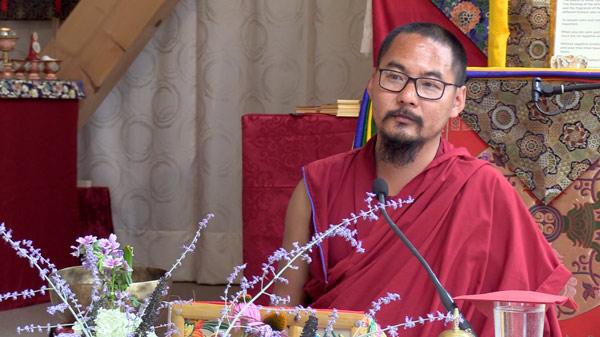
Video
Audio
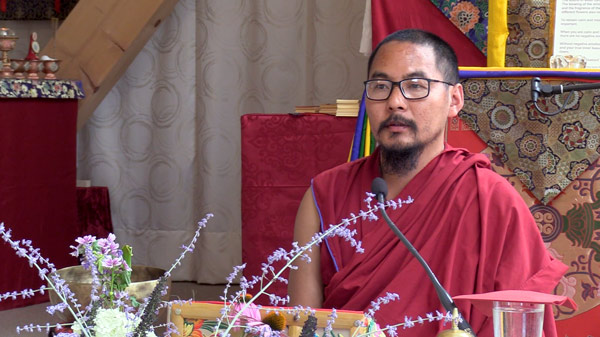
48:40
Okay, so start from prayer, page number
one.
hung orgyen yülgi nupjang tsam
pema gesar dongpo la
yatsen chokgi ngödrup nyé
pema jungné shesu drak
khordu khandro mangpö kor
khyé kyi jesu dak drup kyi
jingyi lapchir sheksu söl
guru pema siddhi hung
HŪM In the northwest of the country of Uḍḍiyāna, born on the pistil of a lotus, endowed with the most marvelous attainment, renowned as the Lotus-born, surrounded by a retinue of many ḍākinis, following you, I will reach accomplishment, Please come forth to bestow your blessing. GURU PADMA SIDDHI HŪM
lochö su drowar jingyi laptu söl chölam du drowar jingyi laptu söl lam trülpa selwar jingyi laptu söl trülpa yeshé su charwar jingyi laptu söl Grant your blessings so that my mind may follow the Dharma. Grant your blessings so that my Dharma practice may become the path. Grant your blessings so that the path may clarify my confusion. Grant your blessings so that confusion may dawn as wisdom.
Verse number 14.
okmin chökyi yingkyi phodrang né düsum sangyé kün gyi ngowo nyi rangsem chöku ngönsum tönzé pa tsawai lamai shapla sölwa dep In the dharmadhātu palace of Akaniṣṭha, I supplicate at the feet of the root guru, the essence of all the Buddhas of the three times, who directly shows my mind as Dharmakāya. chaktsal wadang chöching shakpa dang jesu yirang külshing sölwa yi gewa chung sé dak gi chisak pa thamché dak gi jangchup chir ngo o We prostrate, make offerings, and apologize, rejoice, request and beseech you earnestly. May whatever little goodness we have gathered, all be dedicated to enlightenment.
sashi pöchü juk shing metok tram rirap lingshi nyidé gyenpa di sangyé shingdu mikté phülwa yi drokün namdak shingdu chöpar shok The earth is perfumed with the scented water, and strewn with the flowers, adorned with Mount Meru, the four continents, the sun, and the moon. Imagining this as a buddha realm, I offer it so that all beings may enjoy that pure realm. semchen namki sampa dang loyi jedrak jita war chechung tünmong tekpa yi chökyi khorlo kordu söl In accordance with the capabilities and the diverse aspiration of sentient beings, I ask you to turn the wheel of Dharma of the greater, lesser or conventional vehicles.
Please listen to the Dharma with the proper motivation.
So, last two days
I was speaking about how practicing Dharma is a
basically recognizing one's own potential, and understanding how to develop that potential.
There are three kinds of obscurations that we have, which obscure not to recognize that potential. And in order to eliminate those obscurations during the practice of Dharma, we go through three process, studying, contemplation, and the meditation, which we also call it the three kind of wisdom’s.
Wisdom’s, this comes from studying, and wisdom’s that comes from contemplation, and wisdom that comes from meditation.
Basically, practicing Dharma is working with the mind, and it's important to take care of our mind.
Generally, because of many obscurations, our conscious mind and our subconscious minds are disconnected. And because of that, we want something, something else happens in our life. So it's very, very important to connect this conscious mind and subconscious mind. And when you practice, when you meditate, this is exactly what we are doing, trying to connect our conscious mind to the subconscious mind. And when you do that, there are three levels or stages that you go through. Understanding, experience, and the realization. So you start with the understanding, and slowly, slowly try to transform that understanding into the experience. And slowly, eventually, this experience will become a realization, and which will transform our subconscious mind thoroughly. And this is what we call the ultimate view.
And also, I was saying that when we say, I'm a Buddhist, you can be a Buddhist through ceremonial, and also, you should be a Buddhist according to the view.
If you think I'm Buddhist, you should really aspire to have a Buddhist view, which are four seals. Understanding that every compounded phenomena are impermanent and accepting it when it happens to you. Rather than trying to fight with the impermanent, rejecting or running away from impermanent.
And also understanding that all defiled phenomena are subject to be suffering, and then not longing for the suffering of change.
And of course, understanding that all the problems starts from the so called I or self. And every practice we do should be the directly or indirectly pointing towards this I and eliminating the concept of rigidness of self-cherishing mind of I.
And finally, the fourth one,
the ultimate reality, or the nirvana is beyond non-duality. So whatever we think that I've understood the ultimate reality, as long as it's in your duality mind, you should understand that, that is not the ultimate reality.
So I think these are some basic foundation,
you can say the key points as a Dharma practitioner. But not only Dharma practitioner, I think, if you want to be meaningful, have a meaningful life or have a healthy mind, these things might be very, very helpful in order to have a healthy mind.
So once you have a right view, then meditation and conduct is not that difficult. Because your meditation and conduct is completely influenced by what kind of view you have. Until you don't have a view, then even meditation and conduct is a little bit difficult. So in fact, it is said that
meditation is nothing but the sustaining the view. Yeah. So if you don't have a view, actually, there's not much to be meditated on. Of course, you can meditate, experiment here and there. But again, it will be like, you know, hitting on the tree, not hitting at the same place, you're hitting sometimes up, sometimes down.
Sangye Rinpoche once said that meditation without a view is meditation of hippies.
But that's why we spend a lot of time studying. Because when you say a right view, we are talking about the transformation of subconscious mind. And that's not easy. It's a very difficult thing. And you have to use many, many different kinds of means to convince your subconscious mind that what is reality and what is illusion.
Of course, theoretically, we can easily say, Oh, I understand this, I understand that, I understand emptiness, I understand impermanence. But again, the understanding level only works in conscious level, not in the subconscious level. And conscious is not a view. View comes from our subconscious mind. Because of that, it takes time, it takes some energy and it takes some effort.
So in Tibetan tradition,
I'm generalizing, the one approach that you start with the view, and then you meditate. Yeah, this is what we call gontokni, tawa ??? . You search the view through the meditations.
I think if you look at in four different schools, lineage, you can see that let's say Kagyupas, we are more like you start with the meditation, and then you reach the view later.
Of course, I'm generalizing here.
And then if you look at the Nyingma tradition, basically, mostly the dzogchen tradition, and we call it tatokni gompasova. ??? So you start from the view, and then you meditate. And that's why in Nyingma, we have this so called pointing out, right? So first, you point out the view. And once the students get that, and then you meditate. And this is one way to do. Or you can do both. But it depends on what kind of
karmic, how to say, the conditions that you have. Generally speaking,
what we have is, you have a understanding view. Yeah, that's how you start. But you don't have a realization view. And you use that understanding view. And slowly, eventually, it will transform into the realization view after the meditation. So view can be... understanding view is also a view, and realization view is also a view. But when we say that you meditate first, and then you realize the view, so we are talking about this realization view at the end.
But when we say that first you realize a view, and then you meditate, we are not going through the understanding to experience realization. We are actually starting from the top to the bottom. So first you start with the realization, and then you go to the experience. So that's the only difference.
But generally speaking, most of us, we have to go through this understanding view where you start, and then you meditate. Then you will experience something. This understanding view will transform into the experience view. And then later, as a result of our meditation, we will have this realization view.
So this is one thing.
And also,
since we are Mahāyāna practitioners, and somehow intentionally or
unintentionally, we are somehow engaging this Vajrayāna. Yeah.
I don't know whether it's fortunate or unfortunate, but somehow we are in this mandala.
There are some things that we should keep in mind when you practice, because these two parts, so-called the Sūtrayāna and the Tantrayāna, or the Vajrayāna, although the result is same, but the technique or the approach they use might be quite a contradict, and it's difficult.
We don't like contradict things. We like things that we agreed. Yeah.
First of all, it's important to know that it's really fortunate that we encountered Dharma, we encountered Mahāyāna Dharma, but not only that we have encountered this proper authentic Vajrayāna Dharma. So please don't feel a burden, feel proud.
Now, of course, being involved in this, you have a lot of responsibilities and commitments, and you have to be more careful, definitely.
To make it easy, I think, according to the traditional, they said the difference between Vajrayāna and the Sūtrayāna, or let's say the common vehicle or uncommon vehicle, is there are several features, such as that the result is same, Buddhahood or enlightenment, but the how, the techniques we use are different.
There are several differences. For example,
the first one is that for Vajrayāna, in the Vajrayāna path, they are not,
they are not,
let's say they are thoroughly skillful in the path of skillful means.
So means that in Sūtrayāna, there are some things that you can be used as a path, but there are some things that you cannot use them as a path. So there's a difference between path and non-path.
But when it comes to Vajrayāna, there's nothing that you say, I cannot use it. They can use everything as a path. So this is what we call the thap mawa
the richness in the skillful means or the method. That's why
Vajrayāna not only uses the mind, but also uses the eye, ear. So that's why when you do puja, you have drums, you have incense, and you have so many things that you're trying to use all your senses, not just the mind.
And the second thing it is said that it's a swift path and effortless.
So I think it depends on what you mean by effortless. but it is advertised as effortless path.
And then of course it is for the certain kind of dispositions, not for everyone. And when you have all these things together, then it works very well.
But of course, when you say Sūtrayāna and Vajrayāna, we are not really talking about the one path is going right and one path is going left. It's not like that. It should be understood as something like, if you are artist, painter, and then Sūtrayāna is like a very nice canvas, right? The base. Because if you don't have a proper canvas, if already there are a lot of colors, then you cannot paint properly. So you have to have a proper plain white canvas as a basis for your picture. So this canvas is like a Sūtrayāna . And I think the Vajrayāna is like when you paint on that canvas. So you have a nice picture and that is a Vajrayāna. And you cannot say that canvas is different from the painting, yeah? They are very related. Even though they seem quite different because one is completely colorless and one is lots of color, but they work very well together. If you take one of them, that's difficult.
And generally, you can say that Sūtrayāna is a... Buddhism has two aspects. And Sūtrayāna is a simplicity aspect of Buddhism. And also you can say it's a aspect that's something you can digest. It makes sense. Don't do this, do this, and things are something that we have been expected as a path, as a result.
And now Vajrayāna is a little bit like a complexity aspect of Buddhism, yeah? So
things are a little bit complex and things are a little bit beyond our expectations, or our Let's say...
let's say the deity is holding a sword, that flame is coming out of his sword, and then we talk about compassion. It doesn't really go with it, yeah? Why he's not holding a nice lotus? I mean, there are some deities holding lotus, but we expect that I wish he's holding a lotus rather than the sword. Or maybe he's holding a nice waterfall rather than a flame, yeah?
So actually the
the goal of Vajrayāna is not to make you happy, but to make you think, or a little bit disturb you, yeah? I think what is the English word that... it is a little bit...
It's... I think it's Vajrayāna is a little bit like sarcastic? Does that make sense? Yeah. They don't really mean what they say,
Yeah? So you have to understand that language.
Because
in Sūtrayāna, sometimes you follow the path and it satisfies you. It makes sense.
It means that some... it is a path, but somewhere it is nurturing your ego. When you say, I like it, oh it's good, I understand it. It makes sense. What do we really mean by when you say it makes sense? It means it fits to what I believe, yeah?
That's it. And when you don't say it doesn't make sense, means it doesn't fit what I believe. So what is our belief? Duality. So the more it fits into the duality, we say I like it or it's right way. The moment it goes against the duality. Why? We ask. It looks strange. I don't understand. It doesn't make sense.
So
in Sūtrayāna, they use the language, mostly the verbal language that we also use. So we have almost used the common language. So that's why we understand each other. But in Vajrayāna, they believe that the verbal language is a little bit too confusing.
It's not good enough. So they think that
the symbolic language or the visual language is much, much more powerful and it's less confusing.
But I think for us it's a little bit opposite, yeah? Maybe verbal language is more easy to understand and symbolic language is a little bit difficult. So once you are in the Vajrayāna, it's important to understand there's a difference between verbal language and the symbolic language.
Now, of course, we will argue that if I say, okay, so you know, this is a red color and this is a a represents the wisdom and immediately you will say, why? Why red? Why red is wisdom?
It's very easy. The answer is very easy. Why not?
Why not?
If you think that if the deity is compassionate deity, he should always hold the lotus flower. Why not the sword? Yeah. So we already have so much presumptions, the rules that are made by our duality, when we completely follow that and then we make a decision without even knowing it. Exactly. That's why Vajrayāna is playing this sarcastic game with us. You know, asking a question, why not?
Because the Vajrayāna's main point is not to make you happy, but their main point is to hit the point of duality.
That's why there's no rule.
Because the moment you make the rule, it means you're following the duality. Of course, there's a rule, which is no rule. Yeah. So the reason is that they really want to go directly to the non-duality point of our subconscious mind.
And I think all of you know that when you practice Vajrayāna, sometimes we have to do very strange things, such as drinking a chang yeah, which seems very strange.
But, and then also I'm quite sure when you take the empowerment, and sometimes they bring very good smell, immediately after that so bad smell, you have to smell them. Just to make you understand that
the feeling of good smell and bad smell, and how it triggers your duality mind, and it turns into the attachment and the aversion.
So when you are in Vajrayāna,
it's really important not to trust too much yourself. Yeah, this is very difficult thing.
If you have too much faith into yourself, then practicing Vajrayāna is difficult, because you cannot go out of your own rule or your own duality rules.
And whenever the question comes in Vajrayāna, why? Then just ask yourself, why not? That's quite good enough.
Red is also label, then we can label anything. Why not? But of course, Vajrayāna is not that he comes and destroys and
how to say, throw you into this confusion, of course, although it sounds like that, but it's not like that. It will destroy, not destroy, but let's say it will eliminate our habitual patterns that is completely triggered by our duality mind. But at the same time, it will give you very clear directions where you should go. That's why we have this Vajrasattvas, coming light into us, and then purifying us. And at the end, Vajrasattvas says, he smiles and says, well done, well done.
So it's important to keep in mind that Vajrayāna is not just to make you very confused. Maybe making you confused is the first level, but then they will also lead you in very structured way.
So it's important to understand the Vajrayāna's language in order to practice. And of course, while you practice, you will learn. It's not that you learn everything, Vajrayāna is a little bit different than Sūtrayāna. Sūtrayāna, first you practice, before you study, and then practice. So Vajrayāna is almost you do it, and then you learn it.
Yeah, but don't be too late to learn, yeah? Sometimes it's a little bit too late.
So I just felt that somehow you have these karmic connections with the Mahāyāna and Vajrayāna. We are doing pujas, so I thought it's important to know some basic rules. So that at least, even though you don't understand it, but you think that there must be something. Yeah? Instead of making, thinking that this doesn't make sense.
Now, the game in Vajrayāna is that the compassion of the, let's say the Buddha, or the deity, or the gurus, and the devotion of the students. So guru is saying that, please, you give me devotion, I will give you a blessing.
And then the students are saying, no, first you give me a blessing, then I will give you my devotion.
So basically it's like doing a big business, you know, there's two business partner. But we cannot really trust each other, we really want to do business. But the trust is not enough, and we are waiting for each other, isn't it?
When you practice Vajrasattva, we feel like, please Vajrasattva, just one time you show me, I will do every day.
And then Vajrasattva is saying, no, just think that I am there, you will see me.
So it's just a matter of, who will take the first step.
Sometimes we feel that there's more blessings coming towards me, and sometimes we feel, no, no, I'm giving more devotion to the deity, you know. So this will go up and down.
see, the devotion, again, the communication system, it's almost like a...
you have a phone, and then there's an internet router. It's quite close, but you just don't have a password.
Something is missing as a password. Between the deity and us, or let's say the guru and us.
Because,
theoretically speaking, it is said that the student should take the first move, because,
for example, between you and Buddha, let's say Buddha, Buddha has no agenda at all, and there's no reason why he will wait for you.
It is said that he's like a sun, always be there. His blessings, his...
... compassion is always there. So now the responsibility is coming from the student's point of view. So it really depends on the devotion.
Now the...
once you have some kind of devotion, the communication system starts working. Until that, even though it's very close, but something is kind of in between.
What is devotion?
To make it easy to understand, devotion means believing in something that it is, right? right? It's very easy. For example,
why money is working so well in our economic system, right? Why? For example, I even know how the other country's money looks like, but when somebody gave it to me, I just take it and use it, yeah? Even though I never saw that money before. So if you think why money is so working, even there's different money, different kind of shapes, colors, but even the whole world, the system of money is working very well. You can change easily here and there, and exchange with the food, everything, why? Because we have a common faith in the devotion in the money. That's it. Because of that, money is working so well. Otherwise, it is a piece of paper, right? With a very strange drawing, that's it.
But, when I give this piece of paper to the shopkeeper, I have a devotion that this has a value, and the person who takes the shopkeeper, he also has a common faith or devotion that this is money. So when I give this piece of paper to him, he will give to me food as exchange. It works very well. Otherwise, it's just a piece of money, it's just a piece of paper.
So until you have a devotion, the communication system works very well. The moment you stop the devotion, the communication system will stop.
Of course, when I give the piece of paper, I will say, please take the money. I won't say, please take my devotion or take my trust. But actually, what is happening is saying that I believe that this has a value. And he says, yeah, yeah, he is taking money.
If the value is in the money, then it should always be a money, yeah? But that's not the case.
Maybe recently, you know, that in India, everybody was happy, doing very well. And suddenly, in the middle of the night, the Prime Minister came up and said, from today, 500, it's not money.
And next day, it's not money.
Why? Big paper is the same paper, yeah? Nothing has changed. But you stop having devotion in that piece of paper and from that moment, it's not money at all. It's just a piece of paper.
So I was trying to say is that devotion is also same like that. When you have a devotion, then the communication between you and the Vajrasattva will work very well. Like a shopkeeper and, you know, person who's going to buy something. But until that, it's, you might give, but he won't take or, you know, he will argue if there's money or not. So it kind of stuck there.
HŪM In the northwest of the country of Uḍḍiyāna, born on the pistil of a lotus, endowed with the most marvelous attainment, renowned as the Lotus-born, surrounded by a retinue of many ḍākinis, following you, I will reach accomplishment, Please come forth to bestow your blessing. GURU PADMA SIDDHI HŪM
lochö su drowar jingyi laptu söl chölam du drowar jingyi laptu söl lam trülpa selwar jingyi laptu söl trülpa yeshé su charwar jingyi laptu söl Grant your blessings so that my mind may follow the Dharma. Grant your blessings so that my Dharma practice may become the path. Grant your blessings so that the path may clarify my confusion. Grant your blessings so that confusion may dawn as wisdom.
Verse number 14.
okmin chökyi yingkyi phodrang né düsum sangyé kün gyi ngowo nyi rangsem chöku ngönsum tönzé pa tsawai lamai shapla sölwa dep In the dharmadhātu palace of Akaniṣṭha, I supplicate at the feet of the root guru, the essence of all the Buddhas of the three times, who directly shows my mind as Dharmakāya. chaktsal wadang chöching shakpa dang jesu yirang külshing sölwa yi gewa chung sé dak gi chisak pa thamché dak gi jangchup chir ngo o We prostrate, make offerings, and apologize, rejoice, request and beseech you earnestly. May whatever little goodness we have gathered, all be dedicated to enlightenment.
sashi pöchü juk shing metok tram rirap lingshi nyidé gyenpa di sangyé shingdu mikté phülwa yi drokün namdak shingdu chöpar shok The earth is perfumed with the scented water, and strewn with the flowers, adorned with Mount Meru, the four continents, the sun, and the moon. Imagining this as a buddha realm, I offer it so that all beings may enjoy that pure realm. semchen namki sampa dang loyi jedrak jita war chechung tünmong tekpa yi chökyi khorlo kordu söl In accordance with the capabilities and the diverse aspiration of sentient beings, I ask you to turn the wheel of Dharma of the greater, lesser or conventional vehicles.
Please listen to the Dharma with the proper motivation.
So, last two days
I was speaking about how practicing Dharma is a
basically recognizing one's own potential, and understanding how to develop that potential.
There are three kinds of obscurations that we have, which obscure not to recognize that potential. And in order to eliminate those obscurations during the practice of Dharma, we go through three process, studying, contemplation, and the meditation, which we also call it the three kind of wisdom’s.
Wisdom’s, this comes from studying, and wisdom’s that comes from contemplation, and wisdom that comes from meditation.
Basically, practicing Dharma is working with the mind, and it's important to take care of our mind.
Generally, because of many obscurations, our conscious mind and our subconscious minds are disconnected. And because of that, we want something, something else happens in our life. So it's very, very important to connect this conscious mind and subconscious mind. And when you practice, when you meditate, this is exactly what we are doing, trying to connect our conscious mind to the subconscious mind. And when you do that, there are three levels or stages that you go through. Understanding, experience, and the realization. So you start with the understanding, and slowly, slowly try to transform that understanding into the experience. And slowly, eventually, this experience will become a realization, and which will transform our subconscious mind thoroughly. And this is what we call the ultimate view.
And also, I was saying that when we say, I'm a Buddhist, you can be a Buddhist through ceremonial, and also, you should be a Buddhist according to the view.
If you think I'm Buddhist, you should really aspire to have a Buddhist view, which are four seals. Understanding that every compounded phenomena are impermanent and accepting it when it happens to you. Rather than trying to fight with the impermanent, rejecting or running away from impermanent.
And also understanding that all defiled phenomena are subject to be suffering, and then not longing for the suffering of change.
And of course, understanding that all the problems starts from the so called I or self. And every practice we do should be the directly or indirectly pointing towards this I and eliminating the concept of rigidness of self-cherishing mind of I.
And finally, the fourth one,
the ultimate reality, or the nirvana is beyond non-duality. So whatever we think that I've understood the ultimate reality, as long as it's in your duality mind, you should understand that, that is not the ultimate reality.
So I think these are some basic foundation,
you can say the key points as a Dharma practitioner. But not only Dharma practitioner, I think, if you want to be meaningful, have a meaningful life or have a healthy mind, these things might be very, very helpful in order to have a healthy mind.
So once you have a right view, then meditation and conduct is not that difficult. Because your meditation and conduct is completely influenced by what kind of view you have. Until you don't have a view, then even meditation and conduct is a little bit difficult. So in fact, it is said that
meditation is nothing but the sustaining the view. Yeah. So if you don't have a view, actually, there's not much to be meditated on. Of course, you can meditate, experiment here and there. But again, it will be like, you know, hitting on the tree, not hitting at the same place, you're hitting sometimes up, sometimes down.
Sangye Rinpoche once said that meditation without a view is meditation of hippies.
But that's why we spend a lot of time studying. Because when you say a right view, we are talking about the transformation of subconscious mind. And that's not easy. It's a very difficult thing. And you have to use many, many different kinds of means to convince your subconscious mind that what is reality and what is illusion.
Of course, theoretically, we can easily say, Oh, I understand this, I understand that, I understand emptiness, I understand impermanence. But again, the understanding level only works in conscious level, not in the subconscious level. And conscious is not a view. View comes from our subconscious mind. Because of that, it takes time, it takes some energy and it takes some effort.
So in Tibetan tradition,
I'm generalizing, the one approach that you start with the view, and then you meditate. Yeah, this is what we call gontokni, tawa ??? . You search the view through the meditations.
I think if you look at in four different schools, lineage, you can see that let's say Kagyupas, we are more like you start with the meditation, and then you reach the view later.
Of course, I'm generalizing here.
And then if you look at the Nyingma tradition, basically, mostly the dzogchen tradition, and we call it tatokni gompasova. ??? So you start from the view, and then you meditate. And that's why in Nyingma, we have this so called pointing out, right? So first, you point out the view. And once the students get that, and then you meditate. And this is one way to do. Or you can do both. But it depends on what kind of
karmic, how to say, the conditions that you have. Generally speaking,
what we have is, you have a understanding view. Yeah, that's how you start. But you don't have a realization view. And you use that understanding view. And slowly, eventually, it will transform into the realization view after the meditation. So view can be... understanding view is also a view, and realization view is also a view. But when we say that you meditate first, and then you realize the view, so we are talking about this realization view at the end.
But when we say that first you realize a view, and then you meditate, we are not going through the understanding to experience realization. We are actually starting from the top to the bottom. So first you start with the realization, and then you go to the experience. So that's the only difference.
But generally speaking, most of us, we have to go through this understanding view where you start, and then you meditate. Then you will experience something. This understanding view will transform into the experience view. And then later, as a result of our meditation, we will have this realization view.
So this is one thing.
And also,
since we are Mahāyāna practitioners, and somehow intentionally or
unintentionally, we are somehow engaging this Vajrayāna. Yeah.
I don't know whether it's fortunate or unfortunate, but somehow we are in this mandala.
There are some things that we should keep in mind when you practice, because these two parts, so-called the Sūtrayāna and the Tantrayāna, or the Vajrayāna, although the result is same, but the technique or the approach they use might be quite a contradict, and it's difficult.
We don't like contradict things. We like things that we agreed. Yeah.
First of all, it's important to know that it's really fortunate that we encountered Dharma, we encountered Mahāyāna Dharma, but not only that we have encountered this proper authentic Vajrayāna Dharma. So please don't feel a burden, feel proud.
Now, of course, being involved in this, you have a lot of responsibilities and commitments, and you have to be more careful, definitely.
To make it easy, I think, according to the traditional, they said the difference between Vajrayāna and the Sūtrayāna, or let's say the common vehicle or uncommon vehicle, is there are several features, such as that the result is same, Buddhahood or enlightenment, but the how, the techniques we use are different.
There are several differences. For example,
the first one is that for Vajrayāna, in the Vajrayāna path, they are not,
they are not,
let's say they are thoroughly skillful in the path of skillful means.
So means that in Sūtrayāna, there are some things that you can be used as a path, but there are some things that you cannot use them as a path. So there's a difference between path and non-path.
But when it comes to Vajrayāna, there's nothing that you say, I cannot use it. They can use everything as a path. So this is what we call the thap mawa
the richness in the skillful means or the method. That's why
Vajrayāna not only uses the mind, but also uses the eye, ear. So that's why when you do puja, you have drums, you have incense, and you have so many things that you're trying to use all your senses, not just the mind.
And the second thing it is said that it's a swift path and effortless.
So I think it depends on what you mean by effortless. but it is advertised as effortless path.
And then of course it is for the certain kind of dispositions, not for everyone. And when you have all these things together, then it works very well.
But of course, when you say Sūtrayāna and Vajrayāna, we are not really talking about the one path is going right and one path is going left. It's not like that. It should be understood as something like, if you are artist, painter, and then Sūtrayāna is like a very nice canvas, right? The base. Because if you don't have a proper canvas, if already there are a lot of colors, then you cannot paint properly. So you have to have a proper plain white canvas as a basis for your picture. So this canvas is like a Sūtrayāna . And I think the Vajrayāna is like when you paint on that canvas. So you have a nice picture and that is a Vajrayāna. And you cannot say that canvas is different from the painting, yeah? They are very related. Even though they seem quite different because one is completely colorless and one is lots of color, but they work very well together. If you take one of them, that's difficult.
And generally, you can say that Sūtrayāna is a... Buddhism has two aspects. And Sūtrayāna is a simplicity aspect of Buddhism. And also you can say it's a aspect that's something you can digest. It makes sense. Don't do this, do this, and things are something that we have been expected as a path, as a result.
And now Vajrayāna is a little bit like a complexity aspect of Buddhism, yeah? So
things are a little bit complex and things are a little bit beyond our expectations, or our Let's say...
let's say the deity is holding a sword, that flame is coming out of his sword, and then we talk about compassion. It doesn't really go with it, yeah? Why he's not holding a nice lotus? I mean, there are some deities holding lotus, but we expect that I wish he's holding a lotus rather than the sword. Or maybe he's holding a nice waterfall rather than a flame, yeah?
So actually the
the goal of Vajrayāna is not to make you happy, but to make you think, or a little bit disturb you, yeah? I think what is the English word that... it is a little bit...
It's... I think it's Vajrayāna is a little bit like sarcastic? Does that make sense? Yeah. They don't really mean what they say,
Yeah? So you have to understand that language.
Because
in Sūtrayāna, sometimes you follow the path and it satisfies you. It makes sense.
It means that some... it is a path, but somewhere it is nurturing your ego. When you say, I like it, oh it's good, I understand it. It makes sense. What do we really mean by when you say it makes sense? It means it fits to what I believe, yeah?
That's it. And when you don't say it doesn't make sense, means it doesn't fit what I believe. So what is our belief? Duality. So the more it fits into the duality, we say I like it or it's right way. The moment it goes against the duality. Why? We ask. It looks strange. I don't understand. It doesn't make sense.
So
in Sūtrayāna, they use the language, mostly the verbal language that we also use. So we have almost used the common language. So that's why we understand each other. But in Vajrayāna, they believe that the verbal language is a little bit too confusing.
It's not good enough. So they think that
the symbolic language or the visual language is much, much more powerful and it's less confusing.
But I think for us it's a little bit opposite, yeah? Maybe verbal language is more easy to understand and symbolic language is a little bit difficult. So once you are in the Vajrayāna, it's important to understand there's a difference between verbal language and the symbolic language.
Now, of course, we will argue that if I say, okay, so you know, this is a red color and this is a a represents the wisdom and immediately you will say, why? Why red? Why red is wisdom?
It's very easy. The answer is very easy. Why not?
Why not?
If you think that if the deity is compassionate deity, he should always hold the lotus flower. Why not the sword? Yeah. So we already have so much presumptions, the rules that are made by our duality, when we completely follow that and then we make a decision without even knowing it. Exactly. That's why Vajrayāna is playing this sarcastic game with us. You know, asking a question, why not?
Because the Vajrayāna's main point is not to make you happy, but their main point is to hit the point of duality.
That's why there's no rule.
Because the moment you make the rule, it means you're following the duality. Of course, there's a rule, which is no rule. Yeah. So the reason is that they really want to go directly to the non-duality point of our subconscious mind.
And I think all of you know that when you practice Vajrayāna, sometimes we have to do very strange things, such as drinking a chang yeah, which seems very strange.
But, and then also I'm quite sure when you take the empowerment, and sometimes they bring very good smell, immediately after that so bad smell, you have to smell them. Just to make you understand that
the feeling of good smell and bad smell, and how it triggers your duality mind, and it turns into the attachment and the aversion.
So when you are in Vajrayāna,
it's really important not to trust too much yourself. Yeah, this is very difficult thing.
If you have too much faith into yourself, then practicing Vajrayāna is difficult, because you cannot go out of your own rule or your own duality rules.
And whenever the question comes in Vajrayāna, why? Then just ask yourself, why not? That's quite good enough.
Red is also label, then we can label anything. Why not? But of course, Vajrayāna is not that he comes and destroys and
how to say, throw you into this confusion, of course, although it sounds like that, but it's not like that. It will destroy, not destroy, but let's say it will eliminate our habitual patterns that is completely triggered by our duality mind. But at the same time, it will give you very clear directions where you should go. That's why we have this Vajrasattvas, coming light into us, and then purifying us. And at the end, Vajrasattvas says, he smiles and says, well done, well done.
So it's important to keep in mind that Vajrayāna is not just to make you very confused. Maybe making you confused is the first level, but then they will also lead you in very structured way.
So it's important to understand the Vajrayāna's language in order to practice. And of course, while you practice, you will learn. It's not that you learn everything, Vajrayāna is a little bit different than Sūtrayāna. Sūtrayāna, first you practice, before you study, and then practice. So Vajrayāna is almost you do it, and then you learn it.
Yeah, but don't be too late to learn, yeah? Sometimes it's a little bit too late.
So I just felt that somehow you have these karmic connections with the Mahāyāna and Vajrayāna. We are doing pujas, so I thought it's important to know some basic rules. So that at least, even though you don't understand it, but you think that there must be something. Yeah? Instead of making, thinking that this doesn't make sense.
Now, the game in Vajrayāna is that the compassion of the, let's say the Buddha, or the deity, or the gurus, and the devotion of the students. So guru is saying that, please, you give me devotion, I will give you a blessing.
And then the students are saying, no, first you give me a blessing, then I will give you my devotion.
So basically it's like doing a big business, you know, there's two business partner. But we cannot really trust each other, we really want to do business. But the trust is not enough, and we are waiting for each other, isn't it?
When you practice Vajrasattva, we feel like, please Vajrasattva, just one time you show me, I will do every day.
And then Vajrasattva is saying, no, just think that I am there, you will see me.
So it's just a matter of, who will take the first step.
Sometimes we feel that there's more blessings coming towards me, and sometimes we feel, no, no, I'm giving more devotion to the deity, you know. So this will go up and down.
see, the devotion, again, the communication system, it's almost like a...
you have a phone, and then there's an internet router. It's quite close, but you just don't have a password.
Something is missing as a password. Between the deity and us, or let's say the guru and us.
Because,
theoretically speaking, it is said that the student should take the first move, because,
for example, between you and Buddha, let's say Buddha, Buddha has no agenda at all, and there's no reason why he will wait for you.
It is said that he's like a sun, always be there. His blessings, his...
... compassion is always there. So now the responsibility is coming from the student's point of view. So it really depends on the devotion.
Now the...
once you have some kind of devotion, the communication system starts working. Until that, even though it's very close, but something is kind of in between.
What is devotion?
To make it easy to understand, devotion means believing in something that it is, right? right? It's very easy. For example,
why money is working so well in our economic system, right? Why? For example, I even know how the other country's money looks like, but when somebody gave it to me, I just take it and use it, yeah? Even though I never saw that money before. So if you think why money is so working, even there's different money, different kind of shapes, colors, but even the whole world, the system of money is working very well. You can change easily here and there, and exchange with the food, everything, why? Because we have a common faith in the devotion in the money. That's it. Because of that, money is working so well. Otherwise, it is a piece of paper, right? With a very strange drawing, that's it.
But, when I give this piece of paper to the shopkeeper, I have a devotion that this has a value, and the person who takes the shopkeeper, he also has a common faith or devotion that this is money. So when I give this piece of paper to him, he will give to me food as exchange. It works very well. Otherwise, it's just a piece of money, it's just a piece of paper.
So until you have a devotion, the communication system works very well. The moment you stop the devotion, the communication system will stop.
Of course, when I give the piece of paper, I will say, please take the money. I won't say, please take my devotion or take my trust. But actually, what is happening is saying that I believe that this has a value. And he says, yeah, yeah, he is taking money.
If the value is in the money, then it should always be a money, yeah? But that's not the case.
Maybe recently, you know, that in India, everybody was happy, doing very well. And suddenly, in the middle of the night, the Prime Minister came up and said, from today, 500, it's not money.
And next day, it's not money.
Why? Big paper is the same paper, yeah? Nothing has changed. But you stop having devotion in that piece of paper and from that moment, it's not money at all. It's just a piece of paper.
So I was trying to say is that devotion is also same like that. When you have a devotion, then the communication between you and the Vajrasattva will work very well. Like a shopkeeper and, you know, person who's going to buy something. But until that, it's, you might give, but he won't take or, you know, he will argue if there's money or not. So it kind of stuck there.
19:55
Okay, so start from prayer, page number
one.
hung orgyen yülgi nupjang tsam
pema gesar dongpo la
yatsen chokgi ngödrup nyé
pema jungné shesu drak
khordu khandro mangpö kor
khyé kyi jesu dak drup kyi
jingyi lapchir sheksu söl
guru pema siddhi hung
HŪM In the northwest of the country of Uḍḍiyāna, born on the pistil of a lotus, endowed with the most marvelous attainment, renowned as the Lotus-born, surrounded by a retinue of many ḍākinis, following you, I will reach accomplishment, Please come forth to bestow your blessing. GURU PADMA SIDDHI HŪM
lochö su drowar jingyi laptu söl chölam du drowar jingyi laptu söl lam trülpa selwar jingyi laptu söl trülpa yeshé su charwar jingyi laptu söl Grant your blessings so that my mind may follow the Dharma. Grant your blessings so that my Dharma practice may become the path. Grant your blessings so that the path may clarify my confusion. Grant your blessings so that confusion may dawn as wisdom.
Verse number 14.
okmin chökyi yingkyi phodrang né düsum sangyé kün gyi ngowo nyi rangsem chöku ngönsum tönzé pa tsawai lamai shapla sölwa dep In the dharmadhātu palace of Akaniṣṭha, I supplicate at the feet of the root guru, the essence of all the Buddhas of the three times, who directly shows my mind as Dharmakāya. chaktsal wadang chöching shakpa dang jesu yirang külshing sölwa yi gewa chung sé dak gi chisak pa thamché dak gi jangchup chir ngo o We prostrate, make offerings, and apologize, rejoice, request and beseech you earnestly. May whatever little goodness we have gathered, all be dedicated to enlightenment.
sashi pöchü juk shing metok tram rirap lingshi nyidé gyenpa di sangyé shingdu mikté phülwa yi drokün namdak shingdu chöpar shok The earth is perfumed with the scented water, and strewn with the flowers, adorned with Mount Meru, the four continents, the sun, and the moon. Imagining this as a buddha realm, I offer it so that all beings may enjoy that pure realm. semchen namki sampa dang loyi jedrak jita war chechung tünmong tekpa yi chökyi khorlo kordu söl In accordance with the capabilities and the diverse aspiration of sentient beings, I ask you to turn the wheel of Dharma of the greater, lesser or conventional vehicles.
Please listen to the Dharma with the proper motivation.
So, last two days
I was speaking about how practicing Dharma is a
basically recognizing one's own potential, and understanding how to develop that potential.
There are three kinds of obscurations that we have, which obscure not to recognize that potential. And in order to eliminate those obscurations during the practice of Dharma, we go through three process, studying, contemplation, and the meditation, which we also call it the three kind of wisdom’s.
Wisdom’s, this comes from studying, and wisdom’s that comes from contemplation, and wisdom that comes from meditation.
Basically, practicing Dharma is working with the mind, and it's important to take care of our mind.
Generally, because of many obscurations, our conscious mind and our subconscious minds are disconnected. And because of that, we want something, something else happens in our life. So it's very, very important to connect this conscious mind and subconscious mind. And when you practice, when you meditate, this is exactly what we are doing, trying to connect our conscious mind to the subconscious mind. And when you do that, there are three levels or stages that you go through. Understanding, experience, and the realization. So you start with the understanding, and slowly, slowly try to transform that understanding into the experience. And slowly, eventually, this experience will become a realization, and which will transform our subconscious mind thoroughly. And this is what we call the ultimate view.
And also, I was saying that when we say, I'm a Buddhist, you can be a Buddhist through ceremonial, and also, you should be a Buddhist according to the view.
If you think I'm Buddhist, you should really aspire to have a Buddhist view, which are four seals. Understanding that every compounded phenomena are impermanent and accepting it when it happens to you. Rather than trying to fight with the impermanent, rejecting or running away from impermanent.
And also understanding that all defiled phenomena are subject to be suffering, and then not longing for the suffering of change.
And of course, understanding that all the problems starts from the so called I or self. And every practice we do should be the directly or indirectly pointing towards this I and eliminating the concept of rigidness of self-cherishing mind of I.
And finally, the fourth one,
the ultimate reality, or the nirvana is beyond non-duality. So whatever we think that I've understood the ultimate reality, as long as it's in your duality mind, you should understand that, that is not the ultimate reality.
So I think these are some basic foundation,
you can say the key points as a Dharma practitioner. But not only Dharma practitioner, I think, if you want to be meaningful, have a meaningful life or have a healthy mind, these things might be very, very helpful in order to have a healthy mind.
So once you have a right view, then meditation and conduct is not that difficult. Because your meditation and conduct is completely influenced by what kind of view you have. Until you don't have a view, then even meditation and conduct is a little bit difficult. So in fact, it is said that
meditation is nothing but the sustaining the view. Yeah. So if you don't have a view, actually, there's not much to be meditated on. Of course, you can meditate, experiment here and there. But again, it will be like, you know, hitting on the tree, not hitting at the same place, you're hitting sometimes up, sometimes down.
Sangye Rinpoche once said that meditation without a view is meditation of hippies.
But that's why we spend a lot of time studying. Because when you say a right view, we are talking about the transformation of subconscious mind. And that's not easy. It's a very difficult thing. And you have to use many, many different kinds of means to convince your subconscious mind that what is reality and what is illusion.
Of course, theoretically, we can easily say, Oh, I understand this, I understand that, I understand emptiness, I understand impermanence. But again, the understanding level only works in conscious level, not in the subconscious level. And conscious is not a view. View comes from our subconscious mind. Because of that, it takes time, it takes some energy and it takes some effort.
So in Tibetan tradition,
I'm generalizing, the one approach that you start with the view, and then you meditate. Yeah, this is what we call gontokni, tawa ??? . You search the view through the meditations.
I think if you look at in four different schools, lineage, you can see that let's say Kagyupas, we are more like you start with the meditation, and then you reach the view later.
Of course, I'm generalizing here.
And then if you look at the Nyingma tradition, basically, mostly the dzogchen tradition, and we call it tatokni gompasova. ??? So you start from the view, and then you meditate. And that's why in Nyingma, we have this so called pointing out, right? So first, you point out the view. And once the students get that, and then you meditate. And this is one way to do. Or you can do both. But it depends on what kind of
karmic, how to say, the conditions that you have. Generally speaking,
what we have is, you have a understanding view. Yeah, that's how you start. But you don't have a realization view. And you use that understanding view. And slowly, eventually, it will transform into the realization view after the meditation. So view can be... understanding view is also a view, and realization view is also a view. But when we say that you meditate first, and then you realize the view, so we are talking about this realization view at the end.
But when we say that first you realize a view, and then you meditate, we are not going through the understanding to experience realization. We are actually starting from the top to the bottom. So first you start with the realization, and then you go to the experience. So that's the only difference.
But generally speaking, most of us, we have to go through this understanding view where you start, and then you meditate. Then you will experience something. This understanding view will transform into the experience view. And then later, as a result of our meditation, we will have this realization view.
So this is one thing.
And also,
since we are Mahāyāna practitioners, and somehow intentionally or
unintentionally, we are somehow engaging this Vajrayāna. Yeah.
I don't know whether it's fortunate or unfortunate, but somehow we are in this mandala.
There are some things that we should keep in mind when you practice, because these two parts, so-called the Sūtrayāna and the Tantrayāna, or the Vajrayāna, although the result is same, but the technique or the approach they use might be quite a contradict, and it's difficult.
We don't like contradict things. We like things that we agreed. Yeah.
First of all, it's important to know that it's really fortunate that we encountered Dharma, we encountered Mahāyāna Dharma, but not only that we have encountered this proper authentic Vajrayāna Dharma. So please don't feel a burden, feel proud.
Now, of course, being involved in this, you have a lot of responsibilities and commitments, and you have to be more careful, definitely.
To make it easy, I think, according to the traditional, they said the difference between Vajrayāna and the Sūtrayāna, or let's say the common vehicle or uncommon vehicle, is there are several features, such as that the result is same, Buddhahood or enlightenment, but the how, the techniques we use are different.
There are several differences. For example,
the first one is that for Vajrayāna, in the Vajrayāna path, they are not,
they are not,
let's say they are thoroughly skillful in the path of skillful means.
So means that in Sūtrayāna, there are some things that you can be used as a path, but there are some things that you cannot use them as a path. So there's a difference between path and non-path.
But when it comes to Vajrayāna, there's nothing that you say, I cannot use it. They can use everything as a path. So this is what we call the thap mawa
the richness in the skillful means or the method. That's why
Vajrayāna not only uses the mind, but also uses the eye, ear. So that's why when you do puja, you have drums, you have incense, and you have so many things that you're trying to use all your senses, not just the mind.
And the second thing it is said that it's a swift path and effortless.
So I think it depends on what you mean by effortless. but it is advertised as effortless path.
And then of course it is for the certain kind of dispositions, not for everyone. And when you have all these things together, then it works very well.
But of course, when you say Sūtrayāna and Vajrayāna, we are not really talking about the one path is going right and one path is going left. It's not like that. It should be understood as something like, if you are artist, painter, and then Sūtrayāna is like a very nice canvas, right? The base. Because if you don't have a proper canvas, if already there are a lot of colors, then you cannot paint properly. So you have to have a proper plain white canvas as a basis for your picture. So this canvas is like a Sūtrayāna . And I think the Vajrayāna is like when you paint on that canvas. So you have a nice picture and that is a Vajrayāna. And you cannot say that canvas is different from the painting, yeah? They are very related. Even though they seem quite different because one is completely colorless and one is lots of color, but they work very well together. If you take one of them, that's difficult.
And generally, you can say that Sūtrayāna is a... Buddhism has two aspects. And Sūtrayāna is a simplicity aspect of Buddhism. And also you can say it's a aspect that's something you can digest. It makes sense. Don't do this, do this, and things are something that we have been expected as a path, as a result.
And now Vajrayāna is a little bit like a complexity aspect of Buddhism, yeah? So
things are a little bit complex and things are a little bit beyond our expectations, or our Let's say...
let's say the deity is holding a sword, that flame is coming out of his sword, and then we talk about compassion. It doesn't really go with it, yeah? Why he's not holding a nice lotus? I mean, there are some deities holding lotus, but we expect that I wish he's holding a lotus rather than the sword. Or maybe he's holding a nice waterfall rather than a flame, yeah?
So actually the
the goal of Vajrayāna is not to make you happy, but to make you think, or a little bit disturb you, yeah? I think what is the English word that... it is a little bit...
It's... I think it's Vajrayāna is a little bit like sarcastic? Does that make sense? Yeah. They don't really mean what they say,
Yeah? So you have to understand that language.
Because
in Sūtrayāna, sometimes you follow the path and it satisfies you. It makes sense.
It means that some... it is a path, but somewhere it is nurturing your ego. When you say, I like it, oh it's good, I understand it. It makes sense. What do we really mean by when you say it makes sense? It means it fits to what I believe, yeah?
That's it. And when you don't say it doesn't make sense, means it doesn't fit what I believe. So what is our belief? Duality. So the more it fits into the duality, we say I like it or it's right way. The moment it goes against the duality. Why? We ask. It looks strange. I don't understand. It doesn't make sense.
So
in Sūtrayāna, they use the language, mostly the verbal language that we also use. So we have almost used the common language. So that's why we understand each other. But in Vajrayāna, they believe that the verbal language is a little bit too confusing.
It's not good enough. So they think that
the symbolic language or the visual language is much, much more powerful and it's less confusing.
But I think for us it's a little bit opposite, yeah? Maybe verbal language is more easy to understand and symbolic language is a little bit difficult. So once you are in the Vajrayāna, it's important to understand there's a difference between verbal language and the symbolic language.
Now, of course, we will argue that if I say, okay, so you know, this is a red color and this is a a represents the wisdom and immediately you will say, why? Why red? Why red is wisdom?
It's very easy. The answer is very easy. Why not?
Why not?
If you think that if the deity is compassionate deity, he should always hold the lotus flower. Why not the sword? Yeah. So we already have so much presumptions, the rules that are made by our duality, when we completely follow that and then we make a decision without even knowing it. Exactly. That's why Vajrayāna is playing this sarcastic game with us. You know, asking a question, why not?
Because the Vajrayāna's main point is not to make you happy, but their main point is to hit the point of duality.
That's why there's no rule.
Because the moment you make the rule, it means you're following the duality. Of course, there's a rule, which is no rule. Yeah. So the reason is that they really want to go directly to the non-duality point of our subconscious mind.
And I think all of you know that when you practice Vajrayāna, sometimes we have to do very strange things, such as drinking a chang yeah, which seems very strange.
But, and then also I'm quite sure when you take the empowerment, and sometimes they bring very good smell, immediately after that so bad smell, you have to smell them. Just to make you understand that
the feeling of good smell and bad smell, and how it triggers your duality mind, and it turns into the attachment and the aversion.
So when you are in Vajrayāna,
it's really important not to trust too much yourself. Yeah, this is very difficult thing.
If you have too much faith into yourself, then practicing Vajrayāna is difficult, because you cannot go out of your own rule or your own duality rules.
And whenever the question comes in Vajrayāna, why? Then just ask yourself, why not? That's quite good enough.
Red is also label, then we can label anything. Why not? But of course, Vajrayāna is not that he comes and destroys and
how to say, throw you into this confusion, of course, although it sounds like that, but it's not like that. It will destroy, not destroy, but let's say it will eliminate our habitual patterns that is completely triggered by our duality mind. But at the same time, it will give you very clear directions where you should go. That's why we have this Vajrasattvas, coming light into us, and then purifying us. And at the end, Vajrasattvas says, he smiles and says, well done, well done.
So it's important to keep in mind that Vajrayāna is not just to make you very confused. Maybe making you confused is the first level, but then they will also lead you in very structured way.
So it's important to understand the Vajrayāna's language in order to practice. And of course, while you practice, you will learn. It's not that you learn everything, Vajrayāna is a little bit different than Sūtrayāna. Sūtrayāna, first you practice, before you study, and then practice. So Vajrayāna is almost you do it, and then you learn it.
Yeah, but don't be too late to learn, yeah? Sometimes it's a little bit too late.
So I just felt that somehow you have these karmic connections with the Mahāyāna and Vajrayāna. We are doing pujas, so I thought it's important to know some basic rules. So that at least, even though you don't understand it, but you think that there must be something. Yeah? Instead of making, thinking that this doesn't make sense.
Now, the game in Vajrayāna is that the compassion of the, let's say the Buddha, or the deity, or the gurus, and the devotion of the students. So guru is saying that, please, you give me devotion, I will give you a blessing.
And then the students are saying, no, first you give me a blessing, then I will give you my devotion.
So basically it's like doing a big business, you know, there's two business partner. But we cannot really trust each other, we really want to do business. But the trust is not enough, and we are waiting for each other, isn't it?
When you practice Vajrasattva, we feel like, please Vajrasattva, just one time you show me, I will do every day.
And then Vajrasattva is saying, no, just think that I am there, you will see me.
So it's just a matter of, who will take the first step.
Sometimes we feel that there's more blessings coming towards me, and sometimes we feel, no, no, I'm giving more devotion to the deity, you know. So this will go up and down.
see, the devotion, again, the communication system, it's almost like a...
you have a phone, and then there's an internet router. It's quite close, but you just don't have a password.
Something is missing as a password. Between the deity and us, or let's say the guru and us.
Because,
theoretically speaking, it is said that the student should take the first move, because,
for example, between you and Buddha, let's say Buddha, Buddha has no agenda at all, and there's no reason why he will wait for you.
It is said that he's like a sun, always be there. His blessings, his...
... compassion is always there. So now the responsibility is coming from the student's point of view. So it really depends on the devotion.
Now the...
once you have some kind of devotion, the communication system starts working. Until that, even though it's very close, but something is kind of in between.
What is devotion?
To make it easy to understand, devotion means believing in something that it is, right? right? It's very easy. For example,
why money is working so well in our economic system, right? Why? For example, I even know how the other country's money looks like, but when somebody gave it to me, I just take it and use it, yeah? Even though I never saw that money before. So if you think why money is so working, even there's different money, different kind of shapes, colors, but even the whole world, the system of money is working very well. You can change easily here and there, and exchange with the food, everything, why? Because we have a common faith in the devotion in the money. That's it. Because of that, money is working so well. Otherwise, it is a piece of paper, right? With a very strange drawing, that's it.
But, when I give this piece of paper to the shopkeeper, I have a devotion that this has a value, and the person who takes the shopkeeper, he also has a common faith or devotion that this is money. So when I give this piece of paper to him, he will give to me food as exchange. It works very well. Otherwise, it's just a piece of money, it's just a piece of paper.
So until you have a devotion, the communication system works very well. The moment you stop the devotion, the communication system will stop.
Of course, when I give the piece of paper, I will say, please take the money. I won't say, please take my devotion or take my trust. But actually, what is happening is saying that I believe that this has a value. And he says, yeah, yeah, he is taking money.
If the value is in the money, then it should always be a money, yeah? But that's not the case.
Maybe recently, you know, that in India, everybody was happy, doing very well. And suddenly, in the middle of the night, the Prime Minister came up and said, from today, 500, it's not money.
And next day, it's not money.
Why? Big paper is the same paper, yeah? Nothing has changed. But you stop having devotion in that piece of paper and from that moment, it's not money at all. It's just a piece of paper.
So I was trying to say is that devotion is also same like that. When you have a devotion, then the communication between you and the Vajrasattva will work very well. Like a shopkeeper and, you know, person who's going to buy something. But until that, it's, you might give, but he won't take or, you know, he will argue if there's money or not. So it kind of stuck there.
HŪM In the northwest of the country of Uḍḍiyāna, born on the pistil of a lotus, endowed with the most marvelous attainment, renowned as the Lotus-born, surrounded by a retinue of many ḍākinis, following you, I will reach accomplishment, Please come forth to bestow your blessing. GURU PADMA SIDDHI HŪM
lochö su drowar jingyi laptu söl chölam du drowar jingyi laptu söl lam trülpa selwar jingyi laptu söl trülpa yeshé su charwar jingyi laptu söl Grant your blessings so that my mind may follow the Dharma. Grant your blessings so that my Dharma practice may become the path. Grant your blessings so that the path may clarify my confusion. Grant your blessings so that confusion may dawn as wisdom.
Verse number 14.
okmin chökyi yingkyi phodrang né düsum sangyé kün gyi ngowo nyi rangsem chöku ngönsum tönzé pa tsawai lamai shapla sölwa dep In the dharmadhātu palace of Akaniṣṭha, I supplicate at the feet of the root guru, the essence of all the Buddhas of the three times, who directly shows my mind as Dharmakāya. chaktsal wadang chöching shakpa dang jesu yirang külshing sölwa yi gewa chung sé dak gi chisak pa thamché dak gi jangchup chir ngo o We prostrate, make offerings, and apologize, rejoice, request and beseech you earnestly. May whatever little goodness we have gathered, all be dedicated to enlightenment.
sashi pöchü juk shing metok tram rirap lingshi nyidé gyenpa di sangyé shingdu mikté phülwa yi drokün namdak shingdu chöpar shok The earth is perfumed with the scented water, and strewn with the flowers, adorned with Mount Meru, the four continents, the sun, and the moon. Imagining this as a buddha realm, I offer it so that all beings may enjoy that pure realm. semchen namki sampa dang loyi jedrak jita war chechung tünmong tekpa yi chökyi khorlo kordu söl In accordance with the capabilities and the diverse aspiration of sentient beings, I ask you to turn the wheel of Dharma of the greater, lesser or conventional vehicles.
Please listen to the Dharma with the proper motivation.
So, last two days
I was speaking about how practicing Dharma is a
basically recognizing one's own potential, and understanding how to develop that potential.
There are three kinds of obscurations that we have, which obscure not to recognize that potential. And in order to eliminate those obscurations during the practice of Dharma, we go through three process, studying, contemplation, and the meditation, which we also call it the three kind of wisdom’s.
Wisdom’s, this comes from studying, and wisdom’s that comes from contemplation, and wisdom that comes from meditation.
Basically, practicing Dharma is working with the mind, and it's important to take care of our mind.
Generally, because of many obscurations, our conscious mind and our subconscious minds are disconnected. And because of that, we want something, something else happens in our life. So it's very, very important to connect this conscious mind and subconscious mind. And when you practice, when you meditate, this is exactly what we are doing, trying to connect our conscious mind to the subconscious mind. And when you do that, there are three levels or stages that you go through. Understanding, experience, and the realization. So you start with the understanding, and slowly, slowly try to transform that understanding into the experience. And slowly, eventually, this experience will become a realization, and which will transform our subconscious mind thoroughly. And this is what we call the ultimate view.
And also, I was saying that when we say, I'm a Buddhist, you can be a Buddhist through ceremonial, and also, you should be a Buddhist according to the view.
If you think I'm Buddhist, you should really aspire to have a Buddhist view, which are four seals. Understanding that every compounded phenomena are impermanent and accepting it when it happens to you. Rather than trying to fight with the impermanent, rejecting or running away from impermanent.
And also understanding that all defiled phenomena are subject to be suffering, and then not longing for the suffering of change.
And of course, understanding that all the problems starts from the so called I or self. And every practice we do should be the directly or indirectly pointing towards this I and eliminating the concept of rigidness of self-cherishing mind of I.
And finally, the fourth one,
the ultimate reality, or the nirvana is beyond non-duality. So whatever we think that I've understood the ultimate reality, as long as it's in your duality mind, you should understand that, that is not the ultimate reality.
So I think these are some basic foundation,
you can say the key points as a Dharma practitioner. But not only Dharma practitioner, I think, if you want to be meaningful, have a meaningful life or have a healthy mind, these things might be very, very helpful in order to have a healthy mind.
So once you have a right view, then meditation and conduct is not that difficult. Because your meditation and conduct is completely influenced by what kind of view you have. Until you don't have a view, then even meditation and conduct is a little bit difficult. So in fact, it is said that
meditation is nothing but the sustaining the view. Yeah. So if you don't have a view, actually, there's not much to be meditated on. Of course, you can meditate, experiment here and there. But again, it will be like, you know, hitting on the tree, not hitting at the same place, you're hitting sometimes up, sometimes down.
Sangye Rinpoche once said that meditation without a view is meditation of hippies.
But that's why we spend a lot of time studying. Because when you say a right view, we are talking about the transformation of subconscious mind. And that's not easy. It's a very difficult thing. And you have to use many, many different kinds of means to convince your subconscious mind that what is reality and what is illusion.
Of course, theoretically, we can easily say, Oh, I understand this, I understand that, I understand emptiness, I understand impermanence. But again, the understanding level only works in conscious level, not in the subconscious level. And conscious is not a view. View comes from our subconscious mind. Because of that, it takes time, it takes some energy and it takes some effort.
So in Tibetan tradition,
I'm generalizing, the one approach that you start with the view, and then you meditate. Yeah, this is what we call gontokni, tawa ??? . You search the view through the meditations.
I think if you look at in four different schools, lineage, you can see that let's say Kagyupas, we are more like you start with the meditation, and then you reach the view later.
Of course, I'm generalizing here.
And then if you look at the Nyingma tradition, basically, mostly the dzogchen tradition, and we call it tatokni gompasova. ??? So you start from the view, and then you meditate. And that's why in Nyingma, we have this so called pointing out, right? So first, you point out the view. And once the students get that, and then you meditate. And this is one way to do. Or you can do both. But it depends on what kind of
karmic, how to say, the conditions that you have. Generally speaking,
what we have is, you have a understanding view. Yeah, that's how you start. But you don't have a realization view. And you use that understanding view. And slowly, eventually, it will transform into the realization view after the meditation. So view can be... understanding view is also a view, and realization view is also a view. But when we say that you meditate first, and then you realize the view, so we are talking about this realization view at the end.
But when we say that first you realize a view, and then you meditate, we are not going through the understanding to experience realization. We are actually starting from the top to the bottom. So first you start with the realization, and then you go to the experience. So that's the only difference.
But generally speaking, most of us, we have to go through this understanding view where you start, and then you meditate. Then you will experience something. This understanding view will transform into the experience view. And then later, as a result of our meditation, we will have this realization view.
So this is one thing.
And also,
since we are Mahāyāna practitioners, and somehow intentionally or
unintentionally, we are somehow engaging this Vajrayāna. Yeah.
I don't know whether it's fortunate or unfortunate, but somehow we are in this mandala.
There are some things that we should keep in mind when you practice, because these two parts, so-called the Sūtrayāna and the Tantrayāna, or the Vajrayāna, although the result is same, but the technique or the approach they use might be quite a contradict, and it's difficult.
We don't like contradict things. We like things that we agreed. Yeah.
First of all, it's important to know that it's really fortunate that we encountered Dharma, we encountered Mahāyāna Dharma, but not only that we have encountered this proper authentic Vajrayāna Dharma. So please don't feel a burden, feel proud.
Now, of course, being involved in this, you have a lot of responsibilities and commitments, and you have to be more careful, definitely.
To make it easy, I think, according to the traditional, they said the difference between Vajrayāna and the Sūtrayāna, or let's say the common vehicle or uncommon vehicle, is there are several features, such as that the result is same, Buddhahood or enlightenment, but the how, the techniques we use are different.
There are several differences. For example,
the first one is that for Vajrayāna, in the Vajrayāna path, they are not,
they are not,
let's say they are thoroughly skillful in the path of skillful means.
So means that in Sūtrayāna, there are some things that you can be used as a path, but there are some things that you cannot use them as a path. So there's a difference between path and non-path.
But when it comes to Vajrayāna, there's nothing that you say, I cannot use it. They can use everything as a path. So this is what we call the thap mawa
the richness in the skillful means or the method. That's why
Vajrayāna not only uses the mind, but also uses the eye, ear. So that's why when you do puja, you have drums, you have incense, and you have so many things that you're trying to use all your senses, not just the mind.
And the second thing it is said that it's a swift path and effortless.
So I think it depends on what you mean by effortless. but it is advertised as effortless path.
And then of course it is for the certain kind of dispositions, not for everyone. And when you have all these things together, then it works very well.
But of course, when you say Sūtrayāna and Vajrayāna, we are not really talking about the one path is going right and one path is going left. It's not like that. It should be understood as something like, if you are artist, painter, and then Sūtrayāna is like a very nice canvas, right? The base. Because if you don't have a proper canvas, if already there are a lot of colors, then you cannot paint properly. So you have to have a proper plain white canvas as a basis for your picture. So this canvas is like a Sūtrayāna . And I think the Vajrayāna is like when you paint on that canvas. So you have a nice picture and that is a Vajrayāna. And you cannot say that canvas is different from the painting, yeah? They are very related. Even though they seem quite different because one is completely colorless and one is lots of color, but they work very well together. If you take one of them, that's difficult.
And generally, you can say that Sūtrayāna is a... Buddhism has two aspects. And Sūtrayāna is a simplicity aspect of Buddhism. And also you can say it's a aspect that's something you can digest. It makes sense. Don't do this, do this, and things are something that we have been expected as a path, as a result.
And now Vajrayāna is a little bit like a complexity aspect of Buddhism, yeah? So
things are a little bit complex and things are a little bit beyond our expectations, or our Let's say...
let's say the deity is holding a sword, that flame is coming out of his sword, and then we talk about compassion. It doesn't really go with it, yeah? Why he's not holding a nice lotus? I mean, there are some deities holding lotus, but we expect that I wish he's holding a lotus rather than the sword. Or maybe he's holding a nice waterfall rather than a flame, yeah?
So actually the
the goal of Vajrayāna is not to make you happy, but to make you think, or a little bit disturb you, yeah? I think what is the English word that... it is a little bit...
It's... I think it's Vajrayāna is a little bit like sarcastic? Does that make sense? Yeah. They don't really mean what they say,
Yeah? So you have to understand that language.
Because
in Sūtrayāna, sometimes you follow the path and it satisfies you. It makes sense.
It means that some... it is a path, but somewhere it is nurturing your ego. When you say, I like it, oh it's good, I understand it. It makes sense. What do we really mean by when you say it makes sense? It means it fits to what I believe, yeah?
That's it. And when you don't say it doesn't make sense, means it doesn't fit what I believe. So what is our belief? Duality. So the more it fits into the duality, we say I like it or it's right way. The moment it goes against the duality. Why? We ask. It looks strange. I don't understand. It doesn't make sense.
So
in Sūtrayāna, they use the language, mostly the verbal language that we also use. So we have almost used the common language. So that's why we understand each other. But in Vajrayāna, they believe that the verbal language is a little bit too confusing.
It's not good enough. So they think that
the symbolic language or the visual language is much, much more powerful and it's less confusing.
But I think for us it's a little bit opposite, yeah? Maybe verbal language is more easy to understand and symbolic language is a little bit difficult. So once you are in the Vajrayāna, it's important to understand there's a difference between verbal language and the symbolic language.
Now, of course, we will argue that if I say, okay, so you know, this is a red color and this is a a represents the wisdom and immediately you will say, why? Why red? Why red is wisdom?
It's very easy. The answer is very easy. Why not?
Why not?
If you think that if the deity is compassionate deity, he should always hold the lotus flower. Why not the sword? Yeah. So we already have so much presumptions, the rules that are made by our duality, when we completely follow that and then we make a decision without even knowing it. Exactly. That's why Vajrayāna is playing this sarcastic game with us. You know, asking a question, why not?
Because the Vajrayāna's main point is not to make you happy, but their main point is to hit the point of duality.
That's why there's no rule.
Because the moment you make the rule, it means you're following the duality. Of course, there's a rule, which is no rule. Yeah. So the reason is that they really want to go directly to the non-duality point of our subconscious mind.
And I think all of you know that when you practice Vajrayāna, sometimes we have to do very strange things, such as drinking a chang yeah, which seems very strange.
But, and then also I'm quite sure when you take the empowerment, and sometimes they bring very good smell, immediately after that so bad smell, you have to smell them. Just to make you understand that
the feeling of good smell and bad smell, and how it triggers your duality mind, and it turns into the attachment and the aversion.
So when you are in Vajrayāna,
it's really important not to trust too much yourself. Yeah, this is very difficult thing.
If you have too much faith into yourself, then practicing Vajrayāna is difficult, because you cannot go out of your own rule or your own duality rules.
And whenever the question comes in Vajrayāna, why? Then just ask yourself, why not? That's quite good enough.
Red is also label, then we can label anything. Why not? But of course, Vajrayāna is not that he comes and destroys and
how to say, throw you into this confusion, of course, although it sounds like that, but it's not like that. It will destroy, not destroy, but let's say it will eliminate our habitual patterns that is completely triggered by our duality mind. But at the same time, it will give you very clear directions where you should go. That's why we have this Vajrasattvas, coming light into us, and then purifying us. And at the end, Vajrasattvas says, he smiles and says, well done, well done.
So it's important to keep in mind that Vajrayāna is not just to make you very confused. Maybe making you confused is the first level, but then they will also lead you in very structured way.
So it's important to understand the Vajrayāna's language in order to practice. And of course, while you practice, you will learn. It's not that you learn everything, Vajrayāna is a little bit different than Sūtrayāna. Sūtrayāna, first you practice, before you study, and then practice. So Vajrayāna is almost you do it, and then you learn it.
Yeah, but don't be too late to learn, yeah? Sometimes it's a little bit too late.
So I just felt that somehow you have these karmic connections with the Mahāyāna and Vajrayāna. We are doing pujas, so I thought it's important to know some basic rules. So that at least, even though you don't understand it, but you think that there must be something. Yeah? Instead of making, thinking that this doesn't make sense.
Now, the game in Vajrayāna is that the compassion of the, let's say the Buddha, or the deity, or the gurus, and the devotion of the students. So guru is saying that, please, you give me devotion, I will give you a blessing.
And then the students are saying, no, first you give me a blessing, then I will give you my devotion.
So basically it's like doing a big business, you know, there's two business partner. But we cannot really trust each other, we really want to do business. But the trust is not enough, and we are waiting for each other, isn't it?
When you practice Vajrasattva, we feel like, please Vajrasattva, just one time you show me, I will do every day.
And then Vajrasattva is saying, no, just think that I am there, you will see me.
So it's just a matter of, who will take the first step.
Sometimes we feel that there's more blessings coming towards me, and sometimes we feel, no, no, I'm giving more devotion to the deity, you know. So this will go up and down.
see, the devotion, again, the communication system, it's almost like a...
you have a phone, and then there's an internet router. It's quite close, but you just don't have a password.
Something is missing as a password. Between the deity and us, or let's say the guru and us.
Because,
theoretically speaking, it is said that the student should take the first move, because,
for example, between you and Buddha, let's say Buddha, Buddha has no agenda at all, and there's no reason why he will wait for you.
It is said that he's like a sun, always be there. His blessings, his...
... compassion is always there. So now the responsibility is coming from the student's point of view. So it really depends on the devotion.
Now the...
once you have some kind of devotion, the communication system starts working. Until that, even though it's very close, but something is kind of in between.
What is devotion?
To make it easy to understand, devotion means believing in something that it is, right? right? It's very easy. For example,
why money is working so well in our economic system, right? Why? For example, I even know how the other country's money looks like, but when somebody gave it to me, I just take it and use it, yeah? Even though I never saw that money before. So if you think why money is so working, even there's different money, different kind of shapes, colors, but even the whole world, the system of money is working very well. You can change easily here and there, and exchange with the food, everything, why? Because we have a common faith in the devotion in the money. That's it. Because of that, money is working so well. Otherwise, it is a piece of paper, right? With a very strange drawing, that's it.
But, when I give this piece of paper to the shopkeeper, I have a devotion that this has a value, and the person who takes the shopkeeper, he also has a common faith or devotion that this is money. So when I give this piece of paper to him, he will give to me food as exchange. It works very well. Otherwise, it's just a piece of money, it's just a piece of paper.
So until you have a devotion, the communication system works very well. The moment you stop the devotion, the communication system will stop.
Of course, when I give the piece of paper, I will say, please take the money. I won't say, please take my devotion or take my trust. But actually, what is happening is saying that I believe that this has a value. And he says, yeah, yeah, he is taking money.
If the value is in the money, then it should always be a money, yeah? But that's not the case.
Maybe recently, you know, that in India, everybody was happy, doing very well. And suddenly, in the middle of the night, the Prime Minister came up and said, from today, 500, it's not money.
And next day, it's not money.
Why? Big paper is the same paper, yeah? Nothing has changed. But you stop having devotion in that piece of paper and from that moment, it's not money at all. It's just a piece of paper.
So I was trying to say is that devotion is also same like that. When you have a devotion, then the communication between you and the Vajrasattva will work very well. Like a shopkeeper and, you know, person who's going to buy something. But until that, it's, you might give, but he won't take or, you know, he will argue if there's money or not. So it kind of stuck there.