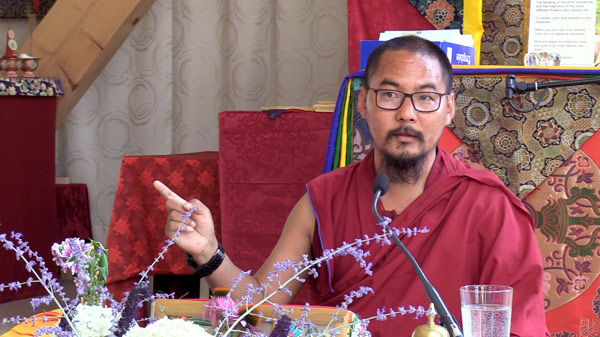
Video
Audio
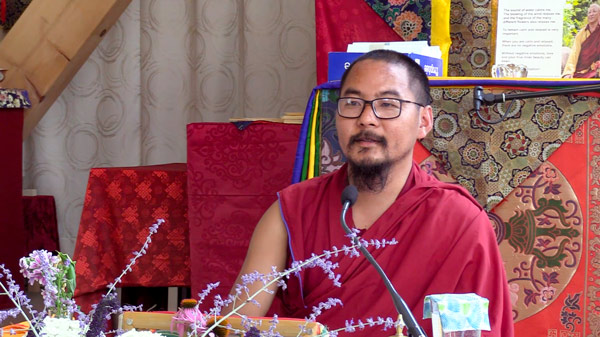
51:13
We will try to follow the tradition now.
We do some pray before the teachings,
and then we do teaching.
And we do some dedication prayers at the
end.
So maybe we do that.
A short one.
Because in Buddhism it is said that whatever practice or
Dharma activities you do, three things are very important. Important in the beginning, starting with good motivation. And important in the middle, where you concentrate. And then important at the end, where you make some dedications. So that's why all the, whether you do meditation, teaching, or long sadhana, all they have these three, something prayers in the beginning, and then some dedication prayers at the end.
So we will also do that here.
If you have Shakyamuni Buddha spread in front of you, is it? No? Then what we have is, you have this one, is it?
Teaching session, okay. So, of course many of you are old, I don't need to say, but also some of our volunteers, they are new, yeah? So we read in Tibetan, and then later in English, yeah? And when you read in Tibetan, if it is words, it's easy, you just follow two, two, two, and then one. So, for example, orgyen yülgi nubjang tsam so there will be seven words, you follow two, two, two, and then stop at the end, so it's the same for the verse.
And there are some different melodies for the different practice but now here you can just follow there.
And this is called Seven Line Prayers. It's a prayer to the Padmasambhava, who is one of the emanations of Buddha, and one who brought Buddhism into Tibet. So we start with praying.
hung orgyen yülgi nupjang tsam pema gesar dongpo la yatsen chokgi ngödrup nyé pema jungné shesu drak khordu khandro mangpö kor khyé kyi jesu dak drup kyi jingyi lapchir sheksu söl guru pema siddhi hung Do you also do the English? Okay.
HŪM In the northwest of the country of Uḍḍiyāna, born on the pistil of a lotus, endowed with the most marvelous attainment, renowned as the Lotus-born, surrounded by a retinue of many ḍākinis, following you, I will reach accomplishment, please come forth to bestow your blessing. GURU PADMA SIDDHI HŪM
So again, next verse is also a supplication, prayers.
lochö su drowar jingyi laptu söl chölam du drowar jingyi laptu söl lam trülpa selwar jingyi laptu söl trülpa yeshé su charwar jingyi laptu söl
Grant your blessings so that my mind may follow the Dharma. Grant your blessings so that my Dharma practice may become the path. Grant your blessings so that the path may clarify my confusion. Grant your blessings so that confusion may dawn as wisdom.
So, we will skip some of them. And page number fourteen.
okmin chökyi yingkyi phodrang né düsum sangyé kün gyi ngowo nyi rangsem chöku ngönsum tönzé pa tsawai lamai shapla sölwa dep In the dharmadhātu palace of Akaniṣṭha, I suplicate at the feet of the root guru, the essence of all the Buddhas of the three times, who directly shows my mind as Dharmakāya.
Next. chaktsal wadang chöching shakpa dang jesu yirang külshing sölwa yi gewa chung sé dak gi chisak pa thamché dak gi jangchup chir ngo o We prostrate, make offerings, and apologize, rejoice, request and beseach you earnestly. May whatever little goodness we have gathered, all be dedicated to enlightenment.
Yes, so now you can... So, I don't know, if you know how to do the Mudra of Mandala offering, you can do. Otherwise, just...
sashi pöchü juk shing metok tram rirap lingshi nyidé gyenpa di sangyé shingdu mikté phülwa yi drokün namdak shingdu chöpar shok
the sun. Imagining this as a buddha realm, I offer this so that all beings may enjoy that pure realm.
So, those who are new, since we value our dharma a lot, and before you get teaching, we request the teacher to turn the wheel of dharma. And for that, it's very important to accumulate some merit so the communication between teachers and students happens properly. And that's why we do this mandala offering. And this mudra, the gesture, you see the kind of like five peaks, mountains, is a symbol of universe, according to Buddhist cosmology. So here is what we call the Mount Meru in the middle, and these four are four continents. So when you offer, you're offering the whole universe, of course mentally, to the Buddhas and bodhisattvas and the teachers in order to turn the wheel of dharma. So it's a sense, it's a kind of valuing the dharma, and appreciating the teaching.
So now the next...
semchen namki sampa dang loyi jedrak jita war chechung tünmong tekpa yi chökyi khorlo kordu söl In accordance with the activity and the diverse aspiration of sentient beings, I ask you to turn the wheel of Dharma of the greater, lesser or conventional vehicles.
Okay, so that's...
Okay, so.
My English is not that fluent, but I hope, you know, we can communicate. So you have to listen with a little bit, how to say, with a tune, so to speak.
So for the few days, coming days, we will be doing this teaching session,
.. I thought that it's good to study some proper texts, so that later you can study by yourself and more enhance your understanding and deepen your experience and practice of dharma by yourself. And also the text is already translated in English. And this is the essence of other texts called Bodhicaryāvatāra, written by Indian Master Śāntideva. And all the Buddhists in the monastery, when you study Buddhist texts, we start with this Bodhicaryāvatāra. But since that text is a detailed one, and this is kind of like an essence of that text, and also it's good for people who are interested in practicing Buddhism, so it's more like practical instructions. So I hope this might be a little bit helpful.
But I think most of you are old Buddhists, already practicing for a long time, know a lot. And also some of you probably who are volunteering here are new, yeah? New to Buddhists. How many of you are like new?
Okay.
So I will try to balance, but...
But I think today I will just say a few... what do you say, key points or things that I felt important to know as a Buddhist and a Dharma practitioner, so it might be helpful.
Then maybe I will start text from tomorrow.
Those who don't know me, I was born in Nepal, originally Tibetan ethnic, and I became a monk in the Ka-Nying Shedrub Ling Monastery that belongs to Chökyi Nyima Rinpoche, when I was nine years old. And I studied there, grew up there, and now I'm serving as a teacher in the monastery. So this time I got some time to travel, and so I came to Denmark here for the short teachings.
So,
okay, maybe today I will say a few things about once you become a Buddhist, what are your identities, or the responsibilities, or your, how to say, obligations, so to speak.
I think first of all, Buddhism,
we can say it's a combination of philosophy, religious, and psychology, so in terms of the knowledge, we can say that actually Buddhism is quite rich. A lot of different schools, different philosophy schools, different lineages, and different techniques of practice and so forth.
I think generally speaking why we need this spiritual path.
Somehow, when we say I, when we say I'm suffering, or I'm being happy, whether we like it or not, we have this I within us, the moment we were born, and sometimes our I is not that obvious, and sometimes our I is very obvious, I'm this, I'm that. Once you have I, and then it's very innate feeling, that wanting to be free from suffering, and to longing for the happiness is almost like our innate qualities.
And according to Buddhism,
in Uttaratantra-Śāstra text, Maitreya said that all the sentient beings have this potential, or what we call the Buddha nature, or the potential to be enlightened. And how we know is that the first among the several signs that wanting to be free from suffering is the one of them. So it's not only even human beings, all the other beings also have that. It's not that human beings was striving for happiness, wanting to be free, even the ants and the small bugs, everyone is, the moment they're born until they die, they're doing something for that. So this is the clear sign that as long as you have a mind, you have a Buddha nature. You have the potential to become free, or become enlightened.
So now when you study Buddhism, and when we say I'm practicing Buddhism, to make it very easy, actually there's only two things that you're doing it. The first thing is you trying to discover, or you try to recognize the potential that you have.
This is what we do. For example, when you practice Buddhist, we study, the first very beginning practice is called understanding the nature of human being. Generally, especially we call it precious human life.
Who am I?
And what kind of potentials that I have?
Many times we don't know that. And we kind of waste this potential because of not knowing. And this is what we call the ignorant.
So when you study, and when you practiced, the first thing is understanding that you're born as a human being. That's amazing. And then you're still alive. Being alive twenty-four hours is amazing. And then you have all this intake, senses, your mind is kind of working well. When you look at how many causes and conditions is needed for that kind of potential, it's very, very rare. And this is what we call the understanding or practicing on the precious human life. This is the first step towards the understanding that you have tremendous potential inside of you and this is just the beginning.
And according to Buddhists, it is believed that,
in the process of evolution, generally speaking, the precious human life is one of the most, how to say, the greatest fruit of the tree of our evolution.
But unfortunately, because of many reasons, we don't recognize that potential. Or sometimes we do recognize, but then we forget them easily. And because of that, we get confused in life.
And for example, we talk about the meaning of life, right? From the Buddhist point of view, there's no meaning for the life. It is you who make the meaning of your own life through your karma or through your action. So if you try to find some sort of one answer, what it is, it's not going to happen because there's no answer for that, one life, one way. But if you understand, recognize your own potential and know how to use and how to develop that potential, then that creates the meaning of your life.
So as long as you don't know your potential and don't know how to develop that potential fully, thoroughly, then life always is a little bit confusing.
And once you understand the potential of your mind, or let's say potential of yourself, and then you know way, how to develop that potential and where you should go, and this becomes the meaning of our life.
So when you study Buddhism, when you practice Buddhism, actually the only two things that we are doing, the first is recognizing that potential and second thing is developing that potential with the proper structure.
Sometimes we feel that I didn't understand the
potential, but we don't have proper structure. So this so-called whole path of Dharma is a full proper structure telling us how to develop that potential in the fully level. So from the Buddhist point of view, we have a tremendous potential. It doesn't really matter your gender or what kind of background or culture you have. We are all the same potential. It is just a matter of a little bit of accumulating the karma and connecting them together. Small, small things. That's why we do the prostations before the practice to accumulate the merit. That's why we do the offerings. We do the prayers. So that all this comes together. It's like cooking a nice food. You have to accumulate small, small things.
So if you look at the word, so-called Buddha, which is a Sanskrit word, and it is translated in English as enlightenment, but the literal translation will be awakened one.
So when you recognize your own potential and then you develop in the fully level, thoroughly, and that means you are completely awakened. That is what it means. Many times we are kind of sleeping, meaning not knowing that potential. And sometimes we know that potential, but we don't know the process to develop it, so we are stuck in a certain level, because of ups and downs. So Buddha is the one who is completely awakening from the sleep of ignorance and who has completely developed that potential in the full level. That is called Buddha. In Tibetan, we use the word sangyé. That's a two word. It's more like meaningly translated.
So sang literally means purification. Buddha has purified all kinds of negativities, illusions, and the suffering and the cause of suffering, and that's why we call sang.
And the next word is called gyé. It means to develop in the full, to develop, to enhance. So the one who has complete sort of developed of its potential, it means realisation. The wisdom of the realisation is completely intact there. And when you put these two things together, it becomes a sangyé, Buddha. It means someone who has completely purified all kinds of illusions and who has developed fully all kinds of wisdom. And this is what we call the Buddha.
So this is, as a Buddhist practitioner, this is our goal. So Buddha is not a name or person, but it's more a title when you practice. So we all have a potential of Buddha, and we all can become exactly same as a Buddha. So this is, I think, a little bit extraordinary sort of ideas of Buddhism.
It's not like you are always second. You can become exactly like a Buddha.
Now, when we talk about the path, the process,
it's quite easy.
When we call Buddhism, I'm a Buddhist. I'm a Buddhist. In English we call Buddhist, but in Tibetan we call nang pa. It literally means the insiders. Insiders. That means we believe that there's an external world, there's an internal world.
And when you say I, there's our physical I, and there's our mental I. We have body and mind, so to speak.
But, ultimately, whether we talk about happiness or whether we talk about suffering, it always comes down to our mind. So everything is kind of created from the mind. So that's why all the problems actually comes down to the mind. Inside. And all the solutions also can be found inside of us. If you try to look happiness outside, you can get some pleasure here and there, but it will always become endless.
So that's why we call insiders, because whether it is problem, suffering, or whether it is happiness and solutions, you always try to find it from the inside. And this is the right way to do it. Because many times we want happiness, but we don't look at the wrong place.
And this happens a lot, because of our ignorance. And that's why Buddha was trying to say that longing for the happiness is your right. You have to do that. But the problem is you have to know where to look at.
Many times you are looking at the wrong place, and then you are complaining.
It's like you want to go to the north, but then you are walking towards the opposite directions. For example, attachment and desires are not really cause of suffering, not happiness. But we still strongly believe that they bring us more happiness.
For example, contentment, and let's say being more compassionate, are cause of happiness. But we kind of try to... we have this strongly subconscious mind that thinks, no, no, these are not the cause of happiness.
And for example, the more you have ego, the more you have self-cherishing mind, that we feel it's more safe or it brings you more happiness. But in reality, it doesn't really work that way. The more ego you have, the more self-cherishing mind you have, it will trigger more anger, aversions, jealousy, and then all these are very much disturbing emotions. So the moment those emotions you have, you are not happy because internally disturbed.
So if you look at, for example, the Four Noble Truths, you know, suffering and cause of suffering, happiness and cause of happiness,
what Buddha wants and what we want is the same. But what we do is quite different. That's the problem. The path is different. The goal is the same.
And because of that ignorance, we spend too much time and energy towards something that is not really necessary or helping to recognize our potential or develop our potential, rather than it kind of sort of suppresses that qualities.
So.
we call the path, the process. It's quite easy. Buddha said in four lines.
In our mind, there is a negative part of our mind. There is an obscuration part of our mind. And there is a quality part of mind. There is a positive part of our mind. You just do what you do is reduce negative aspects of your mind and increase the positive aspects of your mind. That's it. It's quite easy. Just increase as much as you can the quality aspects of your mind means, compassion, altruism or softness and the negative aspects of our mind, which is strong ego, self cherishing mind, too much I and I. And these are not something that you need to ask anyone else or anyone else to tell you because the moment it comes, you will know that. It's quite easy. So first thing is recognizing what is negative, what is the positive aspects of our mind. And second thing is really not just Buddha said it. You have to investigate yourself and see that what happens when you have compassion and what happens when you have anger. Yeah, which is more helpful for yourself, for others. And what happens when you completely you do something that is influenced by compassion or what happens when you do something, it is completely influenced by ego and self nourishing mind. You will see very clearly that which one you wanted to choose.
And the good thing is again, fortunately or unfortunately, we want to be happy. So you will never choose the wrong because as if you wanted suffering, then maybe you will choose the negative part of our mind, disturbing part of our mind, but it's not like that. It doesn't really matter how person looks anger or brutal, but inside of, you know, the basic of our mind is always that we wanted to be good, happy. This is the natural state of our mind. The obscurations are very advantageous, they are not natural state of our mind.
So actually, whatever we do, let's say coming to the teaching, listening this teaching, doing prostations, prayer, directly or indirectly, what we are doing is this two thing. Whether you're trying to enhance the quality of your mind or trying to reduce the negativity aspects of our mind. That's it.
And Buddha said in these four lines that increase your positive aspects of mind, decrease your negative aspects of mind, and just by doing that, tame our mind, that is the essence of my teaching. So that's in Dharmapada, four lines, where he gives all the Dharma into four lines.
So maybe in easy word you can say that when I say I'm a Buddhist or I'm practicing Dharma, it's just that we want happiness, we don't want suffering. That's a very common ground. And unfortunately, sometimes even though we want suffering, but we are almost, we don't want suffering, we want happiness, but we are almost kind of going towards the suffering. Of course we didn't do it intentionally, but because we are not awakened, we are sleeping. So you just have to recognize that, what brings happiness and what brings suffering, and then just follow that. That's it. And to see how you can develop the potential that you have.
Then of course, in order to recognize your potential, in order to develop, you have to go through certain process. So for example, in Buddhism we say that studying, contemplation, and the meditation. So these are like a process. Because without studying, without contemplation, and without meditation,
you might have some ideas, but you won't have this proper path, process.
So now the question is, why we don't recognize it, nature of ourselves? So in a way you can say studying Buddhism is studying oneself. So it's very obvious.
So this, it is said that there are three reasons why we don't recognize that. Let's say three obscurations. In the text called Mahamudra Aspiration, the Karmapa Rangjung Dorje, he said that first one is lack of knowledge, and lack of wisdom. We have this so-called not knowing what is the reality of phenomena.
This is one reason.
Obscurations of not knowing how things are, rather than believing in how things appear to us. Yeah? Sometimes we also call the two truths, ground.
So we understand things, phenomena around us, according to how they appear to us, not what they really are ultimately. So this is the biggest mistakes or problems starts from there. And this is what we call the ma rigpa, not knowing or ignorence. Is it ignorence? Yeah, ignorence.
Unfortunately, this unknowing is not just unknowing, but it plays a big role to the knowing. So it almost blocks that wisdom. That's why we talk a lot about the purification, yeah? So we have to purify this state of unknowing mind.
But the good news is that this not knowing, ma rigpa, actually is not the natural state of our mind. It's we call advantageous obscurations. If it is natural state of mind, then actually we cannot do much, yeah? You have to live it with it. But no, the natural state of our mind is this potential, the Buddha nature, and this so-called ma rigpa is advantageous obscurations.
Now I'm going a little bit into the philosophy aspects, or maybe a little bit these words, yeah? So we have two kind of, we call the obscurations or defiles, that kind of obscure to this understanding what is natural state of things, yeah? One is called the obscurations of emotions, such as anger, jealousy, you know, this emotionally reacting. This is little bit easy to understand, we feel that. Another one is called the cognitive obscurations. We don't know much about it. It means that very subtle things such as, oh, that's a table, oh, that is a flower, you know, just having the duality, I, they, me, subject, object, good, bad, like this, don't like this, yeah? Very subtle kind of duality. And this is what we call the cognitive obscurations.
For example,
It starts with the cognitive obscurations, and then it transforms into the emotional obscurations, and then it will turn into the action and the result, yeah? So then you have this subtle mind, it comes little bit emotional mind, it turns into the action and the result. So this is always how our mind happens. Subconscious mind, conscious mind, action and result. Everything is in this whole process, whether you are happy, sad, good, bad, it's just the cycle of this process. For example, when I look at this thing, yeah,
let's say I, when I look at this, this thing, phenomena. So what my reaction would be, oh, that's a water, yeah? Quite simple. But we, since our mind works in quite a gross level, our appearances, concepts, but if you look at the process of mind, it actually works much, much faster than what we actually know. It's like computer, right? When you press the keyboard A, and then letter A will appear on the screen. It seems like almost same time, yeah? But if you really look it in the very, this mini second times, so many things already happen. When you press, it goes to the memory and there and the motherboard, and when you see the letter A on the screen, it actually went through a lot of process. Our mind also functions exactly the same way. So what we,
we call that, for example, direct perception. That means my eye is designed to see the forms and colors, right? That's the function of my eye. And I have eye consciousness. And so we have this so-called five sense consciousness, eye consciousness, ear and so forth, that we experience mostly our physical world, or called good taste, bad taste. And then we call the sixth mind. That means after all these fifth mind's action, and then you make the picture of what it is, story. And that is what we call the mental, I don't know what is in English, sixth mental cognition or something like that.
So that means that when my eye, my, of course, there are some conditions, yeah? So there has to be form, there has to be my eye organs and there has to be some light and everything. When it comes together, I will see something. But even though I feel like actually I saw a water through my eye conscious eye, yeah, that's not true. Because your eye will never see the water. Because he will just see something is there and he will never judge whether it is water or glass or not. He won't make any judgment. So my eye consciousness will see some kind of form and he will send a message to my mental cognition, so to speak. I'm not sure what is the exact translation of that. We call it "yi kyi nampar shepa". And then he will make a judgment, what is your experience? It comes much later. But it happens so quick that it seems like, oh, I saw it. Right?
Now, our direct perceptions are not very big problem because it happens and it goes. So they are not very strong. But it's our conceptual mind who makes the story. This is the big problem.
All the hopes, fears, agendas are made by our mental mind, the mental cognition.
So, for example, when I see this,
then immediately,
That also come to my room this morning, I don't know, small bat. First I thought it was a butterfly, then I realized it was a bat, small bat.
Because in Buddhism it is said that whatever practice or
Dharma activities you do, three things are very important. Important in the beginning, starting with good motivation. And important in the middle, where you concentrate. And then important at the end, where you make some dedications. So that's why all the, whether you do meditation, teaching, or long sadhana, all they have these three, something prayers in the beginning, and then some dedication prayers at the end.
So we will also do that here.
If you have Shakyamuni Buddha spread in front of you, is it? No? Then what we have is, you have this one, is it?
Teaching session, okay. So, of course many of you are old, I don't need to say, but also some of our volunteers, they are new, yeah? So we read in Tibetan, and then later in English, yeah? And when you read in Tibetan, if it is words, it's easy, you just follow two, two, two, and then one. So, for example, orgyen yülgi nubjang tsam so there will be seven words, you follow two, two, two, and then stop at the end, so it's the same for the verse.
And there are some different melodies for the different practice but now here you can just follow there.
And this is called Seven Line Prayers. It's a prayer to the Padmasambhava, who is one of the emanations of Buddha, and one who brought Buddhism into Tibet. So we start with praying.
hung orgyen yülgi nupjang tsam pema gesar dongpo la yatsen chokgi ngödrup nyé pema jungné shesu drak khordu khandro mangpö kor khyé kyi jesu dak drup kyi jingyi lapchir sheksu söl guru pema siddhi hung Do you also do the English? Okay.
HŪM In the northwest of the country of Uḍḍiyāna, born on the pistil of a lotus, endowed with the most marvelous attainment, renowned as the Lotus-born, surrounded by a retinue of many ḍākinis, following you, I will reach accomplishment, please come forth to bestow your blessing. GURU PADMA SIDDHI HŪM
So again, next verse is also a supplication, prayers.
lochö su drowar jingyi laptu söl chölam du drowar jingyi laptu söl lam trülpa selwar jingyi laptu söl trülpa yeshé su charwar jingyi laptu söl
Grant your blessings so that my mind may follow the Dharma. Grant your blessings so that my Dharma practice may become the path. Grant your blessings so that the path may clarify my confusion. Grant your blessings so that confusion may dawn as wisdom.
So, we will skip some of them. And page number fourteen.
okmin chökyi yingkyi phodrang né düsum sangyé kün gyi ngowo nyi rangsem chöku ngönsum tönzé pa tsawai lamai shapla sölwa dep In the dharmadhātu palace of Akaniṣṭha, I suplicate at the feet of the root guru, the essence of all the Buddhas of the three times, who directly shows my mind as Dharmakāya.
Next. chaktsal wadang chöching shakpa dang jesu yirang külshing sölwa yi gewa chung sé dak gi chisak pa thamché dak gi jangchup chir ngo o We prostrate, make offerings, and apologize, rejoice, request and beseach you earnestly. May whatever little goodness we have gathered, all be dedicated to enlightenment.
Yes, so now you can... So, I don't know, if you know how to do the Mudra of Mandala offering, you can do. Otherwise, just...
sashi pöchü juk shing metok tram rirap lingshi nyidé gyenpa di sangyé shingdu mikté phülwa yi drokün namdak shingdu chöpar shok
the sun. Imagining this as a buddha realm, I offer this so that all beings may enjoy that pure realm.
So, those who are new, since we value our dharma a lot, and before you get teaching, we request the teacher to turn the wheel of dharma. And for that, it's very important to accumulate some merit so the communication between teachers and students happens properly. And that's why we do this mandala offering. And this mudra, the gesture, you see the kind of like five peaks, mountains, is a symbol of universe, according to Buddhist cosmology. So here is what we call the Mount Meru in the middle, and these four are four continents. So when you offer, you're offering the whole universe, of course mentally, to the Buddhas and bodhisattvas and the teachers in order to turn the wheel of dharma. So it's a sense, it's a kind of valuing the dharma, and appreciating the teaching.
So now the next...
semchen namki sampa dang loyi jedrak jita war chechung tünmong tekpa yi chökyi khorlo kordu söl In accordance with the activity and the diverse aspiration of sentient beings, I ask you to turn the wheel of Dharma of the greater, lesser or conventional vehicles.
Okay, so that's...
Okay, so.
My English is not that fluent, but I hope, you know, we can communicate. So you have to listen with a little bit, how to say, with a tune, so to speak.
So for the few days, coming days, we will be doing this teaching session,
.. I thought that it's good to study some proper texts, so that later you can study by yourself and more enhance your understanding and deepen your experience and practice of dharma by yourself. And also the text is already translated in English. And this is the essence of other texts called Bodhicaryāvatāra, written by Indian Master Śāntideva. And all the Buddhists in the monastery, when you study Buddhist texts, we start with this Bodhicaryāvatāra. But since that text is a detailed one, and this is kind of like an essence of that text, and also it's good for people who are interested in practicing Buddhism, so it's more like practical instructions. So I hope this might be a little bit helpful.
But I think most of you are old Buddhists, already practicing for a long time, know a lot. And also some of you probably who are volunteering here are new, yeah? New to Buddhists. How many of you are like new?
Okay.
So I will try to balance, but...
But I think today I will just say a few... what do you say, key points or things that I felt important to know as a Buddhist and a Dharma practitioner, so it might be helpful.
Then maybe I will start text from tomorrow.
Those who don't know me, I was born in Nepal, originally Tibetan ethnic, and I became a monk in the Ka-Nying Shedrub Ling Monastery that belongs to Chökyi Nyima Rinpoche, when I was nine years old. And I studied there, grew up there, and now I'm serving as a teacher in the monastery. So this time I got some time to travel, and so I came to Denmark here for the short teachings.
So,
okay, maybe today I will say a few things about once you become a Buddhist, what are your identities, or the responsibilities, or your, how to say, obligations, so to speak.
I think first of all, Buddhism,
we can say it's a combination of philosophy, religious, and psychology, so in terms of the knowledge, we can say that actually Buddhism is quite rich. A lot of different schools, different philosophy schools, different lineages, and different techniques of practice and so forth.
I think generally speaking why we need this spiritual path.
Somehow, when we say I, when we say I'm suffering, or I'm being happy, whether we like it or not, we have this I within us, the moment we were born, and sometimes our I is not that obvious, and sometimes our I is very obvious, I'm this, I'm that. Once you have I, and then it's very innate feeling, that wanting to be free from suffering, and to longing for the happiness is almost like our innate qualities.
And according to Buddhism,
in Uttaratantra-Śāstra text, Maitreya said that all the sentient beings have this potential, or what we call the Buddha nature, or the potential to be enlightened. And how we know is that the first among the several signs that wanting to be free from suffering is the one of them. So it's not only even human beings, all the other beings also have that. It's not that human beings was striving for happiness, wanting to be free, even the ants and the small bugs, everyone is, the moment they're born until they die, they're doing something for that. So this is the clear sign that as long as you have a mind, you have a Buddha nature. You have the potential to become free, or become enlightened.
So now when you study Buddhism, and when we say I'm practicing Buddhism, to make it very easy, actually there's only two things that you're doing it. The first thing is you trying to discover, or you try to recognize the potential that you have.
This is what we do. For example, when you practice Buddhist, we study, the first very beginning practice is called understanding the nature of human being. Generally, especially we call it precious human life.
Who am I?
And what kind of potentials that I have?
Many times we don't know that. And we kind of waste this potential because of not knowing. And this is what we call the ignorant.
So when you study, and when you practiced, the first thing is understanding that you're born as a human being. That's amazing. And then you're still alive. Being alive twenty-four hours is amazing. And then you have all this intake, senses, your mind is kind of working well. When you look at how many causes and conditions is needed for that kind of potential, it's very, very rare. And this is what we call the understanding or practicing on the precious human life. This is the first step towards the understanding that you have tremendous potential inside of you and this is just the beginning.
And according to Buddhists, it is believed that,
in the process of evolution, generally speaking, the precious human life is one of the most, how to say, the greatest fruit of the tree of our evolution.
But unfortunately, because of many reasons, we don't recognize that potential. Or sometimes we do recognize, but then we forget them easily. And because of that, we get confused in life.
And for example, we talk about the meaning of life, right? From the Buddhist point of view, there's no meaning for the life. It is you who make the meaning of your own life through your karma or through your action. So if you try to find some sort of one answer, what it is, it's not going to happen because there's no answer for that, one life, one way. But if you understand, recognize your own potential and know how to use and how to develop that potential, then that creates the meaning of your life.
So as long as you don't know your potential and don't know how to develop that potential fully, thoroughly, then life always is a little bit confusing.
And once you understand the potential of your mind, or let's say potential of yourself, and then you know way, how to develop that potential and where you should go, and this becomes the meaning of our life.
So when you study Buddhism, when you practice Buddhism, actually the only two things that we are doing, the first is recognizing that potential and second thing is developing that potential with the proper structure.
Sometimes we feel that I didn't understand the
potential, but we don't have proper structure. So this so-called whole path of Dharma is a full proper structure telling us how to develop that potential in the fully level. So from the Buddhist point of view, we have a tremendous potential. It doesn't really matter your gender or what kind of background or culture you have. We are all the same potential. It is just a matter of a little bit of accumulating the karma and connecting them together. Small, small things. That's why we do the prostations before the practice to accumulate the merit. That's why we do the offerings. We do the prayers. So that all this comes together. It's like cooking a nice food. You have to accumulate small, small things.
So if you look at the word, so-called Buddha, which is a Sanskrit word, and it is translated in English as enlightenment, but the literal translation will be awakened one.
So when you recognize your own potential and then you develop in the fully level, thoroughly, and that means you are completely awakened. That is what it means. Many times we are kind of sleeping, meaning not knowing that potential. And sometimes we know that potential, but we don't know the process to develop it, so we are stuck in a certain level, because of ups and downs. So Buddha is the one who is completely awakening from the sleep of ignorance and who has completely developed that potential in the full level. That is called Buddha. In Tibetan, we use the word sangyé. That's a two word. It's more like meaningly translated.
So sang literally means purification. Buddha has purified all kinds of negativities, illusions, and the suffering and the cause of suffering, and that's why we call sang.
And the next word is called gyé. It means to develop in the full, to develop, to enhance. So the one who has complete sort of developed of its potential, it means realisation. The wisdom of the realisation is completely intact there. And when you put these two things together, it becomes a sangyé, Buddha. It means someone who has completely purified all kinds of illusions and who has developed fully all kinds of wisdom. And this is what we call the Buddha.
So this is, as a Buddhist practitioner, this is our goal. So Buddha is not a name or person, but it's more a title when you practice. So we all have a potential of Buddha, and we all can become exactly same as a Buddha. So this is, I think, a little bit extraordinary sort of ideas of Buddhism.
It's not like you are always second. You can become exactly like a Buddha.
Now, when we talk about the path, the process,
it's quite easy.
When we call Buddhism, I'm a Buddhist. I'm a Buddhist. In English we call Buddhist, but in Tibetan we call nang pa. It literally means the insiders. Insiders. That means we believe that there's an external world, there's an internal world.
And when you say I, there's our physical I, and there's our mental I. We have body and mind, so to speak.
But, ultimately, whether we talk about happiness or whether we talk about suffering, it always comes down to our mind. So everything is kind of created from the mind. So that's why all the problems actually comes down to the mind. Inside. And all the solutions also can be found inside of us. If you try to look happiness outside, you can get some pleasure here and there, but it will always become endless.
So that's why we call insiders, because whether it is problem, suffering, or whether it is happiness and solutions, you always try to find it from the inside. And this is the right way to do it. Because many times we want happiness, but we don't look at the wrong place.
And this happens a lot, because of our ignorance. And that's why Buddha was trying to say that longing for the happiness is your right. You have to do that. But the problem is you have to know where to look at.
Many times you are looking at the wrong place, and then you are complaining.
It's like you want to go to the north, but then you are walking towards the opposite directions. For example, attachment and desires are not really cause of suffering, not happiness. But we still strongly believe that they bring us more happiness.
For example, contentment, and let's say being more compassionate, are cause of happiness. But we kind of try to... we have this strongly subconscious mind that thinks, no, no, these are not the cause of happiness.
And for example, the more you have ego, the more you have self-cherishing mind, that we feel it's more safe or it brings you more happiness. But in reality, it doesn't really work that way. The more ego you have, the more self-cherishing mind you have, it will trigger more anger, aversions, jealousy, and then all these are very much disturbing emotions. So the moment those emotions you have, you are not happy because internally disturbed.
So if you look at, for example, the Four Noble Truths, you know, suffering and cause of suffering, happiness and cause of happiness,
what Buddha wants and what we want is the same. But what we do is quite different. That's the problem. The path is different. The goal is the same.
And because of that ignorance, we spend too much time and energy towards something that is not really necessary or helping to recognize our potential or develop our potential, rather than it kind of sort of suppresses that qualities.
So.
we call the path, the process. It's quite easy. Buddha said in four lines.
In our mind, there is a negative part of our mind. There is an obscuration part of our mind. And there is a quality part of mind. There is a positive part of our mind. You just do what you do is reduce negative aspects of your mind and increase the positive aspects of your mind. That's it. It's quite easy. Just increase as much as you can the quality aspects of your mind means, compassion, altruism or softness and the negative aspects of our mind, which is strong ego, self cherishing mind, too much I and I. And these are not something that you need to ask anyone else or anyone else to tell you because the moment it comes, you will know that. It's quite easy. So first thing is recognizing what is negative, what is the positive aspects of our mind. And second thing is really not just Buddha said it. You have to investigate yourself and see that what happens when you have compassion and what happens when you have anger. Yeah, which is more helpful for yourself, for others. And what happens when you completely you do something that is influenced by compassion or what happens when you do something, it is completely influenced by ego and self nourishing mind. You will see very clearly that which one you wanted to choose.
And the good thing is again, fortunately or unfortunately, we want to be happy. So you will never choose the wrong because as if you wanted suffering, then maybe you will choose the negative part of our mind, disturbing part of our mind, but it's not like that. It doesn't really matter how person looks anger or brutal, but inside of, you know, the basic of our mind is always that we wanted to be good, happy. This is the natural state of our mind. The obscurations are very advantageous, they are not natural state of our mind.
So actually, whatever we do, let's say coming to the teaching, listening this teaching, doing prostations, prayer, directly or indirectly, what we are doing is this two thing. Whether you're trying to enhance the quality of your mind or trying to reduce the negativity aspects of our mind. That's it.
And Buddha said in these four lines that increase your positive aspects of mind, decrease your negative aspects of mind, and just by doing that, tame our mind, that is the essence of my teaching. So that's in Dharmapada, four lines, where he gives all the Dharma into four lines.
So maybe in easy word you can say that when I say I'm a Buddhist or I'm practicing Dharma, it's just that we want happiness, we don't want suffering. That's a very common ground. And unfortunately, sometimes even though we want suffering, but we are almost, we don't want suffering, we want happiness, but we are almost kind of going towards the suffering. Of course we didn't do it intentionally, but because we are not awakened, we are sleeping. So you just have to recognize that, what brings happiness and what brings suffering, and then just follow that. That's it. And to see how you can develop the potential that you have.
Then of course, in order to recognize your potential, in order to develop, you have to go through certain process. So for example, in Buddhism we say that studying, contemplation, and the meditation. So these are like a process. Because without studying, without contemplation, and without meditation,
you might have some ideas, but you won't have this proper path, process.
So now the question is, why we don't recognize it, nature of ourselves? So in a way you can say studying Buddhism is studying oneself. So it's very obvious.
So this, it is said that there are three reasons why we don't recognize that. Let's say three obscurations. In the text called Mahamudra Aspiration, the Karmapa Rangjung Dorje, he said that first one is lack of knowledge, and lack of wisdom. We have this so-called not knowing what is the reality of phenomena.
This is one reason.
Obscurations of not knowing how things are, rather than believing in how things appear to us. Yeah? Sometimes we also call the two truths, ground.
So we understand things, phenomena around us, according to how they appear to us, not what they really are ultimately. So this is the biggest mistakes or problems starts from there. And this is what we call the ma rigpa, not knowing or ignorence. Is it ignorence? Yeah, ignorence.
Unfortunately, this unknowing is not just unknowing, but it plays a big role to the knowing. So it almost blocks that wisdom. That's why we talk a lot about the purification, yeah? So we have to purify this state of unknowing mind.
But the good news is that this not knowing, ma rigpa, actually is not the natural state of our mind. It's we call advantageous obscurations. If it is natural state of mind, then actually we cannot do much, yeah? You have to live it with it. But no, the natural state of our mind is this potential, the Buddha nature, and this so-called ma rigpa is advantageous obscurations.
Now I'm going a little bit into the philosophy aspects, or maybe a little bit these words, yeah? So we have two kind of, we call the obscurations or defiles, that kind of obscure to this understanding what is natural state of things, yeah? One is called the obscurations of emotions, such as anger, jealousy, you know, this emotionally reacting. This is little bit easy to understand, we feel that. Another one is called the cognitive obscurations. We don't know much about it. It means that very subtle things such as, oh, that's a table, oh, that is a flower, you know, just having the duality, I, they, me, subject, object, good, bad, like this, don't like this, yeah? Very subtle kind of duality. And this is what we call the cognitive obscurations.
For example,
It starts with the cognitive obscurations, and then it transforms into the emotional obscurations, and then it will turn into the action and the result, yeah? So then you have this subtle mind, it comes little bit emotional mind, it turns into the action and the result. So this is always how our mind happens. Subconscious mind, conscious mind, action and result. Everything is in this whole process, whether you are happy, sad, good, bad, it's just the cycle of this process. For example, when I look at this thing, yeah,
let's say I, when I look at this, this thing, phenomena. So what my reaction would be, oh, that's a water, yeah? Quite simple. But we, since our mind works in quite a gross level, our appearances, concepts, but if you look at the process of mind, it actually works much, much faster than what we actually know. It's like computer, right? When you press the keyboard A, and then letter A will appear on the screen. It seems like almost same time, yeah? But if you really look it in the very, this mini second times, so many things already happen. When you press, it goes to the memory and there and the motherboard, and when you see the letter A on the screen, it actually went through a lot of process. Our mind also functions exactly the same way. So what we,
we call that, for example, direct perception. That means my eye is designed to see the forms and colors, right? That's the function of my eye. And I have eye consciousness. And so we have this so-called five sense consciousness, eye consciousness, ear and so forth, that we experience mostly our physical world, or called good taste, bad taste. And then we call the sixth mind. That means after all these fifth mind's action, and then you make the picture of what it is, story. And that is what we call the mental, I don't know what is in English, sixth mental cognition or something like that.
So that means that when my eye, my, of course, there are some conditions, yeah? So there has to be form, there has to be my eye organs and there has to be some light and everything. When it comes together, I will see something. But even though I feel like actually I saw a water through my eye conscious eye, yeah, that's not true. Because your eye will never see the water. Because he will just see something is there and he will never judge whether it is water or glass or not. He won't make any judgment. So my eye consciousness will see some kind of form and he will send a message to my mental cognition, so to speak. I'm not sure what is the exact translation of that. We call it "yi kyi nampar shepa". And then he will make a judgment, what is your experience? It comes much later. But it happens so quick that it seems like, oh, I saw it. Right?
Now, our direct perceptions are not very big problem because it happens and it goes. So they are not very strong. But it's our conceptual mind who makes the story. This is the big problem.
All the hopes, fears, agendas are made by our mental mind, the mental cognition.
So, for example, when I see this,
then immediately,
That also come to my room this morning, I don't know, small bat. First I thought it was a butterfly, then I realized it was a bat, small bat.
19:52
We will try to follow the tradition now.
We do some pray before the teachings,
and then we do teaching.
And we do some dedication prayers at the
end.
So maybe we do that.
A short one.
Because in Buddhism it is said that whatever practice or
Dharma activities you do, three things are very important. Important in the beginning, starting with good motivation. And important in the middle, where you concentrate. And then important at the end, where you make some dedications. So that's why all the, whether you do meditation, teaching, or long sadhana, all they have these three, something prayers in the beginning, and then some dedication prayers at the end.
So we will also do that here.
If you have Shakyamuni Buddha spread in front of you, is it? No? Then what we have is, you have this one, is it?
Teaching session, okay. So, of course many of you are old, I don't need to say, but also some of our volunteers, they are new, yeah? So we read in Tibetan, and then later in English, yeah? And when you read in Tibetan, if it is words, it's easy, you just follow two, two, two, and then one. So, for example, orgyen yülgi nubjang tsam so there will be seven words, you follow two, two, two, and then stop at the end, so it's the same for the verse.
And there are some different melodies for the different practice but now here you can just follow there.
And this is called Seven Line Prayers. It's a prayer to the Padmasambhava, who is one of the emanations of Buddha, and one who brought Buddhism into Tibet. So we start with praying.
hung orgyen yülgi nupjang tsam pema gesar dongpo la yatsen chokgi ngödrup nyé pema jungné shesu drak khordu khandro mangpö kor khyé kyi jesu dak drup kyi jingyi lapchir sheksu söl guru pema siddhi hung Do you also do the English? Okay.
HŪM In the northwest of the country of Uḍḍiyāna, born on the pistil of a lotus, endowed with the most marvelous attainment, renowned as the Lotus-born, surrounded by a retinue of many ḍākinis, following you, I will reach accomplishment, please come forth to bestow your blessing. GURU PADMA SIDDHI HŪM
So again, next verse is also a supplication, prayers.
lochö su drowar jingyi laptu söl chölam du drowar jingyi laptu söl lam trülpa selwar jingyi laptu söl trülpa yeshé su charwar jingyi laptu söl
Grant your blessings so that my mind may follow the Dharma. Grant your blessings so that my Dharma practice may become the path. Grant your blessings so that the path may clarify my confusion. Grant your blessings so that confusion may dawn as wisdom.
So, we will skip some of them. And page number fourteen.
okmin chökyi yingkyi phodrang né düsum sangyé kün gyi ngowo nyi rangsem chöku ngönsum tönzé pa tsawai lamai shapla sölwa dep In the dharmadhātu palace of Akaniṣṭha, I suplicate at the feet of the root guru, the essence of all the Buddhas of the three times, who directly shows my mind as Dharmakāya.
Next. chaktsal wadang chöching shakpa dang jesu yirang külshing sölwa yi gewa chung sé dak gi chisak pa thamché dak gi jangchup chir ngo o We prostrate, make offerings, and apologize, rejoice, request and beseach you earnestly. May whatever little goodness we have gathered, all be dedicated to enlightenment.
Yes, so now you can... So, I don't know, if you know how to do the Mudra of Mandala offering, you can do. Otherwise, just...
sashi pöchü juk shing metok tram rirap lingshi nyidé gyenpa di sangyé shingdu mikté phülwa yi drokün namdak shingdu chöpar shok
the sun. Imagining this as a buddha realm, I offer this so that all beings may enjoy that pure realm.
So, those who are new, since we value our dharma a lot, and before you get teaching, we request the teacher to turn the wheel of dharma. And for that, it's very important to accumulate some merit so the communication between teachers and students happens properly. And that's why we do this mandala offering. And this mudra, the gesture, you see the kind of like five peaks, mountains, is a symbol of universe, according to Buddhist cosmology. So here is what we call the Mount Meru in the middle, and these four are four continents. So when you offer, you're offering the whole universe, of course mentally, to the Buddhas and bodhisattvas and the teachers in order to turn the wheel of dharma. So it's a sense, it's a kind of valuing the dharma, and appreciating the teaching.
So now the next...
semchen namki sampa dang loyi jedrak jita war chechung tünmong tekpa yi chökyi khorlo kordu söl In accordance with the activity and the diverse aspiration of sentient beings, I ask you to turn the wheel of Dharma of the greater, lesser or conventional vehicles.
Okay, so that's...
Okay, so.
My English is not that fluent, but I hope, you know, we can communicate. So you have to listen with a little bit, how to say, with a tune, so to speak.
So for the few days, coming days, we will be doing this teaching session,
.. I thought that it's good to study some proper texts, so that later you can study by yourself and more enhance your understanding and deepen your experience and practice of dharma by yourself. And also the text is already translated in English. And this is the essence of other texts called Bodhicaryāvatāra, written by Indian Master Śāntideva. And all the Buddhists in the monastery, when you study Buddhist texts, we start with this Bodhicaryāvatāra. But since that text is a detailed one, and this is kind of like an essence of that text, and also it's good for people who are interested in practicing Buddhism, so it's more like practical instructions. So I hope this might be a little bit helpful.
But I think most of you are old Buddhists, already practicing for a long time, know a lot. And also some of you probably who are volunteering here are new, yeah? New to Buddhists. How many of you are like new?
Okay.
So I will try to balance, but...
But I think today I will just say a few... what do you say, key points or things that I felt important to know as a Buddhist and a Dharma practitioner, so it might be helpful.
Then maybe I will start text from tomorrow.
Those who don't know me, I was born in Nepal, originally Tibetan ethnic, and I became a monk in the Ka-Nying Shedrub Ling Monastery that belongs to Chökyi Nyima Rinpoche, when I was nine years old. And I studied there, grew up there, and now I'm serving as a teacher in the monastery. So this time I got some time to travel, and so I came to Denmark here for the short teachings.
So,
okay, maybe today I will say a few things about once you become a Buddhist, what are your identities, or the responsibilities, or your, how to say, obligations, so to speak.
I think first of all, Buddhism,
we can say it's a combination of philosophy, religious, and psychology, so in terms of the knowledge, we can say that actually Buddhism is quite rich. A lot of different schools, different philosophy schools, different lineages, and different techniques of practice and so forth.
I think generally speaking why we need this spiritual path.
Somehow, when we say I, when we say I'm suffering, or I'm being happy, whether we like it or not, we have this I within us, the moment we were born, and sometimes our I is not that obvious, and sometimes our I is very obvious, I'm this, I'm that. Once you have I, and then it's very innate feeling, that wanting to be free from suffering, and to longing for the happiness is almost like our innate qualities.
And according to Buddhism,
in Uttaratantra-Śāstra text, Maitreya said that all the sentient beings have this potential, or what we call the Buddha nature, or the potential to be enlightened. And how we know is that the first among the several signs that wanting to be free from suffering is the one of them. So it's not only even human beings, all the other beings also have that. It's not that human beings was striving for happiness, wanting to be free, even the ants and the small bugs, everyone is, the moment they're born until they die, they're doing something for that. So this is the clear sign that as long as you have a mind, you have a Buddha nature. You have the potential to become free, or become enlightened.
So now when you study Buddhism, and when we say I'm practicing Buddhism, to make it very easy, actually there's only two things that you're doing it. The first thing is you trying to discover, or you try to recognize the potential that you have.
This is what we do. For example, when you practice Buddhist, we study, the first very beginning practice is called understanding the nature of human being. Generally, especially we call it precious human life.
Who am I?
And what kind of potentials that I have?
Many times we don't know that. And we kind of waste this potential because of not knowing. And this is what we call the ignorant.
So when you study, and when you practiced, the first thing is understanding that you're born as a human being. That's amazing. And then you're still alive. Being alive twenty-four hours is amazing. And then you have all this intake, senses, your mind is kind of working well. When you look at how many causes and conditions is needed for that kind of potential, it's very, very rare. And this is what we call the understanding or practicing on the precious human life. This is the first step towards the understanding that you have tremendous potential inside of you and this is just the beginning.
And according to Buddhists, it is believed that,
in the process of evolution, generally speaking, the precious human life is one of the most, how to say, the greatest fruit of the tree of our evolution.
But unfortunately, because of many reasons, we don't recognize that potential. Or sometimes we do recognize, but then we forget them easily. And because of that, we get confused in life.
And for example, we talk about the meaning of life, right? From the Buddhist point of view, there's no meaning for the life. It is you who make the meaning of your own life through your karma or through your action. So if you try to find some sort of one answer, what it is, it's not going to happen because there's no answer for that, one life, one way. But if you understand, recognize your own potential and know how to use and how to develop that potential, then that creates the meaning of your life.
So as long as you don't know your potential and don't know how to develop that potential fully, thoroughly, then life always is a little bit confusing.
And once you understand the potential of your mind, or let's say potential of yourself, and then you know way, how to develop that potential and where you should go, and this becomes the meaning of our life.
So when you study Buddhism, when you practice Buddhism, actually the only two things that we are doing, the first is recognizing that potential and second thing is developing that potential with the proper structure.
Sometimes we feel that I didn't understand the
potential, but we don't have proper structure. So this so-called whole path of Dharma is a full proper structure telling us how to develop that potential in the fully level. So from the Buddhist point of view, we have a tremendous potential. It doesn't really matter your gender or what kind of background or culture you have. We are all the same potential. It is just a matter of a little bit of accumulating the karma and connecting them together. Small, small things. That's why we do the prostations before the practice to accumulate the merit. That's why we do the offerings. We do the prayers. So that all this comes together. It's like cooking a nice food. You have to accumulate small, small things.
So if you look at the word, so-called Buddha, which is a Sanskrit word, and it is translated in English as enlightenment, but the literal translation will be awakened one.
So when you recognize your own potential and then you develop in the fully level, thoroughly, and that means you are completely awakened. That is what it means. Many times we are kind of sleeping, meaning not knowing that potential. And sometimes we know that potential, but we don't know the process to develop it, so we are stuck in a certain level, because of ups and downs. So Buddha is the one who is completely awakening from the sleep of ignorance and who has completely developed that potential in the full level. That is called Buddha. In Tibetan, we use the word sangyé. That's a two word. It's more like meaningly translated.
So sang literally means purification. Buddha has purified all kinds of negativities, illusions, and the suffering and the cause of suffering, and that's why we call sang.
And the next word is called gyé. It means to develop in the full, to develop, to enhance. So the one who has complete sort of developed of its potential, it means realisation. The wisdom of the realisation is completely intact there. And when you put these two things together, it becomes a sangyé, Buddha. It means someone who has completely purified all kinds of illusions and who has developed fully all kinds of wisdom. And this is what we call the Buddha.
So this is, as a Buddhist practitioner, this is our goal. So Buddha is not a name or person, but it's more a title when you practice. So we all have a potential of Buddha, and we all can become exactly same as a Buddha. So this is, I think, a little bit extraordinary sort of ideas of Buddhism.
It's not like you are always second. You can become exactly like a Buddha.
Now, when we talk about the path, the process,
it's quite easy.
When we call Buddhism, I'm a Buddhist. I'm a Buddhist. In English we call Buddhist, but in Tibetan we call nang pa. It literally means the insiders. Insiders. That means we believe that there's an external world, there's an internal world.
And when you say I, there's our physical I, and there's our mental I. We have body and mind, so to speak.
But, ultimately, whether we talk about happiness or whether we talk about suffering, it always comes down to our mind. So everything is kind of created from the mind. So that's why all the problems actually comes down to the mind. Inside. And all the solutions also can be found inside of us. If you try to look happiness outside, you can get some pleasure here and there, but it will always become endless.
So that's why we call insiders, because whether it is problem, suffering, or whether it is happiness and solutions, you always try to find it from the inside. And this is the right way to do it. Because many times we want happiness, but we don't look at the wrong place.
And this happens a lot, because of our ignorance. And that's why Buddha was trying to say that longing for the happiness is your right. You have to do that. But the problem is you have to know where to look at.
Many times you are looking at the wrong place, and then you are complaining.
It's like you want to go to the north, but then you are walking towards the opposite directions. For example, attachment and desires are not really cause of suffering, not happiness. But we still strongly believe that they bring us more happiness.
For example, contentment, and let's say being more compassionate, are cause of happiness. But we kind of try to... we have this strongly subconscious mind that thinks, no, no, these are not the cause of happiness.
And for example, the more you have ego, the more you have self-cherishing mind, that we feel it's more safe or it brings you more happiness. But in reality, it doesn't really work that way. The more ego you have, the more self-cherishing mind you have, it will trigger more anger, aversions, jealousy, and then all these are very much disturbing emotions. So the moment those emotions you have, you are not happy because internally disturbed.
So if you look at, for example, the Four Noble Truths, you know, suffering and cause of suffering, happiness and cause of happiness,
what Buddha wants and what we want is the same. But what we do is quite different. That's the problem. The path is different. The goal is the same.
And because of that ignorance, we spend too much time and energy towards something that is not really necessary or helping to recognize our potential or develop our potential, rather than it kind of sort of suppresses that qualities.
So.
we call the path, the process. It's quite easy. Buddha said in four lines.
In our mind, there is a negative part of our mind. There is an obscuration part of our mind. And there is a quality part of mind. There is a positive part of our mind. You just do what you do is reduce negative aspects of your mind and increase the positive aspects of your mind. That's it. It's quite easy. Just increase as much as you can the quality aspects of your mind means, compassion, altruism or softness and the negative aspects of our mind, which is strong ego, self cherishing mind, too much I and I. And these are not something that you need to ask anyone else or anyone else to tell you because the moment it comes, you will know that. It's quite easy. So first thing is recognizing what is negative, what is the positive aspects of our mind. And second thing is really not just Buddha said it. You have to investigate yourself and see that what happens when you have compassion and what happens when you have anger. Yeah, which is more helpful for yourself, for others. And what happens when you completely you do something that is influenced by compassion or what happens when you do something, it is completely influenced by ego and self nourishing mind. You will see very clearly that which one you wanted to choose.
And the good thing is again, fortunately or unfortunately, we want to be happy. So you will never choose the wrong because as if you wanted suffering, then maybe you will choose the negative part of our mind, disturbing part of our mind, but it's not like that. It doesn't really matter how person looks anger or brutal, but inside of, you know, the basic of our mind is always that we wanted to be good, happy. This is the natural state of our mind. The obscurations are very advantageous, they are not natural state of our mind.
So actually, whatever we do, let's say coming to the teaching, listening this teaching, doing prostations, prayer, directly or indirectly, what we are doing is this two thing. Whether you're trying to enhance the quality of your mind or trying to reduce the negativity aspects of our mind. That's it.
And Buddha said in these four lines that increase your positive aspects of mind, decrease your negative aspects of mind, and just by doing that, tame our mind, that is the essence of my teaching. So that's in Dharmapada, four lines, where he gives all the Dharma into four lines.
So maybe in easy word you can say that when I say I'm a Buddhist or I'm practicing Dharma, it's just that we want happiness, we don't want suffering. That's a very common ground. And unfortunately, sometimes even though we want suffering, but we are almost, we don't want suffering, we want happiness, but we are almost kind of going towards the suffering. Of course we didn't do it intentionally, but because we are not awakened, we are sleeping. So you just have to recognize that, what brings happiness and what brings suffering, and then just follow that. That's it. And to see how you can develop the potential that you have.
Then of course, in order to recognize your potential, in order to develop, you have to go through certain process. So for example, in Buddhism we say that studying, contemplation, and the meditation. So these are like a process. Because without studying, without contemplation, and without meditation,
you might have some ideas, but you won't have this proper path, process.
So now the question is, why we don't recognize it, nature of ourselves? So in a way you can say studying Buddhism is studying oneself. So it's very obvious.
So this, it is said that there are three reasons why we don't recognize that. Let's say three obscurations. In the text called Mahamudra Aspiration, the Karmapa Rangjung Dorje, he said that first one is lack of knowledge, and lack of wisdom. We have this so-called not knowing what is the reality of phenomena.
This is one reason.
Obscurations of not knowing how things are, rather than believing in how things appear to us. Yeah? Sometimes we also call the two truths, ground.
So we understand things, phenomena around us, according to how they appear to us, not what they really are ultimately. So this is the biggest mistakes or problems starts from there. And this is what we call the ma rigpa, not knowing or ignorence. Is it ignorence? Yeah, ignorence.
Unfortunately, this unknowing is not just unknowing, but it plays a big role to the knowing. So it almost blocks that wisdom. That's why we talk a lot about the purification, yeah? So we have to purify this state of unknowing mind.
But the good news is that this not knowing, ma rigpa, actually is not the natural state of our mind. It's we call advantageous obscurations. If it is natural state of mind, then actually we cannot do much, yeah? You have to live it with it. But no, the natural state of our mind is this potential, the Buddha nature, and this so-called ma rigpa is advantageous obscurations.
Now I'm going a little bit into the philosophy aspects, or maybe a little bit these words, yeah? So we have two kind of, we call the obscurations or defiles, that kind of obscure to this understanding what is natural state of things, yeah? One is called the obscurations of emotions, such as anger, jealousy, you know, this emotionally reacting. This is little bit easy to understand, we feel that. Another one is called the cognitive obscurations. We don't know much about it. It means that very subtle things such as, oh, that's a table, oh, that is a flower, you know, just having the duality, I, they, me, subject, object, good, bad, like this, don't like this, yeah? Very subtle kind of duality. And this is what we call the cognitive obscurations.
For example,
It starts with the cognitive obscurations, and then it transforms into the emotional obscurations, and then it will turn into the action and the result, yeah? So then you have this subtle mind, it comes little bit emotional mind, it turns into the action and the result. So this is always how our mind happens. Subconscious mind, conscious mind, action and result. Everything is in this whole process, whether you are happy, sad, good, bad, it's just the cycle of this process. For example, when I look at this thing, yeah,
let's say I, when I look at this, this thing, phenomena. So what my reaction would be, oh, that's a water, yeah? Quite simple. But we, since our mind works in quite a gross level, our appearances, concepts, but if you look at the process of mind, it actually works much, much faster than what we actually know. It's like computer, right? When you press the keyboard A, and then letter A will appear on the screen. It seems like almost same time, yeah? But if you really look it in the very, this mini second times, so many things already happen. When you press, it goes to the memory and there and the motherboard, and when you see the letter A on the screen, it actually went through a lot of process. Our mind also functions exactly the same way. So what we,
we call that, for example, direct perception. That means my eye is designed to see the forms and colors, right? That's the function of my eye. And I have eye consciousness. And so we have this so-called five sense consciousness, eye consciousness, ear and so forth, that we experience mostly our physical world, or called good taste, bad taste. And then we call the sixth mind. That means after all these fifth mind's action, and then you make the picture of what it is, story. And that is what we call the mental, I don't know what is in English, sixth mental cognition or something like that.
So that means that when my eye, my, of course, there are some conditions, yeah? So there has to be form, there has to be my eye organs and there has to be some light and everything. When it comes together, I will see something. But even though I feel like actually I saw a water through my eye conscious eye, yeah, that's not true. Because your eye will never see the water. Because he will just see something is there and he will never judge whether it is water or glass or not. He won't make any judgment. So my eye consciousness will see some kind of form and he will send a message to my mental cognition, so to speak. I'm not sure what is the exact translation of that. We call it "yi kyi nampar shepa". And then he will make a judgment, what is your experience? It comes much later. But it happens so quick that it seems like, oh, I saw it. Right?
Now, our direct perceptions are not very big problem because it happens and it goes. So they are not very strong. But it's our conceptual mind who makes the story. This is the big problem.
All the hopes, fears, agendas are made by our mental mind, the mental cognition.
So, for example, when I see this,
then immediately,
That also come to my room this morning, I don't know, small bat. First I thought it was a butterfly, then I realized it was a bat, small bat.
Because in Buddhism it is said that whatever practice or
Dharma activities you do, three things are very important. Important in the beginning, starting with good motivation. And important in the middle, where you concentrate. And then important at the end, where you make some dedications. So that's why all the, whether you do meditation, teaching, or long sadhana, all they have these three, something prayers in the beginning, and then some dedication prayers at the end.
So we will also do that here.
If you have Shakyamuni Buddha spread in front of you, is it? No? Then what we have is, you have this one, is it?
Teaching session, okay. So, of course many of you are old, I don't need to say, but also some of our volunteers, they are new, yeah? So we read in Tibetan, and then later in English, yeah? And when you read in Tibetan, if it is words, it's easy, you just follow two, two, two, and then one. So, for example, orgyen yülgi nubjang tsam so there will be seven words, you follow two, two, two, and then stop at the end, so it's the same for the verse.
And there are some different melodies for the different practice but now here you can just follow there.
And this is called Seven Line Prayers. It's a prayer to the Padmasambhava, who is one of the emanations of Buddha, and one who brought Buddhism into Tibet. So we start with praying.
hung orgyen yülgi nupjang tsam pema gesar dongpo la yatsen chokgi ngödrup nyé pema jungné shesu drak khordu khandro mangpö kor khyé kyi jesu dak drup kyi jingyi lapchir sheksu söl guru pema siddhi hung Do you also do the English? Okay.
HŪM In the northwest of the country of Uḍḍiyāna, born on the pistil of a lotus, endowed with the most marvelous attainment, renowned as the Lotus-born, surrounded by a retinue of many ḍākinis, following you, I will reach accomplishment, please come forth to bestow your blessing. GURU PADMA SIDDHI HŪM
So again, next verse is also a supplication, prayers.
lochö su drowar jingyi laptu söl chölam du drowar jingyi laptu söl lam trülpa selwar jingyi laptu söl trülpa yeshé su charwar jingyi laptu söl
Grant your blessings so that my mind may follow the Dharma. Grant your blessings so that my Dharma practice may become the path. Grant your blessings so that the path may clarify my confusion. Grant your blessings so that confusion may dawn as wisdom.
So, we will skip some of them. And page number fourteen.
okmin chökyi yingkyi phodrang né düsum sangyé kün gyi ngowo nyi rangsem chöku ngönsum tönzé pa tsawai lamai shapla sölwa dep In the dharmadhātu palace of Akaniṣṭha, I suplicate at the feet of the root guru, the essence of all the Buddhas of the three times, who directly shows my mind as Dharmakāya.
Next. chaktsal wadang chöching shakpa dang jesu yirang külshing sölwa yi gewa chung sé dak gi chisak pa thamché dak gi jangchup chir ngo o We prostrate, make offerings, and apologize, rejoice, request and beseach you earnestly. May whatever little goodness we have gathered, all be dedicated to enlightenment.
Yes, so now you can... So, I don't know, if you know how to do the Mudra of Mandala offering, you can do. Otherwise, just...
sashi pöchü juk shing metok tram rirap lingshi nyidé gyenpa di sangyé shingdu mikté phülwa yi drokün namdak shingdu chöpar shok
the sun. Imagining this as a buddha realm, I offer this so that all beings may enjoy that pure realm.
So, those who are new, since we value our dharma a lot, and before you get teaching, we request the teacher to turn the wheel of dharma. And for that, it's very important to accumulate some merit so the communication between teachers and students happens properly. And that's why we do this mandala offering. And this mudra, the gesture, you see the kind of like five peaks, mountains, is a symbol of universe, according to Buddhist cosmology. So here is what we call the Mount Meru in the middle, and these four are four continents. So when you offer, you're offering the whole universe, of course mentally, to the Buddhas and bodhisattvas and the teachers in order to turn the wheel of dharma. So it's a sense, it's a kind of valuing the dharma, and appreciating the teaching.
So now the next...
semchen namki sampa dang loyi jedrak jita war chechung tünmong tekpa yi chökyi khorlo kordu söl In accordance with the activity and the diverse aspiration of sentient beings, I ask you to turn the wheel of Dharma of the greater, lesser or conventional vehicles.
Okay, so that's...
Okay, so.
My English is not that fluent, but I hope, you know, we can communicate. So you have to listen with a little bit, how to say, with a tune, so to speak.
So for the few days, coming days, we will be doing this teaching session,
.. I thought that it's good to study some proper texts, so that later you can study by yourself and more enhance your understanding and deepen your experience and practice of dharma by yourself. And also the text is already translated in English. And this is the essence of other texts called Bodhicaryāvatāra, written by Indian Master Śāntideva. And all the Buddhists in the monastery, when you study Buddhist texts, we start with this Bodhicaryāvatāra. But since that text is a detailed one, and this is kind of like an essence of that text, and also it's good for people who are interested in practicing Buddhism, so it's more like practical instructions. So I hope this might be a little bit helpful.
But I think most of you are old Buddhists, already practicing for a long time, know a lot. And also some of you probably who are volunteering here are new, yeah? New to Buddhists. How many of you are like new?
Okay.
So I will try to balance, but...
But I think today I will just say a few... what do you say, key points or things that I felt important to know as a Buddhist and a Dharma practitioner, so it might be helpful.
Then maybe I will start text from tomorrow.
Those who don't know me, I was born in Nepal, originally Tibetan ethnic, and I became a monk in the Ka-Nying Shedrub Ling Monastery that belongs to Chökyi Nyima Rinpoche, when I was nine years old. And I studied there, grew up there, and now I'm serving as a teacher in the monastery. So this time I got some time to travel, and so I came to Denmark here for the short teachings.
So,
okay, maybe today I will say a few things about once you become a Buddhist, what are your identities, or the responsibilities, or your, how to say, obligations, so to speak.
I think first of all, Buddhism,
we can say it's a combination of philosophy, religious, and psychology, so in terms of the knowledge, we can say that actually Buddhism is quite rich. A lot of different schools, different philosophy schools, different lineages, and different techniques of practice and so forth.
I think generally speaking why we need this spiritual path.
Somehow, when we say I, when we say I'm suffering, or I'm being happy, whether we like it or not, we have this I within us, the moment we were born, and sometimes our I is not that obvious, and sometimes our I is very obvious, I'm this, I'm that. Once you have I, and then it's very innate feeling, that wanting to be free from suffering, and to longing for the happiness is almost like our innate qualities.
And according to Buddhism,
in Uttaratantra-Śāstra text, Maitreya said that all the sentient beings have this potential, or what we call the Buddha nature, or the potential to be enlightened. And how we know is that the first among the several signs that wanting to be free from suffering is the one of them. So it's not only even human beings, all the other beings also have that. It's not that human beings was striving for happiness, wanting to be free, even the ants and the small bugs, everyone is, the moment they're born until they die, they're doing something for that. So this is the clear sign that as long as you have a mind, you have a Buddha nature. You have the potential to become free, or become enlightened.
So now when you study Buddhism, and when we say I'm practicing Buddhism, to make it very easy, actually there's only two things that you're doing it. The first thing is you trying to discover, or you try to recognize the potential that you have.
This is what we do. For example, when you practice Buddhist, we study, the first very beginning practice is called understanding the nature of human being. Generally, especially we call it precious human life.
Who am I?
And what kind of potentials that I have?
Many times we don't know that. And we kind of waste this potential because of not knowing. And this is what we call the ignorant.
So when you study, and when you practiced, the first thing is understanding that you're born as a human being. That's amazing. And then you're still alive. Being alive twenty-four hours is amazing. And then you have all this intake, senses, your mind is kind of working well. When you look at how many causes and conditions is needed for that kind of potential, it's very, very rare. And this is what we call the understanding or practicing on the precious human life. This is the first step towards the understanding that you have tremendous potential inside of you and this is just the beginning.
And according to Buddhists, it is believed that,
in the process of evolution, generally speaking, the precious human life is one of the most, how to say, the greatest fruit of the tree of our evolution.
But unfortunately, because of many reasons, we don't recognize that potential. Or sometimes we do recognize, but then we forget them easily. And because of that, we get confused in life.
And for example, we talk about the meaning of life, right? From the Buddhist point of view, there's no meaning for the life. It is you who make the meaning of your own life through your karma or through your action. So if you try to find some sort of one answer, what it is, it's not going to happen because there's no answer for that, one life, one way. But if you understand, recognize your own potential and know how to use and how to develop that potential, then that creates the meaning of your life.
So as long as you don't know your potential and don't know how to develop that potential fully, thoroughly, then life always is a little bit confusing.
And once you understand the potential of your mind, or let's say potential of yourself, and then you know way, how to develop that potential and where you should go, and this becomes the meaning of our life.
So when you study Buddhism, when you practice Buddhism, actually the only two things that we are doing, the first is recognizing that potential and second thing is developing that potential with the proper structure.
Sometimes we feel that I didn't understand the
potential, but we don't have proper structure. So this so-called whole path of Dharma is a full proper structure telling us how to develop that potential in the fully level. So from the Buddhist point of view, we have a tremendous potential. It doesn't really matter your gender or what kind of background or culture you have. We are all the same potential. It is just a matter of a little bit of accumulating the karma and connecting them together. Small, small things. That's why we do the prostations before the practice to accumulate the merit. That's why we do the offerings. We do the prayers. So that all this comes together. It's like cooking a nice food. You have to accumulate small, small things.
So if you look at the word, so-called Buddha, which is a Sanskrit word, and it is translated in English as enlightenment, but the literal translation will be awakened one.
So when you recognize your own potential and then you develop in the fully level, thoroughly, and that means you are completely awakened. That is what it means. Many times we are kind of sleeping, meaning not knowing that potential. And sometimes we know that potential, but we don't know the process to develop it, so we are stuck in a certain level, because of ups and downs. So Buddha is the one who is completely awakening from the sleep of ignorance and who has completely developed that potential in the full level. That is called Buddha. In Tibetan, we use the word sangyé. That's a two word. It's more like meaningly translated.
So sang literally means purification. Buddha has purified all kinds of negativities, illusions, and the suffering and the cause of suffering, and that's why we call sang.
And the next word is called gyé. It means to develop in the full, to develop, to enhance. So the one who has complete sort of developed of its potential, it means realisation. The wisdom of the realisation is completely intact there. And when you put these two things together, it becomes a sangyé, Buddha. It means someone who has completely purified all kinds of illusions and who has developed fully all kinds of wisdom. And this is what we call the Buddha.
So this is, as a Buddhist practitioner, this is our goal. So Buddha is not a name or person, but it's more a title when you practice. So we all have a potential of Buddha, and we all can become exactly same as a Buddha. So this is, I think, a little bit extraordinary sort of ideas of Buddhism.
It's not like you are always second. You can become exactly like a Buddha.
Now, when we talk about the path, the process,
it's quite easy.
When we call Buddhism, I'm a Buddhist. I'm a Buddhist. In English we call Buddhist, but in Tibetan we call nang pa. It literally means the insiders. Insiders. That means we believe that there's an external world, there's an internal world.
And when you say I, there's our physical I, and there's our mental I. We have body and mind, so to speak.
But, ultimately, whether we talk about happiness or whether we talk about suffering, it always comes down to our mind. So everything is kind of created from the mind. So that's why all the problems actually comes down to the mind. Inside. And all the solutions also can be found inside of us. If you try to look happiness outside, you can get some pleasure here and there, but it will always become endless.
So that's why we call insiders, because whether it is problem, suffering, or whether it is happiness and solutions, you always try to find it from the inside. And this is the right way to do it. Because many times we want happiness, but we don't look at the wrong place.
And this happens a lot, because of our ignorance. And that's why Buddha was trying to say that longing for the happiness is your right. You have to do that. But the problem is you have to know where to look at.
Many times you are looking at the wrong place, and then you are complaining.
It's like you want to go to the north, but then you are walking towards the opposite directions. For example, attachment and desires are not really cause of suffering, not happiness. But we still strongly believe that they bring us more happiness.
For example, contentment, and let's say being more compassionate, are cause of happiness. But we kind of try to... we have this strongly subconscious mind that thinks, no, no, these are not the cause of happiness.
And for example, the more you have ego, the more you have self-cherishing mind, that we feel it's more safe or it brings you more happiness. But in reality, it doesn't really work that way. The more ego you have, the more self-cherishing mind you have, it will trigger more anger, aversions, jealousy, and then all these are very much disturbing emotions. So the moment those emotions you have, you are not happy because internally disturbed.
So if you look at, for example, the Four Noble Truths, you know, suffering and cause of suffering, happiness and cause of happiness,
what Buddha wants and what we want is the same. But what we do is quite different. That's the problem. The path is different. The goal is the same.
And because of that ignorance, we spend too much time and energy towards something that is not really necessary or helping to recognize our potential or develop our potential, rather than it kind of sort of suppresses that qualities.
So.
we call the path, the process. It's quite easy. Buddha said in four lines.
In our mind, there is a negative part of our mind. There is an obscuration part of our mind. And there is a quality part of mind. There is a positive part of our mind. You just do what you do is reduce negative aspects of your mind and increase the positive aspects of your mind. That's it. It's quite easy. Just increase as much as you can the quality aspects of your mind means, compassion, altruism or softness and the negative aspects of our mind, which is strong ego, self cherishing mind, too much I and I. And these are not something that you need to ask anyone else or anyone else to tell you because the moment it comes, you will know that. It's quite easy. So first thing is recognizing what is negative, what is the positive aspects of our mind. And second thing is really not just Buddha said it. You have to investigate yourself and see that what happens when you have compassion and what happens when you have anger. Yeah, which is more helpful for yourself, for others. And what happens when you completely you do something that is influenced by compassion or what happens when you do something, it is completely influenced by ego and self nourishing mind. You will see very clearly that which one you wanted to choose.
And the good thing is again, fortunately or unfortunately, we want to be happy. So you will never choose the wrong because as if you wanted suffering, then maybe you will choose the negative part of our mind, disturbing part of our mind, but it's not like that. It doesn't really matter how person looks anger or brutal, but inside of, you know, the basic of our mind is always that we wanted to be good, happy. This is the natural state of our mind. The obscurations are very advantageous, they are not natural state of our mind.
So actually, whatever we do, let's say coming to the teaching, listening this teaching, doing prostations, prayer, directly or indirectly, what we are doing is this two thing. Whether you're trying to enhance the quality of your mind or trying to reduce the negativity aspects of our mind. That's it.
And Buddha said in these four lines that increase your positive aspects of mind, decrease your negative aspects of mind, and just by doing that, tame our mind, that is the essence of my teaching. So that's in Dharmapada, four lines, where he gives all the Dharma into four lines.
So maybe in easy word you can say that when I say I'm a Buddhist or I'm practicing Dharma, it's just that we want happiness, we don't want suffering. That's a very common ground. And unfortunately, sometimes even though we want suffering, but we are almost, we don't want suffering, we want happiness, but we are almost kind of going towards the suffering. Of course we didn't do it intentionally, but because we are not awakened, we are sleeping. So you just have to recognize that, what brings happiness and what brings suffering, and then just follow that. That's it. And to see how you can develop the potential that you have.
Then of course, in order to recognize your potential, in order to develop, you have to go through certain process. So for example, in Buddhism we say that studying, contemplation, and the meditation. So these are like a process. Because without studying, without contemplation, and without meditation,
you might have some ideas, but you won't have this proper path, process.
So now the question is, why we don't recognize it, nature of ourselves? So in a way you can say studying Buddhism is studying oneself. So it's very obvious.
So this, it is said that there are three reasons why we don't recognize that. Let's say three obscurations. In the text called Mahamudra Aspiration, the Karmapa Rangjung Dorje, he said that first one is lack of knowledge, and lack of wisdom. We have this so-called not knowing what is the reality of phenomena.
This is one reason.
Obscurations of not knowing how things are, rather than believing in how things appear to us. Yeah? Sometimes we also call the two truths, ground.
So we understand things, phenomena around us, according to how they appear to us, not what they really are ultimately. So this is the biggest mistakes or problems starts from there. And this is what we call the ma rigpa, not knowing or ignorence. Is it ignorence? Yeah, ignorence.
Unfortunately, this unknowing is not just unknowing, but it plays a big role to the knowing. So it almost blocks that wisdom. That's why we talk a lot about the purification, yeah? So we have to purify this state of unknowing mind.
But the good news is that this not knowing, ma rigpa, actually is not the natural state of our mind. It's we call advantageous obscurations. If it is natural state of mind, then actually we cannot do much, yeah? You have to live it with it. But no, the natural state of our mind is this potential, the Buddha nature, and this so-called ma rigpa is advantageous obscurations.
Now I'm going a little bit into the philosophy aspects, or maybe a little bit these words, yeah? So we have two kind of, we call the obscurations or defiles, that kind of obscure to this understanding what is natural state of things, yeah? One is called the obscurations of emotions, such as anger, jealousy, you know, this emotionally reacting. This is little bit easy to understand, we feel that. Another one is called the cognitive obscurations. We don't know much about it. It means that very subtle things such as, oh, that's a table, oh, that is a flower, you know, just having the duality, I, they, me, subject, object, good, bad, like this, don't like this, yeah? Very subtle kind of duality. And this is what we call the cognitive obscurations.
For example,
It starts with the cognitive obscurations, and then it transforms into the emotional obscurations, and then it will turn into the action and the result, yeah? So then you have this subtle mind, it comes little bit emotional mind, it turns into the action and the result. So this is always how our mind happens. Subconscious mind, conscious mind, action and result. Everything is in this whole process, whether you are happy, sad, good, bad, it's just the cycle of this process. For example, when I look at this thing, yeah,
let's say I, when I look at this, this thing, phenomena. So what my reaction would be, oh, that's a water, yeah? Quite simple. But we, since our mind works in quite a gross level, our appearances, concepts, but if you look at the process of mind, it actually works much, much faster than what we actually know. It's like computer, right? When you press the keyboard A, and then letter A will appear on the screen. It seems like almost same time, yeah? But if you really look it in the very, this mini second times, so many things already happen. When you press, it goes to the memory and there and the motherboard, and when you see the letter A on the screen, it actually went through a lot of process. Our mind also functions exactly the same way. So what we,
we call that, for example, direct perception. That means my eye is designed to see the forms and colors, right? That's the function of my eye. And I have eye consciousness. And so we have this so-called five sense consciousness, eye consciousness, ear and so forth, that we experience mostly our physical world, or called good taste, bad taste. And then we call the sixth mind. That means after all these fifth mind's action, and then you make the picture of what it is, story. And that is what we call the mental, I don't know what is in English, sixth mental cognition or something like that.
So that means that when my eye, my, of course, there are some conditions, yeah? So there has to be form, there has to be my eye organs and there has to be some light and everything. When it comes together, I will see something. But even though I feel like actually I saw a water through my eye conscious eye, yeah, that's not true. Because your eye will never see the water. Because he will just see something is there and he will never judge whether it is water or glass or not. He won't make any judgment. So my eye consciousness will see some kind of form and he will send a message to my mental cognition, so to speak. I'm not sure what is the exact translation of that. We call it "yi kyi nampar shepa". And then he will make a judgment, what is your experience? It comes much later. But it happens so quick that it seems like, oh, I saw it. Right?
Now, our direct perceptions are not very big problem because it happens and it goes. So they are not very strong. But it's our conceptual mind who makes the story. This is the big problem.
All the hopes, fears, agendas are made by our mental mind, the mental cognition.
So, for example, when I see this,
then immediately,
That also come to my room this morning, I don't know, small bat. First I thought it was a butterfly, then I realized it was a bat, small bat.