
Video
Audio
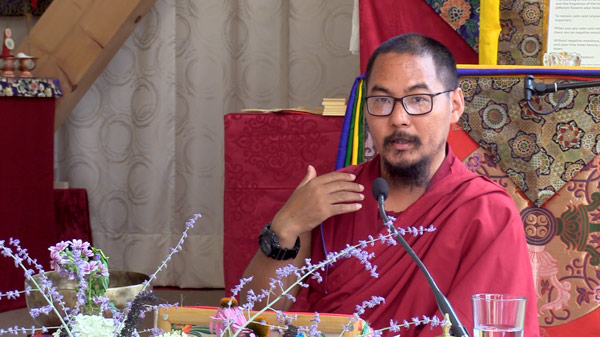
49:48
Now, maybe to make it a little bit more clear,
the first one is a little bit easier. For example, you know, we experience that everything depends on the causing conditions, right? If you look at our inner emotions, if you look at outer phenomena such as this flower. So,
first one, when we say that everything is dependent on the cause and condition, it means that, for example, this flower is also came from cause and conditions. And everything, you know, we have a cup of tea, this also comes from cause and conditions. All the environments, you won't find anything that doesn't have a cause and conditions. Maybe some we know, some we won't be able to know, but there is a cause and conditions. So nothing exists without cause and conditions.
Now, the second thing is a little bit difficult because we cannot really see by our own eye or something directly, perceived directly. For example,
so, for example, this flower here, this flower has certain cause and condition. So it's not random, yeah? Because if you put different seeds, and then you cannot grow the different flower. So, for example, let's say, if you want to make a tea, cup of tea, then we know that tea is a result, and what is the cause and condition for that tea? Yeah, so we put certain kind of water, tea, milk, something like that. So when you go through the proper process and put the water, tea, and milk, it will always turn into the tea. It's not random that sometimes it's tea, sometimes it's wine, or not like that, yeah?
And also when you put the seeds of apple, it will always grow as an apple. So that means the result and cause has a certain relationship, it is not random.
And that's why exactly all our life it depends on the dependent law. That's why it's working very well. For example, let's say we are all here, happening in this class, because we all believe in dependent law, yeah? We say, oh, you come here, you say, and while you are driving, there's a certain rules in your car that if you push this, and accelerate, yes, it will go forward. If you push the brake, it will stop. And then imagine that it's random, yeah? You cannot use your car. And even if, say, the Gomde is here, but it's random, then you come here, Gomde is on the other side, it also doesn't work. And then you push the gas, and instead of going car forward, if you sometimes go backward, sometimes go forward, then it's very difficult. And similarly, we have, so, when you get hungry, there's no doubt that you immediately go to the kitchen, yeah? Why? Instead of bathroom. If they randomly, then, you know, it's difficult, because, so you know that there's a kitchen, and kitchen, there's a food. And then also, immediately, in the breakfast, you know what makes the breakfast, yeah? That's why you put all these cause and conditions. And sometimes you make a tea, then suddenly turns into something else that will be very difficult to make tea. Even to turn on the gas will be a task, like sometimes comes fire, and sometimes comes water.
But it's not like that. So everything's working properly, because of law of this dependent origination. And that's why everything's working very properly, from our cell phones. Also, let's say we are working, yeah? We have job. It's working very well, because of dependent origination. And imagine that your boss says that, okay, you come here, work, but at the end you might get salary or punishment. Probably we won't work.
And imagine that you say you buy a ticket, and then airplane and ticket say yeah, yeah, you can buy a ticket, but we cannot guarantee that we might go back to your country, or maybe you might end up in Afghanistan or something like that, you know. But it's not like that.
So everything is cause, and cause and conditions are not random, and because of that, four noble truth works very well.
This is suffering, this is cause of suffering. And this is a path, so if you practice a path, since they are not random, if you practice a path, it is possible to eliminate the cause of suffering and reach the enlightenment. So it becomes more logical. Of course, we don't know everything, but based on whatever we understand or we experience, the rule or law of dependent origination is working, so we can use the same logic to the things right now out of our experience.
So, it's important to have faith and understanding in the law of dependent origination especially the four noble truths, if you are Buddhist.
Having some kind of confidence that, yes, I believe that suffering comes from the truth of origin, yes, I believe that if I apply the path, it is possible to eliminate the cause of suffering. When you have certain kind of confidence, then your practice becomes very good.
Now, this is general view of Buddhist, believing in tendrel, dependent origination.
Now, if you go a little bit deeper, becoming a Buddhist, according to the view, and Buddha said that you have to have a view of four seals. It's called the four seals. It means that Buddha kind of stamped and saying that if you have these four views, then you are real Buddhist.
Otherwise you are almost like a wannabe Buddhist.
So, the first one is that on top of this, based on this view of dependent, the four seals are called, first one, believing that all the compounded phenomena are impermanent. So, understanding and accepting impermanent is the first one.
And second one is called that all the defiled emotions are subject to be suffering. That means as long as it is defiled by duality, it is subject to be suffering.
The third one is all the phenomena are devoid of self and empty.
And the fourth is nirvana or the enlightenment is beyond conceptual thoughts. So, these are called the four seals. And of course, now we are almost talking about the result Buddhist, yeah? It is almost a result. But this is something that you should really, how to say, aspire to become something within that kind of view.
Now, the first one is easy, so to speak, and then it becomes more and more difficult to understand. And maybe many times we say that, well, I know impermanent and that's not a big deal, yeah?
But actually,
impermanent plays a very big role in our life. Although we don't know much about that. For example, whether you become happy, whether you become sad, whether you become anxious, whether you become a completely rigid person, it really depends a lot on how much understanding and the experience of impermanence you have.
And Buddha says in many sutras that impermanence is important. You should remember, and even in his last words, before he passed away, he said that don't forget that impermanence is very important.
Now, for example, let's say, when you have a strong attachment to something,
the less understanding, impermanent you have, the more attachment will be. Yeah? Because you take this, oh, this is always will be like this, always I want it to be like this, unchanging. And then really this attachment or desire will become very strong. Similarly, when your aversion or anger arises, the more you believe the permanent, the stronger your anger will be. The more you have understanding of impermanent, the lesser the anger it will be. So it plays a big role in our daily life, especially how it triggers our disturbing emotion. Of course, it happens, how to say, without knowing it. Yeah? For example,
if you look at this flower emotionally, and then yes, this flower is so beautiful, but immediately after that there will be hope and fear. I wish it stays one day longer, or you know, it will be followed by lots of sufferings.
The moment you understand this flower is compounded phenomena, then you will enjoy the flower, but this flower won't become a cause of suffering. Because when the flower changes, you accept it instead of trying to make it stay longer and try to do that.
And of course we all,
we saw, we experienced, we heard that we are born, we will be getting old and we will die, but we really don't want to listen, see any kind of those things.
Especially like in death, it's almost like don't want to talk, don't want to listen. We try to avoid the death, this is one of the stupidest things we can do. And avoiding to become old.
Well, you're playing a game with impermanence that you will never, never win.
So the more you try to avoid the impermanence, the more you will suffer. The more you accept, it becomes, actually happiness.
For example, the moment I expect this flower to live longer, already my suffering has started. But the moment I understand this flower's compounded phenomena, it's impermanent. I just enjoy the present moment and I really don't make, it doesn't really matter much what happens after that. And many times we cannot enjoy the present moment because of strong, permanent is coming up and expecting something that is not reality.
For example,
all of us, you know, when somebody asks how old are you, we really hesitate to say what is your age here. Because at least we want to try to look a little bit younger and try to cover up the... I think if you look older than your age, probably you won't hesitate to say it. Yeah? You want to tell the person that actually I'm not that older, although I look a little bit older. But if you look much, much more younger than what you look, where you really are, then you really don't want to tell anyone.
So these small, small things that not understanding and not being... And actually there's nothing wrong with getting old, yeah? But somehow we take the getting old as something bad, but it's not. This is natural process of compounded phenomena. You don't have to feel bad just because you have a grey hair, yeah? That's it. That's very natural. Nothing unnatural is happening with you.
That's why, I think the cosmetic business is one of the biggest businesses in the world. Because everyone is trying best to fight with the impermanence.
And the more you try hard, the more it becomes difficult. Not only that, relationship is also a big problem because you don't understand impermanence.
And when you don't understand impermanence, then you have too much expectation towards each other. And that really ruins our relationships.
So once you understand impermanence, then everything becomes acceptable. Because once you accept, story finished.
Once you try to deny impermanence, then story starts. Oh no, because of you, you did that, so many blaming games come up there.
So the first among the four seal is really contemplating and understanding that whether it is something desirable or something undesirable or something even valuable. And also, for example, sometimes when we get super happy, there's also nothing to be too excited because it's going to be changed. Right? It's impermanent. You can enjoy it, but then you have to understand that it's not going to last like that.
And also sometimes when you're super sad or you go through lots of difficult times and we think that, oh, this will be ever, but that's not true. It's also going to be changed. It's a condition. So there's not much reason to be too sad. It's going to be changed. You will get used to it anyway, after a few times. So the important thing is when you don't understand impermanent, whether you become over-excited or over-disappointed, which is not reality.
And then you become over-arrogant or over-depressed.
But actually life is not too high, not too low. It's kind of like in the middle. It depends on what is your view, how you take it. So once you understand the impermanent and when you try to practice a little bit of impermanent,
putting that understanding into experience, life becomes a kind of like a middle way. Everything is acceptable. And then you gain this strong confidence, well, I will be able to take it. Otherwise there's too much hope and too much fear that there's no confidence.
And then if you are attached to something, it is also going to be changed. There's no reason too much to be attached. And if you really have aversion to someone, it's also going to be changed. There's no reason to be changed, to be so strong. Because sometimes we feel that if somebody is good to us, he is good to me, he will be good to me. You always want this person to be good to you. The more you have that feeling, the more attachment comes up. Right? But that's not true. It's also a compounded phenomenon. Things will be changed. Similarly when you get strong anger to someone, the stronger belief you have that he has hurt me before, he is hurting me now, he will be hurting me in the future. This is not reality where your mind will perceive something like that and then your anger becomes very very strong. Because not understanding the object is impermanent, it's going to be changed.
And the second one is maybe a little bit difficult. It means that it goes quite a high, deeper level. Right now we understand that okay, anger is not good. Yeah? Because I understand when I get angry, it brings me suffering. But we don't understand that the anger actually is triggered by the duality mind. So we don't understand that actually the duality is also cause of suffering. So when you understand that duality is cause of suffering, then you don't just want to get rid of the gross kind of obscuration which is anger. But also you want to really free from these very subtle aspects of obscurations such as duality. And this is called all the defiled or sometimes we call all the emotions are subject to be suffering or pain.
Now the third one is all the phenomenas are devoid of self and empty is...
It's like this. We are going to the point here. So what is the real source of problem? So from the Buddhist point of view, when I say I want to be happy, yesterday as I mentioned.
So or I am sad, I am suffering. So if you look at, happiness also is rooted into this I and suffering is also rooted into this I. Especially,
you can say almost in terms of our outer and inner suffering. 90% of our suffering comes from this soul, you know, inside. And then, let's say, if you just take out the I, then actually there is not much left.
If there is no I, then how you can say want?
And if there is no I, you cannot say am suffering.
So that's why Buddha was trying to say that if you get rid out of... Well, normally we can say that we should get rid our suffering and we should attain the happiness. But in reality, you have to go beyond both.
And that's why in the text, it says that.
the clever person...
The clever person who accumulates the positives goes to heaven.
Stupid person who accumulates the negatives and goes to hell. But the wise one goes beyond both. This is our ultimate. But anyway, since this I is the basis of everything and it's really important to understand what it is and what it appears to us and what is its true nature. And according to Buddhists, the true nature of I is that I-less, self-less. And once you understand that, then actually you got the point and anything can be kind of... You know, when you have many, many lights and then they have a main switch, and when you turn off the main switch, everything can be turned off, something like that. So that's why if you read like Prajñāpāramitā or Heart Sutra, Buddha explains in detail one by one.
So now the fourth one is nirvana is beyond concept is trying to tell you that if you think the ultimate reality or nirvana is within the duality, you are still not understanding what is nirvana. So nirvana is something that is beyond conceptual mind thought on duality. So again, it is difficult to explain what is nirvana, but Buddha is trying to say that what you think nirvana is not a nirvana.
At least that's what he is trying to do. So when you have these four kind of seals, of course it starts with the understanding, and then slowly, slowly you have to transform that into the experience, and then slowly it will transform into the realization. And then you really have a Buddhist view. And then everything changes.
Everything becomes acceptable, and everything becomes a path. You know? That's why in reading when we say that, grant me the blessing, may my mind go into the Dharma, and when we say, trülpa yeshé su charwar, grant me the blessings that all my illusions transform into the wisdom. And when you have that kind of realization and view, that's the state that you have.
Yeah, so I think that's...
So what I was trying to say was, if you have a tremendous potential, it's important to recognize.
To define our life, meaning of our life. And we have a positive aspects in our mind, negative aspects in our mind. So when we say, I'm developing this potential, what you are trying to do is that, increasing the quality aspects of our mind, and decreasing the negative aspects of our mind. And to do that the process is, you have to go through conscious mind to the subconscious mind, and through studying contemplation and meditation. And it starts with the understanding, and in understanding must transform into the experience, and then experience will transform into realization. And as a Buddhist, everything starts with the right view, and the first right view is having a trust, and the confident that everything is dependently originated, that everything comes from the cause, and cause and this result has certain relationship, things are not random.
And to becoming more like real Buddhist, according to the view, you have to have understanding and experience of four seals. And when you have that, and you become a real Buddhist with the view, then everything changes.
So always remember that if you want to be happy, you know when you say, I want to be happy, and please try to reduce the I and want. The more you increase I and want, happiness will go far. So if you try to reduce, decrease the I and want, happiness will automatically come towards you. So that's important.
Yeah, I will stop here, and do you have any questions? One or two questions?
When you like to reduce youe ego. Do you use the I want? Is that also mean reducing positive bag of tricks like I want health from this, I want to be respected? How does this.....??? That's a good question.
It is like this. There's two I, duality I and the negative I and positive I. So this non-duality I is you reduce later, not at the beginning level. So from the beginning level, you recognize this negative I and positive I, and then you reduce the negative I and increase the positive I. But eventually, you have to go through this non-duality I as well. At the beginning, you have to start with this, reducing the, for example, I want to be compassionate, that's okay, good. I want to be arrogant, that's not good. Yeah? So you start from that. But ultimately, you have to get rid of it, even though there are two kinds of I.
And in the text, it says that.
hope and fear is not good, but you are allowed to keep certain kind of hope and fear until you reach certain kind of realizations. So that means wanting to be hoping for the positive and fear of negative. Actually, this is hope and fear, yeah? But it's okay to keep it at a certain level. Ultimately, you go beyond that. For example, wanting to be enlightened is also hope, yeah? And fear of being born, let's say fear of negative is also fear, but it's a good hope and good fear. You start from there. Ultimately, you can go beyond both.
If.
If there is a I and I go beyond the I maybe I only..... automatically because I'm kind of not separate. Exactly, yes, yes. That's why in the text, it says that real compassion will only start when you recognize directly the selflessness of yourself, yeah? Until you have self, your compassion is good, but it's not really ultimate one.
So to mark my own question, if I realize the non-self, would I still need the notion of impermanence?
You will have an impermanence on a different level. Like impermanence based on wisdom, not based on emotion like our impermanence. I don't understamd You will have an understanding of... it's like this. Now, for example, our impermanence is that this is me and let's say I'm trying to practice impermanence when some of my friends pass away or something like that, yeah? So I feel very bad. And I will practice my impermanence based on emotion.
Because, oh, he is my friend. He, I, there's a duality and I want him to stay longer with me. These kind of things, we feel bad. So now I experience, I try to practice impermanent thinking that well, I'm also a compounded phenomena. He's also a compounded phenomena. And once you're born, you get old, you separate and that's the nature of compounded phenomena. And everything happens in the duality and conceptual mind. And this is what we practice. But once you realize the selflessness, that you understand that everything is impermanent because everything is emptiness.
Yeah? Maybe it's a little bit difficult to understand. I understand, but I have this vision of emptiness as being the eternity. Yeah, now I think for us it's difficult to imagine impermanent within the emptiness. Because for us it's almost like different. But once you realize, then it's not. It's different. So he will practice impermanent according to the understanding emptiness. We practice impermanent according to understanding that compounded phenomena changes. It's the nature of things. That's a little bit different.
When you talked about the conscious mind and the subconscious mind. It sounded to me that the subconscious mind sometimes is dualistic and sometimes not. Yeah. Subconscious mind is, you can say,
dualistic in the sense that he still believes in something. Right? Wrong. And subconscious mind might seem non-dualistic because he doesn't make differences between right and wrong by himself. It just follows what is right and what's wrong.
So it depends on how you define a dualistic mind. But generally speaking it's still a dualistic mind. Definitely. Because he said through subconscious mind we gain realization. Yeah. So how is this?
So it's like this. When you have this understanding and experience here as you normally you are still in the conscious mind thinking, oh, right and wrong. But conscious mind does not have a realization. You only have an understanding. And when you have the understanding that is transformed into the experience when the realization happens it is always happens in our subconscious mind.
So for example, now when I look at this flower here my subconscious, my conscious mind knows that flower is changes momentarily. It is impermanent. I know it logically. But when I see I react that this flower is permanent because my subconscious mind still strongly believes that flower is permanent unless I destroy it or something like that because it doesn't change its forms or anything like that. So my subconscious mind realization is now is that flower is permanent. It's not convinced that flower is impermanent. Once when I meditate in impermanent and when I send this the message, right message from my understanding to my experience to my subconscious mind and then when I see the flower I see the impermanent at the same time.
So he won't see it as a permanent flower. He will see it as an impermanent flower. Then my reaction to flower will be completely different. I don't expect flower to be like this tomorrow or when the flower gets old I don't get sad because I take it as natural process. Now I expect... I believe that it's permanent and I expect it to be like that and tomorrow morning when I come and flower is kind of ruined and I feel like sad or something bad.
So realization whether it is right realization or wrong realization it happens within our subconscious mind.
So the good thing is that subconscious mind cannot have two opposite realization at the same time. So that means once I have realization as impermanent then automatically it will. dispel the belief that my subconscious mind has this as permanent. So for example once I have a realization of compassion and then the anger will be automatically eliminated.
This kind of realization you are talking about like impermanence and compassion is it still on a conceptual level even if it is more subtle?
Mostly when we say conceptual and non-conceptual it really depends on the very... how subtle we are talking about. But generally speaking when you say conceptual you are mostly talking about the conscious mind and when you are talking about the realization you are talking about non-conceptual aspects of your experience.
Because your subconscious mind not really compare and think it will just react and only our conscious mind will think and compare. But there is some activity of the mind? Definitely, yeah, definitely. So then you can again even to the subconscious mind you can make a different level of realizations. So comparatively speaking you can say the more subtle becomes a non-conceptual comparatively speaking this might become a conceptual because still duality is there. Certain duality is there certain belief is there from that point of view. But if you compare subconscious mind to the conscious mind then subconscious mind is almost non-conceptual and conscious mind is more conceptual.
Can you talk about enlightened mind? It means that you talk about this unconscious mind or just don't have anybody deal like conscious mind, unconscious it's just... You mean enlightenment? Enlightenment, yeah. No, enlightenment is.
I would say that you start from your conscious mind and then you from understanding experience and you go to realization and where your subconscious mind is completely free from all kind of illusions all that is we can call the enlightenment in that context, yeah. When your subconscious mind is completely free from the the so-called ignorance, yeah and then you can call it enlightenment.
But I think.
again enlightenment is I think a translation of a
probably still is little bit influenced by western culture and western spiritual concepts, I think the word itself. So probably the proper literal would be let's say if you are talking about Buddha, awaken is more I think literal would be more close translation.
In Tibetan we use this Sangyé, let's say Buddha and it has two aspects. the San, the someone who is completely purified all kinds of negativities and the illusions and gyé has a sense of realization so purification and realization so who has complete understanding of everything and when you put this together then they will call Sangyé. So yeah.
Okay, I will stop here do some dedication.
page 19 yeah.
So, I think from yesterday and today what I was trying to say was that what it means to be becoming a Buddhist and what is our responsibility and it's important to recognize potential and know how to develop them properly. And then, of course, you can become a Buddhist starting from ceremonial Buddhist. But it's important to go more deeper that you that you should be Buddhist according to the four seals. View, not just ceremonial Buddhist. And then if you do that, it will bring changes in our life. And you will really look like a Buddhist.
sönam diyi thamché sikpa nyi thopné nyepai dranam phamjé né kyega nachi balap trukpa yi sipai tsolé drowa drölwar shok By this merit, may I attain omniscience, having defeated the enemy, misdeeds. May I free all beings from the ocean of existence with its stormy waves of birth, old age, sickness, and death.
jangchup semchok rinpoché ma kyepa nam kyé gyurchik kyepa nyampa mepa yang gongné gongdu phelwar shok May the supreme and precious mind of enlightenment awaken in those where it has not arisen, where it has arisen, may it never decrease but continue to flourish forevermore.
Okay, thank you.
19:56
Now, maybe to make it a little bit more clear,
the first one is a little bit easier. For example, you know, we experience that everything depends on the causing conditions, right? If you look at our inner emotions, if you look at outer phenomena such as this flower. So,
first one, when we say that everything is dependent on the cause and condition, it means that, for example, this flower is also came from cause and conditions. And everything, you know, we have a cup of tea, this also comes from cause and conditions. All the environments, you won't find anything that doesn't have a cause and conditions. Maybe some we know, some we won't be able to know, but there is a cause and conditions. So nothing exists without cause and conditions.
Now, the second thing is a little bit difficult because we cannot really see by our own eye or something directly, perceived directly. For example,
so, for example, this flower here, this flower has certain cause and condition. So it's not random, yeah? Because if you put different seeds, and then you cannot grow the different flower. So, for example, let's say, if you want to make a tea, cup of tea, then we know that tea is a result, and what is the cause and condition for that tea? Yeah, so we put certain kind of water, tea, milk, something like that. So when you go through the proper process and put the water, tea, and milk, it will always turn into the tea. It's not random that sometimes it's tea, sometimes it's wine, or not like that, yeah?
And also when you put the seeds of apple, it will always grow as an apple. So that means the result and cause has a certain relationship, it is not random.
And that's why exactly all our life it depends on the dependent law. That's why it's working very well. For example, let's say we are all here, happening in this class, because we all believe in dependent law, yeah? We say, oh, you come here, you say, and while you are driving, there's a certain rules in your car that if you push this, and accelerate, yes, it will go forward. If you push the brake, it will stop. And then imagine that it's random, yeah? You cannot use your car. And even if, say, the Gomde is here, but it's random, then you come here, Gomde is on the other side, it also doesn't work. And then you push the gas, and instead of going car forward, if you sometimes go backward, sometimes go forward, then it's very difficult. And similarly, we have, so, when you get hungry, there's no doubt that you immediately go to the kitchen, yeah? Why? Instead of bathroom. If they randomly, then, you know, it's difficult, because, so you know that there's a kitchen, and kitchen, there's a food. And then also, immediately, in the breakfast, you know what makes the breakfast, yeah? That's why you put all these cause and conditions. And sometimes you make a tea, then suddenly turns into something else that will be very difficult to make tea. Even to turn on the gas will be a task, like sometimes comes fire, and sometimes comes water.
But it's not like that. So everything's working properly, because of law of this dependent origination. And that's why everything's working very properly, from our cell phones. Also, let's say we are working, yeah? We have job. It's working very well, because of dependent origination. And imagine that your boss says that, okay, you come here, work, but at the end you might get salary or punishment. Probably we won't work.
And imagine that you say you buy a ticket, and then airplane and ticket say yeah, yeah, you can buy a ticket, but we cannot guarantee that we might go back to your country, or maybe you might end up in Afghanistan or something like that, you know. But it's not like that.
So everything is cause, and cause and conditions are not random, and because of that, four noble truth works very well.
This is suffering, this is cause of suffering. And this is a path, so if you practice a path, since they are not random, if you practice a path, it is possible to eliminate the cause of suffering and reach the enlightenment. So it becomes more logical. Of course, we don't know everything, but based on whatever we understand or we experience, the rule or law of dependent origination is working, so we can use the same logic to the things right now out of our experience.
So, it's important to have faith and understanding in the law of dependent origination especially the four noble truths, if you are Buddhist.
Having some kind of confidence that, yes, I believe that suffering comes from the truth of origin, yes, I believe that if I apply the path, it is possible to eliminate the cause of suffering. When you have certain kind of confidence, then your practice becomes very good.
Now, this is general view of Buddhist, believing in tendrel, dependent origination.
Now, if you go a little bit deeper, becoming a Buddhist, according to the view, and Buddha said that you have to have a view of four seals. It's called the four seals. It means that Buddha kind of stamped and saying that if you have these four views, then you are real Buddhist.
Otherwise you are almost like a wannabe Buddhist.
So, the first one is that on top of this, based on this view of dependent, the four seals are called, first one, believing that all the compounded phenomena are impermanent. So, understanding and accepting impermanent is the first one.
And second one is called that all the defiled emotions are subject to be suffering. That means as long as it is defiled by duality, it is subject to be suffering.
The third one is all the phenomena are devoid of self and empty.
And the fourth is nirvana or the enlightenment is beyond conceptual thoughts. So, these are called the four seals. And of course, now we are almost talking about the result Buddhist, yeah? It is almost a result. But this is something that you should really, how to say, aspire to become something within that kind of view.
Now, the first one is easy, so to speak, and then it becomes more and more difficult to understand. And maybe many times we say that, well, I know impermanent and that's not a big deal, yeah?
But actually,
impermanent plays a very big role in our life. Although we don't know much about that. For example, whether you become happy, whether you become sad, whether you become anxious, whether you become a completely rigid person, it really depends a lot on how much understanding and the experience of impermanence you have.
And Buddha says in many sutras that impermanence is important. You should remember, and even in his last words, before he passed away, he said that don't forget that impermanence is very important.
Now, for example, let's say, when you have a strong attachment to something,
the less understanding, impermanent you have, the more attachment will be. Yeah? Because you take this, oh, this is always will be like this, always I want it to be like this, unchanging. And then really this attachment or desire will become very strong. Similarly, when your aversion or anger arises, the more you believe the permanent, the stronger your anger will be. The more you have understanding of impermanent, the lesser the anger it will be. So it plays a big role in our daily life, especially how it triggers our disturbing emotion. Of course, it happens, how to say, without knowing it. Yeah? For example,
if you look at this flower emotionally, and then yes, this flower is so beautiful, but immediately after that there will be hope and fear. I wish it stays one day longer, or you know, it will be followed by lots of sufferings.
The moment you understand this flower is compounded phenomena, then you will enjoy the flower, but this flower won't become a cause of suffering. Because when the flower changes, you accept it instead of trying to make it stay longer and try to do that.
And of course we all,
we saw, we experienced, we heard that we are born, we will be getting old and we will die, but we really don't want to listen, see any kind of those things.
Especially like in death, it's almost like don't want to talk, don't want to listen. We try to avoid the death, this is one of the stupidest things we can do. And avoiding to become old.
Well, you're playing a game with impermanence that you will never, never win.
So the more you try to avoid the impermanence, the more you will suffer. The more you accept, it becomes, actually happiness.
For example, the moment I expect this flower to live longer, already my suffering has started. But the moment I understand this flower's compounded phenomena, it's impermanent. I just enjoy the present moment and I really don't make, it doesn't really matter much what happens after that. And many times we cannot enjoy the present moment because of strong, permanent is coming up and expecting something that is not reality.
For example,
all of us, you know, when somebody asks how old are you, we really hesitate to say what is your age here. Because at least we want to try to look a little bit younger and try to cover up the... I think if you look older than your age, probably you won't hesitate to say it. Yeah? You want to tell the person that actually I'm not that older, although I look a little bit older. But if you look much, much more younger than what you look, where you really are, then you really don't want to tell anyone.
So these small, small things that not understanding and not being... And actually there's nothing wrong with getting old, yeah? But somehow we take the getting old as something bad, but it's not. This is natural process of compounded phenomena. You don't have to feel bad just because you have a grey hair, yeah? That's it. That's very natural. Nothing unnatural is happening with you.
That's why, I think the cosmetic business is one of the biggest businesses in the world. Because everyone is trying best to fight with the impermanence.
And the more you try hard, the more it becomes difficult. Not only that, relationship is also a big problem because you don't understand impermanence.
And when you don't understand impermanence, then you have too much expectation towards each other. And that really ruins our relationships.
So once you understand impermanence, then everything becomes acceptable. Because once you accept, story finished.
Once you try to deny impermanence, then story starts. Oh no, because of you, you did that, so many blaming games come up there.
So the first among the four seal is really contemplating and understanding that whether it is something desirable or something undesirable or something even valuable. And also, for example, sometimes when we get super happy, there's also nothing to be too excited because it's going to be changed. Right? It's impermanent. You can enjoy it, but then you have to understand that it's not going to last like that.
And also sometimes when you're super sad or you go through lots of difficult times and we think that, oh, this will be ever, but that's not true. It's also going to be changed. It's a condition. So there's not much reason to be too sad. It's going to be changed. You will get used to it anyway, after a few times. So the important thing is when you don't understand impermanent, whether you become over-excited or over-disappointed, which is not reality.
And then you become over-arrogant or over-depressed.
But actually life is not too high, not too low. It's kind of like in the middle. It depends on what is your view, how you take it. So once you understand the impermanent and when you try to practice a little bit of impermanent,
putting that understanding into experience, life becomes a kind of like a middle way. Everything is acceptable. And then you gain this strong confidence, well, I will be able to take it. Otherwise there's too much hope and too much fear that there's no confidence.
And then if you are attached to something, it is also going to be changed. There's no reason too much to be attached. And if you really have aversion to someone, it's also going to be changed. There's no reason to be changed, to be so strong. Because sometimes we feel that if somebody is good to us, he is good to me, he will be good to me. You always want this person to be good to you. The more you have that feeling, the more attachment comes up. Right? But that's not true. It's also a compounded phenomenon. Things will be changed. Similarly when you get strong anger to someone, the stronger belief you have that he has hurt me before, he is hurting me now, he will be hurting me in the future. This is not reality where your mind will perceive something like that and then your anger becomes very very strong. Because not understanding the object is impermanent, it's going to be changed.
And the second one is maybe a little bit difficult. It means that it goes quite a high, deeper level. Right now we understand that okay, anger is not good. Yeah? Because I understand when I get angry, it brings me suffering. But we don't understand that the anger actually is triggered by the duality mind. So we don't understand that actually the duality is also cause of suffering. So when you understand that duality is cause of suffering, then you don't just want to get rid of the gross kind of obscuration which is anger. But also you want to really free from these very subtle aspects of obscurations such as duality. And this is called all the defiled or sometimes we call all the emotions are subject to be suffering or pain.
Now the third one is all the phenomenas are devoid of self and empty is...
It's like this. We are going to the point here. So what is the real source of problem? So from the Buddhist point of view, when I say I want to be happy, yesterday as I mentioned.
So or I am sad, I am suffering. So if you look at, happiness also is rooted into this I and suffering is also rooted into this I. Especially,
you can say almost in terms of our outer and inner suffering. 90% of our suffering comes from this soul, you know, inside. And then, let's say, if you just take out the I, then actually there is not much left.
If there is no I, then how you can say want?
And if there is no I, you cannot say am suffering.
So that's why Buddha was trying to say that if you get rid out of... Well, normally we can say that we should get rid our suffering and we should attain the happiness. But in reality, you have to go beyond both.
And that's why in the text, it says that.
the clever person...
The clever person who accumulates the positives goes to heaven.
Stupid person who accumulates the negatives and goes to hell. But the wise one goes beyond both. This is our ultimate. But anyway, since this I is the basis of everything and it's really important to understand what it is and what it appears to us and what is its true nature. And according to Buddhists, the true nature of I is that I-less, self-less. And once you understand that, then actually you got the point and anything can be kind of... You know, when you have many, many lights and then they have a main switch, and when you turn off the main switch, everything can be turned off, something like that. So that's why if you read like Prajñāpāramitā or Heart Sutra, Buddha explains in detail one by one.
So now the fourth one is nirvana is beyond concept is trying to tell you that if you think the ultimate reality or nirvana is within the duality, you are still not understanding what is nirvana. So nirvana is something that is beyond conceptual mind thought on duality. So again, it is difficult to explain what is nirvana, but Buddha is trying to say that what you think nirvana is not a nirvana.
At least that's what he is trying to do. So when you have these four kind of seals, of course it starts with the understanding, and then slowly, slowly you have to transform that into the experience, and then slowly it will transform into the realization. And then you really have a Buddhist view. And then everything changes.
Everything becomes acceptable, and everything becomes a path. You know? That's why in reading when we say that, grant me the blessing, may my mind go into the Dharma, and when we say, trülpa yeshé su charwar, grant me the blessings that all my illusions transform into the wisdom. And when you have that kind of realization and view, that's the state that you have.
Yeah, so I think that's...
So what I was trying to say was, if you have a tremendous potential, it's important to recognize.
To define our life, meaning of our life. And we have a positive aspects in our mind, negative aspects in our mind. So when we say, I'm developing this potential, what you are trying to do is that, increasing the quality aspects of our mind, and decreasing the negative aspects of our mind. And to do that the process is, you have to go through conscious mind to the subconscious mind, and through studying contemplation and meditation. And it starts with the understanding, and in understanding must transform into the experience, and then experience will transform into realization. And as a Buddhist, everything starts with the right view, and the first right view is having a trust, and the confident that everything is dependently originated, that everything comes from the cause, and cause and this result has certain relationship, things are not random.
And to becoming more like real Buddhist, according to the view, you have to have understanding and experience of four seals. And when you have that, and you become a real Buddhist with the view, then everything changes.
So always remember that if you want to be happy, you know when you say, I want to be happy, and please try to reduce the I and want. The more you increase I and want, happiness will go far. So if you try to reduce, decrease the I and want, happiness will automatically come towards you. So that's important.
Yeah, I will stop here, and do you have any questions? One or two questions?
When you like to reduce youe ego. Do you use the I want? Is that also mean reducing positive bag of tricks like I want health from this, I want to be respected? How does this.....??? That's a good question.
It is like this. There's two I, duality I and the negative I and positive I. So this non-duality I is you reduce later, not at the beginning level. So from the beginning level, you recognize this negative I and positive I, and then you reduce the negative I and increase the positive I. But eventually, you have to go through this non-duality I as well. At the beginning, you have to start with this, reducing the, for example, I want to be compassionate, that's okay, good. I want to be arrogant, that's not good. Yeah? So you start from that. But ultimately, you have to get rid of it, even though there are two kinds of I.
And in the text, it says that.
hope and fear is not good, but you are allowed to keep certain kind of hope and fear until you reach certain kind of realizations. So that means wanting to be hoping for the positive and fear of negative. Actually, this is hope and fear, yeah? But it's okay to keep it at a certain level. Ultimately, you go beyond that. For example, wanting to be enlightened is also hope, yeah? And fear of being born, let's say fear of negative is also fear, but it's a good hope and good fear. You start from there. Ultimately, you can go beyond both.
If.
If there is a I and I go beyond the I maybe I only..... automatically because I'm kind of not separate. Exactly, yes, yes. That's why in the text, it says that real compassion will only start when you recognize directly the selflessness of yourself, yeah? Until you have self, your compassion is good, but it's not really ultimate one.
So to mark my own question, if I realize the non-self, would I still need the notion of impermanence?
You will have an impermanence on a different level. Like impermanence based on wisdom, not based on emotion like our impermanence. I don't understamd You will have an understanding of... it's like this. Now, for example, our impermanence is that this is me and let's say I'm trying to practice impermanence when some of my friends pass away or something like that, yeah? So I feel very bad. And I will practice my impermanence based on emotion.
Because, oh, he is my friend. He, I, there's a duality and I want him to stay longer with me. These kind of things, we feel bad. So now I experience, I try to practice impermanent thinking that well, I'm also a compounded phenomena. He's also a compounded phenomena. And once you're born, you get old, you separate and that's the nature of compounded phenomena. And everything happens in the duality and conceptual mind. And this is what we practice. But once you realize the selflessness, that you understand that everything is impermanent because everything is emptiness.
Yeah? Maybe it's a little bit difficult to understand. I understand, but I have this vision of emptiness as being the eternity. Yeah, now I think for us it's difficult to imagine impermanent within the emptiness. Because for us it's almost like different. But once you realize, then it's not. It's different. So he will practice impermanent according to the understanding emptiness. We practice impermanent according to understanding that compounded phenomena changes. It's the nature of things. That's a little bit different.
When you talked about the conscious mind and the subconscious mind. It sounded to me that the subconscious mind sometimes is dualistic and sometimes not. Yeah. Subconscious mind is, you can say,
dualistic in the sense that he still believes in something. Right? Wrong. And subconscious mind might seem non-dualistic because he doesn't make differences between right and wrong by himself. It just follows what is right and what's wrong.
So it depends on how you define a dualistic mind. But generally speaking it's still a dualistic mind. Definitely. Because he said through subconscious mind we gain realization. Yeah. So how is this?
So it's like this. When you have this understanding and experience here as you normally you are still in the conscious mind thinking, oh, right and wrong. But conscious mind does not have a realization. You only have an understanding. And when you have the understanding that is transformed into the experience when the realization happens it is always happens in our subconscious mind.
So for example, now when I look at this flower here my subconscious, my conscious mind knows that flower is changes momentarily. It is impermanent. I know it logically. But when I see I react that this flower is permanent because my subconscious mind still strongly believes that flower is permanent unless I destroy it or something like that because it doesn't change its forms or anything like that. So my subconscious mind realization is now is that flower is permanent. It's not convinced that flower is impermanent. Once when I meditate in impermanent and when I send this the message, right message from my understanding to my experience to my subconscious mind and then when I see the flower I see the impermanent at the same time.
So he won't see it as a permanent flower. He will see it as an impermanent flower. Then my reaction to flower will be completely different. I don't expect flower to be like this tomorrow or when the flower gets old I don't get sad because I take it as natural process. Now I expect... I believe that it's permanent and I expect it to be like that and tomorrow morning when I come and flower is kind of ruined and I feel like sad or something bad.
So realization whether it is right realization or wrong realization it happens within our subconscious mind.
So the good thing is that subconscious mind cannot have two opposite realization at the same time. So that means once I have realization as impermanent then automatically it will. dispel the belief that my subconscious mind has this as permanent. So for example once I have a realization of compassion and then the anger will be automatically eliminated.
This kind of realization you are talking about like impermanence and compassion is it still on a conceptual level even if it is more subtle?
Mostly when we say conceptual and non-conceptual it really depends on the very... how subtle we are talking about. But generally speaking when you say conceptual you are mostly talking about the conscious mind and when you are talking about the realization you are talking about non-conceptual aspects of your experience.
Because your subconscious mind not really compare and think it will just react and only our conscious mind will think and compare. But there is some activity of the mind? Definitely, yeah, definitely. So then you can again even to the subconscious mind you can make a different level of realizations. So comparatively speaking you can say the more subtle becomes a non-conceptual comparatively speaking this might become a conceptual because still duality is there. Certain duality is there certain belief is there from that point of view. But if you compare subconscious mind to the conscious mind then subconscious mind is almost non-conceptual and conscious mind is more conceptual.
Can you talk about enlightened mind? It means that you talk about this unconscious mind or just don't have anybody deal like conscious mind, unconscious it's just... You mean enlightenment? Enlightenment, yeah. No, enlightenment is.
I would say that you start from your conscious mind and then you from understanding experience and you go to realization and where your subconscious mind is completely free from all kind of illusions all that is we can call the enlightenment in that context, yeah. When your subconscious mind is completely free from the the so-called ignorance, yeah and then you can call it enlightenment.
But I think.
again enlightenment is I think a translation of a
probably still is little bit influenced by western culture and western spiritual concepts, I think the word itself. So probably the proper literal would be let's say if you are talking about Buddha, awaken is more I think literal would be more close translation.
In Tibetan we use this Sangyé, let's say Buddha and it has two aspects. the San, the someone who is completely purified all kinds of negativities and the illusions and gyé has a sense of realization so purification and realization so who has complete understanding of everything and when you put this together then they will call Sangyé. So yeah.
Okay, I will stop here do some dedication.
page 19 yeah.
So, I think from yesterday and today what I was trying to say was that what it means to be becoming a Buddhist and what is our responsibility and it's important to recognize potential and know how to develop them properly. And then, of course, you can become a Buddhist starting from ceremonial Buddhist. But it's important to go more deeper that you that you should be Buddhist according to the four seals. View, not just ceremonial Buddhist. And then if you do that, it will bring changes in our life. And you will really look like a Buddhist.
sönam diyi thamché sikpa nyi thopné nyepai dranam phamjé né kyega nachi balap trukpa yi sipai tsolé drowa drölwar shok By this merit, may I attain omniscience, having defeated the enemy, misdeeds. May I free all beings from the ocean of existence with its stormy waves of birth, old age, sickness, and death.
jangchup semchok rinpoché ma kyepa nam kyé gyurchik kyepa nyampa mepa yang gongné gongdu phelwar shok May the supreme and precious mind of enlightenment awaken in those where it has not arisen, where it has arisen, may it never decrease but continue to flourish forevermore.
Okay, thank you.
the first one is a little bit easier. For example, you know, we experience that everything depends on the causing conditions, right? If you look at our inner emotions, if you look at outer phenomena such as this flower. So,
first one, when we say that everything is dependent on the cause and condition, it means that, for example, this flower is also came from cause and conditions. And everything, you know, we have a cup of tea, this also comes from cause and conditions. All the environments, you won't find anything that doesn't have a cause and conditions. Maybe some we know, some we won't be able to know, but there is a cause and conditions. So nothing exists without cause and conditions.
Now, the second thing is a little bit difficult because we cannot really see by our own eye or something directly, perceived directly. For example,
so, for example, this flower here, this flower has certain cause and condition. So it's not random, yeah? Because if you put different seeds, and then you cannot grow the different flower. So, for example, let's say, if you want to make a tea, cup of tea, then we know that tea is a result, and what is the cause and condition for that tea? Yeah, so we put certain kind of water, tea, milk, something like that. So when you go through the proper process and put the water, tea, and milk, it will always turn into the tea. It's not random that sometimes it's tea, sometimes it's wine, or not like that, yeah?
And also when you put the seeds of apple, it will always grow as an apple. So that means the result and cause has a certain relationship, it is not random.
And that's why exactly all our life it depends on the dependent law. That's why it's working very well. For example, let's say we are all here, happening in this class, because we all believe in dependent law, yeah? We say, oh, you come here, you say, and while you are driving, there's a certain rules in your car that if you push this, and accelerate, yes, it will go forward. If you push the brake, it will stop. And then imagine that it's random, yeah? You cannot use your car. And even if, say, the Gomde is here, but it's random, then you come here, Gomde is on the other side, it also doesn't work. And then you push the gas, and instead of going car forward, if you sometimes go backward, sometimes go forward, then it's very difficult. And similarly, we have, so, when you get hungry, there's no doubt that you immediately go to the kitchen, yeah? Why? Instead of bathroom. If they randomly, then, you know, it's difficult, because, so you know that there's a kitchen, and kitchen, there's a food. And then also, immediately, in the breakfast, you know what makes the breakfast, yeah? That's why you put all these cause and conditions. And sometimes you make a tea, then suddenly turns into something else that will be very difficult to make tea. Even to turn on the gas will be a task, like sometimes comes fire, and sometimes comes water.
But it's not like that. So everything's working properly, because of law of this dependent origination. And that's why everything's working very properly, from our cell phones. Also, let's say we are working, yeah? We have job. It's working very well, because of dependent origination. And imagine that your boss says that, okay, you come here, work, but at the end you might get salary or punishment. Probably we won't work.
And imagine that you say you buy a ticket, and then airplane and ticket say yeah, yeah, you can buy a ticket, but we cannot guarantee that we might go back to your country, or maybe you might end up in Afghanistan or something like that, you know. But it's not like that.
So everything is cause, and cause and conditions are not random, and because of that, four noble truth works very well.
This is suffering, this is cause of suffering. And this is a path, so if you practice a path, since they are not random, if you practice a path, it is possible to eliminate the cause of suffering and reach the enlightenment. So it becomes more logical. Of course, we don't know everything, but based on whatever we understand or we experience, the rule or law of dependent origination is working, so we can use the same logic to the things right now out of our experience.
So, it's important to have faith and understanding in the law of dependent origination especially the four noble truths, if you are Buddhist.
Having some kind of confidence that, yes, I believe that suffering comes from the truth of origin, yes, I believe that if I apply the path, it is possible to eliminate the cause of suffering. When you have certain kind of confidence, then your practice becomes very good.
Now, this is general view of Buddhist, believing in tendrel, dependent origination.
Now, if you go a little bit deeper, becoming a Buddhist, according to the view, and Buddha said that you have to have a view of four seals. It's called the four seals. It means that Buddha kind of stamped and saying that if you have these four views, then you are real Buddhist.
Otherwise you are almost like a wannabe Buddhist.
So, the first one is that on top of this, based on this view of dependent, the four seals are called, first one, believing that all the compounded phenomena are impermanent. So, understanding and accepting impermanent is the first one.
And second one is called that all the defiled emotions are subject to be suffering. That means as long as it is defiled by duality, it is subject to be suffering.
The third one is all the phenomena are devoid of self and empty.
And the fourth is nirvana or the enlightenment is beyond conceptual thoughts. So, these are called the four seals. And of course, now we are almost talking about the result Buddhist, yeah? It is almost a result. But this is something that you should really, how to say, aspire to become something within that kind of view.
Now, the first one is easy, so to speak, and then it becomes more and more difficult to understand. And maybe many times we say that, well, I know impermanent and that's not a big deal, yeah?
But actually,
impermanent plays a very big role in our life. Although we don't know much about that. For example, whether you become happy, whether you become sad, whether you become anxious, whether you become a completely rigid person, it really depends a lot on how much understanding and the experience of impermanence you have.
And Buddha says in many sutras that impermanence is important. You should remember, and even in his last words, before he passed away, he said that don't forget that impermanence is very important.
Now, for example, let's say, when you have a strong attachment to something,
the less understanding, impermanent you have, the more attachment will be. Yeah? Because you take this, oh, this is always will be like this, always I want it to be like this, unchanging. And then really this attachment or desire will become very strong. Similarly, when your aversion or anger arises, the more you believe the permanent, the stronger your anger will be. The more you have understanding of impermanent, the lesser the anger it will be. So it plays a big role in our daily life, especially how it triggers our disturbing emotion. Of course, it happens, how to say, without knowing it. Yeah? For example,
if you look at this flower emotionally, and then yes, this flower is so beautiful, but immediately after that there will be hope and fear. I wish it stays one day longer, or you know, it will be followed by lots of sufferings.
The moment you understand this flower is compounded phenomena, then you will enjoy the flower, but this flower won't become a cause of suffering. Because when the flower changes, you accept it instead of trying to make it stay longer and try to do that.
And of course we all,
we saw, we experienced, we heard that we are born, we will be getting old and we will die, but we really don't want to listen, see any kind of those things.
Especially like in death, it's almost like don't want to talk, don't want to listen. We try to avoid the death, this is one of the stupidest things we can do. And avoiding to become old.
Well, you're playing a game with impermanence that you will never, never win.
So the more you try to avoid the impermanence, the more you will suffer. The more you accept, it becomes, actually happiness.
For example, the moment I expect this flower to live longer, already my suffering has started. But the moment I understand this flower's compounded phenomena, it's impermanent. I just enjoy the present moment and I really don't make, it doesn't really matter much what happens after that. And many times we cannot enjoy the present moment because of strong, permanent is coming up and expecting something that is not reality.
For example,
all of us, you know, when somebody asks how old are you, we really hesitate to say what is your age here. Because at least we want to try to look a little bit younger and try to cover up the... I think if you look older than your age, probably you won't hesitate to say it. Yeah? You want to tell the person that actually I'm not that older, although I look a little bit older. But if you look much, much more younger than what you look, where you really are, then you really don't want to tell anyone.
So these small, small things that not understanding and not being... And actually there's nothing wrong with getting old, yeah? But somehow we take the getting old as something bad, but it's not. This is natural process of compounded phenomena. You don't have to feel bad just because you have a grey hair, yeah? That's it. That's very natural. Nothing unnatural is happening with you.
That's why, I think the cosmetic business is one of the biggest businesses in the world. Because everyone is trying best to fight with the impermanence.
And the more you try hard, the more it becomes difficult. Not only that, relationship is also a big problem because you don't understand impermanence.
And when you don't understand impermanence, then you have too much expectation towards each other. And that really ruins our relationships.
So once you understand impermanence, then everything becomes acceptable. Because once you accept, story finished.
Once you try to deny impermanence, then story starts. Oh no, because of you, you did that, so many blaming games come up there.
So the first among the four seal is really contemplating and understanding that whether it is something desirable or something undesirable or something even valuable. And also, for example, sometimes when we get super happy, there's also nothing to be too excited because it's going to be changed. Right? It's impermanent. You can enjoy it, but then you have to understand that it's not going to last like that.
And also sometimes when you're super sad or you go through lots of difficult times and we think that, oh, this will be ever, but that's not true. It's also going to be changed. It's a condition. So there's not much reason to be too sad. It's going to be changed. You will get used to it anyway, after a few times. So the important thing is when you don't understand impermanent, whether you become over-excited or over-disappointed, which is not reality.
And then you become over-arrogant or over-depressed.
But actually life is not too high, not too low. It's kind of like in the middle. It depends on what is your view, how you take it. So once you understand the impermanent and when you try to practice a little bit of impermanent,
putting that understanding into experience, life becomes a kind of like a middle way. Everything is acceptable. And then you gain this strong confidence, well, I will be able to take it. Otherwise there's too much hope and too much fear that there's no confidence.
And then if you are attached to something, it is also going to be changed. There's no reason too much to be attached. And if you really have aversion to someone, it's also going to be changed. There's no reason to be changed, to be so strong. Because sometimes we feel that if somebody is good to us, he is good to me, he will be good to me. You always want this person to be good to you. The more you have that feeling, the more attachment comes up. Right? But that's not true. It's also a compounded phenomenon. Things will be changed. Similarly when you get strong anger to someone, the stronger belief you have that he has hurt me before, he is hurting me now, he will be hurting me in the future. This is not reality where your mind will perceive something like that and then your anger becomes very very strong. Because not understanding the object is impermanent, it's going to be changed.
And the second one is maybe a little bit difficult. It means that it goes quite a high, deeper level. Right now we understand that okay, anger is not good. Yeah? Because I understand when I get angry, it brings me suffering. But we don't understand that the anger actually is triggered by the duality mind. So we don't understand that actually the duality is also cause of suffering. So when you understand that duality is cause of suffering, then you don't just want to get rid of the gross kind of obscuration which is anger. But also you want to really free from these very subtle aspects of obscurations such as duality. And this is called all the defiled or sometimes we call all the emotions are subject to be suffering or pain.
Now the third one is all the phenomenas are devoid of self and empty is...
It's like this. We are going to the point here. So what is the real source of problem? So from the Buddhist point of view, when I say I want to be happy, yesterday as I mentioned.
So or I am sad, I am suffering. So if you look at, happiness also is rooted into this I and suffering is also rooted into this I. Especially,
you can say almost in terms of our outer and inner suffering. 90% of our suffering comes from this soul, you know, inside. And then, let's say, if you just take out the I, then actually there is not much left.
If there is no I, then how you can say want?
And if there is no I, you cannot say am suffering.
So that's why Buddha was trying to say that if you get rid out of... Well, normally we can say that we should get rid our suffering and we should attain the happiness. But in reality, you have to go beyond both.
And that's why in the text, it says that.
the clever person...
The clever person who accumulates the positives goes to heaven.
Stupid person who accumulates the negatives and goes to hell. But the wise one goes beyond both. This is our ultimate. But anyway, since this I is the basis of everything and it's really important to understand what it is and what it appears to us and what is its true nature. And according to Buddhists, the true nature of I is that I-less, self-less. And once you understand that, then actually you got the point and anything can be kind of... You know, when you have many, many lights and then they have a main switch, and when you turn off the main switch, everything can be turned off, something like that. So that's why if you read like Prajñāpāramitā or Heart Sutra, Buddha explains in detail one by one.
So now the fourth one is nirvana is beyond concept is trying to tell you that if you think the ultimate reality or nirvana is within the duality, you are still not understanding what is nirvana. So nirvana is something that is beyond conceptual mind thought on duality. So again, it is difficult to explain what is nirvana, but Buddha is trying to say that what you think nirvana is not a nirvana.
At least that's what he is trying to do. So when you have these four kind of seals, of course it starts with the understanding, and then slowly, slowly you have to transform that into the experience, and then slowly it will transform into the realization. And then you really have a Buddhist view. And then everything changes.
Everything becomes acceptable, and everything becomes a path. You know? That's why in reading when we say that, grant me the blessing, may my mind go into the Dharma, and when we say, trülpa yeshé su charwar, grant me the blessings that all my illusions transform into the wisdom. And when you have that kind of realization and view, that's the state that you have.
Yeah, so I think that's...
So what I was trying to say was, if you have a tremendous potential, it's important to recognize.
To define our life, meaning of our life. And we have a positive aspects in our mind, negative aspects in our mind. So when we say, I'm developing this potential, what you are trying to do is that, increasing the quality aspects of our mind, and decreasing the negative aspects of our mind. And to do that the process is, you have to go through conscious mind to the subconscious mind, and through studying contemplation and meditation. And it starts with the understanding, and in understanding must transform into the experience, and then experience will transform into realization. And as a Buddhist, everything starts with the right view, and the first right view is having a trust, and the confident that everything is dependently originated, that everything comes from the cause, and cause and this result has certain relationship, things are not random.
And to becoming more like real Buddhist, according to the view, you have to have understanding and experience of four seals. And when you have that, and you become a real Buddhist with the view, then everything changes.
So always remember that if you want to be happy, you know when you say, I want to be happy, and please try to reduce the I and want. The more you increase I and want, happiness will go far. So if you try to reduce, decrease the I and want, happiness will automatically come towards you. So that's important.
Yeah, I will stop here, and do you have any questions? One or two questions?
When you like to reduce youe ego. Do you use the I want? Is that also mean reducing positive bag of tricks like I want health from this, I want to be respected? How does this.....??? That's a good question.
It is like this. There's two I, duality I and the negative I and positive I. So this non-duality I is you reduce later, not at the beginning level. So from the beginning level, you recognize this negative I and positive I, and then you reduce the negative I and increase the positive I. But eventually, you have to go through this non-duality I as well. At the beginning, you have to start with this, reducing the, for example, I want to be compassionate, that's okay, good. I want to be arrogant, that's not good. Yeah? So you start from that. But ultimately, you have to get rid of it, even though there are two kinds of I.
And in the text, it says that.
hope and fear is not good, but you are allowed to keep certain kind of hope and fear until you reach certain kind of realizations. So that means wanting to be hoping for the positive and fear of negative. Actually, this is hope and fear, yeah? But it's okay to keep it at a certain level. Ultimately, you go beyond that. For example, wanting to be enlightened is also hope, yeah? And fear of being born, let's say fear of negative is also fear, but it's a good hope and good fear. You start from there. Ultimately, you can go beyond both.
If.
If there is a I and I go beyond the I maybe I only..... automatically because I'm kind of not separate. Exactly, yes, yes. That's why in the text, it says that real compassion will only start when you recognize directly the selflessness of yourself, yeah? Until you have self, your compassion is good, but it's not really ultimate one.
So to mark my own question, if I realize the non-self, would I still need the notion of impermanence?
You will have an impermanence on a different level. Like impermanence based on wisdom, not based on emotion like our impermanence. I don't understamd You will have an understanding of... it's like this. Now, for example, our impermanence is that this is me and let's say I'm trying to practice impermanence when some of my friends pass away or something like that, yeah? So I feel very bad. And I will practice my impermanence based on emotion.
Because, oh, he is my friend. He, I, there's a duality and I want him to stay longer with me. These kind of things, we feel bad. So now I experience, I try to practice impermanent thinking that well, I'm also a compounded phenomena. He's also a compounded phenomena. And once you're born, you get old, you separate and that's the nature of compounded phenomena. And everything happens in the duality and conceptual mind. And this is what we practice. But once you realize the selflessness, that you understand that everything is impermanent because everything is emptiness.
Yeah? Maybe it's a little bit difficult to understand. I understand, but I have this vision of emptiness as being the eternity. Yeah, now I think for us it's difficult to imagine impermanent within the emptiness. Because for us it's almost like different. But once you realize, then it's not. It's different. So he will practice impermanent according to the understanding emptiness. We practice impermanent according to understanding that compounded phenomena changes. It's the nature of things. That's a little bit different.
When you talked about the conscious mind and the subconscious mind. It sounded to me that the subconscious mind sometimes is dualistic and sometimes not. Yeah. Subconscious mind is, you can say,
dualistic in the sense that he still believes in something. Right? Wrong. And subconscious mind might seem non-dualistic because he doesn't make differences between right and wrong by himself. It just follows what is right and what's wrong.
So it depends on how you define a dualistic mind. But generally speaking it's still a dualistic mind. Definitely. Because he said through subconscious mind we gain realization. Yeah. So how is this?
So it's like this. When you have this understanding and experience here as you normally you are still in the conscious mind thinking, oh, right and wrong. But conscious mind does not have a realization. You only have an understanding. And when you have the understanding that is transformed into the experience when the realization happens it is always happens in our subconscious mind.
So for example, now when I look at this flower here my subconscious, my conscious mind knows that flower is changes momentarily. It is impermanent. I know it logically. But when I see I react that this flower is permanent because my subconscious mind still strongly believes that flower is permanent unless I destroy it or something like that because it doesn't change its forms or anything like that. So my subconscious mind realization is now is that flower is permanent. It's not convinced that flower is impermanent. Once when I meditate in impermanent and when I send this the message, right message from my understanding to my experience to my subconscious mind and then when I see the flower I see the impermanent at the same time.
So he won't see it as a permanent flower. He will see it as an impermanent flower. Then my reaction to flower will be completely different. I don't expect flower to be like this tomorrow or when the flower gets old I don't get sad because I take it as natural process. Now I expect... I believe that it's permanent and I expect it to be like that and tomorrow morning when I come and flower is kind of ruined and I feel like sad or something bad.
So realization whether it is right realization or wrong realization it happens within our subconscious mind.
So the good thing is that subconscious mind cannot have two opposite realization at the same time. So that means once I have realization as impermanent then automatically it will. dispel the belief that my subconscious mind has this as permanent. So for example once I have a realization of compassion and then the anger will be automatically eliminated.
This kind of realization you are talking about like impermanence and compassion is it still on a conceptual level even if it is more subtle?
Mostly when we say conceptual and non-conceptual it really depends on the very... how subtle we are talking about. But generally speaking when you say conceptual you are mostly talking about the conscious mind and when you are talking about the realization you are talking about non-conceptual aspects of your experience.
Because your subconscious mind not really compare and think it will just react and only our conscious mind will think and compare. But there is some activity of the mind? Definitely, yeah, definitely. So then you can again even to the subconscious mind you can make a different level of realizations. So comparatively speaking you can say the more subtle becomes a non-conceptual comparatively speaking this might become a conceptual because still duality is there. Certain duality is there certain belief is there from that point of view. But if you compare subconscious mind to the conscious mind then subconscious mind is almost non-conceptual and conscious mind is more conceptual.
Can you talk about enlightened mind? It means that you talk about this unconscious mind or just don't have anybody deal like conscious mind, unconscious it's just... You mean enlightenment? Enlightenment, yeah. No, enlightenment is.
I would say that you start from your conscious mind and then you from understanding experience and you go to realization and where your subconscious mind is completely free from all kind of illusions all that is we can call the enlightenment in that context, yeah. When your subconscious mind is completely free from the the so-called ignorance, yeah and then you can call it enlightenment.
But I think.
again enlightenment is I think a translation of a
probably still is little bit influenced by western culture and western spiritual concepts, I think the word itself. So probably the proper literal would be let's say if you are talking about Buddha, awaken is more I think literal would be more close translation.
In Tibetan we use this Sangyé, let's say Buddha and it has two aspects. the San, the someone who is completely purified all kinds of negativities and the illusions and gyé has a sense of realization so purification and realization so who has complete understanding of everything and when you put this together then they will call Sangyé. So yeah.
Okay, I will stop here do some dedication.
page 19 yeah.
So, I think from yesterday and today what I was trying to say was that what it means to be becoming a Buddhist and what is our responsibility and it's important to recognize potential and know how to develop them properly. And then, of course, you can become a Buddhist starting from ceremonial Buddhist. But it's important to go more deeper that you that you should be Buddhist according to the four seals. View, not just ceremonial Buddhist. And then if you do that, it will bring changes in our life. And you will really look like a Buddhist.
sönam diyi thamché sikpa nyi thopné nyepai dranam phamjé né kyega nachi balap trukpa yi sipai tsolé drowa drölwar shok By this merit, may I attain omniscience, having defeated the enemy, misdeeds. May I free all beings from the ocean of existence with its stormy waves of birth, old age, sickness, and death.
jangchup semchok rinpoché ma kyepa nam kyé gyurchik kyepa nyampa mepa yang gongné gongdu phelwar shok May the supreme and precious mind of enlightenment awaken in those where it has not arisen, where it has arisen, may it never decrease but continue to flourish forevermore.
Okay, thank you.
