
Video
Audio
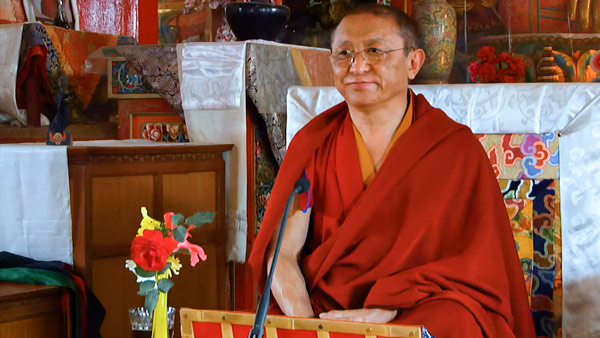
54:27
In the Buddhist tradition,
when we speak about the Buddha,
this refers to the Buddhas of the
past, the Buddha of the present,
the Buddhas of the future, the Buddha of
this present era is the Buddha Shakyamuni.
He turned the wheel of
the Dharma three times.
He taught the Dharma in three turnings of the
wheel, the fundamental turning of the wheel,
the intermediate turning of the wheel, which
is the pāramitā vehicle, and then he turned
the wheel of Dharma a third time, teaching
the teachings of the secret mantra.
And the essence of all of these teachings
given by the Buddha Shakyamuni
is condensed into what we call oral
instructions, or pith instructions.
These were present in the past in India.
The word in Sanskrit is upadeśa, or also in
the songs, the dohas of the great masters.
These were works that sort
of condensed the
essence of the Buddha's teachings
into just a few short words.
Also in Tibet this tradition continued,
in particular with the Kadampa masters.
The works of the Kadampa masters,
without extensive scripture
or reasoning, condensed the words,
the main meaning, the essence,
the pith of the Buddha's
teachings, into just a very few
short words which are easy to understand
and which are very beneficial to the mind.
And so I began to teach one of these texts
last week, and I will continue with
the part that I did not finish
from that text today.
So this text was composed by the Kadampa master Che Gom. And what he said was, the stake of ego clinging is uprooted, uproot the stake of ego clinging. What does this mean? Well, ego clinging is, or grasping to an I, holding on to the I, this is the basis for dualistic clinging. And when we cling to dualism, to self and other, then we end up with attachment, aversion, stupidity, and through those negative emotions we gather karma. And if we do good things, if we gather positive karma, then we are born as a god or a human or a demigod. If we engage in and gather, engage in negative actions and gather negative karma, then we are born as a hell being, a hungry ghost, an animal in one of the lower realms. But basically it is the case that through this type of dualistic clinging, we gather karma, and that karma causes us to take birth again and again throughout the six classes of beings somewhere in saṃsāra. And the thing about that is, wherever we are in saṃsāra, it doesn't matter where, it doesn't matter which of the states, which of the classes of beings, there is suffering everywhere. There is no experience in saṃsāra that is completely free from suffering. And so really, in short, the cause of this suffering is grasping to the self, it is ego clinging. And that is why it says pull up the stake of ego clinging, the metaphor is of a stake which is pounded into the earth, and to pull that up, to uproot the stake of ego clinging.
One begins the practice as a beginner, but through working on and progressing in the practice, one is able to practice in more and more ways to improve one's practice. And so, as it says here, the stake of ego clinging is uprooted. This refers to the first practice, that of a beginner. First we need to pull up the stake of ego clinging, which is the root or the cause of our suffering. But then, from there, the text says, having realized that nothing has a self, your outer and inner desires are exhausted. Dualistic fixation is based on ego clinging. And ego clinging is related to, or it is actually a type of grasping. It is grasping at something as being existent, non-existent, both or neither. In any case, it is a type of grasping. And when we have this type of grasping or clinging, then we are not able to realize the view correctly. And so, as it says here in the text, having realized that nothing has a self, having realized or understood that there is no self in anything, and being free from this type of grasping or clinging, then your outer and inner desires are exhausted. This cutting through the tether of hope and fear is the temporary result. So when we realize nothing to have a self, when we are free from this grasping and clinging to things as having a self, then our desires, our wishes, our hopes, inner and outer, are exhausted. They just run out. And as it says here, this cutting through the tether of hope and fear, this is important here, hope and fear, honestly speaking, every time we have a thought, there is some hope or there is some fear. We are always caught up in hoping for something or having a fear of something. And there is a very coarse level of that, of hope and fear, which brings suffering. But it is also, there are very, very subtle levels of that as well. And it is like a fetter, it is like a tether, it is something that ties us down. And so, as the text says here, cutting through this tether of hope and fear, being completely free from this hope and fear, this is the temporary result, the temporary result.
Having purified awareness within the ground and reached the natural seat of Dharmakāya. So, when we have, the opposite of dualistic ignorance is non-dual wakefulness. And having recognized this non-dual wakefulness, which is opposite of ignorance, which is the opposite of dualistic grasping, this is called the realization of the Dharmakāya, the indivisibility of the Dharmadhātu and wakefulness or wisdom. And when we... And in this state, there is no karma, there are no negative emotions. We are completely free from karma and the negative emotions. This experience is called the Dharmakāya, experiencing the Dharmakāya, realizing the Dharmakāya. And so having purified awareness within the ground, within the ground and reached the natural seat of Dharmakāya, so being completely free from karma and the negative emotions, having achieved the state, which is the unity of, or the indivisibility of wakefulness and the Dharmadhātu, basic space of phenomena, this state is, when we are in this state, then what happens? It says, to act selflessly for the benefit of others is the ultimate result. In this context, having achieved this state, having reached this state, one does not have to put forth effort, but still effortlessly, naturally, spontaneously benefits others or works for the benefit of others. And this type of acting selflessly for the benefit of others, having reached this realization, having reached the natural seat of Dharmakāya, this then is the ultimate result.
Furthermore, with respect to the ultimate, there is no ultimate reference point. This is the ultimate in that temporary context. So here in the context of the ultimate, we're saying that there are basically two aspects. And this is the ultimate in the temporary, in that temporary context that is mentioned. This being so, since that is the case, since the empty ground is empty sound, sound, all sounds are empty sound, form is empty form, the aware... feelings are empty, bliss and awareness, all thoughts are empty awareness. And since that is the case, since the empty ground is empty sound, then do not grasp to empty sound as being real. Don't hold on to or grasp to that as being real.
Since the confused path is a mental imputation, do not negate or affirm that imputation. Path, we talk about the ten bhūmis, the five paths. Basically what is being said here is until one reaches the ultimate state, all of that is called the path. Right? Until one reaches the ultimate understanding, everything before that is the path. And that is just a mental imputation, so don't negate or affirm that imputation. The three resultant kayas are empty words, so do not have hope or fear for those empty words. These words, there's a lot of meaning here. It's very profound, a lot for us to be able to understand here.
So then there is a second text, and it begins, Namo guru, the ten authentic dharmas are as follows. So here ten points will be taught. The first of these, the authentic view of those of lesser capacity is to believe in karmic cause and effect. So believing in karmic cause and effect, believing in past and future lives, believing that these are unfailing, this conviction that karma is unfailing. This is the authentic view, the correct view of those of lesser capacity in the Buddhist tradition.
So believing that when one has good thoughts and does good things, then this will bring beneficial results. And with negative thoughts, one engages in negative acts, body and speech, and that this will bring suffering. The idea that positive thoughts form the basis for positive actions of body and speech. Negative thoughts form the basis for negative actions of body and speech. This is really a fundamental principle taught in the Buddhist tradition, and it really serves actually as the foundation for one's practice. And it's very important then to have conviction in these principles of karmic cause and effect. It's very important to acknowledge that if one does have a positive intention, one will naturally engage in positive acts with one's body and one's speech and will naturally avoid harming others physically or engaging in negative verbal deeds. Because it just, it, everything is based in the mind and if one has a positive mindset, then that will bring positive results. This is really a foundational point and it's very important. Without this as a basis, without a basic conviction, a fundamental conviction in karmic cause and effect, and an understanding of this, then if we try to understand, to realize many high, high profound views and engage in all sorts of really profound practices, without this basis, without this foundation, those other things will not really be so effective actually. Um, this is, is like really the ground or the basis for one's practice. And in that sense it is extremely important to have this type of conviction in karmic cause and effect.
What is the view in the Buddhist tradition? We can say it is the absence of self or emptiness and dependent origination. What is the conduct of Buddhist practice? It is not to harm or hurt anyone. But without a foundation of trust or conviction, belief in karmic cause and effect, if one wishes to realize or thinks one can realize this view of selflessness, of emptiness and dependent origination, actually that's kind of contradictory. Um, it is really important to have the fundamental basis, which is a confidence in karmic cause and effect in past and future lives. This is sort of like the foundation uh, for one's Buddhist practice. And um, we speak about lives, past and future lives. What is this life? Well it is the time while we're breathing. And when we stop breathing, then we speak about the separation, the body and the mind will separate at that point. Why? Because the body is physical matter and that will, that will come to an end. Whereas the mind is consciousness and the continuity of consciousness is not cut. And so having some trust in the process of karmic cause and effect and having trust and belief in past and future lives, this is the foundation, this is the basis for being able to realize the view in the Buddhist tradition and for one's practice. And so, as it says here, this is the authentic view of those of lesser capacity. What this means is that it is absolutely necessary, it is absolutely required, you could say, for a beginning practitioner to have conviction in this uh, system, if you will, of karmic cause and effect. It's so important.
The authentic view of those of middling capacity is to realize all outer and inner phenomena as the four unities. All outer and inner phenomena, all of the phenomena of appearance and existence, all of this one should realize as the four unities. We can express these as appearance and emptiness, and awareness and emptiness.
The authentic view of those of superior capacity is to realize that the act of viewing, the viewer and the realization are indivisible. So the act of viewing, the viewer and the realization, what is realized, understanding this, uh, to, to realize that these are indivisible, this is the authentic view of whom? Of those who have the superior capacity.
The authentic meditation of those of lesser capacity is to rest in the samādhi of one pointed concentration on the meditation object. So, now we are talking about the meditation. How do we meditate? In the context of Mahāmudrā we speak about um, one pointedness. Or we could speak about the practice of uh, samatha, calm abiding, or the development stage. Here we are speaking about resting one pointedly, keeping one's attention focused one pointedly on the meditation object. And this is said to be the authentic meditation of those of lesser capacity.
The authentic meditation of those of middling capacity is to rest in the samādhi of the four unities. So there is a practice one can do of resting in what are called the four unities. The authentic meditation of those of superior capacity is to rest in the state without reference point where there is no active meditation, no meditator, and no experience. So here um, one begins the practice and then progresses. And it is important as a beginner or for a beginner to gain certainty in the view and to gain experience in one's practice. And so here as one progresses, as one gains experience in the practice, certainty in the view and experience in the practice, so one gains this when engaging in the main practice of resting in the natural state, just as it is. In this state there is no act of meditation, no meditator, no experience, no experiencer, no experience that takes place. None of this is actually present when resting naturally within that state. And so this type of practice uh, where one rests in the natural state itself without any reference point, this is the authentic meditation of those of superior capacity.
Next we will talk about the conduct. What is the conduct? The authentic conduct of those of lesser capacity is to guard karmic cause and effect just as one would guard one's own eyes. So we talked already about this, how karmic cause and effect and having trust and conviction in karmic cause and effect is the, is absolutely indispensable for a beginning practitioner or someone who wants to start practicing. This is like the foundation. If you want to build a house without a solid foundation, you're not going to be able to build a house very effectively. And like that, for our practice, the foundation is having conviction in karmic cause and effect. And so as it says here, for this reason, it says here that the conduct of those of lesser capacity is to guard karmic cause and effect just as one would guard one's own eyes. When a little particle of dust gets in your eye, you feel it a lot. When a little particle of dust touches other parts of your body, you don't feel it so much. And, just like that, even if it is one tiny negative thought we shouldn't just think that it's no big deal. Even if we say one small negative word, we shouldn't just think that it's no big deal and not worry about it. We should instead regret. First of all, we should acknowledge that we have said something negative. Second, we should regret that we said it. And then we should make a commitment not to ever say something like that again. Even with the smallest acts, um, it is important to guard our karmic, to guard karmic cause and effect in this way and not to sort of, look down on and think of as not important, even very small acts. And so in this way, this is the authentic conduct of those of lesser capacity. If you want to practice as a beginning practitioner, this is how you should do it.
Just thinking, everything is empty, therefore there is no karmic cause and effect, no past and future lives, it's all just empty. That is a misunderstanding. If you have realized the view of emptiness, okay that's one thing. But if you're just talking about it, if you're just using words, oh it's all empty so none of this is real, that's really a misunderstanding, it's a mistake. And so as it says here, the authentic conduct of those of middling capacity is to conduct oneself as though all phenomena are dreams or illusions. So looking around and saying all of these things appear, but they have no real inherent existence. Forms, sounds, smells, tastes, textures, all of that is apparent to me. It is there, but it's just like a dream. It appears, but it's not real. It's just like an illusion. It appears, but it's not real. To behave in that way, to conduct oneself as if that is really the way things are, this is the authentic conduct of those of middling capacity.
The authentic conduct of those of superior capacity is not to do anything at all. What does this mean? It means that the practice is primarily a mental one. And to avoid accepting and rejecting, taking something up and pushing something else away, to let that go and, to, to not do anything at all, as it says here, to not grasp, to not hold on uh, in any way whatsoever, to be completely free from any type of clinging or grasping. This is the authentic conduct of those of superior capacity.
It's like saying, the view is that there is nothing to see, the conduct is that there is nothing to do, the meditation is that there is nothing to meditate upon, and the result is that there is nothing to obtain. It's basically the same meaning as what is being said here.
The authentic sign of progress of those of superior, middling and lesser capacity is a lessening of ego clinging, lessening of grasping to the self, lessening of the negative emotions, uh, all of them. A lessening of conceptual thought. Conceptual thought here refers to good thoughts, bad thoughts and neutral ones. A lessening of all of these and so forth. This is the authentic sign of progress. These are the authentic qualities of those of superior, middling and lesser capacity. These are the ten authentic dharmas.
First, we need to listen to the Buddhist teachings Then we need to really investigate, to really think about that, to really reflect upon those teachings. And then to really apply them in our mind. An ordinary worldly person, a worldly person does not think much about renunciation and weariness or sadness. A worldly person doesn't like to think so much about those things. Those things don't come to mind. So frequently or so often. But for a practitioner, it's important, it's indispensable to again and again bring to mind renunciation and weariness or sadness. To bring these to mind again and again. This is what a practitioner must do. And also loving kindness and compassion. These are indispensable qualities for those of us who wish to practice.
Worldly people are concerned with the eight worldly concerns. They are concerned with, wealth, pleasure, fame, praise. And they do not want the opposites of those four. A practitioner, it to be, to qualify as a practitioner, to be called someone who is a practitioner. At the very least, we need to separate ourselves somewhat, just a little bit at least, from those eight worldly concerns. And only then can we even say that we're a practitioner if we've just at least given up somewhat our concern with those. This word practitioner, practitioner, we say, oh, he's doing kora, he's prostrating, saying prayers, making supplications. He's a practitioner. Not necessarily. Not necessarily. A practitioner is someone who, who gives up the eight worldly concerns. And if we have given them up a little bit, then we have become, we have qualified as a practitioner. If we've given halfway, if we've just completely, or if we've halfway given up on the eight worldly concerns, then we have accomplished half of the practice. And if we have completely thrown to the side, completely cast off totally and completely the eight worldly concerns, then we have achieved accomplishment. And you can say the, we can talk about this in terms of the eight worldly concerns or the negative emotions and the conceptual, conceptuality associated with that. We can speak of it in that way as well.
If we have, uh, we need to have renunciation. What should we have renunciation for? The happiness and pleasures of this worldly existence. Acknowledging that these are impermanent, that they have no real inherent existence. Um, this is a way that we can give up a little bit our grasping, our clinging, and our attachment to these worldly pleasures. But the root of the attachment to, or the root of our grasping and clinging to these worldly pleasures is the negative emotions, attachment, aversion, stupidity. And we also need to have a feeling of renunciation for them. We need to have a sense of not liking the negative emotions, not wanting to have negative emotions. Some, a sense of sadness about the fact that we do have them. These, this kind of attitude of wanting to get rid of them, not wanting to have them, feeling sad that we do. This is necessary. We need to have this type of feeling with respect to the negative emotions because if we don't have it, we're not going to apply the antidote. And if we don't apply the antidotes, we're not going to get rid of them. We won't be able to abandon the negative emotions without applying the antidote to them. And that's why this feeling of weariness, of sadness, of wanting to turn away from the negative emotions is so important.
It's important for us to uh, give rise to renunciation and weariness, or sadness. And um, for those feelings to, sort of increase within us. And together with that, we need to generate loving-kindness and compassion. And those two things benefit one another as our renunciation and our weariness increases. Also, our love, our loving-kindness and our compassion will increase. They go together, they help one another. And the importance of this is that what we need to realize is the uh, empty, unity of emptiness and compassion. That is what we must realize. And in order, if we want to realize this view, or what makes it easier, you could say, to realize this view, is loving-kindness, compassion, and renunciation and weariness. And so it's easier for us to be able to realize the view of the great vehicle if we cultivate these qualities. That's why they're so important.
The negative emotions present in our minds, headed by attachment, aversion, stupidity. The more that we have these, the harder it is to practice. Uh, they're opposite, which is emptiness and compassion. The less, the, the, the weaker those negative emotions, the fewer those negative emotions that are present within us, the easier it is for us to practice emptiness and compassion, which is the opposite of those negative emotions. And in the practice it is so important that we have, this wish to get rid of those negative emotions. We need to want to rid ourselves of them in order to be able to do so, uh, to have a kind of an aversion to them, if you will. And also, for the practice, it is so important that we really have renunciation and weariness. And what is very, In short, you can say what is really very helpful is just the simple thought of impermanence. It really helps. If you look around and you think, all of this is impermanent. All of this is changing all the time. It's not permanent. What that does, is that thought weakens the attachment, the anger, the pride, the jealousy. All of these negative emotions present in our mind are weakened just by that simple thought, impermanence. All of this is impermanent. On the other hand, the thought, this is all real. This is all permanent and real. That makes us more rigid. We grasp harder and cling harder and our negative emotions are strengthened by that type of attitude.
So this will conclude our teaching for this week. Um, next week begins Rinpoche's seminar. It begins on next Saturday, I believe. And um, Rinpoche says, what I will be teaching is a text by Mipham Rinpoche. Uh, a text on uh, a mind teaching that combines instructions of the teachings of Mahāmudrā and the great perfection. It's called the...
yes, the lamp... I was reading the beginning, the lamp which dispels darkness. By Mipham Rinpoche.
And so, Mipham Rinpoche's instruction is based on the teachings of Śaraha. Which say, um, without thinking of anything, in a state without thought, stay just like a child. So it's like without having any thoughts, without any thinking, just leave your mind like a child. Like the example of a child in a, in a temple, in a shrine room, looking around and seeing everything. But not having any thoughts about it. This is the way of resting. And after that, the pointing out instruction is given through the master's oral instructions. A lot of people get confused actually. And they think this first statement by Śaraha, to rest without any type of thinking whatsoever like a child. To rest just like a child. They think that's the pointing out. That's not the pointing out instruction. That's simply the method of resting. And what follows is the actual pointing out instruction.
And so what follows that verse, it ends with and. So there's something that comes after that. And what comes after that is the actual pointing out, pointing out. And if one receives that from a experienced and realized master, then it is possible that one can realize the mind's nature, the original wakefulness, which is mind's nature. Okay, thank you.
Thank you.
Video
Audio
37:06
In the Buddhist tradition,
when we speak about the Buddha,
this refers to the Buddhas of the
past, the Buddha of the present,
the Buddhas of the future, the Buddha of
this present era is the Buddha Shakyamuni.
He turned the wheel of
the Dharma three times.
He taught the Dharma in three turnings of the
wheel, the fundamental turning of the wheel,
the intermediate turning of the wheel, which
is the pāramitā vehicle, and then he turned
the wheel of Dharma a third time, teaching
the teachings of the secret mantra.
And the essence of all of these teachings
given by the Buddha Shakyamuni
is condensed into what we call oral
instructions, or pith instructions.
These were present in the past in India.
The word in Sanskrit is upadeśa, or also in
the songs, the dohas of the great masters.
These were works that sort
of condensed the
essence of the Buddha's teachings
into just a few short words.
Also in Tibet this tradition continued,
in particular with the Kadampa masters.
The works of the Kadampa masters,
without extensive scripture
or reasoning, condensed the words,
the main meaning, the essence,
the pith of the Buddha's
teachings, into just a very few
short words which are easy to understand
and which are very beneficial to the mind.
And so I began to teach one of these texts
last week, and I will continue with
the part that I did not finish
from that text today.
So this text was composed by the Kadampa master Che Gom. And what he said was, the stake of ego clinging is uprooted, uproot the stake of ego clinging. What does this mean? Well, ego clinging is, or grasping to an I, holding on to the I, this is the basis for dualistic clinging. And when we cling to dualism, to self and other, then we end up with attachment, aversion, stupidity, and through those negative emotions we gather karma. And if we do good things, if we gather positive karma, then we are born as a god or a human or a demigod. If we engage in and gather, engage in negative actions and gather negative karma, then we are born as a hell being, a hungry ghost, an animal in one of the lower realms. But basically it is the case that through this type of dualistic clinging, we gather karma, and that karma causes us to take birth again and again throughout the six classes of beings somewhere in saṃsāra. And the thing about that is, wherever we are in saṃsāra, it doesn't matter where, it doesn't matter which of the states, which of the classes of beings, there is suffering everywhere. There is no experience in saṃsāra that is completely free from suffering. And so really, in short, the cause of this suffering is grasping to the self, it is ego clinging. And that is why it says pull up the stake of ego clinging, the metaphor is of a stake which is pounded into the earth, and to pull that up, to uproot the stake of ego clinging.
One begins the practice as a beginner, but through working on and progressing in the practice, one is able to practice in more and more ways to improve one's practice. And so, as it says here, the stake of ego clinging is uprooted. This refers to the first practice, that of a beginner. First we need to pull up the stake of ego clinging, which is the root or the cause of our suffering. But then, from there, the text says, having realized that nothing has a self, your outer and inner desires are exhausted. Dualistic fixation is based on ego clinging. And ego clinging is related to, or it is actually a type of grasping. It is grasping at something as being existent, non-existent, both or neither. In any case, it is a type of grasping. And when we have this type of grasping or clinging, then we are not able to realize the view correctly. And so, as it says here in the text, having realized that nothing has a self, having realized or understood that there is no self in anything, and being free from this type of grasping or clinging, then your outer and inner desires are exhausted. This cutting through the tether of hope and fear is the temporary result. So when we realize nothing to have a self, when we are free from this grasping and clinging to things as having a self, then our desires, our wishes, our hopes, inner and outer, are exhausted. They just run out. And as it says here, this cutting through the tether of hope and fear, this is important here, hope and fear, honestly speaking, every time we have a thought, there is some hope or there is some fear. We are always caught up in hoping for something or having a fear of something. And there is a very coarse level of that, of hope and fear, which brings suffering. But it is also, there are very, very subtle levels of that as well. And it is like a fetter, it is like a tether, it is something that ties us down. And so, as the text says here, cutting through this tether of hope and fear, being completely free from this hope and fear, this is the temporary result, the temporary result.
Having purified awareness within the ground and reached the natural seat of Dharmakāya. So, when we have, the opposite of dualistic ignorance is non-dual wakefulness. And having recognized this non-dual wakefulness, which is opposite of ignorance, which is the opposite of dualistic grasping, this is called the realization of the Dharmakāya, the indivisibility of the Dharmadhātu and wakefulness or wisdom. And when we... And in this state, there is no karma, there are no negative emotions. We are completely free from karma and the negative emotions. This experience is called the Dharmakāya, experiencing the Dharmakāya, realizing the Dharmakāya. And so having purified awareness within the ground, within the ground and reached the natural seat of Dharmakāya, so being completely free from karma and the negative emotions, having achieved the state, which is the unity of, or the indivisibility of wakefulness and the Dharmadhātu, basic space of phenomena, this state is, when we are in this state, then what happens? It says, to act selflessly for the benefit of others is the ultimate result. In this context, having achieved this state, having reached this state, one does not have to put forth effort, but still effortlessly, naturally, spontaneously benefits others or works for the benefit of others. And this type of acting selflessly for the benefit of others, having reached this realization, having reached the natural seat of Dharmakāya, this then is the ultimate result.
Furthermore, with respect to the ultimate, there is no ultimate reference point. This is the ultimate in that temporary context. So here in the context of the ultimate, we're saying that there are basically two aspects. And this is the ultimate in the temporary, in that temporary context that is mentioned. This being so, since that is the case, since the empty ground is empty sound, sound, all sounds are empty sound, form is empty form, the aware... feelings are empty, bliss and awareness, all thoughts are empty awareness. And since that is the case, since the empty ground is empty sound, then do not grasp to empty sound as being real. Don't hold on to or grasp to that as being real.
Since the confused path is a mental imputation, do not negate or affirm that imputation. Path, we talk about the ten bhūmis, the five paths. Basically what is being said here is until one reaches the ultimate state, all of that is called the path. Right? Until one reaches the ultimate understanding, everything before that is the path. And that is just a mental imputation, so don't negate or affirm that imputation. The three resultant kayas are empty words, so do not have hope or fear for those empty words. These words, there's a lot of meaning here. It's very profound, a lot for us to be able to understand here.
So then there is a second text, and it begins, Namo guru, the ten authentic dharmas are as follows. So here ten points will be taught. The first of these, the authentic view of those of lesser capacity is to believe in karmic cause and effect. So believing in karmic cause and effect, believing in past and future lives, believing that these are unfailing, this conviction that karma is unfailing. This is the authentic view, the correct view of those of lesser capacity in the Buddhist tradition.
So believing that when one has good thoughts and does good things, then this will bring beneficial results. And with negative thoughts, one engages in negative acts, body and speech, and that this will bring suffering. The idea that positive thoughts form the basis for positive actions of body and speech. Negative thoughts form the basis for negative actions of body and speech. This is really a fundamental principle taught in the Buddhist tradition, and it really serves actually as the foundation for one's practice. And it's very important then to have conviction in these principles of karmic cause and effect. It's very important to acknowledge that if one does have a positive intention, one will naturally engage in positive acts with one's body and one's speech and will naturally avoid harming others physically or engaging in negative verbal deeds. Because it just, it, everything is based in the mind and if one has a positive mindset, then that will bring positive results. This is really a foundational point and it's very important. Without this as a basis, without a basic conviction, a fundamental conviction in karmic cause and effect, and an understanding of this, then if we try to understand, to realize many high, high profound views and engage in all sorts of really profound practices, without this basis, without this foundation, those other things will not really be so effective actually. Um, this is, is like really the ground or the basis for one's practice. And in that sense it is extremely important to have this type of conviction in karmic cause and effect.
What is the view in the Buddhist tradition? We can say it is the absence of self or emptiness and dependent origination. What is the conduct of Buddhist practice? It is not to harm or hurt anyone. But without a foundation of trust or conviction, belief in karmic cause and effect, if one wishes to realize or thinks one can realize this view of selflessness, of emptiness and dependent origination, actually that's kind of contradictory. Um, it is really important to have the fundamental basis, which is a confidence in karmic cause and effect in past and future lives. This is sort of like the foundation uh, for one's Buddhist practice. And um, we speak about lives, past and future lives. What is this life? Well it is the time while we're breathing. And when we stop breathing, then we speak about the separation, the body and the mind will separate at that point. Why? Because the body is physical matter and that will, that will come to an end. Whereas the mind is consciousness and the continuity of consciousness is not cut. And so having some trust in the process of karmic cause and effect and having trust and belief in past and future lives, this is the foundation, this is the basis for being able to realize the view in the Buddhist tradition and for one's practice. And so, as it says here, this is the authentic view of those of lesser capacity. What this means is that it is absolutely necessary, it is absolutely required, you could say, for a beginning practitioner to have conviction in this uh, system, if you will, of karmic cause and effect. It's so important.
The authentic view of those of middling capacity is to realize all outer and inner phenomena as the four unities. All outer and inner phenomena, all of the phenomena of appearance and existence, all of this one should realize as the four unities. We can express these as appearance and emptiness, and awareness and emptiness.
The authentic view of those of superior capacity is to realize that the act of viewing, the viewer and the realization are indivisible. So the act of viewing, the viewer and the realization, what is realized, understanding this, uh, to, to realize that these are indivisible, this is the authentic view of whom? Of those who have the superior capacity.
The authentic meditation of those of lesser capacity is to rest in the samādhi of one pointed concentration on the meditation object. So, now we are talking about the meditation. How do we meditate? In the context of Mahāmudrā we speak about um, one pointedness. Or we could speak about the practice of uh, samatha, calm abiding, or the development stage. Here we are speaking about resting one pointedly, keeping one's attention focused one pointedly on the meditation object. And this is said to be the authentic meditation of those of lesser capacity.
The authentic meditation of those of middling capacity is to rest in the samādhi of the four unities. So there is a practice one can do of resting in what are called the four unities. The authentic meditation of those of superior capacity is to rest in the state without reference point where there is no active meditation, no meditator, and no experience. So here um, one begins the practice and then progresses. And it is important as a beginner or for a beginner to gain certainty in the view and to gain experience in one's practice. And so here as one progresses, as one gains experience in the practice, certainty in the view and experience in the practice, so one gains this when engaging in the main practice of resting in the natural state, just as it is. In this state there is no act of meditation, no meditator, no experience, no experiencer, no experience that takes place. None of this is actually present when resting naturally within that state. And so this type of practice uh, where one rests in the natural state itself without any reference point, this is the authentic meditation of those of superior capacity.
Next we will talk about the conduct. What is the conduct? The authentic conduct of those of lesser capacity is to guard karmic cause and effect just as one would guard one's own eyes. So we talked already about this, how karmic cause and effect and having trust and conviction in karmic cause and effect is the, is absolutely indispensable for a beginning practitioner or someone who wants to start practicing. This is like the foundation. If you want to build a house without a solid foundation, you're not going to be able to build a house very effectively. And like that, for our practice, the foundation is having conviction in karmic cause and effect. And so as it says here, for this reason, it says here that the conduct of those of lesser capacity is to guard karmic cause and effect just as one would guard one's own eyes. When a little particle of dust gets in your eye, you feel it a lot. When a little particle of dust touches other parts of your body, you don't feel it so much. And, just like that, even if it is one tiny negative thought we shouldn't just think that it's no big deal. Even if we say one small negative word, we shouldn't just think that it's no big deal and not worry about it. We should instead regret. First of all, we should acknowledge that we have said something negative. Second, we should regret that we said it. And then we should make a commitment not to ever say something like that again. Even with the smallest acts, um, it is important to guard our karmic, to guard karmic cause and effect in this way and not to sort of, look down on and think of as not important, even very small acts. And so in this way, this is the authentic conduct of those of lesser capacity. If you want to practice as a beginning practitioner, this is how you should do it.
Just thinking, everything is empty, therefore there is no karmic cause and effect, no past and future lives, it's all just empty. That is a misunderstanding. If you have realized the view of emptiness, okay that's one thing. But if you're just talking about it, if you're just using words, oh it's all empty so none of this is real, that's really a misunderstanding, it's a mistake. And so as it says here, the authentic conduct of those of middling capacity is to conduct oneself as though all phenomena are dreams or illusions. So looking around and saying all of these things appear, but they have no real inherent existence. Forms, sounds, smells, tastes, textures, all of that is apparent to me. It is there, but it's just like a dream. It appears, but it's not real. It's just like an illusion. It appears, but it's not real. To behave in that way, to conduct oneself as if that is really the way things are, this is the authentic conduct of those of middling capacity.
The authentic conduct of those of superior capacity is not to do anything at all. What does this mean? It means that the practice is primarily a mental one. And to avoid accepting and rejecting, taking something up and pushing something else away, to let that go and, to, to not do anything at all, as it says here, to not grasp, to not hold on uh, in any way whatsoever, to be completely free from any type of clinging or grasping. This is the authentic conduct of those of superior capacity.
It's like saying, the view is that there is nothing to see, the conduct is that there is nothing to do, the meditation is that there is nothing to meditate upon, and the result is that there is nothing to obtain. It's basically the same meaning as what is being said here.
The authentic sign of progress of those of superior, middling and lesser capacity is a lessening of ego clinging, lessening of grasping to the self, lessening of the negative emotions, uh, all of them. A lessening of conceptual thought. Conceptual thought here refers to good thoughts, bad thoughts and neutral ones. A lessening of all of these and so forth. This is the authentic sign of progress. These are the authentic qualities of those of superior, middling and lesser capacity. These are the ten authentic dharmas.
First, we need to listen to the Buddhist teachings Then we need to really investigate, to really think about that, to really reflect upon those teachings. And then to really apply them in our mind. An ordinary worldly person, a worldly person does not think much about renunciation and weariness or sadness. A worldly person doesn't like to think so much about those things. Those things don't come to mind. So frequently or so often. But for a practitioner, it's important, it's indispensable to again and again bring to mind renunciation and weariness or sadness. To bring these to mind again and again. This is what a practitioner must do. And also loving kindness and compassion. These are indispensable qualities for those of us who wish to practice.
Worldly people are concerned with the eight worldly concerns. They are concerned with, wealth, pleasure, fame, praise. And they do not want the opposites of those four. A practitioner, it to be, to qualify as a practitioner, to be called someone who is a practitioner. At the very least, we need to separate ourselves somewhat, just a little bit at least, from those eight worldly concerns. And only then can we even say that we're a practitioner if we've just at least given up somewhat our concern with those. This word practitioner, practitioner, we say, oh, he's doing kora, he's prostrating, saying prayers, making supplications. He's a practitioner. Not necessarily. Not necessarily. A practitioner is someone who, who gives up the eight worldly concerns. And if we have given them up a little bit, then we have become, we have qualified as a practitioner. If we've given halfway, if we've just completely, or if we've halfway given up on the eight worldly concerns, then we have accomplished half of the practice. And if we have completely thrown to the side, completely cast off totally and completely the eight worldly concerns, then we have achieved accomplishment. And you can say the, we can talk about this in terms of the eight worldly concerns or the negative emotions and the conceptual, conceptuality associated with that. We can speak of it in that way as well.
If we have, uh, we need to have renunciation. What should we have renunciation for? The happiness and pleasures of this worldly existence. Acknowledging that these are impermanent, that they have no real inherent existence. Um, this is a way that we can give up a little bit our grasping, our clinging, and our attachment to these worldly pleasures. But the root of the attachment to, or the root of our grasping and clinging to these worldly pleasures is the negative emotions, attachment, aversion, stupidity. And we also need to have a feeling of renunciation for them. We need to have a sense of not liking the negative emotions, not wanting to have negative emotions. Some, a sense of sadness about the fact that we do have them. These, this kind of attitude of wanting to get rid of them, not wanting to have them, feeling sad that we do. This is necessary. We need to have this type of feeling with respect to the negative emotions because if we don't have it, we're not going to apply the antidote. And if we don't apply the antidotes, we're not going to get rid of them. We won't be able to abandon the negative emotions without applying the antidote to them. And that's why this feeling of weariness, of sadness, of wanting to turn away from the negative emotions is so important.
It's important for us to uh, give rise to renunciation and weariness, or sadness. And um, for those feelings to, sort of increase within us. And together with that, we need to generate loving-kindness and compassion. And those two things benefit one another as our renunciation and our weariness increases. Also, our love, our loving-kindness and our compassion will increase. They go together, they help one another. And the importance of this is that what we need to realize is the uh, empty, unity of emptiness and compassion. That is what we must realize. And in order, if we want to realize this view, or what makes it easier, you could say, to realize this view, is loving-kindness, compassion, and renunciation and weariness. And so it's easier for us to be able to realize the view of the great vehicle if we cultivate these qualities. That's why they're so important.
The negative emotions present in our minds, headed by attachment, aversion, stupidity. The more that we have these, the harder it is to practice. Uh, they're opposite, which is emptiness and compassion. The less, the, the, the weaker those negative emotions, the fewer those negative emotions that are present within us, the easier it is for us to practice emptiness and compassion, which is the opposite of those negative emotions. And in the practice it is so important that we have, this wish to get rid of those negative emotions. We need to want to rid ourselves of them in order to be able to do so, uh, to have a kind of an aversion to them, if you will. And also, for the practice, it is so important that we really have renunciation and weariness. And what is very, In short, you can say what is really very helpful is just the simple thought of impermanence. It really helps. If you look around and you think, all of this is impermanent. All of this is changing all the time. It's not permanent. What that does, is that thought weakens the attachment, the anger, the pride, the jealousy. All of these negative emotions present in our mind are weakened just by that simple thought, impermanence. All of this is impermanent. On the other hand, the thought, this is all real. This is all permanent and real. That makes us more rigid. We grasp harder and cling harder and our negative emotions are strengthened by that type of attitude.
So this will conclude our teaching for this week. Um, next week begins Rinpoche's seminar. It begins on next Saturday, I believe. And um, Rinpoche says, what I will be teaching is a text by Mipham Rinpoche. Uh, a text on uh, a mind teaching that combines instructions of the teachings of Mahāmudrā and the great perfection. It's called the...
yes, the lamp... I was reading the beginning, the lamp which dispels darkness. By Mipham Rinpoche.
And so, Mipham Rinpoche's instruction is based on the teachings of Śaraha. Which say, um, without thinking of anything, in a state without thought, stay just like a child. So it's like without having any thoughts, without any thinking, just leave your mind like a child. Like the example of a child in a, in a temple, in a shrine room, looking around and seeing everything. But not having any thoughts about it. This is the way of resting. And after that, the pointing out instruction is given through the master's oral instructions. A lot of people get confused actually. And they think this first statement by Śaraha, to rest without any type of thinking whatsoever like a child. To rest just like a child. They think that's the pointing out. That's not the pointing out instruction. That's simply the method of resting. And what follows is the actual pointing out instruction.
And so what follows that verse, it ends with and. So there's something that comes after that. And what comes after that is the actual pointing out, pointing out. And if one receives that from a experienced and realized master, then it is possible that one can realize the mind's nature, the original wakefulness, which is mind's nature. Okay, thank you.
Thank you.
So this text was composed by the Kadampa master Che Gom. And what he said was, the stake of ego clinging is uprooted, uproot the stake of ego clinging. What does this mean? Well, ego clinging is, or grasping to an I, holding on to the I, this is the basis for dualistic clinging. And when we cling to dualism, to self and other, then we end up with attachment, aversion, stupidity, and through those negative emotions we gather karma. And if we do good things, if we gather positive karma, then we are born as a god or a human or a demigod. If we engage in and gather, engage in negative actions and gather negative karma, then we are born as a hell being, a hungry ghost, an animal in one of the lower realms. But basically it is the case that through this type of dualistic clinging, we gather karma, and that karma causes us to take birth again and again throughout the six classes of beings somewhere in saṃsāra. And the thing about that is, wherever we are in saṃsāra, it doesn't matter where, it doesn't matter which of the states, which of the classes of beings, there is suffering everywhere. There is no experience in saṃsāra that is completely free from suffering. And so really, in short, the cause of this suffering is grasping to the self, it is ego clinging. And that is why it says pull up the stake of ego clinging, the metaphor is of a stake which is pounded into the earth, and to pull that up, to uproot the stake of ego clinging.
One begins the practice as a beginner, but through working on and progressing in the practice, one is able to practice in more and more ways to improve one's practice. And so, as it says here, the stake of ego clinging is uprooted. This refers to the first practice, that of a beginner. First we need to pull up the stake of ego clinging, which is the root or the cause of our suffering. But then, from there, the text says, having realized that nothing has a self, your outer and inner desires are exhausted. Dualistic fixation is based on ego clinging. And ego clinging is related to, or it is actually a type of grasping. It is grasping at something as being existent, non-existent, both or neither. In any case, it is a type of grasping. And when we have this type of grasping or clinging, then we are not able to realize the view correctly. And so, as it says here in the text, having realized that nothing has a self, having realized or understood that there is no self in anything, and being free from this type of grasping or clinging, then your outer and inner desires are exhausted. This cutting through the tether of hope and fear is the temporary result. So when we realize nothing to have a self, when we are free from this grasping and clinging to things as having a self, then our desires, our wishes, our hopes, inner and outer, are exhausted. They just run out. And as it says here, this cutting through the tether of hope and fear, this is important here, hope and fear, honestly speaking, every time we have a thought, there is some hope or there is some fear. We are always caught up in hoping for something or having a fear of something. And there is a very coarse level of that, of hope and fear, which brings suffering. But it is also, there are very, very subtle levels of that as well. And it is like a fetter, it is like a tether, it is something that ties us down. And so, as the text says here, cutting through this tether of hope and fear, being completely free from this hope and fear, this is the temporary result, the temporary result.
Having purified awareness within the ground and reached the natural seat of Dharmakāya. So, when we have, the opposite of dualistic ignorance is non-dual wakefulness. And having recognized this non-dual wakefulness, which is opposite of ignorance, which is the opposite of dualistic grasping, this is called the realization of the Dharmakāya, the indivisibility of the Dharmadhātu and wakefulness or wisdom. And when we... And in this state, there is no karma, there are no negative emotions. We are completely free from karma and the negative emotions. This experience is called the Dharmakāya, experiencing the Dharmakāya, realizing the Dharmakāya. And so having purified awareness within the ground, within the ground and reached the natural seat of Dharmakāya, so being completely free from karma and the negative emotions, having achieved the state, which is the unity of, or the indivisibility of wakefulness and the Dharmadhātu, basic space of phenomena, this state is, when we are in this state, then what happens? It says, to act selflessly for the benefit of others is the ultimate result. In this context, having achieved this state, having reached this state, one does not have to put forth effort, but still effortlessly, naturally, spontaneously benefits others or works for the benefit of others. And this type of acting selflessly for the benefit of others, having reached this realization, having reached the natural seat of Dharmakāya, this then is the ultimate result.
Furthermore, with respect to the ultimate, there is no ultimate reference point. This is the ultimate in that temporary context. So here in the context of the ultimate, we're saying that there are basically two aspects. And this is the ultimate in the temporary, in that temporary context that is mentioned. This being so, since that is the case, since the empty ground is empty sound, sound, all sounds are empty sound, form is empty form, the aware... feelings are empty, bliss and awareness, all thoughts are empty awareness. And since that is the case, since the empty ground is empty sound, then do not grasp to empty sound as being real. Don't hold on to or grasp to that as being real.
Since the confused path is a mental imputation, do not negate or affirm that imputation. Path, we talk about the ten bhūmis, the five paths. Basically what is being said here is until one reaches the ultimate state, all of that is called the path. Right? Until one reaches the ultimate understanding, everything before that is the path. And that is just a mental imputation, so don't negate or affirm that imputation. The three resultant kayas are empty words, so do not have hope or fear for those empty words. These words, there's a lot of meaning here. It's very profound, a lot for us to be able to understand here.
So then there is a second text, and it begins, Namo guru, the ten authentic dharmas are as follows. So here ten points will be taught. The first of these, the authentic view of those of lesser capacity is to believe in karmic cause and effect. So believing in karmic cause and effect, believing in past and future lives, believing that these are unfailing, this conviction that karma is unfailing. This is the authentic view, the correct view of those of lesser capacity in the Buddhist tradition.
So believing that when one has good thoughts and does good things, then this will bring beneficial results. And with negative thoughts, one engages in negative acts, body and speech, and that this will bring suffering. The idea that positive thoughts form the basis for positive actions of body and speech. Negative thoughts form the basis for negative actions of body and speech. This is really a fundamental principle taught in the Buddhist tradition, and it really serves actually as the foundation for one's practice. And it's very important then to have conviction in these principles of karmic cause and effect. It's very important to acknowledge that if one does have a positive intention, one will naturally engage in positive acts with one's body and one's speech and will naturally avoid harming others physically or engaging in negative verbal deeds. Because it just, it, everything is based in the mind and if one has a positive mindset, then that will bring positive results. This is really a foundational point and it's very important. Without this as a basis, without a basic conviction, a fundamental conviction in karmic cause and effect, and an understanding of this, then if we try to understand, to realize many high, high profound views and engage in all sorts of really profound practices, without this basis, without this foundation, those other things will not really be so effective actually. Um, this is, is like really the ground or the basis for one's practice. And in that sense it is extremely important to have this type of conviction in karmic cause and effect.
What is the view in the Buddhist tradition? We can say it is the absence of self or emptiness and dependent origination. What is the conduct of Buddhist practice? It is not to harm or hurt anyone. But without a foundation of trust or conviction, belief in karmic cause and effect, if one wishes to realize or thinks one can realize this view of selflessness, of emptiness and dependent origination, actually that's kind of contradictory. Um, it is really important to have the fundamental basis, which is a confidence in karmic cause and effect in past and future lives. This is sort of like the foundation uh, for one's Buddhist practice. And um, we speak about lives, past and future lives. What is this life? Well it is the time while we're breathing. And when we stop breathing, then we speak about the separation, the body and the mind will separate at that point. Why? Because the body is physical matter and that will, that will come to an end. Whereas the mind is consciousness and the continuity of consciousness is not cut. And so having some trust in the process of karmic cause and effect and having trust and belief in past and future lives, this is the foundation, this is the basis for being able to realize the view in the Buddhist tradition and for one's practice. And so, as it says here, this is the authentic view of those of lesser capacity. What this means is that it is absolutely necessary, it is absolutely required, you could say, for a beginning practitioner to have conviction in this uh, system, if you will, of karmic cause and effect. It's so important.
The authentic view of those of middling capacity is to realize all outer and inner phenomena as the four unities. All outer and inner phenomena, all of the phenomena of appearance and existence, all of this one should realize as the four unities. We can express these as appearance and emptiness, and awareness and emptiness.
The authentic view of those of superior capacity is to realize that the act of viewing, the viewer and the realization are indivisible. So the act of viewing, the viewer and the realization, what is realized, understanding this, uh, to, to realize that these are indivisible, this is the authentic view of whom? Of those who have the superior capacity.
The authentic meditation of those of lesser capacity is to rest in the samādhi of one pointed concentration on the meditation object. So, now we are talking about the meditation. How do we meditate? In the context of Mahāmudrā we speak about um, one pointedness. Or we could speak about the practice of uh, samatha, calm abiding, or the development stage. Here we are speaking about resting one pointedly, keeping one's attention focused one pointedly on the meditation object. And this is said to be the authentic meditation of those of lesser capacity.
The authentic meditation of those of middling capacity is to rest in the samādhi of the four unities. So there is a practice one can do of resting in what are called the four unities. The authentic meditation of those of superior capacity is to rest in the state without reference point where there is no active meditation, no meditator, and no experience. So here um, one begins the practice and then progresses. And it is important as a beginner or for a beginner to gain certainty in the view and to gain experience in one's practice. And so here as one progresses, as one gains experience in the practice, certainty in the view and experience in the practice, so one gains this when engaging in the main practice of resting in the natural state, just as it is. In this state there is no act of meditation, no meditator, no experience, no experiencer, no experience that takes place. None of this is actually present when resting naturally within that state. And so this type of practice uh, where one rests in the natural state itself without any reference point, this is the authentic meditation of those of superior capacity.
Next we will talk about the conduct. What is the conduct? The authentic conduct of those of lesser capacity is to guard karmic cause and effect just as one would guard one's own eyes. So we talked already about this, how karmic cause and effect and having trust and conviction in karmic cause and effect is the, is absolutely indispensable for a beginning practitioner or someone who wants to start practicing. This is like the foundation. If you want to build a house without a solid foundation, you're not going to be able to build a house very effectively. And like that, for our practice, the foundation is having conviction in karmic cause and effect. And so as it says here, for this reason, it says here that the conduct of those of lesser capacity is to guard karmic cause and effect just as one would guard one's own eyes. When a little particle of dust gets in your eye, you feel it a lot. When a little particle of dust touches other parts of your body, you don't feel it so much. And, just like that, even if it is one tiny negative thought we shouldn't just think that it's no big deal. Even if we say one small negative word, we shouldn't just think that it's no big deal and not worry about it. We should instead regret. First of all, we should acknowledge that we have said something negative. Second, we should regret that we said it. And then we should make a commitment not to ever say something like that again. Even with the smallest acts, um, it is important to guard our karmic, to guard karmic cause and effect in this way and not to sort of, look down on and think of as not important, even very small acts. And so in this way, this is the authentic conduct of those of lesser capacity. If you want to practice as a beginning practitioner, this is how you should do it.
Just thinking, everything is empty, therefore there is no karmic cause and effect, no past and future lives, it's all just empty. That is a misunderstanding. If you have realized the view of emptiness, okay that's one thing. But if you're just talking about it, if you're just using words, oh it's all empty so none of this is real, that's really a misunderstanding, it's a mistake. And so as it says here, the authentic conduct of those of middling capacity is to conduct oneself as though all phenomena are dreams or illusions. So looking around and saying all of these things appear, but they have no real inherent existence. Forms, sounds, smells, tastes, textures, all of that is apparent to me. It is there, but it's just like a dream. It appears, but it's not real. It's just like an illusion. It appears, but it's not real. To behave in that way, to conduct oneself as if that is really the way things are, this is the authentic conduct of those of middling capacity.
The authentic conduct of those of superior capacity is not to do anything at all. What does this mean? It means that the practice is primarily a mental one. And to avoid accepting and rejecting, taking something up and pushing something else away, to let that go and, to, to not do anything at all, as it says here, to not grasp, to not hold on uh, in any way whatsoever, to be completely free from any type of clinging or grasping. This is the authentic conduct of those of superior capacity.
It's like saying, the view is that there is nothing to see, the conduct is that there is nothing to do, the meditation is that there is nothing to meditate upon, and the result is that there is nothing to obtain. It's basically the same meaning as what is being said here.
The authentic sign of progress of those of superior, middling and lesser capacity is a lessening of ego clinging, lessening of grasping to the self, lessening of the negative emotions, uh, all of them. A lessening of conceptual thought. Conceptual thought here refers to good thoughts, bad thoughts and neutral ones. A lessening of all of these and so forth. This is the authentic sign of progress. These are the authentic qualities of those of superior, middling and lesser capacity. These are the ten authentic dharmas.
First, we need to listen to the Buddhist teachings Then we need to really investigate, to really think about that, to really reflect upon those teachings. And then to really apply them in our mind. An ordinary worldly person, a worldly person does not think much about renunciation and weariness or sadness. A worldly person doesn't like to think so much about those things. Those things don't come to mind. So frequently or so often. But for a practitioner, it's important, it's indispensable to again and again bring to mind renunciation and weariness or sadness. To bring these to mind again and again. This is what a practitioner must do. And also loving kindness and compassion. These are indispensable qualities for those of us who wish to practice.
Worldly people are concerned with the eight worldly concerns. They are concerned with, wealth, pleasure, fame, praise. And they do not want the opposites of those four. A practitioner, it to be, to qualify as a practitioner, to be called someone who is a practitioner. At the very least, we need to separate ourselves somewhat, just a little bit at least, from those eight worldly concerns. And only then can we even say that we're a practitioner if we've just at least given up somewhat our concern with those. This word practitioner, practitioner, we say, oh, he's doing kora, he's prostrating, saying prayers, making supplications. He's a practitioner. Not necessarily. Not necessarily. A practitioner is someone who, who gives up the eight worldly concerns. And if we have given them up a little bit, then we have become, we have qualified as a practitioner. If we've given halfway, if we've just completely, or if we've halfway given up on the eight worldly concerns, then we have accomplished half of the practice. And if we have completely thrown to the side, completely cast off totally and completely the eight worldly concerns, then we have achieved accomplishment. And you can say the, we can talk about this in terms of the eight worldly concerns or the negative emotions and the conceptual, conceptuality associated with that. We can speak of it in that way as well.
If we have, uh, we need to have renunciation. What should we have renunciation for? The happiness and pleasures of this worldly existence. Acknowledging that these are impermanent, that they have no real inherent existence. Um, this is a way that we can give up a little bit our grasping, our clinging, and our attachment to these worldly pleasures. But the root of the attachment to, or the root of our grasping and clinging to these worldly pleasures is the negative emotions, attachment, aversion, stupidity. And we also need to have a feeling of renunciation for them. We need to have a sense of not liking the negative emotions, not wanting to have negative emotions. Some, a sense of sadness about the fact that we do have them. These, this kind of attitude of wanting to get rid of them, not wanting to have them, feeling sad that we do. This is necessary. We need to have this type of feeling with respect to the negative emotions because if we don't have it, we're not going to apply the antidote. And if we don't apply the antidotes, we're not going to get rid of them. We won't be able to abandon the negative emotions without applying the antidote to them. And that's why this feeling of weariness, of sadness, of wanting to turn away from the negative emotions is so important.
It's important for us to uh, give rise to renunciation and weariness, or sadness. And um, for those feelings to, sort of increase within us. And together with that, we need to generate loving-kindness and compassion. And those two things benefit one another as our renunciation and our weariness increases. Also, our love, our loving-kindness and our compassion will increase. They go together, they help one another. And the importance of this is that what we need to realize is the uh, empty, unity of emptiness and compassion. That is what we must realize. And in order, if we want to realize this view, or what makes it easier, you could say, to realize this view, is loving-kindness, compassion, and renunciation and weariness. And so it's easier for us to be able to realize the view of the great vehicle if we cultivate these qualities. That's why they're so important.
The negative emotions present in our minds, headed by attachment, aversion, stupidity. The more that we have these, the harder it is to practice. Uh, they're opposite, which is emptiness and compassion. The less, the, the, the weaker those negative emotions, the fewer those negative emotions that are present within us, the easier it is for us to practice emptiness and compassion, which is the opposite of those negative emotions. And in the practice it is so important that we have, this wish to get rid of those negative emotions. We need to want to rid ourselves of them in order to be able to do so, uh, to have a kind of an aversion to them, if you will. And also, for the practice, it is so important that we really have renunciation and weariness. And what is very, In short, you can say what is really very helpful is just the simple thought of impermanence. It really helps. If you look around and you think, all of this is impermanent. All of this is changing all the time. It's not permanent. What that does, is that thought weakens the attachment, the anger, the pride, the jealousy. All of these negative emotions present in our mind are weakened just by that simple thought, impermanence. All of this is impermanent. On the other hand, the thought, this is all real. This is all permanent and real. That makes us more rigid. We grasp harder and cling harder and our negative emotions are strengthened by that type of attitude.
So this will conclude our teaching for this week. Um, next week begins Rinpoche's seminar. It begins on next Saturday, I believe. And um, Rinpoche says, what I will be teaching is a text by Mipham Rinpoche. Uh, a text on uh, a mind teaching that combines instructions of the teachings of Mahāmudrā and the great perfection. It's called the...
yes, the lamp... I was reading the beginning, the lamp which dispels darkness. By Mipham Rinpoche.
And so, Mipham Rinpoche's instruction is based on the teachings of Śaraha. Which say, um, without thinking of anything, in a state without thought, stay just like a child. So it's like without having any thoughts, without any thinking, just leave your mind like a child. Like the example of a child in a, in a temple, in a shrine room, looking around and seeing everything. But not having any thoughts about it. This is the way of resting. And after that, the pointing out instruction is given through the master's oral instructions. A lot of people get confused actually. And they think this first statement by Śaraha, to rest without any type of thinking whatsoever like a child. To rest just like a child. They think that's the pointing out. That's not the pointing out instruction. That's simply the method of resting. And what follows is the actual pointing out instruction.
And so what follows that verse, it ends with and. So there's something that comes after that. And what comes after that is the actual pointing out, pointing out. And if one receives that from a experienced and realized master, then it is possible that one can realize the mind's nature, the original wakefulness, which is mind's nature. Okay, thank you.
Thank you.
