
Video
Audio
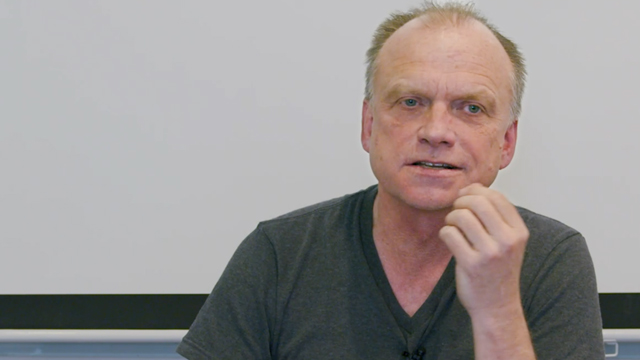
"..is not different and
not the same. To the true
teacher who reveals
this peace, the complete
pacification of constructs to
the perfect Buddha, I bow down."
Yesterday we ended the analysis of the
agent, right? Went through that stanzas.
Up to and including 11, yeah? Looking at the sentence, "The girl goes to school." There's an agent and an action and a place where the action occurs. And then we said, "So, is it the verb that carries the meaning of the action?" And then, as we know, if we do that, if we say that the one action that we're talking about here is picked out by the word "walks," then what about the girl? She's then a girl who has nothing to do with walking, and yet she's supposed to be the one who walks. So, she's a non-walking walker. So, that didn't make sense. And then what if we say that the girl is someone who walks, she has that quality of being a walker. That is what she is. Then in that way, if the girl has that, if the sense of the action is tied to the girl so that there's this intrinsic connection between walking and the girl, then what is it that we say, what is it that we mean when we say that she walks? In that case, we would already have said, have conveyed all that there is to say about walking when we said "the girl." So, what do we mean when we say that she walks? So if we say that, "well, we do mean walking," then again we have to say that there's an action of walking implied when we say "walks." And so, now we have two, we said we need there to be a sense of walking that is applicable to the girl, and then we also say that there has to be still something that she does as a walker, namely walking. So now we have two types of walking, one that makes the girl a walker, and the other that is the walking that she then does in that capacity. So now we started out talking about an act of walking, now we have two acts of walking, but when it gets really absurd is then when we draw the consequence of that, namely that there are then also two agents, because when there when there is a distinct action, then there is a distinct agent as well. So now we started out talking about a girl who walks to school, and now we find that the consequence of this then is that there are two, which is obviously not what we meant when we started out saying. So the question, which we talked a little bit about in the afternoon yesterday is what do we then mean when we say these things? What is it that we mean? Like saying a sentence like that. Anyone would like to explain, like from a personal perspective, what is it that you mean or that you have meant in the past when you said something like that?
What's the best explanation? Because what we are trying to do in this chapter is basically that, it's just trying to understand what actually do we mean when we say the things that we do? And then of course whether what we say and what we think makes sense. But basically in this chapter it's very much about our words and our thoughts. So what do we mean when we say and when we think the things we do? Anyone?
Student: "I think before the analysis we really thought that there is a walking as a thing, and then somehow the agent performs this thing, like really does it. So I think that's what we meant before the analysis. But then after the analysis you realize that there is really no walking. And the thing is that you can even see it when you are walking now. You see yourself and you can see there is..
there is the appearance of walking, but there is no walking. I mean where is it? In your feet or so? It's not on the path, so you cannot really find it. And that gives like a, for me it gives a sense of a lot of space. But the act of walking is really just an appearance, that it's not really there. So that's what I would say." Yeah, thank you.
So then we can also think, if we say that, that I used to mean that there is someone who walks and then there is also an act that this person for example performs, and that's what I meant. Now I see that actually there is no such thing. So if there is no walking, there is no agent of walking either and so on. I suppose you mean that too, no?
So it's just interesting then also to think, okay before I meant that, now I realize that has no meaning. Is it possible to mean something that is completely, this non-existence of the walker, the walking, and the path is not something new obviously. We're talking about the way things are and by definition the way things are is just the way things are. So the way things really are. So we're not talking about, it's not that before there were walkers who walked and now they're not anymore. Of course not, no? So it's always been like that. What was it then that we meant? Is it the, of course we can say this, it makes very good sense but it's also interesting to further think. So there never was walking, there never was a walker. So..
like to mean something, there has to be an example somewhere of what you mean. So it's a sort of strange thing to say that I used to think and mean when I said this such and such and now I realize that there never were these things that I could actually never possibly make sense of them. It's a different kind of revision of one's.. it's a different kind of acknowledgement about what is and is not the case than just saying, "I used to think that my car was a Volkswagen but now I see it's a Honda" or something like that. Like there's still something, such a thing as a car and there's still Volkswagen and Hondas and so on. And I was just, I used to talk about my car thinking that it was a Volkswagen but actually it was a Honda all the way. So I meant Volkswagen and we can point at that type of car and say, "That's what I thought it was." But it's different if we talk about something that there are no examples of anywhere are here and say, "That's what I meant." What really did we mean then? Because what we find now is that all the terms in the sentence are meaningless when we try to go deeper with them. So I suppose that's one way that we can contemplate the significance of what we find out.
Then there is, in stanza 12, there is there is now a discussion that begins about beginnings that is about, I was going to say the fact that we can begin to walk. Someone says that, "well there is walking, there is going in this way because it's possible to first be still and then stand still and then begin to walk." That's something that can be done. Somebody standing, yeah? This is a position where one can begin to walk. Standing and then beginning to walk. So that it's now we're talking again about things that we know what means, no? And I have the sense that I mean exactly this sort of stuff as I speak. 'Walking.' And then there's 'stopping' also. This call it a Okay, now someone is walking again.
Where does it begin then the act of walking? If the idea is here that we can say there is such a thing as walking because it's possible to begin to walk. And if it's possible to initiate the action, then the action also
exists. And then if the action exists, the agent exists and if the agent and action are there then the location is also there. So it's a kind of way to still get the whole framework back in by saying well you haven't looked at the fact that it's possible to begin to walk. And then what we do is we try to be more careful about where that kind of action and under what circumstances that sort of action would be initiated. Going does not begin where it has been nor does it begin where it has yet to occur. That's quite obvious. If we stand still and are about to begin to walk then it's not the place that we begin to walk is not where going has been because it's over there. And it is also not where going has yet to occur because the place where going has yet to occur there is no going yet. And the initiation of going, the beginning to walk, beginning to walk requires some presence of walking. No, you can't begin where there is nothing. Where there is nothing there is no beginning. Where there's.. at a place where there is no walking whatsoever there is no beginning of walking either. So it can't be the place where there is no walking that walking begins on. Any concerns about that? And "Going does not begin where walking takes place either." It's supposed to be the place where it's already happening, no? So it doesn't begin there. And also as we have looked at before, apart from where walking has been and where it's yet to occur there is no place of present walking. So where does going begin? Where does walking begin? So that's looking for the place where walking would begin as if we should be able to find such a place. The next one is about understanding something about the place, namely that such a place couldn't exist. "Before going has been initiated there is no place where walking occurs or has taken place." So if we think of again this occasion where we are standing still and then are about to initiate the act of walking, then at that time, just a minute, yeah, okay. So "Before going has been initiated there is no place where walking occurs." Obviously the action has not begun yet. So how could there be a place where walking happens? Nor is there a place where it has taken place, no? The act that is about to begin has not already taken place. We're talking about the event now of being able to initiate an act of going and the place where that happens is not where it has already taken place. That's quite obvious. Upon which, so "There's no place where walking occurs or has taken place upon which going could begin. And how could there be going where there's none net?" So that's what we just thought about before as well. How can we say that there is..that going is initiated where there is no walking yet? So there is no place, in other words, where walking is initiated. So if we, the previous verse looks at the initiation of walking, the event of beginning to walk, as if there are, there could be such a place. And here in the second, in 13, we're looking more specifically at the place in order to understand that such a place is impossible, a place that serves as the location for the initiation of the act of walking. And we continue in 14: "Since we never witness a beginning of going, how can we conceive of the traversed of what has been traversed and what has yet to be traversed?" So if that's the case, if we can never locate a place where walking actually begins, then how can we talk about all the things that we just did, the path of the future, which is where going has not yet happened, the path of the past where going was before but is over now. And how can we talk about a path of present walking? If it never can be initiated such an action, then all these locations are impossible. So again we can ask ourselves, what did I then have in mind when I said this in the past? What was it I was thinking of when I talked about the path I walked before, the path that I will walk in the future and the path when I'm walking now? It's impossible to initiate the act of walking anywhere because going doesn't begin, walking doesn't begin where it has yet, where it has been. Of course not. It does not begin where it's already happening, even if we assume that there could be such a place, although we have seen that apart from where walking has been and is yet to occur, we cannot identify any place of present walking. And then walking cannot be initiated either at a place where there is no walking yet. A place where there's no walking yet is a place devoid of walking. That's not where the action begins then, right? The beginning of walking has to have some sense of walking. Otherwise it's not the beginning of walking. And the path where walking is yet to occur is a place that has no such thing. So because of that, then how can we at all, it is interesting, he says, how can we conceive of? So he doesn't say it doesn't exist or sometimes he says like that. But here he says, so how is it at all possible that we can think of a path that was traversed, a path that is being traversed and has yet to be traversed?
So why would you say, why is it possible to think in this way? It's another variant of saying, what do I mean when I think these things? Why is it possible to conceive of such paths? Then we can look at, just as we can talk about the beginning of walking, we can also talk about the end of walking. When we walk, then sooner or later we stop, no? So that's perhaps we've come to where we wanted to get to. The girl has reached school now, she's there, she doesn't need to walk anymore. But stopping does not occur where walking takes place, where going has been or where it has yet to occur. So of course, if we talk about bringing that act to an end and now standing still after having been walking, then that act of stopping is not one that takes place where walking, it's not one that occurs where walking takes place because it's still the manifestation of the present action. So that's not where the stopping occurs. And where going has been, it's already over. So that's not where you stop either. When going is over, then there's no sense of stopping. And where going has yet to happen, that's not where you stop either, obviously, because there's no act yet that could be stopped. So stopping doesn't help in any way appeal to the idea that walking comes to an end. When we have reached our destination we stop. All the same problems are present there. So we can then talk about standing still, a being. So having arrived, having not yet set out, we just stand there. We are not moving, we are not walking. But who is it then that stands still? Is it the walker who stands still? Or someone who does not go who stands still? The walker couldn't be the one who stands still, obviously. The walker is a walker. And the one who does not go, meaning the one who stands still, is the one who stands still the one who stands still?
We should think so, no? Who else would it be? But then if the agent is in this way qualified by the standing still, if the agent is indeed someone who intrinsically is that, the one who stands still or someone standing still, then what is the implication of the verb? He stands still. When we say that already the pronoun would have delivered everything if this were the case. That the agent is intrinsically someone who stands still. So in other words if we assign the quality of standing still to the agent, then what does 'standing still' mean in the argument? It is left without meaning. And if we want to say "well, there's the agent and then there's that action that he performs," then again because we want the agent to be not someone who doesn't stand still, no? Like a walker for example. It's not the walker who stands still. So the agent, he who stands still, has to be someone who is intrinsically, really and truly someone who stands. So if that's a fact about the agent, and we also want to leave place for some meaning of the verb, then we have two actions again, or two verbs, verbal meanings. One that is tied to the agent and another that is tied to the verb. And if there are two actions, standing still, two types of standing still, then there are also two entities, two distinct entities that stand still. So it's not the one who stands still who stands still either. And aside from those that go and do not go, meaning walkers and non-walkers, what third party could stand still? If it's not a walker and if it's not someone who doesn't walk, then who should it be? And then yeah, a little more elaboration. "In the absence of going, there cannot reasonably be anyone who goes." The walker is a walker because he or she is involved in that action. Otherwise, why would we call that person a walker? So if at this point we say, well, it is actually despite the, if we go back to the first alternative and say that it is the one who goes, it's the walker who stands still, then it's clarified here that that doesn't hold because the walker has to be someone who walks and how could it then reasonably be said that it is the one who walks who stands still? So this tells us something about what an agent is. So what would you say an agent is in the light of this?
There are many ways that you can conceive an agent as a person. Like I like to think that I'm an agent of many different, performing many different actions and that I go, I walked here, I sat down, opened my computer and so on. So I perform a range of activities. Is that what an agent is?
Or is like more closely tied to the specific action? Am I one
am I one agent when I walk here? Am I another agent when I sit down? And a third agent when I open my computer? What do you think?
What is an agent? Or we simply do not know anymore what an agent is?
Student:"An agent is the ..I mean I don't know anymore but also an agent is conventionally the one that performs the action. I mean there's an action involved otherwise there's no agency, there's no agent. And if it's a true agent the agent should perform the same action indefinitely because otherwise there would be many agents."
So I'm a different agent when I walk here and a different one when I sit down? Student: "I would say so, like if that should hold in any way possible you should be different whenever
whenever the action is different." So is there then.. but how about me? There must be something that connects. "I don't know. Yes, of course there is." Namely? "The label I guess like Thomas. Thomas, you know, I'm thinking that that's Thomas but in reality it's not, the agent has to change. It helps me thinking about that you are the same." Yeah, it's pretty hard, no? I can't think like that. That I'm totally.. impossible. The implication of like, but then what do I mean? I can't think that I'm different, no? So I think I'm the agent in all of this but what do I mean when I think that? "I think it's that, I mean when you scratch the surface it all falls apart but there's a communication aspect. It's like a way of connection." But connection requires that there is something to talk about, no?
Something to connect through or with or something, no? "We kind of all pretend, right? Because I want I want to connect so it helps me to.. to say that you walked here." Helps you? "yeah."
Student: "Maybe a good example would be like a crystal, no? That comes, there comes light and then you have different colors but the colors are never in the crystal, no? So there is somehow magically due to causes and conditions or something, colors came but the colors are not in the crystal so you are not a walker, you are not a teacher, you are nothing. But you too…" That's a very interesting point. That is a very interesting point, no? If I'm not the walker, if I'm something else then I'm never anything of the things that I do, no? "Yeah. But at the same time you somehow are when the conditions kind of come together in a sort of, yeah, I can only think of this magical way, you know? I don't know how to describe it."
How do you think you would do as a school teacher? "I think I would be very bad. Fired." Scandal, no? Like seriously, no? I mean, all respect but… "Well, I could just pretend to get the money and to do a good job, you know? But at the end there is not really meaning in it, somehow, you know? I could also take it seriously." Then money has no meaning either. Sorry, yeah? "No, I was thinking I could also take it very seriously, you know? If I'm a teacher I could really, even though I might not give it a certain heavy reality to it, at the same time I can be very engaged with the children and really trying to teach them something. The analysis doesn't prevent me from doing that. But at the same time it's all, when you think about it, it's all very indescribable, no?"
So this is again something I think very important, no? So if this is important and significant then what are the implications? Like in the beginning it makes not much sense to talk about what's the point to these analyses and so on, no? Because we just want to know so we can get this grab, get this handle on things and say sort of get around the whole process of investigating, When we read this strange stuff then the natural question is so what's the point, yeah? Before we have thought much about it, no? Now we have tried to some extent to think about it. And then now if we ask the question "what is the point with this?" What is the implication? Then it takes on a very different meaning, that question. It's also not so much, certainly not only what is Nāgārjuna trying to tell us, no? But it's also like what is the implication of what he shows here, yeah? So like what is an agent and so on, yeah?
So maybe try to for Monday, you know, there's a weekend to think about these things, no? So why don't you try and think, yeah, try and think of this stuff that, okay, what is an agent then in this, in the light of this, what is an agent? What did I mean before when I said "I walk to school"? What did I mean? What do I understand now about that sentence and its connect or lack of connect with reality? And so what do I now mean when I say that sentence? Why don't you all try to think about that and formulate a little bit, yeah? And then with going, beginning and stopping, the case is the same as with going. So the meaning here is that we're still talking about stopping and because stopping was thought to be the fact that we can stop walking would be a way.. if we can show that that's possible and perhaps just point and say, "See, now I stopped" or "This person has stopped walking now." If that's possible, then all the other stuff is also possible. But then stopping was then criticized in the way we did before. And then again one could use examples and say the opposite of stopping exists, there's going and because there's going, there's stopping. That's how the text progresses and also how the commentaries explain. So we could say, "Okay, we already understood that. Of course that's not possible." But perhaps it says something about the way we think. We don't note down carefully whatever conclusion we have come to and then once we have checked one idea as useless, then we don't return to it in some other incarnation. It happens all the time. So in a way you could say the way that the verses progress here is just acknowledging how we think. So we can get the idea that, "Well, okay, you may criticize stopping in this way that you just did, but hey, it's possible to walk," and so because the opposite of standing still exists, then therefore there's also stopping. But what the stanza then here says is that with going, beginning, or we could say it's possible to begin to stand still and therefore standing still exists. And it's possible to stop standing still, so therefore standing still exists. So these kinds of ways of justifying or accounting for the reality of standing still. Then the text just notes that it's the same move that was already tried before in the case of going. And they were found failed attempts at saving going. So now doing the same stuff, like pointing to the opposite or the initiation or the ceasing of the act in question is not going to help anything. The act of now, there's some juicy ones coming again also here. "The act of going and the one who goes cannot rightly be said to be the same.." Because yeah, if agent and action are the same it's really absurd. If I am the walking, no?
"The act of going cannot be different either," because if me and my walking are distinct, then how can I claim that I'm the one who walks?
If that which is the going were also the one who goes, it would follow that agent and act would be the same. Yet if the going and the goer are thought to be different, then there could be going without something that goes, and someone who goes in the absence of going. If they are different from each other, then we could have me being someone who doesn't go and my walking performed by me, obviously being the act of walking. So there would then be walking taking place, but without anyone who walks, because the agent, me, am distinct from my action and I'm not a walker. So in this case, there would be walking without someone who goes. That would be perfectly possible if object and agent were distinct from each other. Or there could be someone who goes in the absence of going. If I as an agent, a walker, were sitting down, then while sitting down, it would be a walker sitting, like someone walking sitting. So this doesn't make sense either.
So "When two things cannot be established as identical, yet not as different things either, then how can they be established at all?" So that's a question for us.
Is it true that the agent and the action cannot be the same and cannot be different, first of all? Anyone who doesn't agree? Is there anyone who says that they can be different or that they cannot be different or that it is not clear whether or not they can be the same or different?
"Andrew can you unmute?" Student: "Yes, thank you. I would still love to say that they're not exactly the same, not totally different. And I wonder if we've dispensed with that or if that's an option for us here?" What do you think yourself is good about that?
"It seems like to me that that's true. It seems when I think about when I'm walking that in some sense there is a similarity there or in some sense my being is bound up in this activity. So to some extent there's a similarity. At the same time I'm not exactly the same as what's occurring for me right now. So I wouldn't say that I'm exactly the same and at the same time I wouldn't say I'm exactly different. And it seems to preserve the nice thing it seems to preserve is it seems to preserve this ability to distinguish things. But at the same time it still seems to me if I'm completely honest that Nāgārjuna's arguments apply mainly to the case where we say that "I am exactly the same or by contrast totally different." Yeah, very good. So the thing is if we say that, okay so the way to deal with this is to say the walker and the act that is performed by the walker aren't exactly the same. But they are very deeply connected.
Actually already now it gets strange. Like if they're not exactly the same then the same to some extent. Sounds odd to say about me and my walking. No? We're not one and the same. Yeah? Okay fine. But if we're not one and the same we want to say not exactly the same but so the same in some sense? But anyway. And we're not exactly different either. Like we're different enough to be distinguishable but not so distinct that I'm not the agent of that action. No? That sounds okay to say like that. But then what we think is the sort of saving thing here, not exactly the same, not exactly different. When is that observation not applicable? Can you think of two things that are not exactly the same and not exactly different? That are neither, how do I say that? Can you think of two things to which this does not apply? They aren't exactly the same. They aren't exactly different. "Johan?" That was... Student: "I would say a mirror." Sorry? "Maybe a mirror. If I pass a mirror I can see that it looks like me but it's not the same and it's not exactly the same." Yeah but can you think of two things in the universe or within the realm of imagination that are not, of which you cannot say that they are not exactly the same and not exactly different? "I'm not sure if the question was to me directly but the answer that I would give out of my own experience is that things differ or are the same to extents that we can more or less roughly quantify. In other words, two socks are similar to some extent and a sock is not similar to that same extent with a pumpkin. That's how I would answer." Yeah and then if you want to explain more about why that is so you will have to do that. To some extent that again leaves a lot open. So if you want to be more specific about what it is that ties the sock together with its companion sock then you get into more explanation. And if you want to say what it is that makes it less connected with whatever what it was you said, pumpkin, then that too. So in this way you, we basically keep holding things up against each other and without ever being able to say about two things that they are the same and without being able to say about two things that they are just plain different. It's always "..to some extent." Right? So that is perhaps something a way of explaining dependent origination.
What this then also means that all of these things aren't anything at all in and of themselves. Because all what we do is always comparative, no?
And of course we can compare with many things. So there's no, what is the thing itself that we're talking about? What is the sock? Either we can talk about it forever or we can say we can never get to the bottom of it and it is, yeah. And it's just a sock.
So I think that's a good way of concluding to some extent about dependent origination. That indeed it is arising without sameness and difference. It is the dependent arising is also without arising of course, but it is dependent arising has no arising and no cessation. It has no sameness and no difference. So that is, is that your conclusion? When
When you say "to some extent," to some extent same and to some extent different, that the implication of that, of just that statement is that everything is that all that arises dependently never arises, never ceases, never differs, never is identical with anything else?
"Yes." Was there another remark or...?
So when two things cannot be established as identical and yet not as different things however than how can they be established at all? So is.. are they then.. do they then really exist? These things that aren't.. when they are, when they are..
identical to some extent and different to some extent
but not identical and not different. "To some extent" means in some regard. It doesn't mean that they are actually different. Not exactly the same and not exactly different doesn't mean that they are, that they have a certain measure of sameness. It just means that we can look at them in a way so that we would like to say that they are similar in such and such way. And that when we say that they're not exactly the same, that means that there's a way of looking at them that makes it so that they seem, that we want to say that they are different.
So if that is the case then.. can we say that we have found some way of then establishing dependent origination through that? 'Establishing' meaning found rational basis for the principle of dependent origination of all these appearances? Not exactly the same, not exactly different, that proclamation? Does that give us then dependent origination as a sort of solid and compelling and rational principle?
Student: "Yeah, I feel like it does, but then the other thing that I'm noticing is that in that verse, this verse 21, that question, how can they be established at all? It allows something to not be established, which feels very different than establishing something. It sounds stupid when I say it, but it's very obvious. I just wanted to, yeah." Yeah, that's very nice. So we're not.. Yeah, beautiful. We're not trying to establish dependent origination. We're just saying that how could it be established? That's kind of what you're saying?
Yeah, that's very nice. "The one who goes, does not engage in the going," well, we have two minutes left. Let's take those next time, no? Any other question before we pack up for today? Otherwise we can just call it a day. Student: "Hi Dr. Thomas, I was thinking about the Thomas that I see on my screen and the Thomas that's there, seen by the people in the room. So how do I relate that to verse 21 here?" Yeah? Oh! Okay. Yeah, very nice. Yeah.
So you're asking me to relate it or? Yeah? "Yeah, that's what I was thinking about. This could be one of the way to look at it as something that.." Yeah, very good example. So if.. if..the one sitting here and the one reflected on the screen are not identical, which they clearly aren't, no? One is in the screen and the other one is here, but they aren't different either. It's me both, yeah? Then how could there be any reality to either one of those two?
So then we could say that, "Well, the guy on the screen is just that, yeah? The real deal is here. That's actually really interesting to look into. There's a lot of, especially these days with virtual reality and so on. This is one of the real key questions that are on our minds, whether we, whether we know it or not almost right? Because so much when there's so much that we think of and so much that is labeled "virtual reality," then yeah we have this framework to think from and through a whole lot of time during the day that there's the real situation or assume is so bad compared to such and such and so on and so forth. All of these kind of novel situations that we get to because of wanting to say that there's one thing that is real and there's something else that is, uh.. that is just virtual or seeming, yeah? So let's talk about that next time. Um, the, like sort of straight, straight up, then it would be that if the, if I and the reflection are not the same and if we aren't different either then, how can either one of us be real in any way at all? Then there's this objection, "Hey! Then there's one who is sort of the basis for the other. I'm the basis for the reflection down there." So let's talk about that next time. Thank you.
17:25
