
Video
Audio
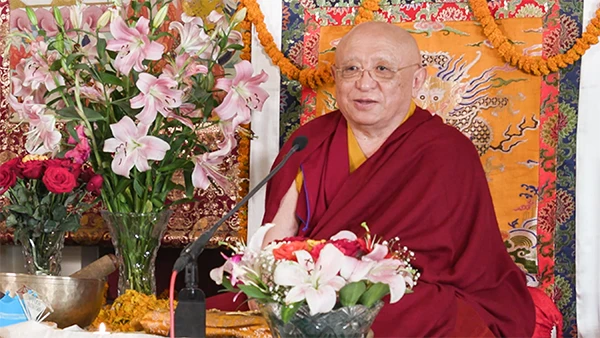
01:07:58
This young, young cute, handsome boy's
birthday.
So we want him to healthy,
happy, long life.
And top of that,
what we really need in 21 century time,
we humans, what we really need is
in heart, we need to reach karuna.
Reach karuna. Mind needs to have knowledge of śūnyatā. Karuna and śūnyatā is savor of this planet. This planet is facing a lot of troubles
to do human's, human's energy. Good energy, bad energy.
We live now in a world which is made out of the five elements. At this time, in this very century, the five elements, they arise as our enemies. The... Also the potency, the ability and the energy of the elements, of the five elements is on the decrease. And we as human beings, we have so many fears, we suffer from a lot of anxiety. Especially we suffer because we cannot trust anything. We are so skeptical and have so many doubts. In the past, it was quite easy for people to put the trust, place the trust in things, place the trust in just ordinary things that they need like food, wealth, possessions, medicine and so forth. Especially in the past, it was easy for people to place the trust in religion. In the 21st century, this is rather difficult. If one understands acutely the benefits and the qualities of a religion, perhaps then one will place one's trust in the tenets or in the philosophies of a spiritual tradition. But otherwise, it's very difficult for human beings nowadays to, to really place the trust and trust themselves to religions. So what is it really that we all need these days? What we need these days is to understand the profound emptiness. All phenomena appear, but while they appear, they are empty. They are Śūnyatā in Sanskrit, the great emptiness, this is what the Buddha clearly explained. So do we need to trust it or believe in it because the Buddha said so? No. The most important is for all of us to use our own reasoning and logical arguments to investigate, investigate the nature of phenomena. How are things? What are they like? And when we investigate, we discover that while phenomena appear and they seem so real and solid, they are emptiness. This is what the Buddha so clearly explained when he said when you study emptiness, you can understand emptiness quite easily by means of reasoning. You can realize in that way emptiness by means of reasoning. So what we need to achieve is we need to become undiluted, not ignorant anymore with respect to all phenomena. If we do that, then there's a lot of things that we can do on the basis of that. The basis for our practice should be emptiness, emptiness which has as its core compassion. What happens if our mind is always suffused by the supreme nectar of compassion? We will give up harming others and also give up harming ourselves.
The teachings of the Buddha is a philosophy which is an inner science. It is concerned with the element of mind. So among the five, we have the study of the five elements and that's the element of mind. And this is precisely what we need to investigate. What is the mind? What is its connection? What is the body? And in the 21st century, the youth, our youth here, they need to really become aware about the empty nature of all phenomena. While understanding emptiness, everybody needs to strive to to feel and experience compassion for all sentient beings, to give up harming others. So this is precisely what our youth nowadays really needs. An understanding or an insight into the nature of all phenomena. Understanding that while phenomena appear, they are empty. And that they are never separated from the supreme moisture of compassion.
All conditioned phenomena, the Buddha said, are impermanent. This is something that we need to take to heart. Whatever we accumulate, any kind of accumulation will end and its depletion will become exhausted. Whatever we create, whatever we try to build or produce, it will disintegrate sooner or later or collapse. Any type of meeting will end in separation. And birth ends in death. So these, these words we need to apply to our heart. What happens if we really take to heart the fact that all conditioned phenomena are impermanent? What happens is that we change. And we don't change only superficially, we change profoundly.
The four seals that mark the teachings continue to say, everything that deteriorates is suffering. Everything that involves negative emotions produces suffering. All phenomena are empty and devoid of self-entity, nirvana, is peace.
So now we will train in the meditation session. Regardless which meditation session we train in, it is important that we allow the very practice to be embraced by the three excellences. The first is the excellent preparation which consists of taking refuge and bodhicitta. Understanding the inconceivable qualities of the three jewels, you give rise to faith and devotion. And with that very faith and appreciation, you then take refuge from the core of your heart. And this practice is so extremely important. The next aspect of the preparation is to give rise to bodhicitta. You understand that all sentient beings have been your kind parents, that they have been extremely kind and now it's time for you to repay their kindness. So you give rise to loving-kindness and compassion. And training constantly in loving-kindness and compassion, this in itself becomes the basis for you to realize emptiness. When training in bodhicitta, this allows you also to perfect the six pāramitās. By means of bodhicitta, you are able to train in the pāramitā of generosity, of discipline, of patience, of diligence, of meditative concentration and finally insight or wisdom. So we need to understand how indispensable the training in bodhicitta is. We train in as the main part of our practice. We train in the practices of samatha and vipassanā. That means that we train in realizing emptiness, which has as its core compassion. The inseparability of emptiness and compassion is our training ground. And any practice that we do should be sealed by the recognition or understanding of that very unity of emptiness and compassion. The excellent conclusion consists of dedication prayers and making aspiration prayers. When we have accumulated something good, when we have done something good, practiced virtue, it's so important to share that with all sentient beings, to dedicate it for the welfare of all sentient beings in a really vast, extensive way. And then having done so, one seals one's practice with aspiration prayers. So these three excellences are contained in the Shakyamuni practice, which we will now train in.
Keep your body straight. If your body, if you sit upright, with your spine straight, then the nadis are straight, the channels are straight, and when the channels are straight, then the inner wind, the prana can flow in an unimpeded way. This very body posture is the best support for samatha practice, for samatha meditation. And based on samatha meditation, as we all know, vipassanā arises, the insight of vipassanā. There are so many different levels and steps when it comes to samatha meditation. Here we are training in a samatha meditation which is called the samatha of uncontrived naturalness. This is the samatha meditation that is set forth and explained so clearly in the teachings of the Great Perfection and the Mahamudra teachings. When traversing the stages of one-pointedness, of simplicity, one-taste, and a non-meditation according to the four or twelve stages of the four yoga’s of Mahamudra, one also trains precisely in this very samatha meditation of uncontrived naturalness. The same goes for the teachings of the Great Perfection where one first of all trains in the kriya, upa yoga, maha, anu, teachings and practices and then one's practice culminates in the practice of ati yoga and precisely also in the ati yoga teachings one trains in the samatha meditation of uncontrived naturalness. So training in that very samatha meditation, what is the purpose? By meditating and training in this very samatha meditation, the wisdom of vipassanā arises.
The best type of meditation is to train in the unity of samatha and vipassanā. The unity of samatha and vipassanā is in fact the enlightened mind of all the victorious ones. So by training in this way, a samatha meditation, the wisdom of vipassanā manifests. And this wisdom may have many different names. It is also called the innate, the innate wisdom of... the non-conceptual innate convergent wisdom. It is also called the naturally occurring timeless awareness. So right here we should be training in that very meditation. And a, we train or we are introduced to the wisdom of of vipassanā by means of relying on the words of the... the teacher of the... the teacher of the words of the Buddha. And also relying on the kindness of a personal teacher, we are then introduced to the wisdom of vipassanā.
Thank you. Short break.
Reach karuna. Mind needs to have knowledge of śūnyatā. Karuna and śūnyatā is savor of this planet. This planet is facing a lot of troubles
to do human's, human's energy. Good energy, bad energy.
We live now in a world which is made out of the five elements. At this time, in this very century, the five elements, they arise as our enemies. The... Also the potency, the ability and the energy of the elements, of the five elements is on the decrease. And we as human beings, we have so many fears, we suffer from a lot of anxiety. Especially we suffer because we cannot trust anything. We are so skeptical and have so many doubts. In the past, it was quite easy for people to put the trust, place the trust in things, place the trust in just ordinary things that they need like food, wealth, possessions, medicine and so forth. Especially in the past, it was easy for people to place the trust in religion. In the 21st century, this is rather difficult. If one understands acutely the benefits and the qualities of a religion, perhaps then one will place one's trust in the tenets or in the philosophies of a spiritual tradition. But otherwise, it's very difficult for human beings nowadays to, to really place the trust and trust themselves to religions. So what is it really that we all need these days? What we need these days is to understand the profound emptiness. All phenomena appear, but while they appear, they are empty. They are Śūnyatā in Sanskrit, the great emptiness, this is what the Buddha clearly explained. So do we need to trust it or believe in it because the Buddha said so? No. The most important is for all of us to use our own reasoning and logical arguments to investigate, investigate the nature of phenomena. How are things? What are they like? And when we investigate, we discover that while phenomena appear and they seem so real and solid, they are emptiness. This is what the Buddha so clearly explained when he said when you study emptiness, you can understand emptiness quite easily by means of reasoning. You can realize in that way emptiness by means of reasoning. So what we need to achieve is we need to become undiluted, not ignorant anymore with respect to all phenomena. If we do that, then there's a lot of things that we can do on the basis of that. The basis for our practice should be emptiness, emptiness which has as its core compassion. What happens if our mind is always suffused by the supreme nectar of compassion? We will give up harming others and also give up harming ourselves.
The teachings of the Buddha is a philosophy which is an inner science. It is concerned with the element of mind. So among the five, we have the study of the five elements and that's the element of mind. And this is precisely what we need to investigate. What is the mind? What is its connection? What is the body? And in the 21st century, the youth, our youth here, they need to really become aware about the empty nature of all phenomena. While understanding emptiness, everybody needs to strive to to feel and experience compassion for all sentient beings, to give up harming others. So this is precisely what our youth nowadays really needs. An understanding or an insight into the nature of all phenomena. Understanding that while phenomena appear, they are empty. And that they are never separated from the supreme moisture of compassion.
All conditioned phenomena, the Buddha said, are impermanent. This is something that we need to take to heart. Whatever we accumulate, any kind of accumulation will end and its depletion will become exhausted. Whatever we create, whatever we try to build or produce, it will disintegrate sooner or later or collapse. Any type of meeting will end in separation. And birth ends in death. So these, these words we need to apply to our heart. What happens if we really take to heart the fact that all conditioned phenomena are impermanent? What happens is that we change. And we don't change only superficially, we change profoundly.
The four seals that mark the teachings continue to say, everything that deteriorates is suffering. Everything that involves negative emotions produces suffering. All phenomena are empty and devoid of self-entity, nirvana, is peace.
So now we will train in the meditation session. Regardless which meditation session we train in, it is important that we allow the very practice to be embraced by the three excellences. The first is the excellent preparation which consists of taking refuge and bodhicitta. Understanding the inconceivable qualities of the three jewels, you give rise to faith and devotion. And with that very faith and appreciation, you then take refuge from the core of your heart. And this practice is so extremely important. The next aspect of the preparation is to give rise to bodhicitta. You understand that all sentient beings have been your kind parents, that they have been extremely kind and now it's time for you to repay their kindness. So you give rise to loving-kindness and compassion. And training constantly in loving-kindness and compassion, this in itself becomes the basis for you to realize emptiness. When training in bodhicitta, this allows you also to perfect the six pāramitās. By means of bodhicitta, you are able to train in the pāramitā of generosity, of discipline, of patience, of diligence, of meditative concentration and finally insight or wisdom. So we need to understand how indispensable the training in bodhicitta is. We train in as the main part of our practice. We train in the practices of samatha and vipassanā. That means that we train in realizing emptiness, which has as its core compassion. The inseparability of emptiness and compassion is our training ground. And any practice that we do should be sealed by the recognition or understanding of that very unity of emptiness and compassion. The excellent conclusion consists of dedication prayers and making aspiration prayers. When we have accumulated something good, when we have done something good, practiced virtue, it's so important to share that with all sentient beings, to dedicate it for the welfare of all sentient beings in a really vast, extensive way. And then having done so, one seals one's practice with aspiration prayers. So these three excellences are contained in the Shakyamuni practice, which we will now train in.
Keep your body straight. If your body, if you sit upright, with your spine straight, then the nadis are straight, the channels are straight, and when the channels are straight, then the inner wind, the prana can flow in an unimpeded way. This very body posture is the best support for samatha practice, for samatha meditation. And based on samatha meditation, as we all know, vipassanā arises, the insight of vipassanā. There are so many different levels and steps when it comes to samatha meditation. Here we are training in a samatha meditation which is called the samatha of uncontrived naturalness. This is the samatha meditation that is set forth and explained so clearly in the teachings of the Great Perfection and the Mahamudra teachings. When traversing the stages of one-pointedness, of simplicity, one-taste, and a non-meditation according to the four or twelve stages of the four yoga’s of Mahamudra, one also trains precisely in this very samatha meditation of uncontrived naturalness. The same goes for the teachings of the Great Perfection where one first of all trains in the kriya, upa yoga, maha, anu, teachings and practices and then one's practice culminates in the practice of ati yoga and precisely also in the ati yoga teachings one trains in the samatha meditation of uncontrived naturalness. So training in that very samatha meditation, what is the purpose? By meditating and training in this very samatha meditation, the wisdom of vipassanā arises.
The best type of meditation is to train in the unity of samatha and vipassanā. The unity of samatha and vipassanā is in fact the enlightened mind of all the victorious ones. So by training in this way, a samatha meditation, the wisdom of vipassanā manifests. And this wisdom may have many different names. It is also called the innate, the innate wisdom of... the non-conceptual innate convergent wisdom. It is also called the naturally occurring timeless awareness. So right here we should be training in that very meditation. And a, we train or we are introduced to the wisdom of of vipassanā by means of relying on the words of the... the teacher of the... the teacher of the words of the Buddha. And also relying on the kindness of a personal teacher, we are then introduced to the wisdom of vipassanā.
Thank you. Short break.
01:07:57
This young, young cute, handsome boy's
birthday.
So we want him to healthy,
happy, long life.
And top of that,
what we really need in 21 century time,
we humans, what we really need is
in heart, we need to reach karuna.
Reach karuna. Mind needs to have knowledge of śūnyatā. Karuna and śūnyatā is savor of this planet. This planet is facing a lot of troubles
to do human's, human's energy. Good energy, bad energy.
We live now in a world which is made out of the five elements. At this time, in this very century, the five elements, they arise as our enemies. The... Also the potency, the ability and the energy of the elements, of the five elements is on the decrease. And we as human beings, we have so many fears, we suffer from a lot of anxiety. Especially we suffer because we cannot trust anything. We are so skeptical and have so many doubts. In the past, it was quite easy for people to put the trust, place the trust in things, place the trust in just ordinary things that they need like food, wealth, possessions, medicine and so forth. Especially in the past, it was easy for people to place the trust in religion. In the 21st century, this is rather difficult. If one understands acutely the benefits and the qualities of a religion, perhaps then one will place one's trust in the tenets or in the philosophies of a spiritual tradition. But otherwise, it's very difficult for human beings nowadays to, to really place the trust and trust themselves to religions. So what is it really that we all need these days? What we need these days is to understand the profound emptiness. All phenomena appear, but while they appear, they are empty. They are Śūnyatā in Sanskrit, the great emptiness, this is what the Buddha clearly explained. So do we need to trust it or believe in it because the Buddha said so? No. The most important is for all of us to use our own reasoning and logical arguments to investigate, investigate the nature of phenomena. How are things? What are they like? And when we investigate, we discover that while phenomena appear and they seem so real and solid, they are emptiness. This is what the Buddha so clearly explained when he said when you study emptiness, you can understand emptiness quite easily by means of reasoning. You can realize in that way emptiness by means of reasoning. So what we need to achieve is we need to become undiluted, not ignorant anymore with respect to all phenomena. If we do that, then there's a lot of things that we can do on the basis of that. The basis for our practice should be emptiness, emptiness which has as its core compassion. What happens if our mind is always suffused by the supreme nectar of compassion? We will give up harming others and also give up harming ourselves.
The teachings of the Buddha is a philosophy which is an inner science. It is concerned with the element of mind. So among the five, we have the study of the five elements and that's the element of mind. And this is precisely what we need to investigate. What is the mind? What is its connection? What is the body? And in the 21st century, the youth, our youth here, they need to really become aware about the empty nature of all phenomena. While understanding emptiness, everybody needs to strive to to feel and experience compassion for all sentient beings, to give up harming others. So this is precisely what our youth nowadays really needs. An understanding or an insight into the nature of all phenomena. Understanding that while phenomena appear, they are empty. And that they are never separated from the supreme moisture of compassion.
All conditioned phenomena, the Buddha said, are impermanent. This is something that we need to take to heart. Whatever we accumulate, any kind of accumulation will end and its depletion will become exhausted. Whatever we create, whatever we try to build or produce, it will disintegrate sooner or later or collapse. Any type of meeting will end in separation. And birth ends in death. So these, these words we need to apply to our heart. What happens if we really take to heart the fact that all conditioned phenomena are impermanent? What happens is that we change. And we don't change only superficially, we change profoundly.
The four seals that mark the teachings continue to say, everything that deteriorates is suffering. Everything that involves negative emotions produces suffering. All phenomena are empty and devoid of self-entity, nirvana, is peace.
So now we will train in the meditation session. Regardless which meditation session we train in, it is important that we allow the very practice to be embraced by the three excellences. The first is the excellent preparation which consists of taking refuge and bodhicitta. Understanding the inconceivable qualities of the three jewels, you give rise to faith and devotion. And with that very faith and appreciation, you then take refuge from the core of your heart. And this practice is so extremely important. The next aspect of the preparation is to give rise to bodhicitta. You understand that all sentient beings have been your kind parents, that they have been extremely kind and now it's time for you to repay their kindness. So you give rise to loving-kindness and compassion. And training constantly in loving-kindness and compassion, this in itself becomes the basis for you to realize emptiness. When training in bodhicitta, this allows you also to perfect the six pāramitās. By means of bodhicitta, you are able to train in the pāramitā of generosity, of discipline, of patience, of diligence, of meditative concentration and finally insight or wisdom. So we need to understand how indispensable the training in bodhicitta is. We train in as the main part of our practice. We train in the practices of samatha and vipassanā. That means that we train in realizing emptiness, which has as its core compassion. The inseparability of emptiness and compassion is our training ground. And any practice that we do should be sealed by the recognition or understanding of that very unity of emptiness and compassion. The excellent conclusion consists of dedication prayers and making aspiration prayers. When we have accumulated something good, when we have done something good, practiced virtue, it's so important to share that with all sentient beings, to dedicate it for the welfare of all sentient beings in a really vast, extensive way. And then having done so, one seals one's practice with aspiration prayers. So these three excellences are contained in the Shakyamuni practice, which we will now train in.
Keep your body straight. If your body, if you sit upright, with your spine straight, then the nadis are straight, the channels are straight, and when the channels are straight, then the inner wind, the prana can flow in an unimpeded way. This very body posture is the best support for samatha practice, for samatha meditation. And based on samatha meditation, as we all know, vipassanā arises, the insight of vipassanā. There are so many different levels and steps when it comes to samatha meditation. Here we are training in a samatha meditation which is called the samatha of uncontrived naturalness. This is the samatha meditation that is set forth and explained so clearly in the teachings of the Great Perfection and the Mahamudra teachings. When traversing the stages of one-pointedness, of simplicity, one-taste, and a non-meditation according to the four or twelve stages of the four yoga’s of Mahamudra, one also trains precisely in this very samatha meditation of uncontrived naturalness. The same goes for the teachings of the Great Perfection where one first of all trains in the kriya, upa yoga, maha, anu, teachings and practices and then one's practice culminates in the practice of ati yoga and precisely also in the ati yoga teachings one trains in the samatha meditation of uncontrived naturalness. So training in that very samatha meditation, what is the purpose? By meditating and training in this very samatha meditation, the wisdom of vipassanā arises.
The best type of meditation is to train in the unity of samatha and vipassanā. The unity of samatha and vipassanā is in fact the enlightened mind of all the victorious ones. So by training in this way, a samatha meditation, the wisdom of vipassanā manifests. And this wisdom may have many different names. It is also called the innate, the innate wisdom of... the non-conceptual innate convergent wisdom. It is also called the naturally occurring timeless awareness. So right here we should be training in that very meditation. And a, we train or we are introduced to the wisdom of of vipassanā by means of relying on the words of the... the teacher of the... the teacher of the words of the Buddha. And also relying on the kindness of a personal teacher, we are then introduced to the wisdom of vipassanā.
Thank you. Short break.
Reach karuna. Mind needs to have knowledge of śūnyatā. Karuna and śūnyatā is savor of this planet. This planet is facing a lot of troubles
to do human's, human's energy. Good energy, bad energy.
We live now in a world which is made out of the five elements. At this time, in this very century, the five elements, they arise as our enemies. The... Also the potency, the ability and the energy of the elements, of the five elements is on the decrease. And we as human beings, we have so many fears, we suffer from a lot of anxiety. Especially we suffer because we cannot trust anything. We are so skeptical and have so many doubts. In the past, it was quite easy for people to put the trust, place the trust in things, place the trust in just ordinary things that they need like food, wealth, possessions, medicine and so forth. Especially in the past, it was easy for people to place the trust in religion. In the 21st century, this is rather difficult. If one understands acutely the benefits and the qualities of a religion, perhaps then one will place one's trust in the tenets or in the philosophies of a spiritual tradition. But otherwise, it's very difficult for human beings nowadays to, to really place the trust and trust themselves to religions. So what is it really that we all need these days? What we need these days is to understand the profound emptiness. All phenomena appear, but while they appear, they are empty. They are Śūnyatā in Sanskrit, the great emptiness, this is what the Buddha clearly explained. So do we need to trust it or believe in it because the Buddha said so? No. The most important is for all of us to use our own reasoning and logical arguments to investigate, investigate the nature of phenomena. How are things? What are they like? And when we investigate, we discover that while phenomena appear and they seem so real and solid, they are emptiness. This is what the Buddha so clearly explained when he said when you study emptiness, you can understand emptiness quite easily by means of reasoning. You can realize in that way emptiness by means of reasoning. So what we need to achieve is we need to become undiluted, not ignorant anymore with respect to all phenomena. If we do that, then there's a lot of things that we can do on the basis of that. The basis for our practice should be emptiness, emptiness which has as its core compassion. What happens if our mind is always suffused by the supreme nectar of compassion? We will give up harming others and also give up harming ourselves.
The teachings of the Buddha is a philosophy which is an inner science. It is concerned with the element of mind. So among the five, we have the study of the five elements and that's the element of mind. And this is precisely what we need to investigate. What is the mind? What is its connection? What is the body? And in the 21st century, the youth, our youth here, they need to really become aware about the empty nature of all phenomena. While understanding emptiness, everybody needs to strive to to feel and experience compassion for all sentient beings, to give up harming others. So this is precisely what our youth nowadays really needs. An understanding or an insight into the nature of all phenomena. Understanding that while phenomena appear, they are empty. And that they are never separated from the supreme moisture of compassion.
All conditioned phenomena, the Buddha said, are impermanent. This is something that we need to take to heart. Whatever we accumulate, any kind of accumulation will end and its depletion will become exhausted. Whatever we create, whatever we try to build or produce, it will disintegrate sooner or later or collapse. Any type of meeting will end in separation. And birth ends in death. So these, these words we need to apply to our heart. What happens if we really take to heart the fact that all conditioned phenomena are impermanent? What happens is that we change. And we don't change only superficially, we change profoundly.
The four seals that mark the teachings continue to say, everything that deteriorates is suffering. Everything that involves negative emotions produces suffering. All phenomena are empty and devoid of self-entity, nirvana, is peace.
So now we will train in the meditation session. Regardless which meditation session we train in, it is important that we allow the very practice to be embraced by the three excellences. The first is the excellent preparation which consists of taking refuge and bodhicitta. Understanding the inconceivable qualities of the three jewels, you give rise to faith and devotion. And with that very faith and appreciation, you then take refuge from the core of your heart. And this practice is so extremely important. The next aspect of the preparation is to give rise to bodhicitta. You understand that all sentient beings have been your kind parents, that they have been extremely kind and now it's time for you to repay their kindness. So you give rise to loving-kindness and compassion. And training constantly in loving-kindness and compassion, this in itself becomes the basis for you to realize emptiness. When training in bodhicitta, this allows you also to perfect the six pāramitās. By means of bodhicitta, you are able to train in the pāramitā of generosity, of discipline, of patience, of diligence, of meditative concentration and finally insight or wisdom. So we need to understand how indispensable the training in bodhicitta is. We train in as the main part of our practice. We train in the practices of samatha and vipassanā. That means that we train in realizing emptiness, which has as its core compassion. The inseparability of emptiness and compassion is our training ground. And any practice that we do should be sealed by the recognition or understanding of that very unity of emptiness and compassion. The excellent conclusion consists of dedication prayers and making aspiration prayers. When we have accumulated something good, when we have done something good, practiced virtue, it's so important to share that with all sentient beings, to dedicate it for the welfare of all sentient beings in a really vast, extensive way. And then having done so, one seals one's practice with aspiration prayers. So these three excellences are contained in the Shakyamuni practice, which we will now train in.
Keep your body straight. If your body, if you sit upright, with your spine straight, then the nadis are straight, the channels are straight, and when the channels are straight, then the inner wind, the prana can flow in an unimpeded way. This very body posture is the best support for samatha practice, for samatha meditation. And based on samatha meditation, as we all know, vipassanā arises, the insight of vipassanā. There are so many different levels and steps when it comes to samatha meditation. Here we are training in a samatha meditation which is called the samatha of uncontrived naturalness. This is the samatha meditation that is set forth and explained so clearly in the teachings of the Great Perfection and the Mahamudra teachings. When traversing the stages of one-pointedness, of simplicity, one-taste, and a non-meditation according to the four or twelve stages of the four yoga’s of Mahamudra, one also trains precisely in this very samatha meditation of uncontrived naturalness. The same goes for the teachings of the Great Perfection where one first of all trains in the kriya, upa yoga, maha, anu, teachings and practices and then one's practice culminates in the practice of ati yoga and precisely also in the ati yoga teachings one trains in the samatha meditation of uncontrived naturalness. So training in that very samatha meditation, what is the purpose? By meditating and training in this very samatha meditation, the wisdom of vipassanā arises.
The best type of meditation is to train in the unity of samatha and vipassanā. The unity of samatha and vipassanā is in fact the enlightened mind of all the victorious ones. So by training in this way, a samatha meditation, the wisdom of vipassanā manifests. And this wisdom may have many different names. It is also called the innate, the innate wisdom of... the non-conceptual innate convergent wisdom. It is also called the naturally occurring timeless awareness. So right here we should be training in that very meditation. And a, we train or we are introduced to the wisdom of of vipassanā by means of relying on the words of the... the teacher of the... the teacher of the words of the Buddha. And also relying on the kindness of a personal teacher, we are then introduced to the wisdom of vipassanā.
Thank you. Short break.
Video
Audio
59:11
This young, young cute, handsome boy's
birthday.
So we want him to healthy,
happy, long life.
And top of that,
what we really need in 21 century time,
we humans, what we really need is
in heart, we need to reach karuna.
Reach karuna. Mind needs to have knowledge of śūnyatā. Karuna and śūnyatā is savor of this planet. This planet is facing a lot of troubles
to do human's, human's energy. Good energy, bad energy.
We live now in a world which is made out of the five elements. At this time, in this very century, the five elements, they arise as our enemies. The... Also the potency, the ability and the energy of the elements, of the five elements is on the decrease. And we as human beings, we have so many fears, we suffer from a lot of anxiety. Especially we suffer because we cannot trust anything. We are so skeptical and have so many doubts. In the past, it was quite easy for people to put the trust, place the trust in things, place the trust in just ordinary things that they need like food, wealth, possessions, medicine and so forth. Especially in the past, it was easy for people to place the trust in religion. In the 21st century, this is rather difficult. If one understands acutely the benefits and the qualities of a religion, perhaps then one will place one's trust in the tenets or in the philosophies of a spiritual tradition. But otherwise, it's very difficult for human beings nowadays to, to really place the trust and trust themselves to religions. So what is it really that we all need these days? What we need these days is to understand the profound emptiness. All phenomena appear, but while they appear, they are empty. They are Śūnyatā in Sanskrit, the great emptiness, this is what the Buddha clearly explained. So do we need to trust it or believe in it because the Buddha said so? No. The most important is for all of us to use our own reasoning and logical arguments to investigate, investigate the nature of phenomena. How are things? What are they like? And when we investigate, we discover that while phenomena appear and they seem so real and solid, they are emptiness. This is what the Buddha so clearly explained when he said when you study emptiness, you can understand emptiness quite easily by means of reasoning. You can realize in that way emptiness by means of reasoning. So what we need to achieve is we need to become undiluted, not ignorant anymore with respect to all phenomena. If we do that, then there's a lot of things that we can do on the basis of that. The basis for our practice should be emptiness, emptiness which has as its core compassion. What happens if our mind is always suffused by the supreme nectar of compassion? We will give up harming others and also give up harming ourselves. The teachings of the Buddha is a philosophy which is an inner science. It is concerned with the element of mind. So among the five, we have the study of the five elements and that's the element of mind. And this is precisely what we need to investigate. What is the mind? What is its connection? What is the body? And in the 21st century, the youth, our youth here, they need to really become aware about the empty nature of all phenomena. While understanding emptiness, everybody needs to strive to to feel and experience compassion for all sentient beings, to give up harming others. So this is precisely what our youth nowadays really needs. An understanding or an insight into the nature of all phenomena. Understanding that while phenomena appear, they are empty. And that they are never separated from the supreme moisture of compassion.
All conditioned phenomena, the Buddha said, are impermanent. This is something that we need to take to heart. Whatever we accumulate, any kind of accumulation will end and its depletion will become exhausted. Whatever we create, whatever we try to build or produce, it will disintegrate sooner or later or collapse. Any type of meeting will end in separation. And birth ends in death. So these, these words we need to apply to our heart. What happens if we really take to heart the fact that all conditioned phenomena are impermanent? What happens is that we change. And we don't change only superficially, we change profoundly.
The four seals that mark the teachings continue to say, everything that deteriorates is suffering. Everything that involves negative emotions produces suffering. All phenomena are empty and devoid of self-entity, nirvana, is peace.
So now we will train in the meditation session. Regardless which meditation session we train in, it is important that we allow the very practice to be embraced by the three excellences. The first is the excellent preparation which consists of taking refuge and bodhicitta. Understanding the inconceivable qualities of the three jewels, you give rise to faith and devotion. And with that very faith and appreciation, you then take refuge from the core of your heart. And this practice is so extremely important. The next aspect of the preparation is to give rise to bodhicitta. You understand that all sentient beings have been your kind parents, that they have been extremely kind and now it's time for you to repay their kindness. So you give rise to loving-kindness and compassion. And training constantly in loving-kindness and compassion, this in itself becomes the basis for you to realize emptiness.
When training in bodhicitta, this allows you also to perfect the six pāramitās. By means of bodhicitta, you are able to train in the pāramitā of generosity, of discipline, of patience, of diligence, of meditative concentration and finally insight or wisdom. So we need to understand how indispensable the training in bodhicitta is.
We train in as the main part of our practice. We train in the practices of samatha and vipassanā. That means that we train in realizing emptiness, which has as its core compassion. The inseparability of emptiness and compassion is our training ground. And any practice that we do should be sealed by the recognition or understanding of that very unity of emptiness and compassion.
The excellent conclusion consists of dedication prayers and making aspiration prayers. When we have accumulated something good, when we have done something good, practiced virtue, it's so important to share that with all sentient beings, to dedicate it for the welfare of all sentient beings in a really vast, extensive way. And then having done so, one seals one's practice with aspiration prayers. So these three excellences are contained in the Shakyamuni practice, which we will now train in.
Keep your body straight. If your body, if you sit upright, with your spine straight, then the nadis are straight, the channels are straight, and when the channels are straight, then the inner wind, the prana can flow in an unimpeded way. This very body posture is the best support for samatha practice, for samatha meditation. And based on samatha meditation, as we all know, vipassanā arises, the insight of vipassanā. There are so many different levels and steps when it comes to samatha meditation. Here we are training in a samatha meditation which is called the samatha of uncontrived naturalness. This is the samatha meditation that is set forth and explained so clearly in the teachings of the Great Perfection and the Mahamudra teachings. When traversing the stages of one-pointedness, of simplicity, one-taste, and a non-meditation according to the four or twelve stages of the four yoga’s of Mahamudra, one also trains precisely in this very samatha meditation of uncontrived naturalness. The same goes for the teachings of the Great Perfection where one first of all trains in the kriya, upa yoga, maha, anu, teachings and practices and then one's practice culminates in the practice of ati yoga and precisely also in the ati yoga teachings one trains in the samatha meditation of uncontrived naturalness. So training in that very samatha meditation, what is the purpose? By meditating and training in this very samatha meditation, the wisdom of vipassanā arises.
The best type of meditation is to train in the unity of samatha and vipassanā. The unity of samatha and vipassanā is in fact the enlightened mind of all the victorious ones. So by training in this way, a samatha meditation, the wisdom of vipassanā manifests. And this wisdom may have many different names. It is also called the innate, the innate wisdom of... the non-conceptual innate convergent wisdom. It is also called the naturally occurring timeless awareness. So right here we should be training in that very meditation. And a, we train or we are introduced to the wisdom of of vipassanā by means of relying on the words of the... the teacher of the... the teacher of the words of the Buddha. And also relying on the kindness of a personal teacher, we are then introduced to the wisdom of vipassanā.
Thank you. Short break.
Thank you. Thank you. Short break.
Reach karuna. Mind needs to have knowledge of śūnyatā. Karuna and śūnyatā is savor of this planet. This planet is facing a lot of troubles
to do human's, human's energy. Good energy, bad energy.
We live now in a world which is made out of the five elements. At this time, in this very century, the five elements, they arise as our enemies. The... Also the potency, the ability and the energy of the elements, of the five elements is on the decrease. And we as human beings, we have so many fears, we suffer from a lot of anxiety. Especially we suffer because we cannot trust anything. We are so skeptical and have so many doubts. In the past, it was quite easy for people to put the trust, place the trust in things, place the trust in just ordinary things that they need like food, wealth, possessions, medicine and so forth. Especially in the past, it was easy for people to place the trust in religion. In the 21st century, this is rather difficult. If one understands acutely the benefits and the qualities of a religion, perhaps then one will place one's trust in the tenets or in the philosophies of a spiritual tradition. But otherwise, it's very difficult for human beings nowadays to, to really place the trust and trust themselves to religions. So what is it really that we all need these days? What we need these days is to understand the profound emptiness. All phenomena appear, but while they appear, they are empty. They are Śūnyatā in Sanskrit, the great emptiness, this is what the Buddha clearly explained. So do we need to trust it or believe in it because the Buddha said so? No. The most important is for all of us to use our own reasoning and logical arguments to investigate, investigate the nature of phenomena. How are things? What are they like? And when we investigate, we discover that while phenomena appear and they seem so real and solid, they are emptiness. This is what the Buddha so clearly explained when he said when you study emptiness, you can understand emptiness quite easily by means of reasoning. You can realize in that way emptiness by means of reasoning. So what we need to achieve is we need to become undiluted, not ignorant anymore with respect to all phenomena. If we do that, then there's a lot of things that we can do on the basis of that. The basis for our practice should be emptiness, emptiness which has as its core compassion. What happens if our mind is always suffused by the supreme nectar of compassion? We will give up harming others and also give up harming ourselves. The teachings of the Buddha is a philosophy which is an inner science. It is concerned with the element of mind. So among the five, we have the study of the five elements and that's the element of mind. And this is precisely what we need to investigate. What is the mind? What is its connection? What is the body? And in the 21st century, the youth, our youth here, they need to really become aware about the empty nature of all phenomena. While understanding emptiness, everybody needs to strive to to feel and experience compassion for all sentient beings, to give up harming others. So this is precisely what our youth nowadays really needs. An understanding or an insight into the nature of all phenomena. Understanding that while phenomena appear, they are empty. And that they are never separated from the supreme moisture of compassion.
All conditioned phenomena, the Buddha said, are impermanent. This is something that we need to take to heart. Whatever we accumulate, any kind of accumulation will end and its depletion will become exhausted. Whatever we create, whatever we try to build or produce, it will disintegrate sooner or later or collapse. Any type of meeting will end in separation. And birth ends in death. So these, these words we need to apply to our heart. What happens if we really take to heart the fact that all conditioned phenomena are impermanent? What happens is that we change. And we don't change only superficially, we change profoundly.
The four seals that mark the teachings continue to say, everything that deteriorates is suffering. Everything that involves negative emotions produces suffering. All phenomena are empty and devoid of self-entity, nirvana, is peace.
So now we will train in the meditation session. Regardless which meditation session we train in, it is important that we allow the very practice to be embraced by the three excellences. The first is the excellent preparation which consists of taking refuge and bodhicitta. Understanding the inconceivable qualities of the three jewels, you give rise to faith and devotion. And with that very faith and appreciation, you then take refuge from the core of your heart. And this practice is so extremely important. The next aspect of the preparation is to give rise to bodhicitta. You understand that all sentient beings have been your kind parents, that they have been extremely kind and now it's time for you to repay their kindness. So you give rise to loving-kindness and compassion. And training constantly in loving-kindness and compassion, this in itself becomes the basis for you to realize emptiness.
When training in bodhicitta, this allows you also to perfect the six pāramitās. By means of bodhicitta, you are able to train in the pāramitā of generosity, of discipline, of patience, of diligence, of meditative concentration and finally insight or wisdom. So we need to understand how indispensable the training in bodhicitta is.
We train in as the main part of our practice. We train in the practices of samatha and vipassanā. That means that we train in realizing emptiness, which has as its core compassion. The inseparability of emptiness and compassion is our training ground. And any practice that we do should be sealed by the recognition or understanding of that very unity of emptiness and compassion.
The excellent conclusion consists of dedication prayers and making aspiration prayers. When we have accumulated something good, when we have done something good, practiced virtue, it's so important to share that with all sentient beings, to dedicate it for the welfare of all sentient beings in a really vast, extensive way. And then having done so, one seals one's practice with aspiration prayers. So these three excellences are contained in the Shakyamuni practice, which we will now train in.
Keep your body straight. If your body, if you sit upright, with your spine straight, then the nadis are straight, the channels are straight, and when the channels are straight, then the inner wind, the prana can flow in an unimpeded way. This very body posture is the best support for samatha practice, for samatha meditation. And based on samatha meditation, as we all know, vipassanā arises, the insight of vipassanā. There are so many different levels and steps when it comes to samatha meditation. Here we are training in a samatha meditation which is called the samatha of uncontrived naturalness. This is the samatha meditation that is set forth and explained so clearly in the teachings of the Great Perfection and the Mahamudra teachings. When traversing the stages of one-pointedness, of simplicity, one-taste, and a non-meditation according to the four or twelve stages of the four yoga’s of Mahamudra, one also trains precisely in this very samatha meditation of uncontrived naturalness. The same goes for the teachings of the Great Perfection where one first of all trains in the kriya, upa yoga, maha, anu, teachings and practices and then one's practice culminates in the practice of ati yoga and precisely also in the ati yoga teachings one trains in the samatha meditation of uncontrived naturalness. So training in that very samatha meditation, what is the purpose? By meditating and training in this very samatha meditation, the wisdom of vipassanā arises.
The best type of meditation is to train in the unity of samatha and vipassanā. The unity of samatha and vipassanā is in fact the enlightened mind of all the victorious ones. So by training in this way, a samatha meditation, the wisdom of vipassanā manifests. And this wisdom may have many different names. It is also called the innate, the innate wisdom of... the non-conceptual innate convergent wisdom. It is also called the naturally occurring timeless awareness. So right here we should be training in that very meditation. And a, we train or we are introduced to the wisdom of of vipassanā by means of relying on the words of the... the teacher of the... the teacher of the words of the Buddha. And also relying on the kindness of a personal teacher, we are then introduced to the wisdom of vipassanā.
Thank you. Short break.
Thank you. Thank you. Short break.
59:10
This young, young cute, handsome boy's
birthday.
So we want him to healthy,
happy, long life.
And top of that,
what we really need in 21 century time,
we humans, what we really need is
in heart, we need to reach karuna.
Reach karuna. Mind needs to have knowledge of śūnyatā. Karuna and śūnyatā is savor of this planet. This planet is facing a lot of troubles
to do human's, human's energy. Good energy, bad energy.
We live now in a world which is made out of the five elements. At this time, in this very century, the five elements, they arise as our enemies. The... Also the potency, the ability and the energy of the elements, of the five elements is on the decrease. And we as human beings, we have so many fears, we suffer from a lot of anxiety. Especially we suffer because we cannot trust anything. We are so skeptical and have so many doubts. In the past, it was quite easy for people to put the trust, place the trust in things, place the trust in just ordinary things that they need like food, wealth, possessions, medicine and so forth. Especially in the past, it was easy for people to place the trust in religion. In the 21st century, this is rather difficult. If one understands acutely the benefits and the qualities of a religion, perhaps then one will place one's trust in the tenets or in the philosophies of a spiritual tradition. But otherwise, it's very difficult for human beings nowadays to, to really place the trust and trust themselves to religions. So what is it really that we all need these days? What we need these days is to understand the profound emptiness. All phenomena appear, but while they appear, they are empty. They are Śūnyatā in Sanskrit, the great emptiness, this is what the Buddha clearly explained. So do we need to trust it or believe in it because the Buddha said so? No. The most important is for all of us to use our own reasoning and logical arguments to investigate, investigate the nature of phenomena. How are things? What are they like? And when we investigate, we discover that while phenomena appear and they seem so real and solid, they are emptiness. This is what the Buddha so clearly explained when he said when you study emptiness, you can understand emptiness quite easily by means of reasoning. You can realize in that way emptiness by means of reasoning. So what we need to achieve is we need to become undiluted, not ignorant anymore with respect to all phenomena. If we do that, then there's a lot of things that we can do on the basis of that. The basis for our practice should be emptiness, emptiness which has as its core compassion. What happens if our mind is always suffused by the supreme nectar of compassion? We will give up harming others and also give up harming ourselves.
The teachings of the Buddha is a philosophy which is an inner science. It is concerned with the element of mind. So among the five, we have the study of the five elements and that's the element of mind. And this is precisely what we need to investigate. What is the mind? What is its connection? What is the body? And in the 21st century, the youth, our youth here, they need to really become aware about the empty nature of all phenomena. While understanding emptiness, everybody needs to strive to to feel and experience compassion for all sentient beings, to give up harming others. So this is precisely what our youth nowadays really needs. An understanding or an insight into the nature of all phenomena. Understanding that while phenomena appear, they are empty. And that they are never separated from the supreme moisture of compassion.
All conditioned phenomena, the Buddha said, are impermanent. This is something that we need to take to heart. Whatever we accumulate, any kind of accumulation will end and its depletion will become exhausted. Whatever we create, whatever we try to build or produce, it will disintegrate sooner or later or collapse. Any type of meeting will end in separation. And birth ends in death. So these, these words we need to apply to our heart. What happens if we really take to heart the fact that all conditioned phenomena are impermanent? What happens is that we change. And we don't change only superficially, we change profoundly.
The four seals that mark the teachings continue to say, everything that deteriorates is suffering. Everything that involves negative emotions produces suffering. All phenomena are empty and devoid of self-entity, nirvana, is peace.
So now we will train in the meditation session. Regardless which meditation session we train in, it is important that we allow the very practice to be embraced by the three excellences. The first is the excellent preparation which consists of taking refuge and bodhicitta. Understanding the inconceivable qualities of the three jewels, you give rise to faith and devotion. And with that very faith and appreciation, you then take refuge from the core of your heart. And this practice is so extremely important. The next aspect of the preparation is to give rise to bodhicitta. You understand that all sentient beings have been your kind parents, that they have been extremely kind and now it's time for you to repay their kindness. So you give rise to loving-kindness and compassion. And training constantly in loving-kindness and compassion, this in itself becomes the basis for you to realize emptiness. When training in bodhicitta, this allows you also to perfect the six pāramitās. By means of bodhicitta, you are able to train in the pāramitā of generosity, of discipline, of patience, of diligence, of meditative concentration and finally insight or wisdom. So we need to understand how indispensable the training in bodhicitta is. We train in as the main part of our practice. We train in the practices of samatha and vipassanā. That means that we train in realizing emptiness, which has as its core compassion. The inseparability of emptiness and compassion is our training ground. And any practice that we do should be sealed by the recognition or understanding of that very unity of emptiness and compassion. The excellent conclusion consists of dedication prayers and making aspiration prayers. When we have accumulated something good, when we have done something good, practiced virtue, it's so important to share that with all sentient beings, to dedicate it for the welfare of all sentient beings in a really vast, extensive way. And then having done so, one seals one's practice with aspiration prayers. So these three excellences are contained in the Shakyamuni practice, which we will now train in.
Keep your body straight. If your body, if you sit upright, with your spine straight, then the nadis are straight, the channels are straight, and when the channels are straight, then the inner wind, the prana can flow in an unimpeded way. This very body posture is the best support for samatha practice, for samatha meditation. And based on samatha meditation, as we all know, vipassanā arises, the insight of vipassanā. There are so many different levels and steps when it comes to samatha meditation. Here we are training in a samatha meditation which is called the samatha of uncontrived naturalness. This is the samatha meditation that is set forth and explained so clearly in the teachings of the Great Perfection and the Mahamudra teachings. When traversing the stages of one-pointedness, of simplicity, one-taste, and a non-meditation according to the four or twelve stages of the four yoga’s of Mahamudra, one also trains precisely in this very samatha meditation of uncontrived naturalness. The same goes for the teachings of the Great Perfection where one first of all trains in the kriya, upa yoga, maha, anu, teachings and practices and then one's practice culminates in the practice of ati yoga and precisely also in the ati yoga teachings one trains in the samatha meditation of uncontrived naturalness. So training in that very samatha meditation, what is the purpose? By meditating and training in this very samatha meditation, the wisdom of vipassanā arises.
The best type of meditation is to train in the unity of samatha and vipassanā. The unity of samatha and vipassanā is in fact the enlightened mind of all the victorious ones. So by training in this way, a samatha meditation, the wisdom of vipassanā manifests. And this wisdom may have many different names. It is also called the innate, the innate wisdom of... the non-conceptual innate convergent wisdom. It is also called the naturally occurring timeless awareness. So right here we should be training in that very meditation. And a, we train or we are introduced to the wisdom of of vipassanā by means of relying on the words of the... the teacher of the... the teacher of the words of the Buddha. And also relying on the kindness of a personal teacher, we are then introduced to the wisdom of vipassanā.
Thank you. Short break.
Reach karuna. Mind needs to have knowledge of śūnyatā. Karuna and śūnyatā is savor of this planet. This planet is facing a lot of troubles
to do human's, human's energy. Good energy, bad energy.
We live now in a world which is made out of the five elements. At this time, in this very century, the five elements, they arise as our enemies. The... Also the potency, the ability and the energy of the elements, of the five elements is on the decrease. And we as human beings, we have so many fears, we suffer from a lot of anxiety. Especially we suffer because we cannot trust anything. We are so skeptical and have so many doubts. In the past, it was quite easy for people to put the trust, place the trust in things, place the trust in just ordinary things that they need like food, wealth, possessions, medicine and so forth. Especially in the past, it was easy for people to place the trust in religion. In the 21st century, this is rather difficult. If one understands acutely the benefits and the qualities of a religion, perhaps then one will place one's trust in the tenets or in the philosophies of a spiritual tradition. But otherwise, it's very difficult for human beings nowadays to, to really place the trust and trust themselves to religions. So what is it really that we all need these days? What we need these days is to understand the profound emptiness. All phenomena appear, but while they appear, they are empty. They are Śūnyatā in Sanskrit, the great emptiness, this is what the Buddha clearly explained. So do we need to trust it or believe in it because the Buddha said so? No. The most important is for all of us to use our own reasoning and logical arguments to investigate, investigate the nature of phenomena. How are things? What are they like? And when we investigate, we discover that while phenomena appear and they seem so real and solid, they are emptiness. This is what the Buddha so clearly explained when he said when you study emptiness, you can understand emptiness quite easily by means of reasoning. You can realize in that way emptiness by means of reasoning. So what we need to achieve is we need to become undiluted, not ignorant anymore with respect to all phenomena. If we do that, then there's a lot of things that we can do on the basis of that. The basis for our practice should be emptiness, emptiness which has as its core compassion. What happens if our mind is always suffused by the supreme nectar of compassion? We will give up harming others and also give up harming ourselves.
The teachings of the Buddha is a philosophy which is an inner science. It is concerned with the element of mind. So among the five, we have the study of the five elements and that's the element of mind. And this is precisely what we need to investigate. What is the mind? What is its connection? What is the body? And in the 21st century, the youth, our youth here, they need to really become aware about the empty nature of all phenomena. While understanding emptiness, everybody needs to strive to to feel and experience compassion for all sentient beings, to give up harming others. So this is precisely what our youth nowadays really needs. An understanding or an insight into the nature of all phenomena. Understanding that while phenomena appear, they are empty. And that they are never separated from the supreme moisture of compassion.
All conditioned phenomena, the Buddha said, are impermanent. This is something that we need to take to heart. Whatever we accumulate, any kind of accumulation will end and its depletion will become exhausted. Whatever we create, whatever we try to build or produce, it will disintegrate sooner or later or collapse. Any type of meeting will end in separation. And birth ends in death. So these, these words we need to apply to our heart. What happens if we really take to heart the fact that all conditioned phenomena are impermanent? What happens is that we change. And we don't change only superficially, we change profoundly.
The four seals that mark the teachings continue to say, everything that deteriorates is suffering. Everything that involves negative emotions produces suffering. All phenomena are empty and devoid of self-entity, nirvana, is peace.
So now we will train in the meditation session. Regardless which meditation session we train in, it is important that we allow the very practice to be embraced by the three excellences. The first is the excellent preparation which consists of taking refuge and bodhicitta. Understanding the inconceivable qualities of the three jewels, you give rise to faith and devotion. And with that very faith and appreciation, you then take refuge from the core of your heart. And this practice is so extremely important. The next aspect of the preparation is to give rise to bodhicitta. You understand that all sentient beings have been your kind parents, that they have been extremely kind and now it's time for you to repay their kindness. So you give rise to loving-kindness and compassion. And training constantly in loving-kindness and compassion, this in itself becomes the basis for you to realize emptiness. When training in bodhicitta, this allows you also to perfect the six pāramitās. By means of bodhicitta, you are able to train in the pāramitā of generosity, of discipline, of patience, of diligence, of meditative concentration and finally insight or wisdom. So we need to understand how indispensable the training in bodhicitta is. We train in as the main part of our practice. We train in the practices of samatha and vipassanā. That means that we train in realizing emptiness, which has as its core compassion. The inseparability of emptiness and compassion is our training ground. And any practice that we do should be sealed by the recognition or understanding of that very unity of emptiness and compassion. The excellent conclusion consists of dedication prayers and making aspiration prayers. When we have accumulated something good, when we have done something good, practiced virtue, it's so important to share that with all sentient beings, to dedicate it for the welfare of all sentient beings in a really vast, extensive way. And then having done so, one seals one's practice with aspiration prayers. So these three excellences are contained in the Shakyamuni practice, which we will now train in.
Keep your body straight. If your body, if you sit upright, with your spine straight, then the nadis are straight, the channels are straight, and when the channels are straight, then the inner wind, the prana can flow in an unimpeded way. This very body posture is the best support for samatha practice, for samatha meditation. And based on samatha meditation, as we all know, vipassanā arises, the insight of vipassanā. There are so many different levels and steps when it comes to samatha meditation. Here we are training in a samatha meditation which is called the samatha of uncontrived naturalness. This is the samatha meditation that is set forth and explained so clearly in the teachings of the Great Perfection and the Mahamudra teachings. When traversing the stages of one-pointedness, of simplicity, one-taste, and a non-meditation according to the four or twelve stages of the four yoga’s of Mahamudra, one also trains precisely in this very samatha meditation of uncontrived naturalness. The same goes for the teachings of the Great Perfection where one first of all trains in the kriya, upa yoga, maha, anu, teachings and practices and then one's practice culminates in the practice of ati yoga and precisely also in the ati yoga teachings one trains in the samatha meditation of uncontrived naturalness. So training in that very samatha meditation, what is the purpose? By meditating and training in this very samatha meditation, the wisdom of vipassanā arises.
The best type of meditation is to train in the unity of samatha and vipassanā. The unity of samatha and vipassanā is in fact the enlightened mind of all the victorious ones. So by training in this way, a samatha meditation, the wisdom of vipassanā manifests. And this wisdom may have many different names. It is also called the innate, the innate wisdom of... the non-conceptual innate convergent wisdom. It is also called the naturally occurring timeless awareness. So right here we should be training in that very meditation. And a, we train or we are introduced to the wisdom of of vipassanā by means of relying on the words of the... the teacher of the... the teacher of the words of the Buddha. And also relying on the kindness of a personal teacher, we are then introduced to the wisdom of vipassanā.
Thank you. Short break.
