Video
Audio
01:05:17
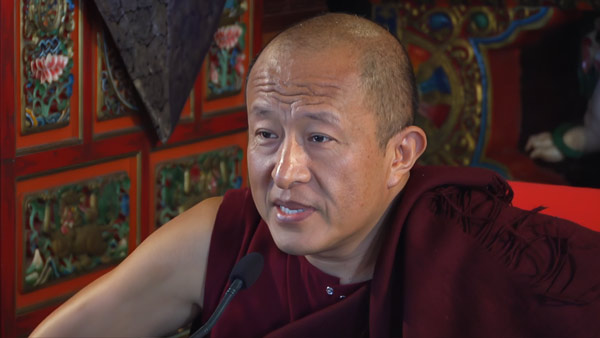
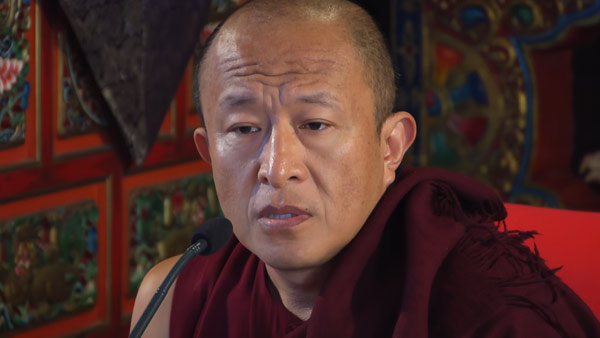
Chokyi Nyima Rinpoche:
Welcome.
My English is bad.
But anyway, we are all very fortunate.
Jamyang Khyentse Wangpo, reincarnation.
One of the very handsome and smart.
Rinpoche
So he will teach today.
So I'm very happy.
Please enjoy.
Thank you very much.
DKR: Okay. So, I'd like to know how many of you...
already
labeling yourself as Buddhist. Can you raise your hand?
I just need to know because
According to the great Nagarjuna,
for those who cherish and venerate
wisdom, even though they may have not necessarily joined a path, a spiritual path,
it is important to explore the the wisdom aspect of the teaching first, and then
go back to the basic and start from the beginning. If you are already in the path, then of course we follow
as it is in most of the traditional texts such as this one. So since the majority of you seem to have already majority of you seem to have already some familiarity with the Buddha Dharma I'm going to go through the stanzas just as it is written by Lama Tsongkhapa.
I have received this teaching from Khyabje Dilgo Khyentse Rinpoche.
Lama Tsongkhapa, as many of you know, is very unique and one of the greatest
scholar, saint.
At times in Tibet, he was referred as one out of the three Manjushri's of Tibet.
Lama Tsongkhapa's influence, as many of you know, is enormous.
This is one of his early works.
And as many of you know, Lama Tsongkhapa also has
a strong influence of Kadampa tradition. And you will hear the Kadampa flavor throughout this text.
And more than ever, we need the Kadampa approach of mind training at this time and age.
So
I take this as an
opportunity to accumulate merit for having this occasion to share Lama Tsongkhapa's work with you.
Some of you, those who are studying in the Ranjung Yeshe Institute, I'm sure know the phenomena of great Mipampa and Goram Jampa. And if you are, you must be quite familiar with
debate or argument between Lama Tsongkhapa and the rest, so to speak.
Argument is one of the most precious Indian psyche. It is actually, a sober argument is probably
one of the most important approach to the study of Buddhism. And if you are, and I stress the word sober, if you look at the argument between, for instance, Gorampa and Lama Tsongkhapa and Mipham Rinpoche's, you will notice Lama Tsongkhapa actually represents some of the most subtle, most important habitual pattern that we so cherish, that need to be discussed and that need to be refined. And that's important, that's really important. Actually, the debate between the philosophical system of India, if you look at it, I don't know so much about other religion, but if you look at the argument and the debate between so-called Hinduism, by the way, the word Hinduism is invented by Abrahamic people. There is no such word as Hindu in the entire Indian philosophical system. It's invented by the Abrahamic people.
Anyway, if you look at study and the argument between so-called Hinduism and Jainism and Buddhism, they are priceless, they are priceless, so precious.
You should not
treat them as some kind of a war between two religions that is fought for territory, quantity of wives and certain hang-ups. Jainism, Buddhism and Hinduism is not a mere survival kit that is given to a specific tribes.
Anyway, let's go back to tune myself into the actual text.
So first stanza, I mean the first, as usual, we find veneration’s to the Guru. We offer our veneration’s to the Guru. Now this is another important... It's not really a culture actually, but it is now perceived as a culture. So for the sake of conversation, let's say this is one of the most important cultures, if you like, in Buddhism and Hinduism or Jainism, veneration’s to the Guru. In the Indian philosophical system, there is something called Guru-Shiksha-Parampara, which is something unfortunately dying today.
But if you can understand the value of the guru and disciple, or the guru and student relationship if you are looking for liberation, then guru-disciple phenomena or the guru-student phenomena is probably one of the most indispensable. But if you are only looking for knowledge, or if you are looking for a temporary feel-good kind of satisfaction, then of course guru is probably the worst news.
Even to have a weekend holiday in somewhere like Bali or Hawaii with your beloved one, somehow you will end up in some kind of argument.
And having a companion called guru from now till forever is just... the very idea is a daunting. But if you are looking for a liberation, guru is must. And as Lama Tsongkhapa will say right after this, this text is dedicated for those who wish to find the liberation, assuming. First and most importantly, we offer our veneration’s to the guru. And this is of course by the author, but of course this also applies to you and me who is discussing this today, if we are looking for liberation. And this is very clearly stated right after this.
If the fortunate being,
if you are this fortunate being whose sole purpose of pursuing the path is liberation, now this is a big statement. It's easy to say this, but to really mean it is difficult. Many of us here, including myself, we are not really looking for liberation. Most of us, we are consciously or unconsciously looking for satisfaction, some sort of gratification, satisfaction,
happiness. And this is where comments like, Buddhism is a vehicle to happiness is very dangerous. It may be kind of... what do you call it? It might create goosebumps when you read in Times magazine if you are a Buddhist. Wow, you know, Buddhism, happiness, non-violence, Buddhism, non-violence, happiness. These are almost like synonymous, but this is dangerous. Buddhists don't care about non-violence ultimately. Buddhists don't care about happiness. It should not. Buddhists should care about liberation. That's more important,
what is non-violence. It's only for people who come from Cape Town, or Scotland, or Byron Bay.
So,
liberation, those who are seeking the liberation,
for them,
I, Tsongkhapa, according to the great Buddhas and Bodhisattvas, according to the path that is praised by the Buddhas and Bodhisattvas, I, Tsongkhapa, shall try to express this here.
Such standards, as many of the Rangjung Yeshe Institute students will know, is again another Indian habit. There is always the veneration, and then there is something called... which is sort of pledging to write a text, or pledging to do something. And it is actually a very wholesome activity, specially prescribed and encouraged for the Bodhisattvas. You know, bodhichitta is, to the certain extent, bodhichitta is a pledge, aspiration, if you like. The pledge, or the aspiration, moves, drives, it is a driving force to do whatever we like, actually, not just the enlightened activities, but any other activities, you need that drive. And specially,
one that wishes to pursue the path of Mahāyāna, Bodhisattvayana path, must always generate this pledge, or aspiration, or promise. So, accordingly, you will find this kind of I am sure many of you know, it is like pledging to write this. Habit. You will find this in many of the Indian classical texts, and therefore the Tibetans later also followed that tradition. I read Jain teachings, and it is almost identical, that is how they write, they venerate to the gurus, and then they pledge to write the holy text.
This is stressed, emphasized again, what we have just discussed.
If I make my own commentary, so to speak, here, Lama Tsongkhapa is saying, this text is written for three kinds of people, or people who have three kinds of attitude, at the least.
One and most importantly, is those who, doesn't those who, this...
This text is written for, or taught for,
type of people who ultimately doesn't give a damn about samsaric values. Ultimately, of course. You know, for the time being, it is impossible for us to, you know, act like, you know, like if you bring a fresh grass in front of a tiger, a tiger will, you know, like that, ignore it. I don't think we can do that right now, when the worldly phenomena such as this, that I'm stirring, you know, there is that, you know, desire and all of that. But, even if you have this ability to give, to really not make big deal out of this samsaric values, ultimately, in other words, Lama Tsongkhapa is talking about a renunciation mind, revulsion, as long as you think that samsara, samsaric life, worldly life, has some sort of a, you know, ultimate value, this text is not for you. As long as you think that all the misgivings that we have been having, and as long as we think that somehow these misgivings can be fixed,
that it can be mended,
this text is not for you.
If you have this attitude, okay, let's say you are plumbing, you know, you are your plumbing system is not working, or your sewage system is not working in your bathroom, and your attitude is, oh well, let's scotch tape it. You understand? Let's scotch tape it, let's glue it. Anyway, if I can use it for maybe like two days, fair enough. Ah, now this text is for you. But if you think that my house, my family, my beloved one, I can fix it, I can really. One day I will live happily forever and have a big family group photograph, as in Bollywood films, usually, towards the end. As long as you have that, this text is not for you. But as long as you think, no matter what, I am stained permanently, with a disease that can never be cured. I am permanently, forever damaged. I can sort of mend a little bit. Actually, can you now see why the Tibetans and the Indians and the Nepalese are not so good with maintenance? Probably this influence of such teachings, they, they have that attitude, you know like, oh well, you know.
I am serious, I am sure this kind of psyche gets influenced by this kind of teachings, you know, impermanent. But anyway, you have to have that kind of... that it's not going to work. We are, you know, this... the moment you stumble out of your mother's womb, the moment you stumble out of that, the doom began. This is why the Nagarjuna, Nagarjuna's letter to his friend, ......he said,
you know how usually we always consider the death as the worst news? But according to the Nagarjuna, he said to his friend, yes, of course death is not good, but there is something worse and that's called birth.
Make sure that you don't reborn again. That was his message by Nagarjuna to ..... As, so.... as soon as we stumble out of mother's womb, we are in a place where where we are, we have to live with permanently damaged and it's going to get worse basically for most of us, quicker than the others. For them, if you can think like that, this text is for you. This Lama Tsongkhapa's advice is written for you.
And then also, this text is written for someone who cherishes. We talked kind of negatively about our life, but then immediately juxtaposing what we have just discussed, cherishing this ability that we have as a human. You know, we as a human, we have so much ability. For instance, the idea of having an address, that is an amazing ability that you can find things, you understand, an address. Just so many things that we have to label. I don't know, measurements. We have the ability to save food for tomorrow. Many, many beings don't have that. Many beings, they just have to eat whatever they encounter, there and then, because next we don't know. Next, they may never find the food. But most of the beings like us, you and me, human beings, we have amazing ability. Amazing, actually, so amazing. And out of the amazing ability that we have, we are probably not even using the one percent of our ability. In fact, most of our ability is being misused. So, this text is written for those who cherishes this ability. Cherishes, but also with a sense of urgency. You know, we don't have much time. Good old, you know, good old 50 years is gone. For some of us, that's half a century. To live, you know, a century old is difficult.
Life ebbs away faster than we think.
So, thinking this way, if you think of impermanence, all the more reason to cherish this human ability that we have. So much ability. Among many abilities that we human beings have, we have the ability to self-contemplate,
aware of oneself. Now, that is quite an amazing ability. Actually, that is the supreme most ability that we have. We can actually be aware of our own thoughts.
Many beings don't. Even the gods, devas, they don't, they don't have this ability. But we do.
We have so many, I don't know, not just mentally, but even biologically there is a lot of condition that makes us, that has the, what do you call it, that has the... facility or faculties that creates the faculties or the facilities or condition to be aware of oneself, such as wasabi.
The most... It would just, you know like, bring you right there. And yes, even romance, love, songs, poetry, all this mushy, touchy-feely stuff that we do have, those are the closest things. You know, And then the ability to, for many of us, the ability to orgasm,
ability to you know, enjoy the so-called bliss out of the friction, stuff like that. So this, there are so many abilities, and that needs to be cherished with a sense of urgency. So for those kind of people, this is written.
The third one, much grander. The first one is like, okay, someone who is a bit wary and a bit suspicious about the samsara. The second one is appreciating the human ability. The third one is a very grander attitude, really grander attitude, Mahāyāna attitude.
Someone who is interested
to follow the path that Buddhas and Bodhisattvas in the past and the present and also in the future likes or pursues. That is a very grand attitude. We are talking about Mahāyāna basically. It doesn't matter whether you are in the samsara or not, okay? My precious human body, it may be damaged, it may be misused, but one thing that we really want to sort of spend our life is to pursue the path that is followed and being followed by the Buddhas and Bodhisattvas, meaning benefiting sentient beings. So those who wish to benefit sentient beings, those who are not only putting everything in self-cherish path, self-cherishing path, but those who wish to cherish others. So for those, this text is written. So that is what he is saying here. If you have that kind of attitude, with a clear, sober, unbiased mind, listen. This is again, every word Tsongkhapa chose is very important, such as..... You don't have to believe, you don't have to be blindly, you know, sucking into this. You have to be, you know, you can read in a bit of clear mind.
Listen to this.
This text is called...
three principles of the path. And briefly they are renunciation mind, bodhichitta, and understanding the dependent arising or emptiness. These three principles are indispensable to make the Mahāyāna path.
So I will just first go through the stanzas, and then we can come back to the, sort of the connection of these three principles. Probably you will get it as we go through. But,
if you find it, there is no reason why the text is so clearly put together. But if you like, and if we have time, we could discuss the relation, the relationship or connection with these three. It's very clearly there.
Again, seemingly repetition, but it's not really a repetition, we are emphasizing this.
But probably I will have to say this one first before we embark on the text.
Because here we are talking about, we are beginning with a renunciation. And then you will hear words like... like longing for liberation. Words like longing for liberation can be at times, quite a lot of times, misleading. So here for those who are, especially those who are already well informed about the Mahāyāna Sūtras and Śāstras, you should hear this information, which is, it's important for the Mahāyāna people to know that
nirvana, or the liberation, is unlongingable. Is there such an English word? Not longable. You know, longing, longing. You cannot, liberation is not longingable. Okay, let's invent a word. English is fine.
You cannot long. It's in the Mahāyāna, again, another set of three principles, which is, you know,
The result is beyond aspiration, sometimes it is termed as. So, because,
yes, you cannot long for, long for the enlightenment, okay?
So then what is the path for? If you can't long for the enlightenment, what is the path for? That's the simple question. Path is there because even though the result, enlightenment, is not longingable, you made a mistake by longing the worldly life, the worldly values. That's what you did. So this is why, this is one angle, this is one angle, there's many different angles to reach here. So you cannot long the enlightenment, but there is a path because you long for things that should only be scotch taped, but you didn't. You are trying to fix it permanently. So we need to liberate you, all of us, you including me. We need to liberate ourselves from this delusion that all these things can be fixed permanently. And this is what we call liberation. So this has been stated many times in the Mahāyāna Śāstra and the Sūtras. I mean the one famous one is Nagarjuna's
Nagarjuna's praise to the Buddha which says, Buddha I praise you who didn't teach us that there is nirvana by abandoning the samsara. But who taught us the very non-existence of the samsara is the nirvana, so on and so forth. There's so many, many of these. So we are basically talking the same thing.
Okay, so if we go back to the stanza then...
We are, okay for the sake of communication, we are longing for peace, we are longing for bliss, the nirvana, but that can only happen by generating genuine renunciation and revulsion towards this vast and deep ocean of samsara. Because until then, if you carry on
with a strong attachment to this illusion of samsara, it will only bind you. So therefore, one who wishes to follow the path must first... must first search for renunciation mind. Even the word... even the word... is such a right choice of word by Lama Tsongkhapa. ...meaning search, search for the renunciation mind. It won't come right away. You have to search, you have to tell yourself, you have to educate, you have to gather influence, you have to pray, you have to... Yes, you have to long, to not long the samsara. This is what... you know this, didn't I say at the beginning? You will hear a lot of flavor of kadampa. And this is, here is another one.
You have to, yes, long to not long the samsaric values.
And here Lama Tsongkhapa gives us few tips on how to generate this renunciation mind.
Never forget this precious human ability is difficult to obtain again and again. It's almost like once in a blue moon.
We have it. Kind of. We don't know whether we have it completely. But I think we do, we kind of...
I mean there are so many better things to do than this. But we are still here. So it must mean either you are trying to finish your dissertation or that you are some sort of you know longing for way out, so to speak. So, let's assume that we do have this kind of ability, human ability. And this is difficult to obtain again and again. And on top of that, you know, on top of that, our life is completely impermanent. We are certainly going to die, that's for sure. But that's not the worst news. Even worse than the certainty of the death is uncertainty when it will come. That's the worst actually. Yes, we are all going to die. That's kind of... You have to take that one. But when we are going to die, that we don't know. And that's the most depressing part. That needs to be thought of again and again.
If you think this again and again. Then...
Amazing choice of words again. Then you will not, you know... At the moment... means this life. It's more than this life actually. We, most of us, we only think what is in front of us. Or sometimes in the Tibetan we call it... means this side, this side. Not beyond this side. You know, Prajñāpāramitā similar. Is this side. We only think of this side. We only have this zone. We have a certain zone. We only think this way. And as I always say, we always... We only think in terms of a certain logic like four plus four is eight. Never go beyond, oh it could be five. That's unheard of. That's like...
breaking a big rule of this zone.
So we have this continuous making big deal out of what we see right in front of you. Now by contemplating on the precious human body and the impermanence of our life this, then become
fragile. I mean, it's a bit like this. If you know you are going to die in two days, for sure. Two days, that's it. Would you still iron your underwear? Would you still go through your Facebooks? Or, a lot of things. Or... You know, there are things that you do
and if somebody comes, somebody with authority says oh, actually you can have another extra day. Would you want it?
Developing this kind of awareness of precious human body and impermanence gradually
divert ourselves from making big deal out of what is in front of you. What is just this, you know, this side. Okay, so that's one. That's Lama Tsongkhapa's suggestion for generating that renunciation. Then,
Then in order to again this is another big one. Not only we should not be making big deal out of what is in front of you, this life but actually as a follower of the Mahāyāna path we should not be making a big deal out of what is next life. That is also not, that should not be in your agenda. Good life, higher rebirth, becoming a tulku, blah blah, all of that should not be in your agenda. Liberation is all you should be caring. Not only your own liberation but the liberation of all sentient beings. So how do we do that?
Think about power of karma and the downfall of samsara, downfall of our life, existence... the worldly existence. Power of karma, that is a very big one. Basically, none of us is free from conditioning. We are all conditioned. Whatever you are thinking right this very moment even though it is most mundane thought it is because of a certain condition. We think... We think we are independent and we are free. Never. There is no freedom. We are terrorized under the tyranny, under the dictatorship of conditioning.
All of us. From the... anarchist, existentialist to the Mahāyāna, Vajrayana practitioners. All of us. We are all under the influence of conditioning. And that is so... What do you call it?
If you think about that then you won't have much appetite for a better future. We are talking about the future right now. Right. We already talked about this one. We are preparing for the future. So he is talking here. Think about the karma. Then your appetite for a better future will dismantle. And that is important. And this, if you think about these again and again and again you will have less and less aspiration for the worldly goods. In fact, you won't have any desire. And then, day and night, every moment you will only long to get out of this net of delusion. And this is an indication that you have achieved ... or renunciation.
That's one principle.
This is amazing. If, okay say you have generated this kind of renunciation mind this kind of revulsion towards the samsaric life perfectly, quite, you know, strongly but if you are lacking the bodhichitta
then such kind of renunciation mind is just pain in the ass. It's really, totally a cause of depression. It's a dead end.
Okay. Things doesn't work, you know. To the certain extent, a lot of modern people have that kind of renunciation mind you know like nothing works, life has no meaning as soon as the effect of the substance is diminishing. Again, back to the hollow life
no purpose breakfast, lunch, dinner, again tomorrow, the same thing. Friends, done this, done that, been there, been here, been everywhere still the same thing.
Multi-brands of moisturizers has been used. Still, the true color and the nature of the skin exhibits more and more everyday
width and the breadth of the type of men and women that we date gets bigger and bigger we are less and less fussy, anything will do, kind of
and nothing satisfies us kind of deeply we have to try all kinds of gadgets
even cheese graters as part of the foreplay game.
Still, we have become so numb our sensitive spots have basically forever disappeared
all the should not be sensitive have become completely exposed. So even, I don't know, sight and the smell of something annoys you etc, etc, when these things happen but anyway, that's not the renunciation mind that's... that's not the renunciation mind we are trying to achieve or cultivate but anyway, here he says...
Even though you have the renunciation mind if you don't have the bodhichitta that kind of renunciation mind will not be the cause of liberation of oneself and others in fact, it will just make you depress. Therefore, wise ones, smart people should cultivate, plant the bodhichitta mind.
So how do we do that? How do we develop the bodhichitta?
To generate this bodhichitta
we need to think about the
situation and the state of the samsaric beings, including oneself, we need to be aware of that first. And what are they? Briefly, Lama Tsongkhapa, clearly represents here.
We are, we are being swayed and carried without any control by the four currents, river. We have no control. We are carried, swept, swayed, drifted by four currents. And they are birth, old age, sickness and death. These four
G7 meetings, United Nations, United this, President this, Prime Minister this, Guru this, Guru that... none of this can control these four currents. None.
If you, if we cannot... even forget about, forget about controlling, if we can't stir a little bit this four currents of birth, old age, sickness and death, the whole point of conferences, summits,
is useless for ecology, for world peace, for, I don't know, trade. It's useless. All these structures are a complete joke, like United Nations, this, that, society. Probably, you know, red light and green light, it's okay, you know, but here it doesn't work so much also. Some of them. Because the root of the problem, I mean, the machine of our suffering is this current, this four currents, the birth, old age, sickness and death. That we can't do anything. Can we have a summit about, okay, birth, we cannot. Can we have a summit and a conference about how to age, wisely? There is a lot, but there are just... when you age, you will age.
Death, sickness,
people who come from Singapore, Switzerland, I don't know, all these developed countries, those who supposedly have the state of art medical system, they are the most sick people sometimes. They are the most unhealthy, complete hypochondriac. Street kids here running around, rolling in the dust, garbages. I don't know whether they even have a flu. They don't seem to cough even. Have you seen a beggar coughing?
You have to wait a long time, I think.
We cannot have summits, we cannot have conferences on those things. Those current, when they come, when they flood, and they do all the time, it's not as if they are... Not now, they are going to come one of these days, it's not that it's coming, it's flowing, it's running right now.
So, we are being swayed, controlled by these currents. We are being bound by amazingly tight rope of our own cause and condition, karma. And then the worst of all, these two are not that bad, but the worst is we are trapped in the casket of, the iron-made casket of clinging to the self, cherishing the self. And therefore, we are
under the darkness of ignorance. And endlessly, we take birth. Endlessly, we die. And therefore, we go through the suffering of suffering, suffering of change, and all pervasive suffering, endlessly. Looking at these situations and the appearance of oneself and all sentient beings, one must generate the bodhichitta. Okay, let's take a break. It's getting a little stuffy.
DKR: Okay. So, I'd like to know how many of you...
already
labeling yourself as Buddhist. Can you raise your hand?
I just need to know because
According to the great Nagarjuna,
for those who cherish and venerate
wisdom, even though they may have not necessarily joined a path, a spiritual path,
it is important to explore the the wisdom aspect of the teaching first, and then
go back to the basic and start from the beginning. If you are already in the path, then of course we follow
as it is in most of the traditional texts such as this one. So since the majority of you seem to have already majority of you seem to have already some familiarity with the Buddha Dharma I'm going to go through the stanzas just as it is written by Lama Tsongkhapa.
I have received this teaching from Khyabje Dilgo Khyentse Rinpoche.
Lama Tsongkhapa, as many of you know, is very unique and one of the greatest
scholar, saint.
At times in Tibet, he was referred as one out of the three Manjushri's of Tibet.
Lama Tsongkhapa's influence, as many of you know, is enormous.
This is one of his early works.
And as many of you know, Lama Tsongkhapa also has
a strong influence of Kadampa tradition. And you will hear the Kadampa flavor throughout this text.
And more than ever, we need the Kadampa approach of mind training at this time and age.
So
I take this as an
opportunity to accumulate merit for having this occasion to share Lama Tsongkhapa's work with you.
Some of you, those who are studying in the Ranjung Yeshe Institute, I'm sure know the phenomena of great Mipampa and Goram Jampa. And if you are, you must be quite familiar with
debate or argument between Lama Tsongkhapa and the rest, so to speak.
Argument is one of the most precious Indian psyche. It is actually, a sober argument is probably
one of the most important approach to the study of Buddhism. And if you are, and I stress the word sober, if you look at the argument between, for instance, Gorampa and Lama Tsongkhapa and Mipham Rinpoche's, you will notice Lama Tsongkhapa actually represents some of the most subtle, most important habitual pattern that we so cherish, that need to be discussed and that need to be refined. And that's important, that's really important. Actually, the debate between the philosophical system of India, if you look at it, I don't know so much about other religion, but if you look at the argument and the debate between so-called Hinduism, by the way, the word Hinduism is invented by Abrahamic people. There is no such word as Hindu in the entire Indian philosophical system. It's invented by the Abrahamic people.
Anyway, if you look at study and the argument between so-called Hinduism and Jainism and Buddhism, they are priceless, they are priceless, so precious.
You should not
treat them as some kind of a war between two religions that is fought for territory, quantity of wives and certain hang-ups. Jainism, Buddhism and Hinduism is not a mere survival kit that is given to a specific tribes.
Anyway, let's go back to tune myself into the actual text.
So first stanza, I mean the first, as usual, we find veneration’s to the Guru. We offer our veneration’s to the Guru. Now this is another important... It's not really a culture actually, but it is now perceived as a culture. So for the sake of conversation, let's say this is one of the most important cultures, if you like, in Buddhism and Hinduism or Jainism, veneration’s to the Guru. In the Indian philosophical system, there is something called Guru-Shiksha-Parampara, which is something unfortunately dying today.
But if you can understand the value of the guru and disciple, or the guru and student relationship if you are looking for liberation, then guru-disciple phenomena or the guru-student phenomena is probably one of the most indispensable. But if you are only looking for knowledge, or if you are looking for a temporary feel-good kind of satisfaction, then of course guru is probably the worst news.
Even to have a weekend holiday in somewhere like Bali or Hawaii with your beloved one, somehow you will end up in some kind of argument.
And having a companion called guru from now till forever is just... the very idea is a daunting. But if you are looking for a liberation, guru is must. And as Lama Tsongkhapa will say right after this, this text is dedicated for those who wish to find the liberation, assuming. First and most importantly, we offer our veneration’s to the guru. And this is of course by the author, but of course this also applies to you and me who is discussing this today, if we are looking for liberation. And this is very clearly stated right after this.
If the fortunate being,
if you are this fortunate being whose sole purpose of pursuing the path is liberation, now this is a big statement. It's easy to say this, but to really mean it is difficult. Many of us here, including myself, we are not really looking for liberation. Most of us, we are consciously or unconsciously looking for satisfaction, some sort of gratification, satisfaction,
happiness. And this is where comments like, Buddhism is a vehicle to happiness is very dangerous. It may be kind of... what do you call it? It might create goosebumps when you read in Times magazine if you are a Buddhist. Wow, you know, Buddhism, happiness, non-violence, Buddhism, non-violence, happiness. These are almost like synonymous, but this is dangerous. Buddhists don't care about non-violence ultimately. Buddhists don't care about happiness. It should not. Buddhists should care about liberation. That's more important,
what is non-violence. It's only for people who come from Cape Town, or Scotland, or Byron Bay.
So,
liberation, those who are seeking the liberation,
for them,
I, Tsongkhapa, according to the great Buddhas and Bodhisattvas, according to the path that is praised by the Buddhas and Bodhisattvas, I, Tsongkhapa, shall try to express this here.
Such standards, as many of the Rangjung Yeshe Institute students will know, is again another Indian habit. There is always the veneration, and then there is something called... which is sort of pledging to write a text, or pledging to do something. And it is actually a very wholesome activity, specially prescribed and encouraged for the Bodhisattvas. You know, bodhichitta is, to the certain extent, bodhichitta is a pledge, aspiration, if you like. The pledge, or the aspiration, moves, drives, it is a driving force to do whatever we like, actually, not just the enlightened activities, but any other activities, you need that drive. And specially,
one that wishes to pursue the path of Mahāyāna, Bodhisattvayana path, must always generate this pledge, or aspiration, or promise. So, accordingly, you will find this kind of I am sure many of you know, it is like pledging to write this. Habit. You will find this in many of the Indian classical texts, and therefore the Tibetans later also followed that tradition. I read Jain teachings, and it is almost identical, that is how they write, they venerate to the gurus, and then they pledge to write the holy text.
This is stressed, emphasized again, what we have just discussed.
If I make my own commentary, so to speak, here, Lama Tsongkhapa is saying, this text is written for three kinds of people, or people who have three kinds of attitude, at the least.
One and most importantly, is those who, doesn't those who, this...
This text is written for, or taught for,
type of people who ultimately doesn't give a damn about samsaric values. Ultimately, of course. You know, for the time being, it is impossible for us to, you know, act like, you know, like if you bring a fresh grass in front of a tiger, a tiger will, you know, like that, ignore it. I don't think we can do that right now, when the worldly phenomena such as this, that I'm stirring, you know, there is that, you know, desire and all of that. But, even if you have this ability to give, to really not make big deal out of this samsaric values, ultimately, in other words, Lama Tsongkhapa is talking about a renunciation mind, revulsion, as long as you think that samsara, samsaric life, worldly life, has some sort of a, you know, ultimate value, this text is not for you. As long as you think that all the misgivings that we have been having, and as long as we think that somehow these misgivings can be fixed,
that it can be mended,
this text is not for you.
If you have this attitude, okay, let's say you are plumbing, you know, you are your plumbing system is not working, or your sewage system is not working in your bathroom, and your attitude is, oh well, let's scotch tape it. You understand? Let's scotch tape it, let's glue it. Anyway, if I can use it for maybe like two days, fair enough. Ah, now this text is for you. But if you think that my house, my family, my beloved one, I can fix it, I can really. One day I will live happily forever and have a big family group photograph, as in Bollywood films, usually, towards the end. As long as you have that, this text is not for you. But as long as you think, no matter what, I am stained permanently, with a disease that can never be cured. I am permanently, forever damaged. I can sort of mend a little bit. Actually, can you now see why the Tibetans and the Indians and the Nepalese are not so good with maintenance? Probably this influence of such teachings, they, they have that attitude, you know like, oh well, you know.
I am serious, I am sure this kind of psyche gets influenced by this kind of teachings, you know, impermanent. But anyway, you have to have that kind of... that it's not going to work. We are, you know, this... the moment you stumble out of your mother's womb, the moment you stumble out of that, the doom began. This is why the Nagarjuna, Nagarjuna's letter to his friend, ......he said,
you know how usually we always consider the death as the worst news? But according to the Nagarjuna, he said to his friend, yes, of course death is not good, but there is something worse and that's called birth.
Make sure that you don't reborn again. That was his message by Nagarjuna to ..... As, so.... as soon as we stumble out of mother's womb, we are in a place where where we are, we have to live with permanently damaged and it's going to get worse basically for most of us, quicker than the others. For them, if you can think like that, this text is for you. This Lama Tsongkhapa's advice is written for you.
And then also, this text is written for someone who cherishes. We talked kind of negatively about our life, but then immediately juxtaposing what we have just discussed, cherishing this ability that we have as a human. You know, we as a human, we have so much ability. For instance, the idea of having an address, that is an amazing ability that you can find things, you understand, an address. Just so many things that we have to label. I don't know, measurements. We have the ability to save food for tomorrow. Many, many beings don't have that. Many beings, they just have to eat whatever they encounter, there and then, because next we don't know. Next, they may never find the food. But most of the beings like us, you and me, human beings, we have amazing ability. Amazing, actually, so amazing. And out of the amazing ability that we have, we are probably not even using the one percent of our ability. In fact, most of our ability is being misused. So, this text is written for those who cherishes this ability. Cherishes, but also with a sense of urgency. You know, we don't have much time. Good old, you know, good old 50 years is gone. For some of us, that's half a century. To live, you know, a century old is difficult.
Life ebbs away faster than we think.
So, thinking this way, if you think of impermanence, all the more reason to cherish this human ability that we have. So much ability. Among many abilities that we human beings have, we have the ability to self-contemplate,
aware of oneself. Now, that is quite an amazing ability. Actually, that is the supreme most ability that we have. We can actually be aware of our own thoughts.
Many beings don't. Even the gods, devas, they don't, they don't have this ability. But we do.
We have so many, I don't know, not just mentally, but even biologically there is a lot of condition that makes us, that has the, what do you call it, that has the... facility or faculties that creates the faculties or the facilities or condition to be aware of oneself, such as wasabi.
The most... It would just, you know like, bring you right there. And yes, even romance, love, songs, poetry, all this mushy, touchy-feely stuff that we do have, those are the closest things. You know, And then the ability to, for many of us, the ability to orgasm,
ability to you know, enjoy the so-called bliss out of the friction, stuff like that. So this, there are so many abilities, and that needs to be cherished with a sense of urgency. So for those kind of people, this is written.
The third one, much grander. The first one is like, okay, someone who is a bit wary and a bit suspicious about the samsara. The second one is appreciating the human ability. The third one is a very grander attitude, really grander attitude, Mahāyāna attitude.
Someone who is interested
to follow the path that Buddhas and Bodhisattvas in the past and the present and also in the future likes or pursues. That is a very grand attitude. We are talking about Mahāyāna basically. It doesn't matter whether you are in the samsara or not, okay? My precious human body, it may be damaged, it may be misused, but one thing that we really want to sort of spend our life is to pursue the path that is followed and being followed by the Buddhas and Bodhisattvas, meaning benefiting sentient beings. So those who wish to benefit sentient beings, those who are not only putting everything in self-cherish path, self-cherishing path, but those who wish to cherish others. So for those, this text is written. So that is what he is saying here. If you have that kind of attitude, with a clear, sober, unbiased mind, listen. This is again, every word Tsongkhapa chose is very important, such as..... You don't have to believe, you don't have to be blindly, you know, sucking into this. You have to be, you know, you can read in a bit of clear mind.
Listen to this.
This text is called...
three principles of the path. And briefly they are renunciation mind, bodhichitta, and understanding the dependent arising or emptiness. These three principles are indispensable to make the Mahāyāna path.
So I will just first go through the stanzas, and then we can come back to the, sort of the connection of these three principles. Probably you will get it as we go through. But,
if you find it, there is no reason why the text is so clearly put together. But if you like, and if we have time, we could discuss the relation, the relationship or connection with these three. It's very clearly there.
Again, seemingly repetition, but it's not really a repetition, we are emphasizing this.
But probably I will have to say this one first before we embark on the text.
Because here we are talking about, we are beginning with a renunciation. And then you will hear words like... like longing for liberation. Words like longing for liberation can be at times, quite a lot of times, misleading. So here for those who are, especially those who are already well informed about the Mahāyāna Sūtras and Śāstras, you should hear this information, which is, it's important for the Mahāyāna people to know that
nirvana, or the liberation, is unlongingable. Is there such an English word? Not longable. You know, longing, longing. You cannot, liberation is not longingable. Okay, let's invent a word. English is fine.
You cannot long. It's in the Mahāyāna, again, another set of three principles, which is, you know,
The result is beyond aspiration, sometimes it is termed as. So, because,
yes, you cannot long for, long for the enlightenment, okay?
So then what is the path for? If you can't long for the enlightenment, what is the path for? That's the simple question. Path is there because even though the result, enlightenment, is not longingable, you made a mistake by longing the worldly life, the worldly values. That's what you did. So this is why, this is one angle, this is one angle, there's many different angles to reach here. So you cannot long the enlightenment, but there is a path because you long for things that should only be scotch taped, but you didn't. You are trying to fix it permanently. So we need to liberate you, all of us, you including me. We need to liberate ourselves from this delusion that all these things can be fixed permanently. And this is what we call liberation. So this has been stated many times in the Mahāyāna Śāstra and the Sūtras. I mean the one famous one is Nagarjuna's
Nagarjuna's praise to the Buddha which says, Buddha I praise you who didn't teach us that there is nirvana by abandoning the samsara. But who taught us the very non-existence of the samsara is the nirvana, so on and so forth. There's so many, many of these. So we are basically talking the same thing.
Okay, so if we go back to the stanza then...
We are, okay for the sake of communication, we are longing for peace, we are longing for bliss, the nirvana, but that can only happen by generating genuine renunciation and revulsion towards this vast and deep ocean of samsara. Because until then, if you carry on
with a strong attachment to this illusion of samsara, it will only bind you. So therefore, one who wishes to follow the path must first... must first search for renunciation mind. Even the word... even the word... is such a right choice of word by Lama Tsongkhapa. ...meaning search, search for the renunciation mind. It won't come right away. You have to search, you have to tell yourself, you have to educate, you have to gather influence, you have to pray, you have to... Yes, you have to long, to not long the samsara. This is what... you know this, didn't I say at the beginning? You will hear a lot of flavor of kadampa. And this is, here is another one.
You have to, yes, long to not long the samsaric values.
And here Lama Tsongkhapa gives us few tips on how to generate this renunciation mind.
Never forget this precious human ability is difficult to obtain again and again. It's almost like once in a blue moon.
We have it. Kind of. We don't know whether we have it completely. But I think we do, we kind of...
I mean there are so many better things to do than this. But we are still here. So it must mean either you are trying to finish your dissertation or that you are some sort of you know longing for way out, so to speak. So, let's assume that we do have this kind of ability, human ability. And this is difficult to obtain again and again. And on top of that, you know, on top of that, our life is completely impermanent. We are certainly going to die, that's for sure. But that's not the worst news. Even worse than the certainty of the death is uncertainty when it will come. That's the worst actually. Yes, we are all going to die. That's kind of... You have to take that one. But when we are going to die, that we don't know. And that's the most depressing part. That needs to be thought of again and again.
If you think this again and again. Then...
Amazing choice of words again. Then you will not, you know... At the moment... means this life. It's more than this life actually. We, most of us, we only think what is in front of us. Or sometimes in the Tibetan we call it... means this side, this side. Not beyond this side. You know, Prajñāpāramitā similar. Is this side. We only think of this side. We only have this zone. We have a certain zone. We only think this way. And as I always say, we always... We only think in terms of a certain logic like four plus four is eight. Never go beyond, oh it could be five. That's unheard of. That's like...
breaking a big rule of this zone.
So we have this continuous making big deal out of what we see right in front of you. Now by contemplating on the precious human body and the impermanence of our life this, then become
fragile. I mean, it's a bit like this. If you know you are going to die in two days, for sure. Two days, that's it. Would you still iron your underwear? Would you still go through your Facebooks? Or, a lot of things. Or... You know, there are things that you do
and if somebody comes, somebody with authority says oh, actually you can have another extra day. Would you want it?
Developing this kind of awareness of precious human body and impermanence gradually
divert ourselves from making big deal out of what is in front of you. What is just this, you know, this side. Okay, so that's one. That's Lama Tsongkhapa's suggestion for generating that renunciation. Then,
Then in order to again this is another big one. Not only we should not be making big deal out of what is in front of you, this life but actually as a follower of the Mahāyāna path we should not be making a big deal out of what is next life. That is also not, that should not be in your agenda. Good life, higher rebirth, becoming a tulku, blah blah, all of that should not be in your agenda. Liberation is all you should be caring. Not only your own liberation but the liberation of all sentient beings. So how do we do that?
Think about power of karma and the downfall of samsara, downfall of our life, existence... the worldly existence. Power of karma, that is a very big one. Basically, none of us is free from conditioning. We are all conditioned. Whatever you are thinking right this very moment even though it is most mundane thought it is because of a certain condition. We think... We think we are independent and we are free. Never. There is no freedom. We are terrorized under the tyranny, under the dictatorship of conditioning.
All of us. From the... anarchist, existentialist to the Mahāyāna, Vajrayana practitioners. All of us. We are all under the influence of conditioning. And that is so... What do you call it?
If you think about that then you won't have much appetite for a better future. We are talking about the future right now. Right. We already talked about this one. We are preparing for the future. So he is talking here. Think about the karma. Then your appetite for a better future will dismantle. And that is important. And this, if you think about these again and again and again you will have less and less aspiration for the worldly goods. In fact, you won't have any desire. And then, day and night, every moment you will only long to get out of this net of delusion. And this is an indication that you have achieved ... or renunciation.
That's one principle.
This is amazing. If, okay say you have generated this kind of renunciation mind this kind of revulsion towards the samsaric life perfectly, quite, you know, strongly but if you are lacking the bodhichitta
then such kind of renunciation mind is just pain in the ass. It's really, totally a cause of depression. It's a dead end.
Okay. Things doesn't work, you know. To the certain extent, a lot of modern people have that kind of renunciation mind you know like nothing works, life has no meaning as soon as the effect of the substance is diminishing. Again, back to the hollow life
no purpose breakfast, lunch, dinner, again tomorrow, the same thing. Friends, done this, done that, been there, been here, been everywhere still the same thing.
Multi-brands of moisturizers has been used. Still, the true color and the nature of the skin exhibits more and more everyday
width and the breadth of the type of men and women that we date gets bigger and bigger we are less and less fussy, anything will do, kind of
and nothing satisfies us kind of deeply we have to try all kinds of gadgets
even cheese graters as part of the foreplay game.
Still, we have become so numb our sensitive spots have basically forever disappeared
all the should not be sensitive have become completely exposed. So even, I don't know, sight and the smell of something annoys you etc, etc, when these things happen but anyway, that's not the renunciation mind that's... that's not the renunciation mind we are trying to achieve or cultivate but anyway, here he says...
Even though you have the renunciation mind if you don't have the bodhichitta that kind of renunciation mind will not be the cause of liberation of oneself and others in fact, it will just make you depress. Therefore, wise ones, smart people should cultivate, plant the bodhichitta mind.
So how do we do that? How do we develop the bodhichitta?
To generate this bodhichitta
we need to think about the
situation and the state of the samsaric beings, including oneself, we need to be aware of that first. And what are they? Briefly, Lama Tsongkhapa, clearly represents here.
We are, we are being swayed and carried without any control by the four currents, river. We have no control. We are carried, swept, swayed, drifted by four currents. And they are birth, old age, sickness and death. These four
G7 meetings, United Nations, United this, President this, Prime Minister this, Guru this, Guru that... none of this can control these four currents. None.
If you, if we cannot... even forget about, forget about controlling, if we can't stir a little bit this four currents of birth, old age, sickness and death, the whole point of conferences, summits,
is useless for ecology, for world peace, for, I don't know, trade. It's useless. All these structures are a complete joke, like United Nations, this, that, society. Probably, you know, red light and green light, it's okay, you know, but here it doesn't work so much also. Some of them. Because the root of the problem, I mean, the machine of our suffering is this current, this four currents, the birth, old age, sickness and death. That we can't do anything. Can we have a summit about, okay, birth, we cannot. Can we have a summit and a conference about how to age, wisely? There is a lot, but there are just... when you age, you will age.
Death, sickness,
people who come from Singapore, Switzerland, I don't know, all these developed countries, those who supposedly have the state of art medical system, they are the most sick people sometimes. They are the most unhealthy, complete hypochondriac. Street kids here running around, rolling in the dust, garbages. I don't know whether they even have a flu. They don't seem to cough even. Have you seen a beggar coughing?
You have to wait a long time, I think.
We cannot have summits, we cannot have conferences on those things. Those current, when they come, when they flood, and they do all the time, it's not as if they are... Not now, they are going to come one of these days, it's not that it's coming, it's flowing, it's running right now.
So, we are being swayed, controlled by these currents. We are being bound by amazingly tight rope of our own cause and condition, karma. And then the worst of all, these two are not that bad, but the worst is we are trapped in the casket of, the iron-made casket of clinging to the self, cherishing the self. And therefore, we are
under the darkness of ignorance. And endlessly, we take birth. Endlessly, we die. And therefore, we go through the suffering of suffering, suffering of change, and all pervasive suffering, endlessly. Looking at these situations and the appearance of oneself and all sentient beings, one must generate the bodhichitta. Okay, let's take a break. It's getting a little stuffy.
01:05:16
Chokyi Nyima Rinpoche:
Welcome.
My English is bad.
But anyway, we are all very fortunate.
Jamyang Khyentse Wangpo, reincarnation.
One of the very handsome and smart.
Rinpoche
So he will teach today.
So I'm very happy.
Please enjoy.
Thank you very much.
DKR: Okay. So, I'd like to know how many of you...
already
labeling yourself as Buddhist. Can you raise your hand?
I just need to know because
According to the great Nagarjuna,
for those who cherish and venerate
wisdom, even though they may have not necessarily joined a path, a spiritual path,
it is important to explore the the wisdom aspect of the teaching first, and then
go back to the basic and start from the beginning. If you are already in the path, then of course we follow
as it is in most of the traditional texts such as this one. So since the majority of you seem to have already majority of you seem to have already some familiarity with the Buddha Dharma I'm going to go through the stanzas just as it is written by Lama Tsongkhapa.
I have received this teaching from Khyabje Dilgo Khyentse Rinpoche.
Lama Tsongkhapa, as many of you know, is very unique and one of the greatest
scholar, saint.
At times in Tibet, he was referred as one out of the three Manjushri's of Tibet.
Lama Tsongkhapa's influence, as many of you know, is enormous.
This is one of his early works.
And as many of you know, Lama Tsongkhapa also has
a strong influence of Kadampa tradition. And you will hear the Kadampa flavor throughout this text.
And more than ever, we need the Kadampa approach of mind training at this time and age.
So
I take this as an
opportunity to accumulate merit for having this occasion to share Lama Tsongkhapa's work with you.
Some of you, those who are studying in the Ranjung Yeshe Institute, I'm sure know the phenomena of great Mipampa and Goram Jampa. And if you are, you must be quite familiar with
debate or argument between Lama Tsongkhapa and the rest, so to speak.
Argument is one of the most precious Indian psyche. It is actually, a sober argument is probably
one of the most important approach to the study of Buddhism. And if you are, and I stress the word sober, if you look at the argument between, for instance, Gorampa and Lama Tsongkhapa and Mipham Rinpoche's, you will notice Lama Tsongkhapa actually represents some of the most subtle, most important habitual pattern that we so cherish, that need to be discussed and that need to be refined. And that's important, that's really important. Actually, the debate between the philosophical system of India, if you look at it, I don't know so much about other religion, but if you look at the argument and the debate between so-called Hinduism, by the way, the word Hinduism is invented by Abrahamic people. There is no such word as Hindu in the entire Indian philosophical system. It's invented by the Abrahamic people.
Anyway, if you look at study and the argument between so-called Hinduism and Jainism and Buddhism, they are priceless, they are priceless, so precious.
You should not
treat them as some kind of a war between two religions that is fought for territory, quantity of wives and certain hang-ups. Jainism, Buddhism and Hinduism is not a mere survival kit that is given to a specific tribes.
Anyway, let's go back to tune myself into the actual text.
So first stanza, I mean the first, as usual, we find veneration’s to the Guru. We offer our veneration’s to the Guru. Now this is another important... It's not really a culture actually, but it is now perceived as a culture. So for the sake of conversation, let's say this is one of the most important cultures, if you like, in Buddhism and Hinduism or Jainism, veneration’s to the Guru. In the Indian philosophical system, there is something called Guru-Shiksha-Parampara, which is something unfortunately dying today.
But if you can understand the value of the guru and disciple, or the guru and student relationship if you are looking for liberation, then guru-disciple phenomena or the guru-student phenomena is probably one of the most indispensable. But if you are only looking for knowledge, or if you are looking for a temporary feel-good kind of satisfaction, then of course guru is probably the worst news.
Even to have a weekend holiday in somewhere like Bali or Hawaii with your beloved one, somehow you will end up in some kind of argument.
And having a companion called guru from now till forever is just... the very idea is a daunting. But if you are looking for a liberation, guru is must. And as Lama Tsongkhapa will say right after this, this text is dedicated for those who wish to find the liberation, assuming. First and most importantly, we offer our veneration’s to the guru. And this is of course by the author, but of course this also applies to you and me who is discussing this today, if we are looking for liberation. And this is very clearly stated right after this.
If the fortunate being,
if you are this fortunate being whose sole purpose of pursuing the path is liberation, now this is a big statement. It's easy to say this, but to really mean it is difficult. Many of us here, including myself, we are not really looking for liberation. Most of us, we are consciously or unconsciously looking for satisfaction, some sort of gratification, satisfaction,
happiness. And this is where comments like, Buddhism is a vehicle to happiness is very dangerous. It may be kind of... what do you call it? It might create goosebumps when you read in Times magazine if you are a Buddhist. Wow, you know, Buddhism, happiness, non-violence, Buddhism, non-violence, happiness. These are almost like synonymous, but this is dangerous. Buddhists don't care about non-violence ultimately. Buddhists don't care about happiness. It should not. Buddhists should care about liberation. That's more important,
what is non-violence. It's only for people who come from Cape Town, or Scotland, or Byron Bay.
So,
liberation, those who are seeking the liberation,
for them,
I, Tsongkhapa, according to the great Buddhas and Bodhisattvas, according to the path that is praised by the Buddhas and Bodhisattvas, I, Tsongkhapa, shall try to express this here.
Such standards, as many of the Rangjung Yeshe Institute students will know, is again another Indian habit. There is always the veneration, and then there is something called... which is sort of pledging to write a text, or pledging to do something. And it is actually a very wholesome activity, specially prescribed and encouraged for the Bodhisattvas. You know, bodhichitta is, to the certain extent, bodhichitta is a pledge, aspiration, if you like. The pledge, or the aspiration, moves, drives, it is a driving force to do whatever we like, actually, not just the enlightened activities, but any other activities, you need that drive. And specially,
one that wishes to pursue the path of Mahāyāna, Bodhisattvayana path, must always generate this pledge, or aspiration, or promise. So, accordingly, you will find this kind of I am sure many of you know, it is like pledging to write this. Habit. You will find this in many of the Indian classical texts, and therefore the Tibetans later also followed that tradition. I read Jain teachings, and it is almost identical, that is how they write, they venerate to the gurus, and then they pledge to write the holy text.
This is stressed, emphasized again, what we have just discussed.
If I make my own commentary, so to speak, here, Lama Tsongkhapa is saying, this text is written for three kinds of people, or people who have three kinds of attitude, at the least.
One and most importantly, is those who, doesn't those who, this...
This text is written for, or taught for,
type of people who ultimately doesn't give a damn about samsaric values. Ultimately, of course. You know, for the time being, it is impossible for us to, you know, act like, you know, like if you bring a fresh grass in front of a tiger, a tiger will, you know, like that, ignore it. I don't think we can do that right now, when the worldly phenomena such as this, that I'm stirring, you know, there is that, you know, desire and all of that. But, even if you have this ability to give, to really not make big deal out of this samsaric values, ultimately, in other words, Lama Tsongkhapa is talking about a renunciation mind, revulsion, as long as you think that samsara, samsaric life, worldly life, has some sort of a, you know, ultimate value, this text is not for you. As long as you think that all the misgivings that we have been having, and as long as we think that somehow these misgivings can be fixed,
that it can be mended,
this text is not for you.
If you have this attitude, okay, let's say you are plumbing, you know, you are your plumbing system is not working, or your sewage system is not working in your bathroom, and your attitude is, oh well, let's scotch tape it. You understand? Let's scotch tape it, let's glue it. Anyway, if I can use it for maybe like two days, fair enough. Ah, now this text is for you. But if you think that my house, my family, my beloved one, I can fix it, I can really. One day I will live happily forever and have a big family group photograph, as in Bollywood films, usually, towards the end. As long as you have that, this text is not for you. But as long as you think, no matter what, I am stained permanently, with a disease that can never be cured. I am permanently, forever damaged. I can sort of mend a little bit. Actually, can you now see why the Tibetans and the Indians and the Nepalese are not so good with maintenance? Probably this influence of such teachings, they, they have that attitude, you know like, oh well, you know.
I am serious, I am sure this kind of psyche gets influenced by this kind of teachings, you know, impermanent. But anyway, you have to have that kind of... that it's not going to work. We are, you know, this... the moment you stumble out of your mother's womb, the moment you stumble out of that, the doom began. This is why the Nagarjuna, Nagarjuna's letter to his friend, ......he said,
you know how usually we always consider the death as the worst news? But according to the Nagarjuna, he said to his friend, yes, of course death is not good, but there is something worse and that's called birth.
Make sure that you don't reborn again. That was his message by Nagarjuna to ..... As, so.... as soon as we stumble out of mother's womb, we are in a place where where we are, we have to live with permanently damaged and it's going to get worse basically for most of us, quicker than the others. For them, if you can think like that, this text is for you. This Lama Tsongkhapa's advice is written for you.
And then also, this text is written for someone who cherishes. We talked kind of negatively about our life, but then immediately juxtaposing what we have just discussed, cherishing this ability that we have as a human. You know, we as a human, we have so much ability. For instance, the idea of having an address, that is an amazing ability that you can find things, you understand, an address. Just so many things that we have to label. I don't know, measurements. We have the ability to save food for tomorrow. Many, many beings don't have that. Many beings, they just have to eat whatever they encounter, there and then, because next we don't know. Next, they may never find the food. But most of the beings like us, you and me, human beings, we have amazing ability. Amazing, actually, so amazing. And out of the amazing ability that we have, we are probably not even using the one percent of our ability. In fact, most of our ability is being misused. So, this text is written for those who cherishes this ability. Cherishes, but also with a sense of urgency. You know, we don't have much time. Good old, you know, good old 50 years is gone. For some of us, that's half a century. To live, you know, a century old is difficult.
Life ebbs away faster than we think.
So, thinking this way, if you think of impermanence, all the more reason to cherish this human ability that we have. So much ability. Among many abilities that we human beings have, we have the ability to self-contemplate,
aware of oneself. Now, that is quite an amazing ability. Actually, that is the supreme most ability that we have. We can actually be aware of our own thoughts.
Many beings don't. Even the gods, devas, they don't, they don't have this ability. But we do.
We have so many, I don't know, not just mentally, but even biologically there is a lot of condition that makes us, that has the, what do you call it, that has the... facility or faculties that creates the faculties or the facilities or condition to be aware of oneself, such as wasabi.
The most... It would just, you know like, bring you right there. And yes, even romance, love, songs, poetry, all this mushy, touchy-feely stuff that we do have, those are the closest things. You know, And then the ability to, for many of us, the ability to orgasm,
ability to you know, enjoy the so-called bliss out of the friction, stuff like that. So this, there are so many abilities, and that needs to be cherished with a sense of urgency. So for those kind of people, this is written.
The third one, much grander. The first one is like, okay, someone who is a bit wary and a bit suspicious about the samsara. The second one is appreciating the human ability. The third one is a very grander attitude, really grander attitude, Mahāyāna attitude.
Someone who is interested
to follow the path that Buddhas and Bodhisattvas in the past and the present and also in the future likes or pursues. That is a very grand attitude. We are talking about Mahāyāna basically. It doesn't matter whether you are in the samsara or not, okay? My precious human body, it may be damaged, it may be misused, but one thing that we really want to sort of spend our life is to pursue the path that is followed and being followed by the Buddhas and Bodhisattvas, meaning benefiting sentient beings. So those who wish to benefit sentient beings, those who are not only putting everything in self-cherish path, self-cherishing path, but those who wish to cherish others. So for those, this text is written. So that is what he is saying here. If you have that kind of attitude, with a clear, sober, unbiased mind, listen. This is again, every word Tsongkhapa chose is very important, such as..... You don't have to believe, you don't have to be blindly, you know, sucking into this. You have to be, you know, you can read in a bit of clear mind.
Listen to this.
This text is called...
three principles of the path. And briefly they are renunciation mind, bodhichitta, and understanding the dependent arising or emptiness. These three principles are indispensable to make the Mahāyāna path.
So I will just first go through the stanzas, and then we can come back to the, sort of the connection of these three principles. Probably you will get it as we go through. But,
if you find it, there is no reason why the text is so clearly put together. But if you like, and if we have time, we could discuss the relation, the relationship or connection with these three. It's very clearly there.
Again, seemingly repetition, but it's not really a repetition, we are emphasizing this.
But probably I will have to say this one first before we embark on the text.
Because here we are talking about, we are beginning with a renunciation. And then you will hear words like... like longing for liberation. Words like longing for liberation can be at times, quite a lot of times, misleading. So here for those who are, especially those who are already well informed about the Mahāyāna Sūtras and Śāstras, you should hear this information, which is, it's important for the Mahāyāna people to know that
nirvana, or the liberation, is unlongingable. Is there such an English word? Not longable. You know, longing, longing. You cannot, liberation is not longingable. Okay, let's invent a word. English is fine.
You cannot long. It's in the Mahāyāna, again, another set of three principles, which is, you know,
The result is beyond aspiration, sometimes it is termed as. So, because,
yes, you cannot long for, long for the enlightenment, okay?
So then what is the path for? If you can't long for the enlightenment, what is the path for? That's the simple question. Path is there because even though the result, enlightenment, is not longingable, you made a mistake by longing the worldly life, the worldly values. That's what you did. So this is why, this is one angle, this is one angle, there's many different angles to reach here. So you cannot long the enlightenment, but there is a path because you long for things that should only be scotch taped, but you didn't. You are trying to fix it permanently. So we need to liberate you, all of us, you including me. We need to liberate ourselves from this delusion that all these things can be fixed permanently. And this is what we call liberation. So this has been stated many times in the Mahāyāna Śāstra and the Sūtras. I mean the one famous one is Nagarjuna's
Nagarjuna's praise to the Buddha which says, Buddha I praise you who didn't teach us that there is nirvana by abandoning the samsara. But who taught us the very non-existence of the samsara is the nirvana, so on and so forth. There's so many, many of these. So we are basically talking the same thing.
Okay, so if we go back to the stanza then...
We are, okay for the sake of communication, we are longing for peace, we are longing for bliss, the nirvana, but that can only happen by generating genuine renunciation and revulsion towards this vast and deep ocean of samsara. Because until then, if you carry on
with a strong attachment to this illusion of samsara, it will only bind you. So therefore, one who wishes to follow the path must first... must first search for renunciation mind. Even the word... even the word... is such a right choice of word by Lama Tsongkhapa. ...meaning search, search for the renunciation mind. It won't come right away. You have to search, you have to tell yourself, you have to educate, you have to gather influence, you have to pray, you have to... Yes, you have to long, to not long the samsara. This is what... you know this, didn't I say at the beginning? You will hear a lot of flavor of kadampa. And this is, here is another one.
You have to, yes, long to not long the samsaric values.
And here Lama Tsongkhapa gives us few tips on how to generate this renunciation mind.
Never forget this precious human ability is difficult to obtain again and again. It's almost like once in a blue moon.
We have it. Kind of. We don't know whether we have it completely. But I think we do, we kind of...
I mean there are so many better things to do than this. But we are still here. So it must mean either you are trying to finish your dissertation or that you are some sort of you know longing for way out, so to speak. So, let's assume that we do have this kind of ability, human ability. And this is difficult to obtain again and again. And on top of that, you know, on top of that, our life is completely impermanent. We are certainly going to die, that's for sure. But that's not the worst news. Even worse than the certainty of the death is uncertainty when it will come. That's the worst actually. Yes, we are all going to die. That's kind of... You have to take that one. But when we are going to die, that we don't know. And that's the most depressing part. That needs to be thought of again and again.
If you think this again and again. Then...
Amazing choice of words again. Then you will not, you know... At the moment... means this life. It's more than this life actually. We, most of us, we only think what is in front of us. Or sometimes in the Tibetan we call it... means this side, this side. Not beyond this side. You know, Prajñāpāramitā similar. Is this side. We only think of this side. We only have this zone. We have a certain zone. We only think this way. And as I always say, we always... We only think in terms of a certain logic like four plus four is eight. Never go beyond, oh it could be five. That's unheard of. That's like...
breaking a big rule of this zone.
So we have this continuous making big deal out of what we see right in front of you. Now by contemplating on the precious human body and the impermanence of our life this, then become
fragile. I mean, it's a bit like this. If you know you are going to die in two days, for sure. Two days, that's it. Would you still iron your underwear? Would you still go through your Facebooks? Or, a lot of things. Or... You know, there are things that you do
and if somebody comes, somebody with authority says oh, actually you can have another extra day. Would you want it?
Developing this kind of awareness of precious human body and impermanence gradually
divert ourselves from making big deal out of what is in front of you. What is just this, you know, this side. Okay, so that's one. That's Lama Tsongkhapa's suggestion for generating that renunciation. Then,
Then in order to again this is another big one. Not only we should not be making big deal out of what is in front of you, this life but actually as a follower of the Mahāyāna path we should not be making a big deal out of what is next life. That is also not, that should not be in your agenda. Good life, higher rebirth, becoming a tulku, blah blah, all of that should not be in your agenda. Liberation is all you should be caring. Not only your own liberation but the liberation of all sentient beings. So how do we do that?
Think about power of karma and the downfall of samsara, downfall of our life, existence... the worldly existence. Power of karma, that is a very big one. Basically, none of us is free from conditioning. We are all conditioned. Whatever you are thinking right this very moment even though it is most mundane thought it is because of a certain condition. We think... We think we are independent and we are free. Never. There is no freedom. We are terrorized under the tyranny, under the dictatorship of conditioning.
All of us. From the... anarchist, existentialist to the Mahāyāna, Vajrayana practitioners. All of us. We are all under the influence of conditioning. And that is so... What do you call it?
If you think about that then you won't have much appetite for a better future. We are talking about the future right now. Right. We already talked about this one. We are preparing for the future. So he is talking here. Think about the karma. Then your appetite for a better future will dismantle. And that is important. And this, if you think about these again and again and again you will have less and less aspiration for the worldly goods. In fact, you won't have any desire. And then, day and night, every moment you will only long to get out of this net of delusion. And this is an indication that you have achieved ... or renunciation.
That's one principle.
This is amazing. If, okay say you have generated this kind of renunciation mind this kind of revulsion towards the samsaric life perfectly, quite, you know, strongly but if you are lacking the bodhichitta
then such kind of renunciation mind is just pain in the ass. It's really, totally a cause of depression. It's a dead end.
Okay. Things doesn't work, you know. To the certain extent, a lot of modern people have that kind of renunciation mind you know like nothing works, life has no meaning as soon as the effect of the substance is diminishing. Again, back to the hollow life
no purpose breakfast, lunch, dinner, again tomorrow, the same thing. Friends, done this, done that, been there, been here, been everywhere still the same thing.
Multi-brands of moisturizers has been used. Still, the true color and the nature of the skin exhibits more and more everyday
width and the breadth of the type of men and women that we date gets bigger and bigger we are less and less fussy, anything will do, kind of
and nothing satisfies us kind of deeply we have to try all kinds of gadgets
even cheese graters as part of the foreplay game.
Still, we have become so numb our sensitive spots have basically forever disappeared
all the should not be sensitive have become completely exposed. So even, I don't know, sight and the smell of something annoys you etc, etc, when these things happen but anyway, that's not the renunciation mind that's... that's not the renunciation mind we are trying to achieve or cultivate but anyway, here he says...
Even though you have the renunciation mind if you don't have the bodhichitta that kind of renunciation mind will not be the cause of liberation of oneself and others in fact, it will just make you depress. Therefore, wise ones, smart people should cultivate, plant the bodhichitta mind.
So how do we do that? How do we develop the bodhichitta?
To generate this bodhichitta
we need to think about the
situation and the state of the samsaric beings, including oneself, we need to be aware of that first. And what are they? Briefly, Lama Tsongkhapa, clearly represents here.
We are, we are being swayed and carried without any control by the four currents, river. We have no control. We are carried, swept, swayed, drifted by four currents. And they are birth, old age, sickness and death. These four
G7 meetings, United Nations, United this, President this, Prime Minister this, Guru this, Guru that... none of this can control these four currents. None.
If you, if we cannot... even forget about, forget about controlling, if we can't stir a little bit this four currents of birth, old age, sickness and death, the whole point of conferences, summits,
is useless for ecology, for world peace, for, I don't know, trade. It's useless. All these structures are a complete joke, like United Nations, this, that, society. Probably, you know, red light and green light, it's okay, you know, but here it doesn't work so much also. Some of them. Because the root of the problem, I mean, the machine of our suffering is this current, this four currents, the birth, old age, sickness and death. That we can't do anything. Can we have a summit about, okay, birth, we cannot. Can we have a summit and a conference about how to age, wisely? There is a lot, but there are just... when you age, you will age.
Death, sickness,
people who come from Singapore, Switzerland, I don't know, all these developed countries, those who supposedly have the state of art medical system, they are the most sick people sometimes. They are the most unhealthy, complete hypochondriac. Street kids here running around, rolling in the dust, garbages. I don't know whether they even have a flu. They don't seem to cough even. Have you seen a beggar coughing?
You have to wait a long time, I think.
We cannot have summits, we cannot have conferences on those things. Those current, when they come, when they flood, and they do all the time, it's not as if they are... Not now, they are going to come one of these days, it's not that it's coming, it's flowing, it's running right now.
So, we are being swayed, controlled by these currents. We are being bound by amazingly tight rope of our own cause and condition, karma. And then the worst of all, these two are not that bad, but the worst is we are trapped in the casket of, the iron-made casket of clinging to the self, cherishing the self. And therefore, we are
under the darkness of ignorance. And endlessly, we take birth. Endlessly, we die. And therefore, we go through the suffering of suffering, suffering of change, and all pervasive suffering, endlessly. Looking at these situations and the appearance of oneself and all sentient beings, one must generate the bodhichitta. Okay, let's take a break. It's getting a little stuffy.
DKR: Okay. So, I'd like to know how many of you...
already
labeling yourself as Buddhist. Can you raise your hand?
I just need to know because
According to the great Nagarjuna,
for those who cherish and venerate
wisdom, even though they may have not necessarily joined a path, a spiritual path,
it is important to explore the the wisdom aspect of the teaching first, and then
go back to the basic and start from the beginning. If you are already in the path, then of course we follow
as it is in most of the traditional texts such as this one. So since the majority of you seem to have already majority of you seem to have already some familiarity with the Buddha Dharma I'm going to go through the stanzas just as it is written by Lama Tsongkhapa.
I have received this teaching from Khyabje Dilgo Khyentse Rinpoche.
Lama Tsongkhapa, as many of you know, is very unique and one of the greatest
scholar, saint.
At times in Tibet, he was referred as one out of the three Manjushri's of Tibet.
Lama Tsongkhapa's influence, as many of you know, is enormous.
This is one of his early works.
And as many of you know, Lama Tsongkhapa also has
a strong influence of Kadampa tradition. And you will hear the Kadampa flavor throughout this text.
And more than ever, we need the Kadampa approach of mind training at this time and age.
So
I take this as an
opportunity to accumulate merit for having this occasion to share Lama Tsongkhapa's work with you.
Some of you, those who are studying in the Ranjung Yeshe Institute, I'm sure know the phenomena of great Mipampa and Goram Jampa. And if you are, you must be quite familiar with
debate or argument between Lama Tsongkhapa and the rest, so to speak.
Argument is one of the most precious Indian psyche. It is actually, a sober argument is probably
one of the most important approach to the study of Buddhism. And if you are, and I stress the word sober, if you look at the argument between, for instance, Gorampa and Lama Tsongkhapa and Mipham Rinpoche's, you will notice Lama Tsongkhapa actually represents some of the most subtle, most important habitual pattern that we so cherish, that need to be discussed and that need to be refined. And that's important, that's really important. Actually, the debate between the philosophical system of India, if you look at it, I don't know so much about other religion, but if you look at the argument and the debate between so-called Hinduism, by the way, the word Hinduism is invented by Abrahamic people. There is no such word as Hindu in the entire Indian philosophical system. It's invented by the Abrahamic people.
Anyway, if you look at study and the argument between so-called Hinduism and Jainism and Buddhism, they are priceless, they are priceless, so precious.
You should not
treat them as some kind of a war between two religions that is fought for territory, quantity of wives and certain hang-ups. Jainism, Buddhism and Hinduism is not a mere survival kit that is given to a specific tribes.
Anyway, let's go back to tune myself into the actual text.
So first stanza, I mean the first, as usual, we find veneration’s to the Guru. We offer our veneration’s to the Guru. Now this is another important... It's not really a culture actually, but it is now perceived as a culture. So for the sake of conversation, let's say this is one of the most important cultures, if you like, in Buddhism and Hinduism or Jainism, veneration’s to the Guru. In the Indian philosophical system, there is something called Guru-Shiksha-Parampara, which is something unfortunately dying today.
But if you can understand the value of the guru and disciple, or the guru and student relationship if you are looking for liberation, then guru-disciple phenomena or the guru-student phenomena is probably one of the most indispensable. But if you are only looking for knowledge, or if you are looking for a temporary feel-good kind of satisfaction, then of course guru is probably the worst news.
Even to have a weekend holiday in somewhere like Bali or Hawaii with your beloved one, somehow you will end up in some kind of argument.
And having a companion called guru from now till forever is just... the very idea is a daunting. But if you are looking for a liberation, guru is must. And as Lama Tsongkhapa will say right after this, this text is dedicated for those who wish to find the liberation, assuming. First and most importantly, we offer our veneration’s to the guru. And this is of course by the author, but of course this also applies to you and me who is discussing this today, if we are looking for liberation. And this is very clearly stated right after this.
If the fortunate being,
if you are this fortunate being whose sole purpose of pursuing the path is liberation, now this is a big statement. It's easy to say this, but to really mean it is difficult. Many of us here, including myself, we are not really looking for liberation. Most of us, we are consciously or unconsciously looking for satisfaction, some sort of gratification, satisfaction,
happiness. And this is where comments like, Buddhism is a vehicle to happiness is very dangerous. It may be kind of... what do you call it? It might create goosebumps when you read in Times magazine if you are a Buddhist. Wow, you know, Buddhism, happiness, non-violence, Buddhism, non-violence, happiness. These are almost like synonymous, but this is dangerous. Buddhists don't care about non-violence ultimately. Buddhists don't care about happiness. It should not. Buddhists should care about liberation. That's more important,
what is non-violence. It's only for people who come from Cape Town, or Scotland, or Byron Bay.
So,
liberation, those who are seeking the liberation,
for them,
I, Tsongkhapa, according to the great Buddhas and Bodhisattvas, according to the path that is praised by the Buddhas and Bodhisattvas, I, Tsongkhapa, shall try to express this here.
Such standards, as many of the Rangjung Yeshe Institute students will know, is again another Indian habit. There is always the veneration, and then there is something called... which is sort of pledging to write a text, or pledging to do something. And it is actually a very wholesome activity, specially prescribed and encouraged for the Bodhisattvas. You know, bodhichitta is, to the certain extent, bodhichitta is a pledge, aspiration, if you like. The pledge, or the aspiration, moves, drives, it is a driving force to do whatever we like, actually, not just the enlightened activities, but any other activities, you need that drive. And specially,
one that wishes to pursue the path of Mahāyāna, Bodhisattvayana path, must always generate this pledge, or aspiration, or promise. So, accordingly, you will find this kind of I am sure many of you know, it is like pledging to write this. Habit. You will find this in many of the Indian classical texts, and therefore the Tibetans later also followed that tradition. I read Jain teachings, and it is almost identical, that is how they write, they venerate to the gurus, and then they pledge to write the holy text.
This is stressed, emphasized again, what we have just discussed.
If I make my own commentary, so to speak, here, Lama Tsongkhapa is saying, this text is written for three kinds of people, or people who have three kinds of attitude, at the least.
One and most importantly, is those who, doesn't those who, this...
This text is written for, or taught for,
type of people who ultimately doesn't give a damn about samsaric values. Ultimately, of course. You know, for the time being, it is impossible for us to, you know, act like, you know, like if you bring a fresh grass in front of a tiger, a tiger will, you know, like that, ignore it. I don't think we can do that right now, when the worldly phenomena such as this, that I'm stirring, you know, there is that, you know, desire and all of that. But, even if you have this ability to give, to really not make big deal out of this samsaric values, ultimately, in other words, Lama Tsongkhapa is talking about a renunciation mind, revulsion, as long as you think that samsara, samsaric life, worldly life, has some sort of a, you know, ultimate value, this text is not for you. As long as you think that all the misgivings that we have been having, and as long as we think that somehow these misgivings can be fixed,
that it can be mended,
this text is not for you.
If you have this attitude, okay, let's say you are plumbing, you know, you are your plumbing system is not working, or your sewage system is not working in your bathroom, and your attitude is, oh well, let's scotch tape it. You understand? Let's scotch tape it, let's glue it. Anyway, if I can use it for maybe like two days, fair enough. Ah, now this text is for you. But if you think that my house, my family, my beloved one, I can fix it, I can really. One day I will live happily forever and have a big family group photograph, as in Bollywood films, usually, towards the end. As long as you have that, this text is not for you. But as long as you think, no matter what, I am stained permanently, with a disease that can never be cured. I am permanently, forever damaged. I can sort of mend a little bit. Actually, can you now see why the Tibetans and the Indians and the Nepalese are not so good with maintenance? Probably this influence of such teachings, they, they have that attitude, you know like, oh well, you know.
I am serious, I am sure this kind of psyche gets influenced by this kind of teachings, you know, impermanent. But anyway, you have to have that kind of... that it's not going to work. We are, you know, this... the moment you stumble out of your mother's womb, the moment you stumble out of that, the doom began. This is why the Nagarjuna, Nagarjuna's letter to his friend, ......he said,
you know how usually we always consider the death as the worst news? But according to the Nagarjuna, he said to his friend, yes, of course death is not good, but there is something worse and that's called birth.
Make sure that you don't reborn again. That was his message by Nagarjuna to ..... As, so.... as soon as we stumble out of mother's womb, we are in a place where where we are, we have to live with permanently damaged and it's going to get worse basically for most of us, quicker than the others. For them, if you can think like that, this text is for you. This Lama Tsongkhapa's advice is written for you.
And then also, this text is written for someone who cherishes. We talked kind of negatively about our life, but then immediately juxtaposing what we have just discussed, cherishing this ability that we have as a human. You know, we as a human, we have so much ability. For instance, the idea of having an address, that is an amazing ability that you can find things, you understand, an address. Just so many things that we have to label. I don't know, measurements. We have the ability to save food for tomorrow. Many, many beings don't have that. Many beings, they just have to eat whatever they encounter, there and then, because next we don't know. Next, they may never find the food. But most of the beings like us, you and me, human beings, we have amazing ability. Amazing, actually, so amazing. And out of the amazing ability that we have, we are probably not even using the one percent of our ability. In fact, most of our ability is being misused. So, this text is written for those who cherishes this ability. Cherishes, but also with a sense of urgency. You know, we don't have much time. Good old, you know, good old 50 years is gone. For some of us, that's half a century. To live, you know, a century old is difficult.
Life ebbs away faster than we think.
So, thinking this way, if you think of impermanence, all the more reason to cherish this human ability that we have. So much ability. Among many abilities that we human beings have, we have the ability to self-contemplate,
aware of oneself. Now, that is quite an amazing ability. Actually, that is the supreme most ability that we have. We can actually be aware of our own thoughts.
Many beings don't. Even the gods, devas, they don't, they don't have this ability. But we do.
We have so many, I don't know, not just mentally, but even biologically there is a lot of condition that makes us, that has the, what do you call it, that has the... facility or faculties that creates the faculties or the facilities or condition to be aware of oneself, such as wasabi.
The most... It would just, you know like, bring you right there. And yes, even romance, love, songs, poetry, all this mushy, touchy-feely stuff that we do have, those are the closest things. You know, And then the ability to, for many of us, the ability to orgasm,
ability to you know, enjoy the so-called bliss out of the friction, stuff like that. So this, there are so many abilities, and that needs to be cherished with a sense of urgency. So for those kind of people, this is written.
The third one, much grander. The first one is like, okay, someone who is a bit wary and a bit suspicious about the samsara. The second one is appreciating the human ability. The third one is a very grander attitude, really grander attitude, Mahāyāna attitude.
Someone who is interested
to follow the path that Buddhas and Bodhisattvas in the past and the present and also in the future likes or pursues. That is a very grand attitude. We are talking about Mahāyāna basically. It doesn't matter whether you are in the samsara or not, okay? My precious human body, it may be damaged, it may be misused, but one thing that we really want to sort of spend our life is to pursue the path that is followed and being followed by the Buddhas and Bodhisattvas, meaning benefiting sentient beings. So those who wish to benefit sentient beings, those who are not only putting everything in self-cherish path, self-cherishing path, but those who wish to cherish others. So for those, this text is written. So that is what he is saying here. If you have that kind of attitude, with a clear, sober, unbiased mind, listen. This is again, every word Tsongkhapa chose is very important, such as..... You don't have to believe, you don't have to be blindly, you know, sucking into this. You have to be, you know, you can read in a bit of clear mind.
Listen to this.
This text is called...
three principles of the path. And briefly they are renunciation mind, bodhichitta, and understanding the dependent arising or emptiness. These three principles are indispensable to make the Mahāyāna path.
So I will just first go through the stanzas, and then we can come back to the, sort of the connection of these three principles. Probably you will get it as we go through. But,
if you find it, there is no reason why the text is so clearly put together. But if you like, and if we have time, we could discuss the relation, the relationship or connection with these three. It's very clearly there.
Again, seemingly repetition, but it's not really a repetition, we are emphasizing this.
But probably I will have to say this one first before we embark on the text.
Because here we are talking about, we are beginning with a renunciation. And then you will hear words like... like longing for liberation. Words like longing for liberation can be at times, quite a lot of times, misleading. So here for those who are, especially those who are already well informed about the Mahāyāna Sūtras and Śāstras, you should hear this information, which is, it's important for the Mahāyāna people to know that
nirvana, or the liberation, is unlongingable. Is there such an English word? Not longable. You know, longing, longing. You cannot, liberation is not longingable. Okay, let's invent a word. English is fine.
You cannot long. It's in the Mahāyāna, again, another set of three principles, which is, you know,
The result is beyond aspiration, sometimes it is termed as. So, because,
yes, you cannot long for, long for the enlightenment, okay?
So then what is the path for? If you can't long for the enlightenment, what is the path for? That's the simple question. Path is there because even though the result, enlightenment, is not longingable, you made a mistake by longing the worldly life, the worldly values. That's what you did. So this is why, this is one angle, this is one angle, there's many different angles to reach here. So you cannot long the enlightenment, but there is a path because you long for things that should only be scotch taped, but you didn't. You are trying to fix it permanently. So we need to liberate you, all of us, you including me. We need to liberate ourselves from this delusion that all these things can be fixed permanently. And this is what we call liberation. So this has been stated many times in the Mahāyāna Śāstra and the Sūtras. I mean the one famous one is Nagarjuna's
Nagarjuna's praise to the Buddha which says, Buddha I praise you who didn't teach us that there is nirvana by abandoning the samsara. But who taught us the very non-existence of the samsara is the nirvana, so on and so forth. There's so many, many of these. So we are basically talking the same thing.
Okay, so if we go back to the stanza then...
We are, okay for the sake of communication, we are longing for peace, we are longing for bliss, the nirvana, but that can only happen by generating genuine renunciation and revulsion towards this vast and deep ocean of samsara. Because until then, if you carry on
with a strong attachment to this illusion of samsara, it will only bind you. So therefore, one who wishes to follow the path must first... must first search for renunciation mind. Even the word... even the word... is such a right choice of word by Lama Tsongkhapa. ...meaning search, search for the renunciation mind. It won't come right away. You have to search, you have to tell yourself, you have to educate, you have to gather influence, you have to pray, you have to... Yes, you have to long, to not long the samsara. This is what... you know this, didn't I say at the beginning? You will hear a lot of flavor of kadampa. And this is, here is another one.
You have to, yes, long to not long the samsaric values.
And here Lama Tsongkhapa gives us few tips on how to generate this renunciation mind.
Never forget this precious human ability is difficult to obtain again and again. It's almost like once in a blue moon.
We have it. Kind of. We don't know whether we have it completely. But I think we do, we kind of...
I mean there are so many better things to do than this. But we are still here. So it must mean either you are trying to finish your dissertation or that you are some sort of you know longing for way out, so to speak. So, let's assume that we do have this kind of ability, human ability. And this is difficult to obtain again and again. And on top of that, you know, on top of that, our life is completely impermanent. We are certainly going to die, that's for sure. But that's not the worst news. Even worse than the certainty of the death is uncertainty when it will come. That's the worst actually. Yes, we are all going to die. That's kind of... You have to take that one. But when we are going to die, that we don't know. And that's the most depressing part. That needs to be thought of again and again.
If you think this again and again. Then...
Amazing choice of words again. Then you will not, you know... At the moment... means this life. It's more than this life actually. We, most of us, we only think what is in front of us. Or sometimes in the Tibetan we call it... means this side, this side. Not beyond this side. You know, Prajñāpāramitā similar. Is this side. We only think of this side. We only have this zone. We have a certain zone. We only think this way. And as I always say, we always... We only think in terms of a certain logic like four plus four is eight. Never go beyond, oh it could be five. That's unheard of. That's like...
breaking a big rule of this zone.
So we have this continuous making big deal out of what we see right in front of you. Now by contemplating on the precious human body and the impermanence of our life this, then become
fragile. I mean, it's a bit like this. If you know you are going to die in two days, for sure. Two days, that's it. Would you still iron your underwear? Would you still go through your Facebooks? Or, a lot of things. Or... You know, there are things that you do
and if somebody comes, somebody with authority says oh, actually you can have another extra day. Would you want it?
Developing this kind of awareness of precious human body and impermanence gradually
divert ourselves from making big deal out of what is in front of you. What is just this, you know, this side. Okay, so that's one. That's Lama Tsongkhapa's suggestion for generating that renunciation. Then,
Then in order to again this is another big one. Not only we should not be making big deal out of what is in front of you, this life but actually as a follower of the Mahāyāna path we should not be making a big deal out of what is next life. That is also not, that should not be in your agenda. Good life, higher rebirth, becoming a tulku, blah blah, all of that should not be in your agenda. Liberation is all you should be caring. Not only your own liberation but the liberation of all sentient beings. So how do we do that?
Think about power of karma and the downfall of samsara, downfall of our life, existence... the worldly existence. Power of karma, that is a very big one. Basically, none of us is free from conditioning. We are all conditioned. Whatever you are thinking right this very moment even though it is most mundane thought it is because of a certain condition. We think... We think we are independent and we are free. Never. There is no freedom. We are terrorized under the tyranny, under the dictatorship of conditioning.
All of us. From the... anarchist, existentialist to the Mahāyāna, Vajrayana practitioners. All of us. We are all under the influence of conditioning. And that is so... What do you call it?
If you think about that then you won't have much appetite for a better future. We are talking about the future right now. Right. We already talked about this one. We are preparing for the future. So he is talking here. Think about the karma. Then your appetite for a better future will dismantle. And that is important. And this, if you think about these again and again and again you will have less and less aspiration for the worldly goods. In fact, you won't have any desire. And then, day and night, every moment you will only long to get out of this net of delusion. And this is an indication that you have achieved ... or renunciation.
That's one principle.
This is amazing. If, okay say you have generated this kind of renunciation mind this kind of revulsion towards the samsaric life perfectly, quite, you know, strongly but if you are lacking the bodhichitta
then such kind of renunciation mind is just pain in the ass. It's really, totally a cause of depression. It's a dead end.
Okay. Things doesn't work, you know. To the certain extent, a lot of modern people have that kind of renunciation mind you know like nothing works, life has no meaning as soon as the effect of the substance is diminishing. Again, back to the hollow life
no purpose breakfast, lunch, dinner, again tomorrow, the same thing. Friends, done this, done that, been there, been here, been everywhere still the same thing.
Multi-brands of moisturizers has been used. Still, the true color and the nature of the skin exhibits more and more everyday
width and the breadth of the type of men and women that we date gets bigger and bigger we are less and less fussy, anything will do, kind of
and nothing satisfies us kind of deeply we have to try all kinds of gadgets
even cheese graters as part of the foreplay game.
Still, we have become so numb our sensitive spots have basically forever disappeared
all the should not be sensitive have become completely exposed. So even, I don't know, sight and the smell of something annoys you etc, etc, when these things happen but anyway, that's not the renunciation mind that's... that's not the renunciation mind we are trying to achieve or cultivate but anyway, here he says...
Even though you have the renunciation mind if you don't have the bodhichitta that kind of renunciation mind will not be the cause of liberation of oneself and others in fact, it will just make you depress. Therefore, wise ones, smart people should cultivate, plant the bodhichitta mind.
So how do we do that? How do we develop the bodhichitta?
To generate this bodhichitta
we need to think about the
situation and the state of the samsaric beings, including oneself, we need to be aware of that first. And what are they? Briefly, Lama Tsongkhapa, clearly represents here.
We are, we are being swayed and carried without any control by the four currents, river. We have no control. We are carried, swept, swayed, drifted by four currents. And they are birth, old age, sickness and death. These four
G7 meetings, United Nations, United this, President this, Prime Minister this, Guru this, Guru that... none of this can control these four currents. None.
If you, if we cannot... even forget about, forget about controlling, if we can't stir a little bit this four currents of birth, old age, sickness and death, the whole point of conferences, summits,
is useless for ecology, for world peace, for, I don't know, trade. It's useless. All these structures are a complete joke, like United Nations, this, that, society. Probably, you know, red light and green light, it's okay, you know, but here it doesn't work so much also. Some of them. Because the root of the problem, I mean, the machine of our suffering is this current, this four currents, the birth, old age, sickness and death. That we can't do anything. Can we have a summit about, okay, birth, we cannot. Can we have a summit and a conference about how to age, wisely? There is a lot, but there are just... when you age, you will age.
Death, sickness,
people who come from Singapore, Switzerland, I don't know, all these developed countries, those who supposedly have the state of art medical system, they are the most sick people sometimes. They are the most unhealthy, complete hypochondriac. Street kids here running around, rolling in the dust, garbages. I don't know whether they even have a flu. They don't seem to cough even. Have you seen a beggar coughing?
You have to wait a long time, I think.
We cannot have summits, we cannot have conferences on those things. Those current, when they come, when they flood, and they do all the time, it's not as if they are... Not now, they are going to come one of these days, it's not that it's coming, it's flowing, it's running right now.
So, we are being swayed, controlled by these currents. We are being bound by amazingly tight rope of our own cause and condition, karma. And then the worst of all, these two are not that bad, but the worst is we are trapped in the casket of, the iron-made casket of clinging to the self, cherishing the self. And therefore, we are
under the darkness of ignorance. And endlessly, we take birth. Endlessly, we die. And therefore, we go through the suffering of suffering, suffering of change, and all pervasive suffering, endlessly. Looking at these situations and the appearance of oneself and all sentient beings, one must generate the bodhichitta. Okay, let's take a break. It's getting a little stuffy.