
Video
Audio
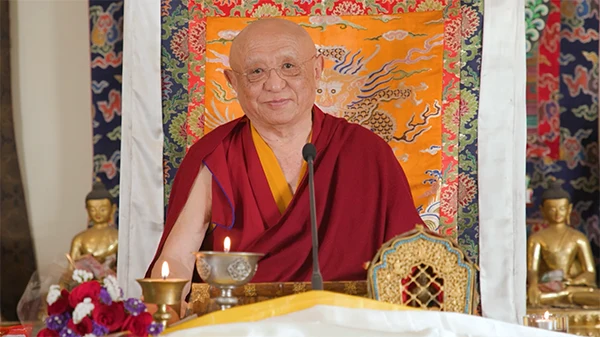
01:00:32
Till now, this kind of teaching
kept quite alive.
Not only text, explaining detailed.
Not only explaining, practicing, seriously,
and gained very high realization.
Many teachers are like that, except me.
And Tartang Rinpoche, he put his heart.
I heard, so many Dharma texts.
He had experience when he was in India,
at that time, shortage of texts.
So they made texts, some kind of
photocopy, very poor photocopy.
And then the texts are sharing with monks.
Monks sharing, sharing.
In the morning, one group of monks,
they study.
In the afternoon, another group.
So he had very heart, heart broke.
So since that, this is not a joke.
Tartang Rinpoche is a Tibetan tulku.
And he is very learned and
very good practitioner.
And he was in Varanasi, the teacher,
one of the teachers.
Then, that time, the monks are living,
how you say, living quality is very poor.
So many of them get different sickness.
Specifically, they called TB, TB.
TB, then it is passing.
TB is like, same as COVID,
it's passing each other.
And many are sick.
And many of them die.
Very learned, one after another die.
Shortage of food, shortage of place,
and medicine, and texts.
Then he told his small group, I will go
Europe or America.
I will give up my monk's life.
And I will go there and make money and
serve to the sangha.
Some they believe, some they think, oh, he's just saying that. He wants to go, he wants to become gentleman. So he's just saying nice. He went Europe, he went America. He worked very hard. First he stayed somebody's garage. Then he teach here, there, little, little. Then now. I think in Tibetan Buddhism, who is the biggest sponsor? Tartang Rinpoche. How to believe that?
The biggest sponsor. Millions, millions of dollars every year he's sharing everywhere. Not only Asia, Tibet. Now he's also serving to the Theravada. Theravada monks he's inviting to Bodhgaya, serving. And what he does, what he eats, so simple. How he works hard. So when I see these texts, I remember him.
And he correcting, he correct. So he stayed in office, he correct, correct. He's quite stubborn. So his helper say, Rinpoche, now this is very late. Still he correct, correct. Often he sleep on desk.
But you know... So that means how much he put his heart to Dharma. To make texts. Every year I think how many Dharma texts he giving free. Also lot of donations here and there. So, I'm quite sure I'm not mistaken. He's the biggest donor. Biggest donor. Specifically in Tibetan Buddhism. Millions, millions of dollars. So think. This is bodhisattva action. He give up his lama... That time there's no way to go to Europe, or America. No way. Only one: marriage. Only one possibility marriage. So he made it. He went and worked hard. Now we all can enjoy. So this is one good example. All of us need to follow. Follow those great lamas action. Like Penor Rinpoche. And like Thrungpa Rinpoche example. Thrungpa Rinpoche in America. When hippie movement is there - camp. He become one of the hippie. He is one of the hippie. And some Tibetan get doubt. He is Tulku. He is great Tulku. He is learned. So sad he become hippie. Some says no possible. Some says no possible. Some says, yeah yeah he become really hippie. He is one of the hippie. Look his hair. Look how he smoking. Look how he... He is one of the hippies.
Some say... Don't say anything. We will know later.
Within in hippie he become teacher. So many hundreds hippies become serious Buddhist. Then he study yuppie. He says, now you need to live high quality. Study well. Good to have career, career. Doctor, lawyer. And serve to Dharma and live high quality living. Tie, tie, cut hair, tripple suit. Your English not good. I will teach English. He teaching to them English. Because he study in England. I believe he study only few month in Oxford. But he is very sharp. So he pick up the pronunciation very good. So he teaching to Americans. Your English is not right. Hospital, no, no, hospital. Busses, not busses. Bus, bus. Teaching through Oxford accent. And when I went there, his students are seeing him is like really... I don't know what to say. So respectful.
So, example. Penor Rinpoche. Shortage, everything shortage. Is bicycle. He going shopping bicycle. Then he shopping small truck. He went truck and buying food, feeding to young monks. Building he himself work. If you check closely those Lamas, how much they put their heart, to the Dharma, to preserve the Dharma. It's amazing. To be honest, this is not Lamas job. What is the real Lamas job? Study well, practice well, and teach to other more than that, shouldn't do. Other all need to do others. Building, serving to monks. Everything need to do by who devoted, devoted to Dharma. And not want to become seriously practitioner, but you want to serve. But that's not like that. Lamas need to go. If Lamas not go, no donation comes. Lamas go here, there, donation comes. So almost like, now it's changing, but before like almost like bird. Lamas like bird collecting and feeding.
So, also today what I say, morning we get up, how I practice, I chanting this.
So, we wake up in the morning with the thoughts, with this commitment that we talked about before, and with the understanding that all conditioned things are impermanent, and that all factors that involve defilement, that they are suffering. And then that all factors are empty and devoid of self. That's the teaching of the Madhyamaka. And the effect of studying Madhyamaka is something to be brought into one's life through practice. It's crucially important that when we then understand that we apply that understanding in practice. Otherwise, if we don't do that, then it becomes as in the saying that if not practicing, even the great pandits will remain in delusion. So we may know a whole lot, but unless it's put into practice what we come to understand, then it has no liberating effect at all. And on the other hand, even if we haven't understood vast and profound teaching, if we know how to practice, then that can be liberating. So by failing to practice, even the great scholar remains in delusion, and knowing how to practice, even the uneducated person is liberated. There is one big mistake.
Some, they say they are follower of Buddha Dharma. What they say? I like to practice, I don't want to study.
What that means?
Then other ones, I like to study, I don't want to practice. That means you want to fly with one wing. You cannot fly. Two wings we need, study and practice. So for that reasons, my big wish.
Whoever studies Dharma, monks, nuns or international students, I want each of you will become a scholar-practitioner. I put my whole heart in it. Now, that movement is going all over the world. Past, when I went to America, Oxford, King's College in Birmingham, King's College, one is Oxford, people saying you can teach but not allowed to say practice.
Now change. Change by Rangjung Yeshe Institute, change by Rangjung Yeshe Institute students. Changed by like Thomas, Erik, Andreas, Catherine, now more, Heidi. Now changed. So please, I want each of you to keep this in your heart. More study, then you know how to practice.
The more profound and the more vast our learning and reflection can become, the more sophisticated our practice can be also. We will know special ways of practicing. Again, one more.
The sign of learning is to be gentle and peaceful. The sign of meditation practice is a few negative emotions.
To meditate without learning and reflection or without learning is like attempting to climb a rock wall without hands. Make sense?
Learning and reflection without meditation is like being blind and lost in the middle of a plane.
Equipoise is really important, to be able to rest in great emptiness beyond conceptual constructs. That is a practice. It's a practice. It's not something, a topic of study just. But sometimes people think that, that great emptiness beyond conceptual constructs, that's something we learn about. And then what we practice, that's Mahamudra and Dzogchen. It's not like that. As it is said, if you grasp existence, there is no liberation. And if you grasp non-existence, it's hard even to reach the higher realms. It's not possible to grasp both simultaneously. So let go in the non-dual state as it comes naturally.
I think most of you are practicing deity.
Peaceful deity, wrathful deity, everything you practice. Right? And many of you like wrathful, Mahakala, Kali, Vajrakila. Careful, careful.
If you can practice the yoga of the deity, embracing that with the view of emptiness, there is no doubt that you will gain accomplishment, both supreme and common accomplishments.
The emptiness view that we embrace the practice with is not just emptiness as a negation, it's the view of emptiness and compassion as an undivided natural unity. That is the view that one embraces the practice of mantra recitation, visualization with, and then it definitely follows that there will be supreme accomplishment, and all the common accomplishments will be achieved too. But if we fail to do that, if we don't have that view of emptiness suffused with compassion as the view whereby we practice, then really what we do is indistinguishable from what is done in other religions. There's nothing particularly Buddhist about it. Okay, maybe the deity looks a little different, but that's all. It's true.
Is there something that you think today, because Rinpoche said it, or is it something that you have always been thinking, or not always, but something that you're used to thinking? Question?
Answer?
Shamatha is very important.
But flawed shamatha is no good.
This is the cause of the animal realm.
It's important to practice shamatha.
But it should be flawless shamatha.
Being stuck in stale shamatha and cultivating that,
we become similar to... No, not similar. Just... we enter, the Many months underground, many months we will stay under the... what do you call it? In a hole in the ground, hibernating. Yeah. It's not a joke.
So Vipashyana, special seeing, that is important. It should also be flawless shamatha and Vipashyana.
But not Madhyamaka as a sort of mental or verbal formula.
Something that you just carry in your mouth, pay lip service to. An intellectual ..., thinking emptiness.
It is all beyond consciousness.
Those kinds of exclamations, conceptual exclamations.
It is like that. That's what it is. That kind of thing. That's a flaw.
And because that's a flaw, it's important to have a good teacher, an experienced teacher.
But if the person who gives the medicine doesn't know very well about medicine, it's quite risky.
Unfortunately, really qualified lamas become... there are less and less of them.
In particular, those who have experience and realization becoming very rare.
And at the same time, those who...
At the same time, those who know how to speak about all of these things, there are more of those. But those who have the ultimate practice in mind, who bear that in their hearts, they are really fewer and fewer.
So, we all...
We all need to become scholar-practitioners. Extremely important. Now, okay, two important things. One, I said it. Tibetan Buddhism, when you say Tibetan Buddhism, what do you, in your mind, comes what? Deity.
What kind of deity? Peaceful, wrathful, many hands, legs. What they dance? Lama dance? Then it stays. Tibetan Buddhism, oh, deity. Then when you see Tibetans that carry mala, oh, mantra, mantra.
Yes, that's true. This is Vajrayana practice. But, how to practice Vajrayana? Proper way?
Just like we talked about it just before, the view of emptiness and compassion... Emptiness suffused with compassion. If that is the... This is important. Hello, hello. Two guys, one second. Just stand there. Stand there and listen. This is true, so important. Nobody will say like this. No, you cannot hear like that easily. Okay, it's priceless. Just listen two minutes. So the view of emptiness suffused with compassion. If that is the view that bears our practice of visualization, recitation, the purity of the divine mandala, the recitation, and the emanation and reabsorption of the deity yoga. If that is how we do it, definitely the common accomplishments like long life, success in mundane terms, health, wealth and so on. All of that enjoyment will be accumulated naturally, achieved naturally. But not only that, also the ultimate accomplishment, liberation and full awakening will definitely be achieved by means of that.
Otherwise, if we fail to have that, then the situation is something that the tantras themselves speak about. They say that don't let secret mantra become child's play. And if we don't have that view, if that view of emptiness suffused with compassion is not acutely present, vividly present as we do the Vajrayana practices, then it is all just child's play. All the exercises, all the movements, all whatever it is that we do, it's just like meaningless child's play. Okay, you two go.
And listen, listen.
That reason you are all studying in the Shedra, Rangjung Yeshe Institute. That reason Thomas giving two month teaching of Mulamadhyamikakarika. That reasons. So, that reasons, how important philosophy? Without philosophy knowledge, to practice deity, or Vajrayana, is joke, same as monkey. We give monkey all, dung, dung, dung, dung...
So their reasons. The monks study very hard, nuns study very hard. Now time comes, you all need to study very hard. You all need to keep the dharma genuinely, genuinely. We shouldn't let it polluted. It is danger. Building is not important. Statue is not important.
Not important. If there is good, comfortable and also inspiring. If you say cave only in cave, some they says, how nice, but mejority says is okay. Lot of colorful, oh, yeah. It's method, method.
But this rich knowledge, if poluted. Then how we can, how you say, how we... Re...?
How to resort?
Where? Nowhere.
Generally, yes, there are millions of Buddhists. We call Buddhists, Buddhists. Taking lightly, Buddhists, Buddhists chanting. So sweet, so good, so nice. But if you go deep down, down, down, down, down, down, down, down, Buddhists is not mantra. Buddhists is not the, not straight philosophy.
Who know philosophy? How many, how many hundred thousands knows philosophy? Not hundred thousands.
It's very, very scary.
I got this hearing transmission three times. From Thrangu Rinpoche, one time. From Tenga Rinpoche, in Rumtek, one time. Here, Dilgo Khyentse Rinpoche gompa, one time. Whole Tengyur, most of Tengyur, but some missing. Three times I got. Today I chant only this Uma Tsawa Sherab. It took over hours. And I try to read slowly to each of you heard. So this is the tradition.
These transmissions, Trilung text transmission, has to be spoken clearly.
So now how to practice Madhyamaka?
Be inspired, motivated by renunciation.
Thinking that there's nothing that lasts.
That we remain in the world of destruction. That we somehow,
we rely, we rely on unreliable. We rely unreliable, but we think reliable.
So we are so strong believing, it's reliable, it will protect you, it will serve me, help me, guide me, save me. Not true. It's a bubble, bubble.
And also we need compassion, definitely, to practice Madhyamaka. Great compassion.
But there has to be a cause of compassion also, no? Otherwise it won't be there.
Our usual kind of compassion is, if we someone who does something wrong, who is maybe sick, has no proper cloth to wear, has broken his leg, has this or that flaw, then we feel compassion when we see someone like that.
and it is compassion, of course, that we feel.
But we talk about great compassion here.
And that's a compassion that is there for all sentient beings without any exception. Everyone that has a mind is ruled by negative emotions. Everyone ruled by negative emotions suffers.
We need that great compassion in order to reach the equipoise of profound emptiness beyond all conceptual constructs. The equipoise state which is like the sky.
Like the sky, because what we are talking about here is something which is beyond or free from all conceptual constructs. Space is unconstructed and there is no elaboration in space. In order to arrive at that unconstructed equipoise, we need great compassion.
And then the post-meditation state is like an illusion. That's what we hear, right?
Whether we move about, whether we sit down, whether we have a meal, lie down to rest, all of this activity is embraced by an understanding that this is just like a dream, just like an illusion.
So, less and less we think that this is real, this lasts, those perceptions, those ways of grasping, they gradually loosen.
So now we know how to practice Madhyamaka.
There is a little difference in terms of the means when we talk about practicing Madhyamaka, Mahamudra and Great Perfection, but in the context of Madhyamaka, the means of great compassion is emphasized.
So in the Madhyamaka, the method of great compassion is really key. In the context of Mahamudra and Great Perfection, it's pure perception and devotion. So of course, there has to be as well renunciation and certainly great compassion. But on top of that, there has to be this overwhelming devotion, pure perception and boundless devotion, like it's said, unbearable devotion. And that is something that not all that many can master, that state of mind. It's okay also if one cannot do that, then one can train in great compassion.
So what if we can't? What if we can't feel overwhelming, unbearable devotion?
Then we have to have unbearable compassion.
And what if we can't have unbearable compassion?
Then we need to be completely in the clear that the cyclic existence samsara is like a prison.
I'm a prisoner in the prison house of samsara, we have to think.
But I must break out, I must break free.
Then what's next?
Then we give up negative actions of our body, of our speech and our mind.
And instead we employ our body, speech and mind with virtous, wholesome activity.
Is that in itself....?
If we do that and do that well, then we will have a very nice place in existence, but not liberation.
It's 100% sure that where we will go will be a good destination.
But not liberation.
What if we need liberation?
Then we need on top of this, on top of the refraining from negativity and accomplishing virtuous actions, we need a flawless shamatha, calm abiding.
And definitely we need special seeing vipashana that realizes the absence of self.
So then it's okay, you know, we didn't need unbearable compassion.
It's easier, an easier path, what we just talked about, isn't it?
Because unbearable compassion, to give rise to that is not so easy.
Unbearable compassion is not something that comes and goes.
If unbearable devotion is something that comes and goes, then it's just an emotion, and the usual thing.
So you understand the real point? Clearly. Hello. You are all becoming like Tibetan now.
Tibetans are becoming like Western. Really. Young Tibetan says, why do we need to prostrate? Good question. Why do we need to chant mantra? Who is Chenrezig? Where is he?
Where is he? Why not she?
They learn from Western. It's fair. They learn from Western, you guys learn from Eastern. So yes, Guruji.
So did you understand the key point? If you understand the key point, then there's natural appreciation for Dharma.
This equipoise...
The equipoise, which is like space, that also has to be flawless. Otherwise, it's a risky. To be in the wrong kind of space-like state. And the post-meditation state, which is like an illusion, that's also something that has to be flawless, the right kind. Otherwise, again, it's pretty risky. You may run into something. You may hurt your head.
We need to be very intelligent. You know, illusion. You try to go through wall. Boom!
So how to dedicate that?
Rinpoche would like to tell his own way of doing it.
This is using the words of the master Shantideva in his Bodhicharyavatara.
So we wake up in the morning with the thought that today I want to avoid doing anything that is negative and unwholesome. I want to do all what I can to accomplish perfect virtue, and I want to tame my own mind. That's the commitment in the morning. And during the day, that's then what we focus on doing. Noticing that all conditioned things are impermanent, that all factors are empty and devoid of self. That has been the practice through the day. We woke up with this kind of wish and that made that commitment. And so the day has been spent in that way. And that means that there's something there to be dedicated.
And the dedication then in the words of Shantideva is made by this virtue of mine.
May all sentient beings without exception, give up negative actions and may they accomplish always perfect goodness. May they give rise to the mind of awakening. May they merge with the practice of Bodhicitta. May they always be protected by the Buddhas. And may they give up all the actions of the Maras.
I think all of you are very fortunate students. How to prove? For hours...
You have listened very keenly, very fresh. Very alert, alert and very intelligent way of...
This is proof. Yeah, it's true. Academic tradition 45 minutes.
But it works four hours works.
Okay. And tomorrow, I and monks, we are going to a mountain, Nagarjuna mountain. We believe ....
The Buddha taught a sutra there.
I think you guys not interested to come. If any reason, if you are interested to come, maybe discuss each other. And the monks going seven o'clock from the Utpala parking, from there. Then I will go with a small group, maybe 7:30. It takes maybe almost two hours. And then we will chant, not so long, maybe two hours. It's quite refreshing and beautiful. But road is a little rough.
Then we start Ngakso drubchen. On the eighth day of the Tibetan months.
And did you understand some really decisive issues?
Whatever it is that we are concerned with, we need to know the stuff we want to know very well, right? Whether it's mundane or Dharma activity. If we put two restaurants. Tibetan restaurant, Chinese restaurant. We make Tibetan restaurant very fancy. Other side Chinese restaurant, not so fancy. Just look where people go more. Definitely Chinese restaurant. Why?
Because there is an emphasis on good food. Chinese, Japanese, Italian or some others. They put sort of whole heart. So that reasons food is good. If you say Tibetan restaurant... Uh la la la....
Tibetan Buddhism, sharp, sharp, sharp. Tibetan restaurant, lousy, lousy. Except Dharma, all so-so. Medicine, so-so. Zila, astrological, so-so. Anything, so-so. Dharma, top.
So, what else to say?
We really need to know the key point.
Flawless shamatha . Authentic.
Sakyapandita, he jokingly said that if someone who hasn't learned and studied well practices Mahamudra then, in the worst case that person will be born as an animal. But if things would turn out a little bit better, then that person will be born as a formless god,
in the divine realm of no form. Okay, better bura go, otherwise...!
Bura go means, the old man needs to move.
Now, any of you, if you want to study Dharma intensively, and because of technology, and also many Dharma texts are translated in different languages. Also, you can study online. So please, please, this opportunity is there, yeah? Opportunity is in your home. No need to go here or there. And also, some teachings are free.
And the Triple Excellence meditation, online practice, is a huge effect. Effect what? Effect the heart. Rangjung Yeshe Institute affects a lot here. Tipler Excellence hit to heart. The heart becomes soft, kind. Rangjung Yeshe Institute becomes very smart. The combination is very important. Okay? How many of you are studying in Thomas's class? Thomas's class. Umala? So, any of you interested to continue? Huh? Are you discussing how to do?
One or two need to lead, yeah? Yeah, please discuss. This opportunity is very special. Okay? How many of you practicing online the Rangjung Yeshe philosophy class? Oh, very good, very good, very good. How many of you practicing Triple Excellence? Oh, a lot. Wow, very good, very good. Please continue. And whoever want to really seriously, genuinely, if you want to practice, and if you want to mingle your Dharma knowledge in daily life, join Triple Excellence. Okay? Okay, thank you. Four hours, very good.
This statue inside, one Buddha Shakyamuni statue, belongs to Nalanda University. So for that reasons today I put here and give Bodhisattva Vow and Refuge Vow.
In the Tibetan tradition, shrine rooms and shrine objects are considered very important. Bathrooms, not so much. So the quality of the toilets is a bit lacking.
Some they believe, some they think, oh, he's just saying that. He wants to go, he wants to become gentleman. So he's just saying nice. He went Europe, he went America. He worked very hard. First he stayed somebody's garage. Then he teach here, there, little, little. Then now. I think in Tibetan Buddhism, who is the biggest sponsor? Tartang Rinpoche. How to believe that?
The biggest sponsor. Millions, millions of dollars every year he's sharing everywhere. Not only Asia, Tibet. Now he's also serving to the Theravada. Theravada monks he's inviting to Bodhgaya, serving. And what he does, what he eats, so simple. How he works hard. So when I see these texts, I remember him.
And he correcting, he correct. So he stayed in office, he correct, correct. He's quite stubborn. So his helper say, Rinpoche, now this is very late. Still he correct, correct. Often he sleep on desk.
But you know... So that means how much he put his heart to Dharma. To make texts. Every year I think how many Dharma texts he giving free. Also lot of donations here and there. So, I'm quite sure I'm not mistaken. He's the biggest donor. Biggest donor. Specifically in Tibetan Buddhism. Millions, millions of dollars. So think. This is bodhisattva action. He give up his lama... That time there's no way to go to Europe, or America. No way. Only one: marriage. Only one possibility marriage. So he made it. He went and worked hard. Now we all can enjoy. So this is one good example. All of us need to follow. Follow those great lamas action. Like Penor Rinpoche. And like Thrungpa Rinpoche example. Thrungpa Rinpoche in America. When hippie movement is there - camp. He become one of the hippie. He is one of the hippie. And some Tibetan get doubt. He is Tulku. He is great Tulku. He is learned. So sad he become hippie. Some says no possible. Some says no possible. Some says, yeah yeah he become really hippie. He is one of the hippie. Look his hair. Look how he smoking. Look how he... He is one of the hippies.
Some say... Don't say anything. We will know later.
Within in hippie he become teacher. So many hundreds hippies become serious Buddhist. Then he study yuppie. He says, now you need to live high quality. Study well. Good to have career, career. Doctor, lawyer. And serve to Dharma and live high quality living. Tie, tie, cut hair, tripple suit. Your English not good. I will teach English. He teaching to them English. Because he study in England. I believe he study only few month in Oxford. But he is very sharp. So he pick up the pronunciation very good. So he teaching to Americans. Your English is not right. Hospital, no, no, hospital. Busses, not busses. Bus, bus. Teaching through Oxford accent. And when I went there, his students are seeing him is like really... I don't know what to say. So respectful.
So, example. Penor Rinpoche. Shortage, everything shortage. Is bicycle. He going shopping bicycle. Then he shopping small truck. He went truck and buying food, feeding to young monks. Building he himself work. If you check closely those Lamas, how much they put their heart, to the Dharma, to preserve the Dharma. It's amazing. To be honest, this is not Lamas job. What is the real Lamas job? Study well, practice well, and teach to other more than that, shouldn't do. Other all need to do others. Building, serving to monks. Everything need to do by who devoted, devoted to Dharma. And not want to become seriously practitioner, but you want to serve. But that's not like that. Lamas need to go. If Lamas not go, no donation comes. Lamas go here, there, donation comes. So almost like, now it's changing, but before like almost like bird. Lamas like bird collecting and feeding.
So, also today what I say, morning we get up, how I practice, I chanting this.
So, we wake up in the morning with the thoughts, with this commitment that we talked about before, and with the understanding that all conditioned things are impermanent, and that all factors that involve defilement, that they are suffering. And then that all factors are empty and devoid of self. That's the teaching of the Madhyamaka. And the effect of studying Madhyamaka is something to be brought into one's life through practice. It's crucially important that when we then understand that we apply that understanding in practice. Otherwise, if we don't do that, then it becomes as in the saying that if not practicing, even the great pandits will remain in delusion. So we may know a whole lot, but unless it's put into practice what we come to understand, then it has no liberating effect at all. And on the other hand, even if we haven't understood vast and profound teaching, if we know how to practice, then that can be liberating. So by failing to practice, even the great scholar remains in delusion, and knowing how to practice, even the uneducated person is liberated. There is one big mistake.
Some, they say they are follower of Buddha Dharma. What they say? I like to practice, I don't want to study.
What that means?
Then other ones, I like to study, I don't want to practice. That means you want to fly with one wing. You cannot fly. Two wings we need, study and practice. So for that reasons, my big wish.
Whoever studies Dharma, monks, nuns or international students, I want each of you will become a scholar-practitioner. I put my whole heart in it. Now, that movement is going all over the world. Past, when I went to America, Oxford, King's College in Birmingham, King's College, one is Oxford, people saying you can teach but not allowed to say practice.
Now change. Change by Rangjung Yeshe Institute, change by Rangjung Yeshe Institute students. Changed by like Thomas, Erik, Andreas, Catherine, now more, Heidi. Now changed. So please, I want each of you to keep this in your heart. More study, then you know how to practice.
The more profound and the more vast our learning and reflection can become, the more sophisticated our practice can be also. We will know special ways of practicing. Again, one more.
The sign of learning is to be gentle and peaceful. The sign of meditation practice is a few negative emotions.
To meditate without learning and reflection or without learning is like attempting to climb a rock wall without hands. Make sense?
Learning and reflection without meditation is like being blind and lost in the middle of a plane.
Equipoise is really important, to be able to rest in great emptiness beyond conceptual constructs. That is a practice. It's a practice. It's not something, a topic of study just. But sometimes people think that, that great emptiness beyond conceptual constructs, that's something we learn about. And then what we practice, that's Mahamudra and Dzogchen. It's not like that. As it is said, if you grasp existence, there is no liberation. And if you grasp non-existence, it's hard even to reach the higher realms. It's not possible to grasp both simultaneously. So let go in the non-dual state as it comes naturally.
I think most of you are practicing deity.
Peaceful deity, wrathful deity, everything you practice. Right? And many of you like wrathful, Mahakala, Kali, Vajrakila. Careful, careful.
If you can practice the yoga of the deity, embracing that with the view of emptiness, there is no doubt that you will gain accomplishment, both supreme and common accomplishments.
The emptiness view that we embrace the practice with is not just emptiness as a negation, it's the view of emptiness and compassion as an undivided natural unity. That is the view that one embraces the practice of mantra recitation, visualization with, and then it definitely follows that there will be supreme accomplishment, and all the common accomplishments will be achieved too. But if we fail to do that, if we don't have that view of emptiness suffused with compassion as the view whereby we practice, then really what we do is indistinguishable from what is done in other religions. There's nothing particularly Buddhist about it. Okay, maybe the deity looks a little different, but that's all. It's true.
Is there something that you think today, because Rinpoche said it, or is it something that you have always been thinking, or not always, but something that you're used to thinking? Question?
Answer?
Shamatha is very important.
But flawed shamatha is no good.
This is the cause of the animal realm.
It's important to practice shamatha.
But it should be flawless shamatha.
Being stuck in stale shamatha and cultivating that,
we become similar to... No, not similar. Just... we enter, the Many months underground, many months we will stay under the... what do you call it? In a hole in the ground, hibernating. Yeah. It's not a joke.
So Vipashyana, special seeing, that is important. It should also be flawless shamatha and Vipashyana.
But not Madhyamaka as a sort of mental or verbal formula.
Something that you just carry in your mouth, pay lip service to. An intellectual ..., thinking emptiness.
It is all beyond consciousness.
Those kinds of exclamations, conceptual exclamations.
It is like that. That's what it is. That kind of thing. That's a flaw.
And because that's a flaw, it's important to have a good teacher, an experienced teacher.
But if the person who gives the medicine doesn't know very well about medicine, it's quite risky.
Unfortunately, really qualified lamas become... there are less and less of them.
In particular, those who have experience and realization becoming very rare.
And at the same time, those who...
At the same time, those who know how to speak about all of these things, there are more of those. But those who have the ultimate practice in mind, who bear that in their hearts, they are really fewer and fewer.
So, we all...
We all need to become scholar-practitioners. Extremely important. Now, okay, two important things. One, I said it. Tibetan Buddhism, when you say Tibetan Buddhism, what do you, in your mind, comes what? Deity.
What kind of deity? Peaceful, wrathful, many hands, legs. What they dance? Lama dance? Then it stays. Tibetan Buddhism, oh, deity. Then when you see Tibetans that carry mala, oh, mantra, mantra.
Yes, that's true. This is Vajrayana practice. But, how to practice Vajrayana? Proper way?
Just like we talked about it just before, the view of emptiness and compassion... Emptiness suffused with compassion. If that is the... This is important. Hello, hello. Two guys, one second. Just stand there. Stand there and listen. This is true, so important. Nobody will say like this. No, you cannot hear like that easily. Okay, it's priceless. Just listen two minutes. So the view of emptiness suffused with compassion. If that is the view that bears our practice of visualization, recitation, the purity of the divine mandala, the recitation, and the emanation and reabsorption of the deity yoga. If that is how we do it, definitely the common accomplishments like long life, success in mundane terms, health, wealth and so on. All of that enjoyment will be accumulated naturally, achieved naturally. But not only that, also the ultimate accomplishment, liberation and full awakening will definitely be achieved by means of that.
Otherwise, if we fail to have that, then the situation is something that the tantras themselves speak about. They say that don't let secret mantra become child's play. And if we don't have that view, if that view of emptiness suffused with compassion is not acutely present, vividly present as we do the Vajrayana practices, then it is all just child's play. All the exercises, all the movements, all whatever it is that we do, it's just like meaningless child's play. Okay, you two go.
And listen, listen.
That reason you are all studying in the Shedra, Rangjung Yeshe Institute. That reason Thomas giving two month teaching of Mulamadhyamikakarika. That reasons. So, that reasons, how important philosophy? Without philosophy knowledge, to practice deity, or Vajrayana, is joke, same as monkey. We give monkey all, dung, dung, dung, dung...
So their reasons. The monks study very hard, nuns study very hard. Now time comes, you all need to study very hard. You all need to keep the dharma genuinely, genuinely. We shouldn't let it polluted. It is danger. Building is not important. Statue is not important.
Not important. If there is good, comfortable and also inspiring. If you say cave only in cave, some they says, how nice, but mejority says is okay. Lot of colorful, oh, yeah. It's method, method.
But this rich knowledge, if poluted. Then how we can, how you say, how we... Re...?
How to resort?
Where? Nowhere.
Generally, yes, there are millions of Buddhists. We call Buddhists, Buddhists. Taking lightly, Buddhists, Buddhists chanting. So sweet, so good, so nice. But if you go deep down, down, down, down, down, down, down, down, Buddhists is not mantra. Buddhists is not the, not straight philosophy.
Who know philosophy? How many, how many hundred thousands knows philosophy? Not hundred thousands.
It's very, very scary.
I got this hearing transmission three times. From Thrangu Rinpoche, one time. From Tenga Rinpoche, in Rumtek, one time. Here, Dilgo Khyentse Rinpoche gompa, one time. Whole Tengyur, most of Tengyur, but some missing. Three times I got. Today I chant only this Uma Tsawa Sherab. It took over hours. And I try to read slowly to each of you heard. So this is the tradition.
These transmissions, Trilung text transmission, has to be spoken clearly.
So now how to practice Madhyamaka?
Be inspired, motivated by renunciation.
Thinking that there's nothing that lasts.
That we remain in the world of destruction. That we somehow,
we rely, we rely on unreliable. We rely unreliable, but we think reliable.
So we are so strong believing, it's reliable, it will protect you, it will serve me, help me, guide me, save me. Not true. It's a bubble, bubble.
And also we need compassion, definitely, to practice Madhyamaka. Great compassion.
But there has to be a cause of compassion also, no? Otherwise it won't be there.
Our usual kind of compassion is, if we someone who does something wrong, who is maybe sick, has no proper cloth to wear, has broken his leg, has this or that flaw, then we feel compassion when we see someone like that.
and it is compassion, of course, that we feel.
But we talk about great compassion here.
And that's a compassion that is there for all sentient beings without any exception. Everyone that has a mind is ruled by negative emotions. Everyone ruled by negative emotions suffers.
We need that great compassion in order to reach the equipoise of profound emptiness beyond all conceptual constructs. The equipoise state which is like the sky.
Like the sky, because what we are talking about here is something which is beyond or free from all conceptual constructs. Space is unconstructed and there is no elaboration in space. In order to arrive at that unconstructed equipoise, we need great compassion.
And then the post-meditation state is like an illusion. That's what we hear, right?
Whether we move about, whether we sit down, whether we have a meal, lie down to rest, all of this activity is embraced by an understanding that this is just like a dream, just like an illusion.
So, less and less we think that this is real, this lasts, those perceptions, those ways of grasping, they gradually loosen.
So now we know how to practice Madhyamaka.
There is a little difference in terms of the means when we talk about practicing Madhyamaka, Mahamudra and Great Perfection, but in the context of Madhyamaka, the means of great compassion is emphasized.
So in the Madhyamaka, the method of great compassion is really key. In the context of Mahamudra and Great Perfection, it's pure perception and devotion. So of course, there has to be as well renunciation and certainly great compassion. But on top of that, there has to be this overwhelming devotion, pure perception and boundless devotion, like it's said, unbearable devotion. And that is something that not all that many can master, that state of mind. It's okay also if one cannot do that, then one can train in great compassion.
So what if we can't? What if we can't feel overwhelming, unbearable devotion?
Then we have to have unbearable compassion.
And what if we can't have unbearable compassion?
Then we need to be completely in the clear that the cyclic existence samsara is like a prison.
I'm a prisoner in the prison house of samsara, we have to think.
But I must break out, I must break free.
Then what's next?
Then we give up negative actions of our body, of our speech and our mind.
And instead we employ our body, speech and mind with virtous, wholesome activity.
Is that in itself....?
If we do that and do that well, then we will have a very nice place in existence, but not liberation.
It's 100% sure that where we will go will be a good destination.
But not liberation.
What if we need liberation?
Then we need on top of this, on top of the refraining from negativity and accomplishing virtuous actions, we need a flawless shamatha, calm abiding.
And definitely we need special seeing vipashana that realizes the absence of self.
So then it's okay, you know, we didn't need unbearable compassion.
It's easier, an easier path, what we just talked about, isn't it?
Because unbearable compassion, to give rise to that is not so easy.
Unbearable compassion is not something that comes and goes.
If unbearable devotion is something that comes and goes, then it's just an emotion, and the usual thing.
So you understand the real point? Clearly. Hello. You are all becoming like Tibetan now.
Tibetans are becoming like Western. Really. Young Tibetan says, why do we need to prostrate? Good question. Why do we need to chant mantra? Who is Chenrezig? Where is he?
Where is he? Why not she?
They learn from Western. It's fair. They learn from Western, you guys learn from Eastern. So yes, Guruji.
So did you understand the key point? If you understand the key point, then there's natural appreciation for Dharma.
This equipoise...
The equipoise, which is like space, that also has to be flawless. Otherwise, it's a risky. To be in the wrong kind of space-like state. And the post-meditation state, which is like an illusion, that's also something that has to be flawless, the right kind. Otherwise, again, it's pretty risky. You may run into something. You may hurt your head.
We need to be very intelligent. You know, illusion. You try to go through wall. Boom!
So how to dedicate that?
Rinpoche would like to tell his own way of doing it.
This is using the words of the master Shantideva in his Bodhicharyavatara.
So we wake up in the morning with the thought that today I want to avoid doing anything that is negative and unwholesome. I want to do all what I can to accomplish perfect virtue, and I want to tame my own mind. That's the commitment in the morning. And during the day, that's then what we focus on doing. Noticing that all conditioned things are impermanent, that all factors are empty and devoid of self. That has been the practice through the day. We woke up with this kind of wish and that made that commitment. And so the day has been spent in that way. And that means that there's something there to be dedicated.
And the dedication then in the words of Shantideva is made by this virtue of mine.
May all sentient beings without exception, give up negative actions and may they accomplish always perfect goodness. May they give rise to the mind of awakening. May they merge with the practice of Bodhicitta. May they always be protected by the Buddhas. And may they give up all the actions of the Maras.
I think all of you are very fortunate students. How to prove? For hours...
You have listened very keenly, very fresh. Very alert, alert and very intelligent way of...
This is proof. Yeah, it's true. Academic tradition 45 minutes.
But it works four hours works.
Okay. And tomorrow, I and monks, we are going to a mountain, Nagarjuna mountain. We believe ....
The Buddha taught a sutra there.
I think you guys not interested to come. If any reason, if you are interested to come, maybe discuss each other. And the monks going seven o'clock from the Utpala parking, from there. Then I will go with a small group, maybe 7:30. It takes maybe almost two hours. And then we will chant, not so long, maybe two hours. It's quite refreshing and beautiful. But road is a little rough.
Then we start Ngakso drubchen. On the eighth day of the Tibetan months.
And did you understand some really decisive issues?
Whatever it is that we are concerned with, we need to know the stuff we want to know very well, right? Whether it's mundane or Dharma activity. If we put two restaurants. Tibetan restaurant, Chinese restaurant. We make Tibetan restaurant very fancy. Other side Chinese restaurant, not so fancy. Just look where people go more. Definitely Chinese restaurant. Why?
Because there is an emphasis on good food. Chinese, Japanese, Italian or some others. They put sort of whole heart. So that reasons food is good. If you say Tibetan restaurant... Uh la la la....
Tibetan Buddhism, sharp, sharp, sharp. Tibetan restaurant, lousy, lousy. Except Dharma, all so-so. Medicine, so-so. Zila, astrological, so-so. Anything, so-so. Dharma, top.
So, what else to say?
We really need to know the key point.
Flawless shamatha . Authentic.
Sakyapandita, he jokingly said that if someone who hasn't learned and studied well practices Mahamudra then, in the worst case that person will be born as an animal. But if things would turn out a little bit better, then that person will be born as a formless god,
in the divine realm of no form. Okay, better bura go, otherwise...!
Bura go means, the old man needs to move.
Now, any of you, if you want to study Dharma intensively, and because of technology, and also many Dharma texts are translated in different languages. Also, you can study online. So please, please, this opportunity is there, yeah? Opportunity is in your home. No need to go here or there. And also, some teachings are free.
And the Triple Excellence meditation, online practice, is a huge effect. Effect what? Effect the heart. Rangjung Yeshe Institute affects a lot here. Tipler Excellence hit to heart. The heart becomes soft, kind. Rangjung Yeshe Institute becomes very smart. The combination is very important. Okay? How many of you are studying in Thomas's class? Thomas's class. Umala? So, any of you interested to continue? Huh? Are you discussing how to do?
One or two need to lead, yeah? Yeah, please discuss. This opportunity is very special. Okay? How many of you practicing online the Rangjung Yeshe philosophy class? Oh, very good, very good, very good. How many of you practicing Triple Excellence? Oh, a lot. Wow, very good, very good. Please continue. And whoever want to really seriously, genuinely, if you want to practice, and if you want to mingle your Dharma knowledge in daily life, join Triple Excellence. Okay? Okay, thank you. Four hours, very good.
This statue inside, one Buddha Shakyamuni statue, belongs to Nalanda University. So for that reasons today I put here and give Bodhisattva Vow and Refuge Vow.
In the Tibetan tradition, shrine rooms and shrine objects are considered very important. Bathrooms, not so much. So the quality of the toilets is a bit lacking.
01:00:31
Till now, this kind of teaching
kept quite alive.
Not only text, explaining detailed.
Not only explaining, practicing, seriously,
and gained very high realization.
Many teachers are like that, except me.
And Tartang Rinpoche, he put his heart.
I heard, so many Dharma texts.
He had experience when he was in India,
at that time, shortage of texts.
So they made texts, some kind of
photocopy, very poor photocopy.
And then the texts are sharing with monks.
Monks sharing, sharing.
In the morning, one group of monks,
they study.
In the afternoon, another group.
So he had very heart, heart broke.
So since that, this is not a joke.
Tartang Rinpoche is a Tibetan tulku.
And he is very learned and
very good practitioner.
And he was in Varanasi, the teacher,
one of the teachers.
Then, that time, the monks are living,
how you say, living quality is very poor.
So many of them get different sickness.
Specifically, they called TB, TB.
TB, then it is passing.
TB is like, same as COVID,
it's passing each other.
And many are sick.
And many of them die.
Very learned, one after another die.
Shortage of food, shortage of place,
and medicine, and texts.
Then he told his small group, I will go
Europe or America.
I will give up my monk's life.
And I will go there and make money and
serve to the sangha.
Some they believe, some they think, oh, he's just saying that. He wants to go, he wants to become gentleman. So he's just saying nice. He went Europe, he went America. He worked very hard. First he stayed somebody's garage. Then he teach here, there, little, little. Then now. I think in Tibetan Buddhism, who is the biggest sponsor? Tartang Rinpoche. How to believe that?
The biggest sponsor. Millions, millions of dollars every year he's sharing everywhere. Not only Asia, Tibet. Now he's also serving to the Theravada. Theravada monks he's inviting to Bodhgaya, serving. And what he does, what he eats, so simple. How he works hard. So when I see these texts, I remember him.
And he correcting, he correct. So he stayed in office, he correct, correct. He's quite stubborn. So his helper say, Rinpoche, now this is very late. Still he correct, correct. Often he sleep on desk.
But you know... So that means how much he put his heart to Dharma. To make texts. Every year I think how many Dharma texts he giving free. Also lot of donations here and there. So, I'm quite sure I'm not mistaken. He's the biggest donor. Biggest donor. Specifically in Tibetan Buddhism. Millions, millions of dollars. So think. This is bodhisattva action. He give up his lama... That time there's no way to go to Europe, or America. No way. Only one: marriage. Only one possibility marriage. So he made it. He went and worked hard. Now we all can enjoy. So this is one good example. All of us need to follow. Follow those great lamas action. Like Penor Rinpoche. And like Thrungpa Rinpoche example. Thrungpa Rinpoche in America. When hippie movement is there - camp. He become one of the hippie. He is one of the hippie. And some Tibetan get doubt. He is Tulku. He is great Tulku. He is learned. So sad he become hippie. Some says no possible. Some says no possible. Some says, yeah yeah he become really hippie. He is one of the hippie. Look his hair. Look how he smoking. Look how he... He is one of the hippies.
Some say... Don't say anything. We will know later.
Within in hippie he become teacher. So many hundreds hippies become serious Buddhist. Then he study yuppie. He says, now you need to live high quality. Study well. Good to have career, career. Doctor, lawyer. And serve to Dharma and live high quality living. Tie, tie, cut hair, tripple suit. Your English not good. I will teach English. He teaching to them English. Because he study in England. I believe he study only few month in Oxford. But he is very sharp. So he pick up the pronunciation very good. So he teaching to Americans. Your English is not right. Hospital, no, no, hospital. Busses, not busses. Bus, bus. Teaching through Oxford accent. And when I went there, his students are seeing him is like really... I don't know what to say. So respectful.
So, example. Penor Rinpoche. Shortage, everything shortage. Is bicycle. He going shopping bicycle. Then he shopping small truck. He went truck and buying food, feeding to young monks. Building he himself work. If you check closely those Lamas, how much they put their heart, to the Dharma, to preserve the Dharma. It's amazing. To be honest, this is not Lamas job. What is the real Lamas job? Study well, practice well, and teach to other more than that, shouldn't do. Other all need to do others. Building, serving to monks. Everything need to do by who devoted, devoted to Dharma. And not want to become seriously practitioner, but you want to serve. But that's not like that. Lamas need to go. If Lamas not go, no donation comes. Lamas go here, there, donation comes. So almost like, now it's changing, but before like almost like bird. Lamas like bird collecting and feeding.
So, also today what I say, morning we get up, how I practice, I chanting this.
So, we wake up in the morning with the thoughts, with this commitment that we talked about before, and with the understanding that all conditioned things are impermanent, and that all factors that involve defilement, that they are suffering. And then that all factors are empty and devoid of self. That's the teaching of the Madhyamaka. And the effect of studying Madhyamaka is something to be brought into one's life through practice. It's crucially important that when we then understand that we apply that understanding in practice. Otherwise, if we don't do that, then it becomes as in the saying that if not practicing, even the great pandits will remain in delusion. So we may know a whole lot, but unless it's put into practice what we come to understand, then it has no liberating effect at all. And on the other hand, even if we haven't understood vast and profound teaching, if we know how to practice, then that can be liberating. So by failing to practice, even the great scholar remains in delusion, and knowing how to practice, even the uneducated person is liberated. There is one big mistake.
Some, they say they are follower of Buddha Dharma. What they say? I like to practice, I don't want to study.
What that means?
Then other ones, I like to study, I don't want to practice. That means you want to fly with one wing. You cannot fly. Two wings we need, study and practice. So for that reasons, my big wish.
Whoever studies Dharma, monks, nuns or international students, I want each of you will become a scholar-practitioner. I put my whole heart in it. Now, that movement is going all over the world. Past, when I went to America, Oxford, King's College in Birmingham, King's College, one is Oxford, people saying you can teach but not allowed to say practice.
Now change. Change by Rangjung Yeshe Institute, change by Rangjung Yeshe Institute students. Changed by like Thomas, Erik, Andreas, Catherine, now more, Heidi. Now changed. So please, I want each of you to keep this in your heart. More study, then you know how to practice.
The more profound and the more vast our learning and reflection can become, the more sophisticated our practice can be also. We will know special ways of practicing. Again, one more.
The sign of learning is to be gentle and peaceful. The sign of meditation practice is a few negative emotions.
To meditate without learning and reflection or without learning is like attempting to climb a rock wall without hands. Make sense?
Learning and reflection without meditation is like being blind and lost in the middle of a plane.
Equipoise is really important, to be able to rest in great emptiness beyond conceptual constructs. That is a practice. It's a practice. It's not something, a topic of study just. But sometimes people think that, that great emptiness beyond conceptual constructs, that's something we learn about. And then what we practice, that's Mahamudra and Dzogchen. It's not like that. As it is said, if you grasp existence, there is no liberation. And if you grasp non-existence, it's hard even to reach the higher realms. It's not possible to grasp both simultaneously. So let go in the non-dual state as it comes naturally.
I think most of you are practicing deity.
Peaceful deity, wrathful deity, everything you practice. Right? And many of you like wrathful, Mahakala, Kali, Vajrakila. Careful, careful.
If you can practice the yoga of the deity, embracing that with the view of emptiness, there is no doubt that you will gain accomplishment, both supreme and common accomplishments.
The emptiness view that we embrace the practice with is not just emptiness as a negation, it's the view of emptiness and compassion as an undivided natural unity. That is the view that one embraces the practice of mantra recitation, visualization with, and then it definitely follows that there will be supreme accomplishment, and all the common accomplishments will be achieved too. But if we fail to do that, if we don't have that view of emptiness suffused with compassion as the view whereby we practice, then really what we do is indistinguishable from what is done in other religions. There's nothing particularly Buddhist about it. Okay, maybe the deity looks a little different, but that's all. It's true.
Is there something that you think today, because Rinpoche said it, or is it something that you have always been thinking, or not always, but something that you're used to thinking? Question?
Answer?
Shamatha is very important.
But flawed shamatha is no good.
This is the cause of the animal realm.
It's important to practice shamatha.
But it should be flawless shamatha.
Being stuck in stale shamatha and cultivating that,
we become similar to... No, not similar. Just... we enter, the Many months underground, many months we will stay under the... what do you call it? In a hole in the ground, hibernating. Yeah. It's not a joke.
So Vipashyana, special seeing, that is important. It should also be flawless shamatha and Vipashyana.
But not Madhyamaka as a sort of mental or verbal formula.
Something that you just carry in your mouth, pay lip service to. An intellectual ..., thinking emptiness.
It is all beyond consciousness.
Those kinds of exclamations, conceptual exclamations.
It is like that. That's what it is. That kind of thing. That's a flaw.
And because that's a flaw, it's important to have a good teacher, an experienced teacher.
But if the person who gives the medicine doesn't know very well about medicine, it's quite risky.
Unfortunately, really qualified lamas become... there are less and less of them.
In particular, those who have experience and realization becoming very rare.
And at the same time, those who...
At the same time, those who know how to speak about all of these things, there are more of those. But those who have the ultimate practice in mind, who bear that in their hearts, they are really fewer and fewer.
So, we all...
We all need to become scholar-practitioners. Extremely important. Now, okay, two important things. One, I said it. Tibetan Buddhism, when you say Tibetan Buddhism, what do you, in your mind, comes what? Deity.
What kind of deity? Peaceful, wrathful, many hands, legs. What they dance? Lama dance? Then it stays. Tibetan Buddhism, oh, deity. Then when you see Tibetans that carry mala, oh, mantra, mantra.
Yes, that's true. This is Vajrayana practice. But, how to practice Vajrayana? Proper way?
Just like we talked about it just before, the view of emptiness and compassion... Emptiness suffused with compassion. If that is the... This is important. Hello, hello. Two guys, one second. Just stand there. Stand there and listen. This is true, so important. Nobody will say like this. No, you cannot hear like that easily. Okay, it's priceless. Just listen two minutes. So the view of emptiness suffused with compassion. If that is the view that bears our practice of visualization, recitation, the purity of the divine mandala, the recitation, and the emanation and reabsorption of the deity yoga. If that is how we do it, definitely the common accomplishments like long life, success in mundane terms, health, wealth and so on. All of that enjoyment will be accumulated naturally, achieved naturally. But not only that, also the ultimate accomplishment, liberation and full awakening will definitely be achieved by means of that.
Otherwise, if we fail to have that, then the situation is something that the tantras themselves speak about. They say that don't let secret mantra become child's play. And if we don't have that view, if that view of emptiness suffused with compassion is not acutely present, vividly present as we do the Vajrayana practices, then it is all just child's play. All the exercises, all the movements, all whatever it is that we do, it's just like meaningless child's play. Okay, you two go.
And listen, listen.
That reason you are all studying in the Shedra, Rangjung Yeshe Institute. That reason Thomas giving two month teaching of Mulamadhyamikakarika. That reasons. So, that reasons, how important philosophy? Without philosophy knowledge, to practice deity, or Vajrayana, is joke, same as monkey. We give monkey all, dung, dung, dung, dung...
So their reasons. The monks study very hard, nuns study very hard. Now time comes, you all need to study very hard. You all need to keep the dharma genuinely, genuinely. We shouldn't let it polluted. It is danger. Building is not important. Statue is not important.
Not important. If there is good, comfortable and also inspiring. If you say cave only in cave, some they says, how nice, but mejority says is okay. Lot of colorful, oh, yeah. It's method, method.
But this rich knowledge, if poluted. Then how we can, how you say, how we... Re...?
How to resort?
Where? Nowhere.
Generally, yes, there are millions of Buddhists. We call Buddhists, Buddhists. Taking lightly, Buddhists, Buddhists chanting. So sweet, so good, so nice. But if you go deep down, down, down, down, down, down, down, down, Buddhists is not mantra. Buddhists is not the, not straight philosophy.
Who know philosophy? How many, how many hundred thousands knows philosophy? Not hundred thousands.
It's very, very scary.
I got this hearing transmission three times. From Thrangu Rinpoche, one time. From Tenga Rinpoche, in Rumtek, one time. Here, Dilgo Khyentse Rinpoche gompa, one time. Whole Tengyur, most of Tengyur, but some missing. Three times I got. Today I chant only this Uma Tsawa Sherab. It took over hours. And I try to read slowly to each of you heard. So this is the tradition.
These transmissions, Trilung text transmission, has to be spoken clearly.
So now how to practice Madhyamaka?
Be inspired, motivated by renunciation.
Thinking that there's nothing that lasts.
That we remain in the world of destruction. That we somehow,
we rely, we rely on unreliable. We rely unreliable, but we think reliable.
So we are so strong believing, it's reliable, it will protect you, it will serve me, help me, guide me, save me. Not true. It's a bubble, bubble.
And also we need compassion, definitely, to practice Madhyamaka. Great compassion.
But there has to be a cause of compassion also, no? Otherwise it won't be there.
Our usual kind of compassion is, if we someone who does something wrong, who is maybe sick, has no proper cloth to wear, has broken his leg, has this or that flaw, then we feel compassion when we see someone like that.
and it is compassion, of course, that we feel.
But we talk about great compassion here.
And that's a compassion that is there for all sentient beings without any exception. Everyone that has a mind is ruled by negative emotions. Everyone ruled by negative emotions suffers.
We need that great compassion in order to reach the equipoise of profound emptiness beyond all conceptual constructs. The equipoise state which is like the sky.
Like the sky, because what we are talking about here is something which is beyond or free from all conceptual constructs. Space is unconstructed and there is no elaboration in space. In order to arrive at that unconstructed equipoise, we need great compassion.
And then the post-meditation state is like an illusion. That's what we hear, right?
Whether we move about, whether we sit down, whether we have a meal, lie down to rest, all of this activity is embraced by an understanding that this is just like a dream, just like an illusion.
So, less and less we think that this is real, this lasts, those perceptions, those ways of grasping, they gradually loosen.
So now we know how to practice Madhyamaka.
There is a little difference in terms of the means when we talk about practicing Madhyamaka, Mahamudra and Great Perfection, but in the context of Madhyamaka, the means of great compassion is emphasized.
So in the Madhyamaka, the method of great compassion is really key. In the context of Mahamudra and Great Perfection, it's pure perception and devotion. So of course, there has to be as well renunciation and certainly great compassion. But on top of that, there has to be this overwhelming devotion, pure perception and boundless devotion, like it's said, unbearable devotion. And that is something that not all that many can master, that state of mind. It's okay also if one cannot do that, then one can train in great compassion.
So what if we can't? What if we can't feel overwhelming, unbearable devotion?
Then we have to have unbearable compassion.
And what if we can't have unbearable compassion?
Then we need to be completely in the clear that the cyclic existence samsara is like a prison.
I'm a prisoner in the prison house of samsara, we have to think.
But I must break out, I must break free.
Then what's next?
Then we give up negative actions of our body, of our speech and our mind.
And instead we employ our body, speech and mind with virtous, wholesome activity.
Is that in itself....?
If we do that and do that well, then we will have a very nice place in existence, but not liberation.
It's 100% sure that where we will go will be a good destination.
But not liberation.
What if we need liberation?
Then we need on top of this, on top of the refraining from negativity and accomplishing virtuous actions, we need a flawless shamatha, calm abiding.
And definitely we need special seeing vipashana that realizes the absence of self.
So then it's okay, you know, we didn't need unbearable compassion.
It's easier, an easier path, what we just talked about, isn't it?
Because unbearable compassion, to give rise to that is not so easy.
Unbearable compassion is not something that comes and goes.
If unbearable devotion is something that comes and goes, then it's just an emotion, and the usual thing.
So you understand the real point? Clearly. Hello. You are all becoming like Tibetan now.
Tibetans are becoming like Western. Really. Young Tibetan says, why do we need to prostrate? Good question. Why do we need to chant mantra? Who is Chenrezig? Where is he?
Where is he? Why not she?
They learn from Western. It's fair. They learn from Western, you guys learn from Eastern. So yes, Guruji.
So did you understand the key point? If you understand the key point, then there's natural appreciation for Dharma.
This equipoise...
The equipoise, which is like space, that also has to be flawless. Otherwise, it's a risky. To be in the wrong kind of space-like state. And the post-meditation state, which is like an illusion, that's also something that has to be flawless, the right kind. Otherwise, again, it's pretty risky. You may run into something. You may hurt your head.
We need to be very intelligent. You know, illusion. You try to go through wall. Boom!
So how to dedicate that?
Rinpoche would like to tell his own way of doing it.
This is using the words of the master Shantideva in his Bodhicharyavatara.
So we wake up in the morning with the thought that today I want to avoid doing anything that is negative and unwholesome. I want to do all what I can to accomplish perfect virtue, and I want to tame my own mind. That's the commitment in the morning. And during the day, that's then what we focus on doing. Noticing that all conditioned things are impermanent, that all factors are empty and devoid of self. That has been the practice through the day. We woke up with this kind of wish and that made that commitment. And so the day has been spent in that way. And that means that there's something there to be dedicated.
And the dedication then in the words of Shantideva is made by this virtue of mine.
May all sentient beings without exception, give up negative actions and may they accomplish always perfect goodness. May they give rise to the mind of awakening. May they merge with the practice of Bodhicitta. May they always be protected by the Buddhas. And may they give up all the actions of the Maras.
I think all of you are very fortunate students. How to prove? For hours...
You have listened very keenly, very fresh. Very alert, alert and very intelligent way of...
This is proof. Yeah, it's true. Academic tradition 45 minutes.
But it works four hours works.
Okay. And tomorrow, I and monks, we are going to a mountain, Nagarjuna mountain. We believe ....
The Buddha taught a sutra there.
I think you guys not interested to come. If any reason, if you are interested to come, maybe discuss each other. And the monks going seven o'clock from the Utpala parking, from there. Then I will go with a small group, maybe 7:30. It takes maybe almost two hours. And then we will chant, not so long, maybe two hours. It's quite refreshing and beautiful. But road is a little rough.
Then we start Ngakso drubchen. On the eighth day of the Tibetan months.
And did you understand some really decisive issues?
Whatever it is that we are concerned with, we need to know the stuff we want to know very well, right? Whether it's mundane or Dharma activity. If we put two restaurants. Tibetan restaurant, Chinese restaurant. We make Tibetan restaurant very fancy. Other side Chinese restaurant, not so fancy. Just look where people go more. Definitely Chinese restaurant. Why?
Because there is an emphasis on good food. Chinese, Japanese, Italian or some others. They put sort of whole heart. So that reasons food is good. If you say Tibetan restaurant... Uh la la la....
Tibetan Buddhism, sharp, sharp, sharp. Tibetan restaurant, lousy, lousy. Except Dharma, all so-so. Medicine, so-so. Zila, astrological, so-so. Anything, so-so. Dharma, top.
So, what else to say?
We really need to know the key point.
Flawless shamatha . Authentic.
Sakyapandita, he jokingly said that if someone who hasn't learned and studied well practices Mahamudra then, in the worst case that person will be born as an animal. But if things would turn out a little bit better, then that person will be born as a formless god,
in the divine realm of no form. Okay, better bura go, otherwise...!
Bura go means, the old man needs to move.
Now, any of you, if you want to study Dharma intensively, and because of technology, and also many Dharma texts are translated in different languages. Also, you can study online. So please, please, this opportunity is there, yeah? Opportunity is in your home. No need to go here or there. And also, some teachings are free.
And the Triple Excellence meditation, online practice, is a huge effect. Effect what? Effect the heart. Rangjung Yeshe Institute affects a lot here. Tipler Excellence hit to heart. The heart becomes soft, kind. Rangjung Yeshe Institute becomes very smart. The combination is very important. Okay? How many of you are studying in Thomas's class? Thomas's class. Umala? So, any of you interested to continue? Huh? Are you discussing how to do?
One or two need to lead, yeah? Yeah, please discuss. This opportunity is very special. Okay? How many of you practicing online the Rangjung Yeshe philosophy class? Oh, very good, very good, very good. How many of you practicing Triple Excellence? Oh, a lot. Wow, very good, very good. Please continue. And whoever want to really seriously, genuinely, if you want to practice, and if you want to mingle your Dharma knowledge in daily life, join Triple Excellence. Okay? Okay, thank you. Four hours, very good.
This statue inside, one Buddha Shakyamuni statue, belongs to Nalanda University. So for that reasons today I put here and give Bodhisattva Vow and Refuge Vow.
In the Tibetan tradition, shrine rooms and shrine objects are considered very important. Bathrooms, not so much. So the quality of the toilets is a bit lacking.
Some they believe, some they think, oh, he's just saying that. He wants to go, he wants to become gentleman. So he's just saying nice. He went Europe, he went America. He worked very hard. First he stayed somebody's garage. Then he teach here, there, little, little. Then now. I think in Tibetan Buddhism, who is the biggest sponsor? Tartang Rinpoche. How to believe that?
The biggest sponsor. Millions, millions of dollars every year he's sharing everywhere. Not only Asia, Tibet. Now he's also serving to the Theravada. Theravada monks he's inviting to Bodhgaya, serving. And what he does, what he eats, so simple. How he works hard. So when I see these texts, I remember him.
And he correcting, he correct. So he stayed in office, he correct, correct. He's quite stubborn. So his helper say, Rinpoche, now this is very late. Still he correct, correct. Often he sleep on desk.
But you know... So that means how much he put his heart to Dharma. To make texts. Every year I think how many Dharma texts he giving free. Also lot of donations here and there. So, I'm quite sure I'm not mistaken. He's the biggest donor. Biggest donor. Specifically in Tibetan Buddhism. Millions, millions of dollars. So think. This is bodhisattva action. He give up his lama... That time there's no way to go to Europe, or America. No way. Only one: marriage. Only one possibility marriage. So he made it. He went and worked hard. Now we all can enjoy. So this is one good example. All of us need to follow. Follow those great lamas action. Like Penor Rinpoche. And like Thrungpa Rinpoche example. Thrungpa Rinpoche in America. When hippie movement is there - camp. He become one of the hippie. He is one of the hippie. And some Tibetan get doubt. He is Tulku. He is great Tulku. He is learned. So sad he become hippie. Some says no possible. Some says no possible. Some says, yeah yeah he become really hippie. He is one of the hippie. Look his hair. Look how he smoking. Look how he... He is one of the hippies.
Some say... Don't say anything. We will know later.
Within in hippie he become teacher. So many hundreds hippies become serious Buddhist. Then he study yuppie. He says, now you need to live high quality. Study well. Good to have career, career. Doctor, lawyer. And serve to Dharma and live high quality living. Tie, tie, cut hair, tripple suit. Your English not good. I will teach English. He teaching to them English. Because he study in England. I believe he study only few month in Oxford. But he is very sharp. So he pick up the pronunciation very good. So he teaching to Americans. Your English is not right. Hospital, no, no, hospital. Busses, not busses. Bus, bus. Teaching through Oxford accent. And when I went there, his students are seeing him is like really... I don't know what to say. So respectful.
So, example. Penor Rinpoche. Shortage, everything shortage. Is bicycle. He going shopping bicycle. Then he shopping small truck. He went truck and buying food, feeding to young monks. Building he himself work. If you check closely those Lamas, how much they put their heart, to the Dharma, to preserve the Dharma. It's amazing. To be honest, this is not Lamas job. What is the real Lamas job? Study well, practice well, and teach to other more than that, shouldn't do. Other all need to do others. Building, serving to monks. Everything need to do by who devoted, devoted to Dharma. And not want to become seriously practitioner, but you want to serve. But that's not like that. Lamas need to go. If Lamas not go, no donation comes. Lamas go here, there, donation comes. So almost like, now it's changing, but before like almost like bird. Lamas like bird collecting and feeding.
So, also today what I say, morning we get up, how I practice, I chanting this.
So, we wake up in the morning with the thoughts, with this commitment that we talked about before, and with the understanding that all conditioned things are impermanent, and that all factors that involve defilement, that they are suffering. And then that all factors are empty and devoid of self. That's the teaching of the Madhyamaka. And the effect of studying Madhyamaka is something to be brought into one's life through practice. It's crucially important that when we then understand that we apply that understanding in practice. Otherwise, if we don't do that, then it becomes as in the saying that if not practicing, even the great pandits will remain in delusion. So we may know a whole lot, but unless it's put into practice what we come to understand, then it has no liberating effect at all. And on the other hand, even if we haven't understood vast and profound teaching, if we know how to practice, then that can be liberating. So by failing to practice, even the great scholar remains in delusion, and knowing how to practice, even the uneducated person is liberated. There is one big mistake.
Some, they say they are follower of Buddha Dharma. What they say? I like to practice, I don't want to study.
What that means?
Then other ones, I like to study, I don't want to practice. That means you want to fly with one wing. You cannot fly. Two wings we need, study and practice. So for that reasons, my big wish.
Whoever studies Dharma, monks, nuns or international students, I want each of you will become a scholar-practitioner. I put my whole heart in it. Now, that movement is going all over the world. Past, when I went to America, Oxford, King's College in Birmingham, King's College, one is Oxford, people saying you can teach but not allowed to say practice.
Now change. Change by Rangjung Yeshe Institute, change by Rangjung Yeshe Institute students. Changed by like Thomas, Erik, Andreas, Catherine, now more, Heidi. Now changed. So please, I want each of you to keep this in your heart. More study, then you know how to practice.
The more profound and the more vast our learning and reflection can become, the more sophisticated our practice can be also. We will know special ways of practicing. Again, one more.
The sign of learning is to be gentle and peaceful. The sign of meditation practice is a few negative emotions.
To meditate without learning and reflection or without learning is like attempting to climb a rock wall without hands. Make sense?
Learning and reflection without meditation is like being blind and lost in the middle of a plane.
Equipoise is really important, to be able to rest in great emptiness beyond conceptual constructs. That is a practice. It's a practice. It's not something, a topic of study just. But sometimes people think that, that great emptiness beyond conceptual constructs, that's something we learn about. And then what we practice, that's Mahamudra and Dzogchen. It's not like that. As it is said, if you grasp existence, there is no liberation. And if you grasp non-existence, it's hard even to reach the higher realms. It's not possible to grasp both simultaneously. So let go in the non-dual state as it comes naturally.
I think most of you are practicing deity.
Peaceful deity, wrathful deity, everything you practice. Right? And many of you like wrathful, Mahakala, Kali, Vajrakila. Careful, careful.
If you can practice the yoga of the deity, embracing that with the view of emptiness, there is no doubt that you will gain accomplishment, both supreme and common accomplishments.
The emptiness view that we embrace the practice with is not just emptiness as a negation, it's the view of emptiness and compassion as an undivided natural unity. That is the view that one embraces the practice of mantra recitation, visualization with, and then it definitely follows that there will be supreme accomplishment, and all the common accomplishments will be achieved too. But if we fail to do that, if we don't have that view of emptiness suffused with compassion as the view whereby we practice, then really what we do is indistinguishable from what is done in other religions. There's nothing particularly Buddhist about it. Okay, maybe the deity looks a little different, but that's all. It's true.
Is there something that you think today, because Rinpoche said it, or is it something that you have always been thinking, or not always, but something that you're used to thinking? Question?
Answer?
Shamatha is very important.
But flawed shamatha is no good.
This is the cause of the animal realm.
It's important to practice shamatha.
But it should be flawless shamatha.
Being stuck in stale shamatha and cultivating that,
we become similar to... No, not similar. Just... we enter, the Many months underground, many months we will stay under the... what do you call it? In a hole in the ground, hibernating. Yeah. It's not a joke.
So Vipashyana, special seeing, that is important. It should also be flawless shamatha and Vipashyana.
But not Madhyamaka as a sort of mental or verbal formula.
Something that you just carry in your mouth, pay lip service to. An intellectual ..., thinking emptiness.
It is all beyond consciousness.
Those kinds of exclamations, conceptual exclamations.
It is like that. That's what it is. That kind of thing. That's a flaw.
And because that's a flaw, it's important to have a good teacher, an experienced teacher.
But if the person who gives the medicine doesn't know very well about medicine, it's quite risky.
Unfortunately, really qualified lamas become... there are less and less of them.
In particular, those who have experience and realization becoming very rare.
And at the same time, those who...
At the same time, those who know how to speak about all of these things, there are more of those. But those who have the ultimate practice in mind, who bear that in their hearts, they are really fewer and fewer.
So, we all...
We all need to become scholar-practitioners. Extremely important. Now, okay, two important things. One, I said it. Tibetan Buddhism, when you say Tibetan Buddhism, what do you, in your mind, comes what? Deity.
What kind of deity? Peaceful, wrathful, many hands, legs. What they dance? Lama dance? Then it stays. Tibetan Buddhism, oh, deity. Then when you see Tibetans that carry mala, oh, mantra, mantra.
Yes, that's true. This is Vajrayana practice. But, how to practice Vajrayana? Proper way?
Just like we talked about it just before, the view of emptiness and compassion... Emptiness suffused with compassion. If that is the... This is important. Hello, hello. Two guys, one second. Just stand there. Stand there and listen. This is true, so important. Nobody will say like this. No, you cannot hear like that easily. Okay, it's priceless. Just listen two minutes. So the view of emptiness suffused with compassion. If that is the view that bears our practice of visualization, recitation, the purity of the divine mandala, the recitation, and the emanation and reabsorption of the deity yoga. If that is how we do it, definitely the common accomplishments like long life, success in mundane terms, health, wealth and so on. All of that enjoyment will be accumulated naturally, achieved naturally. But not only that, also the ultimate accomplishment, liberation and full awakening will definitely be achieved by means of that.
Otherwise, if we fail to have that, then the situation is something that the tantras themselves speak about. They say that don't let secret mantra become child's play. And if we don't have that view, if that view of emptiness suffused with compassion is not acutely present, vividly present as we do the Vajrayana practices, then it is all just child's play. All the exercises, all the movements, all whatever it is that we do, it's just like meaningless child's play. Okay, you two go.
And listen, listen.
That reason you are all studying in the Shedra, Rangjung Yeshe Institute. That reason Thomas giving two month teaching of Mulamadhyamikakarika. That reasons. So, that reasons, how important philosophy? Without philosophy knowledge, to practice deity, or Vajrayana, is joke, same as monkey. We give monkey all, dung, dung, dung, dung...
So their reasons. The monks study very hard, nuns study very hard. Now time comes, you all need to study very hard. You all need to keep the dharma genuinely, genuinely. We shouldn't let it polluted. It is danger. Building is not important. Statue is not important.
Not important. If there is good, comfortable and also inspiring. If you say cave only in cave, some they says, how nice, but mejority says is okay. Lot of colorful, oh, yeah. It's method, method.
But this rich knowledge, if poluted. Then how we can, how you say, how we... Re...?
How to resort?
Where? Nowhere.
Generally, yes, there are millions of Buddhists. We call Buddhists, Buddhists. Taking lightly, Buddhists, Buddhists chanting. So sweet, so good, so nice. But if you go deep down, down, down, down, down, down, down, down, Buddhists is not mantra. Buddhists is not the, not straight philosophy.
Who know philosophy? How many, how many hundred thousands knows philosophy? Not hundred thousands.
It's very, very scary.
I got this hearing transmission three times. From Thrangu Rinpoche, one time. From Tenga Rinpoche, in Rumtek, one time. Here, Dilgo Khyentse Rinpoche gompa, one time. Whole Tengyur, most of Tengyur, but some missing. Three times I got. Today I chant only this Uma Tsawa Sherab. It took over hours. And I try to read slowly to each of you heard. So this is the tradition.
These transmissions, Trilung text transmission, has to be spoken clearly.
So now how to practice Madhyamaka?
Be inspired, motivated by renunciation.
Thinking that there's nothing that lasts.
That we remain in the world of destruction. That we somehow,
we rely, we rely on unreliable. We rely unreliable, but we think reliable.
So we are so strong believing, it's reliable, it will protect you, it will serve me, help me, guide me, save me. Not true. It's a bubble, bubble.
And also we need compassion, definitely, to practice Madhyamaka. Great compassion.
But there has to be a cause of compassion also, no? Otherwise it won't be there.
Our usual kind of compassion is, if we someone who does something wrong, who is maybe sick, has no proper cloth to wear, has broken his leg, has this or that flaw, then we feel compassion when we see someone like that.
and it is compassion, of course, that we feel.
But we talk about great compassion here.
And that's a compassion that is there for all sentient beings without any exception. Everyone that has a mind is ruled by negative emotions. Everyone ruled by negative emotions suffers.
We need that great compassion in order to reach the equipoise of profound emptiness beyond all conceptual constructs. The equipoise state which is like the sky.
Like the sky, because what we are talking about here is something which is beyond or free from all conceptual constructs. Space is unconstructed and there is no elaboration in space. In order to arrive at that unconstructed equipoise, we need great compassion.
And then the post-meditation state is like an illusion. That's what we hear, right?
Whether we move about, whether we sit down, whether we have a meal, lie down to rest, all of this activity is embraced by an understanding that this is just like a dream, just like an illusion.
So, less and less we think that this is real, this lasts, those perceptions, those ways of grasping, they gradually loosen.
So now we know how to practice Madhyamaka.
There is a little difference in terms of the means when we talk about practicing Madhyamaka, Mahamudra and Great Perfection, but in the context of Madhyamaka, the means of great compassion is emphasized.
So in the Madhyamaka, the method of great compassion is really key. In the context of Mahamudra and Great Perfection, it's pure perception and devotion. So of course, there has to be as well renunciation and certainly great compassion. But on top of that, there has to be this overwhelming devotion, pure perception and boundless devotion, like it's said, unbearable devotion. And that is something that not all that many can master, that state of mind. It's okay also if one cannot do that, then one can train in great compassion.
So what if we can't? What if we can't feel overwhelming, unbearable devotion?
Then we have to have unbearable compassion.
And what if we can't have unbearable compassion?
Then we need to be completely in the clear that the cyclic existence samsara is like a prison.
I'm a prisoner in the prison house of samsara, we have to think.
But I must break out, I must break free.
Then what's next?
Then we give up negative actions of our body, of our speech and our mind.
And instead we employ our body, speech and mind with virtous, wholesome activity.
Is that in itself....?
If we do that and do that well, then we will have a very nice place in existence, but not liberation.
It's 100% sure that where we will go will be a good destination.
But not liberation.
What if we need liberation?
Then we need on top of this, on top of the refraining from negativity and accomplishing virtuous actions, we need a flawless shamatha, calm abiding.
And definitely we need special seeing vipashana that realizes the absence of self.
So then it's okay, you know, we didn't need unbearable compassion.
It's easier, an easier path, what we just talked about, isn't it?
Because unbearable compassion, to give rise to that is not so easy.
Unbearable compassion is not something that comes and goes.
If unbearable devotion is something that comes and goes, then it's just an emotion, and the usual thing.
So you understand the real point? Clearly. Hello. You are all becoming like Tibetan now.
Tibetans are becoming like Western. Really. Young Tibetan says, why do we need to prostrate? Good question. Why do we need to chant mantra? Who is Chenrezig? Where is he?
Where is he? Why not she?
They learn from Western. It's fair. They learn from Western, you guys learn from Eastern. So yes, Guruji.
So did you understand the key point? If you understand the key point, then there's natural appreciation for Dharma.
This equipoise...
The equipoise, which is like space, that also has to be flawless. Otherwise, it's a risky. To be in the wrong kind of space-like state. And the post-meditation state, which is like an illusion, that's also something that has to be flawless, the right kind. Otherwise, again, it's pretty risky. You may run into something. You may hurt your head.
We need to be very intelligent. You know, illusion. You try to go through wall. Boom!
So how to dedicate that?
Rinpoche would like to tell his own way of doing it.
This is using the words of the master Shantideva in his Bodhicharyavatara.
So we wake up in the morning with the thought that today I want to avoid doing anything that is negative and unwholesome. I want to do all what I can to accomplish perfect virtue, and I want to tame my own mind. That's the commitment in the morning. And during the day, that's then what we focus on doing. Noticing that all conditioned things are impermanent, that all factors are empty and devoid of self. That has been the practice through the day. We woke up with this kind of wish and that made that commitment. And so the day has been spent in that way. And that means that there's something there to be dedicated.
And the dedication then in the words of Shantideva is made by this virtue of mine.
May all sentient beings without exception, give up negative actions and may they accomplish always perfect goodness. May they give rise to the mind of awakening. May they merge with the practice of Bodhicitta. May they always be protected by the Buddhas. And may they give up all the actions of the Maras.
I think all of you are very fortunate students. How to prove? For hours...
You have listened very keenly, very fresh. Very alert, alert and very intelligent way of...
This is proof. Yeah, it's true. Academic tradition 45 minutes.
But it works four hours works.
Okay. And tomorrow, I and monks, we are going to a mountain, Nagarjuna mountain. We believe ....
The Buddha taught a sutra there.
I think you guys not interested to come. If any reason, if you are interested to come, maybe discuss each other. And the monks going seven o'clock from the Utpala parking, from there. Then I will go with a small group, maybe 7:30. It takes maybe almost two hours. And then we will chant, not so long, maybe two hours. It's quite refreshing and beautiful. But road is a little rough.
Then we start Ngakso drubchen. On the eighth day of the Tibetan months.
And did you understand some really decisive issues?
Whatever it is that we are concerned with, we need to know the stuff we want to know very well, right? Whether it's mundane or Dharma activity. If we put two restaurants. Tibetan restaurant, Chinese restaurant. We make Tibetan restaurant very fancy. Other side Chinese restaurant, not so fancy. Just look where people go more. Definitely Chinese restaurant. Why?
Because there is an emphasis on good food. Chinese, Japanese, Italian or some others. They put sort of whole heart. So that reasons food is good. If you say Tibetan restaurant... Uh la la la....
Tibetan Buddhism, sharp, sharp, sharp. Tibetan restaurant, lousy, lousy. Except Dharma, all so-so. Medicine, so-so. Zila, astrological, so-so. Anything, so-so. Dharma, top.
So, what else to say?
We really need to know the key point.
Flawless shamatha . Authentic.
Sakyapandita, he jokingly said that if someone who hasn't learned and studied well practices Mahamudra then, in the worst case that person will be born as an animal. But if things would turn out a little bit better, then that person will be born as a formless god,
in the divine realm of no form. Okay, better bura go, otherwise...!
Bura go means, the old man needs to move.
Now, any of you, if you want to study Dharma intensively, and because of technology, and also many Dharma texts are translated in different languages. Also, you can study online. So please, please, this opportunity is there, yeah? Opportunity is in your home. No need to go here or there. And also, some teachings are free.
And the Triple Excellence meditation, online practice, is a huge effect. Effect what? Effect the heart. Rangjung Yeshe Institute affects a lot here. Tipler Excellence hit to heart. The heart becomes soft, kind. Rangjung Yeshe Institute becomes very smart. The combination is very important. Okay? How many of you are studying in Thomas's class? Thomas's class. Umala? So, any of you interested to continue? Huh? Are you discussing how to do?
One or two need to lead, yeah? Yeah, please discuss. This opportunity is very special. Okay? How many of you practicing online the Rangjung Yeshe philosophy class? Oh, very good, very good, very good. How many of you practicing Triple Excellence? Oh, a lot. Wow, very good, very good. Please continue. And whoever want to really seriously, genuinely, if you want to practice, and if you want to mingle your Dharma knowledge in daily life, join Triple Excellence. Okay? Okay, thank you. Four hours, very good.
This statue inside, one Buddha Shakyamuni statue, belongs to Nalanda University. So for that reasons today I put here and give Bodhisattva Vow and Refuge Vow.
In the Tibetan tradition, shrine rooms and shrine objects are considered very important. Bathrooms, not so much. So the quality of the toilets is a bit lacking.
Video
Audio
55:16
Till now, this kind of teaching
kept quite alive.
Not only text, explaining detailed.
Not only explaining, practicing, seriously,
and gained very high realization.
Many teachers are like that, except me.
And Tartang Rinpoche, he put his heart.
I heard, so many Dharma texts.
He had experience when he was in India,
at that time, shortage of texts.
So they made texts, some kind of
photocopy, very poor photocopy.
And then the texts are sharing with monks.
Monks sharing, sharing.
In the morning, one group of monks,
they study.
In the afternoon, another group.
So he had very heart, heart broke.
So since that, this is not a joke.
Tartang Rinpoche is a Tibetan tulku.
And he is very learned and
very good practitioner.
And he was in Varanasi, the teacher,
one of the teachers.
Then, that time, the monks are living,
how you say, living quality is very poor.
So many of them get different sickness.
Specifically, they called TB, TB.
TB, then it is passing.
TB is like, same as COVID,
it's passing each other.
And many are sick.
And many of them die.
Very learned, one after another die.
Shortage of food, shortage of place,
and medicine, and texts.
Then he told his small group, I will go
Europe or America.
I will give up my monk's life.
And I will go there and make money and
serve to the sangha.
Some they believe, some they think, oh, he's just saying that. He wants to go, he wants to become gentleman. So he's just saying nice. He went Europe, he went America. He worked very hard. First he stayed somebody's garage. Then he teach here, there, little, little. Then now. I think in Tibetan Buddhism, who is the biggest sponsor? Tartang Rinpoche. How to believe that?
The biggest sponsor. Millions, millions of dollars every year he's sharing everywhere. Not only Asia, Tibet. Now he's also serving to the Theravada. Theravada monks he's inviting to Bodhgaya, serving. And what he does, what he eats, so simple. How he works hard. So when I see these texts, I remember him.
And he correcting, he correct. So he stayed in office, he correct, correct. He's quite stubborn. So his helper say, Rinpoche, now this is very late. Still he correct, correct. Often he sleep on desk.
But you know... So that means how much he put his heart to Dharma. To make texts. Every year I think how many Dharma texts he giving free. Also lot of donations here and there. So, I'm quite sure I'm not mistaken. He's the biggest donor. Biggest donor. Specifically in Tibetan Buddhism. Millions, millions of dollars. So think. This is bodhisattva action. He give up his lama... That time there's no way to go to Europe, or America. No way. Only one: marriage. Only one possibility marriage. So he made it. He went and worked hard. Now we all can enjoy. So this is one good example. All of us need to follow. Follow those great lamas action. Like Penor Rinpoche. And like Thrungpa Rinpoche example. Thrungpa Rinpoche in America. When hippie movement is there - camp. He become one of the hippie. He is one of the hippie. And some Tibetan get doubt. He is Tulku. He is great Tulku. He is learned. So sad he become hippie. Some says no possible. Some says no possible. Some says, yeah yeah he become really hippie. He is one of the hippie. Look his hair. Look how he smoking. Look how he... He is one of the hippies.
Some say... Don't say anything. We will know later.
Within in hippie he become teacher. So many hundreds hippies become serious Buddhist. Then he study yuppie. He says, now you need to live high quality. Study well. Good to have career, career. Doctor, lawyer. And serve to Dharma and live high quality living. Tie, tie, cut hair, tripple suit. Your English not good. I will teach English. He teaching to them English. Because he study in England. I believe he study only few month in Oxford. But he is very sharp. So he pick up the pronunciation very good. So he teaching to Americans. Your English is not right. Hospital, no, no, hospital. Busses, not busses. Bus, bus. Teaching through Oxford accent. And when I went there, his students are seeing him is like really... I don't know what to say. So respectful.
So, example. Penor Rinpoche. Shortage, everything shortage. Is bicycle. He going shopping bicycle. Then he shopping small truck. He went truck and buying food, feeding to young monks. Building he himself work. If you check closely those Lamas, how much they put their heart, to the Dharma, to preserve the Dharma. It's amazing. To be honest, this is not Lamas job. What is the real Lamas job? Study well, practice well, and teach to other more than that, shouldn't do. Other all need to do others. Building, serving to monks. Everything need to do by who devoted, devoted to Dharma. And not want to become seriously practitioner, but you want to serve. But that's not like that. Lamas need to go. If Lamas not go, no donation comes. Lamas go here, there, donation comes. So almost like, now it's changing, but before like almost like bird. Lamas like bird collecting and feeding.
So, also today what I say, morning we get up, how I practice, I chanting this.
So, we wake up in the morning with the thoughts, with this commitment that we talked about before, and with the understanding that all conditioned things are impermanent, and that all factors that involve defilement, that they are suffering. And then that all factors are empty and devoid of self. That's the teaching of the Madhyamaka. And the effect of studying Madhyamaka is something to be brought into one's life through practice. It's crucially important that when we then understand that we apply that understanding in practice. Otherwise, if we don't do that, then it becomes as in the saying that if not practicing, even the great pandits will remain in delusion. So we may know a whole lot, but unless it's put into practice what we come to understand, then it has no liberating effect at all. And on the other hand, even if we haven't understood vast and profound teaching, if we know how to practice, then that can be liberating. So by failing to practice, even the great scholar remains in delusion, and knowing how to practice, even the uneducated person is liberated. There is one big mistake.
Some, they say they are follower of Buddha Dharma. What they say? I like to practice, I don't want to study.
What that means?
Then other ones, I like to study, I don't want to practice. That means you want to fly with one wing. You cannot fly. Two wings we need, study and practice. So for that reasons, my big wish.
Whoever studies Dharma, monks, nuns or international students, I want each of you will become a scholar-practitioner. I put my whole heart in it. Now, that movement is going all over the world. Past, when I went to America, Oxford, King's College in Birmingham, King's College, one is Oxford, people saying you can teach but not allowed to say practice.
Now change. Change by Rangjung Yeshe Institute, change by Rangjung Yeshe Institute students. Changed by like Thomas, Erik, Andreas, Catherine, now more, Heidi. Now changed. So please, I want each of you to keep this in your heart. More study, then you know how to practice.
The more profound and the more vast our learning and reflection can become, the more sophisticated our practice can be also. We will know special ways of practicing. Again, one more.
The sign of learning is to be gentle and peaceful. The sign of meditation practice is a few negative emotions.
To meditate without learning and reflection or without learning is like attempting to climb a rock wall without hands. Make sense?
Learning and reflection without meditation is like being blind and lost in the middle of a plane.
Equipoise is really important, to be able to rest in great emptiness beyond conceptual constructs. That is a practice. It's a practice. It's not something, a topic of study just. But sometimes people think that, that great emptiness beyond conceptual constructs, that's something we learn about. And then what we practice, that's Mahamudra and Dzogchen. It's not like that. As it is said, if you grasp existence, there is no liberation. And if you grasp non-existence, it's hard even to reach the higher realms. It's not possible to grasp both simultaneously. So let go in the non-dual state as it comes naturally.
I think most of you are practicing deity.
Peaceful deity, wrathful deity, everything you practice. Right? And many of you like wrathful, Mahakala, Kali, Vajrakila. Careful, careful.
If you can practice the yoga of the deity, embracing that with the view of emptiness, there is no doubt that you will gain accomplishment, both supreme and common accomplishments.
The emptiness view that we embrace the practice with is not just emptiness as a negation, it's the view of emptiness and compassion as an undivided natural unity. That is the view that one embraces the practice of mantra recitation, visualization with, and then it definitely follows that there will be supreme accomplishment, and all the common accomplishments will be achieved too. But if we fail to do that, if we don't have that view of emptiness suffused with compassion as the view whereby we practice, then really what we do is indistinguishable from what is done in other religions. There's nothing particularly Buddhist about it. Okay, maybe the deity looks a little different, but that's all. It's true.
Is there something that you think today, because Rinpoche said it, or is it something that you have always been thinking, or not always, but something that you're used to thinking? Question?
Answer?
Shamatha is very important.
But flawed shamatha is no good.
This is the cause of the animal realm.
It's important to practice shamatha.
But it should be flawless shamatha.
Being stuck in stale shamatha and cultivating that,
we become similar to... No, not similar. Just... we enter, the Many months underground, many months we will stay under the... what do you call it? In a hole in the ground, hibernating. Yeah. It's not a joke.
So Vipashyana, special seeing, that is important. It should also be flawless shamatha and Vipashyana.
But not Madhyamaka as a sort of mental or verbal formula.
Something that you just carry in your mouth, pay lip service to. An intellectual ..., thinking emptiness.
It is all beyond consciousness.
Those kinds of exclamations, conceptual exclamations.
It is like that. That's what it is. That kind of thing. That's a flaw.
And because that's a flaw, it's important to have a good teacher, an experienced teacher.
But if the person who gives the medicine doesn't know very well about medicine, it's quite risky.
Unfortunately, really qualified lamas become... there are less and less of them.
In particular, those who have experience and realization becoming very rare.
And at the same time, those who...
At the same time, those who know how to speak about all of these things, there are more of those. But those who have the ultimate practice in mind, who bear that in their hearts, they are really fewer and fewer.
So, we all...
We all need to become scholar-practitioners. Extremely important. Now, okay, two important things. One, I said it. Tibetan Buddhism, when you say Tibetan Buddhism, what do you, in your mind, comes what? Deity.
What kind of deity? Peaceful, wrathful, many hands, legs. What they dance? Lama dance? Then it stays. Tibetan Buddhism, oh, deity. Then when you see Tibetans that carry mala, oh, mantra, mantra.
Yes, that's true. This is Vajrayana practice. But, how to practice Vajrayana? Proper way?
Just like we talked about it just before, the view of emptiness and compassion... Emptiness suffused with compassion. If that is the... This is important. Hello, hello. Two guys, one second. Just stand there. Stand there and listen. This is true, so important. Nobody will say like this. No, you cannot hear like that easily. Okay, it's priceless. Just listen two minutes. So the view of emptiness suffused with compassion. If that is the view that bears our practice of visualization, recitation, the purity of the divine mandala, the recitation, and the emanation and reabsorption of the deity yoga. If that is how we do it, definitely the common accomplishments like long life, success in mundane terms, health, wealth and so on. All of that enjoyment will be accumulated naturally, achieved naturally. But not only that, also the ultimate accomplishment, liberation and full awakening will definitely be achieved by means of that.
Otherwise, if we fail to have that, then the situation is something that the tantras themselves speak about. They say that don't let secret mantra become child's play. And if we don't have that view, if that view of emptiness suffused with compassion is not acutely present, vividly present as we do the Vajrayana practices, then it is all just child's play. All the exercises, all the movements, all whatever it is that we do, it's just like meaningless child's play. Okay, you two go.
And listen, listen.
That reason you are all studying in the Shedra, Rangjung Yeshe Institute. That reason Thomas giving two month teaching of Mulamadhyamikakarika. That reasons. So, that reasons, how important philosophy? Without philosophy knowledge, to practice deity, or Vajrayana, is joke, same as monkey. We give monkey all, dung, dung, dung, dung...
So their reasons. The monks study very hard, nuns study very hard. Now time comes, you all need to study very hard. You all need to keep the dharma genuinely, genuinely. We shouldn't let it polluted. It is danger. Building is not important. Statue is not important.
Not important. If there is good, comfortable and also inspiring. If you say cave only in cave, some they says, how nice, but mejority says is okay. Lot of colorful, oh, yeah. It's method, method.
But this rich knowledge, if poluted. Then how we can, how you say, how we... Re...?
How to resort?
Where? Nowhere.
Generally, yes, there are millions of Buddhists. We call Buddhists, Buddhists. Taking lightly, Buddhists, Buddhists chanting. So sweet, so good, so nice. But if you go deep down, down, down, down, down, down, down, down, Buddhists is not mantra. Buddhists is not the, not straight philosophy.
Who know philosophy? How many, how many hundred thousands knows philosophy? Not hundred thousands.
It's very, very scary.
I got this hearing transmission three times. From Thrangu Rinpoche, one time. From Tenga Rinpoche, in Rumtek, one time. Here, Dilgo Khyentse Rinpoche gompa, one time. Whole Tengyur, most of Tengyur, but some missing. Three times I got. Today I chant only this Uma Tsawa Sherab. It took over hours. And I try to read slowly to each of you heard. So this is the tradition.
These transmissions, Trilung text transmission, has to be spoken clearly.
So now how to practice Madhyamaka?
Be inspired, motivated by renunciation.
Thinking that there's nothing that lasts.
That we remain in the world of destruction. That we somehow,
we rely, we rely on unreliable. We rely unreliable, but we think reliable.
So we are so strong believing, it's reliable, it will protect you, it will serve me, help me, guide me, save me. Not true. It's a bubble, bubble.
And also we need compassion, definitely, to practice Madhyamaka. Great compassion.
But there has to be a cause of compassion also, no? Otherwise it won't be there.
Our usual kind of compassion is, if we someone who does something wrong, who is maybe sick, has no proper cloth to wear, has broken his leg, has this or that flaw, then we feel compassion when we see someone like that.
and it is compassion, of course, that we feel.
But we talk about great compassion here.
And that's a compassion that is there for all sentient beings without any exception. Everyone that has a mind is ruled by negative emotions. Everyone ruled by negative emotions suffers.
We need that great compassion in order to reach the equipoise of profound emptiness beyond all conceptual constructs. The equipoise state which is like the sky.
Like the sky, because what we are talking about here is something which is beyond or free from all conceptual constructs. Space is unconstructed and there is no elaboration in space. In order to arrive at that unconstructed equipoise, we need great compassion.
And then the post-meditation state is like an illusion. That's what we hear, right?
Whether we move about, whether we sit down, whether we have a meal, lie down to rest, all of this activity is embraced by an understanding that this is just like a dream, just like an illusion.
So, less and less we think that this is real, this lasts, those perceptions, those ways of grasping, they gradually loosen.
So now we know how to practice Madhyamaka.
There is a little difference in terms of the means when we talk about practicing Madhyamaka, Mahamudra and Great Perfection, but in the context of Madhyamaka, the means of great compassion is emphasized. So in the Madhyamaka, the method of great compassion is really key. In the context of Mahamudra and Great Perfection, it's pure perception and devotion. So of course, there has to be as well renunciation and certainly great compassion. But on top of that, there has to be this overwhelming devotion, pure perception and boundless devotion, like it's said, unbearable devotion. And that is something that not all that many can master, that state of mind. It's okay also if one cannot do that, then one can train in great compassion.
So what if we can't? What if we can't feel overwhelming, unbearable devotion?
Then we have to have unbearable compassion.
And what if we can't have unbearable compassion?
Then we need to be completely in the clear that the cyclic existence samsara is like a prison.
I'm a prisoner in the prison house of samsara, we have to think.
But I must break out, I must break free.
Then what's next?
Then we give up negative actions of our body, of our speech and our mind.
And instead we employ our body, speech and mind with virtous, wholesome activity.
Is that in itself....?
If we do that and do that well, then we will have a very nice place in existence, but not liberation.
It's 100% sure that where we will go will be a good destination.
But not liberation.
What if we need liberation?
Then we need on top of this, on top of the refraining from negativity and accomplishing virtuous actions, we need a flawless shamatha, calm abiding.
And definitely we need special seeing vipashana that realizes the absence of self.
So then it's okay, you know, we didn't need unbearable compassion.
It's easier, an easier path, what we just talked about, isn't it?
Because unbearable compassion, to give rise to that is not so easy.
Unbearable compassion is not something that comes and goes.
If unbearable devotion is something that comes and goes, then it's just an emotion, and the usual thing.
So you understand the real point? Clearly. Hello. You are all becoming like Tibetan now.
Tibetans are becoming like Western. Really. Young Tibetan says, why do we need to prostrate? Good question. Why do we need to chant mantra? Who is Chenrezig? Where is he?
Where is he? Why not she?
They learn from Western. It's fair. They learn from Western, you guys learn from Eastern. So yes, Guruji.
So did you understand the key point? If you understand the key point, then there's natural appreciation for Dharma.
The equipoise, which is like space, that also has to be flawless. Otherwise, it's a risky. To be in the wrong kind of space-like state. And the post-meditation state, which is like an illusion, that's also something that has to be flawless, the right kind. Otherwise, again, it's pretty risky. You may run into something. You may hurt your head.
We need to be very intelligent. You know, illusion. You try to go through wall. Boom!
So how to dedicate that?
Rinpoche would like to tell his own way of doing it.
This is using the words of the master Shantideva in his Bodhicharyavatara.
So we wake up in the morning with the thought that today I want to avoid doing anything that is negative and unwholesome. I want to do all what I can to accomplish perfect virtue, and I want to tame my own mind. That's the commitment in the morning. And during the day, that's then what we focus on doing. Noticing that all conditioned things are impermanent, that all factors are empty and devoid of self. That has been the practice through the day. We woke up with this kind of wish and that made that commitment. And so the day has been spent in that way. And that means that there's something there to be dedicated.
And the dedication then in the words of Shantideva is made by this virtue of mine.
May all sentient beings without exception, give up negative actions and may they accomplish always perfect goodness. May they give rise to the mind of awakening. May they merge with the practice of Bodhicitta. May they always be protected by the Buddhas. And may they give up all the actions of the Maras.
I think all of you are very fortunate students. How to prove? For hours...
You have listened very keenly, very fresh. Very alert, alert and very intelligent way of...
This is proof. Yeah, it's true. Academic tradition 45 minutes.
But it works four hours works.
Okay. And tomorrow, I and monks, we are going to a mountain, Nagarjuna mountain. We believe ....
The Buddha taught a sutra there.
I think you guys not interested to come. If any reason, if you are interested to come, maybe discuss each other. And the monks going seven o'clock from the Utpala parking, from there. Then I will go with a small group, maybe 7:30. It takes maybe almost two hours. And then we will chant, not so long, maybe two hours. It's quite refreshing and beautiful. But road is a little rough.
Then we start Ngakso drubchen. On the eighth day of the Tibetan months.
And did you understand some really decisive issues?
Whatever it is that we are concerned with, we need to know the stuff we want to know very well, right? Whether it's mundane or Dharma activity. If we put two restaurants. Tibetan restaurant, Chinese restaurant. We make Tibetan restaurant very fancy. Other side Chinese restaurant, not so fancy. Just look where people go more. Definitely Chinese restaurant. Why?
Because there is an emphasis on good food. Chinese, Japanese, Italian or some others. They put sort of whole heart. So that reasons food is good. If you say Tibetan restaurant... Uh la la la....
Tibetan Buddhism, sharp, sharp, sharp. Tibetan restaurant, lousy, lousy. Except Dharma, all so-so. Medicine, so-so. Zila, astrological, so-so. Anything, so-so. Dharma, top.
So, what else to say?
We really need to know the key point.
Flawless shamatha . Authentic.
Sakyapandita, he jokingly said that if someone who hasn't learned and studied well practices Mahamudra then, in the worst case that person will be born as an animal. But if things would turn out a little bit better, then that person will be born as a formless god,
in the divine realm of no form. Okay, better bura go, otherwise...!
Bura go means, the old man needs to move.
Now, any of you, if you want to study Dharma intensively, and because of technology, and also many Dharma texts are translated in different languages. Also, you can study online. So please, please, this opportunity is there, yeah? Opportunity is in your home. No need to go here or there. And also, some teachings are free.
And the Triple Excellence meditation, online practice, is a huge effect. Effect what? Effect the heart. Rangjung Yeshe Institute affects a lot here. Tipler Excellence hit to heart. The heart becomes soft, kind. Rangjung Yeshe Institute becomes very smart. The combination is very important. Okay? How many of you are studying in Thomas's class? Thomas's class. Umala? So, any of you interested to continue? Huh? Are you discussing how to do?
One or two need to lead, yeah? Yeah, please discuss. This opportunity is very special. Okay? How many of you practicing online the Rangjung Yeshe philosophy class? Oh, very good, very good, very good. How many of you practicing Triple Excellence? Oh, a lot. Wow, very good, very good. Please continue. And whoever want to really seriously, genuinely, if you want to practice, and if you want to mingle your Dharma knowledge in daily life, join Triple Excellence. Okay? Okay, thank you. Four hours, very good.
This statue inside, one Buddha Shakyamuni statue, belongs to Nalanda University. So for that reasons today I put here and give Bodhisattva Vow and Refuge Vow.
In the Tibetan tradition, shrine rooms and shrine objects are considered very important. Bathrooms, not so much. So the quality of the toilets is a bit lacking.
Some they believe, some they think, oh, he's just saying that. He wants to go, he wants to become gentleman. So he's just saying nice. He went Europe, he went America. He worked very hard. First he stayed somebody's garage. Then he teach here, there, little, little. Then now. I think in Tibetan Buddhism, who is the biggest sponsor? Tartang Rinpoche. How to believe that?
The biggest sponsor. Millions, millions of dollars every year he's sharing everywhere. Not only Asia, Tibet. Now he's also serving to the Theravada. Theravada monks he's inviting to Bodhgaya, serving. And what he does, what he eats, so simple. How he works hard. So when I see these texts, I remember him.
And he correcting, he correct. So he stayed in office, he correct, correct. He's quite stubborn. So his helper say, Rinpoche, now this is very late. Still he correct, correct. Often he sleep on desk.
But you know... So that means how much he put his heart to Dharma. To make texts. Every year I think how many Dharma texts he giving free. Also lot of donations here and there. So, I'm quite sure I'm not mistaken. He's the biggest donor. Biggest donor. Specifically in Tibetan Buddhism. Millions, millions of dollars. So think. This is bodhisattva action. He give up his lama... That time there's no way to go to Europe, or America. No way. Only one: marriage. Only one possibility marriage. So he made it. He went and worked hard. Now we all can enjoy. So this is one good example. All of us need to follow. Follow those great lamas action. Like Penor Rinpoche. And like Thrungpa Rinpoche example. Thrungpa Rinpoche in America. When hippie movement is there - camp. He become one of the hippie. He is one of the hippie. And some Tibetan get doubt. He is Tulku. He is great Tulku. He is learned. So sad he become hippie. Some says no possible. Some says no possible. Some says, yeah yeah he become really hippie. He is one of the hippie. Look his hair. Look how he smoking. Look how he... He is one of the hippies.
Some say... Don't say anything. We will know later.
Within in hippie he become teacher. So many hundreds hippies become serious Buddhist. Then he study yuppie. He says, now you need to live high quality. Study well. Good to have career, career. Doctor, lawyer. And serve to Dharma and live high quality living. Tie, tie, cut hair, tripple suit. Your English not good. I will teach English. He teaching to them English. Because he study in England. I believe he study only few month in Oxford. But he is very sharp. So he pick up the pronunciation very good. So he teaching to Americans. Your English is not right. Hospital, no, no, hospital. Busses, not busses. Bus, bus. Teaching through Oxford accent. And when I went there, his students are seeing him is like really... I don't know what to say. So respectful.
So, example. Penor Rinpoche. Shortage, everything shortage. Is bicycle. He going shopping bicycle. Then he shopping small truck. He went truck and buying food, feeding to young monks. Building he himself work. If you check closely those Lamas, how much they put their heart, to the Dharma, to preserve the Dharma. It's amazing. To be honest, this is not Lamas job. What is the real Lamas job? Study well, practice well, and teach to other more than that, shouldn't do. Other all need to do others. Building, serving to monks. Everything need to do by who devoted, devoted to Dharma. And not want to become seriously practitioner, but you want to serve. But that's not like that. Lamas need to go. If Lamas not go, no donation comes. Lamas go here, there, donation comes. So almost like, now it's changing, but before like almost like bird. Lamas like bird collecting and feeding.
So, also today what I say, morning we get up, how I practice, I chanting this.
So, we wake up in the morning with the thoughts, with this commitment that we talked about before, and with the understanding that all conditioned things are impermanent, and that all factors that involve defilement, that they are suffering. And then that all factors are empty and devoid of self. That's the teaching of the Madhyamaka. And the effect of studying Madhyamaka is something to be brought into one's life through practice. It's crucially important that when we then understand that we apply that understanding in practice. Otherwise, if we don't do that, then it becomes as in the saying that if not practicing, even the great pandits will remain in delusion. So we may know a whole lot, but unless it's put into practice what we come to understand, then it has no liberating effect at all. And on the other hand, even if we haven't understood vast and profound teaching, if we know how to practice, then that can be liberating. So by failing to practice, even the great scholar remains in delusion, and knowing how to practice, even the uneducated person is liberated. There is one big mistake.
Some, they say they are follower of Buddha Dharma. What they say? I like to practice, I don't want to study.
What that means?
Then other ones, I like to study, I don't want to practice. That means you want to fly with one wing. You cannot fly. Two wings we need, study and practice. So for that reasons, my big wish.
Whoever studies Dharma, monks, nuns or international students, I want each of you will become a scholar-practitioner. I put my whole heart in it. Now, that movement is going all over the world. Past, when I went to America, Oxford, King's College in Birmingham, King's College, one is Oxford, people saying you can teach but not allowed to say practice.
Now change. Change by Rangjung Yeshe Institute, change by Rangjung Yeshe Institute students. Changed by like Thomas, Erik, Andreas, Catherine, now more, Heidi. Now changed. So please, I want each of you to keep this in your heart. More study, then you know how to practice.
The more profound and the more vast our learning and reflection can become, the more sophisticated our practice can be also. We will know special ways of practicing. Again, one more.
The sign of learning is to be gentle and peaceful. The sign of meditation practice is a few negative emotions.
To meditate without learning and reflection or without learning is like attempting to climb a rock wall without hands. Make sense?
Learning and reflection without meditation is like being blind and lost in the middle of a plane.
Equipoise is really important, to be able to rest in great emptiness beyond conceptual constructs. That is a practice. It's a practice. It's not something, a topic of study just. But sometimes people think that, that great emptiness beyond conceptual constructs, that's something we learn about. And then what we practice, that's Mahamudra and Dzogchen. It's not like that. As it is said, if you grasp existence, there is no liberation. And if you grasp non-existence, it's hard even to reach the higher realms. It's not possible to grasp both simultaneously. So let go in the non-dual state as it comes naturally.
I think most of you are practicing deity.
Peaceful deity, wrathful deity, everything you practice. Right? And many of you like wrathful, Mahakala, Kali, Vajrakila. Careful, careful.
If you can practice the yoga of the deity, embracing that with the view of emptiness, there is no doubt that you will gain accomplishment, both supreme and common accomplishments.
The emptiness view that we embrace the practice with is not just emptiness as a negation, it's the view of emptiness and compassion as an undivided natural unity. That is the view that one embraces the practice of mantra recitation, visualization with, and then it definitely follows that there will be supreme accomplishment, and all the common accomplishments will be achieved too. But if we fail to do that, if we don't have that view of emptiness suffused with compassion as the view whereby we practice, then really what we do is indistinguishable from what is done in other religions. There's nothing particularly Buddhist about it. Okay, maybe the deity looks a little different, but that's all. It's true.
Is there something that you think today, because Rinpoche said it, or is it something that you have always been thinking, or not always, but something that you're used to thinking? Question?
Answer?
Shamatha is very important.
But flawed shamatha is no good.
This is the cause of the animal realm.
It's important to practice shamatha.
But it should be flawless shamatha.
Being stuck in stale shamatha and cultivating that,
we become similar to... No, not similar. Just... we enter, the Many months underground, many months we will stay under the... what do you call it? In a hole in the ground, hibernating. Yeah. It's not a joke.
So Vipashyana, special seeing, that is important. It should also be flawless shamatha and Vipashyana.
But not Madhyamaka as a sort of mental or verbal formula.
Something that you just carry in your mouth, pay lip service to. An intellectual ..., thinking emptiness.
It is all beyond consciousness.
Those kinds of exclamations, conceptual exclamations.
It is like that. That's what it is. That kind of thing. That's a flaw.
And because that's a flaw, it's important to have a good teacher, an experienced teacher.
But if the person who gives the medicine doesn't know very well about medicine, it's quite risky.
Unfortunately, really qualified lamas become... there are less and less of them.
In particular, those who have experience and realization becoming very rare.
And at the same time, those who...
At the same time, those who know how to speak about all of these things, there are more of those. But those who have the ultimate practice in mind, who bear that in their hearts, they are really fewer and fewer.
So, we all...
We all need to become scholar-practitioners. Extremely important. Now, okay, two important things. One, I said it. Tibetan Buddhism, when you say Tibetan Buddhism, what do you, in your mind, comes what? Deity.
What kind of deity? Peaceful, wrathful, many hands, legs. What they dance? Lama dance? Then it stays. Tibetan Buddhism, oh, deity. Then when you see Tibetans that carry mala, oh, mantra, mantra.
Yes, that's true. This is Vajrayana practice. But, how to practice Vajrayana? Proper way?
Just like we talked about it just before, the view of emptiness and compassion... Emptiness suffused with compassion. If that is the... This is important. Hello, hello. Two guys, one second. Just stand there. Stand there and listen. This is true, so important. Nobody will say like this. No, you cannot hear like that easily. Okay, it's priceless. Just listen two minutes. So the view of emptiness suffused with compassion. If that is the view that bears our practice of visualization, recitation, the purity of the divine mandala, the recitation, and the emanation and reabsorption of the deity yoga. If that is how we do it, definitely the common accomplishments like long life, success in mundane terms, health, wealth and so on. All of that enjoyment will be accumulated naturally, achieved naturally. But not only that, also the ultimate accomplishment, liberation and full awakening will definitely be achieved by means of that.
Otherwise, if we fail to have that, then the situation is something that the tantras themselves speak about. They say that don't let secret mantra become child's play. And if we don't have that view, if that view of emptiness suffused with compassion is not acutely present, vividly present as we do the Vajrayana practices, then it is all just child's play. All the exercises, all the movements, all whatever it is that we do, it's just like meaningless child's play. Okay, you two go.
And listen, listen.
That reason you are all studying in the Shedra, Rangjung Yeshe Institute. That reason Thomas giving two month teaching of Mulamadhyamikakarika. That reasons. So, that reasons, how important philosophy? Without philosophy knowledge, to practice deity, or Vajrayana, is joke, same as monkey. We give monkey all, dung, dung, dung, dung...
So their reasons. The monks study very hard, nuns study very hard. Now time comes, you all need to study very hard. You all need to keep the dharma genuinely, genuinely. We shouldn't let it polluted. It is danger. Building is not important. Statue is not important.
Not important. If there is good, comfortable and also inspiring. If you say cave only in cave, some they says, how nice, but mejority says is okay. Lot of colorful, oh, yeah. It's method, method.
But this rich knowledge, if poluted. Then how we can, how you say, how we... Re...?
How to resort?
Where? Nowhere.
Generally, yes, there are millions of Buddhists. We call Buddhists, Buddhists. Taking lightly, Buddhists, Buddhists chanting. So sweet, so good, so nice. But if you go deep down, down, down, down, down, down, down, down, Buddhists is not mantra. Buddhists is not the, not straight philosophy.
Who know philosophy? How many, how many hundred thousands knows philosophy? Not hundred thousands.
It's very, very scary.
I got this hearing transmission three times. From Thrangu Rinpoche, one time. From Tenga Rinpoche, in Rumtek, one time. Here, Dilgo Khyentse Rinpoche gompa, one time. Whole Tengyur, most of Tengyur, but some missing. Three times I got. Today I chant only this Uma Tsawa Sherab. It took over hours. And I try to read slowly to each of you heard. So this is the tradition.
These transmissions, Trilung text transmission, has to be spoken clearly.
So now how to practice Madhyamaka?
Be inspired, motivated by renunciation.
Thinking that there's nothing that lasts.
That we remain in the world of destruction. That we somehow,
we rely, we rely on unreliable. We rely unreliable, but we think reliable.
So we are so strong believing, it's reliable, it will protect you, it will serve me, help me, guide me, save me. Not true. It's a bubble, bubble.
And also we need compassion, definitely, to practice Madhyamaka. Great compassion.
But there has to be a cause of compassion also, no? Otherwise it won't be there.
Our usual kind of compassion is, if we someone who does something wrong, who is maybe sick, has no proper cloth to wear, has broken his leg, has this or that flaw, then we feel compassion when we see someone like that.
and it is compassion, of course, that we feel.
But we talk about great compassion here.
And that's a compassion that is there for all sentient beings without any exception. Everyone that has a mind is ruled by negative emotions. Everyone ruled by negative emotions suffers.
We need that great compassion in order to reach the equipoise of profound emptiness beyond all conceptual constructs. The equipoise state which is like the sky.
Like the sky, because what we are talking about here is something which is beyond or free from all conceptual constructs. Space is unconstructed and there is no elaboration in space. In order to arrive at that unconstructed equipoise, we need great compassion.
And then the post-meditation state is like an illusion. That's what we hear, right?
Whether we move about, whether we sit down, whether we have a meal, lie down to rest, all of this activity is embraced by an understanding that this is just like a dream, just like an illusion.
So, less and less we think that this is real, this lasts, those perceptions, those ways of grasping, they gradually loosen.
So now we know how to practice Madhyamaka.
There is a little difference in terms of the means when we talk about practicing Madhyamaka, Mahamudra and Great Perfection, but in the context of Madhyamaka, the means of great compassion is emphasized. So in the Madhyamaka, the method of great compassion is really key. In the context of Mahamudra and Great Perfection, it's pure perception and devotion. So of course, there has to be as well renunciation and certainly great compassion. But on top of that, there has to be this overwhelming devotion, pure perception and boundless devotion, like it's said, unbearable devotion. And that is something that not all that many can master, that state of mind. It's okay also if one cannot do that, then one can train in great compassion.
So what if we can't? What if we can't feel overwhelming, unbearable devotion?
Then we have to have unbearable compassion.
And what if we can't have unbearable compassion?
Then we need to be completely in the clear that the cyclic existence samsara is like a prison.
I'm a prisoner in the prison house of samsara, we have to think.
But I must break out, I must break free.
Then what's next?
Then we give up negative actions of our body, of our speech and our mind.
And instead we employ our body, speech and mind with virtous, wholesome activity.
Is that in itself....?
If we do that and do that well, then we will have a very nice place in existence, but not liberation.
It's 100% sure that where we will go will be a good destination.
But not liberation.
What if we need liberation?
Then we need on top of this, on top of the refraining from negativity and accomplishing virtuous actions, we need a flawless shamatha, calm abiding.
And definitely we need special seeing vipashana that realizes the absence of self.
So then it's okay, you know, we didn't need unbearable compassion.
It's easier, an easier path, what we just talked about, isn't it?
Because unbearable compassion, to give rise to that is not so easy.
Unbearable compassion is not something that comes and goes.
If unbearable devotion is something that comes and goes, then it's just an emotion, and the usual thing.
So you understand the real point? Clearly. Hello. You are all becoming like Tibetan now.
Tibetans are becoming like Western. Really. Young Tibetan says, why do we need to prostrate? Good question. Why do we need to chant mantra? Who is Chenrezig? Where is he?
Where is he? Why not she?
They learn from Western. It's fair. They learn from Western, you guys learn from Eastern. So yes, Guruji.
So did you understand the key point? If you understand the key point, then there's natural appreciation for Dharma.
The equipoise, which is like space, that also has to be flawless. Otherwise, it's a risky. To be in the wrong kind of space-like state. And the post-meditation state, which is like an illusion, that's also something that has to be flawless, the right kind. Otherwise, again, it's pretty risky. You may run into something. You may hurt your head.
We need to be very intelligent. You know, illusion. You try to go through wall. Boom!
So how to dedicate that?
Rinpoche would like to tell his own way of doing it.
This is using the words of the master Shantideva in his Bodhicharyavatara.
So we wake up in the morning with the thought that today I want to avoid doing anything that is negative and unwholesome. I want to do all what I can to accomplish perfect virtue, and I want to tame my own mind. That's the commitment in the morning. And during the day, that's then what we focus on doing. Noticing that all conditioned things are impermanent, that all factors are empty and devoid of self. That has been the practice through the day. We woke up with this kind of wish and that made that commitment. And so the day has been spent in that way. And that means that there's something there to be dedicated.
And the dedication then in the words of Shantideva is made by this virtue of mine.
May all sentient beings without exception, give up negative actions and may they accomplish always perfect goodness. May they give rise to the mind of awakening. May they merge with the practice of Bodhicitta. May they always be protected by the Buddhas. And may they give up all the actions of the Maras.
I think all of you are very fortunate students. How to prove? For hours...
You have listened very keenly, very fresh. Very alert, alert and very intelligent way of...
This is proof. Yeah, it's true. Academic tradition 45 minutes.
But it works four hours works.
Okay. And tomorrow, I and monks, we are going to a mountain, Nagarjuna mountain. We believe ....
The Buddha taught a sutra there.
I think you guys not interested to come. If any reason, if you are interested to come, maybe discuss each other. And the monks going seven o'clock from the Utpala parking, from there. Then I will go with a small group, maybe 7:30. It takes maybe almost two hours. And then we will chant, not so long, maybe two hours. It's quite refreshing and beautiful. But road is a little rough.
Then we start Ngakso drubchen. On the eighth day of the Tibetan months.
And did you understand some really decisive issues?
Whatever it is that we are concerned with, we need to know the stuff we want to know very well, right? Whether it's mundane or Dharma activity. If we put two restaurants. Tibetan restaurant, Chinese restaurant. We make Tibetan restaurant very fancy. Other side Chinese restaurant, not so fancy. Just look where people go more. Definitely Chinese restaurant. Why?
Because there is an emphasis on good food. Chinese, Japanese, Italian or some others. They put sort of whole heart. So that reasons food is good. If you say Tibetan restaurant... Uh la la la....
Tibetan Buddhism, sharp, sharp, sharp. Tibetan restaurant, lousy, lousy. Except Dharma, all so-so. Medicine, so-so. Zila, astrological, so-so. Anything, so-so. Dharma, top.
So, what else to say?
We really need to know the key point.
Flawless shamatha . Authentic.
Sakyapandita, he jokingly said that if someone who hasn't learned and studied well practices Mahamudra then, in the worst case that person will be born as an animal. But if things would turn out a little bit better, then that person will be born as a formless god,
in the divine realm of no form. Okay, better bura go, otherwise...!
Bura go means, the old man needs to move.
Now, any of you, if you want to study Dharma intensively, and because of technology, and also many Dharma texts are translated in different languages. Also, you can study online. So please, please, this opportunity is there, yeah? Opportunity is in your home. No need to go here or there. And also, some teachings are free.
And the Triple Excellence meditation, online practice, is a huge effect. Effect what? Effect the heart. Rangjung Yeshe Institute affects a lot here. Tipler Excellence hit to heart. The heart becomes soft, kind. Rangjung Yeshe Institute becomes very smart. The combination is very important. Okay? How many of you are studying in Thomas's class? Thomas's class. Umala? So, any of you interested to continue? Huh? Are you discussing how to do?
One or two need to lead, yeah? Yeah, please discuss. This opportunity is very special. Okay? How many of you practicing online the Rangjung Yeshe philosophy class? Oh, very good, very good, very good. How many of you practicing Triple Excellence? Oh, a lot. Wow, very good, very good. Please continue. And whoever want to really seriously, genuinely, if you want to practice, and if you want to mingle your Dharma knowledge in daily life, join Triple Excellence. Okay? Okay, thank you. Four hours, very good.
This statue inside, one Buddha Shakyamuni statue, belongs to Nalanda University. So for that reasons today I put here and give Bodhisattva Vow and Refuge Vow.
In the Tibetan tradition, shrine rooms and shrine objects are considered very important. Bathrooms, not so much. So the quality of the toilets is a bit lacking.
55:15
Till now, this kind of teaching
kept quite alive.
Not only text, explaining detailed.
Not only explaining, practicing, seriously,
and gained very high realization.
Many teachers are like that, except me.
And Tartang Rinpoche, he put his heart.
I heard, so many Dharma texts.
He had experience when he was in India,
at that time, shortage of texts.
So they made texts, some kind of
photocopy, very poor photocopy.
And then the texts are sharing with monks.
Monks sharing, sharing.
In the morning, one group of monks,
they study.
In the afternoon, another group.
So he had very heart, heart broke.
So since that, this is not a joke.
Tartang Rinpoche is a Tibetan tulku.
And he is very learned and
very good practitioner.
And he was in Varanasi, the teacher,
one of the teachers.
Then, that time, the monks are living,
how you say, living quality is very poor.
So many of them get different sickness.
Specifically, they called TB, TB.
TB, then it is passing.
TB is like, same as COVID,
it's passing each other.
And many are sick.
And many of them die.
Very learned, one after another die.
Shortage of food, shortage of place,
and medicine, and texts.
Then he told his small group, I will go
Europe or America.
I will give up my monk's life.
And I will go there and make money and
serve to the sangha.
Some they believe, some they think, oh, he's just saying that. He wants to go, he wants to become gentleman. So he's just saying nice. He went Europe, he went America. He worked very hard. First he stayed somebody's garage. Then he teach here, there, little, little. Then now. I think in Tibetan Buddhism, who is the biggest sponsor? Tartang Rinpoche. How to believe that?
The biggest sponsor. Millions, millions of dollars every year he's sharing everywhere. Not only Asia, Tibet. Now he's also serving to the Theravada. Theravada monks he's inviting to Bodhgaya, serving. And what he does, what he eats, so simple. How he works hard. So when I see these texts, I remember him.
And he correcting, he correct. So he stayed in office, he correct, correct. He's quite stubborn. So his helper say, Rinpoche, now this is very late. Still he correct, correct. Often he sleep on desk.
But you know... So that means how much he put his heart to Dharma. To make texts. Every year I think how many Dharma texts he giving free. Also lot of donations here and there. So, I'm quite sure I'm not mistaken. He's the biggest donor. Biggest donor. Specifically in Tibetan Buddhism. Millions, millions of dollars. So think. This is bodhisattva action. He give up his lama... That time there's no way to go to Europe, or America. No way. Only one: marriage. Only one possibility marriage. So he made it. He went and worked hard. Now we all can enjoy. So this is one good example. All of us need to follow. Follow those great lamas action. Like Penor Rinpoche. And like Thrungpa Rinpoche example. Thrungpa Rinpoche in America. When hippie movement is there - camp. He become one of the hippie. He is one of the hippie. And some Tibetan get doubt. He is Tulku. He is great Tulku. He is learned. So sad he become hippie. Some says no possible. Some says no possible. Some says, yeah yeah he become really hippie. He is one of the hippie. Look his hair. Look how he smoking. Look how he... He is one of the hippies.
Some say... Don't say anything. We will know later.
Within in hippie he become teacher. So many hundreds hippies become serious Buddhist. Then he study yuppie. He says, now you need to live high quality. Study well. Good to have career, career. Doctor, lawyer. And serve to Dharma and live high quality living. Tie, tie, cut hair, tripple suit. Your English not good. I will teach English. He teaching to them English. Because he study in England. I believe he study only few month in Oxford. But he is very sharp. So he pick up the pronunciation very good. So he teaching to Americans. Your English is not right. Hospital, no, no, hospital. Busses, not busses. Bus, bus. Teaching through Oxford accent. And when I went there, his students are seeing him is like really... I don't know what to say. So respectful.
So, example. Penor Rinpoche. Shortage, everything shortage. Is bicycle. He going shopping bicycle. Then he shopping small truck. He went truck and buying food, feeding to young monks. Building he himself work. If you check closely those Lamas, how much they put their heart, to the Dharma, to preserve the Dharma. It's amazing. To be honest, this is not Lamas job. What is the real Lamas job? Study well, practice well, and teach to other more than that, shouldn't do. Other all need to do others. Building, serving to monks. Everything need to do by who devoted, devoted to Dharma. And not want to become seriously practitioner, but you want to serve. But that's not like that. Lamas need to go. If Lamas not go, no donation comes. Lamas go here, there, donation comes. So almost like, now it's changing, but before like almost like bird. Lamas like bird collecting and feeding.
So, also today what I say, morning we get up, how I practice, I chanting this.
So, we wake up in the morning with the thoughts, with this commitment that we talked about before, and with the understanding that all conditioned things are impermanent, and that all factors that involve defilement, that they are suffering. And then that all factors are empty and devoid of self. That's the teaching of the Madhyamaka. And the effect of studying Madhyamaka is something to be brought into one's life through practice. It's crucially important that when we then understand that we apply that understanding in practice. Otherwise, if we don't do that, then it becomes as in the saying that if not practicing, even the great pandits will remain in delusion. So we may know a whole lot, but unless it's put into practice what we come to understand, then it has no liberating effect at all. And on the other hand, even if we haven't understood vast and profound teaching, if we know how to practice, then that can be liberating. So by failing to practice, even the great scholar remains in delusion, and knowing how to practice, even the uneducated person is liberated. There is one big mistake.
Some, they say they are follower of Buddha Dharma. What they say? I like to practice, I don't want to study.
What that means?
Then other ones, I like to study, I don't want to practice. That means you want to fly with one wing. You cannot fly. Two wings we need, study and practice. So for that reasons, my big wish.
Whoever studies Dharma, monks, nuns or international students, I want each of you will become a scholar-practitioner. I put my whole heart in it. Now, that movement is going all over the world. Past, when I went to America, Oxford, King's College in Birmingham, King's College, one is Oxford, people saying you can teach but not allowed to say practice.
Now change. Change by Rangjung Yeshe Institute, change by Rangjung Yeshe Institute students. Changed by like Thomas, Erik, Andreas, Catherine, now more, Heidi. Now changed. So please, I want each of you to keep this in your heart. More study, then you know how to practice.
The more profound and the more vast our learning and reflection can become, the more sophisticated our practice can be also. We will know special ways of practicing. Again, one more.
The sign of learning is to be gentle and peaceful. The sign of meditation practice is a few negative emotions.
To meditate without learning and reflection or without learning is like attempting to climb a rock wall without hands. Make sense?
Learning and reflection without meditation is like being blind and lost in the middle of a plane.
Equipoise is really important, to be able to rest in great emptiness beyond conceptual constructs. That is a practice. It's a practice. It's not something, a topic of study just. But sometimes people think that, that great emptiness beyond conceptual constructs, that's something we learn about. And then what we practice, that's Mahamudra and Dzogchen. It's not like that. As it is said, if you grasp existence, there is no liberation. And if you grasp non-existence, it's hard even to reach the higher realms. It's not possible to grasp both simultaneously. So let go in the non-dual state as it comes naturally.
I think most of you are practicing deity.
Peaceful deity, wrathful deity, everything you practice. Right? And many of you like wrathful, Mahakala, Kali, Vajrakila. Careful, careful.
If you can practice the yoga of the deity, embracing that with the view of emptiness, there is no doubt that you will gain accomplishment, both supreme and common accomplishments.
The emptiness view that we embrace the practice with is not just emptiness as a negation, it's the view of emptiness and compassion as an undivided natural unity. That is the view that one embraces the practice of mantra recitation, visualization with, and then it definitely follows that there will be supreme accomplishment, and all the common accomplishments will be achieved too. But if we fail to do that, if we don't have that view of emptiness suffused with compassion as the view whereby we practice, then really what we do is indistinguishable from what is done in other religions. There's nothing particularly Buddhist about it. Okay, maybe the deity looks a little different, but that's all. It's true.
Is there something that you think today, because Rinpoche said it, or is it something that you have always been thinking, or not always, but something that you're used to thinking? Question?
Answer?
Shamatha is very important.
But flawed shamatha is no good.
This is the cause of the animal realm.
It's important to practice shamatha.
But it should be flawless shamatha.
Being stuck in stale shamatha and cultivating that,
we become similar to... No, not similar. Just... we enter, the Many months underground, many months we will stay under the... what do you call it? In a hole in the ground, hibernating. Yeah. It's not a joke.
So Vipashyana, special seeing, that is important. It should also be flawless shamatha and Vipashyana.
But not Madhyamaka as a sort of mental or verbal formula.
Something that you just carry in your mouth, pay lip service to. An intellectual ..., thinking emptiness.
It is all beyond consciousness.
Those kinds of exclamations, conceptual exclamations.
It is like that. That's what it is. That kind of thing. That's a flaw.
And because that's a flaw, it's important to have a good teacher, an experienced teacher.
But if the person who gives the medicine doesn't know very well about medicine, it's quite risky.
Unfortunately, really qualified lamas become... there are less and less of them.
In particular, those who have experience and realization becoming very rare.
And at the same time, those who...
At the same time, those who know how to speak about all of these things, there are more of those. But those who have the ultimate practice in mind, who bear that in their hearts, they are really fewer and fewer.
So, we all...
We all need to become scholar-practitioners. Extremely important. Now, okay, two important things. One, I said it. Tibetan Buddhism, when you say Tibetan Buddhism, what do you, in your mind, comes what? Deity.
What kind of deity? Peaceful, wrathful, many hands, legs. What they dance? Lama dance? Then it stays. Tibetan Buddhism, oh, deity. Then when you see Tibetans that carry mala, oh, mantra, mantra.
Yes, that's true. This is Vajrayana practice. But, how to practice Vajrayana? Proper way?
Just like we talked about it just before, the view of emptiness and compassion... Emptiness suffused with compassion. If that is the... This is important. Hello, hello. Two guys, one second. Just stand there. Stand there and listen. This is true, so important. Nobody will say like this. No, you cannot hear like that easily. Okay, it's priceless. Just listen two minutes. So the view of emptiness suffused with compassion. If that is the view that bears our practice of visualization, recitation, the purity of the divine mandala, the recitation, and the emanation and reabsorption of the deity yoga. If that is how we do it, definitely the common accomplishments like long life, success in mundane terms, health, wealth and so on. All of that enjoyment will be accumulated naturally, achieved naturally. But not only that, also the ultimate accomplishment, liberation and full awakening will definitely be achieved by means of that.
Otherwise, if we fail to have that, then the situation is something that the tantras themselves speak about. They say that don't let secret mantra become child's play. And if we don't have that view, if that view of emptiness suffused with compassion is not acutely present, vividly present as we do the Vajrayana practices, then it is all just child's play. All the exercises, all the movements, all whatever it is that we do, it's just like meaningless child's play. Okay, you two go.
And listen, listen.
That reason you are all studying in the Shedra, Rangjung Yeshe Institute. That reason Thomas giving two month teaching of Mulamadhyamikakarika. That reasons. So, that reasons, how important philosophy? Without philosophy knowledge, to practice deity, or Vajrayana, is joke, same as monkey. We give monkey all, dung, dung, dung, dung...
So their reasons. The monks study very hard, nuns study very hard. Now time comes, you all need to study very hard. You all need to keep the dharma genuinely, genuinely. We shouldn't let it polluted. It is danger. Building is not important. Statue is not important.
Not important. If there is good, comfortable and also inspiring. If you say cave only in cave, some they says, how nice, but mejority says is okay. Lot of colorful, oh, yeah. It's method, method.
But this rich knowledge, if poluted. Then how we can, how you say, how we... Re...?
How to resort?
Where? Nowhere.
Generally, yes, there are millions of Buddhists. We call Buddhists, Buddhists. Taking lightly, Buddhists, Buddhists chanting. So sweet, so good, so nice. But if you go deep down, down, down, down, down, down, down, down, Buddhists is not mantra. Buddhists is not the, not straight philosophy.
Who know philosophy? How many, how many hundred thousands knows philosophy? Not hundred thousands.
It's very, very scary.
I got this hearing transmission three times. From Thrangu Rinpoche, one time. From Tenga Rinpoche, in Rumtek, one time. Here, Dilgo Khyentse Rinpoche gompa, one time. Whole Tengyur, most of Tengyur, but some missing. Three times I got. Today I chant only this Uma Tsawa Sherab. It took over hours. And I try to read slowly to each of you heard. So this is the tradition.
These transmissions, Trilung text transmission, has to be spoken clearly.
So now how to practice Madhyamaka?
Be inspired, motivated by renunciation.
Thinking that there's nothing that lasts.
That we remain in the world of destruction. That we somehow,
we rely, we rely on unreliable. We rely unreliable, but we think reliable.
So we are so strong believing, it's reliable, it will protect you, it will serve me, help me, guide me, save me. Not true. It's a bubble, bubble.
And also we need compassion, definitely, to practice Madhyamaka. Great compassion.
But there has to be a cause of compassion also, no? Otherwise it won't be there.
Our usual kind of compassion is, if we someone who does something wrong, who is maybe sick, has no proper cloth to wear, has broken his leg, has this or that flaw, then we feel compassion when we see someone like that.
and it is compassion, of course, that we feel.
But we talk about great compassion here.
And that's a compassion that is there for all sentient beings without any exception. Everyone that has a mind is ruled by negative emotions. Everyone ruled by negative emotions suffers.
We need that great compassion in order to reach the equipoise of profound emptiness beyond all conceptual constructs. The equipoise state which is like the sky.
Like the sky, because what we are talking about here is something which is beyond or free from all conceptual constructs. Space is unconstructed and there is no elaboration in space. In order to arrive at that unconstructed equipoise, we need great compassion.
And then the post-meditation state is like an illusion. That's what we hear, right?
Whether we move about, whether we sit down, whether we have a meal, lie down to rest, all of this activity is embraced by an understanding that this is just like a dream, just like an illusion.
So, less and less we think that this is real, this lasts, those perceptions, those ways of grasping, they gradually loosen.
So now we know how to practice Madhyamaka.
There is a little difference in terms of the means when we talk about practicing Madhyamaka, Mahamudra and Great Perfection, but in the context of Madhyamaka, the means of great compassion is emphasized. So in the Madhyamaka, the method of great compassion is really key. In the context of Mahamudra and Great Perfection, it's pure perception and devotion. So of course, there has to be as well renunciation and certainly great compassion. But on top of that, there has to be this overwhelming devotion, pure perception and boundless devotion, like it's said, unbearable devotion. And that is something that not all that many can master, that state of mind. It's okay also if one cannot do that, then one can train in great compassion.
So what if we can't? What if we can't feel overwhelming, unbearable devotion?
Then we have to have unbearable compassion.
And what if we can't have unbearable compassion?
Then we need to be completely in the clear that the cyclic existence samsara is like a prison.
I'm a prisoner in the prison house of samsara, we have to think.
But I must break out, I must break free.
Then what's next?
Then we give up negative actions of our body, of our speech and our mind.
And instead we employ our body, speech and mind with virtous, wholesome activity.
Is that in itself....?
If we do that and do that well, then we will have a very nice place in existence, but not liberation.
It's 100% sure that where we will go will be a good destination.
But not liberation.
What if we need liberation?
Then we need on top of this, on top of the refraining from negativity and accomplishing virtuous actions, we need a flawless shamatha, calm abiding.
And definitely we need special seeing vipashana that realizes the absence of self.
So then it's okay, you know, we didn't need unbearable compassion.
It's easier, an easier path, what we just talked about, isn't it?
Because unbearable compassion, to give rise to that is not so easy.
Unbearable compassion is not something that comes and goes.
If unbearable devotion is something that comes and goes, then it's just an emotion, and the usual thing.
So you understand the real point? Clearly. Hello. You are all becoming like Tibetan now.
Tibetans are becoming like Western. Really. Young Tibetan says, why do we need to prostrate? Good question. Why do we need to chant mantra? Who is Chenrezig? Where is he?
Where is he? Why not she?
They learn from Western. It's fair. They learn from Western, you guys learn from Eastern. So yes, Guruji.
So did you understand the key point? If you understand the key point, then there's natural appreciation for Dharma.
The equipoise, which is like space, that also has to be flawless. Otherwise, it's a risky. To be in the wrong kind of space-like state. And the post-meditation state, which is like an illusion, that's also something that has to be flawless, the right kind. Otherwise, again, it's pretty risky. You may run into something. You may hurt your head.
We need to be very intelligent. You know, illusion. You try to go through wall. Boom!
So how to dedicate that?
Rinpoche would like to tell his own way of doing it.
This is using the words of the master Shantideva in his Bodhicharyavatara.
So we wake up in the morning with the thought that today I want to avoid doing anything that is negative and unwholesome. I want to do all what I can to accomplish perfect virtue, and I want to tame my own mind. That's the commitment in the morning. And during the day, that's then what we focus on doing. Noticing that all conditioned things are impermanent, that all factors are empty and devoid of self. That has been the practice through the day. We woke up with this kind of wish and that made that commitment. And so the day has been spent in that way. And that means that there's something there to be dedicated.
And the dedication then in the words of Shantideva is made by this virtue of mine.
May all sentient beings without exception, give up negative actions and may they accomplish always perfect goodness. May they give rise to the mind of awakening. May they merge with the practice of Bodhicitta. May they always be protected by the Buddhas. And may they give up all the actions of the Maras.
I think all of you are very fortunate students. How to prove? For hours...
You have listened very keenly, very fresh. Very alert, alert and very intelligent way of...
This is proof. Yeah, it's true. Academic tradition 45 minutes.
But it works four hours works.
Okay. And tomorrow, I and monks, we are going to a mountain, Nagarjuna mountain. We believe ....
The Buddha taught a sutra there.
I think you guys not interested to come. If any reason, if you are interested to come, maybe discuss each other. And the monks going seven o'clock from the Utpala parking, from there. Then I will go with a small group, maybe 7:30. It takes maybe almost two hours. And then we will chant, not so long, maybe two hours. It's quite refreshing and beautiful. But road is a little rough.
Then we start Ngakso drubchen. On the eighth day of the Tibetan months.
And did you understand some really decisive issues?
Whatever it is that we are concerned with, we need to know the stuff we want to know very well, right? Whether it's mundane or Dharma activity. If we put two restaurants. Tibetan restaurant, Chinese restaurant. We make Tibetan restaurant very fancy. Other side Chinese restaurant, not so fancy. Just look where people go more. Definitely Chinese restaurant. Why?
Because there is an emphasis on good food. Chinese, Japanese, Italian or some others. They put sort of whole heart. So that reasons food is good. If you say Tibetan restaurant... Uh la la la....
Tibetan Buddhism, sharp, sharp, sharp. Tibetan restaurant, lousy, lousy. Except Dharma, all so-so. Medicine, so-so. Zila, astrological, so-so. Anything, so-so. Dharma, top.
So, what else to say?
We really need to know the key point.
Flawless shamatha . Authentic.
Sakyapandita, he jokingly said that if someone who hasn't learned and studied well practices Mahamudra then, in the worst case that person will be born as an animal. But if things would turn out a little bit better, then that person will be born as a formless god,
in the divine realm of no form. Okay, better bura go, otherwise...!
Bura go means, the old man needs to move.
Now, any of you, if you want to study Dharma intensively, and because of technology, and also many Dharma texts are translated in different languages. Also, you can study online. So please, please, this opportunity is there, yeah? Opportunity is in your home. No need to go here or there. And also, some teachings are free.
And the Triple Excellence meditation, online practice, is a huge effect. Effect what? Effect the heart. Rangjung Yeshe Institute affects a lot here. Tipler Excellence hit to heart. The heart becomes soft, kind. Rangjung Yeshe Institute becomes very smart. The combination is very important. Okay? How many of you are studying in Thomas's class? Thomas's class. Umala? So, any of you interested to continue? Huh? Are you discussing how to do?
One or two need to lead, yeah? Yeah, please discuss. This opportunity is very special. Okay? How many of you practicing online the Rangjung Yeshe philosophy class? Oh, very good, very good, very good. How many of you practicing Triple Excellence? Oh, a lot. Wow, very good, very good. Please continue. And whoever want to really seriously, genuinely, if you want to practice, and if you want to mingle your Dharma knowledge in daily life, join Triple Excellence. Okay? Okay, thank you. Four hours, very good.
This statue inside, one Buddha Shakyamuni statue, belongs to Nalanda University. So for that reasons today I put here and give Bodhisattva Vow and Refuge Vow.
In the Tibetan tradition, shrine rooms and shrine objects are considered very important. Bathrooms, not so much. So the quality of the toilets is a bit lacking.
Some they believe, some they think, oh, he's just saying that. He wants to go, he wants to become gentleman. So he's just saying nice. He went Europe, he went America. He worked very hard. First he stayed somebody's garage. Then he teach here, there, little, little. Then now. I think in Tibetan Buddhism, who is the biggest sponsor? Tartang Rinpoche. How to believe that?
The biggest sponsor. Millions, millions of dollars every year he's sharing everywhere. Not only Asia, Tibet. Now he's also serving to the Theravada. Theravada monks he's inviting to Bodhgaya, serving. And what he does, what he eats, so simple. How he works hard. So when I see these texts, I remember him.
And he correcting, he correct. So he stayed in office, he correct, correct. He's quite stubborn. So his helper say, Rinpoche, now this is very late. Still he correct, correct. Often he sleep on desk.
But you know... So that means how much he put his heart to Dharma. To make texts. Every year I think how many Dharma texts he giving free. Also lot of donations here and there. So, I'm quite sure I'm not mistaken. He's the biggest donor. Biggest donor. Specifically in Tibetan Buddhism. Millions, millions of dollars. So think. This is bodhisattva action. He give up his lama... That time there's no way to go to Europe, or America. No way. Only one: marriage. Only one possibility marriage. So he made it. He went and worked hard. Now we all can enjoy. So this is one good example. All of us need to follow. Follow those great lamas action. Like Penor Rinpoche. And like Thrungpa Rinpoche example. Thrungpa Rinpoche in America. When hippie movement is there - camp. He become one of the hippie. He is one of the hippie. And some Tibetan get doubt. He is Tulku. He is great Tulku. He is learned. So sad he become hippie. Some says no possible. Some says no possible. Some says, yeah yeah he become really hippie. He is one of the hippie. Look his hair. Look how he smoking. Look how he... He is one of the hippies.
Some say... Don't say anything. We will know later.
Within in hippie he become teacher. So many hundreds hippies become serious Buddhist. Then he study yuppie. He says, now you need to live high quality. Study well. Good to have career, career. Doctor, lawyer. And serve to Dharma and live high quality living. Tie, tie, cut hair, tripple suit. Your English not good. I will teach English. He teaching to them English. Because he study in England. I believe he study only few month in Oxford. But he is very sharp. So he pick up the pronunciation very good. So he teaching to Americans. Your English is not right. Hospital, no, no, hospital. Busses, not busses. Bus, bus. Teaching through Oxford accent. And when I went there, his students are seeing him is like really... I don't know what to say. So respectful.
So, example. Penor Rinpoche. Shortage, everything shortage. Is bicycle. He going shopping bicycle. Then he shopping small truck. He went truck and buying food, feeding to young monks. Building he himself work. If you check closely those Lamas, how much they put their heart, to the Dharma, to preserve the Dharma. It's amazing. To be honest, this is not Lamas job. What is the real Lamas job? Study well, practice well, and teach to other more than that, shouldn't do. Other all need to do others. Building, serving to monks. Everything need to do by who devoted, devoted to Dharma. And not want to become seriously practitioner, but you want to serve. But that's not like that. Lamas need to go. If Lamas not go, no donation comes. Lamas go here, there, donation comes. So almost like, now it's changing, but before like almost like bird. Lamas like bird collecting and feeding.
So, also today what I say, morning we get up, how I practice, I chanting this.
So, we wake up in the morning with the thoughts, with this commitment that we talked about before, and with the understanding that all conditioned things are impermanent, and that all factors that involve defilement, that they are suffering. And then that all factors are empty and devoid of self. That's the teaching of the Madhyamaka. And the effect of studying Madhyamaka is something to be brought into one's life through practice. It's crucially important that when we then understand that we apply that understanding in practice. Otherwise, if we don't do that, then it becomes as in the saying that if not practicing, even the great pandits will remain in delusion. So we may know a whole lot, but unless it's put into practice what we come to understand, then it has no liberating effect at all. And on the other hand, even if we haven't understood vast and profound teaching, if we know how to practice, then that can be liberating. So by failing to practice, even the great scholar remains in delusion, and knowing how to practice, even the uneducated person is liberated. There is one big mistake.
Some, they say they are follower of Buddha Dharma. What they say? I like to practice, I don't want to study.
What that means?
Then other ones, I like to study, I don't want to practice. That means you want to fly with one wing. You cannot fly. Two wings we need, study and practice. So for that reasons, my big wish.
Whoever studies Dharma, monks, nuns or international students, I want each of you will become a scholar-practitioner. I put my whole heart in it. Now, that movement is going all over the world. Past, when I went to America, Oxford, King's College in Birmingham, King's College, one is Oxford, people saying you can teach but not allowed to say practice.
Now change. Change by Rangjung Yeshe Institute, change by Rangjung Yeshe Institute students. Changed by like Thomas, Erik, Andreas, Catherine, now more, Heidi. Now changed. So please, I want each of you to keep this in your heart. More study, then you know how to practice.
The more profound and the more vast our learning and reflection can become, the more sophisticated our practice can be also. We will know special ways of practicing. Again, one more.
The sign of learning is to be gentle and peaceful. The sign of meditation practice is a few negative emotions.
To meditate without learning and reflection or without learning is like attempting to climb a rock wall without hands. Make sense?
Learning and reflection without meditation is like being blind and lost in the middle of a plane.
Equipoise is really important, to be able to rest in great emptiness beyond conceptual constructs. That is a practice. It's a practice. It's not something, a topic of study just. But sometimes people think that, that great emptiness beyond conceptual constructs, that's something we learn about. And then what we practice, that's Mahamudra and Dzogchen. It's not like that. As it is said, if you grasp existence, there is no liberation. And if you grasp non-existence, it's hard even to reach the higher realms. It's not possible to grasp both simultaneously. So let go in the non-dual state as it comes naturally.
I think most of you are practicing deity.
Peaceful deity, wrathful deity, everything you practice. Right? And many of you like wrathful, Mahakala, Kali, Vajrakila. Careful, careful.
If you can practice the yoga of the deity, embracing that with the view of emptiness, there is no doubt that you will gain accomplishment, both supreme and common accomplishments.
The emptiness view that we embrace the practice with is not just emptiness as a negation, it's the view of emptiness and compassion as an undivided natural unity. That is the view that one embraces the practice of mantra recitation, visualization with, and then it definitely follows that there will be supreme accomplishment, and all the common accomplishments will be achieved too. But if we fail to do that, if we don't have that view of emptiness suffused with compassion as the view whereby we practice, then really what we do is indistinguishable from what is done in other religions. There's nothing particularly Buddhist about it. Okay, maybe the deity looks a little different, but that's all. It's true.
Is there something that you think today, because Rinpoche said it, or is it something that you have always been thinking, or not always, but something that you're used to thinking? Question?
Answer?
Shamatha is very important.
But flawed shamatha is no good.
This is the cause of the animal realm.
It's important to practice shamatha.
But it should be flawless shamatha.
Being stuck in stale shamatha and cultivating that,
we become similar to... No, not similar. Just... we enter, the Many months underground, many months we will stay under the... what do you call it? In a hole in the ground, hibernating. Yeah. It's not a joke.
So Vipashyana, special seeing, that is important. It should also be flawless shamatha and Vipashyana.
But not Madhyamaka as a sort of mental or verbal formula.
Something that you just carry in your mouth, pay lip service to. An intellectual ..., thinking emptiness.
It is all beyond consciousness.
Those kinds of exclamations, conceptual exclamations.
It is like that. That's what it is. That kind of thing. That's a flaw.
And because that's a flaw, it's important to have a good teacher, an experienced teacher.
But if the person who gives the medicine doesn't know very well about medicine, it's quite risky.
Unfortunately, really qualified lamas become... there are less and less of them.
In particular, those who have experience and realization becoming very rare.
And at the same time, those who...
At the same time, those who know how to speak about all of these things, there are more of those. But those who have the ultimate practice in mind, who bear that in their hearts, they are really fewer and fewer.
So, we all...
We all need to become scholar-practitioners. Extremely important. Now, okay, two important things. One, I said it. Tibetan Buddhism, when you say Tibetan Buddhism, what do you, in your mind, comes what? Deity.
What kind of deity? Peaceful, wrathful, many hands, legs. What they dance? Lama dance? Then it stays. Tibetan Buddhism, oh, deity. Then when you see Tibetans that carry mala, oh, mantra, mantra.
Yes, that's true. This is Vajrayana practice. But, how to practice Vajrayana? Proper way?
Just like we talked about it just before, the view of emptiness and compassion... Emptiness suffused with compassion. If that is the... This is important. Hello, hello. Two guys, one second. Just stand there. Stand there and listen. This is true, so important. Nobody will say like this. No, you cannot hear like that easily. Okay, it's priceless. Just listen two minutes. So the view of emptiness suffused with compassion. If that is the view that bears our practice of visualization, recitation, the purity of the divine mandala, the recitation, and the emanation and reabsorption of the deity yoga. If that is how we do it, definitely the common accomplishments like long life, success in mundane terms, health, wealth and so on. All of that enjoyment will be accumulated naturally, achieved naturally. But not only that, also the ultimate accomplishment, liberation and full awakening will definitely be achieved by means of that.
Otherwise, if we fail to have that, then the situation is something that the tantras themselves speak about. They say that don't let secret mantra become child's play. And if we don't have that view, if that view of emptiness suffused with compassion is not acutely present, vividly present as we do the Vajrayana practices, then it is all just child's play. All the exercises, all the movements, all whatever it is that we do, it's just like meaningless child's play. Okay, you two go.
And listen, listen.
That reason you are all studying in the Shedra, Rangjung Yeshe Institute. That reason Thomas giving two month teaching of Mulamadhyamikakarika. That reasons. So, that reasons, how important philosophy? Without philosophy knowledge, to practice deity, or Vajrayana, is joke, same as monkey. We give monkey all, dung, dung, dung, dung...
So their reasons. The monks study very hard, nuns study very hard. Now time comes, you all need to study very hard. You all need to keep the dharma genuinely, genuinely. We shouldn't let it polluted. It is danger. Building is not important. Statue is not important.
Not important. If there is good, comfortable and also inspiring. If you say cave only in cave, some they says, how nice, but mejority says is okay. Lot of colorful, oh, yeah. It's method, method.
But this rich knowledge, if poluted. Then how we can, how you say, how we... Re...?
How to resort?
Where? Nowhere.
Generally, yes, there are millions of Buddhists. We call Buddhists, Buddhists. Taking lightly, Buddhists, Buddhists chanting. So sweet, so good, so nice. But if you go deep down, down, down, down, down, down, down, down, Buddhists is not mantra. Buddhists is not the, not straight philosophy.
Who know philosophy? How many, how many hundred thousands knows philosophy? Not hundred thousands.
It's very, very scary.
I got this hearing transmission three times. From Thrangu Rinpoche, one time. From Tenga Rinpoche, in Rumtek, one time. Here, Dilgo Khyentse Rinpoche gompa, one time. Whole Tengyur, most of Tengyur, but some missing. Three times I got. Today I chant only this Uma Tsawa Sherab. It took over hours. And I try to read slowly to each of you heard. So this is the tradition.
These transmissions, Trilung text transmission, has to be spoken clearly.
So now how to practice Madhyamaka?
Be inspired, motivated by renunciation.
Thinking that there's nothing that lasts.
That we remain in the world of destruction. That we somehow,
we rely, we rely on unreliable. We rely unreliable, but we think reliable.
So we are so strong believing, it's reliable, it will protect you, it will serve me, help me, guide me, save me. Not true. It's a bubble, bubble.
And also we need compassion, definitely, to practice Madhyamaka. Great compassion.
But there has to be a cause of compassion also, no? Otherwise it won't be there.
Our usual kind of compassion is, if we someone who does something wrong, who is maybe sick, has no proper cloth to wear, has broken his leg, has this or that flaw, then we feel compassion when we see someone like that.
and it is compassion, of course, that we feel.
But we talk about great compassion here.
And that's a compassion that is there for all sentient beings without any exception. Everyone that has a mind is ruled by negative emotions. Everyone ruled by negative emotions suffers.
We need that great compassion in order to reach the equipoise of profound emptiness beyond all conceptual constructs. The equipoise state which is like the sky.
Like the sky, because what we are talking about here is something which is beyond or free from all conceptual constructs. Space is unconstructed and there is no elaboration in space. In order to arrive at that unconstructed equipoise, we need great compassion.
And then the post-meditation state is like an illusion. That's what we hear, right?
Whether we move about, whether we sit down, whether we have a meal, lie down to rest, all of this activity is embraced by an understanding that this is just like a dream, just like an illusion.
So, less and less we think that this is real, this lasts, those perceptions, those ways of grasping, they gradually loosen.
So now we know how to practice Madhyamaka.
There is a little difference in terms of the means when we talk about practicing Madhyamaka, Mahamudra and Great Perfection, but in the context of Madhyamaka, the means of great compassion is emphasized. So in the Madhyamaka, the method of great compassion is really key. In the context of Mahamudra and Great Perfection, it's pure perception and devotion. So of course, there has to be as well renunciation and certainly great compassion. But on top of that, there has to be this overwhelming devotion, pure perception and boundless devotion, like it's said, unbearable devotion. And that is something that not all that many can master, that state of mind. It's okay also if one cannot do that, then one can train in great compassion.
So what if we can't? What if we can't feel overwhelming, unbearable devotion?
Then we have to have unbearable compassion.
And what if we can't have unbearable compassion?
Then we need to be completely in the clear that the cyclic existence samsara is like a prison.
I'm a prisoner in the prison house of samsara, we have to think.
But I must break out, I must break free.
Then what's next?
Then we give up negative actions of our body, of our speech and our mind.
And instead we employ our body, speech and mind with virtous, wholesome activity.
Is that in itself....?
If we do that and do that well, then we will have a very nice place in existence, but not liberation.
It's 100% sure that where we will go will be a good destination.
But not liberation.
What if we need liberation?
Then we need on top of this, on top of the refraining from negativity and accomplishing virtuous actions, we need a flawless shamatha, calm abiding.
And definitely we need special seeing vipashana that realizes the absence of self.
So then it's okay, you know, we didn't need unbearable compassion.
It's easier, an easier path, what we just talked about, isn't it?
Because unbearable compassion, to give rise to that is not so easy.
Unbearable compassion is not something that comes and goes.
If unbearable devotion is something that comes and goes, then it's just an emotion, and the usual thing.
So you understand the real point? Clearly. Hello. You are all becoming like Tibetan now.
Tibetans are becoming like Western. Really. Young Tibetan says, why do we need to prostrate? Good question. Why do we need to chant mantra? Who is Chenrezig? Where is he?
Where is he? Why not she?
They learn from Western. It's fair. They learn from Western, you guys learn from Eastern. So yes, Guruji.
So did you understand the key point? If you understand the key point, then there's natural appreciation for Dharma.
The equipoise, which is like space, that also has to be flawless. Otherwise, it's a risky. To be in the wrong kind of space-like state. And the post-meditation state, which is like an illusion, that's also something that has to be flawless, the right kind. Otherwise, again, it's pretty risky. You may run into something. You may hurt your head.
We need to be very intelligent. You know, illusion. You try to go through wall. Boom!
So how to dedicate that?
Rinpoche would like to tell his own way of doing it.
This is using the words of the master Shantideva in his Bodhicharyavatara.
So we wake up in the morning with the thought that today I want to avoid doing anything that is negative and unwholesome. I want to do all what I can to accomplish perfect virtue, and I want to tame my own mind. That's the commitment in the morning. And during the day, that's then what we focus on doing. Noticing that all conditioned things are impermanent, that all factors are empty and devoid of self. That has been the practice through the day. We woke up with this kind of wish and that made that commitment. And so the day has been spent in that way. And that means that there's something there to be dedicated.
And the dedication then in the words of Shantideva is made by this virtue of mine.
May all sentient beings without exception, give up negative actions and may they accomplish always perfect goodness. May they give rise to the mind of awakening. May they merge with the practice of Bodhicitta. May they always be protected by the Buddhas. And may they give up all the actions of the Maras.
I think all of you are very fortunate students. How to prove? For hours...
You have listened very keenly, very fresh. Very alert, alert and very intelligent way of...
This is proof. Yeah, it's true. Academic tradition 45 minutes.
But it works four hours works.
Okay. And tomorrow, I and monks, we are going to a mountain, Nagarjuna mountain. We believe ....
The Buddha taught a sutra there.
I think you guys not interested to come. If any reason, if you are interested to come, maybe discuss each other. And the monks going seven o'clock from the Utpala parking, from there. Then I will go with a small group, maybe 7:30. It takes maybe almost two hours. And then we will chant, not so long, maybe two hours. It's quite refreshing and beautiful. But road is a little rough.
Then we start Ngakso drubchen. On the eighth day of the Tibetan months.
And did you understand some really decisive issues?
Whatever it is that we are concerned with, we need to know the stuff we want to know very well, right? Whether it's mundane or Dharma activity. If we put two restaurants. Tibetan restaurant, Chinese restaurant. We make Tibetan restaurant very fancy. Other side Chinese restaurant, not so fancy. Just look where people go more. Definitely Chinese restaurant. Why?
Because there is an emphasis on good food. Chinese, Japanese, Italian or some others. They put sort of whole heart. So that reasons food is good. If you say Tibetan restaurant... Uh la la la....
Tibetan Buddhism, sharp, sharp, sharp. Tibetan restaurant, lousy, lousy. Except Dharma, all so-so. Medicine, so-so. Zila, astrological, so-so. Anything, so-so. Dharma, top.
So, what else to say?
We really need to know the key point.
Flawless shamatha . Authentic.
Sakyapandita, he jokingly said that if someone who hasn't learned and studied well practices Mahamudra then, in the worst case that person will be born as an animal. But if things would turn out a little bit better, then that person will be born as a formless god,
in the divine realm of no form. Okay, better bura go, otherwise...!
Bura go means, the old man needs to move.
Now, any of you, if you want to study Dharma intensively, and because of technology, and also many Dharma texts are translated in different languages. Also, you can study online. So please, please, this opportunity is there, yeah? Opportunity is in your home. No need to go here or there. And also, some teachings are free.
And the Triple Excellence meditation, online practice, is a huge effect. Effect what? Effect the heart. Rangjung Yeshe Institute affects a lot here. Tipler Excellence hit to heart. The heart becomes soft, kind. Rangjung Yeshe Institute becomes very smart. The combination is very important. Okay? How many of you are studying in Thomas's class? Thomas's class. Umala? So, any of you interested to continue? Huh? Are you discussing how to do?
One or two need to lead, yeah? Yeah, please discuss. This opportunity is very special. Okay? How many of you practicing online the Rangjung Yeshe philosophy class? Oh, very good, very good, very good. How many of you practicing Triple Excellence? Oh, a lot. Wow, very good, very good. Please continue. And whoever want to really seriously, genuinely, if you want to practice, and if you want to mingle your Dharma knowledge in daily life, join Triple Excellence. Okay? Okay, thank you. Four hours, very good.
This statue inside, one Buddha Shakyamuni statue, belongs to Nalanda University. So for that reasons today I put here and give Bodhisattva Vow and Refuge Vow.
In the Tibetan tradition, shrine rooms and shrine objects are considered very important. Bathrooms, not so much. So the quality of the toilets is a bit lacking.
